

question stringlengths 43 3.25k | thinking stringlengths 1.43k 1.56k | answer stringlengths 1 203 | id int64 38 93.7k | content stringlengths 1.44k 1.73k | id_ stringlengths 3 6 |
|---|---|---|---|---|---|
A solid rectangular block is formed by gluing together $N$ [ congruent](https://artofproblemsolving.com/wiki/index.php/Congruent_(geometry)) 1-cm [ cubes](https://artofproblemsolving.com/wiki/index.php/Cube_(geometry)) [face](https://artofproblemsolving.com/wiki/index.php/Face) to face. When the block is viewed so that... | <think>The $231$ cubes which are not visible must lie below exactly one layer of cubes. Thus, they form a rectangular solid which is one unit shorter in each dimension. If the original block has dimensions $l \times m \times n$, we must have $(l - 1)\times(m-1) \times(n - 1) = 231$. The [prime factorization](https:/... | 384 | 82,643 | <think>The $231$ cubes which are not visible must lie below exactly one layer of cubes. Thus, they form a rectangular solid which is one unit shorter in each dimension. If the original block has dimensions $l \times m \times n$, we must have $(l - 1)\times(m-1) \times(n - 1) = 231$. The [prime factorization](https:/... | 1_0 |
Let $P$ be an arbitrary point inside $\triangle ABC$ with sides $3,7,8$. What is the probability that the distance of $P$ to at least one vertices of the triangle is less than $1$?
$ \textbf{(A)}\ \frac{\pi}{36}\sqrt 2
\qquad\textbf{(B)}\ \frac{\pi}{36}\sqrt 3
\qquad\textbf{(C)}\ \frac{\pi}{36}
\qquad\textbf{(D)}\ \fr... | <think>1. **Calculate the area of the triangle using Heron's formula:**
- The sides of the triangle are \(a = 3\), \(b = 7\), and \(c = 8\).
- First, compute the semi-perimeter \(s\):
\[
s = \frac{a + b + c}{2} = \frac{3 + 7 + 8}{2} = 9
\]
- Using Heron's formula, the area \(A\) of the triangle ... | \frac{\pi}{36}\sqrt{3} | 19,072 | <think>1. **Calculate the area of the triangle using Heron's formula:**
- The sides of the triangle are \(a = 3\), \(b = 7\), and \(c = 8\).
- First, compute the semi-perimeter \(s\):
\[
s = \frac{a + b + c}{2} = \frac{3 + 7 + 8}{2} = 9
\]
- Using Heron's formula, the area \(A\) of the triangle ... | 1_1 |
Example 2 Let $A$ and $B$ be two unequal $2n (n \in \mathbf{N}_{+})$-digit numbers, the first $n$ digits of $A$ equal the last $n$ digits of $B$, and the last $n$ digits of $A$ equal the first $n$ digits of $B$, and $A \mid B$. Find the value of $A+B$. | <think>Let $x$ be the positive integer corresponding to the first $n$ digits of $A$, and $y$ be the positive integer corresponding to the last $n$ digits of $A$. Then
$$
A=10^{n} x+y, B=10^{n} y+x \text {. }
$$
Let $B=k A(2 \leqslant k \leqslant 9)$, i.e.,
$$
10^{n} y+x=k\left(10^{n} x+y\right) \text {. }
$$
Thus, $A... | 10^{2 n}-1 | 18,122 | <think>Let $x$ be the positive integer corresponding to the first $n$ digits of $A$, and $y$ be the positive integer corresponding to the last $n$ digits of $A$. Then
$$
A=10^{n} x+y, B=10^{n} y+x \text {. }
$$
Let $B=k A(2 \leqslant k \leqslant 9)$, i.e.,
$$
10^{n} y+x=k\left(10^{n} x+y\right) \text {. }
$$
Thus, $A... | 1_2 |
On squared paper, we marked a rectangle consisting of 72 squares. Then, along the grid lines, we drew a closed broken line that passes exactly once through every grid point inside or on the boundary of the rectangle and does not leave the rectangle. What can be the area of the polygon bounded by the broken line? (H) | <think>We use Pick's theorem, which states that if a lattice polygon has $h$ lattice points on its boundary and $b$ lattice points in its interior, then its area is $T=b+\frac{h}{2}-1$. (A proof of this can be found, for example, in István Reiman's textbook "Chapters in Elementary Geometry".)
For the polygons in the p... | 44or49 | 28,950 | <think>We use Pick's theorem, which states that if a lattice polygon has $h$ lattice points on its boundary and $b$ lattice points in its interior, then its area is $T=b+\frac{h}{2}-1$. (A proof of this can be found, for example, in István Reiman's textbook "Chapters in Elementary Geometry".)
For the polygons in the p... | 1_3 |
## Zadatak B-1.4.
Na stranici $\overline{A B}$ trokuta $A B C$ dane su točke $P$ i $Q$ takve da vrijedi $|A P|=|P Q|=|Q B|$.
Na stranici $\overline{B C}$ dana je točka $R$ takva da je $|R C|=\frac{1}{3}|B C|$, a na stranici $\overline{A C}$ točka $S$ takva da je $|S C|=\frac{1}{3}|A C|$. Ako je površina četverokuta $... | <think>## Drugo rješenje.
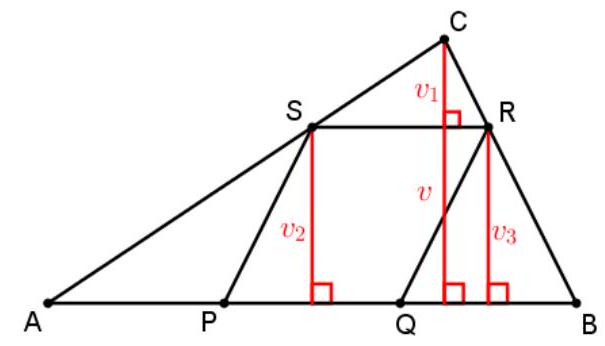
Neka su $v$ visina trokuta $A B C$ iz vrha $C, v_{1}$ visina trokuta $S R C$ iz vrha $C, v_{2}$ visina trokuta $A P S$ iz vrha $S$ i $v_{3}$ visina trokuta $Q B R$ ... | 36\mathrm{~}^{2} | 53,317 | <think>## Drugo rješenje.

Neka su $v$ visina trokuta $A B C$ iz vrha $C, v_{1}$ visina trokuta $S R C$ iz vrha $C, v_{2}$ visina trokuta $A P S$ iz vrha $S$ i $v_{3}$ visina trokuta $Q B R$ ... | 1_4 |
Let $a_1,a_2,\ldots$ be a sequence defined by $a_1=a_2=1$ and $a_{n+2}=a_{n+1}+a_n$ for $n\geq 1$. Find \[\sum_{n=1}^\infty \dfrac{a_n}{4^{n+1}}.\] | <think>1. We start by noting that the sequence \(a_n\) is defined by the recurrence relation \(a_{n+2} = a_{n+1} + a_n\) with initial conditions \(a_1 = 1\) and \(a_2 = 1\). This sequence is known as the Fibonacci sequence, where each term is the sum of the two preceding ones.
2. We need to find the sum \(\sum_{n=1}^\... | \frac{1}{11} | 82,958 | <think>1. We start by noting that the sequence \(a_n\) is defined by the recurrence relation \(a_{n+2} = a_{n+1} + a_n\) with initial conditions \(a_1 = 1\) and \(a_2 = 1\). This sequence is known as the Fibonacci sequence, where each term is the sum of the two preceding ones.
2. We need to find the sum \(\sum_{n=1}^\... | 1_5 |
Example 5. Find the singular solutions of the differential equation
$$
\left(y^{\prime}\right)^{2}(2-3 y)^{2}=4(1-y)
$$ | <think>Solution. Let's find the PDK. Excluding $y^{\prime}$ from the system of equations
$$
\left\{\begin{aligned}
\left(y^{\prime}\right)^{2}(2-3 y)^{2}-4(1-y) & =0 \\
y^{\prime}(2-3 y)^{2} & =0
\end{aligned}\right.
$$
we obtain
$$
(2-3 y)^{2}(1-y)=0 .
$$
Transforming equation (25) to the form
$$
\frac{d x}{d y}=... | 1 | 57,714 | <think>Solution. Let's find the PDK. Excluding $y^{\prime}$ from the system of equations
$$
\left\{\begin{aligned}
\left(y^{\prime}\right)^{2}(2-3 y)^{2}-4(1-y) & =0 \\
y^{\prime}(2-3 y)^{2} & =0
\end{aligned}\right.
$$
we obtain
$$
(2-3 y)^{2}(1-y)=0 .
$$
Transforming equation (25) to the form
$$
\frac{d x}{d y}=... | 1_6 |
The sum of the (decimal) digits of a natural number $n$ equals $100$, and the sum of digits of $44n$ equals $800$. Determine the sum of digits of $3n$. | <think>1. Let \( n \) be a natural number such that the sum of its digits is 100. We can represent \( n \) in its decimal form as:
\[
n = 10^k a_k + 10^{k-1} a_{k-1} + \ldots + 10 a_1 + a_0
\]
where \( a_i \) are the digits of \( n \). Therefore, the sum of the digits of \( n \) is:
\[
a_k + a_{k-1} +... | 300 | 1,377 | <think>1. Let \( n \) be a natural number such that the sum of its digits is 100. We can represent \( n \) in its decimal form as:
\[
n = 10^k a_k + 10^{k-1} a_{k-1} + \ldots + 10 a_1 + a_0
\]
where \( a_i \) are the digits of \( n \). Therefore, the sum of the digits of \( n \) is:
\[
a_k + a_{k-1} +... | 1_7 |
Mice have built an underground house consisting of chambers and tunnels:
- each tunnel leads from one chamber to another (i.e., none are dead ends),
- from each chamber, exactly three tunnels lead to three different chambers,
- from each chamber, one can reach any other chamber via tunnels,
- the house has exactly one... | <think>We will denote cells with circles and tunnels with lines. We start with a critical tunnel, whose collapse divides the house into two separate parts. If we denote the cells at the ends of this tunnel as $A$ and $B$, then each cell belongs to exactly one of the following two groups:
a) cell $A$ and all cells that... | 10 | 37,042 | <think>We will denote cells with circles and tunnels with lines. We start with a critical tunnel, whose collapse divides the house into two separate parts. If we denote the cells at the ends of this tunnel as $A$ and $B$, then each cell belongs to exactly one of the following two groups:
a) cell $A$ and all cells that... | 1_8 |
5. In $\triangle A B C$, $\angle A \leqslant \angle B \leqslant \angle C$, $\frac{\sin A+\sin B+\sin C}{\cos A+\cos B+\cos C}=\sqrt{3}$.
Then the range of $\angle B$ is ( ).
(A) $\left(\frac{\pi}{3}, \frac{\pi}{2}\right)$
(B) $\left(0, \frac{\pi}{2}\right)$
(C) $\frac{\pi}{3}$
(D) $\left(\frac{\pi}{4}, \frac{\pi}{3}\r... | <think>5.C.
From the condition, we have
$$
\begin{array}{l}
\sin A + \sin B + \sin C = \sqrt{3} (\cos A + \cos B + \cos C) \\
\Rightarrow 2 \sin \frac{A+C}{2} \cdot \cos \frac{A-C}{2} + \sin B \\
\quad = \sqrt{3} \left(2 \cos \frac{A+C}{2} \cdot \cos \frac{A-C}{2} + \cos B\right) \\
\Rightarrow \left(2 \sqrt{3} \cos \... | C | 38,018 | <think>5.C.
From the condition, we have
$$
\begin{array}{l}
\sin A + \sin B + \sin C = \sqrt{3} (\cos A + \cos B + \cos C) \\
\Rightarrow 2 \sin \frac{A+C}{2} \cdot \cos \frac{A-C}{2} + \sin B \\
\quad = \sqrt{3} \left(2 \cos \frac{A+C}{2} \cdot \cos \frac{A-C}{2} + \cos B\right) \\
\Rightarrow \left(2 \sqrt{3} \cos \... | 1_9 |
Example 5 Let $A=\{1,2,3,4,5,6\}, B=\{7,8,9, \cdots, n\}$. Take 3 numbers from $A$ and 2 numbers from $B$ to form a set $A_{i}(i=1,2, \cdots, 20)$ with 5 elements, such that $\left|A_{i} \cap A_{j}\right| \leqslant 2,1 \leqslant i<j \leqslant 20$, find the minimum value of $n$. (2002 China National Training Team for IM... | <think>We first prove: Each element in $B$ appears in the subsets $A_{i}(i=1,2, \cdots, 20)$ at most 4 times. If not, assume that an element $b$ in $B$ appears $k(k>4)$ times in the subsets $A_{i}(i=1,2, \cdots, 20)$. Consider the $k$ subsets containing $b$, they contain $3k > 12$ elements from $A$. Thus, by the pigeon... | 16 | 56,031 | <think>We first prove: Each element in $B$ appears in the subsets $A_{i}(i=1,2, \cdots, 20)$ at most 4 times. If not, assume that an element $b$ in $B$ appears $k(k>4)$ times in the subsets $A_{i}(i=1,2, \cdots, 20)$. Consider the $k$ subsets containing $b$, they contain $3k > 12$ elements from $A$. Thus, by the pigeon... | 1_10 |
Suppose you have identical coins distributed in several piles with one or more coins in each pile. An action consists of taking two piles, which have an even total of coins among them, and redistribute their coins in two piles so that they end up with the same number of coins.
A distribution is [i]levelable[/i] if it... | <think>1. **Lemma 1: \( n \) odd doesn't work**
**Proof:**
Let \( n = 2u + 1 \). Consider \( u \) piles with \( k + u + 1 \) coins and \( u + 1 \) piles with \( k - u \) coins. Since \( k + u + 1 \) and \( k - u \) have different parities, we cannot modify the number of coins in each pile by an action. Therefore... | n = 2^j | 36,202 | <think>1. **Lemma 1: \( n \) odd doesn't work**
**Proof:**
Let \( n = 2u + 1 \). Consider \( u \) piles with \( k + u + 1 \) coins and \( u + 1 \) piles with \( k - u \) coins. Since \( k + u + 1 \) and \( k - u \) have different parities, we cannot modify the number of coins in each pile by an action. Therefore... | 1_11 |
Define the sequence of positive integers $a_n$ recursively by $a_1=7$ and $a_n=7^{a_{n-1}}$ for all $n\geq 2$. Determine the last two digits of $a_{2007}$. | <think>To determine the last two digits of \(a_{2007}\), we need to find \(a_{2007} \mod 100\). Given the recursive sequence \(a_1 = 7\) and \(a_n = 7^{a_{n-1}}\) for \(n \geq 2\), we will analyze the periodicity of \(7^n \mod 100\).
1. **Calculate the first few powers of 7 modulo 100:**
\[
\begin{aligned}
7^... | 43 | 36,616 | <think>To determine the last two digits of \(a_{2007}\), we need to find \(a_{2007} \mod 100\). Given the recursive sequence \(a_1 = 7\) and \(a_n = 7^{a_{n-1}}\) for \(n \geq 2\), we will analyze the periodicity of \(7^n \mod 100\).
1. **Calculate the first few powers of 7 modulo 100:**
\[
\begin{aligned}
7^... | 1_12 |
11. (15 points) The right focus of the hyperbola $3 x^{2}-y^{2}+24 x+36=0$ is $F$, and the right directrix is $l$. The ellipse $C$ has $F$ and $l$ as its corresponding focus and directrix. A line parallel to $y=x$ is drawn through $F$, intersecting the ellipse $C$ at points $A$ and $B$. It is known that the center of $... | <think>11. Solution: Transform the hyperbola equation to $\frac{(x+4)^{2}}{4}-\frac{y^{2}}{12}=1$, then the coordinates of $F$ are $(0,0)$, and the equation of the right directrix $l$ is $x=-3$. Establish a polar coordinate system with $F$ as the pole and $F x$ as the polar axis, and let $e$ be the eccentricity of the ... | 0<e<\sqrt{2-\sqrt{2}} | 56,681 | <think>11. Solution: Transform the hyperbola equation to $\frac{(x+4)^{2}}{4}-\frac{y^{2}}{12}=1$, then the coordinates of $F$ are $(0,0)$, and the equation of the right directrix $l$ is $x=-3$. Establish a polar coordinate system with $F$ as the pole and $F x$ as the polar axis, and let $e$ be the eccentricity of the ... | 1_13 |
4. For a set $X$, denote $\mathscr{P}(X)=\{Y: Y \subseteq X\}$. (For example: $\mathscr{P}(\{1\})=$ $\{\varnothing,\{1\}\}$, because the subsets of the set $\{1\}$ are the sets $\varnothing$ and $\{1\} ; \mathscr{P}(\varnothing)=\{\varnothing\}$, because the set $\varnothing$ has exactly one subset, which is $\varnothi... | <think>4. Let $A=\{a, b\}$. Then we have $\mathscr{P}(A)=$ $\{\varnothing,\{a\},\{b\},\{a, b\}\}$. Note that $a$ cannot be equal to either $\{a\}$ or $\{a, b\}$: indeed, if $n$ is the smallest natural number such that $a \in \mathscr{P}^{n}(\varnothing)$, then we have $\{a\},\{a, b\} \notin \mathscr{P}^{n}(\varnothing)... | {\varnothing,{\varnothing}} | 35,602 | <think>4. Let $A=\{a, b\}$. Then we have $\mathscr{P}(A)=$ $\{\varnothing,\{a\},\{b\},\{a, b\}\}$. Note that $a$ cannot be equal to either $\{a\}$ or $\{a, b\}$: indeed, if $n$ is the smallest natural number such that $a \in \mathscr{P}^{n}(\varnothing)$, then we have $\{a\},\{a, b\} \notin \mathscr{P}^{n}(\varnothing)... | 1_14 |
8. Given that $A$, $B$, and $C$ are three points on the parabola $y^{2}=x$, and $\left(2, \frac{4}{3}\right)$ is the centroid of $\triangle A B C$. Then the maximum value of the area of $\triangle A B C$ is $\qquad$ . | <think>8. $\frac{\sqrt{3}}{9}$.
Let $A\left(a^{2}, a\right), B\left(b^{2}, b\right), C\left(c^{2}, c\right)$.
Given that $F$ is the centroid of $\triangle A B C$
$$
\Rightarrow a+b+c=4, a^{2}+b^{2}+c^{2}=6 \text {. }
$$
Then $a b=\frac{1}{2}\left((a+b)^{2}-a^{2}-b^{2}\right)=c^{2}-4 c+5$.
By $(b-c)^{2}=2\left(b^{2}+c... | \frac{\sqrt{3}}{9} | 10,071 | <think>8. $\frac{\sqrt{3}}{9}$.
Let $A\left(a^{2}, a\right), B\left(b^{2}, b\right), C\left(c^{2}, c\right)$.
Given that $F$ is the centroid of $\triangle A B C$
$$
\Rightarrow a+b+c=4, a^{2}+b^{2}+c^{2}=6 \text {. }
$$
Then $a b=\frac{1}{2}\left((a+b)^{2}-a^{2}-b^{2}\right)=c^{2}-4 c+5$.
By $(b-c)^{2}=2\left(b^{2}+c... | 1_15 |
170. Find the derivatives of the following functions:
1) $y=5 \arcsin k x+3 \arccos k x$; 2) $y=\arcsin \frac{a}{x}-\operatorname{arcctg} \frac{x}{a}$;
2) $r=\operatorname{arctg} \frac{m}{\varphi}+\operatorname{arcctg}(m \operatorname{ctg} \varphi)$; $r^{\prime}(0)$ ?, $r^{\prime}(\pi)$ ? | <think>Solution. 1) Using formulas 12 and 13, we find
$$
\begin{gathered}
y^{\prime}=5 \frac{(k x)^{\prime}}{\sqrt{1-(k x)^{2}}}+3\left[-\frac{(k x)^{\prime}}{\sqrt{1-(k x)^{2}}}\right]=\frac{5 k}{\sqrt{1-k^{2} x^{2}}}- \\
-\frac{3 k}{\sqrt{1-k^{2} x^{2}}}=\frac{2 k}{\sqrt{1-k^{2} x^{2}}}
\end{gathered}
$$
2) Using f... | \begin{aligned}1)&\quady^{\}=\frac{2k}{\sqrt{1-k^{2}x^{2}}}\\2)&\quady^{\}=\frac{}{^{2}+x^{2}}-\frac{}{|x|\sqrt{x^{2}-^{2}}}\\3)&\quadr^{\}(0)=0,\ | 6,750 | <think>Solution. 1) Using formulas 12 and 13, we find
$$
\begin{gathered}
y^{\prime}=5 \frac{(k x)^{\prime}}{\sqrt{1-(k x)^{2}}}+3\left[-\frac{(k x)^{\prime}}{\sqrt{1-(k x)^{2}}}\right]=\frac{5 k}{\sqrt{1-k^{2} x^{2}}}- \\
-\frac{3 k}{\sqrt{1-k^{2} x^{2}}}=\frac{2 k}{\sqrt{1-k^{2} x^{2}}}
\end{gathered}
$$
2) Using f... | 1_16 |
2. At a party, there are $n$ guests. For each pair of guests, they are either friends or not friends. Each guest is friends with exactly four other guests. If a guest is not friends with two other guests, it is always the case that those two guests are also not friends with each other.
What are the possible values of ... | <think>2. First, we look at the friends of one of the guests, say Marieke. We know that Marieke has exactly four friends at the party, say Aad, Bob, Carla, and Demi. Marieke is not friends with the other guests (if there are any), and these other guests cannot have friendships among themselves, so they can only be frie... | 5,6,8 | 41,328 | <think>2. First, we look at the friends of one of the guests, say Marieke. We know that Marieke has exactly four friends at the party, say Aad, Bob, Carla, and Demi. Marieke is not friends with the other guests (if there are any), and these other guests cannot have friendships among themselves, so they can only be frie... | 1_17 |
## Problem Statement
Calculate the volumes of the bodies bounded by the surfaces.
$$
\frac{x^{2}}{4}+y^{2}-z^{2}=1, z=0, z=3
$$ | <think>## Solution
In the section of the given figure by the plane $z=$ const, there is an ellipse:
$$
\frac{x^{2}}{4}+y^{2}=z^{2}+1
$$
The area of the ellipse described by the formula: $\frac{x^{2}}{a^{2}}+\frac{y^{2}}{b^{2}}=1$ is $\pi \cdot a \cdot b$
Let's find the radii of the ellipse:
}\ 4.8 \qquad\textbf{(B)}\ 5.4\qquad\textbf{(C)}\ 7.2\qqua... | <think>1. Given triangle \(ABC\) with \(\overline{AB} = \overline{AC} = 3.6\), point \(D\) is on \(AB\) such that \(AD = 1.2\). We need to find \(\overline{AE}\) such that the area of triangle \(AED\) is equal to the area of triangle \(ABC\).
2. Draw perpendiculars from \(D\) and \(B\) to \(AC\), meeting \(AC\) at poi... | 10.8 | 74,399 | <think>1. Given triangle \(ABC\) with \(\overline{AB} = \overline{AC} = 3.6\), point \(D\) is on \(AB\) such that \(AD = 1.2\). We need to find \(\overline{AE}\) such that the area of triangle \(AED\) is equal to the area of triangle \(ABC\).
2. Draw perpendiculars from \(D\) and \(B\) to \(AC\), meeting \(AC\) at poi... | 1_19 |
Cube [ Properties of parts obtained by cutting ]
The surface of a 3 x 3 x 3 Rubik's cube consists of 54 cells. What is the maximum number of cells that can be marked so that the marked cells do not share any vertices? | <think>In Fig. 1, it is shown how to mark 7 cells on three adjacent faces of a cube. On the three "invisible" faces, seven cells symmetrical to these need to be marked.
Now let's prove that it is impossible to mark more than 14 cells in the required manner. We will do this in two ways.
The first way. Let's count the ... | 14 | 31,921 | <think>In Fig. 1, it is shown how to mark 7 cells on three adjacent faces of a cube. On the three "invisible" faces, seven cells symmetrical to these need to be marked.
Now let's prove that it is impossible to mark more than 14 cells in the required manner. We will do this in two ways.
The first way. Let's count the ... | 1_20 |
Determine an equation of third degree with integral coefficients having roots $\sin \frac{\pi}{14}, \sin \frac{5 \pi}{14}$ and $\sin \frac{-3 \pi}{14}.$ | <think>1. We start by noting that the roots of the polynomial we seek are $\sin \frac{\pi}{14}$, $\sin \frac{5 \pi}{14}$, and $\sin \frac{-3 \pi}{14}$. Using the identity $\sin(-x) = -\sin(x)$, we can rewrite $\sin \frac{-3 \pi}{14}$ as $-\sin \frac{3 \pi}{14}$.
2. We use the trigonometric identity for cosine of multi... | 8x^3 - 4x^2 - 4x - 1 = 0 | 15,745 | <think>1. We start by noting that the roots of the polynomial we seek are $\sin \frac{\pi}{14}$, $\sin \frac{5 \pi}{14}$, and $\sin \frac{-3 \pi}{14}$. Using the identity $\sin(-x) = -\sin(x)$, we can rewrite $\sin \frac{-3 \pi}{14}$ as $-\sin \frac{3 \pi}{14}$.
2. We use the trigonometric identity for cosine of multi... | 1_21 |
[ Coordinate method in space ] [ Rectangular parallelepipeds ]
The non-intersecting diagonals of two adjacent faces of a rectangular parallelepiped are inclined to the base plane at angles $\alpha$ and $\beta$. Find the angle between these diagonals. | <think>Consider a rectangular parallelepiped $A B C D A 1 B 1 C 1 D 1$. Let $A D 1$ and $D C 1$ be the specified diagonals. Then $\angle A D 1 A 1=\alpha, \angle D C D 1=\beta$. Choose a coordinate system with the origin at point $A$. The $x$-axis is directed along the ray $A B$, the $y$-axis along the ray $A D$, and t... | \arccos(\sin\alpha\sin\beta) | 23,292 | <think>Consider a rectangular parallelepiped $A B C D A 1 B 1 C 1 D 1$. Let $A D 1$ and $D C 1$ be the specified diagonals. Then $\angle A D 1 A 1=\alpha, \angle D C D 1=\beta$. Choose a coordinate system with the origin at point $A$. The $x$-axis is directed along the ray $A B$, the $y$-axis along the ray $A D$, and t... | 1_22 |
12. (22 points) From the set $M=\{1,2, \cdots, 36\}$, remove $n$ numbers such that in the remaining elements, the sum of any two numbers is not a factor of 2015. Find the minimum value of $n$.
| <think>12. 17.
Notice that the sum of any two elements in set $M$ does not exceed 71.
Since $2015=5 \times 13 \times 31$, the positive divisors of 2015 that are not greater than 71 are $1, 5, 13, 31, 65$. Therefore, in the binary subsets of set $M$,
the pairs with a sum of 5 are $\{1,4\},\{2,3\}$;
the pairs with a su... | 17 | 46,129 | <think>12. 17.
Notice that the sum of any two elements in set $M$ does not exceed 71.
Since $2015=5 \times 13 \times 31$, the positive divisors of 2015 that are not greater than 71 are $1, 5, 13, 31, 65$. Therefore, in the binary subsets of set $M$,
the pairs with a sum of 5 are $\{1,4\},\{2,3\}$;
the pairs with a su... | 1_23 |
Let $ \{a_k\}$ be a sequence of integers such that $ a_1 \equal{} 1$ and $ a_{m \plus{} n} \equal{} a_m \plus{} a_n \plus{} mn$, for all positive integers $ m$ and $ n$. Then $ a_{12}$ is
$ \textbf{(A)}\ 45 \qquad \textbf{(B)}\ 56 \qquad \textbf{(C)}\ 67 \qquad \textbf{(D)}\ 78 \qquad \textbf{(E)}\ 89$ | <think>1. We start with the given sequence definition and initial condition:
\[
a_1 = 1
\]
\[
a_{m+n} = a_m + a_n + mn \quad \text{for all positive integers } m \text{ and } n
\]
2. We need to find \(a_{12}\). To do this, we will first compute the initial terms of the sequence to identify a pattern.
... | 78 | 13,337 | <think>1. We start with the given sequence definition and initial condition:
\[
a_1 = 1
\]
\[
a_{m+n} = a_m + a_n + mn \quad \text{for all positive integers } m \text{ and } n
\]
2. We need to find \(a_{12}\). To do this, we will first compute the initial terms of the sequence to identify a pattern.
... | 1_24 |
How many rearrangements of the letters of "$HMMTHMMT$" do not contain the substring "$HMMT$"? (For instance, one such arrangement is $HMMHMTMT$.) | <think>1. **Calculate the total number of unrestricted permutations of the letters in "HMMTHMMT":**
The word "HMMTHMMT" consists of 8 letters where 'H' appears 2 times, 'M' appears 4 times, and 'T' appears 2 times. The total number of permutations of these letters is given by the multinomial coefficient:
\[
\... | 361 | 49,028 | <think>1. **Calculate the total number of unrestricted permutations of the letters in "HMMTHMMT":**
The word "HMMTHMMT" consists of 8 letters where 'H' appears 2 times, 'M' appears 4 times, and 'T' appears 2 times. The total number of permutations of these letters is given by the multinomial coefficient:
\[
\... | 1_25 |
10.4. Let's consider all 7! seven-digit numbers obtained from the number 1234567 by all possible permutations of its digits. How many of them give a remainder of 5 when divided by 7? Answer: 6!. | <think>Solution. Let $A_{n}, n=0,1, \ldots, 6$ be the sets of the considered numbers that give remainders $0,1,2, \ldots 6$ respectively when divided by 7. We will prove that each of these sets contains the same number of elements, equal to $7!/ 7=6!$. Note that the number 1111111 gives a remainder of 1 when divided by... | 6! | 53,690 | <think>Solution. Let $A_{n}, n=0,1, \ldots, 6$ be the sets of the considered numbers that give remainders $0,1,2, \ldots 6$ respectively when divided by 7. We will prove that each of these sets contains the same number of elements, equal to $7!/ 7=6!$. Note that the number 1111111 gives a remainder of 1 when divided by... | 1_26 |
1. In the set of positive real numbers, solve the system of equations:
$$
\begin{aligned}
& x_{1}+x_{2}^{2}+x_{3}^{3}=3 \\
& x_{2}+x_{3}^{2}+x_{4}^{3}=3 \\
& x_{3}+x_{4}^{2}+x_{1}^{3}=3 \\
& x_{4}+x_{1}^{2}+x_{2}^{3}=3
\end{aligned}
$$ | <think>Solution. Let the quadruple $\left(x_{1}, x_{2}, x_{3}, x_{4}\right)$ of positive real numbers be a solution to the given system of equations.
a) Suppose that at least two of the numbers $x_{1}, x_{2}, x_{3}, x_{4}$ are equal to 1. Since any two unknowns appear together in at least one equation, it is easy to s... | (1,1,1,1) | 59,884 | <think>Solution. Let the quadruple $\left(x_{1}, x_{2}, x_{3}, x_{4}\right)$ of positive real numbers be a solution to the given system of equations.
a) Suppose that at least two of the numbers $x_{1}, x_{2}, x_{3}, x_{4}$ are equal to 1. Since any two unknowns appear together in at least one equation, it is easy to s... | 1_27 |
23. Given four different non-zero digits, it is possible to form 24 different four-digit numbers containing each of these four digits.
What is the largest prime factor of the sum of the 24 numbers?
A 23
B 93
C 97
D 101
E 113 | <think>Solution
D
Let the four different non-zero digits be $a, b, c$ and $d$. If we use them to make 24 different four-digit numbers, then each of $a, b, c$ and $d$ occurs 6 times in the units position, 6 times in the tens position, 6 times in the hundreds position, and 6 times in the thousands position.
It follows t... | 101 | 31,059 | <think>Solution
D
Let the four different non-zero digits be $a, b, c$ and $d$. If we use them to make 24 different four-digit numbers, then each of $a, b, c$ and $d$ occurs 6 times in the units position, 6 times in the tens position, 6 times in the hundreds position, and 6 times in the thousands position.
It follows t... | 1_28 |
Five. (20 points) Try to find all functions $f(x)$ that satisfy the following conditions:
(1) $f(x)$ is a monotonic function defined on $\mathbf{R}$;
(2) For any real numbers $x, y$,
$$
f(x+y)=f(x) f(y) \text{; }
$$
(3) $f(1)=a(0<a \neq 1)$. | <think>Lemma: Let $A$ and $B$ be constants. If for any $n \in \mathbf{N}_{+}$, we have $|A-B| \leqslant \frac{1}{n}$, then $A=B$.
Proof of the Lemma: Suppose $A \neq B$, then according to the problem,
$|A-B| \leqslant 1$.
Let $|A-B|=\frac{1}{m} (m \geqslant 1)$. Take $n=[m]+1$. Then $|A-B|=\frac{1}{m}>\frac{1}{n}$, wh... | f(x)=a^{x} | 46,976 | <think>Lemma: Let $A$ and $B$ be constants. If for any $n \in \mathbf{N}_{+}$, we have $|A-B| \leqslant \frac{1}{n}$, then $A=B$.
Proof of the Lemma: Suppose $A \neq B$, then according to the problem,
$|A-B| \leqslant 1$.
Let $|A-B|=\frac{1}{m} (m \geqslant 1)$. Take $n=[m]+1$. Then $|A-B|=\frac{1}{m}>\frac{1}{n}$, wh... | 1_29 |
15. The quadratic function $f(x)=a x^{2}+b x+c(a, b, c \in \mathbf{R}, a \neq 0)$ satisfies the following conditions:
(1) $f(-1)=0$;
(2) For $x \in \mathbf{R}$, $f(x) \geqslant x$;
(3) For $x \in(0,2)$, $f(x) \leqslant \frac{(x+1)^{2}}{4}$.
If $x_{1}, x_{2}, x_{3} \in(0,2)$, and $\frac{1}{x_{1}}+\frac{1}{x_{2}}+\frac{1... | <think>15. Since $f(x) \geqslant x$, we have $f(1) \geqslant 1$; also, since $f(x) \leqslant \frac{(x+1)^{2}}{4}$, we have $f(1) \leqslant \frac{(1+1)^{2}}{4}=1$, thus $f(1)=1$. Given $f(-1)=0$, we have
$$
\left\{\begin{array}{l}
a+b+c=1 \\
a-b+c=0
\end{array}\right.
$$
Solving these, we get $b=\frac{1}{2}, a+c=\frac{... | 1 | 58,335 | <think>15. Since $f(x) \geqslant x$, we have $f(1) \geqslant 1$; also, since $f(x) \leqslant \frac{(x+1)^{2}}{4}$, we have $f(1) \leqslant \frac{(1+1)^{2}}{4}=1$, thus $f(1)=1$. Given $f(-1)=0$, we have
$$
\left\{\begin{array}{l}
a+b+c=1 \\
a-b+c=0
\end{array}\right.
$$
Solving these, we get $b=\frac{1}{2}, a+c=\frac{... | 1_30 |
Question 133, Find the value: $\sum_{m=1}^{\infty} \sum_{n=1}^{\infty} \frac{m^{2} n}{3^{m}\left(n \cdot 3^{m}+m \cdot 3^{n}\right)}$.
Translate the above text into English, please retain the original text's line breaks and format, and output the translation result directly. | <think>$m n^{2}$
Question 133, Solution: By symmetry, we know that $\sum_{m=1}^{\infty} \sum_{n=1}^{\infty} \frac{m^{2}}{3^{m}\left(n \cdot 3^{m}+m \cdot 3^{n}\right)}=\sum_{m=1}^{\infty}=\sum_{n}^{\infty}=13^{n} \frac{3^{n}\left(\pi n^{2}\right.}{}$
$$
\begin{array}{l}
\sum_{m=1}^{\infty} \sum_{n=1}^{\infty} \frac{m^{... | \frac{9}{32} | 26,510 | <think>$m n^{2}$
Question 133, Solution: By symmetry, we know that $\sum_{m=1}^{\infty} \sum_{n=1}^{\infty} \frac{m^{2}}{3^{m}\left(n \cdot 3^{m}+m \cdot 3^{n}\right)}=\sum_{m=1}^{\infty}=\sum_{n}^{\infty}=13^{n} \frac{3^{n}\left(\pi n^{2}\right.}{}$
$$
\begin{array}{l}
\sum_{m=1}^{\infty} \sum_{n=1}^{\infty} \frac{m^{... | 1_31 |
16. On the plane there are two triangles, each with side lengths 18,24 and 30 . If the two triangles do not completely overlap, but share the same circumcircle as well as the same inscribed circle, find the area of the region common to both triangles.
(2 marks)
平面上有兩個三角形,邊長都是 18、24、30。若兩個三角形並非完全重疊,
但它們的外接圓相同, 內切圓也相同, 求... | <think>16. 132
16. First of all, note that a 18-24-30 triangle is a 6time magnification of a 3-4-5 triangle, and so is right-angled. Thus the midpoint of the hypotenuse of each triangle is the centre of their common circumcircle, and the in-radius is $(18+24-30) \div 2=6$. Let one of the triangles be $\triangle A B C$ ... | 132 | 23,815 | <think>16. 132
16. First of all, note that a 18-24-30 triangle is a 6time magnification of a 3-4-5 triangle, and so is right-angled. Thus the midpoint of the hypotenuse of each triangle is the centre of their common circumcircle, and the in-radius is $(18+24-30) \div 2=6$. Let one of the triangles be $\triangle A B C$ ... | 1_32 |
4.63 Find all values of \( x \) that satisfy the equation
\[
\sqrt{x^{2}-p}+2 \sqrt{x^{2}-1}=x
\]
where \( p \) is a real parameter. | <think>[Solution] $\sqrt{x^{2}-p}+2 \sqrt{x^{2}-1}=x$
Rearranging and squaring both sides, we get
$$
x^{2}-p=x^{2}+4\left(x^{2}-1\right)-4 x \sqrt{x^{2}-1} \text {, }
$$
which simplifies to $4\left(x^{2}-1\right)+p=4 x \sqrt{x^{2}-1}$.
Squaring both sides again, we get
$$
16\left(x^{2}-1\right)^{2}+8 p\left(x^{2}-1\ri... | \frac{4-p}{2\sqrt{2(2-p)}}for0\le | 73,044 | <think>[Solution] $\sqrt{x^{2}-p}+2 \sqrt{x^{2}-1}=x$
Rearranging and squaring both sides, we get
$$
x^{2}-p=x^{2}+4\left(x^{2}-1\right)-4 x \sqrt{x^{2}-1} \text {, }
$$
which simplifies to $4\left(x^{2}-1\right)+p=4 x \sqrt{x^{2}-1}$.
Squaring both sides again, we get
$$
16\left(x^{2}-1\right)^{2}+8 p\left(x^{2}-1\ri... | 1_33 |
1195. Find the first five terms of the power series expansion of the particular integral of the equation $y^{\prime \prime}-y e^{x}=0$, satisfying the initial conditions: $y(0)=2, y^{\prime}(0)=1$. | <think>Solution. Applying the same method as in the solution of the previous problem, we get:
$$
\begin{aligned}
& y^{\prime \prime}=y e^{x}, \quad y^{\prime \prime}(0)=2 \\
& y^{(3)}=\left(y+y^{\prime}\right) e^{x}, \quad y^{(3)}(0)=3 \\
& y^{(4)}=\left(y+2 y^{\prime}+y^{\prime \prime}\right) e^{x}, \quad y^{(4)}(0)=... | 2+x+x^{2}+\frac{x^{3}}{2}+\frac{x^{4}}{4}+\ldots | 61,482 | <think>Solution. Applying the same method as in the solution of the previous problem, we get:
$$
\begin{aligned}
& y^{\prime \prime}=y e^{x}, \quad y^{\prime \prime}(0)=2 \\
& y^{(3)}=\left(y+y^{\prime}\right) e^{x}, \quad y^{(3)}(0)=3 \\
& y^{(4)}=\left(y+2 y^{\prime}+y^{\prime \prime}\right) e^{x}, \quad y^{(4)}(0)=... | 1_34 |
4. A right triangle $ABC$ with hypotenuse $AB$ is inscribed in a circle. The feet of the perpendiculars from points $A, B$ to the tangent $k$ of this circle at point $C$ are denoted as $D, E$. Express the length of segment $DE$ in terms of the lengths of the legs of triangle $ABC$.
| <think>SOLUTION. Let the legs of the right triangle $ABC$ be denoted by $a, b$ and the opposite angles by $\alpha, \beta$. The midpoint of the hypotenuse $AB$ (the center of the circumscribed circle) is denoted by $O$ (Fig. 1).
The height $v = CP$ divides the triangle $ABC$ into triangles $ACP$ and $CBP$, which are si... | \frac{2ab}{\sqrt{^2+b^2}} | 40,121 | <think>SOLUTION. Let the legs of the right triangle $ABC$ be denoted by $a, b$ and the opposite angles by $\alpha, \beta$. The midpoint of the hypotenuse $AB$ (the center of the circumscribed circle) is denoted by $O$ (Fig. 1).
The height $v = CP$ divides the triangle $ABC$ into triangles $ACP$ and $CBP$, which are si... | 1_35 |
Let $N$ be the number of ordered pairs of integers $(x, y)$ such that
\[
4x^2 + 9y^2 \le 1000000000.
\]
Let $a$ be the first digit of $N$ (from the left) and let $b$ be the second digit of $N$. What is the value of $10a + b$ ? | <think>1. **Identify the given inequality and its geometric interpretation:**
\[
4x^2 + 9y^2 \le 1000000000
\]
This represents an ellipse centered at the origin with semi-major axis \(a\) and semi-minor axis \(b\). To find \(a\) and \(b\), we rewrite the inequality in the standard form of an ellipse:
\[
... | 52 | 28,046 | <think>1. **Identify the given inequality and its geometric interpretation:**
\[
4x^2 + 9y^2 \le 1000000000
\]
This represents an ellipse centered at the origin with semi-major axis \(a\) and semi-minor axis \(b\). To find \(a\) and \(b\), we rewrite the inequality in the standard form of an ellipse:
\[
... | 1_36 |
A deck has 900 cards numbered from 100 to 999. Cards whose sum of digits is the same have the same color, and cards with different sums have different colors. Alice, Bia, Carla, and Dani each take a certain number of cards.
a) All the cards Alice took had different colors. What is the maximum number of cards Alice cou... | <think>Solution
a) 27 cards. The maximum number of cards Alice picked corresponds to the number of different sums of the digits of the numbers from 100 to 999. Since the smallest sum is $1+0+0=1$ and the largest is $9+9+9=27$, the total number of sums is 27. To ensure that all these sums exist, we can list an example ... | 27,233,243, | 28,578 | <think>Solution
a) 27 cards. The maximum number of cards Alice picked corresponds to the number of different sums of the digits of the numbers from 100 to 999. Since the smallest sum is $1+0+0=1$ and the largest is $9+9+9=27$, the total number of sums is 27. To ensure that all these sums exist, we can list an example ... | 1_37 |
Basketball star Shanille O'Keal's team statistician keeps track of the number, $S(N),$ of successful free throws she has made in her first $N$ attempts of the season. Early in the season, $S(N)$ was less than 80% of $N,$ but by the end of the season, $S(N)$ was more than 80% of $N.$ Was there necessarily a moment in be... | <think>1. Define the function \( S(N) \) as the number of successful free throws made by Shanille O'Keal in her first \( N \) attempts.
2. According to the problem, early in the season, \( S(N) < 0.8N \). This means that for some initial number of attempts \( N_1 \), the success rate is less than 80%.
3. By the end of ... | \text{Yes} | 32,167 | <think>1. Define the function \( S(N) \) as the number of successful free throws made by Shanille O'Keal in her first \( N \) attempts.
2. According to the problem, early in the season, \( S(N) < 0.8N \). This means that for some initial number of attempts \( N_1 \), the success rate is less than 80%.
3. By the end of ... | 1_38 |
## Problem Statement
Calculate the limit of the function:
$$
\lim _{x \rightarrow 0}(1-\ln (\cos x))^{\frac{1}{\operatorname{tg}^{2} x}}
$$ | <think>## Solution
$\lim _{x \rightarrow 0}(1-\ln (\cos x))^{\frac{1}{\operatorname{tg}^{2} x}}=$
$=\lim _{x \rightarrow 0}\left(e^{\ln (1-\ln (\cos x))}\right)^{\frac{1}{\operatorname{tg}^{2} x}}=$
$=\lim _{x \rightarrow 0} e^{\ln (1-\ln (\cos x)) / \operatorname{tg}^{2} x}=$
$=\exp \left\{\lim _{x \rightarrow 0} \fr... | e^{\frac{1}{2}} | 6,602 | <think>## Solution
$\lim _{x \rightarrow 0}(1-\ln (\cos x))^{\frac{1}{\operatorname{tg}^{2} x}}=$
$=\lim _{x \rightarrow 0}\left(e^{\ln (1-\ln (\cos x))}\right)^{\frac{1}{\operatorname{tg}^{2} x}}=$
$=\lim _{x \rightarrow 0} e^{\ln (1-\ln (\cos x)) / \operatorname{tg}^{2} x}=$
$=\exp \left\{\lim _{x \rightarrow 0} \fr... | 1_39 |
## Task B-2.3.
In a right-angled triangle, the ratio of the height and the median drawn from the vertex of the right angle is equal to $\frac{12}{37}$. Determine the ratio of the lengths of the legs of this triangle. | <think>## Solution.
Let $A, B, C$ be the vertices of the given triangle, and $N$ the foot of the altitude from the right angle vertex $C$.

With the labels as in the figure, from $v_{c}: t_{... | \frac{b}{}=\frac{1}{6} | 56,319 | <think>## Solution.
Let $A, B, C$ be the vertices of the given triangle, and $N$ the foot of the altitude from the right angle vertex $C$.

With the labels as in the figure, from $v_{c}: t_{... | 1_40 |
9. Let $\alpha, \beta, \gamma$ satisfy $0<\alpha<\beta<\gamma<2 \pi$. If for any $x \in \mathbf{R}, \cos (x+\alpha)+\cos (x+\beta)+$ $\cos (x+\gamma)=0$, then $\gamma-\alpha=$ $\qquad$ . | <think>9. $\frac{4 \pi}{3}$.
Let $f(x)=\cos (x+\alpha)+\cos (x+\beta)+\cos (x+\gamma)$.
Given $x \in \mathbf{R}, f(x) \equiv 0$, we know
$$
f(-\alpha)=0, f(-\gamma)=0, f(-\beta)=0,
$$
which means
$$
\begin{array}{l}
\cos (\beta-\alpha)+\cos (\gamma-\alpha)=-1, \\
\cos (\alpha-\beta)+\cos (\gamma-\beta)=-1, \\
\cos (\... | \frac{4 \pi}{3} | 68,100 | <think>9. $\frac{4 \pi}{3}$.
Let $f(x)=\cos (x+\alpha)+\cos (x+\beta)+\cos (x+\gamma)$.
Given $x \in \mathbf{R}, f(x) \equiv 0$, we know
$$
f(-\alpha)=0, f(-\gamma)=0, f(-\beta)=0,
$$
which means
$$
\begin{array}{l}
\cos (\beta-\alpha)+\cos (\gamma-\alpha)=-1, \\
\cos (\alpha-\beta)+\cos (\gamma-\beta)=-1, \\
\cos (\... | 1_41 |
\section*{Problem 3 - 251013}
The cross-section of a channel has the shape of an isosceles trapezoid. Its parallel sides are horizontal, the longer one on top, the shorter one at the bottom (bottom of the ditch). The sloping side walls are inclined at an angle of \(30^{\circ}\) to the vertical.
Due to the required fl... | <think>}

The mentioned trapezoid is \(A B C\) with \(A B \| D C\) and \(A B < D C\).
The feet of the perpendiculars from \(A\) and \(B\) to \(D C\) are \(L\) and \(N\), respectively. Acc... | \frac{}{2}\sqrt{3}+\sqrt{\frac{3}{4}^{2}+F\sqrt{3}} | 32,744 | <think>}

The mentioned trapezoid is \(A B C\) with \(A B \| D C\) and \(A B < D C\).
The feet of the perpendiculars from \(A\) and \(B\) to \(D C\) are \(L\) and \(N\), respectively. Acc... | 1_42 |
## Problem Statement
Calculate the definite integral:
$$
\int_{0}^{2 \pi} \sin ^{4}\left(\frac{x}{4}\right) \cos ^{4}\left(\frac{x}{4}\right) d x
$$ | <think>## Solution
$$
\begin{aligned}
& \int_{0}^{2 \pi} \sin ^{4}\left(\frac{x}{4}\right) \cos ^{4}\left(\frac{x}{4}\right) d x=\int_{0}^{2 \pi}\left(\sin \left(\frac{x}{4}\right) \cos \left(\frac{x}{4}\right)\right)^{4} d x=\int_{0}^{2 \pi}\left(\frac{\sin \left(\frac{x}{2}\right)}{2}\right)^{4} d x= \\
& =\frac{1}{... | \frac{3\pi}{64} | 30,026 | <think>## Solution
$$
\begin{aligned}
& \int_{0}^{2 \pi} \sin ^{4}\left(\frac{x}{4}\right) \cos ^{4}\left(\frac{x}{4}\right) d x=\int_{0}^{2 \pi}\left(\sin \left(\frac{x}{4}\right) \cos \left(\frac{x}{4}\right)\right)^{4} d x=\int_{0}^{2 \pi}\left(\frac{\sin \left(\frac{x}{2}\right)}{2}\right)^{4} d x= \\
& =\frac{1}{... | 1_43 |
Example 11 (2004 China Mathematical Olympiad) In a convex quadrilateral $E F G H$, the vertices $E, F, G, H$ are on the sides $A B, B C, C D, D A$ of another convex quadrilateral $A B C D$, respectively, satisfying: $\frac{A E}{E B} \cdot \frac{B F}{F C} \cdot \frac{C G}{G D} \cdot \frac{D H}{H A}=1$; and the points $A... | <think>(1) If $E F / / A C$, then
$$
\frac{B E}{E A}=\frac{B F}{F C}
$$
Substituting the known conditions, we can get $\frac{D H}{H A}=\frac{D G}{G C}$.
Therefore, $H G / / A C$, and thus $E_{1} F_{1} / / A C / / G_{1} H_{1}$,
hence $\frac{F_{1} C}{C G_{1}}=\frac{E_{1} A}{A H_{1}}=\lambda$
(2) If $E F$ is not parallel... | \lambda | 8,329 | <think>(1) If $E F / / A C$, then
$$
\frac{B E}{E A}=\frac{B F}{F C}
$$
Substituting the known conditions, we can get $\frac{D H}{H A}=\frac{D G}{G C}$.
Therefore, $H G / / A C$, and thus $E_{1} F_{1} / / A C / / G_{1} H_{1}$,
hence $\frac{F_{1} C}{C G_{1}}=\frac{E_{1} A}{A H_{1}}=\lambda$
(2) If $E F$ is not parallel... | 1_44 |
Four. (50 points) Given $x_{1}, x_{2}, \cdots, x_{n}$ are real numbers, and $\left|x_{i}\right| \geqslant 1$, for $X=\{1,2, \cdots, n\}$, the subset $A=$ $\left\{i_{1}, i_{2}, \cdots, i_{t}\right\}$, define
$$
S(A)=x_{i_{1}}+x_{i_{2}}+\cdots+x_{i_{1}},
$$
where it is specified that $S(\varnothing)=0$. Question: From t... | <think>Let's assume all $x_{i}>0$.
In fact, if there is some $x_{i}<0$, then replace $x_{i}$ with $-x_{i}$, and change the set $A$ to:
$A^{\prime}=A \cup\{i\}(i \notin A)$ or $A^{\prime}=A \backslash\{i\}(i \in A)$.
Thus, the "sum $S(A)$" becomes $S\left(A^{\prime}\right)=S(A)-x_{i}$, meaning all $2^{n}$ sums increase ... | \mathrm{C}_{n}^{\left[\frac{n}{2}\right]} | 43,978 | <think>Let's assume all $x_{i}>0$.
In fact, if there is some $x_{i}<0$, then replace $x_{i}$ with $-x_{i}$, and change the set $A$ to:
$A^{\prime}=A \cup\{i\}(i \notin A)$ or $A^{\prime}=A \backslash\{i\}(i \in A)$.
Thus, the "sum $S(A)$" becomes $S\left(A^{\prime}\right)=S(A)-x_{i}$, meaning all $2^{n}$ sums increase ... | 1_45 |
7.44 A finite set of polygons in the plane is said to be properly placed if for any two of them, there is a line through the origin that intersects both.
Find the smallest natural number $m$ such that for any properly placed set of polygons, one can draw $m$ lines through the origin so that each polygon in the set int... | <think>[Solution]In the case of 3 polygons shown in the right figure, any line passing through the origin intersects at most two of them, hence we know that $m \geqslant 2$.
Since there are only a finite number of polygons, there must be one polygon that subtends the smallest angle at the origin. Let this polygon be $... | 2 | 8,864 | <think>[Solution]In the case of 3 polygons shown in the right figure, any line passing through the origin intersects at most two of them, hence we know that $m \geqslant 2$.
Since there are only a finite number of polygons, there must be one polygon that subtends the smallest angle at the origin. Let this polygon be $... | 1_46 |
10. (10 points) As shown in the figure, in triangle $ABC$, $AD=2BD$, $AD=EC$, $BC=18$, the area of triangle $AFC$ is equal to the area of quadrilateral $DBEF$. What is the length of $AB$? | <think>【Analysis】This problem can be approached by finding the lengths of $A D$ and $B D$ to determine the length of $A B$. Since $A D = E C$, we only need to find the length of $E C$ to know the length of $A D$. Given that the area of triangle $A F C$ is equal to the area of quadrilateral $D B E F$, we can find that $... | 9 | 1,838 | <think>【Analysis】This problem can be approached by finding the lengths of $A D$ and $B D$ to determine the length of $A B$. Since $A D = E C$, we only need to find the length of $E C$ to know the length of $A D$. Given that the area of triangle $A F C$ is equal to the area of quadrilateral $D B E F$, we can find that $... | 1_47 |
For any positive integer $x$, let $f(x)=x^x$. Suppose that $n$ is a positive integer such that there exists a positive integer $m$ with $m \neq 1$ such that $f(f(f(m)))=m^{m^{n+2020}}$. Compute the smallest possible value of $n$.
[i]Proposed by Luke Robitaille[/i] | <think>1. We start with the given function \( f(x) = x^x \) and the equation \( f(f(f(m))) = m^{m^{n+2020}} \).
2. We need to express \( f(f(f(m))) \) in terms of \( m \):
\[
f(m) = m^m
\]
\[
f(f(m)) = f(m^m) = (m^m)^{m^m} = m^{m \cdot m^m} = m^{m^{m+1}}
\]
\[
f(f(f(m))) = f(m^{m^{m+1}}) = (m^{m... | 13611 | 5,249 | <think>1. We start with the given function \( f(x) = x^x \) and the equation \( f(f(f(m))) = m^{m^{n+2020}} \).
2. We need to express \( f(f(f(m))) \) in terms of \( m \):
\[
f(m) = m^m
\]
\[
f(f(m)) = f(m^m) = (m^m)^{m^m} = m^{m \cdot m^m} = m^{m^{m+1}}
\]
\[
f(f(f(m))) = f(m^{m^{m+1}}) = (m^{m... | 1_48 |
In square $ABCD,$ points $E$ and $F$ are chosen in the interior of sides $BC$ and $CD$, respectively. The line drawn from $F$ perpendicular to $AE$ passes through the intersection point $G$ of $AE$ and diagonal $BD$. A point $K$ is chosen on $FG$ such that $|AK|= |EF|$. Find $\angle EKF.$ | <think>1. **Identify the given information and draw the diagram:**
- \(ABCD\) is a square.
- Points \(E\) and \(F\) are on sides \(BC\) and \(CD\) respectively.
- Line \(FG\) is perpendicular to \(AE\) and passes through \(G\), the intersection of \(AE\) and diagonal \(BD\).
- Point \(K\) is on \(FG\) such ... | 135^\circ | 91,717 | <think>1. **Identify the given information and draw the diagram:**
- \(ABCD\) is a square.
- Points \(E\) and \(F\) are on sides \(BC\) and \(CD\) respectively.
- Line \(FG\) is perpendicular to \(AE\) and passes through \(G\), the intersection of \(AE\) and diagonal \(BD\).
- Point \(K\) is on \(FG\) such ... | 1_49 |
When a certain biased coin is flipped five times, the probability of getting heads exactly once is not equal to $0$ and is the same as that of getting heads exactly twice. Let $\frac ij$, in lowest terms, be the probability that the coin comes up heads in exactly $3$ out of $5$ flips. Find $i+j$. | <think>1. Let \( p \) be the probability of getting heads in a single flip. The probability of getting tails is \( 1 - p \).
2. The probability of getting exactly one head in five flips is given by the binomial probability formula:
\[
P(X = 1) = \binom{5}{1} p^1 (1-p)^4 = 5p(1-p)^4
\]
3. The probability of g... | 283 | 30,407 | <think>1. Let \( p \) be the probability of getting heads in a single flip. The probability of getting tails is \( 1 - p \).
2. The probability of getting exactly one head in five flips is given by the binomial probability formula:
\[
P(X = 1) = \binom{5}{1} p^1 (1-p)^4 = 5p(1-p)^4
\]
3. The probability of g... | 1_50 |
## Task Condition
Determine the work (in joules) performed when lifting a satellite from the Earth's surface to a height of $H$ km. The mass of the satellite is $m$ tons, the radius of the Earth $R_{3}=6380$ km. The acceleration due to gravity $g$ at the Earth's surface is taken to be $10 \mathrm{~m} / \mathbf{c}^{2}$... | <think>## Solution
By definition, the elementary work $\Delta A=F(x) \Delta x$, where $F(x)=G \cdot \frac{m \cdot M}{\left(R_{3}+x\right)^{2}} ; G=6.67 \cdot 10^{-11} \mathrm{H}^{*} \mathrm{m}^{*} \mathrm{m} /($ kg*kg)
\[
\begin{aligned}
& F_{x}=G \cdot \frac{m \cdot M}{\left(R_{3}+x\right)^{2}}-\text { force of attr... | 18546511628 | 1,271 | <think>## Solution
By definition, the elementary work $\Delta A=F(x) \Delta x$, where $F(x)=G \cdot \frac{m \cdot M}{\left(R_{3}+x\right)^{2}} ; G=6.67 \cdot 10^{-11} \mathrm{H}^{*} \mathrm{m}^{*} \mathrm{m} /($ kg*kg)
\[
\begin{aligned}
& F_{x}=G \cdot \frac{m \cdot M}{\left(R_{3}+x\right)^{2}}-\text { force of attr... | 1_51 |
End of preview. Expand in Data Studio
README.md exists but content is empty.
- Downloads last month
- 4