

question stringlengths 33 4.98k | thinking stringlengths 1.32k 1.43k | answer stringlengths 1 186 | id int64 13 93.7k | content stringlengths 1.32k 1.62k | id_ stringlengths 3 6 |
|---|---|---|---|---|---|
9. Specify all values of $a$ for which the system of equations $(x-a)^{2}=4(y-x+a-1), \frac{\sqrt{y}-1}{\sqrt{x}-1}=1$ has at least one solution, and solve it for each $a$.
# | <think># Solution:
The second equation is equivalent to the system: $x \geq 0, x \neq 1, y=x$. Substituting $y=x$ into the first equation, we get: $(x-a)^{2}=4(a-1)$, or $x^{2}-2 a x+a^{2}-4 a+4=0(*)$, for which $D / 4=a^{2}-a^{2}+4 a-4=4(a-1)$. The number of solutions to the given system of equations depends on the n... | \in(1;5)\cup(5;+\infty),\2\sqrt{-1};\quad=5,9,9 | 79,263 | <think># Solution:
The second equation is equivalent to the system: $x \geq 0, x \neq 1, y=x$. Substituting $y=x$ into the first equation, we get: $(x-a)^{2}=4(a-1)$, or $x^{2}-2 a x+a^{2}-4 a+4=0(*)$, for which $D / 4=a^{2}-a^{2}+4 a-4=4(a-1)$. The number of solutions to the given system of equations depends on the n... | 1_0 |
11. Given the function $y=f(x)$ satisfies $\boldsymbol{a}=\left(x^{2}, y\right), \boldsymbol{b}=\left(x-\frac{1}{x},-1\right)$, and $\boldsymbol{a} \cdot \boldsymbol{b}=-1$. If there exists a positive sequence $\left\{a_{n}\right\}$ such that: $a_{1}=\frac{1}{2}, \sum_{i=1}^{n} f\left(a_{i}\right)-n=\sum_{i=1}^{n} a_{i... | <think>11. Solution: (1) From the given, $x^{2}\left(x-\frac{1}{x}\right)-y=-1$, then $y=f(x)=x^{3}-x+1$, thus $\sum_{i=1}^{n}\left(a_{i}^{3}-a_{i}+1\right)-n=\sum_{i=1}^{n} a_{i}^{3}-n^{2} a_{n}$, let $S_{n}=\sum_{i=1}^{n} a_{i}$, we get $S_{n}=n^{2} a_{n}$, hence $S_{n-1}=(n-1)^{2} a_{n-1}$, subtracting the two equat... | 3-\frac{2}{\sqrt{n}}<3 | 49,380 | <think>11. Solution: (1) From the given, $x^{2}\left(x-\frac{1}{x}\right)-y=-1$, then $y=f(x)=x^{3}-x+1$, thus $\sum_{i=1}^{n}\left(a_{i}^{3}-a_{i}+1\right)-n=\sum_{i=1}^{n} a_{i}^{3}-n^{2} a_{n}$, let $S_{n}=\sum_{i=1}^{n} a_{i}$, we get $S_{n}=n^{2} a_{n}$, hence $S_{n-1}=(n-1)^{2} a_{n-1}$, subtracting the two equat... | 1_1 |
Problem 1. Consider the set $A=\left\{1,2,3,4, \ldots, 2^{n}\right\}, n \geq 2$. Find the number of the subsets $B$ of $A$, such that if the sum of two elements of $A$ is a power of 2 then exactly one of them belongs to $B$.
Aleksandar Ivanov | <think>1. Let $B$ be a subset of $A$ having the given property. Since $1+3=2^{2}$, we have that exactly one of the numbers 1 or 3 belongs to $B$.
If $1 \in B$ then $3 \notin B$. We prove by induction that for any integer $t, 0 \leq$ $t2.2^{l}=2^{l+1}$ giving $0<2^{l+1}-(4 s+5)<4 s+5$. Set $x=4 s+5$ and $y=2^{l+1}-(4 s... | 2^{n+1} | 46,089 | <think>1. Let $B$ be a subset of $A$ having the given property. Since $1+3=2^{2}$, we have that exactly one of the numbers 1 or 3 belongs to $B$.
If $1 \in B$ then $3 \notin B$. We prove by induction that for any integer $t, 0 \leq$ $t2.2^{l}=2^{l+1}$ giving $0<2^{l+1}-(4 s+5)<4 s+5$. Set $x=4 s+5$ and $y=2^{l+1}-(4 s... | 1_2 |
[ Inclusion-Exclusion Principle ] [ Recurrence relations (other).]
An implausible legend says that one day Stirling was contemplating Stirling numbers of the second kind and, in a pensive mood, was tossing 10 fair dice onto the table. After another throw, he suddenly noticed that the combination of points that came u... | <think>Let's find the probability of event $A$ "some number is missing in the rolled combination". Denote $A_{k}$ as the event "number $k$ is missing". Then
$A=A_{1} \cup A_{2} \cup A_{3} \cup A_{4} \cup A_{5} \cup A_{6}$.
Using the inclusion-exclusion principle, we get:
$\mathrm{P}(A)=\mathrm{P}\left(A_{1}\right)+\... | 0.272 | 76,412 | <think>Let's find the probability of event $A$ "some number is missing in the rolled combination". Denote $A_{k}$ as the event "number $k$ is missing". Then
$A=A_{1} \cup A_{2} \cup A_{3} \cup A_{4} \cup A_{5} \cup A_{6}$.
Using the inclusion-exclusion principle, we get:
$\mathrm{P}(A)=\mathrm{P}\left(A_{1}\right)+\... | 1_3 |
Suppose $a$, $b$ and $c$ are integers such that the greatest common divisor of $x^2+ax+b$ and $x^2+bx+c$ is $x+1$ (in the set of polynomials in $x$ with integer coefficients), and the least common multiple of $x^2+ax+b$ and $x^2+bx+c$ $x^3-4x^2+x+6$. Find $a+b+c$. | <think>1. Given that the greatest common divisor (GCD) of the polynomials \(x^2 + ax + b\) and \(x^2 + bx + c\) is \(x + 1\), we can write:
\[
\gcd(x^2 + ax + b, x^2 + bx + c) = x + 1
\]
This implies that both polynomials share \(x + 1\) as a factor.
2. Given that the least common multiple (LCM) of the pol... | -6 | 16,196 | <think>1. Given that the greatest common divisor (GCD) of the polynomials \(x^2 + ax + b\) and \(x^2 + bx + c\) is \(x + 1\), we can write:
\[
\gcd(x^2 + ax + b, x^2 + bx + c) = x + 1
\]
This implies that both polynomials share \(x + 1\) as a factor.
2. Given that the least common multiple (LCM) of the pol... | 1_4 |
Example 7 (2002 Australian National Mathematics Competition) Find all prime numbers $p, q, r$ such that $p^{q}+p^{r}$ is a perfect square. | <think>If $q=r$, then $p^{q}+p^{r}=2 p^{q}$, so, $p=2, q$ is an odd prime. Therefore, $(2, q, q)$ is a three-element array that satisfies the condition, where the prime $q \geqslant 3$.
If $q \neq r$, without loss of generality, assume $q<r$, then
$p^{q}+p^{r}=p^{q}\left(1+p^{s}\right)$, where $s=r-q \geqslant 1$.
Sinc... | (2,2,5),(2,5,2),(3,2,3),(3,3,2),(2,q,q)wheretheq\geqslant3 | 36,119 | <think>If $q=r$, then $p^{q}+p^{r}=2 p^{q}$, so, $p=2, q$ is an odd prime. Therefore, $(2, q, q)$ is a three-element array that satisfies the condition, where the prime $q \geqslant 3$.
If $q \neq r$, without loss of generality, assume $q<r$, then
$p^{q}+p^{r}=p^{q}\left(1+p^{s}\right)$, where $s=r-q \geqslant 1$.
Sinc... | 1_5 |
1. It is known that $\alpha^{2005}+\beta^{2005}$ can be expressed as a bivariate polynomial in terms of $\alpha+\beta$ and $\alpha \beta$. Find the sum of the coefficients of this polynomial.
(Zhu Huawei provided the problem) | <think>1. Solution 1: In the expansion of $\alpha^{k}+\beta^{k}$, let $\alpha+\beta=1$, $\alpha \beta=1$, the sum of the coefficients we are looking for is $S_{k}=\alpha^{k}+\beta^{k}$. From
$$
\begin{array}{l}
(\alpha+\beta)\left(\alpha^{k-1}+\beta^{k-1}\right) \\
=\left(\alpha^{k}+\beta^{k}\right)+\alpha \beta\left(\... | 1 | 92,874 | <think>1. Solution 1: In the expansion of $\alpha^{k}+\beta^{k}$, let $\alpha+\beta=1$, $\alpha \beta=1$, the sum of the coefficients we are looking for is $S_{k}=\alpha^{k}+\beta^{k}$. From
$$
\begin{array}{l}
(\alpha+\beta)\left(\alpha^{k-1}+\beta^{k-1}\right) \\
=\left(\alpha^{k}+\beta^{k}\right)+\alpha \beta\left(\... | 1_6 |
A sequence $ (x_n)$ is given as follows: $ x_0,x_1$ are arbitrary positive real numbers, and $ x_{n\plus{}2}\equal{}\frac{1\plus{}x_{n\plus{}1}}{x_n}$ for $ n \ge 0$. Find $ x_{1998}$. | <think>1. Let \( x_0 = a \) and \( x_1 = b \). We start by using the given recursion formula \( x_{n+2} = \frac{1 + x_{n+1}}{x_n} \).
2. Calculate the first few terms of the sequence:
\[
x_2 = \frac{1 + x_1}{x_0} = \frac{1 + b}{a}
\]
\[
x_3 = \frac{1 + x_2}{x_1} = \frac{1 + \frac{1 + b}{a}}{b} = \frac{a... | \frac{a + b + 1}{ab} | 50,203 | <think>1. Let \( x_0 = a \) and \( x_1 = b \). We start by using the given recursion formula \( x_{n+2} = \frac{1 + x_{n+1}}{x_n} \).
2. Calculate the first few terms of the sequence:
\[
x_2 = \frac{1 + x_1}{x_0} = \frac{1 + b}{a}
\]
\[
x_3 = \frac{1 + x_2}{x_1} = \frac{1 + \frac{1 + b}{a}}{b} = \frac{a... | 1_7 |
6. Given the sequence $\left\{a_{n}\right\}$ satisfies
$$
a_{1}=6, a_{2}=20, a_{n}\left(a_{n}-8\right)=a_{n-1} a_{n+1}-12(n \geqslant 2) \text {. }
$$
Let $\{x\}=x-[x]$, where $[x]$ denotes the greatest integer not exceeding the real number $x$. Then $\lim _{n \rightarrow \infty}\left\{\sqrt{a_{n}}\right\}=$ $\qquad$ | <think>6. $\frac{1}{2}$.
According to the recursive relation and initial value, it is easy to calculate $a_{3}=42$.
From $a_{n}\left(a_{n}-8\right)=a_{n-1} a_{n+1}-12$,
we get
$$
a_{n+1}\left(a_{n+1}-8\right)=a_{n} a_{n+2}-12 \text {. }
$$
Subtracting (1) from (2) gives
$$
a_{n+1}^{2}-a_{n}^{2}-8\left(a_{n+1}-a_{n}\ri... | \frac{1}{2} | 59,050 | <think>6. $\frac{1}{2}$.
According to the recursive relation and initial value, it is easy to calculate $a_{3}=42$.
From $a_{n}\left(a_{n}-8\right)=a_{n-1} a_{n+1}-12$,
we get
$$
a_{n+1}\left(a_{n+1}-8\right)=a_{n} a_{n+2}-12 \text {. }
$$
Subtracting (1) from (2) gives
$$
a_{n+1}^{2}-a_{n}^{2}-8\left(a_{n+1}-a_{n}\ri... | 1_8 |
Call a $ 3$-digit number [i]geometric[/i] if it has $ 3$ distinct digits which, when read from left to right, form a geometric sequence. Find the difference between the largest and smallest geometric numbers. | <think>1. **Form of the Number**:
A 3-digit number in a geometric sequence can be written as \(100a + 10ar + ar^2\), where \(a\), \(ar\), and \(ar^2\) are the digits of the number. Here, \(a\) is the first digit, \(ar\) is the second digit, and \(ar^2\) is the third digit.
2. **Maximizing the Number**:
To maximi... | 840 | 59,060 | <think>1. **Form of the Number**:
A 3-digit number in a geometric sequence can be written as \(100a + 10ar + ar^2\), where \(a\), \(ar\), and \(ar^2\) are the digits of the number. Here, \(a\) is the first digit, \(ar\) is the second digit, and \(ar^2\) is the third digit.
2. **Maximizing the Number**:
To maximi... | 1_9 |
5.24. In parallelogram $A B C D$ it is given: $M \in B C$ and $B M: M C=1: 2$; $N \in D C, D N: N C=1: 2 ; \overline{A M}=\bar{a} ; \overline{A N}=\bar{b}$. Express the vectors $\overline{A B}, \overline{A D}, \overline{M N}$ and $\overline{B D}$ in terms of $\bar{a}$ and $\bar{b}$. | <think>5.24. Given that $\overline{A M}=\bar{a}, \overline{A N}=\bar{b}$ (Fig. 5.14) and, therefore, $\overline{M N}=\overline{A N}-\overline{A M}=\bar{b}-\bar{a}. \quad$ Since
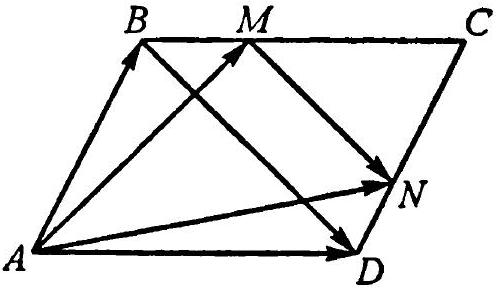
Fig. 5.14 $\... | \overline{AB}=\frac{9}{8}\bar{}-\frac{3}{8}\bar{b},\overline{AD}=\frac{9}{8}\bar{b}-\frac{3}{8}\bar{},\overline{MN}=\bar{b}-\bar{},\overline{BD}=\frac{3}{2}\bar{b}- | 42,671 | <think>5.24. Given that $\overline{A M}=\bar{a}, \overline{A N}=\bar{b}$ (Fig. 5.14) and, therefore, $\overline{M N}=\overline{A N}-\overline{A M}=\bar{b}-\bar{a}. \quad$ Since

Fig. 5.14 $\... | 1_10 |
Dave arrives at an airport which has twelve gates arranged in a straight line with exactly $100$ feet between adjacent gates. His departure gate is assigned at random. After waiting at that gate, Dave is told the departure gate has been changed to a different gate, again at random. Let the [probability](https://artofpr... | <think>Solution 1
There are $12 \cdot 11 = 132$ possible situations ($12$ choices for the initially assigned gate, and $11$ choices for which gate Dave's flight was changed to). We are to count the situations in which the two gates are at most $400$ feet apart.
If we number the gates $1$ through $12$, then gates $1$ an... | 52 | 25,292 | <think>Solution 1
There are $12 \cdot 11 = 132$ possible situations ($12$ choices for the initially assigned gate, and $11$ choices for which gate Dave's flight was changed to). We are to count the situations in which the two gates are at most $400$ feet apart.
If we number the gates $1$ through $12$, then gates $1$ an... | 1_11 |
[Example 2.4.4] Let non-negative real numbers $a_{1}, a_{2}, \cdots, a_{n}$ satisfy
$$
a_{1}+a_{2}+\cdots+a_{n}=1 .
$$
Find the minimum value of $S=\sum_{i=1}^{n} \frac{a_{i}}{2-a_{i}}$. | <think>First, simplify $\frac{a_{i}}{2-a_{i}}, i=1,2, \cdots, n$,
$$
\frac{a_{i}}{2-a_{i}}=\frac{a_{i}-2+2}{2-a_{i}}=\frac{2}{2-a_{i}}-1 .
$$
For $\frac{2}{2-a_{i}}$, we still use the parameterized inequality
$$
\begin{array}{c}
\frac{x^{2}}{y} \geqslant 2 \lambda x-\lambda^{2} y . \\
\frac{1}{2-a_{i}} \geqslant 2 \la... | \frac{n}{2n-1} | 13,845 | <think>First, simplify $\frac{a_{i}}{2-a_{i}}, i=1,2, \cdots, n$,
$$
\frac{a_{i}}{2-a_{i}}=\frac{a_{i}-2+2}{2-a_{i}}=\frac{2}{2-a_{i}}-1 .
$$
For $\frac{2}{2-a_{i}}$, we still use the parameterized inequality
$$
\begin{array}{c}
\frac{x^{2}}{y} \geqslant 2 \lambda x-\lambda^{2} y . \\
\frac{1}{2-a_{i}} \geqslant 2 \la... | 1_12 |
15. Given $k$ as a positive integer, the sequence $\left\{a_{n}\right\}$ satisfies
$$
a_{1}=3, a_{n+1}=\left(3^{\frac{2}{2 k-1}}-1\right) S_{n}+3\left(n \in \mathbf{Z}_{+}\right) \text {, }
$$
where $S_{n}$ is the sum of the first $n$ terms of the sequence $\left\{a_{n}\right\}$.
Let $b_{n}=\frac{1}{n} \log _{3} a_{1}... | <think>15. From the problem, we know
Also, $a_{n+1}=\left(3^{\frac{2}{2 k-1}}-1\right) S_{n}+3$,
$$
a_{n}=\left(3^{\frac{2}{2 k-1}}-1\right) S_{n-1}+3(n \geqslant 2) \text {, }
$$
Thus, $a_{n+1}-a_{n}=\left(3^{\frac{2}{2 k-1}}-1\right) a_{n}$
$\Rightarrow a_{n+1}=3^{\frac{2}{2 k-1}} a_{n}$
$$
\Rightarrow a_{n}=a_{2}\... | 1 | 19,286 | <think>15. From the problem, we know
Also, $a_{n+1}=\left(3^{\frac{2}{2 k-1}}-1\right) S_{n}+3$,
$$
a_{n}=\left(3^{\frac{2}{2 k-1}}-1\right) S_{n-1}+3(n \geqslant 2) \text {, }
$$
Thus, $a_{n+1}-a_{n}=\left(3^{\frac{2}{2 k-1}}-1\right) a_{n}$
$\Rightarrow a_{n+1}=3^{\frac{2}{2 k-1}} a_{n}$
$$
\Rightarrow a_{n}=a_{2}\... | 1_13 |
A four-digit number has the following properties:
(a) It is a perfect square;
(b) Its first two digits are equal
(c) Its last two digits are equal.
Find all such four-digit numbers. | <think>1. Let the four-digit number be represented as \(aabb\), where \(a\) and \(b\) are digits.
2. Since the number is a perfect square, we can write it as \(n^2\) for some integer \(n\).
3. The number \(aabb\) can be expressed as \(1100a + 11b\), which simplifies to \(11(100a + b)\).
4. Therefore, \(n^2 = 11(100a + ... | 7744 | 55,674 | <think>1. Let the four-digit number be represented as \(aabb\), where \(a\) and \(b\) are digits.
2. Since the number is a perfect square, we can write it as \(n^2\) for some integer \(n\).
3. The number \(aabb\) can be expressed as \(1100a + 11b\), which simplifies to \(11(100a + b)\).
4. Therefore, \(n^2 = 11(100a + ... | 1_14 |
1. Three non-zero real numbers form an arithmetic progression, and their squares taken in the same order form a geometric progression. Find all possible common ratios of the geometric progression. | <think>Solution. Let the real numbers $a, b, c$ form an arithmetic progression, and the numbers $a^{2}, b^{2}, c^{2}$ form a geometric progression. Therefore, $2 b=c+a$ and $b^{4}=c^{2} a^{2}$. If we square the equation $2 b=c+a$, we get
$$
4 b^{2}=a^{2}+2 a c+c^{2}
$$
From the equation $b^{4}=c^{2} a^{2}$, we get $b... | 1,3-\sqrt{8},3+\sqrt{8} | 75,213 | <think>Solution. Let the real numbers $a, b, c$ form an arithmetic progression, and the numbers $a^{2}, b^{2}, c^{2}$ form a geometric progression. Therefore, $2 b=c+a$ and $b^{4}=c^{2} a^{2}$. If we square the equation $2 b=c+a$, we get
$$
4 b^{2}=a^{2}+2 a c+c^{2}
$$
From the equation $b^{4}=c^{2} a^{2}$, we get $b... | 1_15 |
7. Let $\omega$ be a positive real number. If there exist $a, b(\pi \leqslant a<b \leqslant 2 \pi)$ such that $\sin \omega a + \sin \omega b = 2$, then the range of $\omega$ is $\qquad$. | <think>7. $\omega \in\left[\frac{9}{4}, \frac{5}{2}\right] \cup\left[\frac{13}{4},+\infty\right)$.
Given $\sin \omega a+\sin \omega b=2$
$\Rightarrow \sin \omega a=\sin \omega b=1$.
And $[\omega a, \omega b] \subseteq[\omega \pi, 2 \omega \pi]$, hence the given condition is equivalent to: there exist integers $k, l (k... | [\frac{9}{4},\frac{5}{2}]\cup[\frac{13}{4},+\infty) | 49,431 | <think>7. $\omega \in\left[\frac{9}{4}, \frac{5}{2}\right] \cup\left[\frac{13}{4},+\infty\right)$.
Given $\sin \omega a+\sin \omega b=2$
$\Rightarrow \sin \omega a=\sin \omega b=1$.
And $[\omega a, \omega b] \subseteq[\omega \pi, 2 \omega \pi]$, hence the given condition is equivalent to: there exist integers $k, l (k... | 1_16 |
Five. (15 points) Suppose there are $n$ distinct positive integers $a_{1}, a_{2}$, $\cdots, a_{n}$. Then among the integers of the form $t_{1} a_{1}+t_{2} a_{2}+\cdots+t_{n} a_{n}$ (where $t_{1}$ takes 1 or $-1, i=1,2, \cdots, n)$, there exist $\frac{n^{2}+n+2}{2}$ distinct integers that are either all odd or all even. | <think>Let's assume $a_{1}<a_{2}<\cdots<a_{n}$, then $a=-a_{1}-a_{2}-\cdots-a_{n}$ is the smallest integer of the form $t_{1} a_{1}+t_{2} a_{2}+\cdots+t_{n} a_{n}$. $a+2 a_{1}=a_{1}-a_{2}-\cdots-a_{n}$ is also an integer of the form $t_{1} a_{1}+t_{2} a_{2}+\cdots+t_{n} a_{n}$. Generally, $a+2 a_{1}+2 a_{2}$ is also an... | \frac{n^{2}+n+2}{2} | 59,498 | <think>Let's assume $a_{1}<a_{2}<\cdots<a_{n}$, then $a=-a_{1}-a_{2}-\cdots-a_{n}$ is the smallest integer of the form $t_{1} a_{1}+t_{2} a_{2}+\cdots+t_{n} a_{n}$. $a+2 a_{1}=a_{1}-a_{2}-\cdots-a_{n}$ is also an integer of the form $t_{1} a_{1}+t_{2} a_{2}+\cdots+t_{n} a_{n}$. Generally, $a+2 a_{1}+2 a_{2}$ is also an... | 1_17 |
23. C3 (GBR) A biologist watches a chameleon. The chameleon catches flies and rests after each catch. The biologist notices that:
(i) the first fly is caught after a resting period of one minute;
(ii) the resting period before catching the $2 m$ th fly is the same as the resting period before catching the mth fly and o... | <think>23. Let $r(m)$ denote the rest period before the $m$ th catch, $t(m)$ the number of minutes before the $m$ th catch, and $f(n)$ as the number of flies caught in $n$ minutes. We have $r(1)=1, r(2 m)=r(m)$, and $r(2 m+1)=f(m)+1$. We then have by induction that $r(m)$ is the number of ones in the binary representat... | 510,312,462 | 22,463 | <think>23. Let $r(m)$ denote the rest period before the $m$ th catch, $t(m)$ the number of minutes before the $m$ th catch, and $f(n)$ as the number of flies caught in $n$ minutes. We have $r(1)=1, r(2 m)=r(m)$, and $r(2 m+1)=f(m)+1$. We then have by induction that $r(m)$ is the number of ones in the binary representat... | 1_18 |
7. In village $A$, there are 100 schoolchildren, and in village $B$, there are 50 schoolchildren. The distance between the villages is 3 kilometers. At what point on the road from $A$ to $B$ should a school be built to minimize the total distance traveled by all schoolchildren? | <think>$\triangle$ It seems fair to build the school closer to $A$, as there are more students there. But how much closer? Sometimes it is suggested to build the school one kilometer from $A$ and two kilometers from $B$ (twice as many students, so the school is twice as close). However, from the perspective of the give... | 0 | 70,380 | <think>$\triangle$ It seems fair to build the school closer to $A$, as there are more students there. But how much closer? Sometimes it is suggested to build the school one kilometer from $A$ and two kilometers from $B$ (twice as many students, so the school is twice as close). However, from the perspective of the give... | 1_19 |
1. Find all real pairs $(x, y)$ that satisfy:
$$
\left\{\begin{array}{l}
x^{2}+y^{2}+x+y=x y(x+y)-\frac{10}{27}, \\
|x y| \leqslant \frac{25}{9} .
\end{array}\right.
$$ | <think>1. $(x, y)=\left(-\frac{1}{3},-\frac{1}{3}\right),\left(\frac{5}{3}, \frac{5}{3}\right)$.
From $x^{2}+y^{2}+x+y-x y(x+y)-2$
$$
\begin{array}{l}
=-(1-x)(1-y)(x+y+2) \\
\Rightarrow(1-x)(1-y)(x+y+2)=\frac{64}{27} .
\end{array}
$$
Let $k^{3}=1-x, l^{3}=1-y, m^{3}=x+y+2$. Then
$k^{3}+l^{3}+m^{3}=4, k l m=\frac{4}{3... | (x,y)=(-\frac{1}{3},-\frac{1}{3}),(\frac{5}{3},\frac{5}{3}) | 69,859 | <think>1. $(x, y)=\left(-\frac{1}{3},-\frac{1}{3}\right),\left(\frac{5}{3}, \frac{5}{3}\right)$.
From $x^{2}+y^{2}+x+y-x y(x+y)-2$
$$
\begin{array}{l}
=-(1-x)(1-y)(x+y+2) \\
\Rightarrow(1-x)(1-y)(x+y+2)=\frac{64}{27} .
\end{array}
$$
Let $k^{3}=1-x, l^{3}=1-y, m^{3}=x+y+2$. Then
$k^{3}+l^{3}+m^{3}=4, k l m=\frac{4}{3... | 1_20 |
3. [6 points] On the plane $O x y$, the equation $5 a^{2}+12 a x+4 a y+8 x^{2}+8 x y+4 y^{2}=0$ defines the coordinates of point $A$, and the equation $a x^{2}-2 a^{2} x-a y+a^{3}+4=0$ defines a parabola with vertex at point $B$. Find all values of the parameter $a$ for which points $A$ and $B$ lie on opposite sides of... | <think>Answer: $(-\infty ;-2) \cup\left(0 ; \frac{2}{3}\right) \cup\left(\frac{8}{7} ;+\infty\right)$.
Solution. The first equation can be transformed as follows:
$$
\begin{aligned}
& \left(4 y^{2}+4(2 x+a) y\right)+8 x^{2}+12 a x+5 a^{2}=0 \Leftrightarrow \\
& \Leftrightarrow\left((2 y)^{2}+2 \cdot 2 y \cdot(2 x+a)+... | (-\infty;-2)\cup(0;\frac{2}{3})\cup(\frac{8}{7};+\infty) | 73,992 | <think>Answer: $(-\infty ;-2) \cup\left(0 ; \frac{2}{3}\right) \cup\left(\frac{8}{7} ;+\infty\right)$.
Solution. The first equation can be transformed as follows:
$$
\begin{aligned}
& \left(4 y^{2}+4(2 x+a) y\right)+8 x^{2}+12 a x+5 a^{2}=0 \Leftrightarrow \\
& \Leftrightarrow\left((2 y)^{2}+2 \cdot 2 y \cdot(2 x+a)+... | 1_21 |
16. Let $a_{1}, a_{2}, \ldots, a_{24}$ be integers with sum 0 and satisfying $\left|a_{i}\right| \leq i$ for all $i$. Find the greatest possible value of $a_{1}+2 a_{2}+3 a_{3}+\cdots+24 a_{24}$.
(2 marks)設 $a_{1} 、 a_{2} 、 \cdots 、 a_{24}$ 為整数, 它們之和為 0 , 且對所有 $i$ 皆有 $\left|a_{i}\right| \leq i$ 。求 $a_{1}+2 a_{2}+3 a_{3... | <think>16. 1432
16. Clearly the maximum value exists as $a_{1}+2 a_{2}+3 a_{3}+\cdots+24 a_{24} \leq 1^{2}+2^{2}+\cdots+24^{2}$. Let's see what happens when maximality is reached. We claim that at maximality, we must have $a_{m}=-m$ or $a_{n}=n$ for any pair $(m, n)$ satisfying $1 \leq m<n \leq 24$. Indeed, if this is ... | 1432 | 30,157 | <think>16. 1432
16. Clearly the maximum value exists as $a_{1}+2 a_{2}+3 a_{3}+\cdots+24 a_{24} \leq 1^{2}+2^{2}+\cdots+24^{2}$. Let's see what happens when maximality is reached. We claim that at maximality, we must have $a_{m}=-m$ or $a_{n}=n$ for any pair $(m, n)$ satisfying $1 \leq m<n \leq 24$. Indeed, if this is ... | 1_22 |
ABCDEF - a six-digit number. All digits are different and are arranged from left to right in ascending order. The number is a perfect square.
Determine what this number is.
# | <think>The number ABCDEF is the square of a three-digit number.
## Solution
Let $\mathrm{ABCDEF}=\mathrm{XYZ}^{2}$. Clearly, $\mathrm{F}$ is the units digit of $\mathrm{Z}^{2}$. Since the digits A, B, C, D, E, F are in ascending order, $\mathrm{A} \leq 4$,
$\mathrm{E} \geq 5$, and $\mathrm{F} \geq 6$.
If $A=4$, the... | 134689 | 18,426 | <think>The number ABCDEF is the square of a three-digit number.
## Solution
Let $\mathrm{ABCDEF}=\mathrm{XYZ}^{2}$. Clearly, $\mathrm{F}$ is the units digit of $\mathrm{Z}^{2}$. Since the digits A, B, C, D, E, F are in ascending order, $\mathrm{A} \leq 4$,
$\mathrm{E} \geq 5$, and $\mathrm{F} \geq 6$.
If $A=4$, the... | 1_23 |
Determine all integer numbers $x$ and $y$ such that
$$
\frac{1}{x}+\frac{1}{y}=\frac{1}{19}
$$ | <think>The original equation assumes $x \neq 0$ and $y \neq 0$, so we can consider the equivalent equation
$$
x y=19(x+y), \quad \text { with } \quad x \neq 0, y \neq 0
$$
Since we are looking for integer solutions and 19 is a prime number, this equality implies that $x$ or $y$ must be divisible by 19. As the equatio... | (38,38),(380,20),(-342,18),(20,380),(18,-342) | 30,838 | <think>The original equation assumes $x \neq 0$ and $y \neq 0$, so we can consider the equivalent equation
$$
x y=19(x+y), \quad \text { with } \quad x \neq 0, y \neq 0
$$
Since we are looking for integer solutions and 19 is a prime number, this equality implies that $x$ or $y$ must be divisible by 19. As the equatio... | 1_24 |
3. Solve the system of equations $\left\{\begin{array}{l}x-y+z-w=2, \\ x^{2}-y^{2}+z^{2}-w^{2}=6, \\ x^{3}-y^{3}+z^{3}-w^{3}=20, \\ x^{4}-y^{4}+z^{4}-w^{4}=66 .\end{array}\right.$ | <think>Let $u=x+z, v=x z, s=y+w, t=y w$,
then $x^{2}+z^{2}=u^{2}-2 v, x^{3}+z^{3}=u^{3}-3 u v, x^{4}+z^{4}=u^{4}-4 u^{2} v+2 v^{2}$.
Thus, the original system of equations can be transformed into $\left\{\begin{array}{l}u-s=2, \\ u^{2}-s^{2}-2 v+2 t=6, \\ u^{3}-s^{3}-3 u v+3 s t=20, \\ u^{4}-s^{4}-4 u^{2} v+4 s^{2} t+2... | (1,0,3,2),(1,2,3,0),(3,0,1,2),(3,2,1,0) | 11,424 | <think>Let $u=x+z, v=x z, s=y+w, t=y w$,
then $x^{2}+z^{2}=u^{2}-2 v, x^{3}+z^{3}=u^{3}-3 u v, x^{4}+z^{4}=u^{4}-4 u^{2} v+2 v^{2}$.
Thus, the original system of equations can be transformed into $\left\{\begin{array}{l}u-s=2, \\ u^{2}-s^{2}-2 v+2 t=6, \\ u^{3}-s^{3}-3 u v+3 s t=20, \\ u^{4}-s^{4}-4 u^{2} v+4 s^{2} t+2... | 1_25 |
Vanya believes that fractions are "reduced" by crossing out identical digits in the numerator and denominator. Seryozha noticed that sometimes Vanya gets correct equalities, for example, $49 / 98 = 4 / 8$. Find all proper fractions with numerators and denominators consisting of two non-zero digits that can be "reduced"... | <think>Let's consider all possible cases of cancellations.
1) $\frac{\overline{\beta a}}{\overline{\overline{b c}}}$. We get $(10 b + a) c = (10 b + c) a$, which simplifies to $b c = b a$. Since $b \neq 0$, it follows that $c = a$. However, by the condition, the fraction is proper. Therefore, there are no solutions.
2... | 26/65,16/64,19/95,49/98 | 64,734 | <think>Let's consider all possible cases of cancellations.
1) $\frac{\overline{\beta a}}{\overline{\overline{b c}}}$. We get $(10 b + a) c = (10 b + c) a$, which simplifies to $b c = b a$. Since $b \neq 0$, it follows that $c = a$. However, by the condition, the fraction is proper. Therefore, there are no solutions.
2... | 1_26 |
Let's construct a triangle, given the side $a$ and the opposite angle $\alpha$, and we know that the angle bisector of $\alpha$ forms a $45^{\circ}$ angle with side $a$. | <think>We denote the vertex opposite to the side of length $a$ as $A$, the endpoint of the shorter side starting from $A$ as $B$, and the third vertex as $C$. We measure on the extensions of the lines $AB$ and $AC$ beyond $A$ the segments $AD = AC$ and $AE = AB$, and connect the resulting points $D$ and $E$ to $C$ and ... | \alpha/2<45 | 86,564 | <think>We denote the vertex opposite to the side of length $a$ as $A$, the endpoint of the shorter side starting from $A$ as $B$, and the third vertex as $C$. We measure on the extensions of the lines $AB$ and $AC$ beyond $A$ the segments $AD = AC$ and $AE = AB$, and connect the resulting points $D$ and $E$ to $C$ and ... | 1_27 |
Example 2.7. $\int_{-1}^{1} \frac{d}{d x}\left(\frac{1}{1+3^{1 / x}}\right) d x$.
| <think>Solution. Formal application of the Newton-Leibniz formula is impossible here, since $F(x)=\frac{1}{\left(1+3^{1 / x}\right)}$ is an antiderivative of the integrand everywhere except $x=0$, but this point belongs to the interval of integration $[-1,1]$. To compute this integral, we will first use the additivity ... | \frac{1}{2} | 76,469 | <think>Solution. Formal application of the Newton-Leibniz formula is impossible here, since $F(x)=\frac{1}{\left(1+3^{1 / x}\right)}$ is an antiderivative of the integrand everywhere except $x=0$, but this point belongs to the interval of integration $[-1,1]$. To compute this integral, we will first use the additivity ... | 1_28 |
[Trigonometric ratios in a right triangle] ] [ Rhombi. Criteria and properties $]$
In the rhombus $A B C D$, a perpendicular $B E$ is dropped from vertex $B$ to side $A D$. Find the angles of the rhombus if $2 \sqrt{3} C E=$ $\sqrt{7} A C$. | <think>Apply the Law of Cosines to triangle $C A E$.
## Solution
Let $O$ be the point of intersection of the diagonals of the rhombus. Let $A C=2 x, \angle B A D=\alpha$. Then
$$
A B=\frac{A O}{\cos \angle B A O}=\frac{x}{\cos \frac{\alpha}{2}}, A E=A B \cos \angle B A E=\frac{x \cos \alpha}{\cos \frac{\alpha}{2}}, ... | 60,120 | 65,583 | <think>Apply the Law of Cosines to triangle $C A E$.
## Solution
Let $O$ be the point of intersection of the diagonals of the rhombus. Let $A C=2 x, \angle B A D=\alpha$. Then
$$
A B=\frac{A O}{\cos \angle B A O}=\frac{x}{\cos \frac{\alpha}{2}}, A E=A B \cos \angle B A E=\frac{x \cos \alpha}{\cos \frac{\alpha}{2}}, ... | 1_29 |
Example 8 Find:
(1) $\mathrm{C}_{n}^{1}-3 \mathrm{C}_{n}^{3}+5 \mathrm{C}_{n}^{5}-7 \mathrm{C}_{n}^{7}+\cdots$;
(2) $2 C_{n}^{2}-4 C_{n}^{4}+6 C_{n}^{6}-8 C_{n}^{8}+\cdots$. | <think>Solution: From the binomial expansion and (III), we have
$$
\begin{array}{rl}
n & n(1+\mathrm{i})^{n-1} \\
= & n\left(\mathrm{C}_{n-1}^{0}+\mathrm{i} \mathrm{C}_{n-1}^{1}+\mathrm{i}^{2} \mathrm{C}_{n-1}^{2} \cdots+\right. \\
& \left.\mathrm{i}^{n-1} \mathrm{C}_{n-1}^{n-1}\right) \\
= & n\left(\mathrm{C}_{n-1}^{0... | \begin{array}{l}
\text{(1) } \mathrm{C}_{n}^{1}-3 \mathrm{C}_{n}^{3}+5 \mathrm{C}_{n}^{5}-7 \mathrm{C}_{n}^{7}+\cdots = n \times 2^{\frac{n-1}{2}} \cos \frac{(n-1) \pi}{4} \\
\text{(2) } | 89,389 | <think>Solution: From the binomial expansion and (III), we have
$$
\begin{array}{rl}
n & n(1+\mathrm{i})^{n-1} \\
= & n\left(\mathrm{C}_{n-1}^{0}+\mathrm{i} \mathrm{C}_{n-1}^{1}+\mathrm{i}^{2} \mathrm{C}_{n-1}^{2} \cdots+\right. \\
& \left.\mathrm{i}^{n-1} \mathrm{C}_{n-1}^{n-1}\right) \\
= & n\left(\mathrm{C}_{n-1}^{0... | 1_30 |
Example 3 Find all integer solutions of the indeterminate equation
$$
\left(x^{2}-4\right)\left(y^{2}-4\right)=t^{2}+12
$$ | <think>When $|x| \leqslant 2$, we can obtain
$$
(x, y, t)=(0,0, \pm 2),(0, \pm 1,0),( \pm 1,0,0) \text {. }
$$
The following proof shows that these are the only solutions.
When $|x| \geqslant 3$, without loss of generality, assume $x, y, t \geqslant 0$.
It is easy to see that $y \geqslant 3, 3 \nmid x, 3 \nmid y$.
The... | (0,0,\2),(0,\1,0),(\1,0,0) | 43,584 | <think>When $|x| \leqslant 2$, we can obtain
$$
(x, y, t)=(0,0, \pm 2),(0, \pm 1,0),( \pm 1,0,0) \text {. }
$$
The following proof shows that these are the only solutions.
When $|x| \geqslant 3$, without loss of generality, assume $x, y, t \geqslant 0$.
It is easy to see that $y \geqslant 3, 3 \nmid x, 3 \nmid y$.
The... | 1_31 |
385*. Solve the system of equations:
$$
\left\{\begin{array}{l}
x=\frac{2 y^{2}}{1+z^{2}} \\
y=\frac{2 z^{2}}{1+x^{2}} \\
z=\frac{2 x^{2}}{1+y^{2}}
\end{array}\right.
$$ | <think>$\triangle$ From the system, it is clear that all unknowns $x, y$, and $z$ are non-negative.
Multiply all the equations of the system and reduce the resulting equation to an algebraic one:
$$
\begin{aligned}
& x y z=\frac{8 x^{2} y^{2} z^{2}}{\left(1+x^{2}\right)\left(1+y^{2}\right)\left(1+z^{2}\right)}, \quad... | (0;0;0),(1;1;1) | 1,259 | <think>$\triangle$ From the system, it is clear that all unknowns $x, y$, and $z$ are non-negative.
Multiply all the equations of the system and reduce the resulting equation to an algebraic one:
$$
\begin{aligned}
& x y z=\frac{8 x^{2} y^{2} z^{2}}{\left(1+x^{2}\right)\left(1+y^{2}\right)\left(1+z^{2}\right)}, \quad... | 1_32 |
Four, (This question is worth 50 points) Let $a_{1}, a_{2}, \cdots, a_{20} \in\{1,2, \cdots, 5\}, b_{1}, b_{2}, \cdots, b_{20} \in\{1,2, \cdots, 10\}$, and the set $X=\left\{(i, j) \mid 1 \leq i<j \leq 20,\left(a_{i}-a_{j}\right)\left(b_{i}-b_{j}\right)<0\right\}$, find the maximum value of the number of elements in $X... | <think>Solution: Consider a set of positive integers $\left(a_{1}, a_{2}, \cdots, a_{20}, b_{1}, b_{2}, \cdots, b_{20}\right)$.
For $k=1,2, \cdots, 5$, let $t_{k}$ be the number of elements in $a_{1}, \cdots, a_{20}$ that take the value $k$. According to the definition of $X$, when $a_{k}=a_{j}$, $(i, j) \notin X$, so ... | 160 | 20,025 | <think>Solution: Consider a set of positive integers $\left(a_{1}, a_{2}, \cdots, a_{20}, b_{1}, b_{2}, \cdots, b_{20}\right)$.
For $k=1,2, \cdots, 5$, let $t_{k}$ be the number of elements in $a_{1}, \cdots, a_{20}$ that take the value $k$. According to the definition of $X$, when $a_{k}=a_{j}$, $(i, j) \notin X$, so ... | 1_33 |
5. Given the number $200 \ldots 002$ (100 zeros). It is required to replace some two zeros with non-zero digits so that after the replacement, the resulting number is divisible by 66. In how many ways can this be done? | <think>Answer: 27100.
Solution. $66=3 \cdot 2 \cdot 11$. Divisibility by 2 is always satisfied since the number ends in two. To investigate divisibility by 11, it is significant which positions the replaceable digits occupy.
First case. We replace two zeros in positions of the same parity (both even or both odd). For... | 27100 | 79,126 | <think>Answer: 27100.
Solution. $66=3 \cdot 2 \cdot 11$. Divisibility by 2 is always satisfied since the number ends in two. To investigate divisibility by 11, it is significant which positions the replaceable digits occupy.
First case. We replace two zeros in positions of the same parity (both even or both odd). For... | 1_34 |
Problem 11.7. An archipelago consists of $N \geqslant 7$ islands. Any two islands are connected by no more than one bridge. It is known that from each island, no more than 5 bridges lead, and among any 7 islands, there are definitely two connected by a bridge. What is the largest value that $N$ can take? | <think>Answer: 36.
Solution. There can be 36 islands in the archipelago, for example, as follows: they form 6 groups of 6 islands each, and two islands are connected by a bridge if and only if they are in the same group. It is clear that from each island, exactly 5 bridges lead out, and among any 7 islands, there are ... | 36 | 55,732 | <think>Answer: 36.
Solution. There can be 36 islands in the archipelago, for example, as follows: they form 6 groups of 6 islands each, and two islands are connected by a bridge if and only if they are in the same group. It is clear that from each island, exactly 5 bridges lead out, and among any 7 islands, there are ... | 1_35 |
$a_1=-1$, $a_2=2$, and $a_n=\frac {a_{n-1}}{a_{n-2}}$ for $n\geq 3$. What is $a_{2006}$?
$
\textbf{(A)}\ -2
\qquad\textbf{(B)}\ -1
\qquad\textbf{(C)}\ -\frac 12
\qquad\textbf{(D)}\ \frac 12
\qquad\textbf{(E)}\ 2
$ | <think>1. First, we list out the initial terms given in the problem:
\[
a_1 = -1, \quad a_2 = 2
\]
2. Using the recurrence relation \(a_n = \frac{a_{n-1}}{a_{n-2}}\) for \(n \geq 3\), we calculate the next few terms:
\[
a_3 = \frac{a_2}{a_1} = \frac{2}{-1} = -2
\]
\[
a_4 = \frac{a_3}{a_2} = \fra... | 2 | 3,997 | <think>1. First, we list out the initial terms given in the problem:
\[
a_1 = -1, \quad a_2 = 2
\]
2. Using the recurrence relation \(a_n = \frac{a_{n-1}}{a_{n-2}}\) for \(n \geq 3\), we calculate the next few terms:
\[
a_3 = \frac{a_2}{a_1} = \frac{2}{-1} = -2
\]
\[
a_4 = \frac{a_3}{a_2} = \fra... | 1_36 |
$A$ walks $30 \mathrm{~km}$ per day from $P$ to $Q$. After walking $72 \mathrm{~km}$, $B$ starts from $Q$ towards $P$ on the same road, and walks $\frac{1}{10}$ of the entire distance each day. After $B$ has walked for as many days as the $\frac{1}{8}$ of the distance he walks per day, he meets $A$. What is the distanc... | <think>I. Solution: Let the distance $P Q$ be $x \text{ km}$. While traveling from $B Q$, it takes $\frac{x}{10} \cdot \frac{1}{8} = \frac{x}{80}$ days to meet $A$. Therefore, by the time they meet, $A$ has traveled $72 + 30 \cdot \frac{x}{80} \text{ km}$, while $B$ has traveled $\frac{x}{10} \cdot \frac{x}{80} \text{ ... | 320 | 64,620 | <think>I. Solution: Let the distance $P Q$ be $x \text{ km}$. While traveling from $B Q$, it takes $\frac{x}{10} \cdot \frac{1}{8} = \frac{x}{80}$ days to meet $A$. Therefore, by the time they meet, $A$ has traveled $72 + 30 \cdot \frac{x}{80} \text{ km}$, while $B$ has traveled $\frac{x}{10} \cdot \frac{x}{80} \text{ ... | 1_37 |
\section*{Problem 3B - 111043B}
Dirk explains to Jürgen the usefulness of differential calculus using the solution to the following problem: Let \(A B C D E\) be a planar convex pentagon such that \(A, B, C, E\) are the vertices of a rectangle and \(C, D, E\) are the vertices of an equilateral triangle. The area of th... | <think>}
It is \(F=a b+\frac{\sqrt{3}}{4} a^{2}\) and \(u=3 a+2 b\), so \(b=\frac{u-3 a}{2}\) and thus
\[
F=a \cdot \frac{u}{2}-\frac{3}{2} a^{2}+\frac{\sqrt{3}}{4} a^{2} \quad \text { or } \quad u=\frac{1}{a} \cdot\left(2 F+3 a^{2}-\frac{\sqrt{3}}{2} a^{2}\right)=\frac{2 F}{a}+\left(3-\frac{\sqrt{3}}{2}\right) a
\]
... | 1+\frac{\sqrt{3}}{3} | 43,765 | <think>}
It is \(F=a b+\frac{\sqrt{3}}{4} a^{2}\) and \(u=3 a+2 b\), so \(b=\frac{u-3 a}{2}\) and thus
\[
F=a \cdot \frac{u}{2}-\frac{3}{2} a^{2}+\frac{\sqrt{3}}{4} a^{2} \quad \text { or } \quad u=\frac{1}{a} \cdot\left(2 F+3 a^{2}-\frac{\sqrt{3}}{2} a^{2}\right)=\frac{2 F}{a}+\left(3-\frac{\sqrt{3}}{2}\right) a
\]
... | 1_38 |
4. We will call a point convenient for a circle if the angle between the tangents drawn from this point to the circle is $60^{\circ}$. Two circles with centers $A$ and $B$ touch each other, and point $M$ is convenient for each of them. Find the ratio of the radii of the circles if $\triangle A B M$ is a right triangle. | <think>Solution. Note (see Fig. 1) that a point $M$ is convenient for a circle with center $O$ if and only if $O M$ is twice the radius.

1
 that a point $M$ is convenient for a circle with center $O$ if and only if $O M$ is twice the radius.

1
, \(15\), \(25\), \(35\), or \(45\) pounds.
- The bar itself weighs \(45\) pounds.
- Vlad mistakenly thought Arnold was lifting \(600\) pounds.
- Arnold was actually lifting \(470\) pounds.
- Vlad mistook each pla... | 13 | 35,322 | <think>1. **Identify the problem and given information:**
- Arnold has plates weighing \(5\), \(15\), \(25\), \(35\), or \(45\) pounds.
- The bar itself weighs \(45\) pounds.
- Vlad mistakenly thought Arnold was lifting \(600\) pounds.
- Arnold was actually lifting \(470\) pounds.
- Vlad mistook each pla... | 1_40 |
1. Given a linear function $f(x)$. It is known that the distance between the points of intersection of the graphs $y=x^{2}-2$ and $y=f(x)$ is $\sqrt{26}$, and the distance between the points of intersection of the graphs $y=x^{2}$ and $y=f(x)+1$ is $3 \sqrt{2}$. Find the distance between the points of intersection of t... | <think>Answer: $\sqrt{10}$.
Solution. Let $f(x)=a x+b$. Then the abscissas of the points of intersection of the graphs in the first case are determined from the equation $x^{2}-2=a x+b$, and in the second case - from the equation $x^{2}=a x+b+1$. Consider the first case in more detail. The equation has the form $x^{2}... | \sqrt{10} | 93,151 | <think>Answer: $\sqrt{10}$.
Solution. Let $f(x)=a x+b$. Then the abscissas of the points of intersection of the graphs in the first case are determined from the equation $x^{2}-2=a x+b$, and in the second case - from the equation $x^{2}=a x+b+1$. Consider the first case in more detail. The equation has the form $x^{2}... | 1_41 |
Example 19 Find $(101101)_{2} \div(1111)_{2}=$ ? | <think>First, find the complement of the divisor $(1111)_2$, which is $(0001)_2 = (1)_2$. Then add the complement $(1)_2$ to the dividend $(101101)_2$ and subtract $(10000)_2$ to obtain the remainder after the first subtraction of the divisor, i.e.,
Then add the complement $(1)_2$ to the remainder $(11110)_2$ and subt... | (11)_2 | 65,650 | <think>First, find the complement of the divisor $(1111)_2$, which is $(0001)_2 = (1)_2$. Then add the complement $(1)_2$ to the dividend $(101101)_2$ and subtract $(10000)_2$ to obtain the remainder after the first subtraction of the divisor, i.e.,
Then add the complement $(1)_2$ to the remainder $(11110)_2$ and subt... | 1_42 |
3. (3 points) There are two cylinders with a volume ratio of 5:8, and the lateral surfaces of these cylinders unfold into the same rectangle. If the length and width of this rectangle are both increased by 6, its area increases by 114. What is the area of this rectangle $\qquad$ . | <think>【Analysis】The lateral development is a rectangle of the same size, indicating that this rectangle can be wrapped horizontally to form a cuboid and vertically to form another cuboid, with a volume ratio of 5:8. As shown in the figure, the area of the shaded part is 114, so $(a+b)$ is $(114 - 6 \times 6) \div 6 = ... | 40 | 21,089 | <think>【Analysis】The lateral development is a rectangle of the same size, indicating that this rectangle can be wrapped horizontally to form a cuboid and vertically to form another cuboid, with a volume ratio of 5:8. As shown in the figure, the area of the shaded part is 114, so $(a+b)$ is $(114 - 6 \times 6) \div 6 = ... | 1_43 |
15. (12 points) For the function $f(x)$, if $f(x)=x$, then $x$ is called a "fixed point" of $f(x)$; if $f(f(x))=x$, then $x$ is called a "stable point" of $f(x)$. The sets of "fixed points" and "stable points" of the function $f(x)$ are denoted as $A$ and $B$, respectively, i.e., $A=\{x \mid f(x)=x\}, B=\{x \mid f(f(x)... | <think>(1) If $A=\varnothing$, then $A \subseteq B$ is obviously true.
If $A \neq \varnothing$, let $t \in A$, then
$$
f(t)=t, f(f(t))=f(t)=t \text {. }
$$
Thus, $t \in B$, hence $A \subseteq B$.
(2) The elements of $A$ are the real roots of the equation $f(x)=x$, i.e., $a x^{2}-1=x$. Since $A \neq \varnothing$, we ha... | \left[-\frac{1}{4}, \frac{3}{4}\right] | 80,559 | <think>(1) If $A=\varnothing$, then $A \subseteq B$ is obviously true.
If $A \neq \varnothing$, let $t \in A$, then
$$
f(t)=t, f(f(t))=f(t)=t \text {. }
$$
Thus, $t \in B$, hence $A \subseteq B$.
(2) The elements of $A$ are the real roots of the equation $f(x)=x$, i.e., $a x^{2}-1=x$. Since $A \neq \varnothing$, we ha... | 1_44 |
Example 9 Let the sequence $\left\{x_{n}\right\}$ satisfy: $x_{1}=2, x_{2}=3$, and
$$
\left\{\begin{array}{l}
x_{2 m+1}=x_{2 m}+x_{2 m-1}, m \geqslant 1, \\
x_{2 m}=x_{2 m-1}+2 x_{2 m-2}, m \geqslant 2 .
\end{array}\right.
$$
Find the general term formula of the sequence $\left\{x_{n}\right\}$. | <think>Solve: From the recurrence relation, when $m \geqslant 2$, we have $x_{2 m+1}=x_{2 m}+x_{2 m-1}=2 x_{2 m-1}+2 x_{2 m-2}$,
and $x_{2 m-2}=x_{2 m-1}-x_{2 m-3}$,
so $x_{2 m+1}=4 x_{2 m-1}-2 x_{2 m-3}$.
Let $a_{m}=x_{2 m-1}$, then $a_{m+1}=4 a_{m}-2 a_{m-1}, m \geqslant 2$.
Similarly, let $b_{m}=x_{2 m}$, we can als... | \begin{pmatrix}当n=2-1,\quadx_{n}=\frac{1}{4}(3-\sqrt{2})(2+\sqrt{2})^{}+\frac{1}{4}(3+\sqrt{2})(2-\sqrt{2})^{};\\当n=2,\quadx_{n}=\frac{1}{4}(1+2\ | 6,293 | <think>Solve: From the recurrence relation, when $m \geqslant 2$, we have $x_{2 m+1}=x_{2 m}+x_{2 m-1}=2 x_{2 m-1}+2 x_{2 m-2}$,
and $x_{2 m-2}=x_{2 m-1}-x_{2 m-3}$,
so $x_{2 m+1}=4 x_{2 m-1}-2 x_{2 m-3}$.
Let $a_{m}=x_{2 m-1}$, then $a_{m+1}=4 a_{m}-2 a_{m-1}, m \geqslant 2$.
Similarly, let $b_{m}=x_{2 m}$, we can als... | 1_45 |
14. (15 points) A rectangular container without a lid, with a length of 40, width of 25, and height of 60 (neglecting the thickness), is filled with water to a depth of $a$, where $0<a \leqslant 60$. Now, a cubic iron block with an edge length of 10 is placed on the bottom of the container. What is the water depth afte... | <think>【Analysis】From the problem, we know that the container is a lidless rectangular prism with a length of 40, width of 25, and height of 60 (neglecting the thickness). It is filled with water to a depth of $a$, where $0<a \leqslant 60$. This means the water depth is unknown and uncertain, so we need to discuss diff... | \frac{10}{9}when0<<9;+1when9\leqslant<59;60when59\leqslant\leqslant60 | 86,155 | <think>【Analysis】From the problem, we know that the container is a lidless rectangular prism with a length of 40, width of 25, and height of 60 (neglecting the thickness). It is filled with water to a depth of $a$, where $0<a \leqslant 60$. This means the water depth is unknown and uncertain, so we need to discuss diff... | 1_46 |
Problem 9. In a football championship, 16 teams participate, each playing against each other once. What is the minimum number of games that must be played so that among any three teams, there are two that have already played against each other?
# | <think># Answer: 56 games.
Solution. We will consider the games that have not been played. The condition means that there will be no three teams that have not played against each other at all. We will prove by induction on $k$ that for $2k$ teams, the maximum number of unplayed games is no more than $k^2$.
Base case:... | 56 | 64,674 | <think># Answer: 56 games.
Solution. We will consider the games that have not been played. The condition means that there will be no three teams that have not played against each other at all. We will prove by induction on $k$ that for $2k$ teams, the maximum number of unplayed games is no more than $k^2$.
Base case:... | 1_47 |
## Task A-1.5.
Let $A B C D E$ be a regular pentagon and let $F$ be a point inside it such that triangle $A B F$ is equilateral. Determine the angles of triangle $D E F$. | <think>## Solution.
The sum of the measures of all angles in a regular pentagon is $(5-2) \cdot 180^{\circ}=540^{\circ}$. Therefore, each interior angle in a regular pentagon is $108^{\circ}$.
Since triangle $A B F$ is equilateral, we have $\varangle E A F=\varangle E A B-\varangle F A B=$ $108^{\circ}-60^{\circ}=48^... | 42,54,84 | 93,641 | <think>## Solution.
The sum of the measures of all angles in a regular pentagon is $(5-2) \cdot 180^{\circ}=540^{\circ}$. Therefore, each interior angle in a regular pentagon is $108^{\circ}$.
Since triangle $A B F$ is equilateral, we have $\varangle E A F=\varangle E A B-\varangle F A B=$ $108^{\circ}-60^{\circ}=48^... | 1_48 |
$a,b,c,d,e$ are equal to $1,2,3,4,5$ in some order, such that no two of $a,b,c,d,e$ are equal to the same integer. Given that $b \leq d, c \geq a,a \leq e,b \geq e,$ and that $d\neq5,$ determine the value of $a^b+c^d+e.$ | <think>1. We are given the conditions:
\[
b \leq d, \quad c \geq a, \quad a \leq e, \quad b \geq e, \quad \text{and} \quad d \neq 5
\]
and the fact that \(a, b, c, d, e\) are distinct integers from the set \(\{1, 2, 3, 4, 5\}\).
2. From the inequalities \(a \leq e\) and \(b \geq e\), we can deduce:
\[
... | 628 | 38,548 | <think>1. We are given the conditions:
\[
b \leq d, \quad c \geq a, \quad a \leq e, \quad b \geq e, \quad \text{and} \quad d \neq 5
\]
and the fact that \(a, b, c, d, e\) are distinct integers from the set \(\{1, 2, 3, 4, 5\}\).
2. From the inequalities \(a \leq e\) and \(b \geq e\), we can deduce:
\[
... | 1_49 |
4. As shown in Figure 1, in the tetrahedron $P-ABC$, the three lateral edges $PA$, $PB$, and $PC$ are mutually perpendicular. The dihedral angles formed by the lateral faces $PAB$, $PBC$, and $PCA$ with the base $ABC$ have plane angles of $\theta_{1}$, $\theta_{2}$, and $\theta_{3}$, respectively. The area of the base ... | <think>4. C.
As shown in Figure 5, let's assume
$$
\begin{array}{l}
P A=a, P B=b, \\
P C=c. \text{ Draw } P N \perp \\
A B \text{ at } N \text{, and connect } C N. \\
\text{ It is easy to see that } \angle P N C=\theta_{1} \\
\Rightarrow \tan \theta_{1} \\
=\tan \angle P N C \\
=\frac{P C}{P N} \\
=\frac{P C}{\frac{2 ... | C | 12,527 | <think>4. C.
As shown in Figure 5, let's assume
$$
\begin{array}{l}
P A=a, P B=b, \\
P C=c. \text{ Draw } P N \perp \\
A B \text{ at } N \text{, and connect } C N. \\
\text{ It is easy to see that } \angle P N C=\theta_{1} \\
\Rightarrow \tan \theta_{1} \\
=\tan \angle P N C \\
=\frac{P C}{P N} \\
=\frac{P C}{\frac{2 ... | 1_50 |
Example 7 Given
$$
\begin{array}{l}
\frac{x^{2}}{2^{2}-1^{2}}+\frac{y^{2}}{2^{2}-3^{2}}+\frac{z^{2}}{2^{2}-5^{2}}+\frac{w^{2}}{2^{2}-7^{2}}=1, \\
\frac{x^{2}}{4^{2}-1^{2}}+\frac{y^{2}}{4^{2}-3^{2}}+\frac{z^{2}}{4^{2}-5^{2}}+\frac{w^{2}}{4^{2}-7^{2}}=1, \\
\frac{x^{2}}{6^{2}-1^{2}}+\frac{y^{2}}{6^{2}-3^{2}}+\frac{z^{2}}... | <think>Analysis: If we consider the four known equations as a system of four equations in $x, y, z, w$, solving this system to find the values of $x, y, z, w$ would be quite difficult. However, if we view these four equations as a whole and temporarily treat $x, y, z, w$ as known numbers, then these four equations can ... | 36 | 49,030 | <think>Analysis: If we consider the four known equations as a system of four equations in $x, y, z, w$, solving this system to find the values of $x, y, z, w$ would be quite difficult. However, if we view these four equations as a whole and temporarily treat $x, y, z, w$ as known numbers, then these four equations can ... | 1_51 |
Example 10 In $\triangle A B C$ with area 1, points $D, E$ are on sides $A B, A C$ respectively, and line segments $B E, C D$ intersect at point $P$. Points $D, E$ move on $A B, A C$ respectively, satisfying the condition that the area of quadrilateral $B C E D$ is twice the area of $\triangle P B C$. Find the maximum ... | <think>Consider $\triangle PDE, \triangle PBC, \triangle PBD, \triangle PCE$ with areas $S_{1}, S_{2}, S_{3}, S_{4}$ respectively. Let $AD: AB = \lambda_{1}$ and $AE: AC = \lambda_{2}$. Then, $S_{\triangle ADE}: S_{\triangle ABC} = \lambda_{1} \lambda_{2}$, which means
$$
S_{\triangle ADE} = \lambda_{1} \lambda_{2}, \q... | 5\sqrt{2}-7 | 11,691 | <think>Consider $\triangle PDE, \triangle PBC, \triangle PBD, \triangle PCE$ with areas $S_{1}, S_{2}, S_{3}, S_{4}$ respectively. Let $AD: AB = \lambda_{1}$ and $AE: AC = \lambda_{2}$. Then, $S_{\triangle ADE}: S_{\triangle ABC} = \lambda_{1} \lambda_{2}$, which means
$$
S_{\triangle ADE} = \lambda_{1} \lambda_{2}, \q... | 1_52 |
## Task A-3.4.
Inside the triangle $ABC$ there is a point $T$ such that $|AT|=56,|BT|=40,|CT|=$ 35. The feet of the perpendiculars from point $T$ to the sides of triangle $ABC$ are the vertices of an equilateral triangle. Determine the angle $\varangle ABC$. | <think>## Solution.
Let $K, L$, and $M$ be the feet of the perpendiculars from point $T$ to the sides $\overline{B C}, \overline{C A}$, and $\overline{A B}$, respectively, and let $d$ be the length of the side of the equilateral triangle $K L M$. Denote the angles and side lengths of triangle $A B C$ in the usual way ... | 60 | 70,282 | <think>## Solution.
Let $K, L$, and $M$ be the feet of the perpendiculars from point $T$ to the sides $\overline{B C}, \overline{C A}$, and $\overline{A B}$, respectively, and let $d$ be the length of the side of the equilateral triangle $K L M$. Denote the angles and side lengths of triangle $A B C$ in the usual way ... | 1_53 |
Example 11 In the cube $A B C D-A_{1} B_{1} C_{1} D_{1}$, the degree of the dihedral angle $A-B D_{1}-A_{1}$ is $\qquad$ .
(2004 National High School League Question) | <think>Let the cube be a unit cube, and establish a spatial rectangular coordinate system as shown in Figure 20-10. Then, $D(0,0,0), A(1,0,0), D_{1}(0,0,1), B(1,1,0), A_{1}(1,0,1)$.
Thus, $\overrightarrow{A D_{1}}=(-1,0,1), \overrightarrow{A B}=(0,1,0), \overrightarrow{A_{1} B}=(0,1,-1), \overrightarrow{A_{1} D_{1}}=(... | 60 | 27,389 | <think>Let the cube be a unit cube, and establish a spatial rectangular coordinate system as shown in Figure 20-10. Then, $D(0,0,0), A(1,0,0), D_{1}(0,0,1), B(1,1,0), A_{1}(1,0,1)$.
Thus, $\overrightarrow{A D_{1}}=(-1,0,1), \overrightarrow{A B}=(0,1,0), \overrightarrow{A_{1} B}=(0,1,-1), \overrightarrow{A_{1} D_{1}}=(... | 1_54 |
$p$ is a prime number such that the period of its decimal reciprocal is 200 . That is,
$$
\frac{1}{p}=0 . X X X X \ldots
$$
for some block of 200 digits $X$, but
$$
\frac{1}{p} \neq 0 . Y Y Y Y \ldots
$$
for all blocks $Y$ with less than 200 digits. Find the 101st digit, counting from the left, of $X$. | <think>Let $X$ be a block of $n$ digits and let $a=0 . X \ldots$ Then $10^{n} a=X . X \ldots$. Subtracting the previous two equalities gives us $\left(10^{n}-1\right) a=X$, i.e. $a=\frac{X}{10^{n}-1}$.
Then the condition that $a=\frac{1}{p}$ reduces to $\frac{1}{p}=\frac{X}{10^{n}-1}$ or $p X=10^{n}-1$. For a given $p... | 9 | 7,822 | <think>Let $X$ be a block of $n$ digits and let $a=0 . X \ldots$ Then $10^{n} a=X . X \ldots$. Subtracting the previous two equalities gives us $\left(10^{n}-1\right) a=X$, i.e. $a=\frac{X}{10^{n}-1}$.
Then the condition that $a=\frac{1}{p}$ reduces to $\frac{1}{p}=\frac{X}{10^{n}-1}$ or $p X=10^{n}-1$. For a given $p... | 1_55 |
End of preview. Expand in Data Studio
README.md exists but content is empty.
- Downloads last month
- 4