

problem stringlengths 15 7.47k | answer stringlengths 1 252 | source stringclasses 2
values | reasoning stringlengths 0 13.5k | input_text stringlengths 34 7.49k | target_text stringlengths 10 13.5k |
|---|---|---|---|---|---|
1. Given $t \in \mathbf{R}_{+}$. Then the minimum value of $\frac{1}{\sqrt{1+3 t^{4}}}+\frac{t^{3}}{\sqrt[4]{12}}$ is $\qquad$ . | \frac{2 \sqrt{2}}{3} | openr1 | $$
=1 \cdot \frac{2 \sqrt{2}}{3} \text {. }
$$
From $1+3 t^{4} \geqslant 2 \sqrt{3 t^{4}}=\sqrt{12 t^{4}}$, we know
$$
\begin{array}{l}
\sqrt{1+3 t^{4}} \geqslant \sqrt{12 t} . \\
\text { Therefore, } \frac{1}{\sqrt{1+3 t^{4}}}+\frac{t^{3}}{\sqrt{12}} \geqslant \frac{1+t^{4}}{\sqrt{1+3 t^{4}}} . \\
=\frac{\sqrt{1+3 t^... | Problem: 1. Given $t \in \mathbf{R}_{+}$. Then the minimum value of $\frac{1}{\sqrt{1+3 t^{4}}}+\frac{t^{3}}{\sqrt[4]{12}}$ is $\qquad$ .
Solution: | $$
=1 \cdot \frac{2 \sqrt{2}}{3} \text {. }
$$
From $1+3 t^{4} \geqslant 2 \sqrt{3 t^{4}}=\sqrt{12 t^{4}}$, we know
$$
\begin{array}{l}
\sqrt{1+3 t^{4}} \geqslant \sqrt{12 t} . \\
\text { Therefore, } \frac{1}{\sqrt{1+3 t^{4}}}+\frac{t^{3}}{\sqrt{12}} \geqslant \frac{1+t^{4}}{\sqrt{1+3 t^{4}}} . \\
=\frac{\sqrt{1+3 t^... |
Jon makes 3/4's the salary that Karen makes. John makes $3000 per month. How long will it take him to make the same amount of money that Karen does in 3 months? | 4 | gsm8k | Karen makes $3000 / (3/4) = $<<3000/(3/4)=4000>>4000 per month.
In three months, Karen would make a total of $4000 * 3 = $<<4000*3=12000>>12000.
To make the same amount of money John would need to work $12000 / $3000 = <<12000/3000=4>>4 months. | Problem: Jon makes 3/4's the salary that Karen makes. John makes $3000 per month. How long will it take him to make the same amount of money that Karen does in 3 months?
Solution: | Karen makes $3000 / (3/4) = $<<3000/(3/4)=4000>>4000 per month.
In three months, Karen would make a total of $4000 * 3 = $<<4000*3=12000>>12000.
To make the same amount of money John would need to work $12000 / $3000 = <<12000/3000=4>>4 months.
#### 4 |
1. Given that the vertices $A$ and $C$ of $\triangle A B C$ lie on the graph of the inverse proportion function $y=\frac{\sqrt{3}}{x}(x>0)$, $\angle A C B=90^{\circ}$, $\angle A B C=30^{\circ}$, $A B \perp x$-axis, point $B$ is above point $A$, and $A B=6$. Then the coordinates of point $C$ are | (\frac{\sqrt{3}}{2},2) | openr1 | 二, 1. $\left(\frac{\sqrt{3}}{2}, 2\right)$.
Draw $C D \perp A B$ at point $D$.
Let $C\left(m, \frac{\sqrt{3}}{m}\right), A\left(n, \frac{\sqrt{3}}{n}\right)$.
From the problem, we know $n>m>0, D\left(n, \frac{\sqrt{3}}{m}\right)$.
Thus, point $C\left(\frac{\sqrt{3}}{2}, 2\right)$. | Problem: 1. Given that the vertices $A$ and $C$ of $\triangle A B C$ lie on the graph of the inverse proportion function $y=\frac{\sqrt{3}}{x}(x>0)$, $\angle A C B=90^{\circ}$, $\angle A B C=30^{\circ}$, $A B \perp x$-axis, point $B$ is above point $A$, and $A B=6$. Then the coordinates of point $C$ are
Solution: | 二, 1. $\left(\frac{\sqrt{3}}{2}, 2\right)$.
Draw $C D \perp A B$ at point $D$.
Let $C\left(m, \frac{\sqrt{3}}{m}\right), A\left(n, \frac{\sqrt{3}}{n}\right)$.
From the problem, we know $n>m>0, D\left(n, \frac{\sqrt{3}}{m}\right)$.
Thus, point $C\left(\frac{\sqrt{3}}{2}, 2\right)$.
#### (\frac{\sqrt{3}}{2},2) |
[ Auxiliary circle ] [ Law of Cosines ]
In triangle $ABC$, a point $M$ is taken on side $BC$, such that $BM = 2MC$ and $\angle AMB = 60^{\circ}$. Given that $\angle BAC = 60^{\circ}$, find the angles $B$ and $C$ of triangle $ABC$. | 75;45 | openr1 | The foot of the perpendicular dropped from point $B$ to $A M$ is the center of the circle circumscribed around triangle $A B C$.
## Solution
Let point $O$ be the foot of the perpendicular dropped from point $B$ to $A M$. Then
$$
O M=\frac{1}{2} B M=M C, \angle M O C=\angle O C M=30^{\circ}, \angle B O C=120^{\circ}
... | Problem: [ Auxiliary circle ] [ Law of Cosines ]
In triangle $ABC$, a point $M$ is taken on side $BC$, such that $BM = 2MC$ and $\angle AMB = 60^{\circ}$. Given that $\angle BAC = 60^{\circ}$, find the angles $B$ and $C$ of triangle $ABC$.
Solution: | The foot of the perpendicular dropped from point $B$ to $A M$ is the center of the circle circumscribed around triangle $A B C$.
## Solution
Let point $O$ be the foot of the perpendicular dropped from point $B$ to $A M$. Then
$$
O M=\frac{1}{2} B M=M C, \angle M O C=\angle O C M=30^{\circ}, \angle B O C=120^{\circ}
... |
B. Find the sum of each pair of five distinct real numbers. If the smallest two sums are $20$ and $200$, and the largest two sums are 2014 and 2000, then the range of the smallest number $a$ among these five numbers is $\qquad$ | -793<10 | openr1 | B. $-793<a<10$.
Let the five numbers in ascending order be $a, b, c, d, e$. Then, among the ten sums of these numbers taken two at a time, the smallest two are $a+b, a+c$, and the largest two are $d+e, c+e$.
Hence, $a+b=20, a+c=200$,
$$
d+e=2014, c+e=2000 \text {. }
$$
Solving these equations, we get
$$
\begin{array}... | Problem: B. Find the sum of each pair of five distinct real numbers. If the smallest two sums are $20$ and $200$, and the largest two sums are 2014 and 2000, then the range of the smallest number $a$ among these five numbers is $\qquad$
Solution: | B. $-793<a<10$.
Let the five numbers in ascending order be $a, b, c, d, e$. Then, among the ten sums of these numbers taken two at a time, the smallest two are $a+b, a+c$, and the largest two are $d+e, c+e$.
Hence, $a+b=20, a+c=200$,
$$
d+e=2014, c+e=2000 \text {. }
$$
Solving these equations, we get
$$
\begin{array}... |
Miriam is trying to exercise more and figures if she counts her exercises it will be encouraging to see her numbers go up. On Monday she does 5 push-ups. On Tuesday she does 7 push-ups. On Wednesday she does twice as many push-ups as the day before. On Thursday she does half the number of total pushups she already did ... | 39 | gsm8k | On Monday Miriam does 5 push-ups + 7 push-ups on Tuesday = <<5+7=12>>12 push-ups on both days.
On Wednesday she does twice as many push-ups as she did on Tuesday, 7 x 2 = <<7*2=14>>14 push-ups on Wednesday.
Over the first 3 days, she did a total of 14 + 12 = <<14+12=26>>26 pushups
On Thursday Miriam did 1/2 the same nu... | Problem: Miriam is trying to exercise more and figures if she counts her exercises it will be encouraging to see her numbers go up. On Monday she does 5 push-ups. On Tuesday she does 7 push-ups. On Wednesday she does twice as many push-ups as the day before. On Thursday she does half the number of total pushups she alr... | On Monday Miriam does 5 push-ups + 7 push-ups on Tuesday = <<5+7=12>>12 push-ups on both days.
On Wednesday she does twice as many push-ups as she did on Tuesday, 7 x 2 = <<7*2=14>>14 push-ups on Wednesday.
Over the first 3 days, she did a total of 14 + 12 = <<14+12=26>>26 pushups
On Thursday Miriam did 1/2 the same nu... |
Each angle of a rectangle is trisected. The intersections of the pairs of trisectors adjacent to the same side always form:
$ \textbf{(A)}\ \text{a square} \qquad\textbf{(B)}\ \text{a rectangle} \qquad\textbf{(C)}\ \text{a parallelogram with unequal sides} \\
\textbf{(D)}\ \text{a rhombus} \qquad\textbf{(E)}\ \text{a... | \textbf{(D)} | openr1 | 1. Consider a rectangle \(ABCD\) with vertices \(A\), \(B\), \(C\), and \(D\). Each angle of the rectangle is \(90^\circ\).
2. Trisect each angle of the rectangle. This means each \(90^\circ\) angle is divided into three \(30^\circ\) angles.
3. Let the trisectors of \(\angle A\) meet the trisectors of \(\angle B\) at p... | Problem: Each angle of a rectangle is trisected. The intersections of the pairs of trisectors adjacent to the same side always form:
$ \textbf{(A)}\ \text{a square} \qquad\textbf{(B)}\ \text{a rectangle} \qquad\textbf{(C)}\ \text{a parallelogram with unequal sides} \\
\textbf{(D)}\ \text{a rhombus} \qquad\textbf{(E)}... | 1. Consider a rectangle \(ABCD\) with vertices \(A\), \(B\), \(C\), and \(D\). Each angle of the rectangle is \(90^\circ\).
2. Trisect each angle of the rectangle. This means each \(90^\circ\) angle is divided into three \(30^\circ\) angles.
3. Let the trisectors of \(\angle A\) meet the trisectors of \(\angle B\) at p... |
A pelican caught 13 fish and a kingfisher caught 7 more fish than the pelican. If a fisherman caught 3 times the total amount of fish the pelican and kingfisher caught, how many more fish did the fisherman catch than the pelican? | 86 | gsm8k | The kingfisher caught 13 + 7 = <<13+7=20>>20 fish.
The pelican and kingfisher caught 13 + 20 = <<13+20=33>>33 fish
The fisherman caught 3 x 33 = <<3*33=99>>99 fish
The fisherman caught 99 - 13 = <<99-13=86>>86 more fish than the pelican. | Problem: A pelican caught 13 fish and a kingfisher caught 7 more fish than the pelican. If a fisherman caught 3 times the total amount of fish the pelican and kingfisher caught, how many more fish did the fisherman catch than the pelican?
Solution: | The kingfisher caught 13 + 7 = <<13+7=20>>20 fish.
The pelican and kingfisher caught 13 + 20 = <<13+20=33>>33 fish
The fisherman caught 3 x 33 = <<3*33=99>>99 fish
The fisherman caught 99 - 13 = <<99-13=86>>86 more fish than the pelican.
#### 86 |
134. Solve the equation
$$
\left(x^{2}-a^{2}\right)^{2}=4 a x+1
$$ | x_{1}=+1,x_{2}=-1 | openr1 | Solution. By adding $4 a^{2} x^{2}$ to both sides of the equation, we get:
$$
\left(x^{2}-a^{2}\right)^{2}+4 a^{2} x^{2}=4 a^{2} x^{2}+4 a x+1
$$
or
$$
\left(x^{2}+a^{2}\right)^{2}=(2 a x+1)^{2}
$$
From this: 1) $x^{2}+a^{2}=2 a x+1$, i.e., $(x-a)^{2}=1$, and therefore, $x_{1}=a+1, x_{2}=a-1$
2) $x^{2}+a^{2}=-2 a x... | Problem: 134. Solve the equation
$$
\left(x^{2}-a^{2}\right)^{2}=4 a x+1
$$
Solution: | Solution. By adding $4 a^{2} x^{2}$ to both sides of the equation, we get:
$$
\left(x^{2}-a^{2}\right)^{2}+4 a^{2} x^{2}=4 a^{2} x^{2}+4 a x+1
$$
or
$$
\left(x^{2}+a^{2}\right)^{2}=(2 a x+1)^{2}
$$
From this: 1) $x^{2}+a^{2}=2 a x+1$, i.e., $(x-a)^{2}=1$, and therefore, $x_{1}=a+1, x_{2}=a-1$
2) $x^{2}+a^{2}=-2 a x... |
Problem 2. Given is the rectangle $A B C D$ with sides $\overline{A B}=5 \mathrm{~cm}$ and $\overline{B C}=4 \mathrm{~cm}$. Point $M$ lies on side $A B$, and point $N$ lies on side $C D$. Determine the length of segment $M N$ if the perimeters of quadrilaterals $A M N D$ and $M B C N$ are both $14 \mathrm{~cm}$. | 5\mathrm{~} | openr1 | Solution. The perimeter of rectangle $ABCD$ is equal to $2(5+4)=18 \mathrm{~cm}$. The sum of the perimeters of quadrilaterals $AMND$ and $MBCN$ is equal to $2 \cdot 14=28 \mathrm{~cm}$.
If we subtract these sums, we will get twice the length of segment $MN$. Therefore,
$$
\overline{MN}=(28-18): 2=5 \mathrm{~cm}
$$
!... | Problem: Problem 2. Given is the rectangle $A B C D$ with sides $\overline{A B}=5 \mathrm{~cm}$ and $\overline{B C}=4 \mathrm{~cm}$. Point $M$ lies on side $A B$, and point $N$ lies on side $C D$. Determine the length of segment $M N$ if the perimeters of quadrilaterals $A M N D$ and $M B C N$ are both $14 \mathrm{~cm}... | Solution. The perimeter of rectangle $ABCD$ is equal to $2(5+4)=18 \mathrm{~cm}$. The sum of the perimeters of quadrilaterals $AMND$ and $MBCN$ is equal to $2 \cdot 14=28 \mathrm{~cm}$.
If we subtract these sums, we will get twice the length of segment $MN$. Therefore,
$$
\overline{MN}=(28-18): 2=5 \mathrm{~cm}
$$
!... |
11. If numbers $a_{1}, a_{2}, a_{3}$ are taken in increasing order from the set $1,2, \cdots, 14$, such that both $a_{2}-$ $a_{1} \geqslant 3$ and $a_{3}-a_{2} \geqslant 3$ are satisfied, then the total number of different ways to choose such numbers is $\qquad$. | 120 | openr1 | If $a_{1}, a_{2}, a_{3}$ meet the conditions, then $a_{1}^{\prime}=a_{1}, a_{2}^{\prime}=a_{2}-2, a_{3}^{\prime}=a_{3}-4$ are distinct, so $a_{1}^{\prime}, a_{2}^{\prime}, a_{3}^{\prime}$ are selected in ascending order from the numbers $1,2, \cdots, 10$. Conversely, this is also true.
Therefore, the number of differen... | Problem: 11. If numbers $a_{1}, a_{2}, a_{3}$ are taken in increasing order from the set $1,2, \cdots, 14$, such that both $a_{2}-$ $a_{1} \geqslant 3$ and $a_{3}-a_{2} \geqslant 3$ are satisfied, then the total number of different ways to choose such numbers is $\qquad$.
Solution: | If $a_{1}, a_{2}, a_{3}$ meet the conditions, then $a_{1}^{\prime}=a_{1}, a_{2}^{\prime}=a_{2}-2, a_{3}^{\prime}=a_{3}-4$ are distinct, so $a_{1}^{\prime}, a_{2}^{\prime}, a_{3}^{\prime}$ are selected in ascending order from the numbers $1,2, \cdots, 10$. Conversely, this is also true.
Therefore, the number of differen... |
1. Baron Munchhausen was told that some polynomial $P(x)=a_{n} x^{n}+\ldots+a_{1} x+a_{0}$ is such that $P(x)+P(-x)$ has exactly 45 distinct real roots. Baron doesn't know the value of $n$. Nevertheless he claims that he can determine one of the coefficients $a_{n}, \ldots, a_{1}, a_{0}$ (indicating its position and va... | a_0 = 0 | openr1 | 1. Consider the polynomial \( P(x) = a_n x^n + a_{n-1} x^{n-1} + \ldots + a_1 x + a_0 \).
2. We are given that \( P(x) + P(-x) \) has exactly 45 distinct real roots.
3. Notice that \( P(x) + P(-x) \) is an even function because:
\[
P(x) + P(-x) = a_n x^n + a_{n-1} x^{n-1} + \ldots + a_1 x + a_0 + a_n (-x)^n + a_{... | Problem: 1. Baron Munchhausen was told that some polynomial $P(x)=a_{n} x^{n}+\ldots+a_{1} x+a_{0}$ is such that $P(x)+P(-x)$ has exactly 45 distinct real roots. Baron doesn't know the value of $n$. Nevertheless he claims that he can determine one of the coefficients $a_{n}, \ldots, a_{1}, a_{0}$ (indicating its positi... | 1. Consider the polynomial \( P(x) = a_n x^n + a_{n-1} x^{n-1} + \ldots + a_1 x + a_0 \).
2. We are given that \( P(x) + P(-x) \) has exactly 45 distinct real roots.
3. Notice that \( P(x) + P(-x) \) is an even function because:
\[
P(x) + P(-x) = a_n x^n + a_{n-1} x^{n-1} + \ldots + a_1 x + a_0 + a_n (-x)^n + a_{... |
2. In $\triangle A B C$, it is known that the angle bisector of $\angle B$ intersects $A C$ at point $K$. If $B C=2, C K=1, B K=\frac{3 \sqrt{2}}{2}$, then the area of $\triangle A B C$ is | \frac{15 \sqrt{7}}{16} | openr1 | 2. $\frac{15 \sqrt{7}}{16}$.
As shown in Figure 1, let $A C = b, A B = c$. Then, by the cosine rule, we have
$$
\begin{array}{l}
8 + 2 b^{2} - 2 c^{2} \\
= b .
\end{array}
$$
Also, $\frac{A K}{C K} = \frac{A B}{B C}$, so
$$
\frac{b-1}{1} = \frac{c}{2} \text{. }
$$
From equations (1) and (2), we know $b = \frac{5}{2}... | Problem: 2. In $\triangle A B C$, it is known that the angle bisector of $\angle B$ intersects $A C$ at point $K$. If $B C=2, C K=1, B K=\frac{3 \sqrt{2}}{2}$, then the area of $\triangle A B C$ is
Solution: | 2. $\frac{15 \sqrt{7}}{16}$.
As shown in Figure 1, let $A C = b, A B = c$. Then, by the cosine rule, we have
$$
\begin{array}{l}
8 + 2 b^{2} - 2 c^{2} \\
= b .
\end{array}
$$
Also, $\frac{A K}{C K} = \frac{A B}{B C}$, so
$$
\frac{b-1}{1} = \frac{c}{2} \text{. }
$$
From equations (1) and (2), we know $b = \frac{5}{2}... |
Du Chin bakes 200 meat pies in a day. He sells them for $20 each and uses 3/5 of the sales to buy ingredients to make meat pies for sale on the next day. How much money does Du Chin remain with after setting aside the money for buying ingredients? | 1600 | gsm8k | From the 200 meat pies, Du Chin makes 200*$20 = $<<200*20=4000>>4000 after the sales.
The amount of money he uses to buy ingredients to make pies for sale on the next day is 3/5*$4000 = $<<3/5*4000=2400>>2400
After setting aside money for buying ingredients, Du Chin remains with $4000-$2400 = $<<4000-2400=1600>>1600 | Problem: Du Chin bakes 200 meat pies in a day. He sells them for $20 each and uses 3/5 of the sales to buy ingredients to make meat pies for sale on the next day. How much money does Du Chin remain with after setting aside the money for buying ingredients?
Solution: | From the 200 meat pies, Du Chin makes 200*$20 = $<<200*20=4000>>4000 after the sales.
The amount of money he uses to buy ingredients to make pies for sale on the next day is 3/5*$4000 = $<<3/5*4000=2400>>2400
After setting aside money for buying ingredients, Du Chin remains with $4000-$2400 = $<<4000-2400=1600>>1600
##... |
25. At the end of a chess tournament that lasted for $k$ rounds, it turned out that the number of points scored by the participants formed a geometric progression with a natural denominator greater than 1. How many participants could there have been:
a) when $k=1989$
b) when $k=1988$? | n=2whenk=1989,n=2orn=3whenk=1988 | openr1 | 89.25. Answer. If \( k=1989 \), there were two participants in the tournament, and if \( k=1988 \), there could have been two or three chess players.
Suppose there were \( n \) participants: the first scored \( A \) points, the second \( A p \) points, ..., and the winner \( A p^{n-1} \) points. The winner cannot scor... | Problem: 25. At the end of a chess tournament that lasted for $k$ rounds, it turned out that the number of points scored by the participants formed a geometric progression with a natural denominator greater than 1. How many participants could there have been:
a) when $k=1989$
b) when $k=1988$?
Solution: | 89.25. Answer. If \( k=1989 \), there were two participants in the tournament, and if \( k=1988 \), there could have been two or three chess players.
Suppose there were \( n \) participants: the first scored \( A \) points, the second \( A p \) points, ..., and the winner \( A p^{n-1} \) points. The winner cannot scor... |
12.016. Two heights of a parallelogram, drawn from the vertex of the obtuse angle, are equal to $h_{1}$ and $h_{2}$, and the angle between them is $\alpha$. Find the larger diagonal of the parallelogram. | \frac{\sqrt{h_{2}^{2}+h_{1}^{2}+2h_{1}h_{2}\cdot\cos\alpha}}{\sin\alpha} | openr1 | Solution.
By the condition $B F \perp C D, B F=h_{2}, B E \perp A D, B E=h_{1}, \angle E B F=\alpha$. Then $\angle A B F=\angle C F B=90^{\circ} \quad(A B \| C D), \angle A B E=90^{\circ}-\alpha$. From $\triangle B E A$ $\angle B E A=90^{\circ}, A E=h_{1} \cdot \operatorname{tg}\left(90^{\circ}-\alpha\right)=h_{1} \cd... | Problem: 12.016. Two heights of a parallelogram, drawn from the vertex of the obtuse angle, are equal to $h_{1}$ and $h_{2}$, and the angle between them is $\alpha$. Find the larger diagonal of the parallelogram.
Solution: | Solution.
By the condition $B F \perp C D, B F=h_{2}, B E \perp A D, B E=h_{1}, \angle E B F=\alpha$. Then $\angle A B F=\angle C F B=90^{\circ} \quad(A B \| C D), \angle A B E=90^{\circ}-\alpha$. From $\triangle B E A$ $\angle B E A=90^{\circ}, A E=h_{1} \cdot \operatorname{tg}\left(90^{\circ}-\alpha\right)=h_{1} \cd... |
Five identical rectangles are arranged to form a larger rectangle $P Q R S$, as shown. The area of $P Q R S$ is 4000 . The length, $x$, of each of the identical rectangles is closest to
(A) 35
(B) 39
(C) 41
(D) 37
(E) 33
, then $2 x=3 w$, or $w=\frac{2}{3} x$.
Therefore, the area of each of the five identical rectangles is $x\left(\frac{2}{3} x\right)=\frac{2}{3} x^{2}$.
Since the area of $P Q R S$ is 40... | Problem: Five identical rectangles are arranged to form a larger rectangle $P Q R S$, as shown. The area of $P Q R S$ is 4000 . The length, $x$, of each of the identical rectangles is closest to
(A) 35
(B) 39
(C) 41
(D) 37
(E) 33
, then $2 x=3 w$, or $w=\frac{2}{3} x$.
Therefore, the area of each of the five identical rectangles is $x\left(\frac{2}{3} x\right)=\frac{2}{3} x^{2}$.
Since the area of $P Q R S$ is 40... |
It's Yvette's turn to treat herself and her three best friends to a round of ice cream sundaes. Alicia orders the peanut butter sundae for $7.50. Brant orders the Royal banana split sundae for $10.00. Josh orders the death by chocolate sundae for $8.50 and Yvette orders the cherry jubilee sundae for $9.00. She leav... | 42 | gsm8k | Yvette spent 7.50+10+8.5+9 = $<<7.50+10+8.5+9=35.00>>35.00 on ice cream sundaes
Her bill comes to $35.00 and she leaves a 20% tip for the waiter so that's 35*.20 = $7.00
The bill was $35.00 and she added a $7.00 tip for a total of 35+7 = $<<35+7=42.00>>42.00 | Problem: It's Yvette's turn to treat herself and her three best friends to a round of ice cream sundaes. Alicia orders the peanut butter sundae for $7.50. Brant orders the Royal banana split sundae for $10.00. Josh orders the death by chocolate sundae for $8.50 and Yvette orders the cherry jubilee sundae for $9.00. ... | Yvette spent 7.50+10+8.5+9 = $<<7.50+10+8.5+9=35.00>>35.00 on ice cream sundaes
Her bill comes to $35.00 and she leaves a 20% tip for the waiter so that's 35*.20 = $7.00
The bill was $35.00 and she added a $7.00 tip for a total of 35+7 = $<<35+7=42.00>>42.00
#### 42 |
Let $ \{a_k\}$ be a sequence of integers such that $ a_1 \equal{} 1$ and $ a_{m \plus{} n} \equal{} a_m \plus{} a_n \plus{} mn$, for all positive integers $ m$ and $ n$. Then $ a_{12}$ is
$ \textbf{(A)}\ 45 \qquad \textbf{(B)}\ 56 \qquad \textbf{(C)}\ 67 \qquad \textbf{(D)}\ 78 \qquad \textbf{(E)}\ 89$ | 78 | openr1 | 1. We start with the given sequence definition and initial condition:
\[
a_1 = 1
\]
\[
a_{m+n} = a_m + a_n + mn \quad \text{for all positive integers } m \text{ and } n
\]
2. We need to find \(a_{12}\). To do this, we will first compute the initial terms of the sequence to identify a pattern.
3. Com... | Problem: Let $ \{a_k\}$ be a sequence of integers such that $ a_1 \equal{} 1$ and $ a_{m \plus{} n} \equal{} a_m \plus{} a_n \plus{} mn$, for all positive integers $ m$ and $ n$. Then $ a_{12}$ is
$ \textbf{(A)}\ 45 \qquad \textbf{(B)}\ 56 \qquad \textbf{(C)}\ 67 \qquad \textbf{(D)}\ 78 \qquad \textbf{(E)}\ 89$
Solu... | 1. We start with the given sequence definition and initial condition:
\[
a_1 = 1
\]
\[
a_{m+n} = a_m + a_n + mn \quad \text{for all positive integers } m \text{ and } n
\]
2. We need to find \(a_{12}\). To do this, we will first compute the initial terms of the sequence to identify a pattern.
3. Com... |
A father is building a playset for his son and needs to purchase lumber, nails, and fabric. When he started planning the project, the necessary lumber cost $450, the nails cost $30, and the fabric cost $80. However, recent economic inflation has caused the price of lumber to increase by 20%, the price of nails to inc... | 97 | gsm8k | First, the initial, pre-inflation, cost of the project was 450 + 30 + 80 = $<<450+30+80=560>>560.
Then, the price of the lumber increased to 450*1.20 = $<<450*1.20=540>>540.
Similarly, the price of the nails increased to 30*1.10 = $<<30*1.10=33>>33.
And the price of the fabric increased to 80*1.05 = $<<80*1.05=84>>84.
... | Problem: A father is building a playset for his son and needs to purchase lumber, nails, and fabric. When he started planning the project, the necessary lumber cost $450, the nails cost $30, and the fabric cost $80. However, recent economic inflation has caused the price of lumber to increase by 20%, the price of nai... | First, the initial, pre-inflation, cost of the project was 450 + 30 + 80 = $<<450+30+80=560>>560.
Then, the price of the lumber increased to 450*1.20 = $<<450*1.20=540>>540.
Similarly, the price of the nails increased to 30*1.10 = $<<30*1.10=33>>33.
And the price of the fabric increased to 80*1.05 = $<<80*1.05=84>>84.
... |
1. If $f(x)=x^{6}-2 \sqrt{2006} x^{5}-x^{4}+x^{3}-$ $2 \sqrt{2007} x^{2}+2 x-\sqrt{2006}$, then $f(\sqrt{2006}+\sqrt{2007})=$ $\qquad$ | \sqrt{2007} | openr1 | $$
\begin{array}{l}
\text { 2. } \sqrt{2007}. \\
\text { Consider the quadratic equations } \\
x^{2}-2 \sqrt{2006} x-1=0, \\
x^{2}-2 \sqrt{2007} x+1=0 .
\end{array}
$$
From equation (1), we get $x^{2}-2 \sqrt{2006} x+2006-2007=0$, which is
$$
(x-\sqrt{2006}+\sqrt{2007})(x-\sqrt{2006}-\sqrt{2007})=0.
$$
From equation ... | Problem: 1. If $f(x)=x^{6}-2 \sqrt{2006} x^{5}-x^{4}+x^{3}-$ $2 \sqrt{2007} x^{2}+2 x-\sqrt{2006}$, then $f(\sqrt{2006}+\sqrt{2007})=$ $\qquad$
Solution: | $$
\begin{array}{l}
\text { 2. } \sqrt{2007}. \\
\text { Consider the quadratic equations } \\
x^{2}-2 \sqrt{2006} x-1=0, \\
x^{2}-2 \sqrt{2007} x+1=0 .
\end{array}
$$
From equation (1), we get $x^{2}-2 \sqrt{2006} x+2006-2007=0$, which is
$$
(x-\sqrt{2006}+\sqrt{2007})(x-\sqrt{2006}-\sqrt{2007})=0.
$$
From equation ... |
18. If $A C$ and $C E$ are two diagonals of a regular hexagon $A B C D E F$, and points $M$ and $N$ internally divide $A C$ and $C E$ such that $A M: A C = C N: C E = r$, if $B$, $M$, and $N$ are collinear, find $r$. | \frac{1}{\sqrt{3}} | openr1 | 18. Let $A C, B E$ intersect at $K$. By the collinearity of $B, M, N$ and Menelaus' theorem, we have $\frac{C N}{N E} \cdot \frac{E B}{B K} \cdot \frac{K M}{M C}=1$.
Assume the side length of the regular hexagon is 1, then $A C=C E=\sqrt{3}$. And $\frac{C N}{N E}=\frac{C N}{C E-C N}=\frac{r}{1-r}$,
also $\frac{E B}{B ... | Problem: 18. If $A C$ and $C E$ are two diagonals of a regular hexagon $A B C D E F$, and points $M$ and $N$ internally divide $A C$ and $C E$ such that $A M: A C = C N: C E = r$, if $B$, $M$, and $N$ are collinear, find $r$.
Solution: | 18. Let $A C, B E$ intersect at $K$. By the collinearity of $B, M, N$ and Menelaus' theorem, we have $\frac{C N}{N E} \cdot \frac{E B}{B K} \cdot \frac{K M}{M C}=1$.
Assume the side length of the regular hexagon is 1, then $A C=C E=\sqrt{3}$. And $\frac{C N}{N E}=\frac{C N}{C E-C N}=\frac{r}{1-r}$,
also $\frac{E B}{B ... |
4B. A cube is inscribed in a right regular pyramid such that four of its edges are on the lateral faces of the pyramid, and the other four edges are on the base of the pyramid.
Determine the volume and surface area of the cube if the pyramid has height $h$ and base edge $a$. | P=6(\frac{}{+})^{2},\quadV=(\frac{}{+})^{3} | openr1 | Solution. Let's denote the pyramid as $S A B C D$, and the cube inscribed in it as $A_{1} B_{1} C_{1} D_{1} A_{2} B_{2} C_{2} D_{2}$. Let the side length of the cube be $x$. From the similarity of $\triangle S O_{1} B \sim \triangle S O B_{1}$, we get
$$
\overline{S O}: \overline{S O_{1}}=\overline{O B_{1}}: \overline... | Problem: 4B. A cube is inscribed in a right regular pyramid such that four of its edges are on the lateral faces of the pyramid, and the other four edges are on the base of the pyramid.
Determine the volume and surface area of the cube if the pyramid has height $h$ and base edge $a$.
Solution: | Solution. Let's denote the pyramid as $S A B C D$, and the cube inscribed in it as $A_{1} B_{1} C_{1} D_{1} A_{2} B_{2} C_{2} D_{2}$. Let the side length of the cube be $x$. From the similarity of $\triangle S O_{1} B \sim \triangle S O B_{1}$, we get
$$
\overline{S O}: \overline{S O_{1}}=\overline{O B_{1}}: \overline... |
At Roosevelt high school there are 600 students in the senior class. A fifth of the students are in the marching band. Of the students in the marching band, half of them play a brass instrument. Of the students that play a brass instrument, a fifth of them play the saxophone. Of the students that play the saxophone, a ... | 4 | gsm8k | The number of students in the marching band is 600 / 5 = <<600/5=120>>120 students
The number of students that play a brass instrument is 120 / 2 = <<120/2=60>>60 students
The number of students that play the saxophone is 60 / 5 = <<60/5=12>>12 students
The number of students that play the alto saxophone is 12 / 3 = <<... | Problem: At Roosevelt high school there are 600 students in the senior class. A fifth of the students are in the marching band. Of the students in the marching band, half of them play a brass instrument. Of the students that play a brass instrument, a fifth of them play the saxophone. Of the students that play the saxo... | The number of students in the marching band is 600 / 5 = <<600/5=120>>120 students
The number of students that play a brass instrument is 120 / 2 = <<120/2=60>>60 students
The number of students that play the saxophone is 60 / 5 = <<60/5=12>>12 students
The number of students that play the alto saxophone is 12 / 3 = <<... |
11. A four-digit number whose last digit is not 0, if the first two digits can divide 2014, and the product of the first two digits and the last two digits can be divided by 2014, then the largest such four-digit number is $\qquad$ _ | 5376 | openr1 | 【Analysis】 $2014=2 \times 19 \times 53,2014$'s largest two-digit divisor is 53, to make this four-digit number the largest, then the first two digits of this four-digit number should be 53
$2014 \div 53=38$, to make 53 multiplied by the last two digits divisible by 2014, then the last two digits should be a multiple of... | Problem: 11. A four-digit number whose last digit is not 0, if the first two digits can divide 2014, and the product of the first two digits and the last two digits can be divided by 2014, then the largest such four-digit number is $\qquad$ _
Solution: | 【Analysis】 $2014=2 \times 19 \times 53,2014$'s largest two-digit divisor is 53, to make this four-digit number the largest, then the first two digits of this four-digit number should be 53
$2014 \div 53=38$, to make 53 multiplied by the last two digits divisible by 2014, then the last two digits should be a multiple of... |
James earns $20 an hour while working at his main job. He earns 20% less while working his second job. He works 30 hours at his main job and half that much at his second job. How much does he earn per week? | 840 | gsm8k | James earns 20*.2=$<<20*.2=4>>4 less while working his second job
So he earns 20-4=$<<20-4=16>>16 an hour
At his first job he earns 20*30=$<<20*30=600>>600
He works 30/2=<<30/2=15>>15 hours at his second job
So he earns 15*16=$<<15*16=240>>240
So he earns 600+240=$<<600+240=840>>840 a week | Problem: James earns $20 an hour while working at his main job. He earns 20% less while working his second job. He works 30 hours at his main job and half that much at his second job. How much does he earn per week?
Solution: | James earns 20*.2=$<<20*.2=4>>4 less while working his second job
So he earns 20-4=$<<20-4=16>>16 an hour
At his first job he earns 20*30=$<<20*30=600>>600
He works 30/2=<<30/2=15>>15 hours at his second job
So he earns 15*16=$<<15*16=240>>240
So he earns 600+240=$<<600+240=840>>840 a week
#### 840 |
2. The equation
$$
6 y^{4}-35 y^{3}+62 y^{2}-35 y+6=0
$$
has ( ) integer solutions.
(A) 1
(B) 2
(C) 3
(D) 4 | B | openr1 | 2. B.
From the given, we have
$$
\begin{array}{l}
6\left(y+\frac{1}{y}\right)^{2}-35\left(y+\frac{1}{y}\right)+50=0 \\
\Rightarrow y+\frac{1}{y}=2+\frac{1}{2} \text { or } y+\frac{1}{y}=3+\frac{1}{3} \\
\Rightarrow y_{1}=2, y_{2}=\frac{1}{2}, y_{3}=3, y_{4}=\frac{1}{3} .
\end{array}
$$ | Problem: 2. The equation
$$
6 y^{4}-35 y^{3}+62 y^{2}-35 y+6=0
$$
has ( ) integer solutions.
(A) 1
(B) 2
(C) 3
(D) 4
Solution: | 2. B.
From the given, we have
$$
\begin{array}{l}
6\left(y+\frac{1}{y}\right)^{2}-35\left(y+\frac{1}{y}\right)+50=0 \\
\Rightarrow y+\frac{1}{y}=2+\frac{1}{2} \text { or } y+\frac{1}{y}=3+\frac{1}{3} \\
\Rightarrow y_{1}=2, y_{2}=\frac{1}{2}, y_{3}=3, y_{4}=\frac{1}{3} .
\end{array}
$$
#### B |
Penny has $20. Penny buys 4 pairs of socks for $2 a pair and a hat for $7. How much money does Penny have left? | 5 | gsm8k | Penny buys 4 pairs of socks for $2 x 4 = $<<4*2=8>>8.
In total, Penny spent $8 + $7 = $<<8+7=15>>15 on 4 pairs of socks and a hat.
Penny has $20 -$15 = $<<20-15=5>>5 left after buying 4 pairs of socks and a hat. | Problem: Penny has $20. Penny buys 4 pairs of socks for $2 a pair and a hat for $7. How much money does Penny have left?
Solution: | Penny buys 4 pairs of socks for $2 x 4 = $<<4*2=8>>8.
In total, Penny spent $8 + $7 = $<<8+7=15>>15 on 4 pairs of socks and a hat.
Penny has $20 -$15 = $<<20-15=5>>5 left after buying 4 pairs of socks and a hat.
#### 5 |
A6. The equation of a line that has a zero at $x=-1$ is:
(A) $y=x-1$
(B) $y=2 x-2$
(C) $y=-1 x$
(D) $\frac{x}{-1}+\frac{y}{1}=-1$
(E) $6 y+3 x+3=0$ | E | openr1 | A6. To calculate the zero of a line, we consider the condition $y=0$. The line $6 y+3 x+3=0$ has a zero at $x=-1$. | Problem: A6. The equation of a line that has a zero at $x=-1$ is:
(A) $y=x-1$
(B) $y=2 x-2$
(C) $y=-1 x$
(D) $\frac{x}{-1}+\frac{y}{1}=-1$
(E) $6 y+3 x+3=0$
Solution: | A6. To calculate the zero of a line, we consider the condition $y=0$. The line $6 y+3 x+3=0$ has a zero at $x=-1$.
#### E |
Problem 3. A rectangle with an area of $99 \mathrm{~cm}^{2}$ has a width of $9 \mathrm{~cm}$. Calculate the area of the square whose perimeter is equal to the perimeter of the given rectangle. | 100\mathrm{~}^{2} | openr1 | Solution. If the area of the rectangle is $99 \mathrm{~cm}^{2}$, and the width is $9 \mathrm{~cm}$, then the length of the rectangle is $99: 9=11 \mathrm{~cm}$. The perimeter of the rectangle is $L=2 \cdot 9+2 \cdot 11=40 \mathrm{~cm}$. Then, the perimeter of the square is $40 \mathrm{~cm}$, and its side has a length o... | Problem: Problem 3. A rectangle with an area of $99 \mathrm{~cm}^{2}$ has a width of $9 \mathrm{~cm}$. Calculate the area of the square whose perimeter is equal to the perimeter of the given rectangle.
Solution: | Solution. If the area of the rectangle is $99 \mathrm{~cm}^{2}$, and the width is $9 \mathrm{~cm}$, then the length of the rectangle is $99: 9=11 \mathrm{~cm}$. The perimeter of the rectangle is $L=2 \cdot 9+2 \cdot 11=40 \mathrm{~cm}$. Then, the perimeter of the square is $40 \mathrm{~cm}$, and its side has a length o... |
A used car lot has 24 cars and motorcycles (in total) for sale. A third of the vehicles are motorcycles, and a quarter of the cars have a spare tire included. How many tires are on the used car lot’s vehicles in all? | 84 | gsm8k | The used car lot has 24 / 3 = <<24/3=8>>8 motorcycles with 2 tires each.
The lot has 24 - 8 = <<24-8=16>>16 cars for sale
There are 16 / 4 = 4 cars with a spare tire with 5 tires each.
The lot has 16 - 4 = <<16-4=12>>12 cars with 4 tires each.
Thus, the used car lot’s vehicles have 8 * 2 + 4 * 5 + 12 * 4 = 16 + 20 + 48... | Problem: A used car lot has 24 cars and motorcycles (in total) for sale. A third of the vehicles are motorcycles, and a quarter of the cars have a spare tire included. How many tires are on the used car lot’s vehicles in all?
Solution: | The used car lot has 24 / 3 = <<24/3=8>>8 motorcycles with 2 tires each.
The lot has 24 - 8 = <<24-8=16>>16 cars for sale
There are 16 / 4 = 4 cars with a spare tire with 5 tires each.
The lot has 16 - 4 = <<16-4=12>>12 cars with 4 tires each.
Thus, the used car lot’s vehicles have 8 * 2 + 4 * 5 + 12 * 4 = 16 + 20 + 48... |
Enrico owns a rooster farm, he sells each rooster for $0.50 per kilogram. He was able to sell a 30-kilogram rooster and a 40-kilogram rooster, how much money was he able to earn? | 35 | gsm8k | Enrico was able to sell the 30-kilogram rooster for 30 x 0.50 = $<<30*0.50=15>>15.
And he was able to sell the 40-kilogram rooster for 40 x 0.50= $<<40*0.50=20>>20.
Therefore, he was able to earn $20 + $15 = $<<20+15=35>>35. | Problem: Enrico owns a rooster farm, he sells each rooster for $0.50 per kilogram. He was able to sell a 30-kilogram rooster and a 40-kilogram rooster, how much money was he able to earn?
Solution: | Enrico was able to sell the 30-kilogram rooster for 30 x 0.50 = $<<30*0.50=15>>15.
And he was able to sell the 40-kilogram rooster for 40 x 0.50= $<<40*0.50=20>>20.
Therefore, he was able to earn $20 + $15 = $<<20+15=35>>35.
#### 35 |
Christopher, Jameson, and June each bought a toy sword. June's sword is 5 inches longer than Jameson's sword. Jameson's sword is 3 inches longer than twice the length of Christopher's sword. Christopher's sword is 15 inches long. How many inches longer is June's sword than Christopher's sword? | 23 | gsm8k | Twice the length of Christopher's sword is 15 x 2 = <<15*2=30>>30 inches.
So, Jameson's sword is 30 + 3 = <<30+3=33>>33 inches long.
June's sword is 33 + 5 = <<33+5=38>>38 inches long.
Thus, June's sword is 38 - 15 = <<38-15=23>>23 inches longer than Christopher's sword. | Problem: Christopher, Jameson, and June each bought a toy sword. June's sword is 5 inches longer than Jameson's sword. Jameson's sword is 3 inches longer than twice the length of Christopher's sword. Christopher's sword is 15 inches long. How many inches longer is June's sword than Christopher's sword?
Solution: | Twice the length of Christopher's sword is 15 x 2 = <<15*2=30>>30 inches.
So, Jameson's sword is 30 + 3 = <<30+3=33>>33 inches long.
June's sword is 33 + 5 = <<33+5=38>>38 inches long.
Thus, June's sword is 38 - 15 = <<38-15=23>>23 inches longer than Christopher's sword.
#### 23 |
Hannah has 5 times as many dolls as her sister. Her sister has 8 dolls. How many dolls do they have altogether? | 48 | gsm8k | Hanna has 5 times as many dolls as her sister, so 5 x 8 dolls = <<5*8=40>>40 dolls.
Together, they have 8 dolls + 40 dolls = <<8+40=48>>48 dolls. | Problem: Hannah has 5 times as many dolls as her sister. Her sister has 8 dolls. How many dolls do they have altogether?
Solution: | Hanna has 5 times as many dolls as her sister, so 5 x 8 dolls = <<5*8=40>>40 dolls.
Together, they have 8 dolls + 40 dolls = <<8+40=48>>48 dolls.
#### 48 |
23. In 1975, the largest geothermal power station in our country was $\qquad$
A. Yangyi Geothermal Station
B. Langjiu Geothermal Station
C. Yangbajing Geothermal Power Station
D. Naqu Geothermal Station | C | openr1 | 【Answer】C
【Analysis】The Yangbajing Geothermal Power Station located in Dangxiong County, Lhasa City, Tibet, is the largest geothermal power station in China. In 1975, the Regional Industry Bureau organized a test team to install a self-developed 50-kilowatt generator set in the Yangbajing geothermal field, which succes... | Problem: 23. In 1975, the largest geothermal power station in our country was $\qquad$
A. Yangyi Geothermal Station
B. Langjiu Geothermal Station
C. Yangbajing Geothermal Power Station
D. Naqu Geothermal Station
Solution: | 【Answer】C
【Analysis】The Yangbajing Geothermal Power Station located in Dangxiong County, Lhasa City, Tibet, is the largest geothermal power station in China. In 1975, the Regional Industry Bureau organized a test team to install a self-developed 50-kilowatt generator set in the Yangbajing geothermal field, which succes... |
8.1. The older brother's journey to school takes 12 minutes, while the younger brother's journey (along the same route) takes 20 minutes. How many minutes will pass from the moment the younger brother leaves home until he is caught up by the older brother, if the older brother left 5 minutes after the younger brother? | 12.5 | openr1 | Answer: In 12.5 minutes.
Solution: Let $S$ be the distance from home to school. Since the younger brother covers this distance in 20 minutes, in 5 minutes he will cover the distance $\frac{5 S}{20}=\frac{S}{4}$. After the older brother leaves the house, the rate at which the distance between them decreases will be $\f... | Problem: 8.1. The older brother's journey to school takes 12 minutes, while the younger brother's journey (along the same route) takes 20 minutes. How many minutes will pass from the moment the younger brother leaves home until he is caught up by the older brother, if the older brother left 5 minutes after the younger ... | Answer: In 12.5 minutes.
Solution: Let $S$ be the distance from home to school. Since the younger brother covers this distance in 20 minutes, in 5 minutes he will cover the distance $\frac{5 S}{20}=\frac{S}{4}$. After the older brother leaves the house, the rate at which the distance between them decreases will be $\f... |
6th CanMO 1974 Problem 6 What is the largest integer n which cannot be represented as 8a + 15b with a and b non-negative integers? Solution | 97 | openr1 | : 97 (=8.15 - 15 - 8). 98 = 6·15 + 8, 99 = 5·15 + 3·8, 100 = 4·15 + 5·8, 101 = 3·15 + 7·8, 102 = 2·15 + 9·8, 103 = 1·15 + 11·8, 104 = 13·8, 105 = 7·15. That gives 8 consecutive numbers. We can now get any larger number by adding a multiple of 8 to one of 98-105. To see that 97 cannot be expressed as 8a + 15b, note that... | Problem: 6th CanMO 1974 Problem 6 What is the largest integer n which cannot be represented as 8a + 15b with a and b non-negative integers? Solution
Solution: | : 97 (=8.15 - 15 - 8). 98 = 6·15 + 8, 99 = 5·15 + 3·8, 100 = 4·15 + 5·8, 101 = 3·15 + 7·8, 102 = 2·15 + 9·8, 103 = 1·15 + 11·8, 104 = 13·8, 105 = 7·15. That gives 8 consecutive numbers. We can now get any larger number by adding a multiple of 8 to one of 98-105. To see that 97 cannot be expressed as 8a + 15b, note that... |
Hannah ran 9 kilometers on Monday. She ran 4816 meters on Wednesday and 2095 meters on Friday. How many meters farther did she run on Monday than Wednesday and Friday combined? | 2089 | gsm8k | Wednesday + Friday = 4816 + 2095 = <<4816+2095=6911>>6911 meters
9 km = <<9*1000=9000>>9000 meters
9000 - 6911 = <<9000-6911=2089>>2089 meters
Hannah ran 2089 meters farther on Monday than Wednesday and Friday. | Problem: Hannah ran 9 kilometers on Monday. She ran 4816 meters on Wednesday and 2095 meters on Friday. How many meters farther did she run on Monday than Wednesday and Friday combined?
Solution: | Wednesday + Friday = 4816 + 2095 = <<4816+2095=6911>>6911 meters
9 km = <<9*1000=9000>>9000 meters
9000 - 6911 = <<9000-6911=2089>>2089 meters
Hannah ran 2089 meters farther on Monday than Wednesday and Friday.
#### 2089 |
2. The integer solutions of the equation $\left(x^{2}+x-1\right)^{x+98}=1$ are ( ) in number.
(A) 2
(B) 3
(C) 4
(D) 5 | C | openr1 | 2. (C).
From $\left\{\begin{array}{l}x+98=0, \\ x^{2}+x-1 \neq 0\end{array}\right.$ we get $x_{1}=-98$,
From $x^{2}+x-1=1$ we get $x_{2}=1, x_{3}=-2$,
From $\left\{\begin{array}{l}x^{2}+x-1=-1, \\ x+98 \text { is even }\end{array}\right.$ we get $x_{4}=0$. | Problem: 2. The integer solutions of the equation $\left(x^{2}+x-1\right)^{x+98}=1$ are ( ) in number.
(A) 2
(B) 3
(C) 4
(D) 5
Solution: | 2. (C).
From $\left\{\begin{array}{l}x+98=0, \\ x^{2}+x-1 \neq 0\end{array}\right.$ we get $x_{1}=-98$,
From $x^{2}+x-1=1$ we get $x_{2}=1, x_{3}=-2$,
From $\left\{\begin{array}{l}x^{2}+x-1=-1, \\ x+98 \text { is even }\end{array}\right.$ we get $x_{4}=0$.
#### C |
Marcy uses 6 ounces of pet cleaner to clean up a dog stain, 4 ounces to clean up a cat stain, and 1 ounce to clean up a rabbit stain. How much cleaner does she need to clean up after 6 dogs, 3 cats and 1 rabbit? | 49 | gsm8k | First find the total amount of cleaner used for the dogs: 6 ounces/dog * 6 dogs = <<6*6=36>>36 ounces
Then find the total amount of cleaner used for the cats: 4 ounces/cat * 3 cats = <<4*3=12>>12 ounces
Then add the amount of cleaner used for each species to find the total amount used: 36 ounces + 12 ounces + 1 ounce =... | Problem: Marcy uses 6 ounces of pet cleaner to clean up a dog stain, 4 ounces to clean up a cat stain, and 1 ounce to clean up a rabbit stain. How much cleaner does she need to clean up after 6 dogs, 3 cats and 1 rabbit?
Solution: | First find the total amount of cleaner used for the dogs: 6 ounces/dog * 6 dogs = <<6*6=36>>36 ounces
Then find the total amount of cleaner used for the cats: 4 ounces/cat * 3 cats = <<4*3=12>>12 ounces
Then add the amount of cleaner used for each species to find the total amount used: 36 ounces + 12 ounces + 1 ounce =... |
Bert bought some unique stamps for his collection. Before the purchase, he had only half the stamps he bought. If he bought 300 stamps, how many stamps does Bert have in total after the purchase? | 450 | gsm8k | Before the purchase, Bert had 300 * 1/2 = <<300*1/2=150>>150 stamps.
So after the purchase he has 300 + 150 = <<300+150=450>>450 stamps. | Problem: Bert bought some unique stamps for his collection. Before the purchase, he had only half the stamps he bought. If he bought 300 stamps, how many stamps does Bert have in total after the purchase?
Solution: | Before the purchase, Bert had 300 * 1/2 = <<300*1/2=150>>150 stamps.
So after the purchase he has 300 + 150 = <<300+150=450>>450 stamps.
#### 450 |
Example 3. For the equation $t^{2} + z t + z i = 0$ with $z$ and $i$ as coefficients, it always has a real root $\alpha$. Find the locus equation of point $z$.
保持源文本的换行和格式如下:
Example 3. For the equation $t^{2} + z t + z i$ $=0$ with $z$ and $i$ as coefficients, it always has a real root $\alpha$. Find the locus equat... | x^{2}(1-y)=y^{3} | openr1 | Let $z=x+y i$, we need to find the relationship between $x$ and $y$. Substituting $\lambda a^{2}+\alpha z+z i=0$, and applying the condition for equality of complex numbers, we get $\boldsymbol{a}^{2}+\boldsymbol{\alpha} x-y=0, a y+x=0$. If $y=0$, then $x=0$; assuming $y \neq 0$, then $a=-\frac{x}{y}$. Substituting int... | Problem: Example 3. For the equation $t^{2} + z t + z i = 0$ with $z$ and $i$ as coefficients, it always has a real root $\alpha$. Find the locus equation of point $z$.
保持源文本的换行和格式如下:
Example 3. For the equation $t^{2} + z t + z i$ $=0$ with $z$ and $i$ as coefficients, it always has a real root $\alpha$. Find the lo... | Let $z=x+y i$, we need to find the relationship between $x$ and $y$. Substituting $\lambda a^{2}+\alpha z+z i=0$, and applying the condition for equality of complex numbers, we get $\boldsymbol{a}^{2}+\boldsymbol{\alpha} x-y=0, a y+x=0$. If $y=0$, then $x=0$; assuming $y \neq 0$, then $a=-\frac{x}{y}$. Substituting int... |
Rudolph bikes at a [constant](https://artofproblemsolving.com/wiki/index.php/Constant) rate and stops for a five-minute break at the end of every mile. Jennifer bikes at a constant rate which is three-quarters the rate that Rudolph bikes, but Jennifer takes a five-minute break at the end of every two miles. Jennifer an... | 620 | openr1 | Let Rudolf bike at a rate $r$, so Jennifer bikes at the rate $\dfrac 34r$. Let the time both take be $t$.
Then Rudolf stops $49$ times (because the rest after he reaches the finish does not count), losing a total of $49 \cdot 5 = 245$ minutes, while Jennifer stops $24$ times, losing a total of $24 \cdot 5 = 120$ minut... | Problem: Rudolph bikes at a [constant](https://artofproblemsolving.com/wiki/index.php/Constant) rate and stops for a five-minute break at the end of every mile. Jennifer bikes at a constant rate which is three-quarters the rate that Rudolph bikes, but Jennifer takes a five-minute break at the end of every two miles. Je... | Let Rudolf bike at a rate $r$, so Jennifer bikes at the rate $\dfrac 34r$. Let the time both take be $t$.
Then Rudolf stops $49$ times (because the rest after he reaches the finish does not count), losing a total of $49 \cdot 5 = 245$ minutes, while Jennifer stops $24$ times, losing a total of $24 \cdot 5 = 120$ minut... |
A plane figure's orthogonal projection on two perpendicular planes is a 2 unit side square on each. What is the perimeter of the plane figure if one of its sides is $\sqrt{5}$ units? | 2(\sqrt{5}+\sqrt{7}) | openr1 | Since the orthogonal projections of the opposite sides of the quadrilateral on the two intersecting planes are parallel in each plane, the opposite sides of the quadrilateral are also parallel, so the quadrilateral is a parallelogram. Move the parallelogram so that the vertex which was closest to the intersection line ... | Problem: A plane figure's orthogonal projection on two perpendicular planes is a 2 unit side square on each. What is the perimeter of the plane figure if one of its sides is $\sqrt{5}$ units?
Solution: | Since the orthogonal projections of the opposite sides of the quadrilateral on the two intersecting planes are parallel in each plane, the opposite sides of the quadrilateral are also parallel, so the quadrilateral is a parallelogram. Move the parallelogram so that the vertex which was closest to the intersection line ... |
1. Function
$$
f(x)=27^{x}-3^{x+3}+1
$$
The minimum value of the function on the interval $[0,3]$ is $\qquad$ | -53 | openr1 | - 1. -53.
Let $t=3^{x}(x \in[0,3])$. Then $f(x)=g(t)=t^{3}-27 t+1(t \in[0,27])$. And $g^{\prime}(t)=3 t^{2}-27=3(t-3)(t+3)$, so when $t \in[1,3]$, $g^{\prime}(t)0, g(t)$ is monotonically increasing.
Therefore, when $t=3$, $g(t)$ reaches its minimum value
$$
g(t)_{\min }=g(3)=-53,
$$
which means when $x=1$, $f(x)$ tak... | Problem: 1. Function
$$
f(x)=27^{x}-3^{x+3}+1
$$
The minimum value of the function on the interval $[0,3]$ is $\qquad$
Solution: | - 1. -53.
Let $t=3^{x}(x \in[0,3])$. Then $f(x)=g(t)=t^{3}-27 t+1(t \in[0,27])$. And $g^{\prime}(t)=3 t^{2}-27=3(t-3)(t+3)$, so when $t \in[1,3]$, $g^{\prime}(t)0, g(t)$ is monotonically increasing.
Therefore, when $t=3$, $g(t)$ reaches its minimum value
$$
g(t)_{\min }=g(3)=-53,
$$
which means when $x=1$, $f(x)$ tak... |
Subject 3. Solve the equations:
a) $x=\frac{\{x\}}{[x]}$
b) $[x] \cdot\{x\}=[x]-\{x\}$, where $[x]$ represents the integer part of the real number $x$ and $\{x\}$ the fractional part of $x$. | \frac{k^{2}+2k}{k+1},k\in\mathbb{Z}k\neq-1 | openr1 | ## Solution.

$$
\begin{aligned}
& x \geq 1 \Rightarrow x \cdot[x] \geq 1 \Rightarrow \text { the equation has no solutions........................................................................ | Problem: Subject 3. Solve the equations:
a) $x=\frac{\{x\}}{[x]}$
b) $[x] \cdot\{x\}=[x]-\{x\}$, where $[x]$ represents the integer part of the real number $x$ and $\{x\}$ the fractional part of $x$.
Solution: | ## Solution.

$$
\begin{aligned}
& x \geq 1 \Rightarrow x \cdot[x] \geq 1 \Rightarrow \text { the equation has no solutions........................................................................ |
$\left.\begin{array}{ll}{[\text { Intersecting lines, angle between them }]} \\ {[\quad \text { Prism (other) }}\end{array}\right]$
On the lateral edges $A A 1, B B 1$, and $C C 1$ of the triangular prism $A B C A 1 B 1 C 1$, points $M, N$, and $P$ are located such that $A M: A A 1 = B 1 N: B B 1 = C 1 P: C C 1 = 3: 4... | \frac{1}{3} | openr1 | Note that one can draw no more than one line parallel to the line $B 1 P$ and intersecting the skew lines $C M$ and $A 1 N$. Indeed, if points $E 1$ and $F 1$, distinct from points $E$ and $F$, lie on the lines $C M$ and $A 1 N$ respectively, such that $E 1 F 1 \| B 1 P$, then the lines $E F$ and $E 1 F 1$ are parallel... | Problem: $\left.\begin{array}{ll}{[\text { Intersecting lines, angle between them }]} \\ {[\quad \text { Prism (other) }}\end{array}\right]$
On the lateral edges $A A 1, B B 1$, and $C C 1$ of the triangular prism $A B C A 1 B 1 C 1$, points $M, N$, and $P$ are located such that $A M: A A 1 = B 1 N: B B 1 = C 1 P: C C... | Note that one can draw no more than one line parallel to the line $B 1 P$ and intersecting the skew lines $C M$ and $A 1 N$. Indeed, if points $E 1$ and $F 1$, distinct from points $E$ and $F$, lie on the lines $C M$ and $A 1 N$ respectively, such that $E 1 F 1 \| B 1 P$, then the lines $E F$ and $E 1 F 1$ are parallel... |
【Question 6】The value of the 1000th term in the sequence $1,2,2,3,3,3,4,4,4,4,5,5,5,5,5,6, \cdots$ is $\qquad$
Translate the above text into English, please retain the original text's line breaks and format, and output the translation result directly. | 45 | openr1 | $$
\begin{array}{l}
1+2+\cdots+44=(1+44) \times 44 \div 2=990 ; \\
1+2+\cdots+45=(1+45) \times 45 \div 2=1035 ;
\end{array}
$$
The value of the 1000th term is 45. | Problem: 【Question 6】The value of the 1000th term in the sequence $1,2,2,3,3,3,4,4,4,4,5,5,5,5,5,6, \cdots$ is $\qquad$
Translate the above text into English, please retain the original text's line breaks and format, and output the translation result directly.
Solution: | $$
\begin{array}{l}
1+2+\cdots+44=(1+44) \times 44 \div 2=990 ; \\
1+2+\cdots+45=(1+45) \times 45 \div 2=1035 ;
\end{array}
$$
The value of the 1000th term is 45.
#### 45 |
Troy makes soup. He buys 4 pounds of beef and 6 pounds of vegetables. The vegetables cost $2 per pound and the beef is 3 times that price. How much does everything cost? | 36 | gsm8k | The vegetables cost 2*6=$<<2*6=12>>12
The beef cost 2*3=$<<2*3=6>>6 per pound
So the beef cost 4*6=$<<4*6=24>>24
So the total cost is 12+24=$<<12+24=36>>36 | Problem: Troy makes soup. He buys 4 pounds of beef and 6 pounds of vegetables. The vegetables cost $2 per pound and the beef is 3 times that price. How much does everything cost?
Solution: | The vegetables cost 2*6=$<<2*6=12>>12
The beef cost 2*3=$<<2*3=6>>6 per pound
So the beef cost 4*6=$<<4*6=24>>24
So the total cost is 12+24=$<<12+24=36>>36
#### 36 |
C4. Let $f(x)=x^{2}-a x+b$, where $a$ and $b$ are positive integers.
(a) Suppose $a=2$ and $b=2$. Determine the set of real roots of $f(x)-x$, and the set of real roots of $f(f(x))-x$.
(b) Determine the number of pairs of positive integers $(a, b)$ with $1 \leq a, b \leq 2011$ for which every root of $f(f(x))-x$ is an ... | 43 | openr1 | Solution:
(a) If $a=2$ and $b=2$, then $f(x)=x^{2}-2 x+2$. Hence, $f(x)-x=x^{2}-3 x+2=(x-2)(x-1)$. Therefore, the roots of $f(x)-x$ are 1 and 2 .
We now determine $f(f(x))-x$. Note that $f(f(x))=\left(x^{2}-2 x+2\right)^{2}-2\left(x^{2}-2 x+2\right)+2=$ $x^{4}-4 x^{3}+6 x^{2}-4 x+2$. Therefore,
$$
f(f(x))-x=x^{4}-4 x^... | Problem: C4. Let $f(x)=x^{2}-a x+b$, where $a$ and $b$ are positive integers.
(a) Suppose $a=2$ and $b=2$. Determine the set of real roots of $f(x)-x$, and the set of real roots of $f(f(x))-x$.
(b) Determine the number of pairs of positive integers $(a, b)$ with $1 \leq a, b \leq 2011$ for which every root of $f(f(x))-... | Solution:
(a) If $a=2$ and $b=2$, then $f(x)=x^{2}-2 x+2$. Hence, $f(x)-x=x^{2}-3 x+2=(x-2)(x-1)$. Therefore, the roots of $f(x)-x$ are 1 and 2 .
We now determine $f(f(x))-x$. Note that $f(f(x))=\left(x^{2}-2 x+2\right)^{2}-2\left(x^{2}-2 x+2\right)+2=$ $x^{4}-4 x^{3}+6 x^{2}-4 x+2$. Therefore,
$$
f(f(x))-x=x^{4}-4 x^... |
Sabina is starting her first year of college that costs $30,000. She has saved $10,000 for her first year. She was awarded a grant that will cover 40% of the remainder of her tuition. How much will Sabina need to apply for to receive a loan that will cover her tuition? | 12000 | gsm8k | The remainder of Sabina’s tuition bill comes to $30,000 - $10,000 = $<<30000-10000=20000>>20,000.
The grant will cover $20,000 * 0.40 = $<<20000*0.40=8000>>8,000 of her tuition.
That means that Sabina will need to apply for a loan of $20,000 - $8,000 = $<<20000-8000=12000>>12,000 to pay for the rest of her tuition. | Problem: Sabina is starting her first year of college that costs $30,000. She has saved $10,000 for her first year. She was awarded a grant that will cover 40% of the remainder of her tuition. How much will Sabina need to apply for to receive a loan that will cover her tuition?
Solution: | The remainder of Sabina’s tuition bill comes to $30,000 - $10,000 = $<<30000-10000=20000>>20,000.
The grant will cover $20,000 * 0.40 = $<<20000*0.40=8000>>8,000 of her tuition.
That means that Sabina will need to apply for a loan of $20,000 - $8,000 = $<<20000-8000=12000>>12,000 to pay for the rest of her tuition.
###... |
12. $[\mathbf{8}]$ A sequence of integers $\left\{a_{i}\right\}$ is defined as follows: $a_{i}=i$ for all $1 \leq i \leq 5$, and $a_{i}=a_{1} a_{2} \cdots a_{i-1}-1$ for all $i>5$. Evaluate $a_{1} a_{2} \cdots a_{2011}-\sum_{i=1}^{2011} a_{i}^{2}$. | -1941 | openr1 | Answer: -1941
For all $i \geq 6$, we have $a_{i}=a_{1} a_{2} \cdots a_{i-1}-1$. So
$$
\begin{aligned}
a_{i+1} & =a_{1} a_{2} \cdots a_{i}-1 \\
& =\left(a_{1} a_{2} \cdots a_{i-1}\right) a_{i}-1 \\
& =\left(a_{i}+1\right) a_{i}-1 \\
& =a_{i}^{2}+a_{i}-1
\end{aligned}
$$
Therefore, for all $i \geq 6$, we have $a_{i}^{2}... | Problem: 12. $[\mathbf{8}]$ A sequence of integers $\left\{a_{i}\right\}$ is defined as follows: $a_{i}=i$ for all $1 \leq i \leq 5$, and $a_{i}=a_{1} a_{2} \cdots a_{i-1}-1$ for all $i>5$. Evaluate $a_{1} a_{2} \cdots a_{2011}-\sum_{i=1}^{2011} a_{i}^{2}$.
Solution: | Answer: -1941
For all $i \geq 6$, we have $a_{i}=a_{1} a_{2} \cdots a_{i-1}-1$. So
$$
\begin{aligned}
a_{i+1} & =a_{1} a_{2} \cdots a_{i}-1 \\
& =\left(a_{1} a_{2} \cdots a_{i-1}\right) a_{i}-1 \\
& =\left(a_{i}+1\right) a_{i}-1 \\
& =a_{i}^{2}+a_{i}-1
\end{aligned}
$$
Therefore, for all $i \geq 6$, we have $a_{i}^{2}... |
5. (10 points) In a square $ABCD$ with side length of 2 cm, draw quarter circles with radius 2 cm, centered at $A, B, C, D$, intersecting at points $E, F, G, H$, as shown in the figure. Then the perimeter of the shaded area in the middle is $\qquad$ cm. (Take $\pi=3.141$) | 4.188 | openr1 | 【Analysis】As shown in the figure: It is easy to conclude from the problem that $\triangle A B F$ is an equilateral triangle, so arc $\widehat{\mathrm{AGF}}$ is $\frac{1}{6}$ of the circumference of the circle. Similarly, arc $\widehat{\mathrm{FGC}}$ is also $\frac{1}{6}$ of the circumference of the circle. Therefore, a... | Problem: 5. (10 points) In a square $ABCD$ with side length of 2 cm, draw quarter circles with radius 2 cm, centered at $A, B, C, D$, intersecting at points $E, F, G, H$, as shown in the figure. Then the perimeter of the shaded area in the middle is $\qquad$ cm. (Take $\pi=3.141$)
Solution: | 【Analysis】As shown in the figure: It is easy to conclude from the problem that $\triangle A B F$ is an equilateral triangle, so arc $\widehat{\mathrm{AGF}}$ is $\frac{1}{6}$ of the circumference of the circle. Similarly, arc $\widehat{\mathrm{FGC}}$ is also $\frac{1}{6}$ of the circumference of the circle. Therefore, a... |
5.1. (14 points) In an acute-angled triangle $A B C$, angle $A$ is equal to $35^{\circ}$, segments $B B_{1}$ and $C C_{1}$ are altitudes, points $B_{2}$ and $C_{2}$ are the midpoints of sides $A C$ and $A B$ respectively. Lines $B_{1} C_{2}$ and $C_{1} B_{2}$ intersect at point $K$. Find the measure (in degrees) of ang... | 75 | openr1 | Answer: 75.
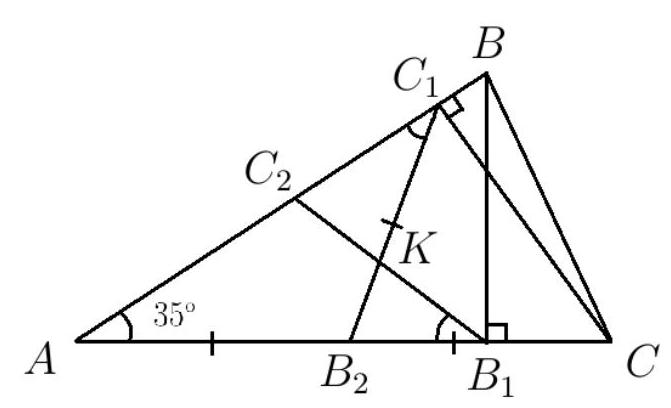
Solution. Note that angles $B$ and $C$ of triangle $ABC$ are greater than $\angle A=35^{\circ}$ (otherwise it would be an obtuse triangle), so point $C_{1}$ lies on side $AB$ be... | Problem: 5.1. (14 points) In an acute-angled triangle $A B C$, angle $A$ is equal to $35^{\circ}$, segments $B B_{1}$ and $C C_{1}$ are altitudes, points $B_{2}$ and $C_{2}$ are the midpoints of sides $A C$ and $A B$ respectively. Lines $B_{1} C_{2}$ and $C_{1} B_{2}$ intersect at point $K$. Find the measure (in degree... | Answer: 75.

Solution. Note that angles $B$ and $C$ of triangle $ABC$ are greater than $\angle A=35^{\circ}$ (otherwise it would be an obtuse triangle), so point $C_{1}$ lies on side $AB$ be... |
Example 10 (1998 National High School Mathematics League Question) Let the function $f(x)=a x^{2}+8 x+3(a<0)$. For a given negative number $a$, there is a largest positive number $L(a)$, such that the inequality $|f(x)| \leqslant 5$ holds for the entire interval $[0, L(a)]$. For what value of $a$ is $L(a)$ the largest?... | \frac{\sqrt{5}+1}{2} | openr1 | For a given negative number $a$, there is a function $L(a)>0$ related to $a$, such that $|f(x)| \leqslant 5$ holds for the entire interval $[0, L(a)]$.
Below, we use the idea of combining numbers and shapes to construct a new problem-solving context.
$$
f(x)=a x^{2}+8 x+3=a\left(x+\frac{4}{a}\right)^{2}+3-\frac{16}{a},... | Problem: Example 10 (1998 National High School Mathematics League Question) Let the function $f(x)=a x^{2}+8 x+3(a<0)$. For a given negative number $a$, there is a largest positive number $L(a)$, such that the inequality $|f(x)| \leqslant 5$ holds for the entire interval $[0, L(a)]$. For what value of $a$ is $L(a)$ the... | For a given negative number $a$, there is a function $L(a)>0$ related to $a$, such that $|f(x)| \leqslant 5$ holds for the entire interval $[0, L(a)]$.
Below, we use the idea of combining numbers and shapes to construct a new problem-solving context.
$$
f(x)=a x^{2}+8 x+3=a\left(x+\frac{4}{a}\right)^{2}+3-\frac{16}{a},... |
6.087. $\left\{\begin{array}{l}x^{4}-y^{4}=15 \\ x^{3} y-x y^{3}=6 .\end{array}\right.$ | (-2,-1),(2,1) | openr1 | ## Solution.
Let $t=\frac{y}{x}$, then $y=t x$ and the system becomes
$\left\{\begin{array}{l}x^{4}-t^{4} x^{4}=15, \\ x^{4} t-x^{4} t^{3}=6\end{array} \Leftrightarrow\left\{\begin{array}{l}x^{4}\left(1-t^{4}\right)=15, \\ x^{4}\left(t-t^{3}\right)=6 .\end{array}\right.\right.$
After dividing, we get $\frac{1-t^{4}}... | Problem: 6.087. $\left\{\begin{array}{l}x^{4}-y^{4}=15 \\ x^{3} y-x y^{3}=6 .\end{array}\right.$
Solution: | ## Solution.
Let $t=\frac{y}{x}$, then $y=t x$ and the system becomes
$\left\{\begin{array}{l}x^{4}-t^{4} x^{4}=15, \\ x^{4} t-x^{4} t^{3}=6\end{array} \Leftrightarrow\left\{\begin{array}{l}x^{4}\left(1-t^{4}\right)=15, \\ x^{4}\left(t-t^{3}\right)=6 .\end{array}\right.\right.$
After dividing, we get $\frac{1-t^{4}}... |
Let's determine those polynomials $f(x)$ for which there exists a polynomial $p(t)$ that satisfies the identity
$$
f\left(x^{2}\right)=p(f(x))
$$ | f(x)=a_{n}x^{n}+a_{0},\quad\text{where}\quadn\geq0 | openr1 | Let $f(x)=a_{n} x^{n}+a_{n-1} x^{n-1}+\cdots+a_{0}$ be an $n$-th degree polynomial. Then $p(f(x))=f\left(x^{2}\right)=a_{n} x^{2 n}+a_{n-1} x^{2 n-2}+\cdots+a_{0}$ has degree $2n$. If the degree of the polynomial $p(t)$ is $z$, then the degree of $p(f(x))$ is $z \cdot n$, from which $z \cdot n=2n$. For $n \geq 1$, divi... | Problem: Let's determine those polynomials $f(x)$ for which there exists a polynomial $p(t)$ that satisfies the identity
$$
f\left(x^{2}\right)=p(f(x))
$$
Solution: | Let $f(x)=a_{n} x^{n}+a_{n-1} x^{n-1}+\cdots+a_{0}$ be an $n$-th degree polynomial. Then $p(f(x))=f\left(x^{2}\right)=a_{n} x^{2 n}+a_{n-1} x^{2 n-2}+\cdots+a_{0}$ has degree $2n$. If the degree of the polynomial $p(t)$ is $z$, then the degree of $p(f(x))$ is $z \cdot n$, from which $z \cdot n=2n$. For $n \geq 1$, divi... |
In a bookstore, a book costs $5. When Sheryll bought 10 books, she was given a discount of $0.5 each. How much did Sheryll pay in all? | 45 | gsm8k | Instead of $5 each, a book costs $5 - $0.5 = $<<5-0.5=4.5>>4.5 each.
Sheryll paid $4.5/book x 10 books = $<<4.5*10=45>>45. | Problem: In a bookstore, a book costs $5. When Sheryll bought 10 books, she was given a discount of $0.5 each. How much did Sheryll pay in all?
Solution: | Instead of $5 each, a book costs $5 - $0.5 = $<<5-0.5=4.5>>4.5 each.
Sheryll paid $4.5/book x 10 books = $<<4.5*10=45>>45.
#### 45 |
12. (20 points) Let $a \in \mathbf{R}$, and for any real number $b$, we have $\max _{x \in[0,1]}\left|x^{2}+a x+b\right| \geqslant 1$. Find the range of values for $a$. | \geqslant1or\leqslant-3 | openr1 | 12. Let $f(x)=x^{2}+a x+b$. Then $|f(0)|=|b|$.
Below, we only need to consider $|b|f\left(-\frac{a}{2}\right)$.
Thus, $f(1)=1+a+b \geqslant 1 \Rightarrow a \geqslant 1$.
(2) When $-2 \leqslant a<0$, for $b=0$ we have
$$
\left.|f(1)|=|1+a|<1,|f|-\frac{a}{2}\right) \left.|=| \frac{-a^{2}}{4} \right\rvert\,<1 \text {. }
$... | Problem: 12. (20 points) Let $a \in \mathbf{R}$, and for any real number $b$, we have $\max _{x \in[0,1]}\left|x^{2}+a x+b\right| \geqslant 1$. Find the range of values for $a$.
Solution: | 12. Let $f(x)=x^{2}+a x+b$. Then $|f(0)|=|b|$.
Below, we only need to consider $|b|f\left(-\frac{a}{2}\right)$.
Thus, $f(1)=1+a+b \geqslant 1 \Rightarrow a \geqslant 1$.
(2) When $-2 \leqslant a<0$, for $b=0$ we have
$$
\left.|f(1)|=|1+a|<1,|f|-\frac{a}{2}\right) \left.|=| \frac{-a^{2}}{4} \right\rvert\,<1 \text {. }
$... |
1.45 If $y=x+\frac{1}{x}$, then $x^{4}+x^{3}-4 x^{2}+x+1=0$ becomes
(A) $x^{2}\left(y^{2}+y-2\right)=0$.
(B) $x^{2}\left(y^{2}+y-3\right)=0$.
(C) $x^{2}\left(y^{2}+y-4\right)=0$.
(D) $x^{2}\left(y^{2}+y-6\right)=0$.
(E) None of the above.
(4th American High School Mathematics Examination, 1953) | D | openr1 | [Solution] From the given and $x^{4}+x^{3}-4 x^{2}+x+1$
$$
\begin{array}{l}
=\left(x^{4}+1\right)+\left(x^{3}+x\right)-4 x^{2} \\
=x^{2}\left[\left(x^{2}+\frac{1}{x^{2}}\right)+\left(x+\frac{1}{x}\right)-4\right] \\
=x^{2}\left[\left(x+\frac{1}{x}\right)^{2}+\left(x+\frac{1}{x}\right)-6\right] \\
=x^{2}\left(y^{2}+y-6\... | Problem: 1.45 If $y=x+\frac{1}{x}$, then $x^{4}+x^{3}-4 x^{2}+x+1=0$ becomes
(A) $x^{2}\left(y^{2}+y-2\right)=0$.
(B) $x^{2}\left(y^{2}+y-3\right)=0$.
(C) $x^{2}\left(y^{2}+y-4\right)=0$.
(D) $x^{2}\left(y^{2}+y-6\right)=0$.
(E) None of the above.
(4th American High School Mathematics Examination, 1953)
Solution: | [Solution] From the given and $x^{4}+x^{3}-4 x^{2}+x+1$
$$
\begin{array}{l}
=\left(x^{4}+1\right)+\left(x^{3}+x\right)-4 x^{2} \\
=x^{2}\left[\left(x^{2}+\frac{1}{x^{2}}\right)+\left(x+\frac{1}{x}\right)-4\right] \\
=x^{2}\left[\left(x+\frac{1}{x}\right)^{2}+\left(x+\frac{1}{x}\right)-6\right] \\
=x^{2}\left(y^{2}+y-6\... |
2. (5 points) At the World Meteorologists Conference, each participant in turn announced the average monthly temperature in their hometown. At this moment, all the others recorded the product of the temperatures in their and the speaker's cities. In total, 92 positive and 40 negative numbers were recorded. What is the ... | 2 | openr1 | Answer: 2
Solution: When solving, we will not consider cities with a zero temperature, as no positive or negative numbers appear when interacting with them.
1) Let there be $x$ participants at the conference, each giving $x-1$ answers, so $x(x-1)=40+92$, which means $x=12$.
2) Let there be $y$ people with "positive t... | Problem: 2. (5 points) At the World Meteorologists Conference, each participant in turn announced the average monthly temperature in their hometown. At this moment, all the others recorded the product of the temperatures in their and the speaker's cities. In total, 92 positive and 40 negative numbers were recorded. Wha... | Answer: 2
Solution: When solving, we will not consider cities with a zero temperature, as no positive or negative numbers appear when interacting with them.
1) Let there be $x$ participants at the conference, each giving $x-1$ answers, so $x(x-1)=40+92$, which means $x=12$.
2) Let there be $y$ people with "positive t... |
Let's say a positive integer is simple if it has only the digits 1 or 2 (or both). How many numbers less than 1 million are simple? | 126 | openr1 | With 1 digit, we have the simple numbers 1 and 2; with 2 digits, we have the $2^{2}=4$ simple numbers 11, 12, 21, and 22; with 3 digits, we have the $2^{3}=8$ simple numbers 111, 112, 121, 122, 211, 212, 221, and 222. With 4 digits, we have $2^{4}=16$ simple numbers, with 5 digits, we have $2^{5}=32$ simple numbers, an... | Problem: Let's say a positive integer is simple if it has only the digits 1 or 2 (or both). How many numbers less than 1 million are simple?
Solution: | With 1 digit, we have the simple numbers 1 and 2; with 2 digits, we have the $2^{2}=4$ simple numbers 11, 12, 21, and 22; with 3 digits, we have the $2^{3}=8$ simple numbers 111, 112, 121, 122, 211, 212, 221, and 222. With 4 digits, we have $2^{4}=16$ simple numbers, with 5 digits, we have $2^{5}=32$ simple numbers, an... |
4. In rectangle $A B C D$, it is known that $A B=5, B C=9$, points $E, F, G, H$ are on sides $A B, B C, C D, D A$ respectively, such that $A E=C G=3, B F=D H=4, P$ is a point inside the rectangle. If the area of quadrilateral $A E P H$ is 15, then the area of quadrilateral $P F C G$ is $\qquad$ | 11 | openr1 | 4. 11.
As shown in Figure 3, let the distances from $P$ to $AB$ and $AD$ be $a$ and $b$, respectively. Then the distances from $P$ to $BC$ and $CD$ are $5-b$ and $9-a$, respectively. Given that $S_{\text {quadrilateral } AEPH}=\frac{1}{2}(3a+5b)=15$, we have
$$
\begin{array}{l}
S_{\text {quadrilateral PFCG }}=\frac{1}... | Problem: 4. In rectangle $A B C D$, it is known that $A B=5, B C=9$, points $E, F, G, H$ are on sides $A B, B C, C D, D A$ respectively, such that $A E=C G=3, B F=D H=4, P$ is a point inside the rectangle. If the area of quadrilateral $A E P H$ is 15, then the area of quadrilateral $P F C G$ is $\qquad$
Solution: | 4. 11.
As shown in Figure 3, let the distances from $P$ to $AB$ and $AD$ be $a$ and $b$, respectively. Then the distances from $P$ to $BC$ and $CD$ are $5-b$ and $9-a$, respectively. Given that $S_{\text {quadrilateral } AEPH}=\frac{1}{2}(3a+5b)=15$, we have
$$
\begin{array}{l}
S_{\text {quadrilateral PFCG }}=\frac{1}... |
A country used to have a tax rate of 20%. They raised it to 30%. In that same time frame, John went from making 1,000,000 a year to 1,500,000 a year. How much more does he pay in taxes now compared to then? | 250000 | gsm8k | At 20% he paid .2*1000000=$<<.2*1000000=200000>>200,000
Now he pays 1500000*.3=$<<1500000*.3=450000>>450,000
So he pays an extra 450000-200000=$<<450000-200000=250000>>250000 | Problem: A country used to have a tax rate of 20%. They raised it to 30%. In that same time frame, John went from making 1,000,000 a year to 1,500,000 a year. How much more does he pay in taxes now compared to then?
Solution: | At 20% he paid .2*1000000=$<<.2*1000000=200000>>200,000
Now he pays 1500000*.3=$<<1500000*.3=450000>>450,000
So he pays an extra 450000-200000=$<<450000-200000=250000>>250000
#### 250000 |
Brian goes fishing twice as often as Chris, but catches 2/5 times fewer fish than Chris per trip. If Brian caught 400 fish every time he went fishing, how many fish did they catch altogether if Chris went fishing 10 times? | 13600 | gsm8k | If Brian caught 400 fish in one trip, he caught 2*400=<<400*2=800>>800 fish in two trips.
Since Brian catches 2/5 times less fish than Chris per trip, Chris catches 2/5*400=<<2/5*400=160>>160 more fish in one fishing trip.
Chris's total number of fish in one trip is 400+160 = <<400+160=560>>560 fish.
In 10 trips, Chris... | Problem: Brian goes fishing twice as often as Chris, but catches 2/5 times fewer fish than Chris per trip. If Brian caught 400 fish every time he went fishing, how many fish did they catch altogether if Chris went fishing 10 times?
Solution: | If Brian caught 400 fish in one trip, he caught 2*400=<<400*2=800>>800 fish in two trips.
Since Brian catches 2/5 times less fish than Chris per trip, Chris catches 2/5*400=<<2/5*400=160>>160 more fish in one fishing trip.
Chris's total number of fish in one trip is 400+160 = <<400+160=560>>560 fish.
In 10 trips, Chris... |
1. At a melon stand, watermelons and melons are sold. The average weight of a watermelon is 12 kg, and the average weight of a melon is 6 kg. How many watermelons and how many melons are there at the stand, if their total number is 300, and the total weight is 2.4 tons? | x=100,y=200 | openr1 | Answer: watermelons - 100, melons - 200.
Let $x$ and $y$ represent the number of watermelons and melons, respectively, then we get $12x + 6y = 2400$ and $x + y = 300$, from which $x = 100$ and $y = 200$. | Problem: 1. At a melon stand, watermelons and melons are sold. The average weight of a watermelon is 12 kg, and the average weight of a melon is 6 kg. How many watermelons and how many melons are there at the stand, if their total number is 300, and the total weight is 2.4 tons?
Solution: | Answer: watermelons - 100, melons - 200.
Let $x$ and $y$ represent the number of watermelons and melons, respectively, then we get $12x + 6y = 2400$ and $x + y = 300$, from which $x = 100$ and $y = 200$.
#### x=100,y=200 |
2. Given the parabola $y=-x^{2}+m x-1$, points $A(3,0), B(0,3)$, find the range of $m$ when the parabola intersects the line segment $A B$ at two distinct points. | [3,\frac{10}{3}] | openr1 | 2. Solution Convert to the system of equations $\left\{\begin{array}{l}y=-x^{2}+m x-1 \\ x+y-3=0,(0 \leqslant x \leqslant 3)\end{array}\right.$ having two different solutions, which means $x^{2}-(m+1) x+4=0$ has two different solutions. Clearly, $x \neq 0$, and $m=x+\frac{4}{x}-1$. The function $f(x)=x+\frac{4}{x}-1$ i... | Problem: 2. Given the parabola $y=-x^{2}+m x-1$, points $A(3,0), B(0,3)$, find the range of $m$ when the parabola intersects the line segment $A B$ at two distinct points.
Solution: | 2. Solution Convert to the system of equations $\left\{\begin{array}{l}y=-x^{2}+m x-1 \\ x+y-3=0,(0 \leqslant x \leqslant 3)\end{array}\right.$ having two different solutions, which means $x^{2}-(m+1) x+4=0$ has two different solutions. Clearly, $x \neq 0$, and $m=x+\frac{4}{x}-1$. The function $f(x)=x+\frac{4}{x}-1$ i... |
10.215. In a right-angled triangle, the medians of the legs are $\sqrt{52}$ and $\sqrt{73}$. Find the hypotenuse of the triangle. | 10 | openr1 | ## Solution.
In $\triangle A B C$ (Fig. 10.25) $\angle A C B=90^{\circ}, B P$ and $A E$ are medians, $B P=\sqrt{52}$, $A E=\sqrt{73}$. Let $B C=x, A C=y$. Then $A B=\sqrt{x^{2}+y^{2}}$.
From $\triangle A C E\left(\angle A C E=90^{\circ}\right):$
$$
A C^{2}+C E^{2}=A E^{2} ; y^{2}+\frac{x^{2}}{4}=73
$$
From $\triang... | Problem: 10.215. In a right-angled triangle, the medians of the legs are $\sqrt{52}$ and $\sqrt{73}$. Find the hypotenuse of the triangle.
Solution: | ## Solution.
In $\triangle A B C$ (Fig. 10.25) $\angle A C B=90^{\circ}, B P$ and $A E$ are medians, $B P=\sqrt{52}$, $A E=\sqrt{73}$. Let $B C=x, A C=y$. Then $A B=\sqrt{x^{2}+y^{2}}$.
From $\triangle A C E\left(\angle A C E=90^{\circ}\right):$
$$
A C^{2}+C E^{2}=A E^{2} ; y^{2}+\frac{x^{2}}{4}=73
$$
From $\triang... |
3. [8] A semicircle with radius 2021 has diameter $A B$ and center $O$. Points $C$ and $D$ lie on the semicircle such that $\angle A O C<\angle A O D=90^{\circ}$. A circle of radius $r$ is inscribed in the sector bounded by $O A$ and $O C$ and is tangent to the semicircle at $E$. If $C D=C E$, compute $\lfloor r\rfloor... | 673 | openr1 | Answer: 673
Solution: We are given
$$
m \angle E O C=m \angle C O D
$$
and
$$
m \angle A O C+m \angle C O D=2 m \angle E O C+m \angle C O D=90^{\circ} .
$$
So $m \angle E O C=30^{\circ}$ and $m \angle A O C=60^{\circ}$. Letting the radius of the semicircle be $R$, we have
$$
(R-r) \sin \angle A O C=r \Rightarrow r=\f... | Problem: 3. [8] A semicircle with radius 2021 has diameter $A B$ and center $O$. Points $C$ and $D$ lie on the semicircle such that $\angle A O C<\angle A O D=90^{\circ}$. A circle of radius $r$ is inscribed in the sector bounded by $O A$ and $O C$ and is tangent to the semicircle at $E$. If $C D=C E$, compute $\lfloor... | Answer: 673
Solution: We are given
$$
m \angle E O C=m \angle C O D
$$
and
$$
m \angle A O C+m \angle C O D=2 m \angle E O C+m \angle C O D=90^{\circ} .
$$
So $m \angle E O C=30^{\circ}$ and $m \angle A O C=60^{\circ}$. Letting the radius of the semicircle be $R$, we have
$$
(R-r) \sin \angle A O C=r \Rightarrow r=\f... |
Task 2. By which smallest natural number should the number 63000 be multiplied so that the resulting product is a perfect square? | 70 | openr1 | Solution. We factorize the number 63000 into prime factors and get
$$
63000=2 \cdot 2 \cdot 2 \cdot 3 \cdot 3 \cdot 5 \cdot 5 \cdot 5 \cdot 7=2^{3} \cdot 3^{2} \cdot 5^{3} \cdot 7
$$
A number is a perfect square of a natural number if each number that appears in the factorization of the number into prime factors appe... | Problem: Task 2. By which smallest natural number should the number 63000 be multiplied so that the resulting product is a perfect square?
Solution: | Solution. We factorize the number 63000 into prime factors and get
$$
63000=2 \cdot 2 \cdot 2 \cdot 3 \cdot 3 \cdot 5 \cdot 5 \cdot 5 \cdot 7=2^{3} \cdot 3^{2} \cdot 5^{3} \cdot 7
$$
A number is a perfect square of a natural number if each number that appears in the factorization of the number into prime factors appe... |
Janeth bought 5 bags of round balloons with 20 balloons in each bag. She also bought 4 bags of long balloons with 30 balloons in each bag. While blowing up the balloons, 5 round balloons burst. How many balloons are left? | 215 | gsm8k | Janeth bought 5 x 20 = <<5*20=100>>100 round balloons.
She bought 4 x 30 = <<4*30=120>>120 long balloons.
So, she has a total of 100 + 120 = <<100+120=220>>220 balloons.
Since 5 round balloons burst, then there are only 220 - 5 = <<220-5=215>>215 balloons left. | Problem: Janeth bought 5 bags of round balloons with 20 balloons in each bag. She also bought 4 bags of long balloons with 30 balloons in each bag. While blowing up the balloons, 5 round balloons burst. How many balloons are left?
Solution: | Janeth bought 5 x 20 = <<5*20=100>>100 round balloons.
She bought 4 x 30 = <<4*30=120>>120 long balloons.
So, she has a total of 100 + 120 = <<100+120=220>>220 balloons.
Since 5 round balloons burst, then there are only 220 - 5 = <<220-5=215>>215 balloons left.
#### 215 |
The product of four different positive integers is 360 . What is the maximum possible sum of these four integers?
(A) 68
(B) 66
(C) 52
(D) 39
(E) 24 | 66 | openr1 | For the sum to be a maximum, we must choose the three smallest divisors in an effort to make the fourth divisor as large as possible.
The smallest 3 divisors of 360 are 1, 2 and 3, making $\frac{360}{1 \times 2 \times 3}=60$ the fourth divisor.
We note here that 1, 2 and 3 are the smallest three different divisors of... | Problem: The product of four different positive integers is 360 . What is the maximum possible sum of these four integers?
(A) 68
(B) 66
(C) 52
(D) 39
(E) 24
Solution: | For the sum to be a maximum, we must choose the three smallest divisors in an effort to make the fourth divisor as large as possible.
The smallest 3 divisors of 360 are 1, 2 and 3, making $\frac{360}{1 \times 2 \times 3}=60$ the fourth divisor.
We note here that 1, 2 and 3 are the smallest three different divisors of... |
2. A palindromic number is a positive integer which reads the same when its digits are reversed, for example 269 962. Find all six-digit palindromic numbers that are divisible by 45 . | 504405,513315,522225,531135,540045,549945,558855,567765,576675,585585,594495 | openr1 | SolUTION
Let $P$ represent such a six-digit number.
As $P$ is palindromic it must have the form ' $a b c c b a$ ', where $a, b$ and $c$ are single-digits and $a$ is non-zero (as $P$ must be a six-digit number).
As $P$ is divisible by 45 , it must also be divisible by 5 which means that $a=5$ and so $P$ can be written ... | Problem: 2. A palindromic number is a positive integer which reads the same when its digits are reversed, for example 269 962. Find all six-digit palindromic numbers that are divisible by 45 .
Solution: | SolUTION
Let $P$ represent such a six-digit number.
As $P$ is palindromic it must have the form ' $a b c c b a$ ', where $a, b$ and $c$ are single-digits and $a$ is non-zero (as $P$ must be a six-digit number).
As $P$ is divisible by 45 , it must also be divisible by 5 which means that $a=5$ and so $P$ can be written ... |
15.35 Given the binary operation “ * ” defined as $a * b=a^{b}$ (where $a$ and $b$ are any positive numbers), then for all positive numbers $a, b, c, n$, we have
(A) $a * b=b * a$.
(B) $a *(b * c)=(a * b) * c$.
(C) $\left(a * b^{n}\right)=(a * n) * b$.
(D) $(a * b)^{n}=a *(b n)$.
(E) None of the above.
(21st American H... | D | openr1 | [Solution] Given $a * b=a^{b}$, and $b * a=b^{a}$, generally speaking, $a^{b}$ is not equal to $b^{a}$, so (A) is not true.
Also, $(a * b) * c=a^{b} * c=\left(a^{b}\right)^{c}=a^{b c}$,
while $a *(b * c)=a * b^{c}=a^{b^{c}}$, for all positive numbers, they are not necessarily equal, so (B) is not true.
Given $a * b^{n... | Problem: 15.35 Given the binary operation “ * ” defined as $a * b=a^{b}$ (where $a$ and $b$ are any positive numbers), then for all positive numbers $a, b, c, n$, we have
(A) $a * b=b * a$.
(B) $a *(b * c)=(a * b) * c$.
(C) $\left(a * b^{n}\right)=(a * n) * b$.
(D) $(a * b)^{n}=a *(b n)$.
(E) None of the above.
(21st A... | [Solution] Given $a * b=a^{b}$, and $b * a=b^{a}$, generally speaking, $a^{b}$ is not equal to $b^{a}$, so (A) is not true.
Also, $(a * b) * c=a^{b} * c=\left(a^{b}\right)^{c}=a^{b c}$,
while $a *(b * c)=a * b^{c}=a^{b^{c}}$, for all positive numbers, they are not necessarily equal, so (B) is not true.
Given $a * b^{n... |
Example 9 Let $a, b, c$ be positive integers, and the quadratic equation $a x^{2}+b x+c=0$ has two real roots whose absolute values are both less than $\frac{1}{3}$. Find the minimum value of $a+b+c$.
(2005, National High School Mathematics League, Fujian Province Preliminary | 25 | openr1 | Let the two real roots of the equation be $x_{1}$ and $x_{2}$. By Vieta's formulas, we know $x_{1}x_{2} = \frac{c}{a} = 9$. Therefore,
\[ b^{2} \geqslant 4ac = 4 \times \frac{a}{c} \times c^{2} > 4 \times 9 \times 1^{2} = 36. \]
Thus, $b \geqslant 7$.
Also, $\frac{b}{a} = (-x_{1}) + (-x_{2}) \Rightarrow \frac{3}{2} b \... | Problem: Example 9 Let $a, b, c$ be positive integers, and the quadratic equation $a x^{2}+b x+c=0$ has two real roots whose absolute values are both less than $\frac{1}{3}$. Find the minimum value of $a+b+c$.
(2005, National High School Mathematics League, Fujian Province Preliminary
Solution: | Let the two real roots of the equation be $x_{1}$ and $x_{2}$. By Vieta's formulas, we know $x_{1}x_{2} = \frac{c}{a} = 9$. Therefore,
\[ b^{2} \geqslant 4ac = 4 \times \frac{a}{c} \times c^{2} > 4 \times 9 \times 1^{2} = 36. \]
Thus, $b \geqslant 7$.
Also, $\frac{b}{a} = (-x_{1}) + (-x_{2}) \Rightarrow \frac{3}{2} b \... |
Santana has 7 brothers. 3 of them have birthdays in March, 1 of them has a birthday in October, 1 has a birthday in November, and another 2 of them were born in December. If Santana always buys each of her brothers a birthday present and a Christmas present, how many more presents does she have to buy in the second hal... | 8 | gsm8k | Santana has 1 + 1 + 2 = <<1+1+2=4>>4 brothers with birthdays in the second half of the year.
She has 7 brothers - 4 brothers = <<7-4=3>>3 brothers with birthdays in the first half of the year.
Altogether, she has to buy 4 + 7 = <<4+7=11>>11 presents in the second half of the year.
Therefore, she has to buy 11 - 3 = <<1... | Problem: Santana has 7 brothers. 3 of them have birthdays in March, 1 of them has a birthday in October, 1 has a birthday in November, and another 2 of them were born in December. If Santana always buys each of her brothers a birthday present and a Christmas present, how many more presents does she have to buy in the s... | Santana has 1 + 1 + 2 = <<1+1+2=4>>4 brothers with birthdays in the second half of the year.
She has 7 brothers - 4 brothers = <<7-4=3>>3 brothers with birthdays in the first half of the year.
Altogether, she has to buy 4 + 7 = <<4+7=11>>11 presents in the second half of the year.
Therefore, she has to buy 11 - 3 = <<1... |
Mary and her two friends agreed to evenly pay for the cost of 2 pounds of chicken. Mary's mother went to the grocery and bought the 2-pound chicken, 3 pounds of beef that cost $4 per pound, and a liter of oil that costs $1. If Mary's mother paid a total of $16 for the grocery, how much should Mary and her two friends p... | 1 | gsm8k | Three pounds of beef cost $4 x 3 = $<<4*3=12>>12.
Mary's mother paid $12 + $1 = $<<12+1=13>>13 for the beef and oil.
Hence, the 2-pound chicken cost $16 - $13 = $<<16-13=3>>3.
There are 1 (Mary) + 2 friends = <<1+2=3>>3 people who will split the $3 cost.
Therefore, each of them will pay $3/3 = $<<3/3=1>>1. | Problem: Mary and her two friends agreed to evenly pay for the cost of 2 pounds of chicken. Mary's mother went to the grocery and bought the 2-pound chicken, 3 pounds of beef that cost $4 per pound, and a liter of oil that costs $1. If Mary's mother paid a total of $16 for the grocery, how much should Mary and her two ... | Three pounds of beef cost $4 x 3 = $<<4*3=12>>12.
Mary's mother paid $12 + $1 = $<<12+1=13>>13 for the beef and oil.
Hence, the 2-pound chicken cost $16 - $13 = $<<16-13=3>>3.
There are 1 (Mary) + 2 friends = <<1+2=3>>3 people who will split the $3 cost.
Therefore, each of them will pay $3/3 = $<<3/3=1>>1.
#### 1 |
Given the equilateral triangle $ABC$. It is known that the radius of the inscribed circle is in this triangle is equal to $1$. The rectangle $ABDE$ is such that point $C$ belongs to its side $DE$. Find the radius of the circle circumscribed around the rectangle $ABDE$. | \frac{\sqrt{21}}{2} | openr1 | 1. **Determine the side length of the equilateral triangle \(ABC\):**
- Given that the radius of the inscribed circle (inradius) of the equilateral triangle \(ABC\) is 1.
- The formula for the inradius \(r\) of an equilateral triangle with side length \(a\) is:
\[
r = \frac{a \sqrt{3}}{6}
\]
- G... | Problem: Given the equilateral triangle $ABC$. It is known that the radius of the inscribed circle is in this triangle is equal to $1$. The rectangle $ABDE$ is such that point $C$ belongs to its side $DE$. Find the radius of the circle circumscribed around the rectangle $ABDE$.
Solution: | 1. **Determine the side length of the equilateral triangle \(ABC\):**
- Given that the radius of the inscribed circle (inradius) of the equilateral triangle \(ABC\) is 1.
- The formula for the inradius \(r\) of an equilateral triangle with side length \(a\) is:
\[
r = \frac{a \sqrt{3}}{6}
\]
- G... |
1. Find all natural numbers such that if you add their smallest divisor greater than one to them, the result is 30. | 25,27,28 | openr1 | Answer: $25 ; 27 ; 28$.
Solution. The smallest divisor greater than one is a prime number. If each of the addends is divisible by it, then the sum is also divisible. The number 30 has three prime factors: $2,3,5$. Possible options for the desired numbers: $30-2=28,30-3=27,30-5=25$. Checking shows that all these number... | Problem: 1. Find all natural numbers such that if you add their smallest divisor greater than one to them, the result is 30.
Solution: | Answer: $25 ; 27 ; 28$.
Solution. The smallest divisor greater than one is a prime number. If each of the addends is divisible by it, then the sum is also divisible. The number 30 has three prime factors: $2,3,5$. Possible options for the desired numbers: $30-2=28,30-3=27,30-5=25$. Checking shows that all these number... |
In the quadrilateral $A B C D$ given in the figure, we have $A B=5, B C=17$, $C D=5$ and $D A=9$. Determine $D B$, knowing that its measure is an integer.
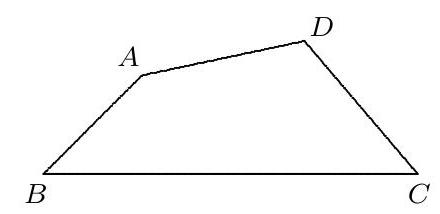 | 13 | openr1 | Remember that any side of a triangle is greater than the difference and less than the sum of the other two sides. In triangle $A D B$, we have $A D - A B < B D < A D + A B$ and in triangle $C B D$, we have $B C - C D < B D < B C + C D$.

Solution: | Remember that any side of a triangle is greater than the difference and less than the sum of the other two sides. In triangle $A D B$, we have $A D - A B < B D < A D + A B$ and in triangle $C B D$, we have $B C - C D < B D < B C + C D$.
$ and $(8,6)$ as the endpoints of a diameter intersects the $x$-axis at a second point. What is the $x$-coordinate of this point?
$\textbf{(A) } 4\sqrt{2} \qquad\textbf{(B) } 6 \qquad\textbf{(C) } 5\sqrt{2} \qquad\textbf{(D) } 8 \qquad\textbf{(E) } 6\sqrt{2}$ | 8 | openr1 | Because the two points are on a diameter, the center must be halfway between them at the point (4,3). The distance from (0,0) to (4,3) is 5 so the circle has radius 5. Thus, the equation of the circle is $(x-4)^2+(y-3)^2=25$.
To find the x-intercept, y must be 0, so $(x-4)^2+(0-3)^2=25$, so $(x-4)^2=16$, $x-4=4$, $x=8... | Problem: The circle having $(0,0)$ and $(8,6)$ as the endpoints of a diameter intersects the $x$-axis at a second point. What is the $x$-coordinate of this point?
$\textbf{(A) } 4\sqrt{2} \qquad\textbf{(B) } 6 \qquad\textbf{(C) } 5\sqrt{2} \qquad\textbf{(D) } 8 \qquad\textbf{(E) } 6\sqrt{2}$
Solution: | Because the two points are on a diameter, the center must be halfway between them at the point (4,3). The distance from (0,0) to (4,3) is 5 so the circle has radius 5. Thus, the equation of the circle is $(x-4)^2+(y-3)^2=25$.
To find the x-intercept, y must be 0, so $(x-4)^2+(0-3)^2=25$, so $(x-4)^2=16$, $x-4=4$, $x=8... |
Solve the equation $[x] \cdot \{x\} = 1991x$. (Here $[x]$ denotes the greatest integer less than or equal to $x$, and $\{x\}=x-[x]$.) | 0 \text{ or } -\frac{1}{1992} | openr1 | Given the equation \([x] \cdot \{x\} = 1991x\), where \([x]\) denotes the greatest integer less than or equal to \(x\), and \(\{x\} = x - [x]\).
1. Let \(a = \lfloor x \rfloor\) and \(b = \{x\}\). Then, we can rewrite the equation as:
\[
a \cdot b = 1991(a + b)
\]
2. Rearrange the equation to isolate terms i... | Problem: Solve the equation $[x] \cdot \{x\} = 1991x$. (Here $[x]$ denotes the greatest integer less than or equal to $x$, and $\{x\}=x-[x]$.)
Solution: | Given the equation \([x] \cdot \{x\} = 1991x\), where \([x]\) denotes the greatest integer less than or equal to \(x\), and \(\{x\} = x - [x]\).
1. Let \(a = \lfloor x \rfloor\) and \(b = \{x\}\). Then, we can rewrite the equation as:
\[
a \cdot b = 1991(a + b)
\]
2. Rearrange the equation to isolate terms i... |
Task 2.
In a table consisting of $n$ rows and $m$ columns, numbers (not necessarily integers) were written such that the sum of the elements in each row is 408, and the sum of the elements in each column is 340. After that, $k$ columns were added to the table, the sum of the elements in each of which is 476, and a col... | 4 | openr1 | Answer: 4 when $n=65, m=78, k=18$. | Problem: Task 2.
In a table consisting of $n$ rows and $m$ columns, numbers (not necessarily integers) were written such that the sum of the elements in each row is 408, and the sum of the elements in each column is 340. After that, $k$ columns were added to the table, the sum of the elements in each of which is 476, ... | Answer: 4 when $n=65, m=78, k=18$.
#### 4 |
Find all functions $f\colon \mathbb{R}\to\mathbb{R}$ that satisfy $f(x+y)-f(x-y)=2y(3x^2+y^2)$ for all $x,y{\in}R$
______________________________________
Azerbaijan Land of the Fire :lol: | f(x) = x^3 + a | openr1 | 1. Let \( P(x, y) \) be the assertion \( f(x+y) - f(x-y) = 2y(3x^2 + y^2) \).
2. First, we test the function \( f(x) = x^3 + a \) to see if it satisfies the given functional equation. Assume \( f(x) = x^3 + a \).
3. Substitute \( f(x) = x^3 + a \) into the functional equation:
\[
f(x+y) = (x+y)^3 + a
\]
\... | Problem: Find all functions $f\colon \mathbb{R}\to\mathbb{R}$ that satisfy $f(x+y)-f(x-y)=2y(3x^2+y^2)$ for all $x,y{\in}R$
______________________________________
Azerbaijan Land of the Fire :lol:
Solution: | 1. Let \( P(x, y) \) be the assertion \( f(x+y) - f(x-y) = 2y(3x^2 + y^2) \).
2. First, we test the function \( f(x) = x^3 + a \) to see if it satisfies the given functional equation. Assume \( f(x) = x^3 + a \).
3. Substitute \( f(x) = x^3 + a \) into the functional equation:
\[
f(x+y) = (x+y)^3 + a
\]
\... |
# 3. Option 1.
In a box, there are chips. Tolya and Kolya were asked how many chips are in the box. Tolya answered: “Less than 7”, and Kolya answered: “Less than 5”. How many chips can be in the box if it is known that one of the answers is correct? Find all the options. In the answer, write their sum. | 11 | openr1 | Answer: 11.
Solution: If there are 7 or more chips in the box, then both boys are lying. If there are 4 or fewer chips in the box, then both boys are telling the truth. If there are 5 or 6 chips in the box, then Tolya is telling the truth, and Kolya is lying. | Problem: # 3. Option 1.
In a box, there are chips. Tolya and Kolya were asked how many chips are in the box. Tolya answered: “Less than 7”, and Kolya answered: “Less than 5”. How many chips can be in the box if it is known that one of the answers is correct? Find all the options. In the answer, write their sum.
Soluti... | Answer: 11.
Solution: If there are 7 or more chips in the box, then both boys are lying. If there are 4 or fewer chips in the box, then both boys are telling the truth. If there are 5 or 6 chips in the box, then Tolya is telling the truth, and Kolya is lying.
#### 11 |
## Task B-4.3.
Determine $f^{2018}(2018)$ if for the function $f: \mathbb{R} \rightarrow \mathbb{R}$ it holds that
$$
(x-1) f(x)+f\left(\frac{1}{x}\right)=\frac{1}{x-1}
$$
Note: $f^{2018}(x)=(\underbrace{f \circ f \circ \ldots \circ f}_{2018})(x)$. | \frac{2017}{2018} | openr1 | ## Solution.
By substituting $x=t$ and $x=\frac{1}{t}$ into the given functional equation, we obtain the system:
$$
\begin{aligned}
(t-1) f(t)+f\left(\frac{1}{t}\right) & =\frac{1}{t-1} \\
f(t)+\left(\frac{1}{t}-1\right) f\left(\frac{1}{t}\right) & =\frac{1}{\frac{1}{t}-1}=\frac{t}{1-t}
\end{aligned}
$$
Multiplying ... | Problem: ## Task B-4.3.
Determine $f^{2018}(2018)$ if for the function $f: \mathbb{R} \rightarrow \mathbb{R}$ it holds that
$$
(x-1) f(x)+f\left(\frac{1}{x}\right)=\frac{1}{x-1}
$$
Note: $f^{2018}(x)=(\underbrace{f \circ f \circ \ldots \circ f}_{2018})(x)$.
Solution: | ## Solution.
By substituting $x=t$ and $x=\frac{1}{t}$ into the given functional equation, we obtain the system:
$$
\begin{aligned}
(t-1) f(t)+f\left(\frac{1}{t}\right) & =\frac{1}{t-1} \\
f(t)+\left(\frac{1}{t}-1\right) f\left(\frac{1}{t}\right) & =\frac{1}{\frac{1}{t}-1}=\frac{t}{1-t}
\end{aligned}
$$
Multiplying ... |
Problem 1. Given an integer $n \geq 3$, determine the smallest positive number $k$ such that any two points in any $n$-gon (or at its boundary) in the plane can be connected by a polygonal path consisting of $k$ line segments contained in the $n$-gon (including its boundary).
(David Hruška) | \lfloor\frac{n}{2}\rfloor | openr1 | Solution. The following example shows that at least $m$ segments are needed for any $2 m$-gon, $m \geq 2$ :

FiguRE 1. Example for $m=5$
Indeed, a polygonal path connecting the marked verti... | Problem: Problem 1. Given an integer $n \geq 3$, determine the smallest positive number $k$ such that any two points in any $n$-gon (or at its boundary) in the plane can be connected by a polygonal path consisting of $k$ line segments contained in the $n$-gon (including its boundary).
(David Hruška)
Solution: | Solution. The following example shows that at least $m$ segments are needed for any $2 m$-gon, $m \geq 2$ :

FiguRE 1. Example for $m=5$
Indeed, a polygonal path connecting the marked verti... |
End of preview. Expand in Data Studio
README.md exists but content is empty.
- Downloads last month
- 16