

PyTorchFire: A GPU-Accelerated Wildfire Simulator with Differentiable Cellular Automata
Paper • 2502.18738 • Published
name stringclasses 6
values | canopy listlengths 410k 1.06M | density listlengths 410k 1.06M | slope listlengths 410k 1.06M | shape list |
|---|---|---|---|---|
Bear_2020 | [45,45,45,45,45,55,65,65,45,0,0,45,45,45,35,45,35,35,55,55,65,55,55,45,45,75,65,65,65,65,65,65,55,55(...TRUNCATED) | [0.07999999821186066,0.07999999821186066,0.07999999821186066,0.07999999821186066,0.07999999821186066(...TRUNCATED) | [14,11,10,11,11,11,10,9,10,7,5,4,3,3,3,6,13,14,11,9,7,5,4,7,5,12,17,16,7,0,1,4,1,4,8,12,11,14,13,12,(...TRUNCATED) | [
805,
749
] |
Brattain_2020 | [0,0,0,0,0,0,0,0,0,0,0,0,0,0,0,0,0,0,0,0,0,0,0,0,0,0,0,0,0,0,0,0,0,0,0,0,0,0,0,0,0,0,0,0,0,0,0,0,0,0(...TRUNCATED) | [0.0,0.0,0.0,0.0,0.0,0.0,0.0,0.0,0.0,0.0,0.0,0.0,0.0,0.0,0.0,0.0,0.0,0.0,0.0,0.0,0.0,0.0,0.0,0.0,0.0(...TRUNCATED) | [0,0,0,0,0,0,0,0,0,0,0,0,0,0,0,0,0,0,0,0,0,0,0,0,0,0,0,0,0,0,0,0,0,0,0,0,0,0,0,0,0,0,0,0,0,0,0,0,0,0(...TRUNCATED) | [
1129,
939
] |
Buck_2017 | [0,0,0,0,45,0,0,0,0,0,0,0,0,0,0,45,55,55,65,65,65,55,55,55,45,65,0,65,0,0,0,55,55,55,45,45,55,55,65,(...TRUNCATED) | [0.0,0.0,0.0,0.0,0.07999999821186066,0.0,0.0,0.0,0.0,0.0,0.0,0.0,0.0,0.0,0.0,0.07999999821186066,0.1(...TRUNCATED) | [14,13,10,7,13,16,15,15,15,13,23,21,20,24,21,20,20,19,19,19,20,21,25,22,16,25,19,14,14,10,9,10,24,30(...TRUNCATED) | [
648,
633
] |
Chimney_2016 | [0,0,0,0,0,0,35,35,45,45,35,35,45,45,0,0,0,45,0,25,0,0,35,0,0,0,0,35,0,0,35,0,35,25,0,0,0,0,0,0,0,0,(...TRUNCATED) | [0.0,0.0,0.0,0.0,0.0,0.0,0.05999999865889549,0.05999999865889549,0.07999999821186066,0.0799999982118(...TRUNCATED) | [3,5,13,8,11,9,10,12,9,9,9,9,10,11,9,8,7,9,8,7,5,5,5,12,19,14,13,2,12,15,15,10,6,11,16,14,9,11,11,8,(...TRUNCATED) | [
899,
982
] |
Ferguson_2018 | [55,55,55,55,55,45,65,55,55,55,55,55,55,55,55,55,55,55,55,55,55,55,55,55,0,45,45,55,55,35,35,0,35,35(...TRUNCATED) | [0.08999999612569809,0.08999999612569809,0.08999999612569809,0.08999999612569809,0.08999999612569809(...TRUNCATED) | [18,15,9,15,22,26,29,28,28,32,30,28,26,27,23,18,22,27,24,23,25,21,17,19,19,2,8,11,20,22,22,16,9,17,1(...TRUNCATED) | [
971,
913
] |
Pier_2017 | [0,0,15,0,15,15,25,25,25,35,25,25,25,25,25,25,25,25,25,25,25,25,25,35,25,25,25,25,25,25,25,25,15,25,(...TRUNCATED) | [0.0,0.0,0.04999999701976776,0.0,0.04999999701976776,0.029999999329447746,0.009999999776482582,0.059(...TRUNCATED) | [31,33,35,33,31,29,28,27,22,18,19,18,19,18,17,16,16,14,14,12,11,10,9,7,5,6,7,8,6,7,7,6,5,6,7,6,6,4,4(...TRUNCATED) | [
838,
882
] |
This is a dataset containing real-world map data for wildfire simulations. The data is in the form of 2D maps with the following features:
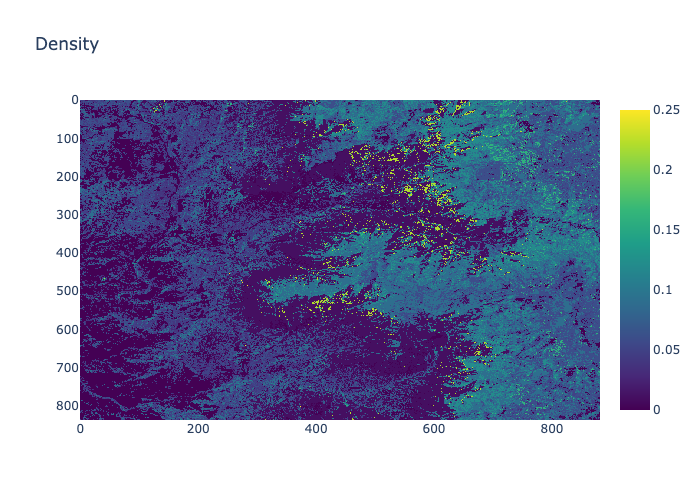
name: The name of the map data.shape: The shape of the area, in pixels.canopy: The canopy cover in the area, in percentage.density: The density of the area, in percentage.slope: The slope of the area, in degrees.Install the package using pip:
pip install datasets
Then you can use the dataset as follows with NumPy:
import numpy as np
from datasets import load_dataset

# Load the dataset
ds = load_dataset("xiazeyu/WildfireSimMaps", split="train")
ds = ds.with_format("numpy")

def preprocess_function(examples):
    # Reshape arrays based on the 'shape' field
    examples['density'] = [d.reshape(sh) for d, sh in zip(examples['density'], examples['shape'])]
    examples['slope'] = [s.reshape(sh) for s, sh in zip(examples['slope'], examples['shape'])]
    examples['canopy'] = [c.reshape(sh) for c, sh in zip(examples['canopy'], examples['shape'])]

    return examples

ds = ds.map(preprocess_function, batched=True, batch_size=None)  # Adjust batch_size as needed

print(ds[0])
To use the dataset with PyTorch, you can use the following code:
import torch
from datasets import load_dataset

device = torch.device("cuda" if torch.cuda.is_available() else "cpu")

# Load the dataset
ds = load_dataset("xiazeyu/WildfireSimMaps", split="train")
ds = ds.with_format("torch", device=device)

def preprocess_function(examples):
    # Reshape arrays based on the 'shape' field
    examples['density'] = [d.reshape(sh.tolist()) for d, sh in zip(examples['density'], examples['shape'])]
    examples['slope'] = [s.reshape(sh.tolist()) for s, sh in zip(examples['slope'], examples['shape'])]
    examples['canopy'] = [c.reshape(sh.tolist()) for c, sh in zip(examples['canopy'], examples['shape'])]

    return examples

ds = ds.map(preprocess_function, batched=True, batch_size=None)  # Adjust batch_size as needed

print(ds[0])
In order to make practical use of this dataset, you may perform the following tasks:
In general, you can use the dataset as you would use any other dataset in your pipeline.
And the most important thing is to have fun and learn from the data!
Density
Canopy

Slope

This dataset accompanies PyTorchFire (paper · arXiv:2502.18738 · code). If you use it, please cite:
@article{xia2025pytorchfire,
  title   = {PyTorchFire: A GPU-accelerated wildfire simulator with Differentiable Cellular Automata},
  author  = {Xia, Zeyu and Cheng, Sibo},
  journal = {Environmental Modelling \& Software},
  volume  = {188},
  pages   = {106401},
  year    = {2025},
  doi     = {10.1016/j.envsoft.2025.106401}
}
The dataset is licensed under the CC BY-NC 4.0 License.