
Datasets:

license: cc-by-4.0
language:
  - en
pretty_name: Grid-Bench
size_categories:
  - 1K<n<10K
task_categories:
  - text-generation
tags:
  - arxiv:2610.22312
  - benchmark
  - llm-evaluation
  - spatial-reasoning
  - state-prediction
  - executable-benchmark
  - synthetic-data
configs:
  - config_name: benchmark
    default: true
    data_files:
      - split: test
        path: data/benchmark.parquet
  - config_name: results
    data_files:
      - split: test
        path: data/results.parquet




Grid-Bench: Can LLMs Predict How Discrete Worlds Change?
Grid-Bench evaluates complete spatial state prediction. Each instance gives a language model an initial grid, explicit transition rules, and an ordered event history as text. The model predicts the complete final grid. Executable rules provide exact reference states, allowing both complete answers and individual cell values to be checked.
Use the companion code repository to simulate, generate, and score tasks, and explore the project website for interactive examples. Maintainer: Zixiang Xu (xzx34). Original data and documentation are licensed under CC BY 4.0. Collected model answers are not distributed; see licensing and release scope.
Quick start
from datasets import load_dataset

benchmark = load_dataset("xzx34/Grid-Bench", "benchmark", split="test")
results = load_dataset("xzx34/Grid-Bench", "results", split="test")
print(benchmark[0]["prompt"])
Send each prompt to your model, then score the responses with the
grid-bench evaluate
command. Load the dataset covers offline downloads and the
evaluator.
Leaderboard
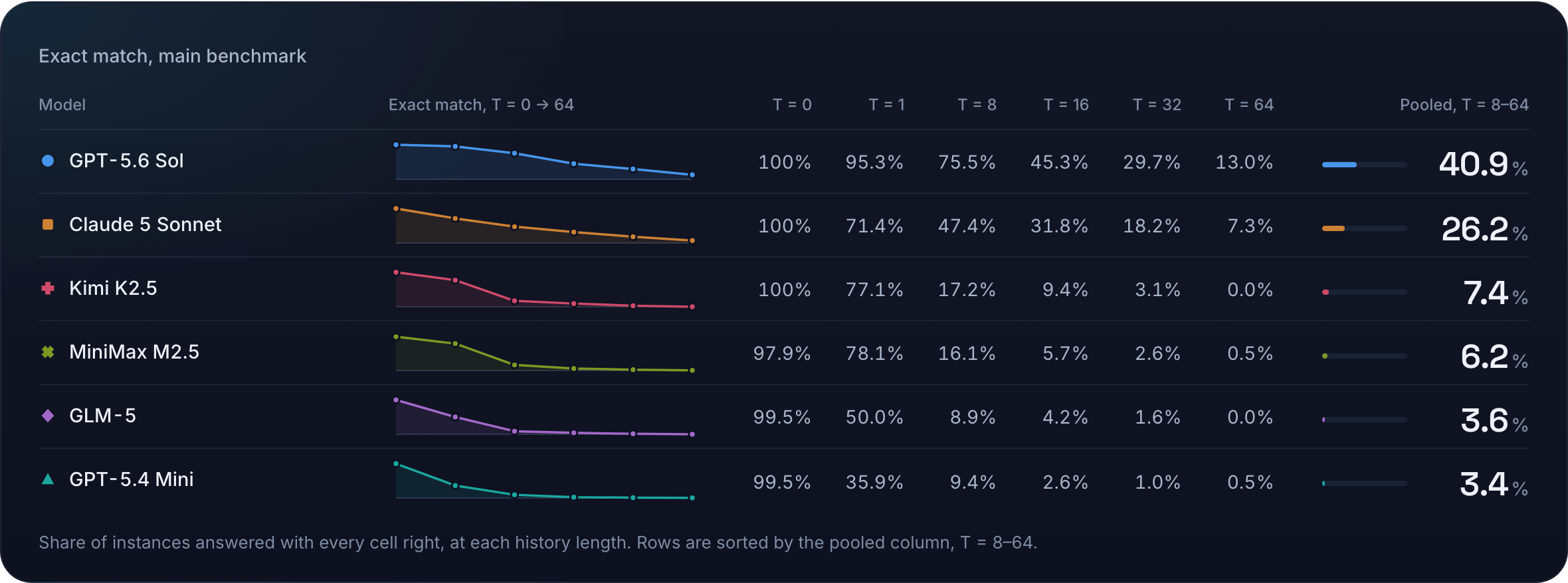
Exact match on the main view, aggregated from the results configuration.
Six models answer the same prompts, once each and without tools; a grid counts
only if every cell is right. T is the number of events in the history. Empty,
invalid, and length-terminated outputs count as wrong.
Leaderboard as a table
| Model | T = 0 | T = 1 | T = 8 | T = 16 | T = 32 | T = 64 | Pooled, T = 8–64 |
|---|---|---|---|---|---|---|---|
| GPT-5.6 Sol | 100% | 95.3% | 75.5% | 45.3% | 29.7% | 13.0% | 40.9% |
| Claude 5 Sonnet | 100% | 71.4% | 47.4% | 31.8% | 18.2% | 7.3% | 26.2% |
| Kimi K2.5 | 100% | 77.1% | 17.2% | 9.4% | 3.1% | 0.0% | 7.4% |
| MiniMax M2.5 | 97.9% | 78.1% | 16.1% | 5.7% | 2.6% | 0.5% | 6.2% |
| GLM-5 | 99.5% | 50.0% | 8.9% | 4.2% | 1.6% | 0.0% | 3.6% |
| GPT-5.4 Mini | 99.5% | 35.9% | 9.4% | 2.6% | 1.0% | 0.5% | 3.4% |
Contents
| Configuration | Split | Rows | Unit |
|---|---|---|---|
benchmark (default) |
test |
1,488 | A unique prefix instance |
results |
test |
8,928 | Recorded measurements for one model and instance |
Each configuration has equivalent Parquet and JSONL files. There are no training or validation splits. Instances cover PAINT, REFLECT, STENCIL, MIX, RELABEL, LAYER, MOVE, and COMPRESS on two-, three-, and four-dimensional grids. The histories have 0, 1, 8, 16, 32, or 64 events. Each history uses one operation family and may include SET assignments.
The six evaluated models, in fixed display order, are GPT-5.6 Sol, Claude 5 Sonnet, GPT-5.4 Mini, GLM-5, Kimi K2.5, and MiniMax M2.5. All six answer the same benchmark instances. Result rows describe evaluations of these questions, not additional benchmark questions. They contain measurements, not model answers.
The task
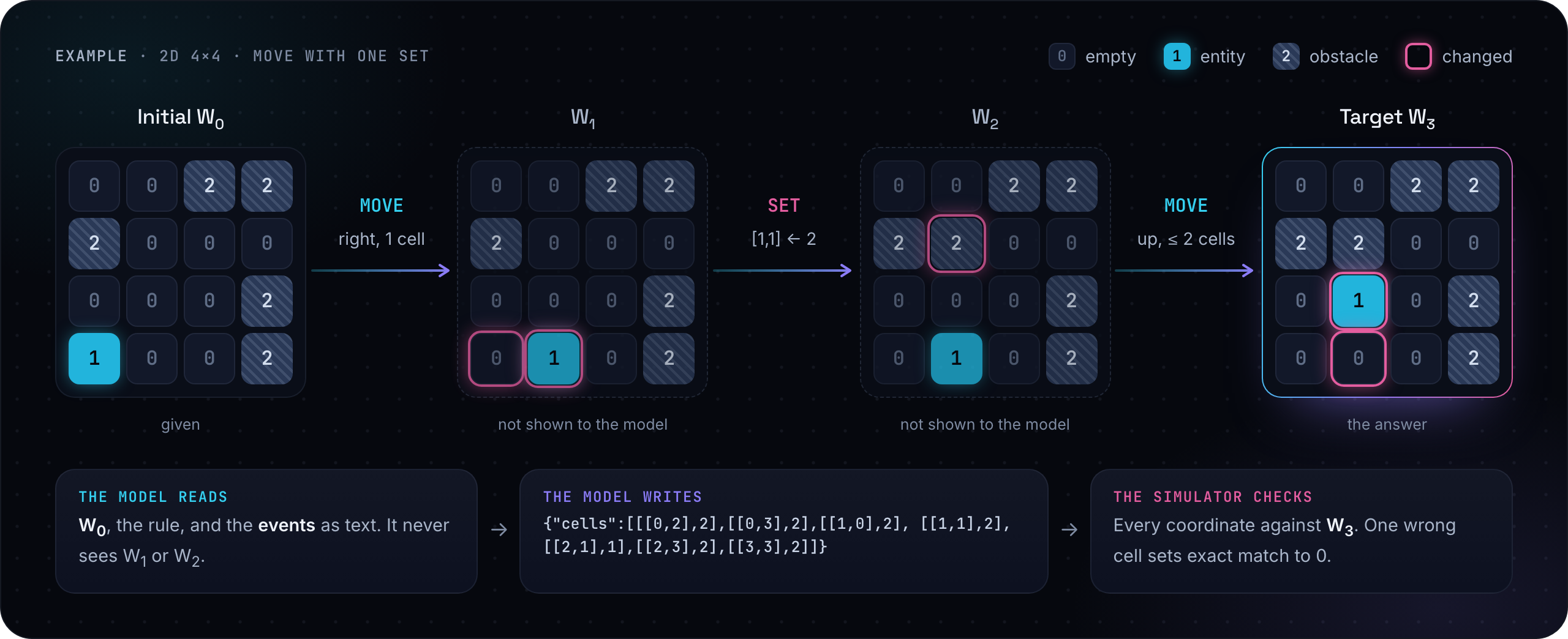
The figure follows the paper's Figure 1 example; it is not a test instance. An
entity 1 moves right one cell, a SET event places an obstacle 2 at [1,1],
and the entity then moves up until that obstacle stops it. The complete answer is:
{"cells": [[[0, 2], 2], [[0, 3], 2], [[1, 0], 2], [[1, 1], 2], [[2, 1], 1], [[2, 3], 2], [[3, 3], 2]]}
Coordinates and axes are zero-based. Unlisted cells have value zero. The canonical output contains every nonzero cell exactly once in lexicographic coordinate order. The supplied prompt explains the applicable rule and includes a worked example.
Load the dataset
For offline evaluation and summary reproduction, download the full package.
Install huggingface_hub with python -m pip install huggingface_hub, then run:
from huggingface_hub import snapshot_download

snapshot_download(
    repo_id="xzx34/Grid-Bench",
    repo_type="dataset",
    local_dir="Grid-Bench-data",
)
This includes the manifest and supplementary evidence needed by the reproduction script. A downloaded directory can also replace the repository ID in the loading example.
The companion Python package uses grid_bench; its command is grid-bench.
After installing the code repository, evaluate your own response file directly:
grid-bench evaluate --data /absolute/path/to/Grid-Bench-data \
  --predictions responses.jsonl --view main --out results
Each response record contains public_id and the delivered response string.
The default main view contains 1,152 instances; use workload for the 528-instance
workload view or all for all 1,488 instances. Missing responses stay in the
selected denominator. Duplicate and unknown IDs are rejected. See the
code evaluation guide.
Alternatively, stream data/benchmark.jsonl or data/results.jsonl using
Python's json module. JSON-string fields can be decoded with json.loads.
The Parquet export preserves the same field values, including nulls.
Benchmark fields
The machine-readable types are in schema.json.
| Fields | Meaning |
|---|---|
public_id |
Unique release ID: source_dataset:instance_id |
public_trajectory_id |
Unique trajectory ID: source_dataset:rollout_id |
source_dataset, instance_id, rollout_id |
Original source identity and native IDs |
cohort |
original or expansion; the two disjoint trajectory cohorts |
family, dimension, shape, history_length, workload |
Operation and condition metadata |
in_main, in_workload |
Membership in two overlapping analysis views |
instance_json |
Complete native instance, including initial state and events |
reference_json |
Complete native gold record, including the final state and reference workloads |
source_metadata_json |
Original instance metadata |
prompt |
Exact formal model-visible text |
prompt_version, source_prompt_version |
Formal rendered-prompt identity and original metadata identity |
schema_version, generator_version |
Native version identities |
instance_sha256, gold_sha256, prompt_sha256 |
Frozen content identities, verified during export |
Only prompt is sent to the model in the formal interface. Reference states and
result fields are evaluation-side information.
The formal prompt is spatial-worlds-prompt/0.4. Source metadata retains its
historical prompt identity, including version 0.3. The exporter renders 0.4
explicitly and verifies its hash against the formal request. Source hash fields
follow the frozen serialization convention; per-file export hashes are recorded
separately in manifest.json.
Construction, coverage, and sample units
The frozen selection contains 248 trajectories, each evaluated at six prefix lengths. The main design crosses eight operation families and three dimensions, with eight trajectories per family–dimension condition: 192 trajectories and 1,152 instances. Seven additional workload conditions supply 56 trajectories and 336 instances.
The 528-instance workload view combines those 336 instances with 192 reused main instances. Filter the membership fields rather than concatenating the views. There are 1,488 unique instances in total.
Main world shapes are [16,16], [6,6,7], and [4,4,4,4]. Initializers,
alphabets, SET policies, and within-family workload targets are preserved in
native metadata and the source evidence. All instances are synthetic. The
English prompts describe mathematical spatial operations; no human participants
or demographic groups are represented by the generated grids.
Prefixes from one trajectory share an underlying history. The paper's uncertainty intervals resample whole trajectories within the reported strata, using 2,000 bootstrap replicates. Neither the six prefixes nor six model answers create six independent reference trajectories.
Result fields and scoring
Join results.public_id to benchmark.public_id. model_id, model_name, and
zero-based model_order identify the model. Field names and storage types are in
schema.json; the principal groups are:
| Fields | Meaning |
|---|---|
em, strict_em |
Semantic and strict full-world exact match |
valid_json, valid_state, canonical_format |
Parsing, state validity, and canonical format |
answer_status, visible_text_empty |
Answer-content categories |
refusal |
Recorded refusal indicator, separate from state validity |
wrong_cells, total_cells, cell_accuracy |
Returned-state error extent |
changed_cells, changed_cell_accuracy, unchanged_cell_accuracy |
Final-value update/preservation diagnostics |
copy_baseline_*, zero_baseline_* |
Initial-state and all-zero reference baselines |
finish_reason, termination |
Original provider reason and normalized termination category |
usage_json, usage_complete, latency_s |
Available usage and timing observations |
request_json |
Scientific request settings, retaining native model parameters |
response_model |
Model identifier recorded by the response interface |
source_campaign, source_condition_id, source_request_sha256 |
Frozen outcome provenance |
collection_finalized, analysis_eligible, answer_eligible |
Frozen collection/selection flags; all are true for every released row, including unsuccessful answers |
prompt_version, scoring_version, evaluation_protocol |
Evaluation version identities |
extraction_method, extraction_applied |
Fixed extraction and scoring diagnostics |
Identity fields shared with benchmark have the same meaning in both
configurations. wrong_cells is null for invalid states; changed/unchanged-cell
accuracies are null when the state is invalid or the respective reference subset
is empty. The JSON-string fields decode to objects with json.loads.
Semantic exact match is one only when a valid complete state equals the reference everywhere. Incorrect, absent, and invalid answers remain in the denominator and score zero. A fixed extractor may locate a complete JSON answer within surrounding text; it does not repair state values. Strict exact match scores the delivered text without that extraction.
Cell-level error analyses use valid returned states, and error-extent analyses use valid incorrect states. Changed and preserved cells are defined by the initial and final reference values. Empty conditional subsets remain null; stored low-level invalid-state sentinel values should not be treated as valid cell-error observations.
The common collection conditions were one answer, no tools, a 128,000-token
combined reasoning-and-answer ceiling, and a 7,200-second deadline. Temperature,
top_p, and seed were omitted. Five interfaces requested high reasoning effort;
MiniMax M2.5 used native always-on thinking. model-settings.json
preserves the scientific settings. The export includes measurements for all final requests without filtering on
correctness, validity, or termination. Answer text, predicted states, answer
hashes, and free-text parsing errors are excluded.
Provenance and reproduction
provenance.json records source bindings and export transformations. manifest.json records exported member sizes and SHA-256 hashes. The export keeps original instance, prompt, and result identities while omitting provider infrastructure, account information, headers, and billing records. The original answers remain in the private research archive.
The evidence/ directory carries the frozen analysis and diagnostic tables.
The companion code repository provides scripts/reproduce_release.py for
reference replay and supported summary/plot reconstruction from measurements.
It does not rescore the collected answers, which are not distributed.
Those steps run offline. The original provider ledger is not needed for these
checks and is not part of this dataset.
Citation and maintenance
Please cite Grid-Bench: Can LLMs Predict How Discrete Worlds Change?
when using this dataset. The code repository also provides the paper citation in
CITATION.cff.
@misc{xu2026gridbench,
  title = {Grid-Bench: Can {LLMs} Predict How Discrete Worlds Change?},
  author = {Xu, Zixiang and Song, Zirui and Zheng, Wanrong and Zhang, Chiyu and Huang, Yue and Peng, Yuyang and Zhang, Kexin and Chen, Jinkun and Chen, Xiuying and Zhang, Xiangliang and Liu, Yan and Itti, Laurent and Shyu, Frank and Luo, Xiaoqiang and Pandey, Sandeep and Liu, Xi and Simon, Luke and Hu, Xiyang and Zhao, Yue},
  year = {2026},
  eprint = {2610.22312},
  archivePrefix = {arXiv},
  primaryClass = {cs.CL},
  doi = {10.48550/arXiv.2610.22312},
  url = {https://arxiv.org/abs/2610.22312}
}
Report a data issue with its public instance ID, expected behavior, and affected release revision. Corrections require a new revision and changelog; frozen instances and result identities should not be replaced silently.