

pretty_name: WorldAuditBench
task_categories:
  - other
language:
  - en
size_categories:
  - n<1K
tags:
  - worldauditbench
  - 3d
  - simulation
  - benchmark
  - multimodal
configs:
  - config_name: default
    data_files:
      - split: test
        path: dataset/tasks.parquet
WorldAuditBench
Interactive 3D World Auditing with Multimodal Agents




213 tasks · 13 environments · 5 anomaly families
UC Santa Barbara · MIT CSAIL · MIT–IBM Watson AI Lab
WorldAuditBench evaluates whether multimodal agents can explore a 3D world, investigate suspicious observations, and identify anomalies with visual evidence. An agent may need to approach an object, test a collision, change its viewpoint, or revisit a location to establish what is wrong.
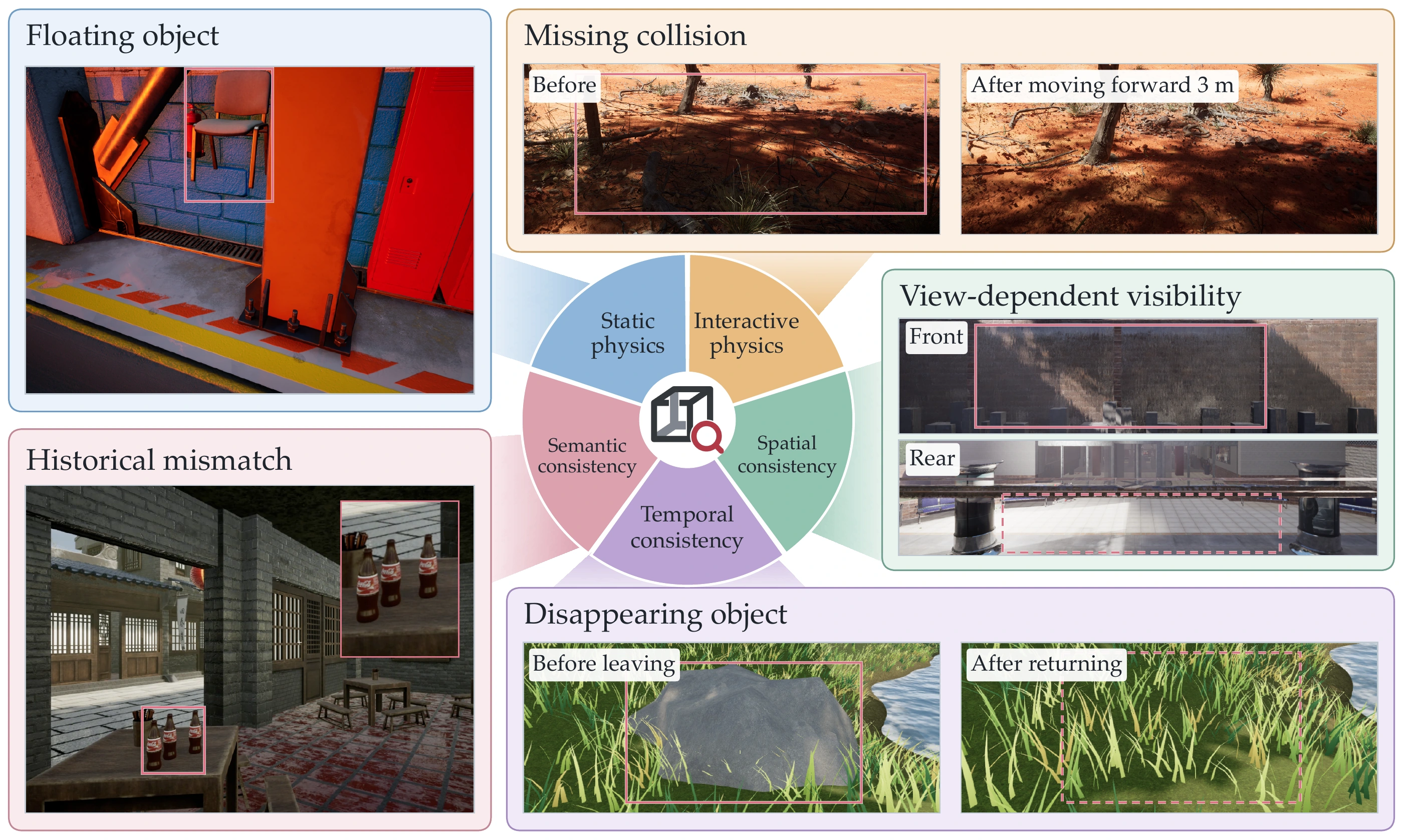
Representative examples from the paper: static physics, interactive physics, spatial consistency, temporal consistency, and semantic consistency.
The benchmark
The evaluation set spans 126 Unreal Engine tasks and 87 Three.js tasks, covering furnished interiors, urban scenes and natural environments.
| Anomaly family | What agents investigate | Tasks |
|---|---|---|
| Static physics | Floating objects, intersections and implausible scale | 59 |
| Interactive physics | Missing collisions, unexpected obstacles and abnormal trajectories | 41 |
| Spatial consistency | Visibility, viewpoint, lighting and material inconsistencies | 51 |
| Temporal consistency | Changes in existence, attributes or operational state | 40 |
| Semantic consistency | Improper configurations and historical incompatibilities | 22 |
| Total | 15 anomaly types across 13 environments | 213 |
Unreal: Ancient City, Indoor, Industrial, Medieval Village, Rural Australia, Subway and Urban.
Three.js: Airfield, Cottage, House, Reef, Sponza and Wilderness.
Data
One task per row. dataset/tasks.parquet contains all 213 tasks, including inputs, categories, rubrics and maps.
| Field | Contents |
|---|---|
task_id, engine, environment |
Task and environment identifiers |
category, subcategory |
Anomaly family and type |
input |
Instruction and scene description |
rubric |
anomaly: anomaly description; expected: expected behavior |
map |
Map path or scene URL |
In-context examples are grouped by subcategory.
from datasets import load_dataset

benchmark = load_dataset("ziyjiang/WorldAuditBench", split="test")
task = benchmark[0]
print(task["task_id"], task["input"])
Auditing paradigms
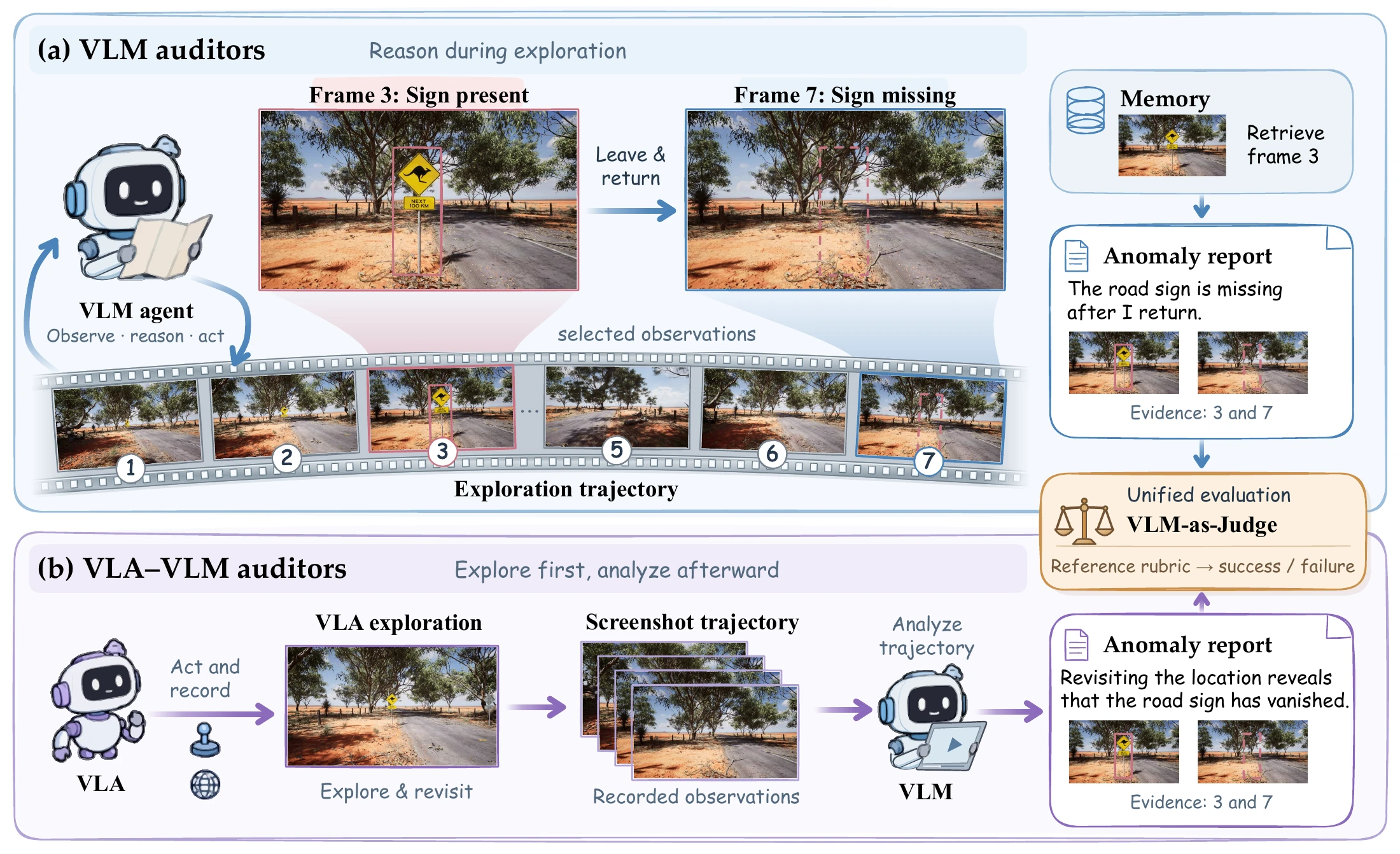
VLM agents reason during exploration and choose their next actions from observations and evidence, with a budget of 40 actions. VLA + VLM separates exploration from analysis: a VLA explores for 60 simulated seconds, then a VLM examines the recorded trajectory.
The strongest evaluated agent reaches 42.3% success, compared with 83.4% for humans.
Citation
@article{jiang2026worldauditbench,
  title={WorldAuditBench: Interactive 3D World Auditing with Multimodal Agents},
  author={Jiang, Ziyan and Yang, Jingbo and Ji, Jiabao and Liu, Yujian and Wu, Qiucheng and Jaakkola, Tommi and Zhang, Yang and Chang, Shiyu},
  journal={arXiv preprint arXiv:2609.40325},
  year={2026}
}