

Canora text-to-speech
Collection
Canora text-to-speech models, one per language, 82 million parameters each. Apache 2.0. • 9 items • Updated

Website · All models · Platform · Discord
Canora Korean is a Korean text-to-speech (TTS) model with two voices, seoyeon (female) and minjun (male). It has 82 million parameters, the size and speed of Kokoro-82M, and loads in the standard kokoro Python package. ONNX weights in full precision, half precision and int8 are included for ONNX Runtime and transformers.js.
한국어: Canora Korean은 여성과 남성 목소리를 제공하는 한국어 음성 합성(TTS) 모델이며, Apache 2.0 라이선스로 상업적 용도를 포함해 자유롭게 사용할 수 있습니다.
seoyeon (female) and minjun (male).kokoro, plus a one-file text-to-phoneme module in this repository.| Voice | Text | Audio |
|---|---|---|
seoyeon (female) |
좋은 아침입니다! 오늘은 맑고 기온은 21도 정도가 되겠습니다. | |
seoyeon (female) |
부산행 열차는 오후 2시 35분에 출발합니다. | |
seoyeon (female) |
여기 커피 한 잔은 4,500원입니다. | |
minjun (male) |
좋은 아침입니다! 오늘은 맑고 기온은 21도 정도가 되겠습니다. | |
minjun (male) |
부산행 열차는 오후 2시 35분에 출발합니다. | |
minjun (male) |
여기 커피 한 잔은 4,500원입니다. |
More samples (ten per voice) are in the samples folder.
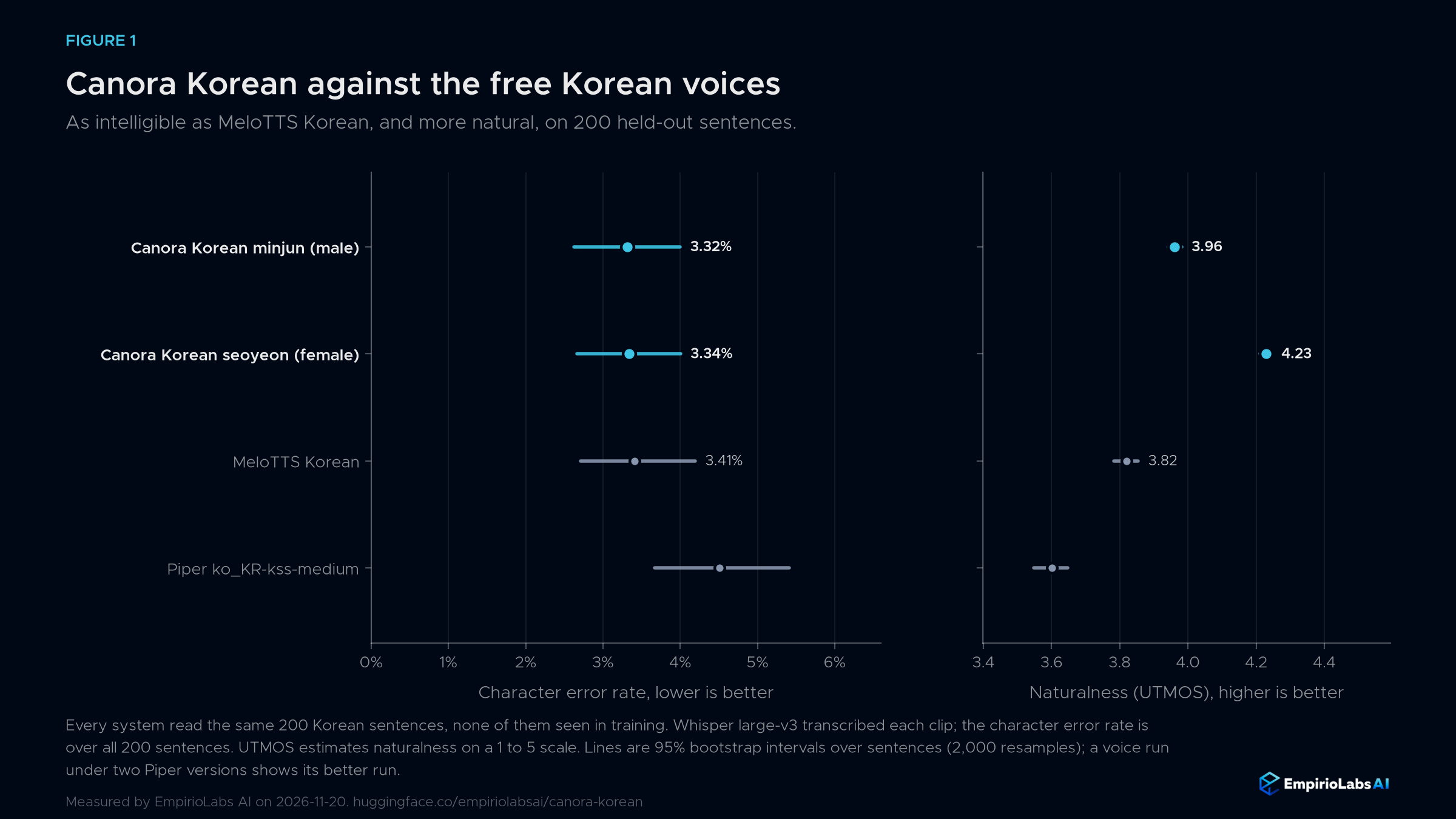
Measured by EmpirioLabs on 2026-11-20 on 200 Korean sentences the model never saw. Every system read the same sentences; openai/whisper-large-v3 transcribed each clip and the transcript was compared with the text (CER: character error rate, lower is better). UTMOS is an automatic estimate of naturalness on a 1 to 5 scale (higher is better). Bold marks the best score in a column.
| System | CER | UTMOS |
|---|---|---|
Canora Korean seoyeon |
3.34% | 4.23 |
Canora Korean minjun |
3.32% | 3.96 |
| MeloTTS Korean | 3.41% | 3.82 |
Piper ko_KR-kss-medium |
4.51% | 3.60 |
The int8 ONNX file measures seoyeon 3.48% CER and UTMOS 3.49, minjun 3.13% CER and UTMOS 3.36 on the same sentences.
Speed, 60 sentences on 4 threads of an AMD EPYC 7B13 64-Core Processor (audio seconds per second of computation): PyTorch 4.0x real time, ONNX full precision 4.5x, ONNX int8 5.2x. Speed depends on the processor and the number of threads; the architecture is Kokoro-82M's, so it matches Kokoro-82M on the same machine.
pip install kokoro soundfile huggingface_hub
The Korean text-to-phoneme module is pure Python and needs no other program.
import importlib, sys
from pathlib import Path
import soundfile as sf
import torch
from huggingface_hub import hf_hub_download
from kokoro import KModel

REPO = "empiriolabsai/canora-korean"
sys.path.insert(0, str(Path(hf_hub_download(REPO, "g2p_ko.py")).parent))
g2p = importlib.import_module("g2p_ko").KoreanG2P()
model = KModel(repo_id=REPO, config=hf_hub_download(REPO, "config.json"),
               model=hf_hub_download(REPO, "canora-korean.pth")).eval()
voice = torch.load(hf_hub_download(REPO, "voices/seoyeon.pt"), weights_only=True)

phonemes, _ = g2p("회의는 2025년 3월 12일 오후 2시 30분에 시작합니다.")
with torch.no_grad():
    audio = model(phonemes, voice[len(phonemes) - 1], 1.0)
sf.write("speech.wav", audio.numpy(), 24000)
The third argument of model(...) is the speed (1.0 is normal). Keep one call to about 500 phonemes; split longer text into sentences and join the audio.
Continuing the example above, the same phonemes and voice run on ONNX Runtime (pip install onnxruntime):
import json
import numpy as np
import onnxruntime as ort

vocab = json.load(open(hf_hub_download(REPO, "config.json")))["vocab"]
session = ort.InferenceSession(hf_hub_download(REPO, "onnx/model.onnx"))
ids = [0] + [vocab[p] for p in phonemes if p in vocab] + [0]
audio = session.run(None, {
    "input_ids": np.array([ids], dtype=np.int64),
    "style": voice[len(phonemes) - 1].numpy(),
    "speed": np.ones(1, dtype=np.float32),
})[0].reshape(-1)
onnx/model.onnx is full precision, onnx/model_fp16.onnx half precision and onnx/model_quantized.onnx int8, the smallest (its scores are in Results). In JavaScript, transformers.js loads the same files as StyleTextToSpeech2Model and takes the same inputs: phoneme ids from config.json and one row of voices/<name>.bin (raw float32, [510, 256]). The text-to-phoneme module itself is Python.
| Voice | Description |
|---|---|
seoyeon |
A clear, warm adult female voice, calm and even. |
minjun |
A clear, warm adult male voice, medium-low and calm. |
The voices are designed voices, not recordings or imitations of a real person.
Reading Korean text aloud in applications, accessibility tools, voice assistants, audiobooks and prototypes, on a server, a laptop or in the browser.
Canora text-to-speech in other languages: Dutch, French, German, Norwegian, Polish, Russian, Spanish, Turkish. They are listed together in the Canora text-to-speech collection.
EmpirioLabs AI builds AI models, from decision models to open text-to-speech and classifier models, and offers specialized AI model hosting for open, proprietary, and custom stacks, with GPU Cloud instances and hosted AI agents on the same platform. Website · Platform · Docs
Apache 2.0. The weights and code in this repository may be used commercially. See LICENSE and NOTICE.