

Canora text-to-speech
Collection
Canora text-to-speech models, one per language, 82 million parameters each. Apache 2.0. • 9 items • Updated

Website · All models · Platform · Discord
Canora Russian is a Russian text-to-speech (TTS) model with one voice, vera (female). It has 82 million parameters, the size and speed of Kokoro-82M, and loads in the standard kokoro Python package. ONNX weights in full precision, half precision and int8 are included for ONNX Runtime and transformers.js.
По-русски: Canora Russian является русской моделью синтеза речи (TTS) с женским голосом, доступной по лицензии Apache 2.0, в том числе для коммерческого использования.
vera (female).dima and sveta: word error rate 3.1% against 2.8%.dima and sveta we tested (UTMOS).openai/whisper-large-v3 identifies vera as Russian with a mean probability of 0.98 or more, as high as the native voices it was compared with.kokoro, plus a one-file text-to-phoneme module in this repository (which places stress with RUAccent).| Voice | Text | Audio |
|---|---|---|
vera (female) |
Доброе утро! Сегодня будет солнечный день, температура около 21 градуса. | |
vera (female) |
Поезд до Санкт-Петербурга отправляется в 14:35 с пятого пути. | |
vera (female) |
Чашка кофе стоит здесь 189,50 руб., а печенье входит в стоимость. |
More samples (ten of vera) are in the samples folder.
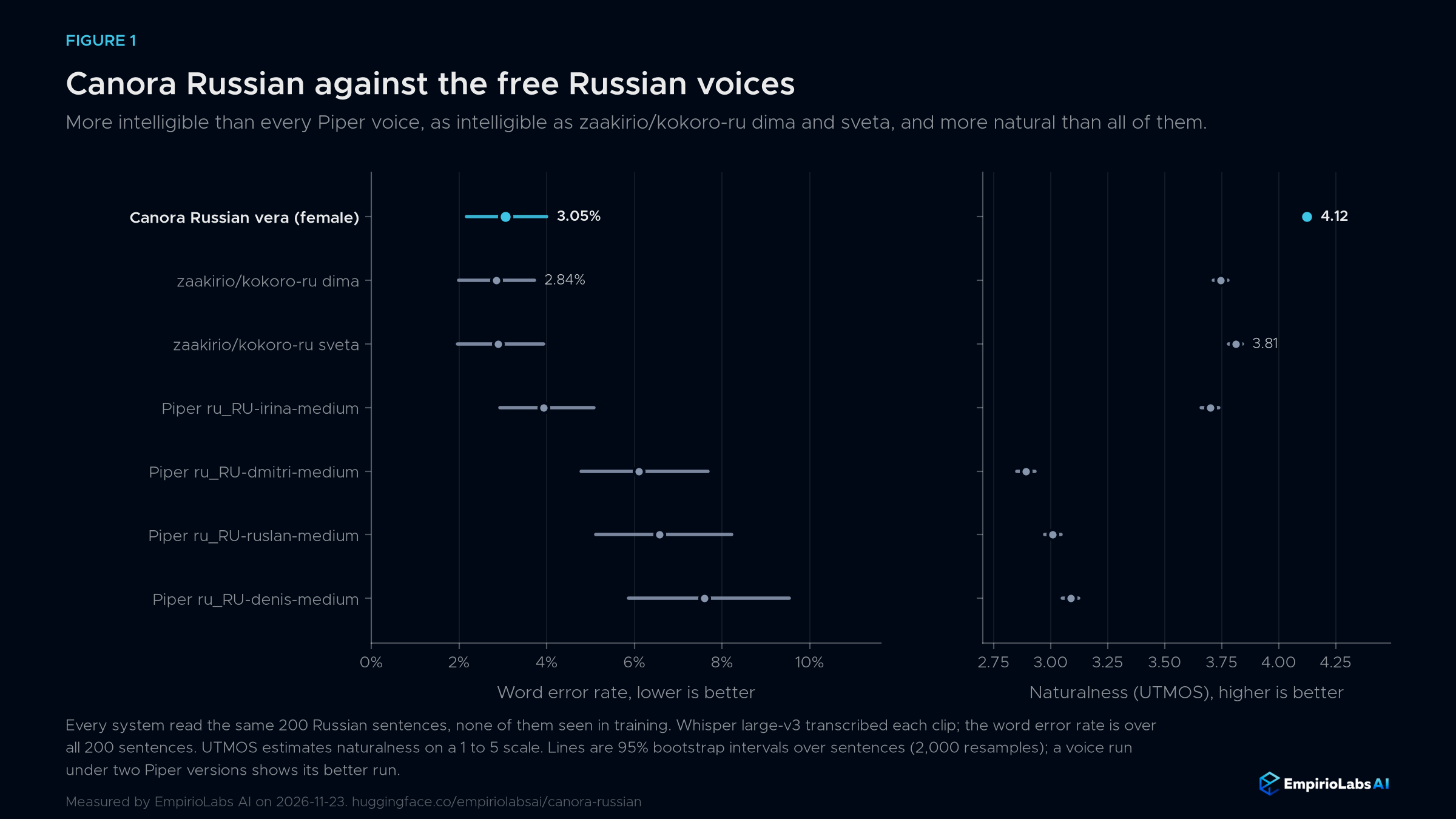
Measured by EmpirioLabs on 2026-11-23 on 200 Russian sentences the model never saw. Every system read the same sentences; openai/whisper-large-v3 transcribed each clip and the transcript was compared with the text (WER: word error rate, lower is better). UTMOS is an automatic estimate of naturalness on a 1 to 5 scale (higher is better). Bold marks the best score in a column.
| System | WER | UTMOS |
|---|---|---|
Canora Russian vera |
3.05% | 4.12 |
zaakirio/kokoro-ru dima |
2.84% | 3.75 |
zaakirio/kokoro-ru sveta |
2.90% | 3.81 |
Piper ru_RU-irina-medium |
3.93% | 3.70 |
Piper ru_RU-dmitri-medium |
6.10% | 2.89 |
Piper ru_RU-ruslan-medium |
6.57% | 3.01 |
Piper ru_RU-denis-medium |
7.60% | 3.09 |
Language ID, the mean probability openai/whisper-large-v3 gives Russian on the same clips: vera 0.99; the other voices 0.99 to 1.00.
zaakirio/kokoro-ru is another Kokoro-82M Russian model, run exactly as its card describes.
The int8 ONNX file measures vera 3.41% WER and UTMOS 3.12 on the same sentences.
Speed, 60 sentences on 4 threads of an AMD EPYC 7713 64-Core Processor (audio seconds per second of computation): PyTorch 3.6x real time, ONNX full precision 3.9x, ONNX int8 4.6x. Speed depends on the processor and the number of threads; the architecture is Kokoro-82M's, so it matches Kokoro-82M on the same machine.
pip install kokoro soundfile huggingface_hub "ruaccent @ https://github.com/Den4ikAI/ruaccent/archive/3ac0ad5f6508f6c1a4a604220042232c70a7baf9.zip"
The text-to-phoneme module places stress and ё with RUAccent (MIT) and needs no other program. Its first use downloads RUAccent's models, about 690 MB, from Hugging Face.
import importlib, sys
from pathlib import Path
import soundfile as sf
import torch
from huggingface_hub import hf_hub_download
from kokoro import KModel

REPO = "empiriolabsai/canora-russian"
sys.path.insert(0, str(Path(hf_hub_download(REPO, "g2p_ru.py")).parent))
g2p = importlib.import_module("g2p_ru").RussianG2P()
model = KModel(repo_id=REPO, config=hf_hub_download(REPO, "config.json"),
               model=hf_hub_download(REPO, "canora-russian.pth")).eval()
voice = torch.load(hf_hub_download(REPO, "voices/vera.pt"), weights_only=True)

phonemes, _ = g2p("Поезд до Санкт-Петербурга отправляется в 14:35 с пятого пути.")
with torch.no_grad():
    audio = model(phonemes, voice[len(phonemes) - 1], 1.0)
sf.write("speech.wav", audio.numpy(), 24000)
The third argument of model(...) is the speed (1.0 is normal). Keep one call to about 500 phonemes; split longer text into sentences and join the audio.
Continuing the example above, the same phonemes and voice run on ONNX Runtime (pip install onnxruntime):
import json
import numpy as np
import onnxruntime as ort

vocab = json.load(open(hf_hub_download(REPO, "config.json")))["vocab"]
session = ort.InferenceSession(hf_hub_download(REPO, "onnx/model.onnx"))
ids = [0] + [vocab[p] for p in phonemes if p in vocab] + [0]
audio = session.run(None, {
    "input_ids": np.array([ids], dtype=np.int64),
    "style": voice[len(phonemes) - 1].numpy(),
    "speed": np.ones(1, dtype=np.float32),
})[0].reshape(-1)
onnx/model.onnx is full precision, onnx/model_fp16.onnx half precision and onnx/model_quantized.onnx int8, the smallest (its scores are in Results). In JavaScript, transformers.js loads the same files as StyleTextToSpeech2Model and takes the same inputs: phoneme ids from config.json and one row of voices/<name>.bin (raw float32, [510, 256]). The text-to-phoneme module itself is Python.
| Voice | Description |
|---|---|
vera |
A clear, warm adult female voice, calm and even. |
The voice is a designed voice, not a recording or an imitation of a real person.
Reading Russian text aloud in applications, accessibility tools, voice assistants, audiobooks and prototypes, on a server, a laptop or in the browser.
Canora text-to-speech in other languages: Dutch, French, German, Korean, Norwegian, Polish, Spanish, Turkish. They are listed together in the Canora text-to-speech collection.
EmpirioLabs AI builds AI models, from decision models to open text-to-speech and classifier models, and offers specialized AI model hosting for open, proprietary, and custom stacks, with GPU Cloud instances and hosted AI agents on the same platform. Website · Platform · Docs
Apache 2.0. The weights and code in this repository may be used commercially. See LICENSE and NOTICE.