

Speech and text classifiers
Collection
Multilingual classifiers for financial sentiment, speaker gender and speaker age, in standard pipelines with ONNX weights. Apache 2.0. • 4 items • Updated

Website · All models · Platform · Discord
Speaker Age is a speech age estimation model: it tells the age group of the person speaking in a clip, one of seven bands, teens, 20s, 30s, 40s, 50s, 60s and 70+, with a probability for each. It was tested on speech in 40 languages, has 581 million parameters, and runs in the standard audio-classification pipeline, with ONNX weights for ONNX Runtime and transformers.js.
Try it in your browser, with nothing to install: Speech and text classifiers.
transformers with no custom code; 16 kHz input.female or male in the same pipeline.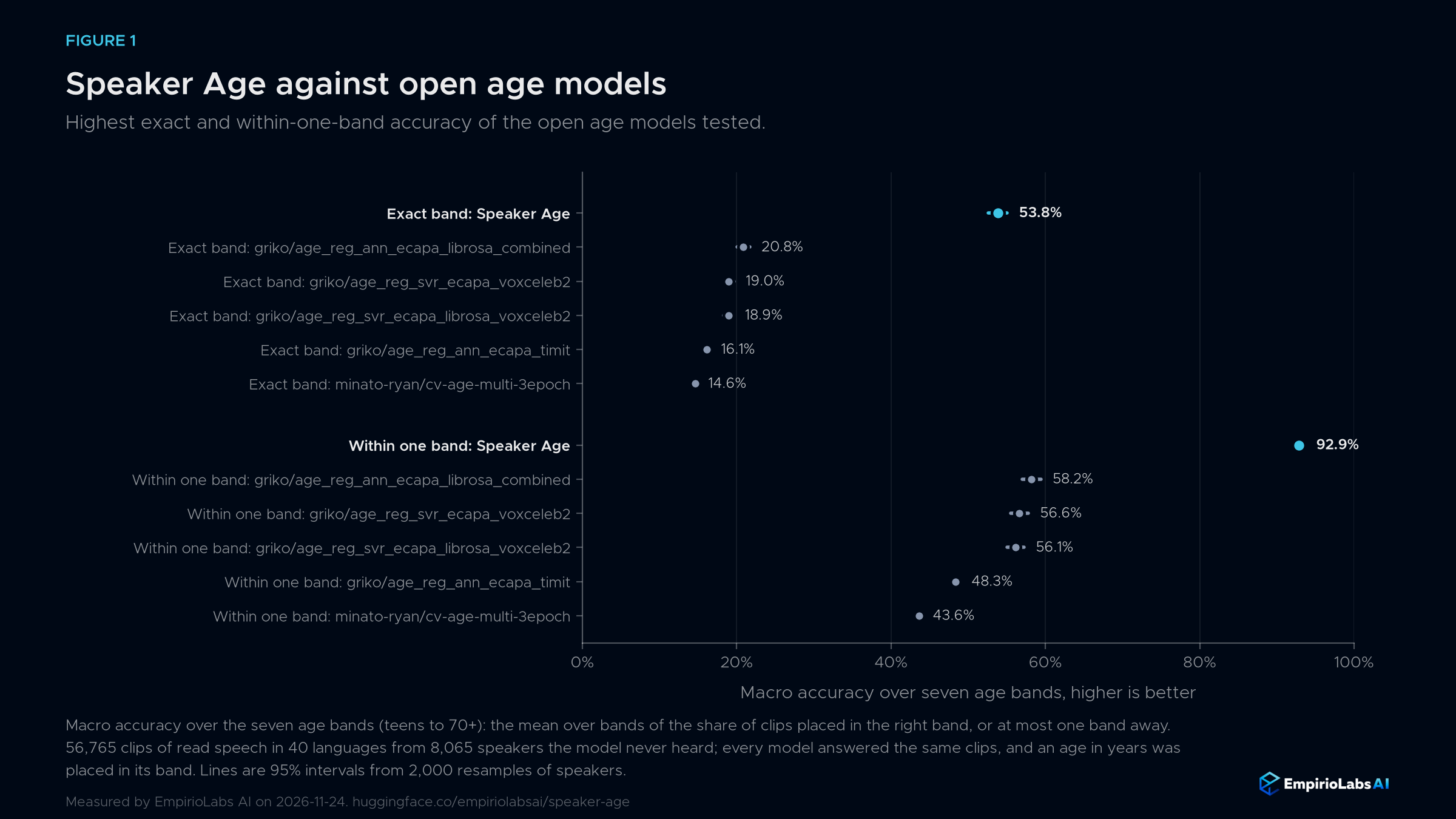
Measured by EmpirioLabs on 2026-11-24 on 56,765 clips of read speech in 40 languages from 8,065 speakers the model never heard. Every model answered the same clips. Exact is the share of clips placed in the speaker's own band and within one the share at most one band away, each averaged over the seven bands so that every age group counts the same; band error is the mean distance in bands between the answer and the speaker's band, averaged the same way (lower is better). Bold marks the best score in a column.
| Model | Exact | Within one | Band error |
|---|---|---|---|
| Speaker Age | 53.8% | 92.9% | 0.56 |
| griko/age_reg_ann_ecapa_librosa_combined | 20.8% | 58.2% | 1.39 |
| griko/age_reg_svr_ecapa_voxceleb2 | 19.0% | 56.6% | 1.43 |
| griko/age_reg_svr_ecapa_librosa_voxceleb2 | 18.9% | 56.1% | 1.43 |
| griko/age_reg_ann_ecapa_timit | 16.1% | 48.3% | 1.83 |
| minato-ryan/cv-age-multi-3epoch | 14.6% | 43.6% | 2.21 |
For scale: answering 20s, the most common band, for every clip scores 14.3% exact and 42.9% within one on these measures. Counting every clip equally instead, Speaker Age places 52.8% of clips in the right band and 93.9% within one band.
The four griko models estimate an age in years, which was placed in its band (under 20 is teens, 70 and over is 70+); the other model answers with age groups that map to these bands.
| Band | Clips | Exact | Within one |
|---|---|---|---|
teens |
5,144 | 67.9% | 94.1% |
20s |
21,718 | 53.8% | 97.2% |
30s |
11,613 | 58.9% | 92.5% |
40s |
8,620 | 39.8% | 92.2% |
50s |
5,869 | 46.7% | 86.1% |
60s |
2,965 | 40.0% | 96.2% |
70+ |
836 | 69.7% | 91.7% |
Exact and within one band by language, averaged over the bands present in that language:
| Language | Clips | Exact | Within one |
|---|---|---|---|
| Arabic | 398 | 33.5% | 71.5% |
| Bashkir | 271 | 46.7% | 87.5% |
| Basque | 2,249 | 48.8% | 91.2% |
| Bengali | 836 | 37.5% | 99.6% |
| Cantonese (Hong Kong) | 444 | 38.8% | 93.7% |
| Catalan | 8,503 | 52.2% | 92.2% |
| Central Kurdish | 477 | 41.3% | 82.8% |
| Chinese (Taiwan) | 649 | 48.8% | 95.6% |
| Czech | 383 | 36.4% | 83.2% |
| Dutch | 538 | 62.0% | 95.2% |
| English | 12,664 | 50.6% | 90.1% |
| Esperanto | 301 | 35.4% | 91.9% |
| Estonian | 759 | 42.6% | 98.0% |
| French | 4,685 | 51.6% | 93.5% |
| Frisian | 317 | 48.2% | 91.0% |
| Galician | 1,247 | 50.6% | 97.8% |
| Georgian | 586 | 65.1% | 92.1% |
| German | 3,763 | 50.5% | 90.7% |
| Hungarian | 538 | 55.9% | 96.2% |
| Italian | 2,048 | 52.0% | 95.3% |
| Japanese | 2,325 | 48.5% | 93.1% |
| Kabyle | 322 | 32.9% | 68.2% |
| Kinyarwanda | 171 | 42.7% | 66.7% |
| Latvian | 477 | 49.0% | 89.8% |
| Luganda | 402 | 39.2% | 82.4% |
| Meadow Mari | 314 | 46.1% | 91.6% |
| Persian | 951 | 41.3% | 81.2% |
| Polish | 418 | 51.5% | 92.5% |
| Portuguese | 909 | 55.0% | 92.9% |
| Russian | 1,056 | 57.7% | 95.5% |
| Spanish | 3,906 | 46.2% | 93.9% |
| Swahili | 597 | 31.5% | 76.9% |
| Tamil | 292 | 47.2% | 90.8% |
| Thai | 649 | 44.2% | 85.0% |
| Turkish | 526 | 47.1% | 94.0% |
| Ukrainian | 470 | 34.1% | 94.3% |
| Urdu | 447 | 28.8% | 91.6% |
| Uyghur | 273 | 49.9% | 94.0% |
| Uzbek | 437 | 43.7% | 85.2% |
| Welsh | 167 | 40.4% | 90.4% |
Languages with few speakers in a band have wider uncertainty.
On 700 test clips (100 per band), the int8 ONNX file gives the same top band as the full-precision model on 95.9% of them; exact 54.7% against 55.0%, within one band 92.0% against 92.3%.
pip install transformers torch
from transformers import pipeline

classifier = pipeline("audio-classification", model="empiriolabsai/speaker-age")
classifier("speech.wav", top_k=7)
# [{'label': '30s', 'score': ...}, {'label': '40s', 'score': ...}, ...] every band, most likely first
Pass a file path (decoded with ffmpeg) or a 16 kHz mono float array as {"raw": array, "sampling_rate": 16000}. Clips of 2 to 15 seconds of one person speaking work best.
import { pipeline } from "@huggingface/transformers";

const classifier = await pipeline("audio-classification", "empiriolabsai/speaker-age", { dtype: "q8" });
const result = await classifier(audioUrl, { top_k: 7 }); // a URL, or a Float32Array of 16 kHz samples
dtype: "q8" loads onnx/model_quantized.onnx (818 MB); leave it out for the full-precision model (onnx/model.onnx with its external data files, 2.3 GB).
Aggregate analytics of voice recordings, balancing and filtering speech datasets by age group, and voice applications where the people recorded have agreed to it.
40s 39.8%, 60s 40.0%) and by language (the tables above). Neighbouring bands are often confused; within one band is the more reliable reading.EmpirioLabs AI builds AI models, from decision models to open text-to-speech and classifier models, and offers specialized AI model hosting for open, proprietary, and custom stacks, with GPU Cloud instances and hosted AI agents on the same platform. Website · Platform · Docs
Apache 2.0. The weights and code in this repository may be used commercially. See LICENSE and NOTICE.
Base model
facebook/w2v-bert-2.0