

A ConvNet for the 2020s
Paper • 2201.03545 • Published • 2
Independent engineering project · 2026 · part of Pathos Pro, AI assistance for breast sentinel lymph nodes 
Live demo | Code | Results | Quick start | Files | Cite | English · Français
Abstract: Cancer_pathos is a ConvNeXt-Tiny classifier with a residual head (28.3 M parameters) that tells whether the centre of a 96 px haematoxylin and eosin patch of lymph node contains metastatic tissue. It reaches an AUC of 0.9979 [0.9975 ; 0.9982] on a locked PatchCamelyon test set of 33,004 patches that was never used for training, model selection or tuning. Five-fold cross-validation gives 0.9975 ± 0.0001. The repository also documents what the model looks at (Grad-CAM, counterfactual masking), how sure it is (Monte Carlo dropout) and which known cases resemble a query (FAISS). This is a research model. It is not a certified medical device and it must not be used for diagnosis.
Why it matters: on sentinel lymph nodes, AI assistance raised micrometastasis sensitivity from 83.3% to 91.2% and cut the review time of micrometastases from 116 s to 61 s (Steiner et al., Am J Surg Pathol 2018). A patch model is the smallest unit of such assistance, and the place where its claims are easiest to check.
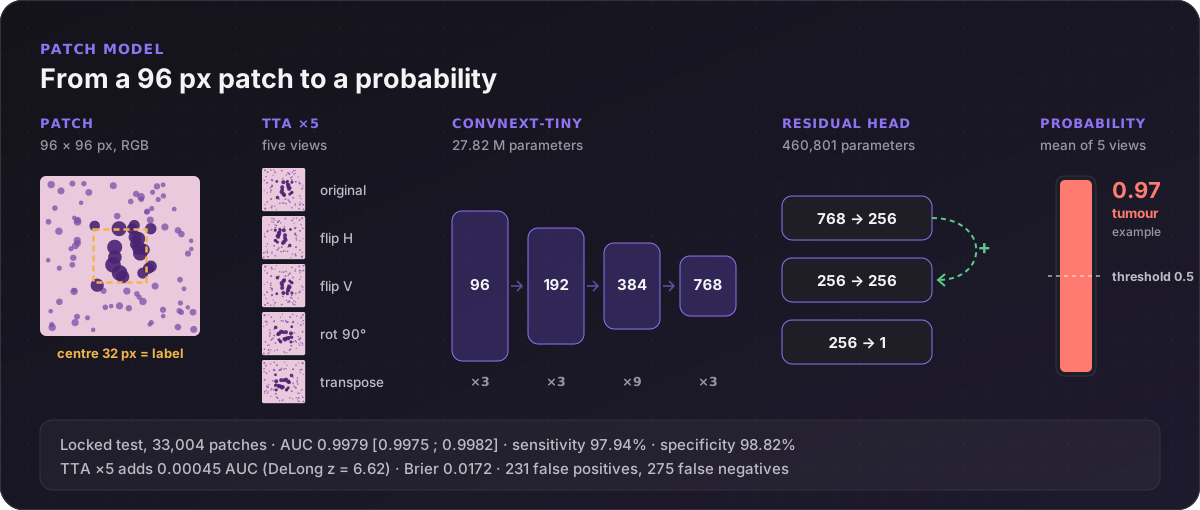
[0.485, 0.456, 0.406],
std [0.229, 0.224, 0.225]).timm convnext_tiny, ImageNet initialisation, no classification layer, 768-dimensional
features (27.82 M parameters).768 → 256 → 256 → 1 with batch normalisation, GELU, dropout 0.3 and a linear
shortcut (460,801 parameters). One logit, then a sigmoid.| Setting | Value |
|---|---|
| Data | PatchCamelyon as distributed by the Kaggle Histopathologic Cancer Detection challenge, 220,025 labelled patches, 40.50% tumour |
| Split | 70 / 15 / 15 stratified, seed 42: 154,017 train · 33,004 validation · 33,004 locked test |
| Loss | Focal loss, α = 0.25, γ = 2.0 |
| Optimiser | AdamW, learning rate 1e-4, weight decay 1e-5 |
| Schedule | CosineAnnealingLR, 20 epochs at most, early stopping on validation AUC with patience 4 |
| Batch and precision | 64, automatic mixed precision |
| Augmentation | Albumentations: flips, 90° rotations, transpose, shift-scale-rotate, elastic and grid distortion, colour jitter, hue-saturation, CLAHE, noise, blur, coarse dropout |
| Hardware | One NVIDIA Tesla T4 |

All values come from the result files in results_v2/.
No value is rounded up.
| Metric | 5-fold cross-validation | Locked test, TTA ×5 | Locked test, no TTA |
|---|---|---|---|
| AUC-ROC | 0.9975 ± 0.0001 | 0.9979 [0.9975 ; 0.9982] | 0.9974 |
| Accuracy | 0.9821 ± 0.0008 | 0.9847 | 0.9827 |
| F1 | 0.9778 ± 0.0010 | 0.9810 | 0.9787 |
| Sensitivity | 0.9753 ± 0.0015 | 0.9794 | 0.9779 |
| Specificity | 0.9867 ± 0.0006 | 0.9882 | 0.9860 |
| Brier score | 0.0212 ± 0.0005 | 0.0172 | 0.0183 |
Confusion matrix on the 33,004 test patches at threshold 0.5: 19,405 true negatives, 231 false positives, 275 false negatives, 13,093 true positives.


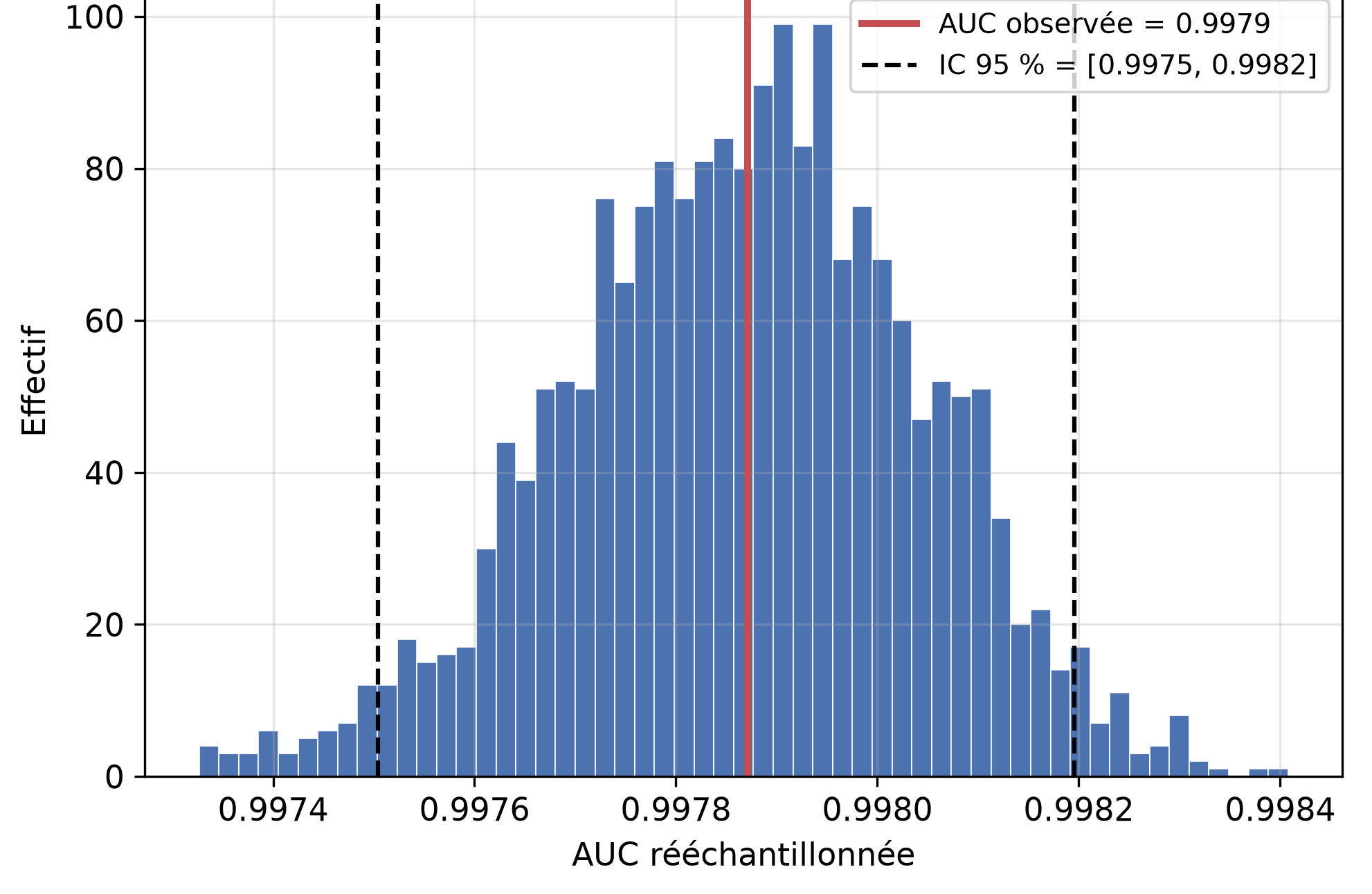
Top: ROC over the five cross-validation folds, and confusion matrix on the locked test (counts, then share per row). Bottom: reliability diagram, and bootstrap distribution of the test AUC (2,000 resamples). Some figure labels are in French.
Test-time augmentation: the gain is statistically significant (paired DeLong test, z = 6.62, p = 3.5 × 10⁻¹¹) and small in size, +0.00045 AUC. It is kept for stability, not for performance.
Calibration: Brier score 0.0172, expected calibration error 0.0449 on the locked test.

Grad-CAM on locked-test patches: tumour on the top row, normal tissue on the bottom row.

Share of the model's errors caught (vertical) against share of patches reviewed (horizontal), most uncertain first. The dashed line is a random review.
Monte Carlo dropout, 30 passes on 20,000 locked-test patches (346 errors):
The 768-dimensional features are indexed with FAISS (exact flat index, cosine similarity). With a base of 20,000 training patches and 1,000 test queries, 97.9% of the five nearest neighbours share the class of the query (98.2% normal, 97.6% tumour).

Pathos Pro is a complete second-read system for breast sentinel lymph nodes: slide intake, whole-slide analysis, a viewer that records the pathologist's impression before showing any AI output, a sourced copilot and an audit journal. The slide-level verdict is not produced by this patch model. It comes from H-optimus-0 tile features pooled by gated-attention multiple instance learning:
| Level | Data | Model | Metric | Value |
|---|---|---|---|---|
| Patch | PatchCamelyon, locked test, 33,004 patches | This model, TTA ×5 | AUC [95% CI] | 0.9979 [0.9975 ; 0.9982] |
| Slide | CAMELYON16 test, 129 slides | ABMIL + H-optimus-0, five-fold ensemble | AUC | 0.9949 |
| Slide, external | SLN-Breast, 130 slides, 36 positive | Same ensemble, no retraining | AUC [95% CI] | 0.9566 [0.9019 ; 0.9964] |
The slide-level weights are not in this repository. Code, design notes and the full product description are on GitHub.
| Path | Content |
|---|---|
models/final_model_v2_locked.pth |
The model described on this page (v2, raw state_dict, 113 MB). Also the one served by the demo. |
results_v2/ |
Test metrics, cross-validation folds, DeLong and bootstrap significance, summary table |
assets/ |
Animations and v2 figures of this page |
models/best_model_epoch*.pth |
v1 training history, 31 checkpoints of 340 MB each. Their file names carry validation AUCs, which also drove early stopping. Do not quote them as results. |
figures/ |
v1 figures, measured on the v1 validation split. Kept for history. |
pip install torch timm huggingface_hub
import torch, timm
import torch.nn as nn
from huggingface_hub import hf_hub_download
class ResidualHead(nn.Module):
def __init__(self, in_features, hidden=256, dropout=0.3):
super().__init__()
self.fc1, self.bn1 = nn.Linear(in_features, hidden), nn.BatchNorm1d(hidden)
self.fc2, self.bn2 = nn.Linear(hidden, hidden), nn.BatchNorm1d(hidden)
self.fc_out, self.shortcut = nn.Linear(hidden, 1), nn.Linear(in_features, hidden)
self.gelu, self.dropout = nn.GELU(), nn.Dropout(dropout)
def forward(self, x):
identity = self.shortcut(x)
out = self.dropout(self.gelu(self.bn1(self.fc1(x))))
out = self.gelu(self.bn2(self.fc2(out)) + identity)
return self.fc_out(self.dropout(out))
class CancerClassifier(nn.Module):
def __init__(self):
super().__init__()
self.backbone = timm.create_model("convnext_tiny", pretrained=False, num_classes=0)
self.head = ResidualHead(self.backbone.num_features)
def forward(self, x):
return self.head(self.backbone(x))
model = CancerClassifier()
path = hf_hub_download("hakim78/Cancer_pathos", "models/final_model_v2_locked.pth")
model.load_state_dict(torch.load(path, map_location="cpu", weights_only=True))
model.eval()
def predict(x):
"""x: float tensor (N, 3, 96, 96), ImageNet-normalised. Returns the tumour probability, TTA x5."""
views = [x, x.flip(-1), x.flip(-2), x.rot90(1, (-2, -1)), x.transpose(-2, -1)]
with torch.no_grad():
return torch.stack([torch.sigmoid(model(v)) for v in views]).mean(0)
This snippet was run against the published file: all keys match and the model counts 28,280,929 parameters.
Or try it in the browser: Cancer_pathos_demo (CPU Space, about 0.8 s per patch once warm, test-time augmentation included).
Research and teaching on computational pathology: benchmarking, explainability studies, a feature extractor for tile-level analysis. Patches should match PatchCamelyon: haematoxylin and eosin, lymph node tissue, about 0.97 µm per pixel (10× equivalent).
Out of scope: any diagnostic use, any decision about a patient, other organs or stains, other magnifications without rescaling. This model is not a medical device and carries no CE marking.
Weights and code are released under the MIT License, for research use. PatchCamelyon is derived from CAMELYON16 and distributed under CC0. No patient data is stored in this repository.
This work builds on PatchCamelyon (Veeling et al., 2018), the CAMELYON16
challenge, ConvNeXt (Liu et al., 2022) and timm, Grad-CAM
(Selvaraju et al., 2017), and the Mahmood Lab's
UNI and CLAM repositories, whose README conventions this page follows.
@software{djaalal2026pathos,
author = {Djaalal, Hakim},
title = {Pathos Pro: AI assistance for breast sentinel lymph node metastasis detection},
year = {2026},
url = {https://github.com/Hakim78/histopathologic-cancer-detection}
}
import timm

model = timm.create_model("hf-hub:hakim78/Cancer_pathos", pretrained=True)