


metadata
base_model: stabilityai/stable-diffusion-2-1-base
license: creativeml-openrail-m
library_name: diffusers
pipeline_tag: text-to-image
tags:
  - stable-diffusion
  - stable-diffusion-diffusers
  - textual_inversion
inference: true
cgDDI: Keloid Textual Inversion Model
This repository contains the textual inversion adaptation weights for stabilityai/stable-diffusion-2-1-base representing the keloid disease concept.
It is part of the cgDDI (Controllable Generation of Diverse Dermatological Imagery) framework introduced in the paper Controllable Generation of Diverse Dermatological Imagery for Fair and Efficient Malignancy Classification (MICCAI 2026).
Model Description
cgDDI is a hybrid framework designed to address the systematic lack of expertly annotated dermatological images across diverse skin tones and rare diseases. This model learns the specific concept of keloid through textual inversion and fine-tuning, allowing the generation of diverse, realistic, and skin-tone-controlled synthetic samples.
- Disease Category: Keloid
- Trigger Token/Concept:
<keloid-class> - Base Model:
stabilityai/stable-diffusion-2-1-base
cgDDI Framework Overview
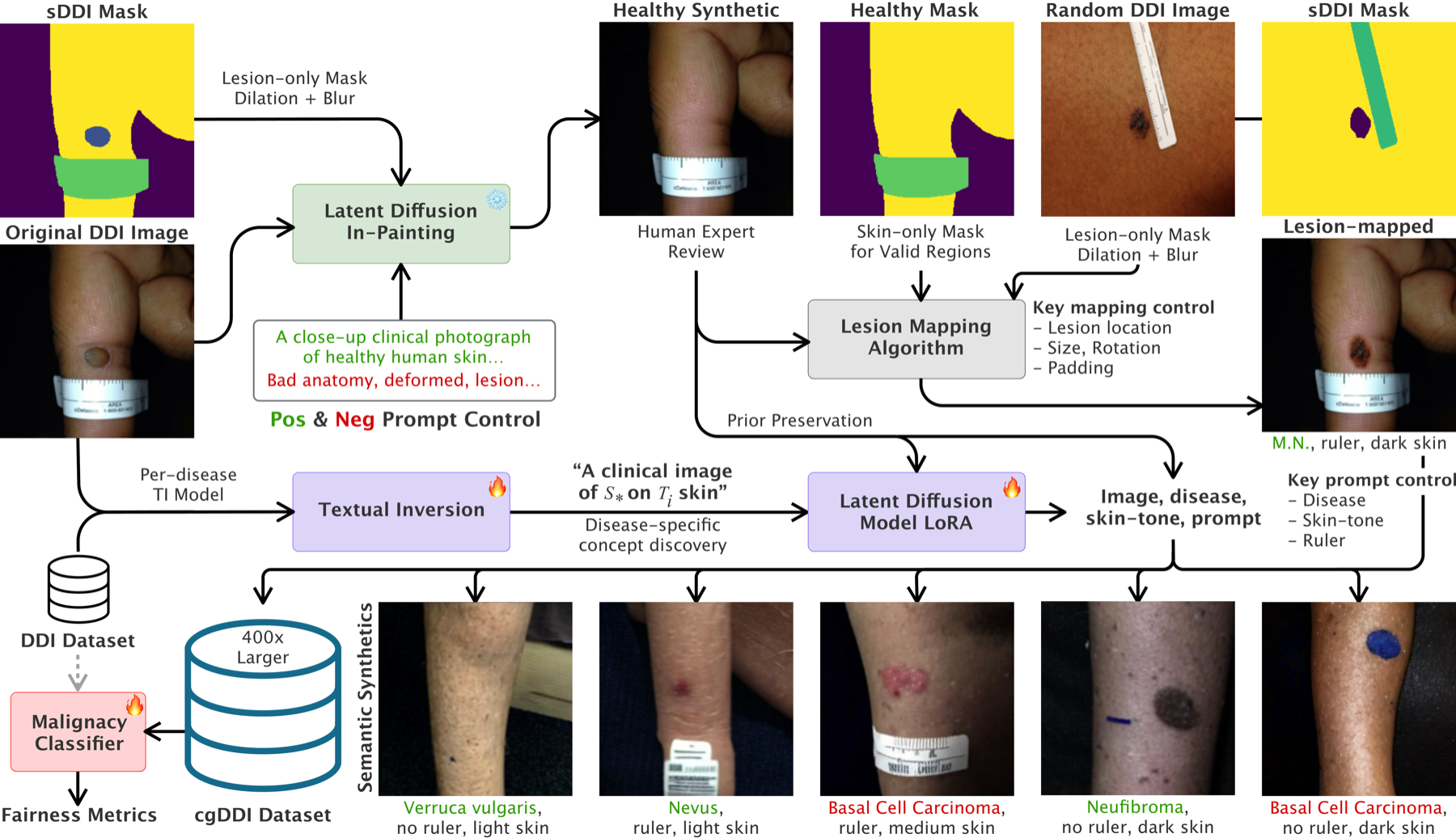
- Healthy Synthetics: Synthesizes realistic healthy skin samples without disturbing other input properties.
- Lesion Mapping: Maps single-sample rare lesions onto novel skin-tones and locations non-parametrically.
- Semantic Synthetics: Allows for efficient parametric generation of targeted dermatological conditions using textual inversion and LoRA.
Resources
- Paper: Controllable Generation of Diverse Dermatological Imagery for Fair and Efficient Malignancy Classification
- Code: GitHub Repository
- Dataset: Hugging Face Dataset
Citation
@inproceedings{carrion2026cgddi,
  title     = {Controllable Generation of Diverse Dermatological Imagery for Fair and Efficient Malignancy Classification},
  author    = {Carri{\'o}n, H{\'e}ctor and Norouzi, Narges},
  booktitle = {Medical Image Computing and Computer-Assisted Intervention (MICCAI)},
  year      = {2026},
  publisher = {Springer},
  series    = {Lecture Notes in Computer Science}
}