| # GenQ |
|
|
| In our paper [BEIR: A Heterogenous Benchmark for Zero-shot Evaluation of Information Retrieval Models](https://arxiv.org/abs/2104.08663) we presented a method to adapt a model for [asymmetric semantic search](../../applications/semantic-search/) without for a corpus without labeled training data. |
|
|
| ## Background |
| In [asymmetric semantic search](../../applications/semantic-search/), the user provides a (short) query like some keywords or a question. We then want to retrieve a longer text passage that provides the answer. |
|
|
| For example: |
| ``` |
| query: What is Python? |
| passage to retrieve: Python is an interpreted, high-level and general-purpose programming language. Python's design philosophy emphasizes code readability with its notable use of significant whitespace. Its language constructs and object-oriented approach aim to help programmers write clear, logical code for small and large-scale projects. |
| ``` |
|
|
| We showed how to train such models if sufficient training data (query & relevant passage) is available here: [Training MS MARCO dataset](../../training/ms_marco) |
|
|
| In this tutorial, we show to train such models if **no training data is available**, i.e., if you don't have thousands of labeled query & relevant passage pairs. |
|
|
| ## Overview |
|
|
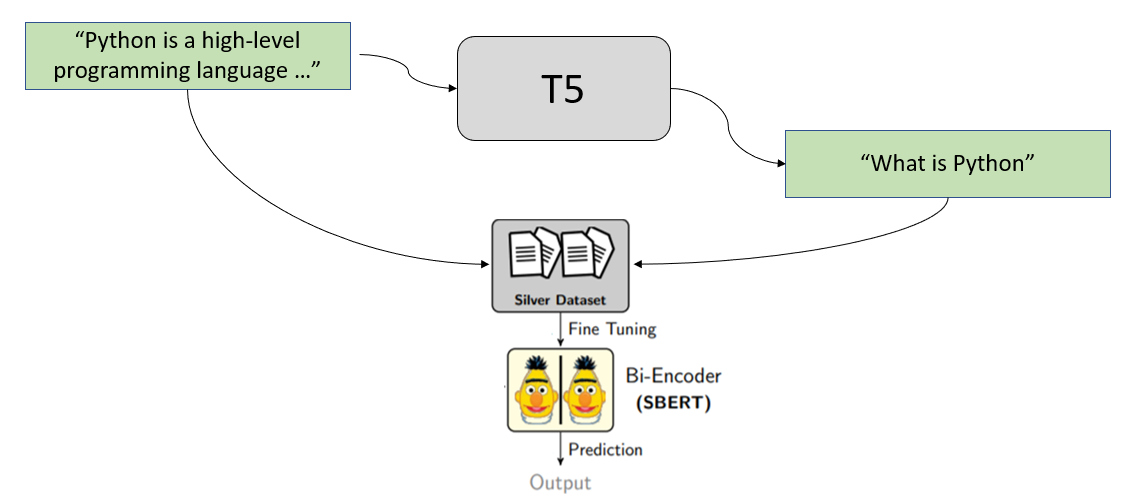
| We use **synthethic query generation** to achieve our goal. We start with the passage from our document collection and create for these possible queries users might ask / might search for. |
|
|
|  |
|
|
|
|
| For example, we have the following text passage: |
| ``` |
| Python is an interpreted, high-level and general-purpose programming language. Python's design philosophy emphasizes code readability with its notable use of significant whitespace. Its language constructs and object-oriented approach aim to help programmers write clear, logical code for small and large-scale projects. |
| ``` |
|
|
| We pass this passage through a specially trained [T5 model](https://arxiv.org/abs/1910.10683) which generates possible queries for us. For the above passage, it might generate these queries: |
| - What is python |
| - definition python |
| - what language uses whitespaces |
|
|
|
|
| We then use these generated queries to create our training set: |
| ``` |
| (What is python, Python is an interpreted...) |
| (definition python, Python is an interpreted...) |
| (what language uses whitespaces, Python is an interpreted...) |
| ```` |
|
|
| And train our SentenceTransformer bi-encoder with it. |
|
|
| ## Query Generation |
|
|
| In [BeIR](https://huggingface.co/BeIR) we provide different models that can be used for query generation. In this example, we use the T5 model that was trained by [docTTTTTquery](https://github.com/castorini/docTTTTTquery): |
|
|
| ```python |
| from transformers import T5Tokenizer, T5ForConditionalGeneration |
| import torch |
| |
| tokenizer = T5Tokenizer.from_pretrained('BeIR/query-gen-msmarco-t5-large-v1') |
| model = T5ForConditionalGeneration.from_pretrained('BeIR/query-gen-msmarco-t5-large-v1') |
| model.eval() |
| |
| para = "Python is an interpreted, high-level and general-purpose programming language. Python's design philosophy emphasizes code readability with its notable use of significant whitespace. Its language constructs and object-oriented approach aim to help programmers write clear, logical code for small and large-scale projects." |
| |
| input_ids = tokenizer.encode(para, return_tensors='pt') |
| with torch.no_grad(): |
| outputs = model.generate( |
| input_ids=input_ids, |
| max_length=64, |
| do_sample=True, |
| top_p=0.95, |
| num_return_sequences=3) |
| |
| print("Paragraph:") |
| print(para) |
| |
| print("\nGenerated Queries:") |
| for i in range(len(outputs)): |
| query = tokenizer.decode(outputs[i], skip_special_tokens=True) |
| print(f'{i + 1}: {query}') |
| ``` |
|
|
| In the above code, we use [Top-p (nucleus) sampling](https://huggingface.co/blog/how-to-generate) which will randomly pick a word from a collection of likely words. As a consequence, the model will generate different queries each time. |
|
|
|
|
| ## Bi-Encoder Training |
|
|
| With the generated queries, we can then train a bi-encoder using the use [MultipleNegativesRankingLoss](https://www.sbert.net/docs/package_reference/losses.html#multiplenegativesrankingloss). |
| |
| ## Full Example |
| We train a semantic search model to search through Wikipedia |
| articles about programming articles & technologies. |
|
|
| We use the text paragraphs from the following Wikipedia articles: |
| Assembly language, C , C# , C++, Go , Java , JavaScript, Keras, Laravel, MATLAB, Matplotlib, MongoDB, MySQL, Natural Language Toolkit, NumPy, pandas (software), Perl, PHP, PostgreSQL, Python , PyTorch, R , React, Rust , Scala , scikit-learn, SciPy, Swift , TensorFlow, Vue.js |
|
|
| In: |
| - [1_programming_query_generation.py](1_programming_query_generation.py) - We generate queries for all paragraphs from these articles |
| - [2_programming_train_bi-encoder.py](2_programming_train_bi-encoder.py) - We train a SentenceTransformer bi-encoder with these generated queries. This results in a model we can then use for sematic search (for the given Wikipedia articles). |
| - [3_programming_semantic_search.py](3_programming_semantic_search.py) - Shows how the trained model can be used for semantic search. |
|
|

