

Low-Complexity Patch-based No-Reference Point Cloud Quality Metric exploiting Weighted Structure and Texture Features
Paper • 2503.15001 • Published • 1
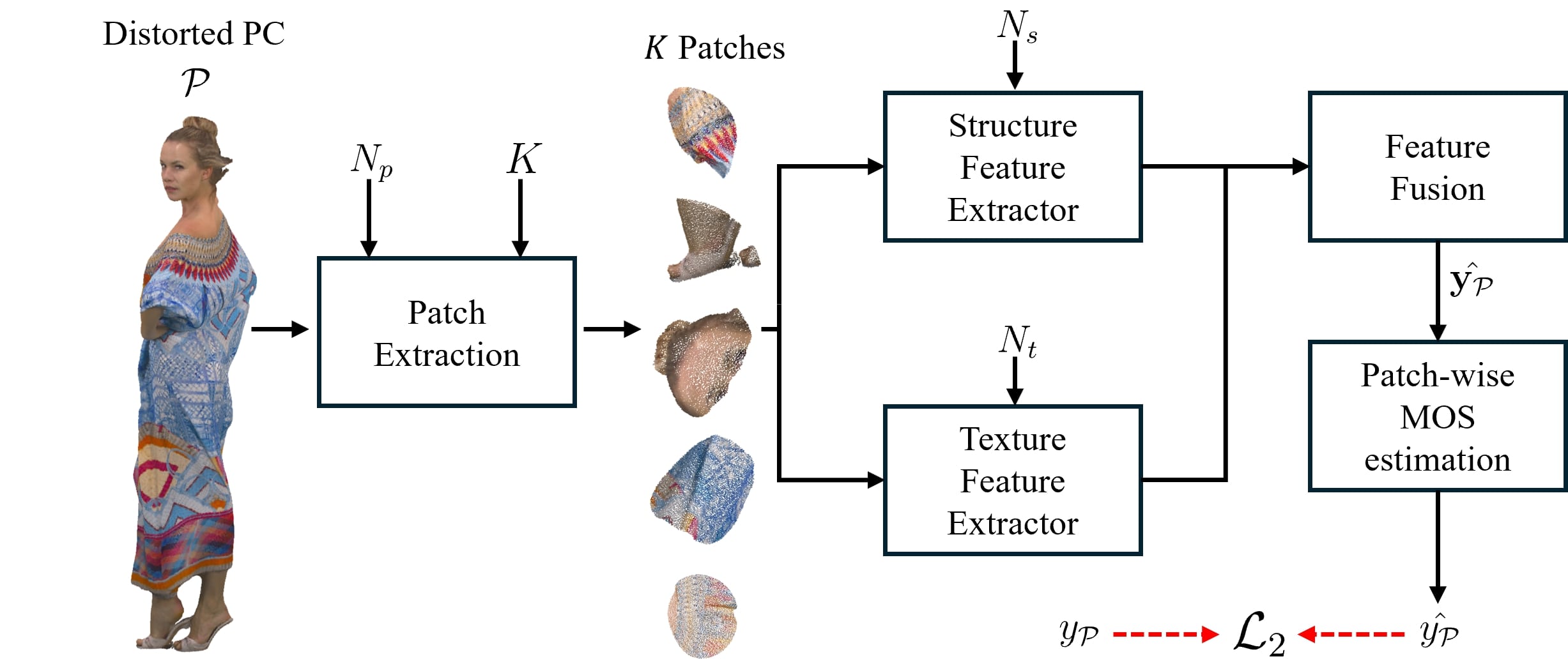
PST-PCQA is a learning-based no-reference point cloud quality assessment (NR-PCQA) model. Given a distorted, coloured point cloud (no reference needed), it predicts a Mean Opinion Score (MOS) by splitting the cloud into local patches, extracting structure and texture features from each patch, predicting a quality score and an importance weight per patch, and combining them into a global score.
Both checkpoints were trained on the WPC dataset. No SJTU-PCQA or SIAT-PCQD checkpoints are provided in the repository. If needed, please contact Michael Neri at michael.neri@tuni.fi
| File | Patches K | Trained on | Saved at epoch |
|---|---|---|---|
PST_PCQAModule_K_16.ckpt |
16 | WPC | 396 |
PST_PCQAModule_K_8.ckpt |
8 | WPC | 233 |
The number of patches is baked into the network (two BatchNorm1d(patches) layers), so each checkpoint must be loaded with the matching patches value and fed exactly K patches.
Pre-processing (per point cloud)
x, y, z, r, g, b):x_b of shape (B, K, 1024, 6)x_s of shape (B, K, 8192, 6)Network (model.py)
S_TFE), one for structure and one for texture, each made of two sampling-grouping layers (512 then 256 points, 32 neighbours) with grouped 1×1 convolutions and ELU activations.ŷ_p and a weight w_p. The global score is the mean over patches of w_p · ŷ_p.(mos, mos_per_patch).Training objective: MSE on the global score + MSE between each patch score and the global MOS (weights 1 and 1).
From the training scripts (training_val_test_{WPC,SJTU,SIAT}.py) and the paper:
| Setting | Value |
|---|---|
| Optimizer | Adam, weight decay 1e-5 |
| Learning rate | 1e-3, cosine annealing (T_max = 400, minimum 1e-4) |
| Epochs | 400 |
| Batch size | 4 in the paper and SJTU/SIAT scripts; 2 in the WPC script |
| Dropout | 0 (WPC, SJTU), 0.2 (SIAT) |
| Checkpoint selection | top-k checkpoints by validation MSE, then the one with the best test PLCC is kept |
| Hardware | NVIDIA RTX 4070 |
| Dataset | References | Distorted | Protocol |
|---|---|---|---|
| WPC | 20 | 740 | train/test split as in prior work (ref. [9] of the paper) |
| SJTU-PCQA | 10 | 378 | leave-one-out, 10 folds |
| SIAT-PCQD | 20 | 340 | leave-one-out, 20 folds |
The datasets are not distributed with this model and must be obtained from their original sources.
Within-dataset performance (K = 16)
| Dataset | PLCC ↑ | SRCC ↑ | KRCC ↑ | RMSE ↓ |
|---|---|---|---|---|
| WPC | 0.8821 | 0.8624 | 0.6854 | 10.5769 |
| SJTU-PCQA | 0.9593 | 0.9514 | 0.8049 | 0.6630 |
| SIAT-PCQD | 0.8304 | 0.7931 | 0.5785 | 0.0183 |
Effect of the number of patches K (WPC)
| K | PLCC ↑ | SRCC ↑ | KRCC ↑ | RMSE ↓ |
|---|---|---|---|---|
| 2 | 0.8075 | 0.7906 | 0.6251 | 13.1335 |
| 4 | 0.8208 | 0.8087 | 0.6235 | 12.5506 |
| 8 | 0.8772 | 0.8779 | 0.6965 | 10.7112 |
| 16 | 0.8821 | 0.8624 | 0.6854 | 10.5769 |
| 32 | 0.8438 | 0.8266 | 0.6390 | 11.7893 |
Cross-dataset generalisation
| Train → Test | SRCC ↑ | PLCC ↑ |
|---|---|---|
| WPC → SJTU-PCQA | 0.7413 | 0.7522 |
| SJTU-PCQA → WPC | 0.2737 | 0.3797 |
Speed: On average 70ms, enabling real-time inference. This has been computed on a NVIDIA RTX 4070.
Install the dependencies from environment.yml (Python 3.10, PyTorch 2.5.1, PyTorch Lightning 2.3.0, Open3D 0.18.0, SciPy, pandas), then:
import numpy as np
import torch
from model import PST_PCQAModule          # from the GitHub repository
from data import patches_extraction

K = 16
model = PST_PCQAModule.load_from_checkpoint(
    "PST_PCQAModule_K_16.ckpt",
    points_texture=8192, points_structure=1024,
    dropout=0.0, patches=K, lr=1e-3,
).eval()

x_b, x_s = patches_extraction(
    filename="example_pointcloud/house_gsigma_0_tsigma_16.ply",
    number_patches=K, points_per_patch=14900, small_points_per_patch=8192,
)

# structure input: random subset of 1,024 points per patch
np.random.seed(0)
idx = np.random.choice(x_b.shape[1], 1024, replace=False)
x_b = torch.tensor(np.array(x_b[:, idx]), device=model.device).float()
x_s = torch.tensor(np.array(x_s), device=model.device).float()

with torch.no_grad():
    mos, mos_per_patch = model(x_b.unsqueeze(0), x_s.unsqueeze(0))
print(mos, mos_per_patch)
This mirrors example_inference.ipynb, which also shows how to plot the per-patch scores on the point cloud.
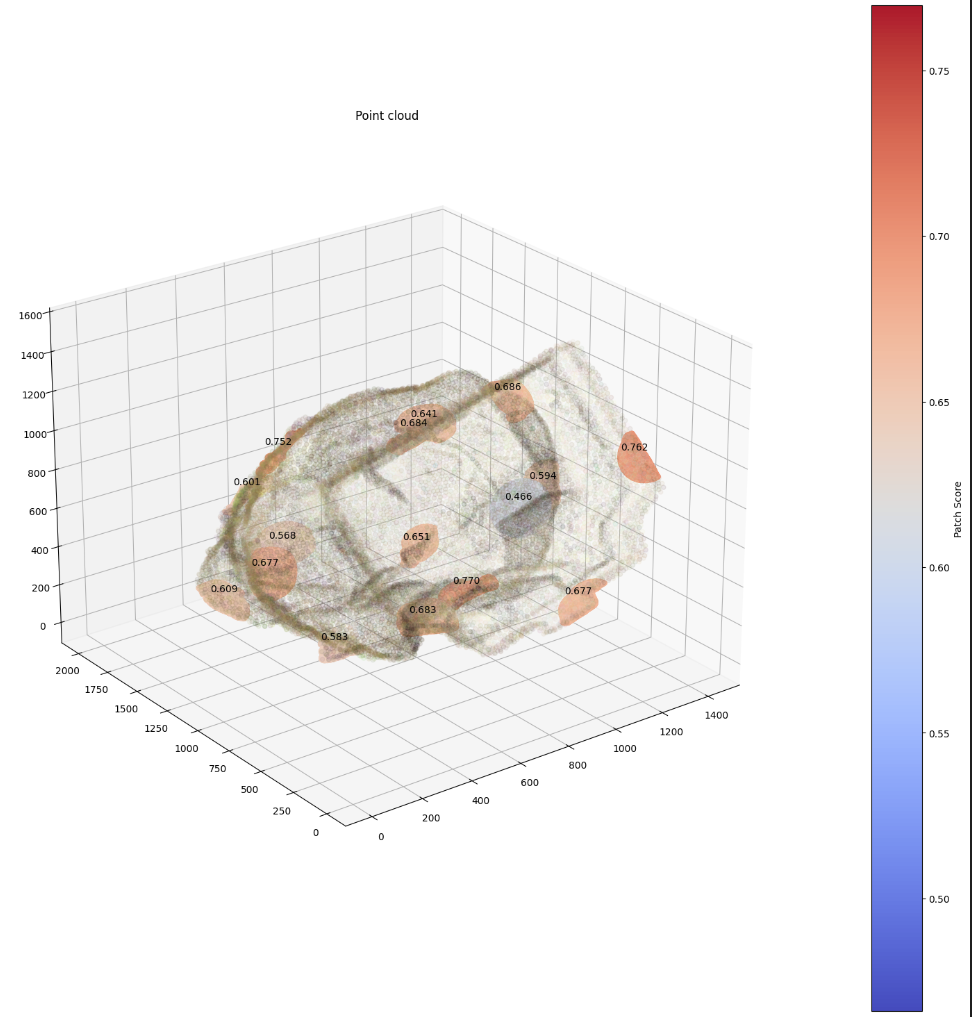
N.B.: The model outputs a normalised score: for the WPC checkpoints, multiply by 100 to get the MOS on the WPC scale (0–100)
Or download the checkpoint from the Hugging Face Hub:
import torch
from huggingface_hub import hf_hub_download
from model import PST_PCQAModule   # from the cloned GitHub repository

K = 16  # use 8 with "PST_PCQAModule_K_8.ckpt"
ckpt_path = hf_hub_download(
    repo_id="michaelneri/PST-PCQA",
    filename=f"PST_PCQAModule_K_{K}.ckpt",
)

model = PST_PCQAModule.load_from_checkpoint(
    ckpt_path,
    map_location="cuda" if torch.cuda.is_available() else "cpu",
    points_texture=8192, points_structure=1024,
    dropout=0.0, patches=K, lr=1e-3,
).eval()

# Shape check with dummy inputs: (batch, K, points, xyz+rgb)
x_b = torch.rand(1, K, 1024, 6, device=model.device)   # structure input
x_s = torch.rand(1, K, 8192, 6, device=model.device)   # texture input
with torch.no_grad():
    mos, mos_per_patch = model(x_b, x_s)
print(mos.shape, mos_per_patch.shape)  # torch.Size([1]) torch.Size([1, 16])
@ARTICLE{Neri_TBC_2025,
   author={Neri, Michael and Battisti, Federica},
   journal={IEEE Transactions on Broadcasting},
   title={Low-Complexity Patch-Based No-Reference Point Cloud Quality Metric Exploiting Weighted Structure and Texture Features},
   year={2025},
   volume={71},
   number={2},
   pages={631-640},
   doi={10.1109/TBC.2025.3553305}
}