

Deep Compression Autoencoder for Efficient High-Resolution Diffusion Models
Paper • 2410.10733 • Published • 9
MLX builds of EfficientViT-SAM, made by Moonbox for Apple Silicon Macs. Each precision is a folder; keep a folder's files together. Only the parts listed below are converted: the rest of the pipeline comes from the original repository unless the section below says otherwise.
The last column is how far each build is from the original PyTorch model on the same inputs (see the section below for what was measured).
| Precision | File | Size | sha256 | Checked against the original |
|---|---|---|---|---|
| bf16 | bf16/config.json |
0.3 kB | 9e98792690f7 |
below threshold (experimental): mask IoU 0.714 mean / 0.091 worst |
| bf16 | bf16/mlx_model.py |
25.4 kB | 42cea84fb312 |
below threshold (experimental): mask IoU 0.714 mean / 0.091 worst |
| bf16 | bf16/model.safetensors |
122.7 MB | e7acc4ef2253 |
below threshold (experimental): mask IoU 0.714 mean / 0.091 worst |
| fp16 | fp16/config.json |
0.3 kB | 9b286f991620 |
below threshold (experimental): mask IoU 0.942 mean / 0.611 worst (float32 port: 0.9996 / 0.997) |
| fp16 | fp16/mlx_model.py |
25.4 kB | 42cea84fb312 |
below threshold (experimental): mask IoU 0.942 mean / 0.611 worst (float32 port: 0.9996 / 0.997) |
| fp16 | fp16/model.safetensors |
122.7 MB | f4b4b159c9f7 |
below threshold (experimental): mask IoU 0.942 mean / 0.611 worst (float32 port: 0.9996 / 0.997) |
EfficientViT-SAM L2 (EfficientViT-L2 image encoder at 512 px + SAM's prompt encoder and mask decoder) ported to
MLX. Each folder holds model.safetensors, config.json and mlx_model.py, the port (only mlx, numpy and
pillow needed), with EfficientViTSamPredictor's interface:
import numpy as np, mlx_model
from PIL import Image
model = mlx_model.load("fp16")
rgb = np.array(Image.open("in.jpg").convert("RGB"))
emb = mlx_model.embed(model, rgb)
masks, scores, low_res, logits = mlx_model.predict(model, emb, points=[[320, 240]], labels=[1], multimask=True)
Both folders are experimental: this model needs float32. Thirty of its 1x1 convolutions are followed by a
BatchNorm with a running variance down to 5.5e-7 (scales up to 600): those channels carry their signal in the 4th-5th
significant digit of the convolution output, which 16-bit weights or arithmetic can't hold. The port itself is exact:
run in float32 (with MLX_ENABLE_TF32=0, else MLX's float32 matmuls use TF32) it matches PyTorch to mask IoU 0.9996.
There are no 8bit / 6bit / 4bit folders: quantized, the model gives no usable masks.
| Precision | Size | Mask IoU vs PyTorch fp32 (mean / worst) | Status |
|---|---|---|---|
fp16/ |
122.7 MB | 0.942 / 0.611 | below threshold (0.95), experimental |
bf16/ |
122.7 MB | 0.714 / 0.091 | below threshold, experimental |
To run in float32, load either folder and cast the parameters up (model.update(mlx.utils.tree_map(lambda a: a.astype(mx.float32), model.parameters()))): fp16 weights in float32 give 0.966 mean / 0.62 worst, still short of
the original's float32 weights. About 55 ms per image (encoder + 2 prompts) on an Apple M5.
From EfficientViT-SAM at revision de7d7733cc: the original weights loaded in MLX and stored as bf16 or fp16, or
quantized with MLX's affine quantization (8bit, 6bit, 4bit, group size 64; layers MLX can't quantize, such as
convolutions and norms, stay bf16). Every build was checked against the original before upload; the sha256 column
above is what the files must hash to.
apache-2.0. These files are a derivative of the original model and carry its license: it is copied in this repository, and it governs your use of these files. The original model card follows unchanged.

Deep Compression Autoencoder (DC-AE) is a new family of high-spatial compression autoencoders with a spatial compression ratio of up to 128 while maintaining reconstruction quality. It accelerates all latent diffusion models regardless of the diffusion model architecture.

Figure 1: We address the reconstruction accuracy drop of high spatial-compression autoencoders.

Figure 2: DC-AE speeds up latent diffusion models.

Figure 3: DC-AE enables efficient text-to-image generation on the laptop: SANA.
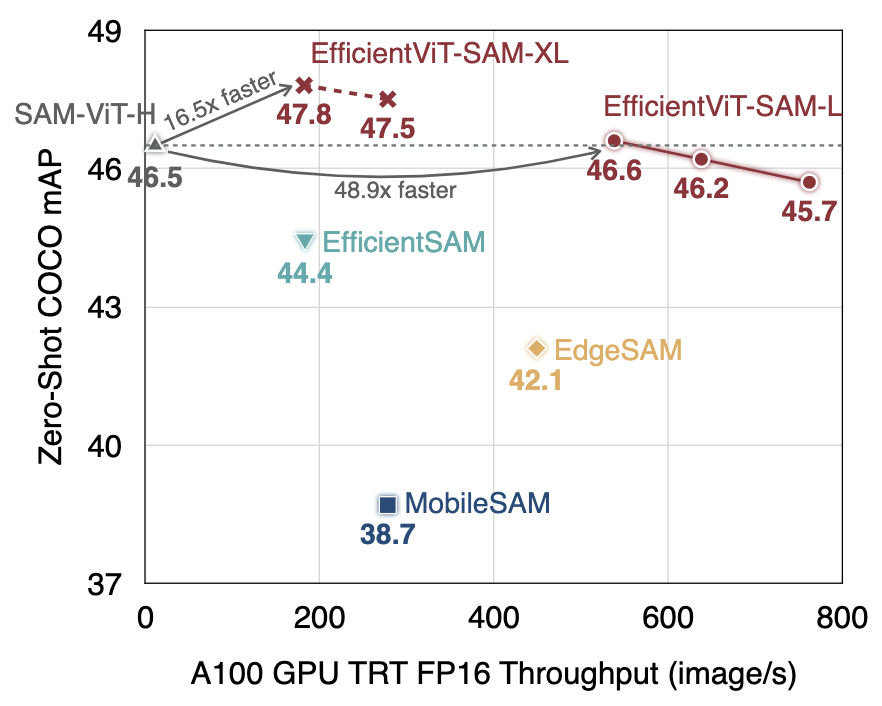
EfficientViT-SAM is a new family of accelerated segment anything models by replacing SAM's heavy image encoder with EfficientViT. It delivers a 48.9x measured TensorRT speedup on A100 GPU over SAM-ViT-H without sacrificing accuracy.
Efficient image classification models with EfficientViT backbones.

Efficient semantic segmantation models with EfficientViT backbones.

Gaze-prompted image segmentation models capable of running in real time with TensorRT on an NVIDIA RTX 4070.

conda create -n efficientvit python=3.10
conda activate efficientvit
pip install -U -r requirements.txt
If EfficientViT or EfficientViT-SAM or DC-AE is useful or relevant to your research, please kindly recognize our contributions by citing our paper:
@inproceedings{cai2023efficientvit,
title={Efficientvit: Lightweight multi-scale attention for high-resolution dense prediction},
author={Cai, Han and Li, Junyan and Hu, Muyan and Gan, Chuang and Han, Song},
booktitle={Proceedings of the IEEE/CVF International Conference on Computer Vision},
pages={17302--17313},
year={2023}
}
@article{zhang2024efficientvit,
title={EfficientViT-SAM: Accelerated Segment Anything Model Without Performance Loss},
author={Zhang, Zhuoyang and Cai, Han and Han, Song},
journal={arXiv preprint arXiv:2402.05008},
year={2024}
}
@article{chen2024deep,
title={Deep Compression Autoencoder for Efficient High-Resolution Diffusion Models},
author={Chen, Junyu and Cai, Han and Chen, Junsong and Xie, Enze and Yang, Shang and Tang, Haotian and Li, Muyang and Lu, Yao and Han, Song},
journal={arXiv preprint arXiv:2410.10733},
year={2024}
}
Quantized
# Download the model from the Hub
pip install huggingface_hub[hf_xet]

hf download moonbox-ai/efficientvit-MLX --local-dir efficientvit-MLX