

X-ray Customs Security Detection — Multi-Model YOLO Ensemble
An end-to-end computer vision system that detects prohibited and suspicious items in X-ray baggage scans, built for customs and airport security screening. The project merges 9 public X-ray datasets into one unified taxonomy, trains 7 specialized YOLOv8 models, and serves them through a single web interface that runs all models on every image and merges their results in real time.
Overview
Security X-ray screening is a classic multi-class object detection problem, but with a twist: the objects of interest range from knives and firearms to lighters, power banks, and liquids — categories that look nothing alike and don't share visual features. Instead of forcing one model to learn all 38 classes at once, this project takes a divide-and-specialize approach:
- 7 independent YOLOv8 models, one per object category, each trained only on its own group of visually related classes.
- A Gradio ensemble interface that runs every uploaded scan through all 7 models simultaneously, then merges overlapping detections using IoU-based filtering — keeping only the highest-confidence box per object.
- A fully reproducible data pipeline that standardizes, cleans, merges, and splits 9 heterogeneous public X-ray datasets into one consistent, trainable format.
The result is a system where any single category can be retrained or improved independently, without retouching the other six models.
Why 7 Models Instead of 1?
| Criterion | Single Model (38 classes) | 7 Models + Ensemble (this project) |
|---|---|---|
| Per-category accuracy | Lower — confuses visually unrelated classes | Higher — each model specializes in one coherent category |
| Inference time per image | Faster (one pass) | Slower (7 passes + merge step) |
| Retraining a single category | Requires retraining everything | Only the affected model needs retraining |
Data Pipeline
The training data comes from 9 public X-ray datasets (HiXray, GDXray-Baggages, ClCXray, DvXray, HUMSXray, X-ray Contraband, OPIXray, SiXray, and LDXray), each originally published in a different annotation format — custom CSV, COCO JSON, Pascal VOC XML, and pre-formatted YOLO. LDXray was fully converted but excluded from the final training set due to bounding boxes that didn't match object scale.
The raw sources were processed through a 6-stage pipeline:
- Dataset Collection — sourcing and validating 9 public X-ray datasets.
- Format Standardization — a dedicated converter per source, normalizing every annotation format into the standard YOLO
class x_center y_center width heightformat. - Data Cleaning — automated match-checking between images and labels, with a strict report → confirm → delete workflow to safely remove orphan files.
- Merging & Taxonomy — a unified taxonomy dictionary mapping every source-specific class alias (e.g.
knife,Knife,KnifeCustom) to one final class ID, so adding a new dataset later only requires adding its aliases. - Stratified Train/Val/Test Split (70/15/15) — a custom greedy, per-class-balanced splitting algorithm that processes rarest classes first, ensuring even rare categories are represented in every split.
- Ready-for-Training Packaging — each category shipped as a self-contained package (images, labels,
classes.txt,dataset.yaml,train.py).
Classes & Taxonomy
7 main categories · 38 total classes, aggregated from overlapping labels across all 9 source datasets.
| Category | # Classes | Classes |
|---|---|---|
| Weapons | 5 | Bat, Baton, Bullet, Gun, HandCuffs |
| Tools | 4 | Hammer, Plier, Screwdriver, Wrench |
| Liquids & Cans | 7 | Cans, CartonDrinks, GlassBottle, PlasticBottle, Tin, VacuumCup, Water |
| Sharp Objects | 12 | Blade, Dagger, Dart, Folding Knife, Knife, Multi-tool Knife, Razor Blade, Saw Blade, Scissors, Straight Knife, SwissArmyKnife, Utility Knife |
| Explosives & Flammable | 7 | Battery, Fireworks, Lighter, Nonmetallic Lighter, Pressure Vessel, SprayCans, Sprayer |
| Cosmetic | 1 | Cosmetic |
| Electronics | 4 | Laptops, Mobile phones, PowerBank, Tablet |
The full numbered class list for every model is available in
all_classes.txt.
Model Training
Each of the 7 models is trained independently with transfer learning, starting from COCO-pretrained YOLOv8m weights — chosen as a balance between speed and accuracy for a moderate number of classes per category. Key training choices:
- 30 epochs with early stopping (patience = 15) to prevent overfitting.
- Cosine learning rate schedule for smooth decay.
- Mosaic (1.0) and Mixup (0.1) augmentation to improve detection of small and partially occluded objects — common in cluttered baggage scans.
- Checkpoints saved every 5 epochs, not just best/last.
The same training script is reused for all 7 categories by simply pointing it to a different dataset config and output path — no code duplication.
Multi-Model Ensemble Detection Interface
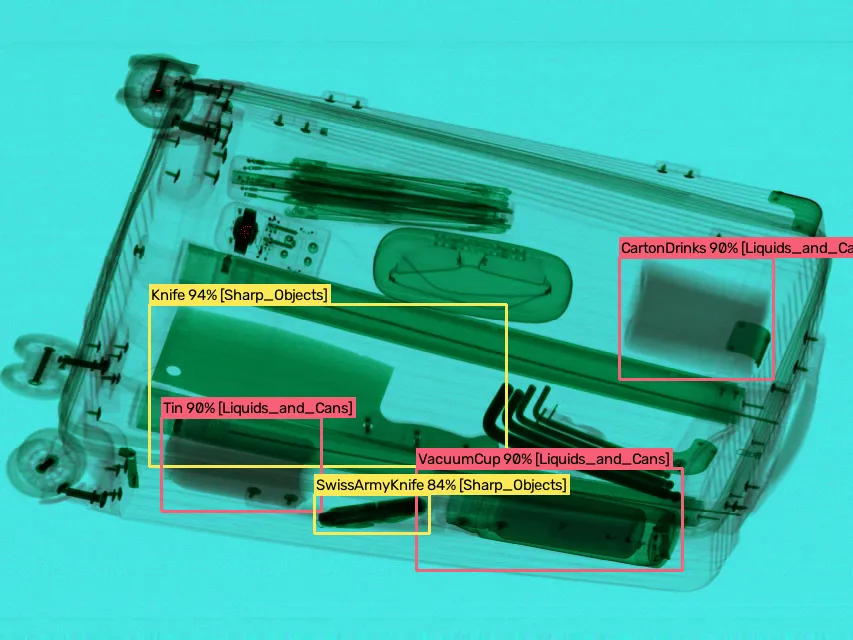
A single X-ray scan can contain items from several categories at once (e.g. a weapon and a liquid in the same bag). Rather than picking one model, the app runs all 7 models on every uploaded image simultaneously, then merges the results:
- All 7
.ptmodel files are loaded once at startup (not per-request) for fast inference. - Every detection's box is compared against every other using IoU (Intersection over Union).
- Detections are sorted by confidence; any box that overlaps an already-accepted higher-confidence box beyond the IoU threshold is discarded — keeping only the best detection per real-world object.
- Results are rendered on a Gradio web interface with adjustable confidence and IoU-merge sliders for interactive control.

Each model is assigned a fixed, consistent color for its bounding boxes, so the source model of any detection is visible at a glance directly on the output image.