| --- |
| license: cc-by-4.0 |
| library_name: pytorch |
| tags: |
| - anomaly-detection |
| - industrial-inspection |
| - patchcore |
| - visa |
| --- |
| |
| # DefectLens: PatchCore models for VisA product categories |
|
|
| ## Links |
|
|
| - Source code: <https://github.com/pavan-dangeti/DefectLens> |
| - Release v1.0.0: <https://github.com/pavan-dangeti/DefectLens/releases/tag/v1.0.0> |
| - Demo recording: <https://raw.githubusercontent.com/pavan-dangeti/DefectLens/main/docs/media/demo.gif> |
|
|
| 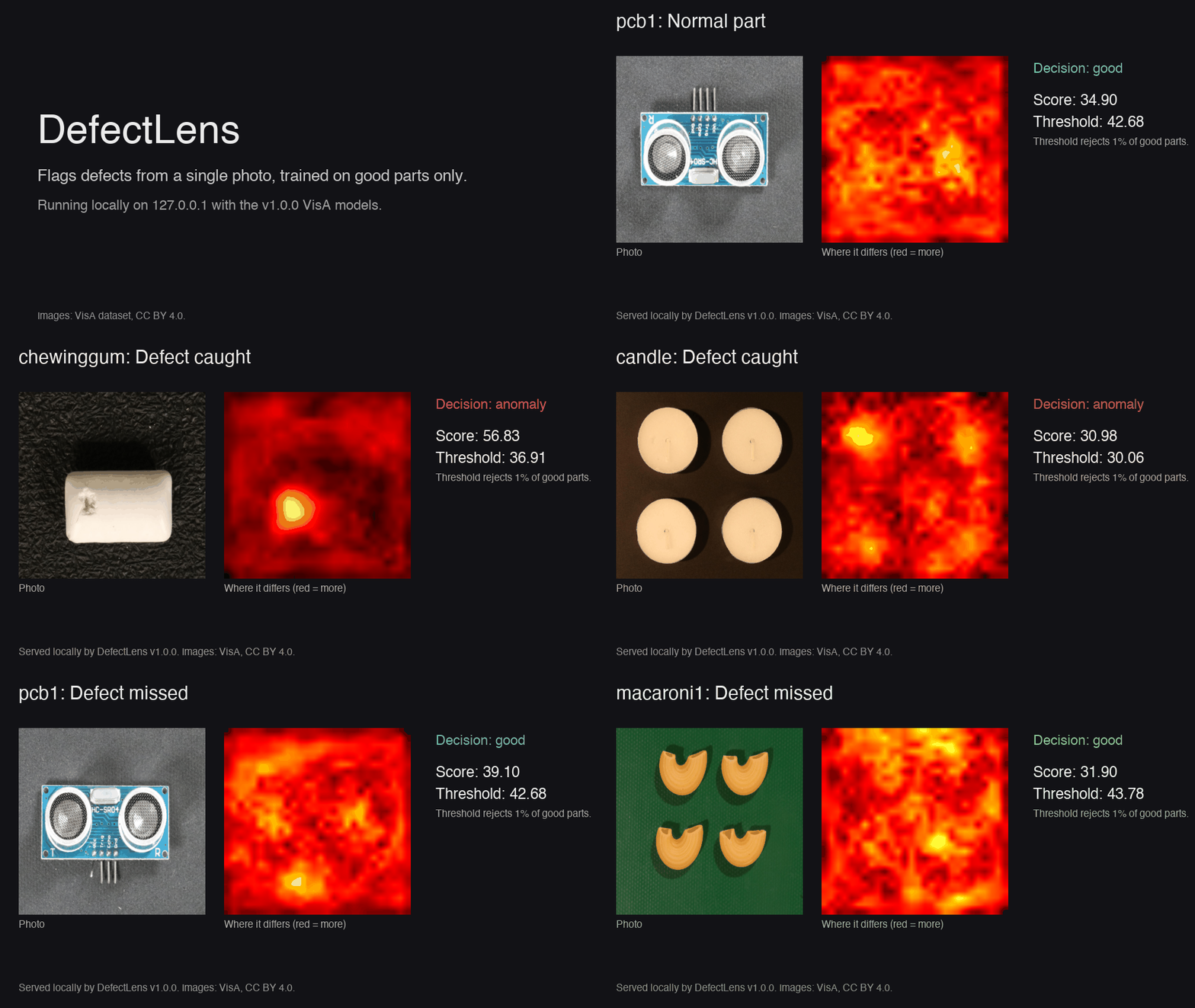 |
|
|
| Demo recorded from the local service with these weights. Source and video: <https://github.com/pavan-dangeti/DefectLens>. |
|
|
| Per-category PatchCore models that flag defects on manufactured parts. Each model is trained only on |
| images of **good** parts; no defective examples are used, in fitting or in calibration. |
|
|
| Source code: <https://github.com/pavan-dangeti/DefectLens> (release v1.0.0). |
|
|
| ## Model details |
|
|
| - **Method.** PatchCore: frozen ImageNet-pretrained WideResNet-50 features from layers 2 and 3, |
| average-pooled, concatenated (1536 dimensions per patch). The memory bank of nominal patch features |
| is reduced by greedy k-centre coreset selection, and each patch is scored by its nearest neighbour in |
| the bank. |
| - **Input.** An RGB image, resized to 256 by 256 and centre-cropped to 224 by 224, normalised with the |
| ImageNet statistics. Grayscale, CMYK and palette images are converted. |
| - **Output.** An image anomaly score, a pixel-level score map, and a decision: `good` or `anomaly`, from |
| a per-category threshold. |
| - **Threshold.** Calibrated on a held-out 10% of the good images to reject 1% of good parts (target |
| false-reject rate 1%). |
| - **Coreset ratio.** 0.01 for every category in these weights (`configs/coreset.yaml`). |
| - **Artefact format.** `torch.save` dictionary with the coreset, the threshold and the configuration, |
| loaded with `weights_only=True`. Each file has a SHA-256 sidecar that the service checks before loading. |
| - **Version.** 1.0.0. |
|
|
| ## Training data |
|
|
| The VisA dataset from Amazon Science (`github.com/amazon-science/spot-diff`), 12 categories, released |
| under **CC BY 4.0** (verified on the dataset's official page, 2026-10-30). The weights use the good |
| images of the training split. They contain feature vectors computed from those images, not the images |
| themselves. The 80% of good images used for fitting and the 10% used for calibration are drawn with |
| seed 0. |
|
|
| These weights are derived from VisA and carry the same licence. Credit VisA when you reuse them, with |
| this citation, as given on the dataset's official page: |
|
|
| > Zou, Yang and Jeong, Jongheon and Pemula, Latha and Zhang, Dongqing and Dabeer, Onkar. *SPot-the-Difference |
| > Self-Supervised Pre-training for Anomaly Detection and Segmentation.* arXiv:2207.14315, 2022 (ECCV 2022). |
|
|
| **No weights fitted on MVTec AD are included.** MVTec AD is licensed CC BY-NC-SA 4.0 (non-commercial only, |
| verified on its official page). It is used here only as a research benchmark, and the benchmark numbers in |
| this card are not weights. This card and its weights are CC BY 4.0. |
|
|
| ## Backbone |
|
|
| The feature extractor is timm's `wide_resnet50_2`, loaded with `pretrained=True`. timm's default weights |
| for this architecture are the `racm_in1k` tag (`timm/wide_resnet50_2.racm_in1k` on the Hugging Face Hub), |
| not the torchvision weights. Its licence is **Apache-2.0**. It was trained on ImageNet-1k with the |
| timm "RACM" recipe from *ResNet Strikes Back* (arXiv:2110.00476), on the Wide Residual Network architecture |
| (arXiv:1605.07146). This release does not redistribute the backbone weights: they are downloaded from the |
| Hub when the service starts. |
|
|
| ImageNet-1k is a dataset with its own terms, which as commonly stated restrict it to non-commercial research |
| use. The ImageNet terms were not re-fetched for this card. Whether those terms apply to weights trained on |
| it is not settled here. Confirm it before any commercial use of |
| the service. |
|
|
| ## Evaluation |
|
|
| Three seeds (0, 1, 2) per category. Each seed re-draws the 80 / 10 / 10 split of the good training |
| images. The test set is the benchmark's own test split. Intervals are 95% Student-t intervals across seeds. |
|
|
| | Dataset | Categories | Image AUROC | Pixel AUROC | AUPRO | Escape rate at 1% FRR | |
| |---|---|---|---|---|---| |
| | VisA | 12 | 0.891 ± 0.017 | 0.954 ± 0.025 | 0.736 ± 0.078 | 0.446 ± 0.069 | |
|
|
| Per-category results are in the repository's `results/evaluation/tables.md`. The spread is wide: the |
| weakest VisA categories are `capsules` (image AUROC 0.676 ± 0.028) and `macaroni2` (0.679 ± 0.051). |
|
|
| These numbers are above the 0.5 chance level but below the published VisA PatchCore reference (Real-IAD |
| paper, Table 2: image AUROC 0.951, AUPRO 0.912, reproduced with Anomalib). The protocol differs in the |
| coreset ratio, the fit split and the AUPRO integration; see the repository README. |
|
|
| **The escape rate is high for several categories.** At a 1% false-reject target, `macaroni2` lets 0.91 of |
| its defects through and `macaroni1` 0.79. A decision from these models is not a substitute for human |
| inspection where a missed defect is costly. |
|
|
| ## Intended use |
|
|
| - Screening: flagging parts for a human to inspect, to reduce the inspection load. |
| - Onboarding a new product line from good images only, as a first model before defect data exists. |
|
|
| ## Out of scope |
|
|
| - Autonomous rejection or acceptance without human review. |
| - Categories other than the 12 VisA categories these weights were fitted on. A new category needs its own |
| fit and calibration. |
| - Rotated, heavily blurred, or extremely lit images: these are flagged as low confidence by the service, |
| but rotation is not detected. |
| - Defects the training data never showed on good parts: the models only know what nominal looks like. |
|
|
| ## Limitations and known gaps |
|
|
| - PaDiM, the baseline, has no measured result in this release. |
| - The MMD distribution-shift check is not implemented; drift monitoring uses a KS test on scores and a |
| decision-rate alert. |
| - The anomalib configuration has been compared only on MVTec AD, not on VisA. |
| - Latency and memory were measured on Apple Silicon. The 2-core ARM target host has not been measured. |
| - Thresholds are calibrated on 45 to 91 good images per VisA category. The achieved false-reject rate on |
| held-out data departs from 1% for some categories. |
|
|
| ## How to reproduce |
|
|
| ```bash |
| uv sync |
| uv run defectlens data download visa |
| uv run defectlens fit --root data/visa --category <name> --out <registry-dir> |
| uv run python results/evaluation/run.py --dataset visa --seeds 0 1 2 |
| ``` |
|
|

