
Spaces:
Sleeping


title: Protest Segments
emoji: 🔍
colorFrom: yellow
colorTo: gray
sdk: docker
suggested_hardware: t4-small
pinned: false
license: apache-2.0
Protest Segments
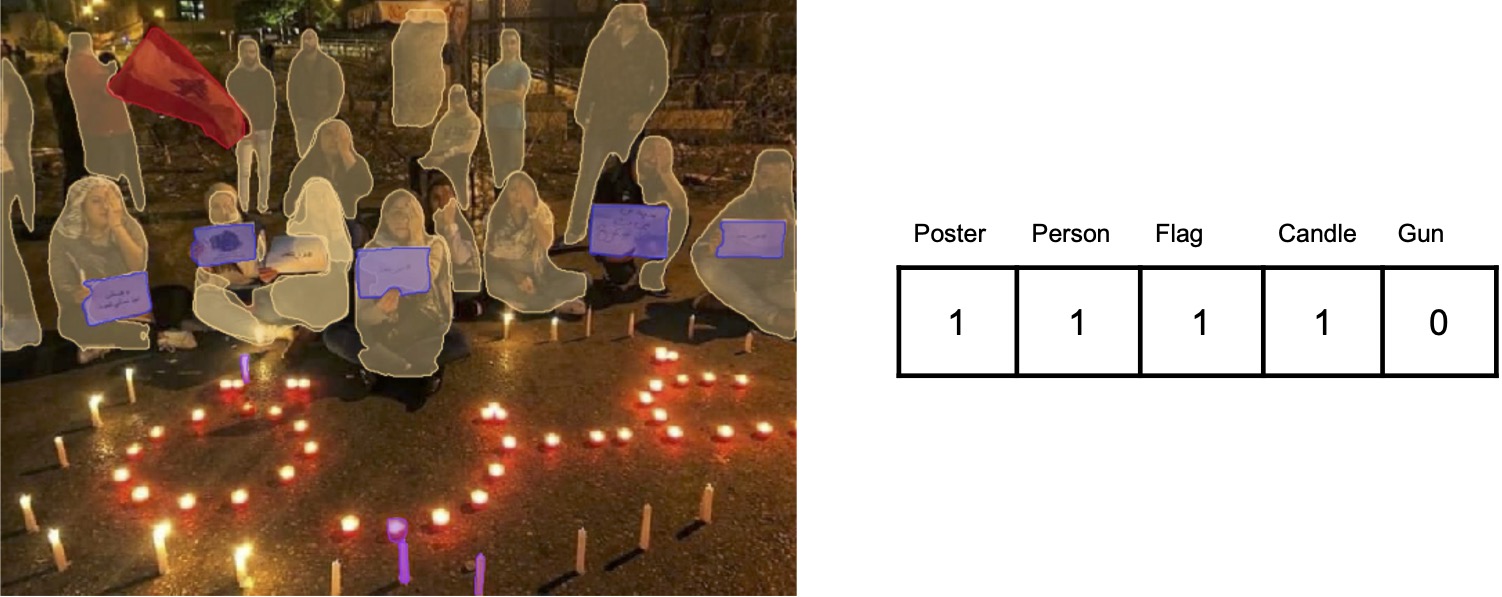
Protest segments is a two-level classification method that detects the segments present in images and aggregates them into feature vectors, which are then used in the second level by a standard machine learning classifiers to discriminate between images. It was introduced in the paper "Improving Computer Vision Interpretability: Transparent Two-level Classification for Complex Scenes" and demonstrated in this repository.
Paper · Code · Demo · Data
Getting Started
If you just want to try out our method with a couple of your images, we recommend you to view the demo. The demo allows you to upload an image, define a vocabulary of objects, an aggregation, and returns the segmented image and the respective feature vector.
Even if you want to generate these vectors for a larger number of images, you don't have to go through the following installation on your personal computer. Instead, you can use the demo via API, for which you only need to install the Gradio client for Python and follow the below Python code snippet to obtain the vector for a sample image.
⚠️ If you want to use the same segmentation models as in the paper, then you have to duplicate this space in a space environment with GPU accelerator.
Install the Gradio client for Python.
pip install gradio_client
Execute the below Python code snippet to obtain the feature vector for a sample image.
from gradio_client import Client, file

client = Client("https://ciass-protest-segments.hf.space/")
result = client.predict(
        image=file("https://raw.githubusercontent.com/ciass-konstanz/protest-segments/main/docs/demo.jpg"),
        vocabulary="COCO",
        feature_aggregation="count",
        api_name="/predict"
)
print(result)
License
The project's code is distributed under the Apache 2.0 License, while its data and model weights are distributed under the CC-BY-4.0 License.
Citation
If you find this project and its materials useful, please cite our paper.
@article{
    scholz2025improving,
    title={Improving Computer Vision Interpretability: Transparent Two-Level Classification for Complex Scenes},
    volume={33},
    DOI={10.1017/pan.2024.18},
    number={2},
    journal={Political Analysis},
    author={Scholz, Stefan and Weidmann, Nils B. and Steinert-Threlkeld, Zachary C. and Keremoğlu, Eda and Goldlücke, Bastian},
    year={2025},
    pages={107–121}
}