

🔥 UPDATED — tokenizer refreshed & quantization improved:
layer-0 dense MLP and shared experts now preserved in BF16
Chat Template from: https://huggingface.co/sanjxz/Laguna-S-2.1-Agentic-Chat-Template-Jinja 🔥
Linear-RFA 4-bit quant of poolside/Laguna-S-2.1
This is
tcclaviger/Laguna-S-2.1-RFA_L— an RFA 4-bit quantization of Poolside's Laguna-S-2.1. The_L(linear-only) build quantizes the MLP and expert linear layers to 4-bit (IQ4_NL grid, group 16, Hadamard-16 rotation, asymmetric block-float scales) while keeping all attention, the router gate, the lm_head, the layer-0 dense MLP, and the shared experts in bf16. 71.2 GB total, 4.504 bits/weight. All credit for the model to Poolside; this repo only changes the numerics. The full original model card is preserved verbatim below.Runtime: requires
tcclaviger/vllm:latest— an RDNA 4 (gfx12xx) vLLM image and the only build with the RFA kernels; no other vLLM build loads these weights. Not validated on any other hardware at this time.DFlash speculative decoding works with this RFA checkpoint. Pair it with the Laguna-S-2.1-DFlash draft model exactly as documented in the vLLM section below — the RFA quant does not touch the attention path, so the DFlash draft head runs unchanged.
**DRY has been incorportaed if desired into the docker image as has repetition blocking guard, two layers of protention. See the help for DRY parameters.
Evaluation results (this RFA quant)
Eval Result Throughput 80.6 tok/s out @ conc 1 (DFlash accept ~2.1); 615.7 tok/s out @ conc 50, ISL 512 WikiText-2 PPL 8.109 ± 0.043 (n_ctx 2048, llama.cpp-compatible) Loglikelihood acc arc_challenge 0.503 / arc_easy 0.769 / winogrande 0.658 / hellaswag 0.814 (acc_norm) tool-eval-bench (no-think) 89/100 (full 69 scenarios) GSM8K / MMLU / IFEval 90% / 60% / 95% (prompt-level) Long-context code recall 0.980 overall (py 1.00 / js 0.93 / rs 0.99 / cpp 1.00); tool pass 93.5% Hard Mode agentic (thinking-ON) 73/100 — 10 pass / 2 partial / 3 fail Test harnesses:
vllm bench serve(random dataset, saturation sweep) · llama.cpp-compatible WikiText-2 perplexity · lm-evaluation-harness (loglikelihood, local-completions) · tool-eval-bench v2 (69 scenarios + GSM8K/MMLU/IFEval + 15 Hard Mode scenarios) · codeneedle (positional recall, 4 corpora + tool pass).Hardware:
tcclaviger/vllm:latest, 4× AMD AI PRO R9700 GPUs (TP4), Ryzen 9 9950X, 256 GB DDR5-6000. (Not yet fully tuned for throughput.)
Use on OpenRouter · Use on Vercel AI Gateway · Release blog post
Laguna S 2.1
Laguna S 2.1 is a 118B total parameter Mixture-of-Experts model with 8B activated parameters per token, designed for agentic coding and long-horizon work. It sits between Laguna XS 2.1 (33B-A3B) and Laguna M.1 (225B-A23B) in the Laguna series and shares the family recipe: a token-choice router with softplus gating over 256 routed experts plus one shared expert, grouped-query attention, and interleaved full/sliding-window attention.
Highlights
- Mixed SWA and global attention layout: 48 layers in a 1:3 global-to-SWA ratio (12 global attention layers, 36 sliding-window layers, window 512), with softplus attention gating and per-layer-type rotary scales
- 1M context: 1,048,576-token context window
- Native reasoning support: interleaved thinking between tool calls, with
per-request control via
enable_thinking - Speculative decoding: a trained DFlash draft model is available for lower-latency serving
- Quantized variants: FP8, NVFP4, INT4 and GGUF
- OpenMDW-1.1 license: Use and modify the model and associated materials freely for commercial and non-commercial purposes (learn more about OpenMDW)
Model overview
- Number of parameters: 118B total, ~8B activated per token
- Layers: 48 (12 global attention, 36 sliding-window attention)
- Experts: 256 routed (top-10) plus 1 shared expert
- Attention: grouped-query, 8 KV heads, head dim 128; per-head softplus output gating
- Sliding window: 512 tokens
- Context window: 1,048,576 tokens
- Vocabulary: 100,352 tokens (Laguna family tokenizer)
- Modality: text-to-text
- Reasoning: interleaved thinking with preserved thinking
Benchmark results
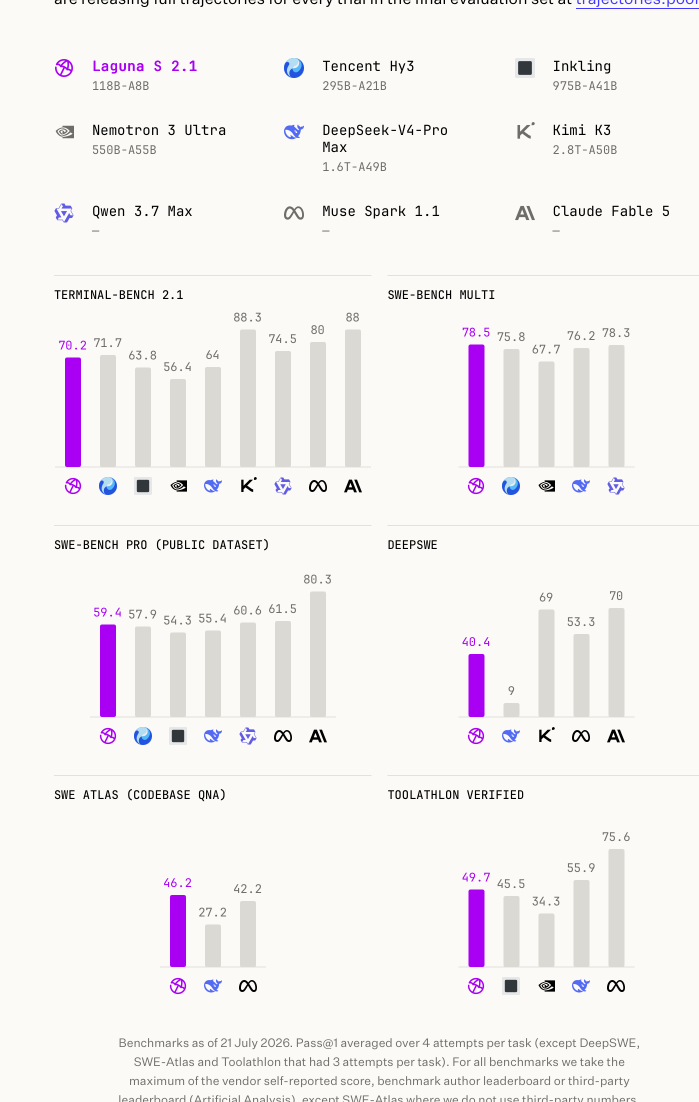
| Model | Size | Terminal-Bench 2.1 | SWE-bench Multilingual | SWE-Bench Pro (Public Dataset) | DeepSWE | SWE Atlas (Codebase QnA) | Toolathlon Verified |
|---|---|---|---|---|---|---|---|
| Laguna S 2.1 | 118B-A8B | 70.2% | 78.5% | 59.4% | 40.4% | 46.2% | 49.7% |
| Tencent Hy3 | 295B-A21B | 71.7% | 75.8% | 57.9% | - | - | - |
| Inkling | 975B-A41B | 63.8% | - | 54.3% | - | - | 45.5%* |
| Nemotron 3 Ultra | 550B-A55B | 56.4% | 67.7% | - | - | - | 34.3%* |
| DeepSeek-V4-Pro Max | 1.6T-A49B | 64.0%* | 76.2% | 55.4% | 9.0%* | 27.2%* | 55.9%* |
| Kimi K3 | 2800B-A50B | 88.3% | - | - | 69% | - | - |
| Qwen 3.7 Max | - | 74.5%* | 78.3% | 60.6% | - | - | - |
| Muse Spark 1.1 | - | 80% | - | 61.5% | 53.3% | 42.2%* | 75.6% |
| Claude Fable 5 | - | 88% | - | 80.3% | 70% | - | - |
Benchmarks as of 21 July 2026. Laguna S 2.1 in bold; a dash (-) marks a benchmark a model was not evaluated on. Scores marked * are as reported by third parties: Terminal-Bench 2.1 and DeepSWE via Artificial Analysis, SWE Atlas via Scale AI's official leaderboard, and Toolathlon Verified via its official leaderboard. Full evaluation trajectories: trajectories.poolside.ai.
Usage
Laguna S 2.1 uses the same laguna architecture as Laguna XS 2.1, so the same
engine integrations apply (vLLM, SGLang, Transformers, TRT-LLM, llama.cpp). At 118B
parameters the BF16 checkpoint needs multiple GPUs (roughly 236GB of weights);
quantized variants reduce this substantially.
vLLM
vllm serve \
    --model poolside/Laguna-S-2.1 \
    --tensor-parallel-size 4 \
    --tool-call-parser poolside_v1 \
    --reasoning-parser poolside_v1 \
    --enable-auto-tool-choice \
    --served-model-name laguna \
    --default-chat-template-kwargs '{"enable_thinking": true}'
Optional: speculative decoding with DFlash. Pair with the Laguna S 2.1 DFlash draft model by adding
--speculative-config '{"model":"poolside/Laguna-S-2.1-DFlash","num_speculative_tokens":7,"method":"dflash"}'.
SGLang
python -m sglang.launch_server \
  --model-path poolside/Laguna-S-2.1 \
  --tp-size 4 \
  --reasoning-parser poolside_v1 \
  --tool-call-parser poolside_v1 \
  --trust-remote-code
TRT-LLM
trtllm-serve poolside/Laguna-S-2.1 --trust-remote-code \
    --tool_parser poolside_v1 --reasoning_parser laguna
Note the flag names differ from vLLM's (--tool_parser, and the reasoning parser
is laguna, not poolside_v1).
llama.cpp
GGUF conversions are available at
poolside/Laguna-S-2.1-GGUF.
Serve with poolside's llama.cpp fork, branch
laguna, which carries
full Laguna support including DFlash speculative decoding. (Base Laguna support
is also in upstream review:
ggml-org/llama.cpp#25165.)
git clone --branch laguna https://github.com/poolsideai/llama.cpp
cd llama.cpp && cmake -B build && cmake --build build -j

./build/bin/llama-server -m laguna-s-2.1-Q4_K_M.gguf --jinja --port 8000

# with DFlash speculative decoding:
./build/bin/llama-server -m laguna-s-2.1-Q4_K_M.gguf \
  -md laguna-s-2.1-DFlash-BF16.gguf \
  --spec-type draft-dflash --spec-draft-n-max 7 -fa on --jinja --port 8000
Controlling reasoning
Laguna S 2.1 has native reasoning support and works best with preserved thinking:
keep reasoning_content from prior assistant messages in the message history.
The model will generally reason before calling tools and between tool calls, and
may stop reasoning in follow-up steps if prior thinking blocks are dropped.
Thinking is controlled per request via the chat template:
extra_body={"chat_template_kwargs": {"enable_thinking": False}}
or at the server level with
--default-chat-template-kwargs '{"enable_thinking": true}'. For agentic coding
use cases we recommend enabling thinking and preserving reasoning in the message
history.
License
This model is licensed under the OpenMDW-1.1 License.
Intended and Responsible Use
Laguna S 2.1 is designed for software engineering and agentic coding use cases, and you are responsible for confirming that it is appropriate for your intended application. Laguna S 2.1 is subject to the OpenMDW-1.1 License, and should be used consistently with Poolside's Acceptable Use Policy. We advise against circumventing Laguna S 2.1 safety guardrails without implementing substantially equivalent mitigations appropriate for your use case.
Please report security vulnerabilities or safety concerns to security@poolside.ai.
- Downloads last month
- 40
Model tree for tcclaviger/Laguna-S-2.1-RFA_L
Base model
poolside/Laguna-S-2.1