

KOMOS: Automatic Mean Opinion Score Estimation for Korean Speech
Paper • 2610.15353 • Published
Automatic Mean Opinion Score Estimation for Korean Speech



KOMOS is a Korean mean opinion score predictor for overall speech quality across read and spontaneous speech. It combines a fully fine-tuned Whisper-medium encoder with a listener-conditioned prediction head and returns a score on the 1–5 MOS scale.
On the Korean test set, KOMOS follows the human MOS scale more closely than UTMOS v1.
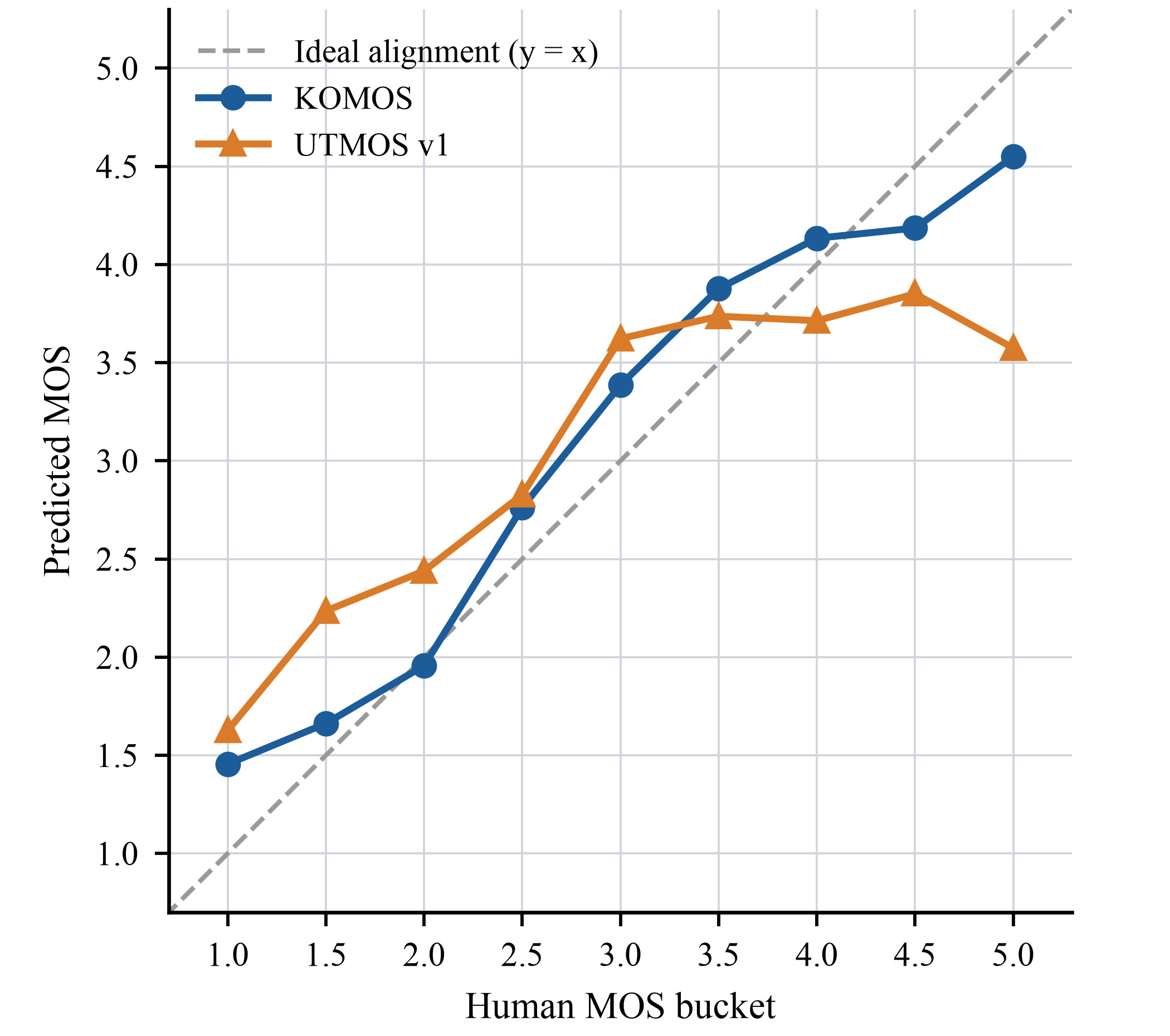
Mean predicted MOS by human-MOS bucket after validation-set affine calibration. The dashed line shows ideal alignment.
Utterance-level correlation with human MOS on the 100 utterance test set. UTMOS v1 and v2 are evaluated as English-trained zero-shot baselines, while KOMOS is fine-tuned on Korean quality ratings.
| Model | Test SRCC ↑ | Test LCC ↑ |
|---|---|---|
| UTMOS v1 | 0.703 | 0.798 |
| UTMOS v2 | 0.767 | 0.858 |
| KOMOS | 0.900 | 0.950 |
Utterance-level SRCC on test subsets whose speakers or texts are absent from both the training and validation sets.
| Model | Overall ↑ | Speaker-disjoint ↑ | Text-disjoint ↑ |
|---|---|---|---|
| UTMOS v1 | 0.703 | 0.818 | 0.719 |
| UTMOS v2 | 0.767 | 0.823 | 0.778 |
| KOMOS | 0.900 | 0.951 | 0.878 |
Python 3.10 or later is required.
Install KOMOS from PyPI:
pip install komos
To work from a local checkout instead:
git clone https://github.com/upskyy/komos.git
cd komos
uv sync --no-dev
from komos import KOMOS

model = KOMOS.from_pretrained("upskyy/komos").eval()
score = model.score("audio.wav")
print(score)
Move the model to CUDA with model.to("cuda") when GPU inference is needed.
import torch

model = torch.hub.load("upskyy/komos:v0.0.2", "komos", trust_repo=True)
print(model.score("audio.wav"))
pip install "komos[onnx]"
from komos.onnx import KOMOSOnnx

model = KOMOSOnnx.from_pretrained("upskyy/komos")
score = model.score("audio.wav")
print(score)
score() accepts an audio path or a mono NumPy array or PyTorch tensor with an explicit sample rate. File inputs are downmixed to mono and resampled to 16 kHz.
score() evaluates up to the first 10 seconds and returns a validation-calibrated score clipped to the 1–5 range.score_long_form() supports recordings of up to 60 seconds and computes a duration-weighted mean of raw scores from non-overlapping 10-second chunks before calibration.If you use KOMOS in your research, please cite:
@misc{ha2026komos,
  title         = {KOMOS: Automatic Mean Opinion Score Estimation for Korean Speech},
  author        = {Sangchun Ha and Junwon Moon and Kyuhong Shim},
  year          = {2026},
  eprint        = {2610.15353},
  archivePrefix = {arXiv},
  primaryClass  = {eess.AS},
  url           = {https://arxiv.org/abs/2610.15353},
}
KOMOS is released under the MIT License. See LICENSE and NOTICE.
Base model
openai/whisper-medium