

Pev
Collection
Calibrated fast-decision model for personal agents: Pev-27B, the Pev-Bench benchmark, tech report and leaderboard. • 3 items • Updated
This repository is publicly accessible, but you have to accept the conditions to access its files and content.
This adapter was trained on text that quotes third-party reviews and emails and on LLM-rendered data; it is released for non-commercial research use only (CC-BY-NC-4.0 with the additional conditions in LICENSE.md). By requesting access you agree to use it for non-commercial research only, not to use it to identify, contact or profile the people quoted in its training data, and to cite the technical report and the data sources.
Log in or Sign Up to review the conditions and access this model content.
Paper (PDF) · Code · Dataset · Leaderboard · Collection
Pev-27B is a LoRA adapter for Qwen3.8-27B (revision
1d4bf0f2ff6012fd82039f2fa52739d0dd7c60c0) that answers typed decision questions for a personal agent with long-term
memory, with calibrated probabilities. It was trained and evaluated on
Pev-Bench; code, pre-registration, results and the
technical report are in the Pev repository. Authors: EnvLoop Research
(research@envloop.ai).
qwen-adapter.tar.gz, SHA-256
6b07a7d36eba59b9cfd9cf440bdc5783f4fc12d4d726cfa5beef2462860d8d81 (per-file hashes in release-manifest.json).| File | What |
|---|---|
adapter_config.json, adapter_model.safetensors |
The LoRA (PEFT 0.21; r 16, alpha 32; 992 tensors) |
tokenizer.json, tokenizer_config.json, chat_template.jinja |
Saved with the adapter; identical in use to the base model's tokenizer and chat template |
temperature.json |
Calibration temperature fitted on VAL by NLL: T = 2.772 |
thresholds.json |
Automation threshold for a 5% error budget, fitted on VAL: 0.369 |
usage_example.py |
Loads base + adapter and prints the calibrated distribution for each question of a record |
release-manifest.json |
Archive and per-file SHA-256, base revision, template hash, training-row hash |
One question per prompt. The prompt is the base model's chat template (thinking disabled) around the frozen
direct template (packages/decision-eval/decision_eval/templates/direct.txt in the code repository): the state, the
question, and the options with single-token labels — A, B, … for choices, no/yes for yes/no questions, 0…3
for scores. The prediction is the softmax over the label tokens' next-token log-probabilities divided by the
temperature fitted on VAL (T = 2.772 for this adapter; T = 1.675 for the zero-shot base). Do not use free
generation: build prompts with the code repository's render_prompt, which renders them byte-identically to training
and evaluation.
# pip install "decision-eval @ git+https://github.com/EnvLoop/Pev#subdirectory=packages/decision-eval"
import json, torch
from huggingface_hub import snapshot_download
from peft import PeftModel
from transformers import AutoModelForCausalLM, AutoTokenizer
from decision_eval.conventions import question_keys
from decision_eval.prompts import MODEL, REVISION, render_prompt, verify_labels   # Qwen/Qwen3.8-27B @ 1d4bf0f2

adapter = snapshot_download("EnvLoop/Pev-27B-LoRA")
tok = AutoTokenizer.from_pretrained(MODEL, revision=REVISION)
base = AutoModelForCausalLM.from_pretrained(MODEL, revision=REVISION, dtype=torch.bfloat16, device_map={"": "cuda"})
model = PeftModel.from_pretrained(base, adapter, is_trainable=False).eval()
T = json.load(open(f"{adapter}/temperature.json"))["temperature"]             # 2.772, fitted on VAL

record = json.loads(open("test_a.jsonl").readline())                         # a record from EnvLoop/Pev-Bench
for qid, q in record["questions"].items():
    prompt, labels = render_prompt(record, qid, "direct", tok)               # frozen template, thinking disabled
    label_ids = verify_labels(tok, labels)                                   # one token per option label
    ids = tok(prompt, add_special_tokens=False, return_tensors="pt").input_ids.to(model.device)
    with torch.no_grad():
        logits = model(input_ids=ids, logits_to_keep=1).logits[0, -1].float()
    probs = torch.softmax(torch.log_softmax(logits, -1)[label_ids] / T, -1)  # calibrated distribution
    print(qid, dict(zip(question_keys(q["type"], q.get("criteria")), probs.tolist())), "label:", q.get("label"))
usage_example.py is the same code as a script. For whole files use the evaluator, which batches and checkpoints:
uv run --project packages/decision-eval predict-base --model Qwen/Qwen3.8-27B \
    --revision 1d4bf0f2ff6012fd82039f2fa52739d0dd7c60c0 --template direct --adapter ./adapter \
    --data records.jsonl --out preds.jsonl
Deployment guidance from the evaluation: automate a decision only when its calibrated max-probability clears the VAL
threshold for a 5% error budget (thresholds.json); always ask the user for pick_option — its VAL threshold
over-automates (realized error 43.8% on DEV, 44.7% on HIDDEN and 37% on TEST against the 5% budget).
| Method | SFT on the option-label token only: input = prompt ids (exactly what the evaluator scores) + 1 label token; loss = NLL of the label token; no EOS; no truncation |
| LoRA | r 16, alpha 32, dropout 0.05, bias none; attention q/k/v/o_proj, Gated DeltaNet linear_attn.in_proj_qkv/z/a/b, out_proj, MLP gate/up/down_proj (all layers) |
| Optimisation | AdamW (torch), lr 5e-5, cosine, 24 warmup steps, 776 steps, batch 1 x grad. accumulation 8 (~1 epoch), bf16, gradient checkpointing, seed 20260930, max length 12,288 |
| Data | 6,201 SFT rows: 4,341 from 1,970 Pev-Bench TRAIN records (5,001 questions; 660 with tied soft labels excluded) + 1,860 general decision questions (30% of rows) from Kev evals/decision-v2/train.jsonl @ 0fe8fc97, leakage-audited against DEV, VAL and the guard (SFT rows SHA-256 046a2ddb…) |
| Compute | 1 x H100 80 GB, ~2.75 h, ~USD 11 for this run (the GPU cost of the whole project is itemized in the technical report, Appendix D) |
| Reproduce | training/train_text_choice.py with training/configs/qwen3.8-27b-r2-mix-s20260930.json (transformers 5.17.0, peft 0.21.x, torch 2.14.0) |
The original run used an internal trainer (TRL SFTTrainer 1.14 with pre-tokenized rows); the open script reproduces
its data handling, loss and optimisation. Bitwise-identical weights are not expected (kernels, LoRA initialisation).
Retraining on the released TRAIN will not hash-match the original rows: the released records are pseudonymized
(distractor names, user ids) and the Kev mix is rebuilt by script.
All numbers are family-macro accuracy (7 families, equal weight; questions with tied soft labels excluded), paired state-clustered bootstrap (10,000 resamples, seed 20260930).
TEST (public; 980 states from 720 new users, 2,156 scorable questions; half A rendered by gpt-6-astra, half B by Claude Opus 5.5; pseudonymized before scoring; every model run once). Adapter − model with 95% CI, Holm-corrected over the five comparisons (Holm-adjusted p = 5 × 10⁻⁴ in every column):
| Model | All | A half | B half | Adapter − model, all | Without pick_option (6 families) |
|---|---|---|---|---|---|
| Pev-27B | 0.915 | 0.913 | 0.917 | — | 0.987 |
| gpt-6-astra | 0.873 | 0.876 | 0.871 | +4.1 [+2.8, +5.5] | 0.945 (+4.2 [+3.1, +5.3]) |
| Kev-27B | 0.823 | 0.825 | 0.821 | +9.2 [+7.8, +10.5] | 0.888 (+9.9 [+8.7, +11.2]) |
Jev (jev-1.13.0) |
0.788 | 0.779 | 0.797 | +12.7 [+11.2, +14.1] | 0.851 (+13.7 [+12.2, +15.1]) |
| Qwen3.8-27B (base, B0) | 0.762 | 0.759 | 0.766 | +15.2 [+13.6, +16.8] | 0.818 (+16.9 [+15.4, +18.6]) |
| Qwen3.5-4B | 0.652 | 0.627 | 0.677 | +26.3 [+24.1, +28.4] | 0.686 (+30.1 [+27.9, +32.3]) |
Per family (adapter): apply_memory 1.000, forgotten_violation 0.997, needs_approval 0.993, share_ok 0.990, route
0.988, notify_level 0.955, pick_option 0.480 (all six models 0.41–0.48; a "priciest" shortcut scores 0.347 against a
chance of 0.276, so pick_option progress is not claimed). Brier 0.125, ECE 0.065, automation coverage at a 5% error
budget 0.94 (B0 0.56, Kev-27B 0.71). Safety false negatives (forgotten_violation / needs_approval / share_ok): adapter
0% / 1.3% / 2.0%; gpt-6-astra 0.7% / 0% / 0%; B0 6.0% / 4.7% / 4.6%. The lead over gpt-6-astra is +3.7 points on the
half gpt-6-astra rendered and +4.6 on the Claude Opus 5.5 half.
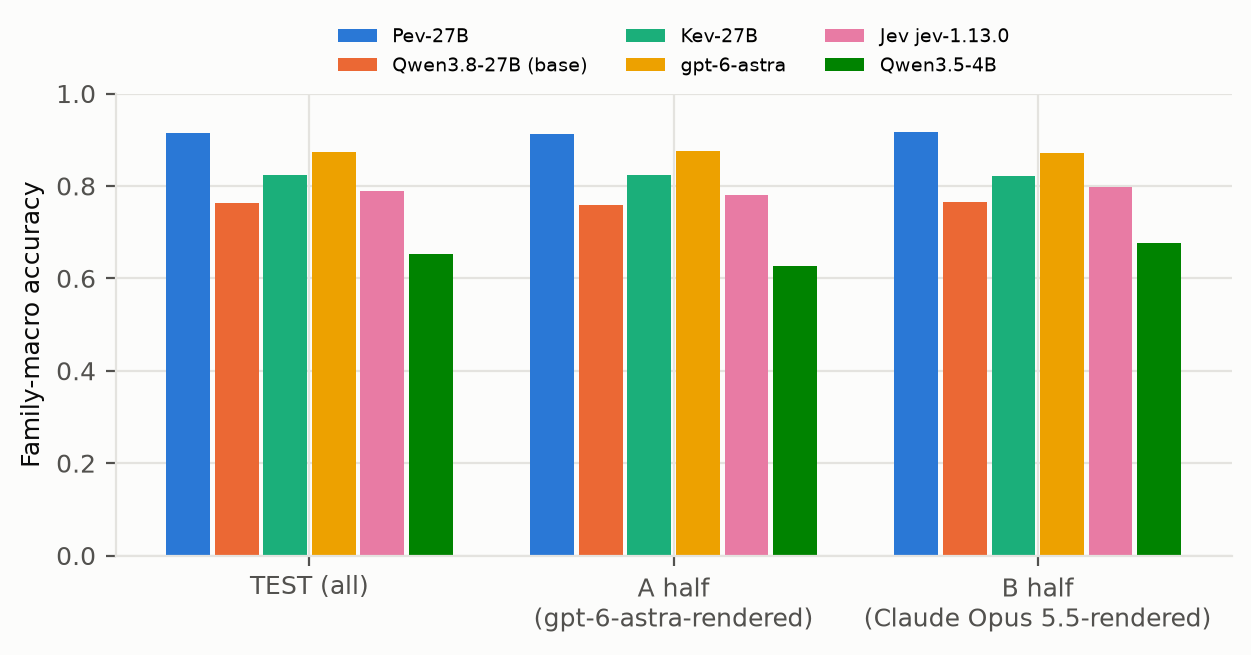
TEST family-macro accuracy per model, overall and per renderer half (A: gpt-6-astra, B: Claude Opus 5.5).
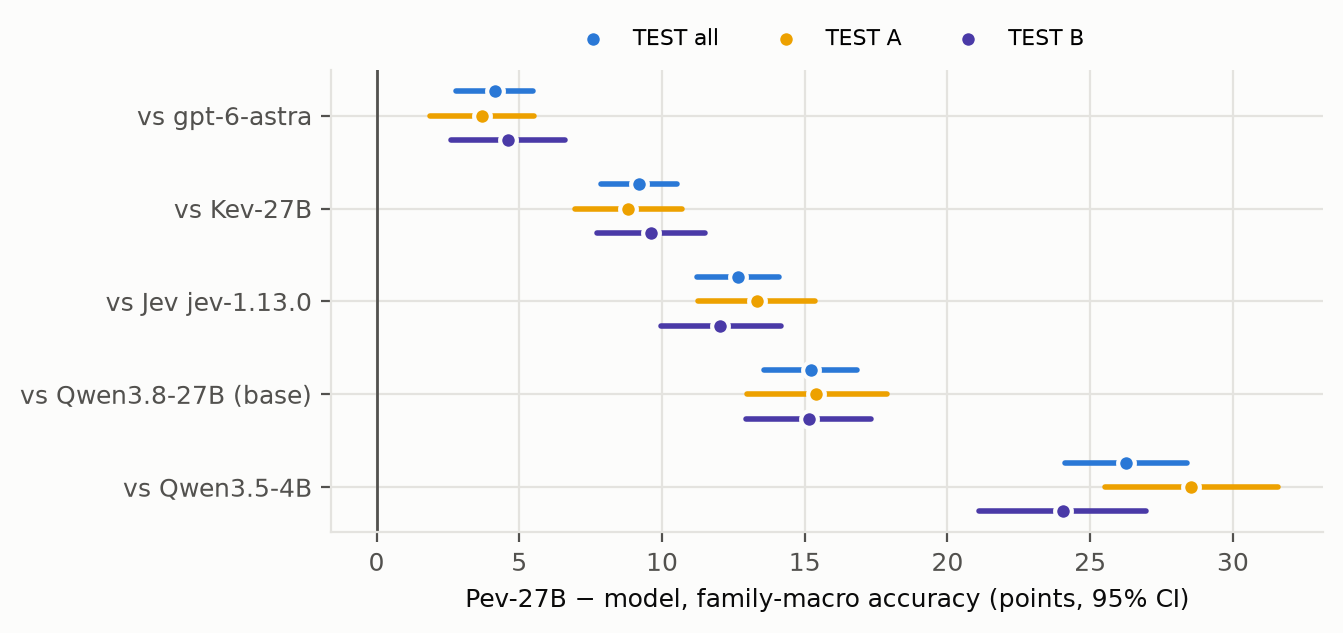
Pev-27B minus each model on TEST, family-macro accuracy with paired 95% CIs, overall and per half.
HIDDEN (one-shot gate; 960 states from 720 users, 2,106 scorable of 2,456 questions; not released): base 0.754 -> adapter 0.905 (+15.1, CI95 [+13.5, +16.8], one-sided p = 1 × 10⁻⁴; McNemar 359 vs 48). Per family (base -> adapter): apply_memory 0.84 -> 1.00, forgotten_violation 0.96 -> 1.00, needs_approval 0.83 -> 0.99, share_ok 0.81 -> 0.97, route 0.90 -> 0.98, notify_level 0.55 -> 0.97, pick_option 0.40 -> 0.43 (n.s.). Automation coverage at 5% error 0.54 -> 0.93.
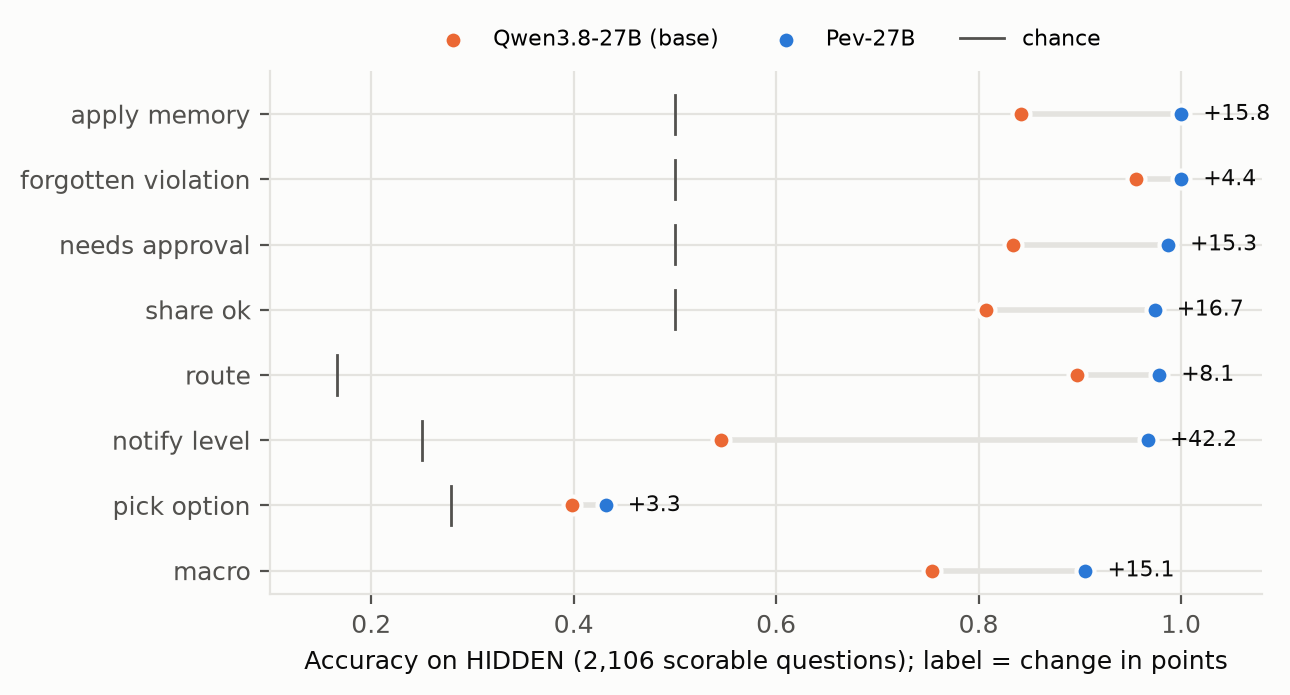
Per-family accuracy on HIDDEN for the base model (orange) and Pev-27B (blue), with chance marks.
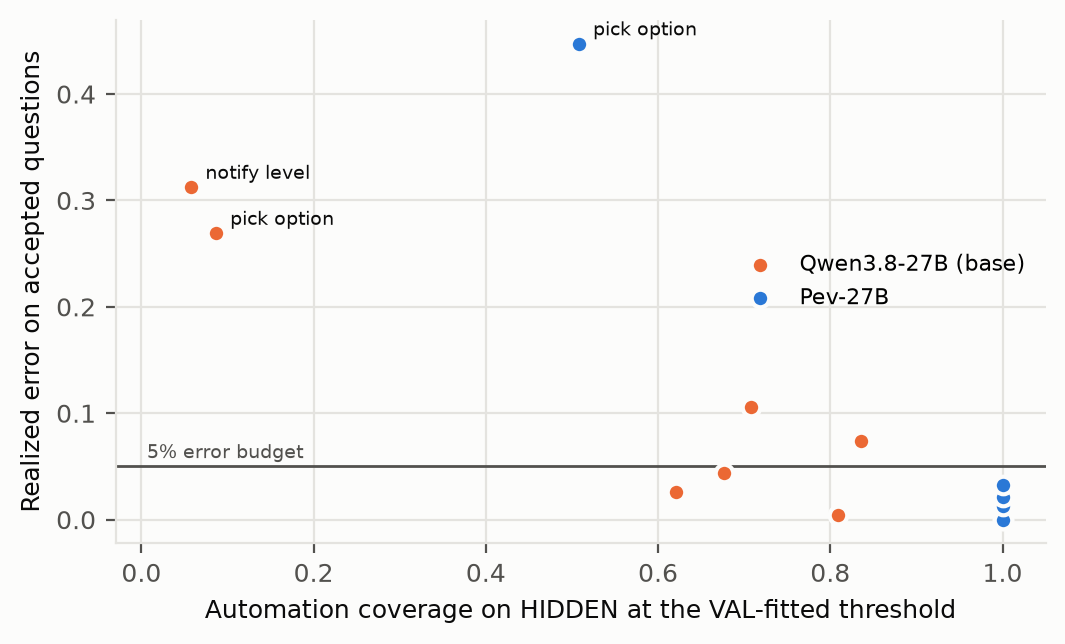
Coverage and realized error per family on HIDDEN at the VAL-fitted thresholds; the line is the 5% error budget.
DEV (630 states, 1,409 scorable): 0.766 -> 0.907 (+14.1). Brier 0.261 -> 0.131, ECE 0.074 -> 0.066, coverage at 5% error 0.57 -> 0.93. Regression guard (Kev decision-v7 test): 0.834 -> 0.848 (partly in-distribution: the general mix comes from the same suite's train split). References on DEV: Qwen3.5-4B 0.638, Jev 0.785, Kev-27B 0.824, gpt-6-astra 0.881; adapter − gpt-6-astra +2.7 (CI95 [+1.1, +4.2]).
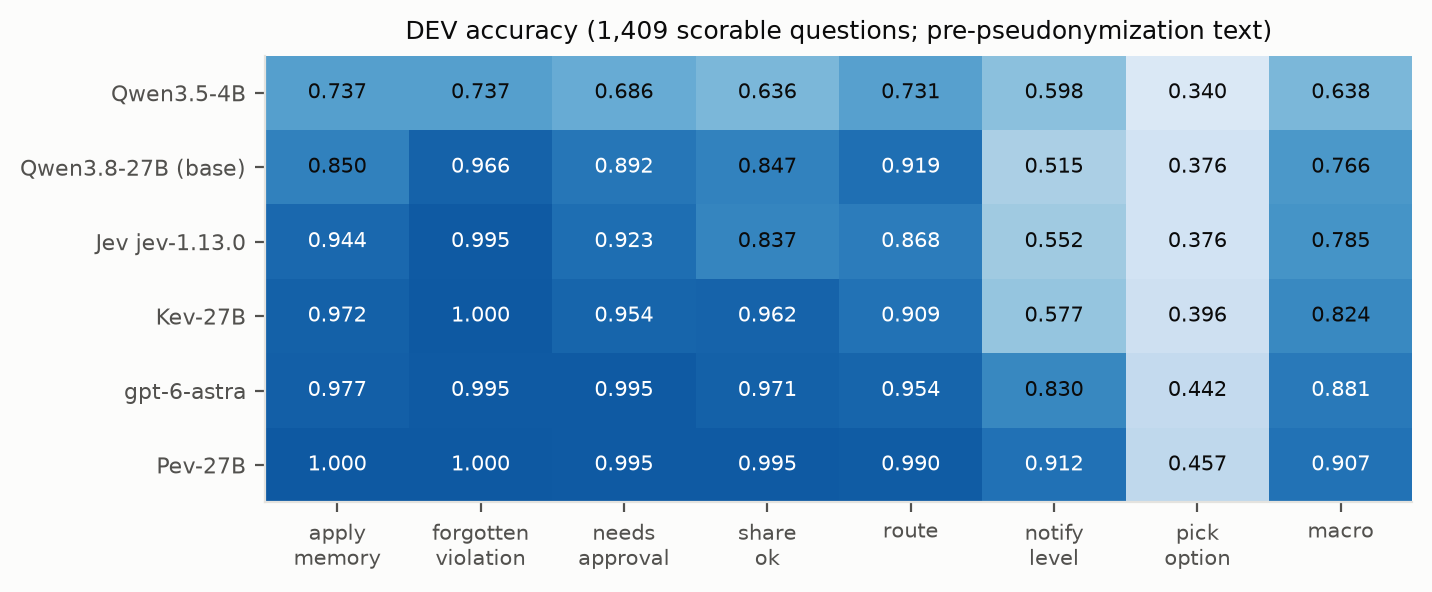
DEV accuracy per family and predictor.
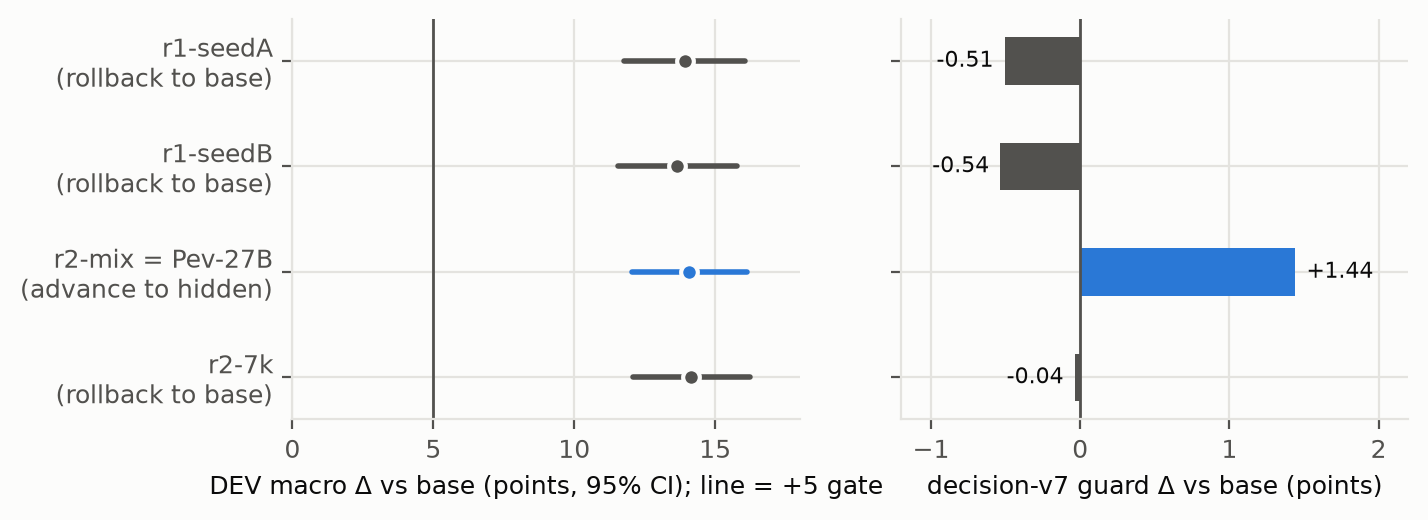
DEV macro-accuracy gain over the base model (left) and change on the regression guard (right) for each hill-climbing candidate.
DEV/VAL numbers were computed on the pre-pseudonymization text; the released VAL/DEV are pseudonymized (names, user ids; options and labels unchanged) and were not re-scored, so re-running on them may differ slightly. TEST was pseudonymized before scoring (released TEST == scored TEST).
pick_option (predicting real choices from review history) is essentially unsolved (~0.43–0.48 vs ~0.28 chance).Amazon Reviews 2023 and Google Local 2021 (UCSD McAuley Lab; no explicit licence, research use, cite), Enron email corpus (CMU; distractor text, pseudonymized), OpenFlights (ODbL 1.0; produced work), text rendered and memory facts extracted by gpt-6-astra, Kev decision-v2 train rows (Kev code Apache-2.0; the rows contain AG News, Amazon-multi, Banking77, BoolQ, DBpedia-14, IMDB, MNLI, SST-5, TREC and Yelp text under their own terms). No TEST data, Claude Opus 5.5-rendered text or Jev output was used for training.
Research use only, gated: the adapter weights are released under CC-BY-NC-4.0 with the additional conditions in
LICENSE.md (non-commercial research; no attempt to identify people quoted in the training data; cite the sources).
The base model Qwen/Qwen3.8-27B is Apache-2.0 and must be obtained under its own licence.
@techreport{envloop_pev,
  title       = {Pev: A Calibrated Fast-Decision Model for Personal Agents},
  author      = {{EnvLoop Research}},
  institution = {EnvLoop},
  url         = {https://github.com/EnvLoop/Pev}
}
Please also cite the models and data sources listed under References. Contact and removal requests: research@envloop.ai.
Base model
Qwen/Qwen3.8-27B