| --- |
| license: mit |
| library_name: assayloop |
| tags: |
| - biology |
| - genomics |
| - crispr |
| - active-learning |
| - drug-discovery |
| pipeline_tag: other |
| --- |
| |
| # AssayFormer |
|
|
|
|
| [Website](https://genentech.github.io/AssayLoop) | [Models and Data](https://huggingface.co/collections/Genentech/assaybench) | [Paper](https://arxiv.org/abs/2609.11877) | [](https://pypi.org/project/assaybench/) |
|
|
|  |
|
|
|
|
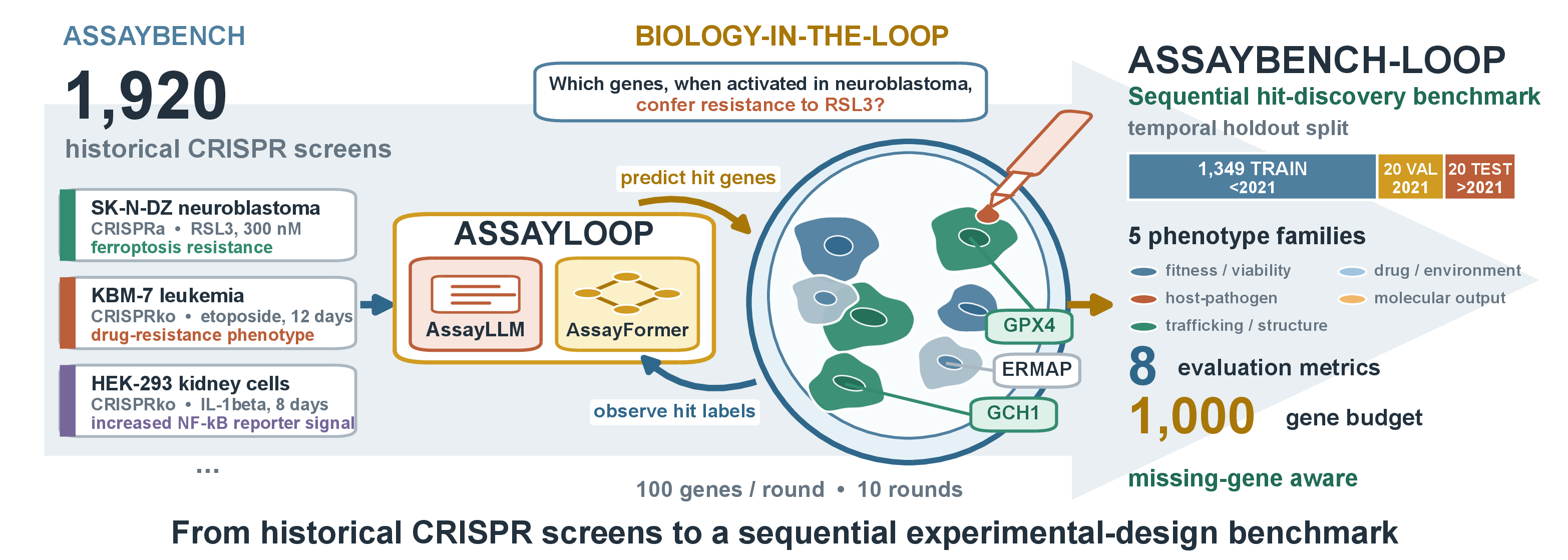
| The amortized gene ranker from **AssayLoop**: *Biology-in-the-loop: Amortized |
| Adaptive Hit Discovery in CRISPR Screens*. Given a screen description and the |
| hit labels revealed so far, it scores every gene in a 24,217-gene vocabulary and |
| proposes the next batch to assay. In the paper, a 21,147 gene subset was used. |
|
|
|
|
| ## Usage |
|
|
| ```python |
| from huggingface_hub import snapshot_download |
| from assayloop.models.amortized_ranker import AmortizedRankerModel |
| |
| ckpt = snapshot_download("Genentech/assayformer") |
| model = AmortizedRankerModel(checkpoint=ckpt, ckpt_file="model_last.pt") |
| ``` |
|
|
| Note the explicit `ckpt_file`: the loader defaults to `model.pt`, which is not |
| in this repository. |
|
|
| Then run it on a held-out screen and score the trajectory: |
|
|
| ```python |
| from assaybench import SequentialLoop, enrichment_factor, gene_universe, load_screens |
| from assayloop.acquisitions.greedy_from_model import GreedyFromModel |
| from assayloop.tasks import AssayBenchGeneBatchTask |
| |
| screens = load_screens("assayloop-test") # the paper's 20-screen test set |
| universe = gene_universe(screens) # the f2 pool, 21,147 genes |
| |
| screen = screens[0] |
| task = AssayBenchGeneBatchTask(screen, universe_genes=universe) |
| run = SequentialLoop(task, model, GreedyFromModel(), metrics=[], batch_size=100).run(n_steps=10) |
| |
| picked = [g for step in run.history for g in step.acquired_batch] |
| hits = [g for g, h in zip(screen.genes, screen.hits) if h] |
| print(enrichment_factor(picked, screen.genes, hits, universe=universe, budget=1000)) # 7.61 on U_1733_merged |
| ``` |
|
|
|
|
| ## Results |
|
|
|
|
| | metric | value | |
| |---|---| |
| | Enrichment factor (EF, domain-adjusted) | 4.83 | |
| | Fraction of hits recovered at budget 1000 | 0.232 | |
| | Domain-adjusted nAUC | 0.172 | |
| | Picks outside the screen's library | 0.100 | |
| | DepMap common-essential fraction | 0.407 | |
| | Effective pathways EP-B / EP-S / EP-D | 19.3 / 46.7 / 65.0 | |
|
|
|
|
| ## Files |
|
|
| | file | what | |
| |---|---| |
| | `model_last.pt` | weights — 5,033,117 parameters, the final GRPO epoch | |
| | `config.json` | architecture and RL hyperparameters | |
| | `vocab.json` | the 24,217-entry gene vocabulary (index 0 is `<unk>`) | |
|
|
| `model_last.pt` is the checkpoint the paper reports. If you want the gene embedding table on its |
| own it is `state_dict["gene_emb.weight"]`, shape (24217, 10). |
|
|
| ## Architecture |
|
|
| A 3-layer transformer encoder over a sequence of observed (gene, label) pairs |
| plus the screen description, scoring candidates by dot product against a learned |
| gene embedding. |
|
|
| | | | |
| |---|---| |
| | encoder | 3 layers, `d_model` 384, 2 heads, FFN 1024, no dropout | |
| | gene embeddings | 24,217 × 10, initialised from a K=10 BPMF fit | |
| | description | 1536-d, projected to 384 | |
| | context | up to 1024 observations | |
|
|
| **The description input is a precomputed embedding, not text.** The model |
| expects a 1536-d vector from OpenAI `text-embedding-3-small`. The |
| repository ships the screen-description embeddings for the benchmark screens, so |
| you only need an embedding backend for screens of your own. |
|
|
|
|
| ## Citation |
|
|
| ```bibtex |
| @article{edwards2026biologyloop, |
| title={Biology-in-the-loop: Amortized Adaptive Hit Discovery in CRISPR Screens}, |
| author={Edwards, Carl and De Brouwer, Edward and Li, Xiner and Lee, Namkyeong and |
| Hajiramezanali, Ehsan and Biton, Anne and Mostafavi, Sara and Scalia, Gabriele}, |
| journal={arXiv preprint arXiv:2609.11877}, |
| url={https://arxiv.org/abs/2609.11877}, |
| year={2026} |
| } |
| ``` |
|
|
| Licensed MIT, © 2026 Genentech, Inc. |
|
|