
problem stringlengths 15 4.7k | solution stringlengths 2 11.9k | answer stringclasses 51
values | problem_type stringclasses 8
values | question_type stringclasses 4
values | problem_is_valid stringclasses 1
value | solution_is_valid stringclasses 1
value | source stringclasses 6
values | synthetic bool 1
class |
|---|---|---|---|---|---|---|---|---|
1. What is the greatest common divisor of the numbers $11 n+4$ and $7 n+2$, where $n$ is a natural number? | II/1. The greatest common divisor of the numbers $11 n+4$ and $7 n+2$ also divides $7(11 n+4)-11(7 n+2)=6$, so it can be at most 6. If $n=4$, then $11 n+4=48$ and $7 n+2=30$, and the greatest common divisor of these two numbers is exactly 6. The answer is therefore 6.
2. method. We find the greatest common divisor of ... | 6 | Number Theory | math-word-problem | Yes | Yes | olympiads | false |
A1. What is the maximum number of odd sums among $x+y, x+z, x+w, y+z, y+w$ and $z+w$, if $x, y, z$ and $w$ are natural numbers?
(A) 2
(B) 3
(C) 4
(D) 5
(E) 6 | A1. We observe that the given sums are precisely all possible sums of 2 out of the numbers $x, y, z$ and $w$. If none of the numbers $x, y, z$ and $w$ is odd, then none of the sums is odd. If exactly 1 of the numbers is odd, then exactly 3 of the sums are odd. If 2 of the numbers are odd, then 4 of the sums are odd. If... | 4 | Number Theory | MCQ | Yes | Yes | olympiads | false |
A1. The diagonals of squares $A B C D$ and $B E F G$ are 8 cm and 11 cm long, respectively. Point $P$ is the intersection of the diagonals of square $B E F G$ (see figure). How many square centimeters is the area of triangle $A P F$?
(A) 8
(B) 9
(C) 10
(D) 11
(E) 12
 4
(B) 3
(C) 2
(D) 1
(E) 0 | A2. Since the coefficient of $x^{2}$ is 1, by Vieta's formulas, the product $x_{1} x_{2}$ of both solutions of the equation is equal to $p q$. Since both solutions must be integers and $p$ and $q$ are prime numbers, the set of solutions $\left\{x_{1}, x_{2}\right\}$ has only the possibilities $\{1, p q\},\{-1,-p q\},\{... | 4 | Algebra | MCQ | Yes | Yes | olympiads | false |
A3. Let $f: \mathbb{R} \rightarrow \mathbb{R}$ be a function such that
$$
f(x)= \begin{cases}x ; & x \geq 2 \\ f(4-x) ; & 0 \leq x<2 \\ f(x+2) ; & x<0\end{cases}
$$
What is $f(-5)$?
(A) -3
(B) -1
(C) 1
(D) 3
(E) 5
Problems for 3rd grade | A3. Taking into account the properties of the function $f$, we calculate
$$
f(-5)=f(-5+2)=f(-3)=f(-3+2)=f(-1)=f(-1+2)=f(1)=f(4-1)=f(3)=3
$$ | 3 | Algebra | MCQ | Yes | Yes | olympiads | false |
A1. The domain of the function $f(x)=\frac{x}{x^{2}+(a+1) x+b}$ is $\mathbb{R} \backslash\{-2\}$. What is the value of the expression $5 a-3 b$?
(A) 3
(B) 7
(C) 11
(D) 13
(E) 27 | A1. From the condition of the problem, it follows that $x^{2}+(a+1) x+b=(x+2)^{2}=x^{2}+4 x+4$. Therefore, $a+1=4$ or $a=3$ and $b=4$. It follows that $5 a-3 b=5 \cdot 3-3 \cdot 4=3$. | 3 | Algebra | MCQ | Yes | Yes | olympiads | false |
A3. What is the value of the expression $2019^{3}-3 \cdot 2019 \cdot 2018-2018^{3}$?
(A) -1
(B) 0
(C) 1
(D) 2018
(E) 2019 | A3. Choose $2019^{3}-3 \cdot 2019 \cdot 2018-2018^{3}=2019^{3}-3 \cdot 2019 \cdot 2018 \cdot(2019-2018)-2018^{3}=$ $2019^{3}-3 \cdot 2019^{2} \cdot 2018+3 \cdot 2019 \cdot 2018^{2}-2018^{3}=(2019-2018)^{3}=1$. | 1 | Algebra | MCQ | Yes | Yes | olympiads | false |
B1. Find all natural numbers $n$ whose cube is equal to the sum of the squares of three not necessarily distinct divisors of the number $n$. | B1. Let $a, b$ and $c$ be divisors of the number $n$, for which $n^{3}=a^{2}+b^{2}+c^{2}$. Then $a, b, c \leq n$, so $n^{3}=a^{2}+b^{2}+c^{2} \leq 3 n^{2}$ or $n \leq 3$. The case $n=1$ is excluded, as 1 is not the sum of three natural numbers. If $n=2$, the only divisors are 1 and 2. However, none of the sums $1^{2}+1... | 3 | Number Theory | math-word-problem | Yes | Yes | olympiads | false |
A2. Segments $A E$ and $B C$ in the figure are parallel and perpendicular to segment $A B$. It is also given that $|A B|=4$, $|B C|=6$, and $|A E|=8$. What is the difference between the areas of triangles $A D E$ and $B C D$?
(A) 2
(B) 4
(C) 5
(D) 8
(E) 9 | A2. The difference between the areas of triangles $A D E$ and $B C D$ is equal to the difference between the areas of triangles $A B E$ and $A B C$, which is $\frac{|A B| \cdot|A E|}{2}-\frac{|A B| \cdot|B C|}{2}=\frac{4.8}{2}-\frac{4 \cdot 6}{2}=4$. | 4 | Geometry | MCQ | Yes | Yes | olympiads | false |
A3. David has come up with a three-digit natural number with three different digits. He replaced each digit of this number with a letter to get the word $E N A$, which represents his number. He noticed that for his number, $c \cdot E N A=$ 2331, where $c$ is some natural number. What is the value of the number $c$?
(A)... | A3. The positive divisors of the number $2331=3^{2} \cdot 7 \cdot 37$ are $1,3,7,9,21,37,63,111,259,333,777$ and 2331. Among them, only 259 is a trimest natural number with three different digits. Therefore, $E N A=259$ and thus $c=2331: 259=9$. | 9 | Number Theory | MCQ | Yes | Yes | olympiads | false |
A2. The lengths of the diagonals of the faces of a cuboid are $|X Y|=8 \mathrm{~cm}$, $|Y Z|=9 \mathrm{~cm}$, and $|Z X|=\sqrt{55} \mathrm{~cm}$ (see figure). How many centimeters is the length of the space diagonal of this cuboid?
(A) $\sqrt{90}$
(B) 10
(C) $\sqrt{120}$
(D) $\sqrt{200}$
(E) 20
=200$. The length of the space diagonal of the ... | 10 | Geometry | MCQ | Yes | Yes | olympiads | false |
A3. Peter covered a wound with 2 rectangular bandages (see the figure). The area of the region covered by both bandages at the same time is $40 \mathrm{~cm}^{2}$, and the perimeter of the region covered by both bandages at the same time is $30 \mathrm{~cm}$. The upper bandage is $8 \mathrm{~cm}$ wide. How many centimet... | A3. The area covered by both parallelograms has the shape of a parallelogram. Let's denote the sides of the parallelogram by $a$ and $b$, and with $x$ the side of the lower parallelogram, whose length we are looking for (see figure).
 6
(B) 7
(C) 9
(D) 11
(... | A2. Let $a, b$, and $c$ be the numbers chosen by Lucijana, with $a > b > c$. The largest possible number that can be written with them is $\overline{a b c}$, and the smallest possible number is $\overline{c b a}$. For their sum, it holds that $100 a + 10 b + c + 100 c + 10 b + a = 101(a + c) + 20 b = 545$. By comparing... | 7 | Number Theory | MCQ | Yes | Yes | olympiads | false |
A1. What is the value of the expression $2^{0^{2^{3}}}+0^{2^{3^{2}}}+2^{3^{2^{0}}}+3^{2^{0^{2}}}$?
(A) 3
(B) 4
(C) 7
(D) 12
(E) Greater than 100. | A1. Considering that $0^{m}=0$ and $n^{0}=1$ for any natural numbers $m$ and $n$, we get
$$
2^{0^{2^{3}}}+0^{2^{3^{2}}}+2^{3^{2^{0}}}+3^{2^{0^{2}}}=2^{0}+0+2^{3^{2^{0}}}+3^{2^{0}}=1+0+2^{3}+3=1+0+8+3=12
$$ | 12 | Algebra | MCQ | Yes | Yes | olympiads | false |
B1. Determine the smallest possible value of the expression $\left|25^{m}-36^{n}\right|$, where $m$ and $n$ are natural numbers. | B1. By considering $25=5^{2}$ and $36=6^{2}$, the expression can be factored as
$$
\left|25^{m}-36^{n}\right|=\left|5^{2 m}-6^{2 n}\right|=\left|\left(5^{m}\right)^{2}-\left(6^{n}\right)^{2}\right|=\left|\left(5^{m}+6^{n}\right)\left(5^{m}-6^{n}\right)\right|=\left(5^{m}+6^{n}\right)\left|\left(5^{m}-6^{n}\right)\righ... | 11 | Number Theory | math-word-problem | Yes | Yes | olympiads | false |
A1. Let $n$ be a two-digit natural number. If we add the next three consecutive natural numbers following $n$, we get a two-digit number with the same digits as $n$. How many positive divisors does the number $n$ have?
(A) 3
(B) 4
(C) 5
(D) 6
(E) 8 | A1. Let $n=\overline{a b}=10 a+b$. Then $(n+1)+(n+2)+(n+3)=\overline{b a}=10 b+a$. It follows that $10 b+a=3 n+6=30 a+3 b+6$ or $29 a=7 b-6$. Since $a$ and $b$ are digits, $29 a \leq 7 \cdot 9-6=57$, from which it follows that $a=1$. Therefore, $7 b=35$ or $b=5$ and thus $n=15$. The number $n$ has 4 positive divisors, ... | 4 | Number Theory | MCQ | Yes | Yes | olympiads | false |
B3. We have a sheet of graph paper of size $7 \times 7$ squares and an equally large plastic graph stencil, on which some squares are green, and the rest are transparent. If we place the stencil on the sheet of paper so that the sides of the stencil align with the sides of the paper, the grid pattern on the stencil mat... | B3. A template can be placed on paper in 8 different ways; in 4 ways with the front side facing up, and in 4 ways with the back side facing up. We transition between different placements by rotating the template by $90^{\circ}$ around its center and by flipping the template over one of its 4 axes of symmetry (which cor... | 10 | Combinatorics | math-word-problem | Yes | Yes | olympiads | false |
A1. A divisor of a natural number $n$ is a proper divisor if it is different from 1 and $n$. For how many natural numbers $n$ is the number 17 the greatest proper divisor?
(A) 0
(B) 1
(C) 3
(D) 5
(E) 7 | A1. Since 17 is a proper divisor of the number $n$, we have $n=17 k$ for some natural number $k \geq 2$. Since $k$ is also a proper divisor of the number $n$, it must be that $k \leq 17$. At the same time, $k$ must be a prime number, because if $k=ab$ for some natural numbers $a, b>1$, then $17a$ would be a proper divi... | 7 | Number Theory | MCQ | Yes | Yes | olympiads | false |
A2. Lili found that the average of the digits of the year 2015 is 2, since $\frac{2+0+1+5}{4}=2$. How many times in the 21st century after the year 2015 will a year have the same average of digits as the year 2015?
(A) 1
(B) 2
(C) 5
(D) 6
(E) 9 | A2. The sum of the digits of the year must be 8. Since it is a year in the 21st century, the first two digits are 2 and 0. The sum of the last two digits must therefore be 6. There are five such years after 2015, they are $2024, 2033, 2042, 2051$ and 2060. | 5 | Number Theory | MCQ | Yes | Yes | olympiads | false |
A3. At the first school hour, the number of boys and girls in the class was in the ratio $3: 4$. When 4 more girls came to the class before the second school hour, and 4 boys left the class, the ratio became $2: 5$. How many more girls than boys were there in the class at the second school hour?
(A) 5
(B) 6
(C) 7
(D) 8... | A3. Let's denote the number of boys in the class during the first school hour by $f$ and the number of girls by $d$. Then, $\frac{f}{d}=\frac{3}{4}$. During the second school hour, there are $f-4$ boys and $d+4$ girls in the class, so the ratio is $\frac{f-4}{d+4}=\frac{2}{5}$. From the first equation, we express $f=\f... | 12 | Algebra | MCQ | Yes | Yes | olympiads | false |
B2. How many quadruples of natural numbers $(a, b, c, d)$ satisfy the inequalities
$$
a>b>c>d \quad \text{and} \quad \frac{1}{a}+\frac{1}{b}+\frac{1}{c}+\frac{1}{d}>2 ?
$$ | B2. If $d \geq 2$, then $\frac{1}{a}+\frac{1}{b}+\frac{1}{c}+\frac{1}{d} \leq 4 \cdot \frac{1}{2}=2$, which is a contradiction. Therefore, $d=1$. If $c \geq 3$, then $\frac{1}{a}+\frac{1}{b}+\frac{1}{c}+\frac{1}{d} \leq 3 \cdot \frac{1}{3}+1=2$, which is again a contradiction. Therefore, $c=2$. Similarly, it follows th... | 2 | Number Theory | math-word-problem | Yes | Yes | olympiads | false |
B1. If the polynomial $p$ is divided by the polynomial $2-x$, the quotient is $2 x^{2}-x+3$. Determine the remainder of this division, given that the product of all the zeros of the polynomial $p$ is equal to $\frac{11}{2}$. | B1. According to the division theorem, $p(x)=\left(2 x^{2}-x+3\right)(2-x)+o$, where $o$ is the remainder when the polynomial $p(x)$ is divided by the polynomial $2-x$. Since we are dividing by a polynomial of degree 1, the remainder $o$ is some constant. Therefore, the constant term of the polynomial $p(x)=-2 x^{3}+5 ... | 5 | Algebra | math-word-problem | Yes | Yes | olympiads | false |
A3. Sara is looking for a three-digit natural number $\overline{x y z}$ (where $z$ are the units, $y$ are the tens, and $x$ are the hundreds), for which $1 \leq x<y<z$ holds, and the sum of the numbers $\overline{x y z}, \overline{y z x}$, and $\overline{z x y}$ is a three-digit number with all digits being the same. W... | A3. The sum of the numbers $\overline{x y z}, \overline{y z x}$ and $\overline{z x y}$ is equal to $100(x+y+z)+10(y+z+x)+(z+x+y)$. Since this must be a three-digit number, $x+y+z<10$ and in this case, all digits of this number are automatically equal. We are therefore looking for the number of triples of numbers $(x, y... | 7 | Number Theory | MCQ | Yes | Yes | olympiads | false |
A2. What is the value of the product $x \cdot y$, if $3^{x}=a$ and $a^{y}=81$?
(A) 4
(B) 3
(C) 12
(D) 0
(E) 1 | A2. Since $81=a^{y}=\left(3^{x}\right)^{y}=3^{x y}$, it follows that $x y=4$. Therefore, the correct answer is $A$. | 4 | Algebra | MCQ | Yes | Yes | olympiads | false |
A1. If there are three cash registers open at the ticket counter, visitors have to wait 15 minutes to buy tickets. By how many minutes is the waiting time reduced if two more cash registers are opened?
(A) 3
(B) 5
(C) 6
(D) 7
(E) 10 | A1. If 3 cash registers are open, the waiting time is 15 minutes. If only 1 cash register is open, the waiting time is 3 times longer, which is 45 minutes. If 5 cash registers are open, the waiting time is $\frac{45}{5}=9$ minutes. If two more cash registers are opened, the waiting time will be reduced by $15-9=6$ minu... | 6 | Algebra | MCQ | Yes | Yes | olympiads | false |
A2. Let $x=2^{2013}$. What is the value of the expression
$$
x-\sqrt{x^{2}+1}+\frac{1}{\sqrt{x^{2}+1}+x} ?
$$
equal to
(A) -1
(B) 0
(C) 1
(D) $2^{2013}$
(E) 2 | A2. If we bring the expression to a common denominator and rearrange, we get
$$
\frac{\left(x+\sqrt{x^{2}+1}\right)\left(x-\sqrt{x^{2}+1}\right)+1}{\sqrt{x^{2}+1}+x}=\frac{\left(x^{2}-\left(x^{2}+1\right)\right)+1}{\sqrt{x^{2}+1}+x}=0 .
$$
The correct answer is $B$. | 0 | Algebra | MCQ | Yes | Yes | olympiads | false |
A2. In a square with side 2, we draw two semicircles, whose diameters are the sides of the square, as shown in the figure. What is the area of the unshaded part of the square?
(A) $\frac{\pi}{2}$
(B) 2
(C) $\frac{3}{2}+\frac{\pi}{4}$
(D) $\frac{3 \pi}{4}-\frac{1}{2}$
(E) $\frac{3 \pi}{4}$
 4
(B) 5
(C) 6
(D) 7
(E) 8 | A1. Let the number of blue, yellow, and green balls be denoted by $m, r$, and $z$ respectively, where $m + r + z = 10$. These balls can be arranged in a row in $\frac{10!}{m!r!z!}$ different ways. Therefore, $\frac{10!}{m!r!z!} = 360$. We can rearrange this equation to $10 \cdot 9 \cdot \ldots \cdot (m+1) = 360 \cdot r... | 7 | Combinatorics | MCQ | Yes | Yes | olympiads | false |
B1. Let points $A$ and $B$ and a circle $\mathcal{K}$ with diameter $A B$ be given. On the segment $A B$, choose a point $T$ different from $A$ and $B$. The perpendicular to the segment $A B$ through point $T$ intersects the circle $\mathcal{K}$ at points $M$ and $N$. Let $|A T|=x,|T B|=y$ and $|T N|=z$. Calculate the ... | B1.
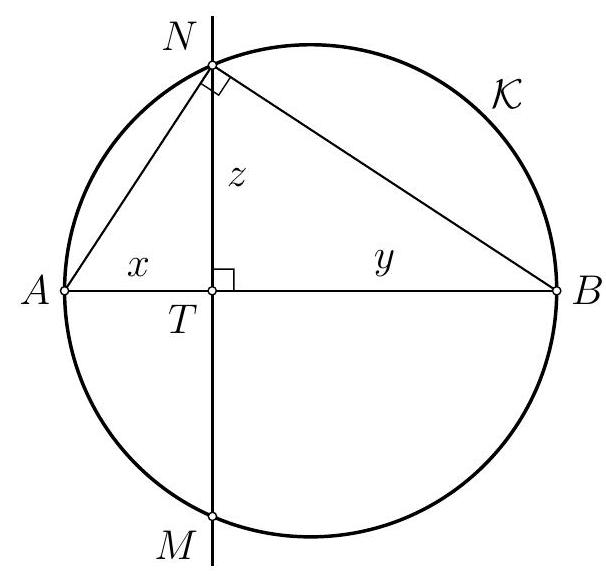
By Thales' theorem about the angle in a semicircle, the triangle $ABN$ is a right triangle with a right angle at $N$. By the altitude theorem in a right triangle, we have $z^2 = xy$. The... | 2 | Geometry | math-word-problem | Yes | Yes | olympiads | false |
B1. At least how many times must we roll two fair dice simultaneously so that the probability of rolling the same number of pips on both dice at least once is greater than $\frac{1}{2}$?
(20 points) | B1. The power of the algebra of events when rolling two dice is $6 \cdot 6=36$. At the same time, the same number of dots can fall on both dice in 6 ways. The probability that the same number of dots falls on both dice when rolled once is therefore $p=\frac{6}{36}=\frac{1}{6}$.
Suppose we roll the dice $n$ times. Let ... | 4 | Combinatorics | math-word-problem | Yes | Yes | olympiads | false |
A1. Each of the squares $A B C D$ and $E F G H$ with side length 1 is divided into congruent smaller squares, in which circles are inscribed, as shown in the figure. What is the ratio of the areas between the shaded part of square $A B C D$ and the shaded part of square $E F G H$?
(A) $\frac{9}{16}$
(B) $\frac{3}{4}$
(... | A1. The ratio of the area of a circle inscribed in a square is $\frac{\pi}{4}$. In square $A B C D$, each of the nine congruent smaller squares has a shaded area ratio of $\frac{\pi}{4}$, so square $A B C D$ also has a shaded area ratio of $\frac{\pi}{4}$. The same applies to square $E F G H$. Therefore, the ratios of ... | 1 | Geometry | MCQ | Yes | Yes | olympiads | false |
A1. Each of the equilateral triangles $ABC$ and $DEF$ with side length 1 is divided into congruent equilateral triangles, in which circles are inscribed, as shown in the figure. What is the ratio of the areas between the shaded part of triangle $ABC$ and the shaded part of triangle $DEF$?
(A) $\frac{9}{16}$
(B) $\frac{... | A1. The ratio of the area of a triangle covered by its inscribed circle is $\frac{\pi \sqrt{3}}{9}$. In triangle $ABC$, each of the nine congruent triangles has a shaded area ratio of $\frac{\pi \sqrt{3}}{9}$, so triangle $ABC$ also has a shaded area ratio of $\frac{\pi \sqrt{3}}{9}$. The same applies to triangle $DEF$... | 1 | Geometry | MCQ | Yes | Yes | olympiads | false |
B3. Twelve balls are numbered with the numbers $1,2,3, \ldots, 12$. Each ball is painted either red or green such that the following conditions are met:
(a) if the balls labeled with different numbers $a$ and $b$ are painted red and $a+b<13$, then the ball labeled with the number $a+b$ is also painted red;
(b) if the... | B3. Suppose ball 1 is red. If ball 2 is also red, then red are also $1+2=3, 1+3=4, \ldots, 1+11=12$. Therefore, all balls are red.
If ball 2 is green, we again consider two cases. If ball 3 is red, then red are also $1+3=4, 1+4=5, \ldots, 1+11=12$, so all other balls are red. If ball 3 is green, then $2+3=5$ is also g... | 6 | Combinatorics | math-word-problem | Yes | Yes | olympiads | false |
A3. How many pairs $(m, n)$ of natural numbers satisfy the condition $\frac{3}{m}+\frac{2}{n}=1$ ?
(A) 2
(B) 3
(C) 4
(D) 5
(E) More than 5. | A3. It is clear that $m>3$ and $n>2$. Since $\mathbf{z}$ with increasing $m$ the number $n$ decreases, we see that the only possible solutions are $(m, n) \in\{(4,8),(5,5),(6,4),(9,3)\}$. | 4 | Algebra | MCQ | Yes | Yes | olympiads | false |
B3. In a red box, there are twelve balls numbered from 1 to 12. Jan moved some of these balls to a green box. He found that for any two balls in the green box, if the numbers on these balls are $a$ and $b$, then the ball with the number $|a-b|$ is in the red box. What is the maximum number of balls Jan could have moved... | B3. Jan can move 6 balls. If he chose all the balls with odd numbers, the difference between the numbers on any two balls is an even number that is not written on any of the balls in the green box.
Suppose Jan moved at least 7 balls. Let the numbers on the seven balls in the green box be $a_{1}<a_{2}<a_{3}<a_{4}<a_{5}... | 6 | Combinatorics | math-word-problem | Yes | Yes | olympiads | false |
A1. Which digit of the 7-digit number 2345678 must be deleted so that the resulting 6-digit number is divisible by 9?
(A) 8
(B) 7
(C) 6
(D) 5
(E) 4 | A1. A natural number is divisible by 9 if and only if the sum of its digits is divisible by 9. Since the sum of the digits of the 7-digit number 2345678 is $35=3 \cdot 9+8$, we must delete the digit 8. This gives us the 6-digit number 234567, whose sum of digits is $27=3 \cdot 9$, and is therefore divisible by 9. | 8 | Number Theory | MCQ | Yes | Yes | olympiads | false |
A2. On the playground, there were 17 girls and 12 boys. What is the minimum number of additional children that need to come to the playground so that all of them can be divided into 2 equal groups, with the same number of girls and boys in each group?
(A) 1
(B) 3
(C) 5
(D) 7
(E) 9 | A2. If at some point the children on the playground can be divided into 2 equal groups, with $\mathrm{v}$ each group having $n$ boys and $n$ girls, then the total number of girls on the playground is $2n$, which is an even number and equal to the total number of boys on the playground. For the number of girls on the pl... | 7 | Number Theory | MCQ | Yes | Yes | olympiads | false |
A1. In the animal garden, rabbits, pigeons, and ducks have a total of 24 heads, 14 wings, and 62 legs. How many ducks are there in the animal garden?
(A) 5
(B) 6
(C) 7
(D) 8
(E) 9 | A1. Hares and ducks do not have wings, but parrots have two wings each, so there are 14 : $2=7$ parrots in the zoo. Parrots thus have a total of $7 \cdot 2=14$ legs. Since ducks do not have legs, the hares have a total of $62-14=48$ legs. Each hare has 4 legs, so there are $48: 4=12$ hares in the zoo. Therefore, there ... | 5 | Logic and Puzzles | MCQ | Yes | Yes | olympiads | false |
A1. Samo wrote a 3-digit odd natural number on a piece of paper and told Peter only the last digit of this number. Peter immediately realized that the number Samo wrote on the paper is not a prime number. Which digit did Samo tell Peter?
(A) 1
(B) 3
(C) 5
(D) 7
(E) 9 | A1. From the last digit of a natural number in the trimester, we can determine that it is not a prime number only if the last digit is even (and thus the number is divisible by 2) or if it is 5 (and thus the number is divisible by 5). All other digits can be the last digits of a trimester prime number, for example, the... | 5 | Number Theory | MCQ | Yes | Yes | olympiads | false |
A3. How many two-digit numbers have a predecessor and a successor that are a prime number and a perfect square, not necessarily in that order?
(A) 1
(B) 2
(C) 3
(D) 4
(E) 5 | A3. The perfect squares that are the predecessor or successor of a two-digit number are exactly $9,16,25,36,49,64,81$ and 100. The two-digit numbers whose predecessor or successor is a perfect square are thus only the numbers $10,15,17,24,26,35,37,48,50,63,65,80,82$ and 99. However, a two-digit number whose predecessor... | 5 | Number Theory | MCQ | Yes | Yes | olympiads | false |
A3. On Saturday, Metod bought 15 donuts and paid 1950 SIT for them. On Monday, he had 1600 SIT with him. Since they were selling donuts at a discount that day, he got 15 donuts for 1600 SIT. How many fewer donuts would Metod have received if there were no discounts?
(A) 1
(B) 2
(C) 3
(D) 4
(E) 5 | A3. If there was a discount, then 1 donut cost $\frac{1950}{15}=130$ SIT. With 1600 SIT, Metod could buy 12 donuts and have 40 SIT left. Without the discount, he would therefore get 3 fewer donuts. | 3 | Algebra | MCQ | Yes | Yes | olympiads | false |
A6. What number must we add to the numerator and the denominator of the fraction $\frac{2}{5}$ to get a fraction that has the value $\frac{2}{3}$?
(A) -2
(B) 0
(C) 4
(D) 13
(E) Such a number does not exist. | A6. To the numerator and denominator of the fraction $\frac{2}{5}$, we must add 4. Then we indeed get $\frac{2+4}{5+4}=\frac{6}{9}=\frac{2}{3}$.
We can also solve it differently. For example, if we add the number $x$ to the numerator and denominator of the fraction $\frac{2}{5}$, then $\frac{2+x}{5+x}=\frac{2}{3}$, fr... | 4 | Algebra | MCQ | Yes | Yes | olympiads | false |
A7. Vika can move through the maze only horizontally or vertically, and she can pass through each cell only once. At the entrance, she has the number 0 recorded on her sheet, and then she adds the numbers she reads on the cells she passes through. How many paths are there that result in a total of 13?
(A) 4
(B) 1
(C) 2... | A7. Through the labyrinth, we can go along the following three paths: $3 \rightarrow 2 \rightarrow 0 \rightarrow 4 \rightarrow 3 \rightarrow 1, 3 \rightarrow 2 \rightarrow$ $0 \rightarrow 2 \rightarrow 1 \rightarrow 4 \rightarrow 0 \rightarrow 1$ and $3 \rightarrow 1 \rightarrow 0 \rightarrow 2 \rightarrow 2 \rightarro... | 3 | Combinatorics | MCQ | Yes | Yes | olympiads | false |
A10. The three-digit number $2 A 4$ is added to 329 to get $5 B 3$. What is the largest possible value of the digit $A$ if $5 B 3$ is divisible by 3?
(A) 7
(B) 8
(C) 4
(D) 1
(E) 9
# Seventh Regional Mathematics Competition for Students of Vocational Schools
April 4, 2007
## II. Part: LONGER PROBLEMS
Instruction: So... | A10. In the ternary number $2 A 4$, $A$ can have a maximum value of 4. Then the sum $244+329=573$ is divisible by 3. For divisibility by 3, the digit $A$ could be increased by 3, but then the sum $274+329=603$ would not have the form $5 B 3$.
## II. PART | 4 | Number Theory | math-word-problem | Yes | Yes | olympiads | false |
A8. If you walk to school and get back home by car, it takes you 3.5 hours for the round trip from home to school and back. If you drive both ways, it takes 1 hour. How long does it take if you walk to school and back?
(A) 4.5 hours
(B) 1 hour
(C) 6 hours
(D) 7 hours
(E) 8 hours | A8. For both directions by car, you need 1 hour, for one direction, you need 0.5 hours. Therefore, for one direction on foot, you need $3.5-0.5=3$ hours, for both directions, 6 hours. | 6 | Algebra | MCQ | Yes | Yes | olympiads | false |
B3. Maja designed floral arrangements. If she put 7 flowers in each vase, four flowers would remain, and if she put 8 flowers in each vase, two flowers would be missing. How many vases and how many flowers does Maja have? | B3. Let $x$ be the number of vases. Then the number of flowers is $7 x+4$ and $8 x-2$. We get the equation $7 x+4=8 x-2$, from which it follows that $x=6$. Maja has $6 \mathrm{vases}$ and $7 \cdot 6+4=46$ flowers. | 6 | Algebra | math-word-problem | Yes | Yes | olympiads | false |
A2 V kinu so v zadnji vrsti še trije prosti sedeži. Na koliko različnih načinov se lahko posedejo trije prijatelji?
(A) 1
(B) 2
(C) 3
(D) 4
(E) 6
In the last row of the cinema, there are still three free seats. In how many different ways can three friends sit down?
(A) 1
(B) 2
(C) 3
(D) 4
(E) 6 | A2 The first friend chooses among 3 seats, the second among 2, and the third is left with 1 seat. Thus $3 \cdot 2 \cdot 1=6$ possibilities. | 6 | Combinatorics | MCQ | Yes | Yes | olympiads | false |
A6 V In a survey about the favorite morning drink, 60 people participated. The frequency pie chart shows the results of the survey: How many more people drink tea than milk?
(A) 9
(B) 12
(C) 15
(D) 21
(E) 35
 7
(B) 8
(C) 9
(D) 10
(E) 11
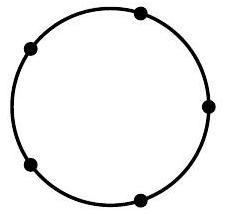 | A3. We mark the points on the circle as $A, B, C, D$ and $E$. If we write down all the different possible triangles: $A B C, A B D, A B E, A C D, A C E, A D E, B C D, B C E, B D E, C D E$, there are 10. | 10 | Combinatorics | MCQ | Yes | Yes | olympiads | false |
B1. Write the expression that corresponds to the given diagram.
Then calculate the value of the expression if:
A is the least common multiple of the numbers 3 and 5,
$B$ is the length of the leg in a right triangle with a hypotenuse of 5 units and another leg of 4 units,
$C$ is the smallest prime number.
:((107-98) \cdot C)
$$
Since $A=15, B=3$ and $C=2$, its value is $(95-15: 3):((107-98) \cdot 2)=5$.

Scoring: Total: 7 poin... | 5 | Algebra | math-word-problem | Yes | Yes | olympiads | false |
B4. a) How many different pizzas can you make if you have four different toppings and each pizza must have at least two toppings?
b) An ice cream shop offers 9 different ice cream flavors. A group of children came to the ice cream shop and each of them bought two scoops. No child chose scoops of the same flavor, and a... | B4. a) We can make 6 pizzas with two toppings, 4 pizzas with three toppings, and 1 pizza with four toppings, totaling 11 pizzas.
b) When choosing the first ice cream flavor, we can still choose from the remaining eight flavors; when choosing the second ice cream flavor, seven flavors remain for selection .... There we... | 11 | Combinatorics | math-word-problem | Yes | Yes | olympiads | false |
A1. How many minutes is the difference between $6.20 \mathrm{~h}$ and $6 \mathrm{~h} 20$ min?
(A) 0
(B) 2
(C) 8
(D) 10
(E) 12 | A1. The difference between $6.20 \mathrm{~h}=372 \mathrm{~min}$ and $6 \mathrm{~h} 20 \mathrm{~min}=380 \mathrm{~min}$ is $8 \mathrm{~min}$. | 8 | Logic and Puzzles | MCQ | Yes | Yes | olympiads | false |
B1. Žiga will prepare identical shelves from a board that is $30 \mathrm{~cm}$ wide and $30 \mathrm{~mm}$ thick. He will attach them to a wall in the shape of a rectangle that is $2.5 \mathrm{~m}$ high and $3 \mathrm{~m}$ wide, one above the other, with a vertical distance of $4 \mathrm{dm}$ between them. Each shelf wi... | B1. The bottom surface of the highest shelf will be at a height of $1.47 \mathrm{~m}$, the bottom surface of the second shelf will be at a height of $1.04 \mathrm{~m}$, and the bottom surface of the third shelf will be at a height of $0.61 \mathrm{~m}$. Each shelf will be $1.4 \mathrm{~m}$ long, and for all three toget... | 3 | Geometry | math-word-problem | Yes | Yes | olympiads | false |
A4. In an ice cream shop, there are five different ice cream flavors: vanilla, chocolate, strawberry, peach, and yogurt. An ice cream serving consists of three scoops of ice cream, each scoop being a different flavor. How many different ice cream servings can the ice cream maker create?
(A) 60
(B) 10
(C) 15
(D) 6
(E) n... | A4. An ice cream portion consists of three scoops of ice cream of different flavors, there are 10 different portions. If we briefly denote the flavors as $V, K, J, M$ and $T$, we have the options: $V K J, V K M, V K T, V J M$, $V J T, V M T, K J M, K J T, K M T$ and $J M T$. | 10 | Combinatorics | MCQ | Yes | Yes | olympiads | false |
A3 How tall is the pole if one third of the pole is in the ground, half is in the water, and above the water is 1.5 meters?
(A) $7.5 \mathrm{~m}$
(B) $8 \mathrm{~m}$
(C) $9 \mathrm{~m}$
(D) $9.5 \mathrm{~m}$
(E) $10 \mathrm{~m}$ | A3. If $x$ is the height of the entire pole, its half measures $\frac{x}{2}$, and its third $\frac{x}{3}$. From the equation $\frac{x}{3}+\frac{x}{2}+1.5 \text{ m}=x$, we find that the height of the pole is $x=9 \text{ m}$. | 9 | Algebra | MCQ | Yes | Yes | olympiads | false |
B3 Alpine Expedition has 420 kg of luggage.
A What is the minimum number of porters they need to hire if each porter can carry a maximum of 35 kg of load?
B On average, how much weight should each porter carry if there are 15 of them?
C In how many ways can the first three porters choose their loads if they are choo... | B3. At least $\frac{420 \mathrm{~kg}}{35 \mathrm{~kg}}=12$ carriers must be hired.
If there were 15, each carrier would have to carry an average load of $\frac{420 \mathrm{~kg}}{15}=28 \mathrm{~kg}$.
The carriers can choose their load in $10 \cdot 9 \cdot 8=720$ ways.
The volume of the cylinder is calculated using t... | 1 | Other | math-word-problem | Yes | Yes | olympiads | false |
A6 If $\binom{5}{1}=\frac{5}{1},\binom{5}{2}=\frac{5 \cdot 4}{1 \cdot 2},\binom{5}{3}=\frac{5 \cdot 4 \cdot 3}{1 \cdot 2 \cdot 3},\binom{5}{4}=\frac{5 \cdot 4 \cdot 3 \cdot 2}{1 \cdot 2 \cdot 3 \cdot 4}$, then $\binom{4}{1}+\binom{4}{3}$ is:
(A) 8
(B) 10
(C) 12
(D) 14
(E) 16 | A6. By analogy, $\binom{4}{1}=\frac{4}{1}=4$ and $\binom{4}{3}=\frac{4 \cdot 3 \cdot 2}{1 \cdot 2 \cdot 3}=4$. Therefore, $\binom{4}{1}+\binom{4}{3}=4+4=8$.
## FURTHER PROBLEMS | 8 | Combinatorics | MCQ | Yes | Yes | olympiads | false |
B1. During his vacation, Jan did holiday work. His earnings are shown in the table.
| Days | Earnings in EUR |
| :---: | :---: |
| Monday | 12 |
| Tuesday | |
| Wednesday | 20 |
| Thursday | |
A. How much did he earn on Tuesday if his average earnings for the first three days were 14 EUR per day?
B. How much did h... | B1. From the equation $\frac{12+x+20}{3}=14$ we calculate the Thursday's earnings $x=10$ euros. From Monday to Wednesday, the earnings amounted to $12+10+20=42$ euros. Since the total earnings for the first four days were 50 euros, the Thursday's earnings amounted to $50-42=8$ euros.
$\mathrm{For} 1 \mathrm{~h}$ and $... | 8 | Algebra | math-word-problem | Yes | Yes | olympiads | false |
A5. Mija and Maja had to cut out an equilateral triangle from paper for their homework. The side of Mija's triangle is $5 \mathrm{~cm}$ long, and the side of Maja's triangle is $10 \mathrm{~cm}$. How many times larger is the area of Maja's triangle compared to the area of Mija's triangle?
(A) 2 times
(B) $\sqrt{3}$ tim... | A5. We calculate the areas of both equilateral triangles. If $a_{1}=5 \mathrm{~cm}$, then $S_{1}=\frac{25 \sqrt{3}}{4} \mathrm{~cm}^{2}$. If $a_{2}=10 \mathrm{~cm}$, then $S_{2}=\frac{100 \sqrt{3}}{4} \mathrm{~cm}^{2}$. The area $S_{2}$ is 4 times larger than the area $S_{1}$. | 4 | Geometry | MCQ | Yes | Yes | olympiads | false |
A5. Katarina baked three types of pastries and brewed tea and coffee, and she also has juice in the fridge. What is the maximum number of people Katarina can serve differently, if each person gets one piece of pastry and a drink?
(A) 6
(B) 9
(C) 15
(D) 18
(E) None of the above. | A5. Katarina has 3 types of drinks. To each, she can add a piece of pastry, which she chooses from three different types. Therefore, she has $3 \times 3=9$ different options. | 9 | Combinatorics | MCQ | Yes | Yes | olympiads | false |
A5. In a workshop on healthy eating, 11 people gathered. They talked about fruits and vegetables. Three of them do not like either fruits or vegetables. Four like fruits but not vegetables. Five of them like fruits. How many of them like both fruits and vegetables?
(A) 1
(B) 2
(C) 3
(D) 4
(E) 5 | A5. Let $S$ be the set of people who like fruit and $Z$ be the set of people who like vegetables. We know: $|S|=5$ and $|S-Z|=4$ from this it follows that $|S \cap Z|=1$. | 1 | Logic and Puzzles | MCQ | Yes | Yes | olympiads | false |
A8. The function is $f(x)=\frac{3}{2} x^{2}+5 x-3$. The value of the expression $f(-4)-3 f(0)+2 f(-2)$ is equal to:
(A) -8
(B) -6
(C) -4
(D) 0
(E) 3 | A8. The value of $f(-4)=1, f(0)=-3$ and $f(-2)=-7$. The value of the expression $f(-4)-3 f(0)+2 f(-2)=$ $1-3 \cdot(-3)+2 \cdot(-7)=-4$. | -4 | Algebra | MCQ | Yes | Yes | olympiads | false |
A2. The sum of the digits of a 4-digit PIN code for Matej's bank card is 24. The first and last digits are both 7. The number representing the code reads the same from left to right and from right to left. What is the second-to-last digit in the PIN code?
(A) 0
(B) 2
(C) 4
(D) 5
(E) cannot be determined | A2 The sum of the first and last digit is 14. For the sum of the second and third digit, we are left with 10. Since the number is a palindrome, the second and third digits are also equal, so they are both equal to 5. The penultimate digit is 5. | 5 | Number Theory | MCQ | Yes | Yes | olympiads | false |
A5. Which expression does not have the value 1?
(A) $-\frac{\sqrt{64}}{(-2)^{3}}$
(B) $-(-1)^{4}$
(C) $(-1)^{2018}$
(D) $1^{-10}$
(E) $2018^{0}$ | A5. All expressions, except $-(-1)^{4}=-1$, have the value 1. | -1 | Algebra | MCQ | Yes | Yes | olympiads | false |
A8. If $F=400$ and $5 \leq a \leq 10$ and $20 \geq b \geq 8$, the difference between the maximum possible value of the expression $\frac{F}{a b}$ and the minimum possible value of this expression is:
(A) 1
(B) 4
(C) 6
(D) 8
(E) 160 | A8. If $a=5$ and $b=8$, the value of the expression $\frac{F}{a b}=\frac{400}{5 \cdot 8}=10$. If $a=10$ and $b=20$, the value of the expression $\frac{F}{a b}=\frac{400}{10 \cdot 20}=2$. The difference between 10 and 2 is 8.
## FURTHER PROBLEMS | 8 | Algebra | MCQ | Yes | Yes | olympiads | false |
A2. We throw two dice at once multiple times and each time we add the numbers of dots on the top faces of both. What is the maximum number of different sums of dots we can get?
(A) 10
(B) 11
(C) 12
(D) 18
(E) 20 | A2. Possible sums of the dots on the upper faces of the dice are: $2=1+1,3=1+2=2+1$, $4=1+3=2+2=3+1,5=1+4=2+3=3+2=4+1,6=1+5=$ $2+4=3+3=4+2=5+1,7=1+6=2+5=3+4=4+3=5+2=6+1$, $8=2+6=3+5=4+4=5+3=6+2,9=3+6=4+5=5+4=6+3$, $10=4+6=5+5=6+4,11=5+6=6+5$ and $12=6+6$, a total of 11 different sums. | 11 | Combinatorics | MCQ | Yes | Yes | olympiads | false |
A3. If $F=400$ and $5 \leq a \leq 10$ and $20 \geq b \geq 8$, the difference between the maximum possible value of the expression $\frac{F}{a b}$ and the minimum possible value of this expression is:
(A) 1
(B) 4
(C) 6
(D) 8
(E) 160 | A3. If $a=5$ and $b=8$, the value of the expression $\frac{F}{a b}=\frac{400}{5 \cdot 8}=10$. If $a=10$ and $b=20$, the value of the expression $\frac{F}{a b}=\frac{400}{10 \cdot 20}=2$. The difference between 10 and 2 is 8. | 8 | Algebra | MCQ | Yes | Yes | olympiads | false |
A6. Which expression does not have the value 1?
(A) $-\frac{\sqrt{64}}{(-2)^{3}}$
(B) $-(-1)^{4}$
(C) $(-1)^{2018}$
(D) $1^{-10}$
(E) $2018^{0}$ | A6. All expressions, except $-(-1)^{4}=-1$, have the value 1. | -1 | Algebra | MCQ | Yes | Yes | olympiads | false |
A4 In the six-digit number $\square 36230$, the first digit is hidden. If we round the six-digit number to the nearest hundred thousand, we get 100000. What is the hidden digit?
(A) 0
(B) 1
(C) 3
(D) 4
(E) 9 | A4 This is true for the digit 1, as 136230, rounded to the nearest hundred thousand, is equal to 100000. | 1 | Number Theory | MCQ | Yes | Yes | olympiads | false |
A6 The histogram shows how many kilograms of muscle mass boys gained in one school year with regular visits to the fitness center. How many boys gained at least $2 \mathrm{~kg}$ of muscle mass?
(A) 2
(B) 3
(C) 4
(D) 5
(E) 11 | A6 From the histogram, we read that four boys maintained their weight, five boys gained $1 \mathrm{~kg}$, two gained $2 \mathrm{~kg}$, and one gained $3 \mathrm{~kg}$. At least $2 \mathrm{~kg}$ was gained by three boys. | 3 | Other | MCQ | Yes | Yes | olympiads | false |
A10 How many of the following statements are correct?
$20 \%$ of $40=8$
$2^{3}=8$
$3^{2}-1^{2}=8$
$7-3 \cdot 2=8$
$2 \cdot(6-4)^{2}=8$
(A) 1
(B) 2
(C) 3
(D) 4
(E) 5
km traveled | A10 Correct are 4 statements, since:
- $20 \%$ of $40=8$ is correct, because $0.20 \cdot 40=8$,
- $2^{3}=8$ is correct, because $2 \cdot 2 \cdot 2=8$,
- $3^{2}-1^{2}=8$ is correct, because $3^{2}-1^{2}=9-1=8$,
- $7-3 \cdot 2=8$ is not correct, because $7-3 \cdot 2=7-6=1$,
- $2 \cdot(6-4)^{2}=8$ is correct, because $2 ... | 4 | Algebra | MCQ | Yes | Yes | olympiads | false |
A2. Dana so števila $11,12,13,14,15,16$ and 17. How many of them are prime numbers?
(A) 0
(B) 1
(C) 2
(D) 3
(E) 4 | A2. Among the listed numbers, there are three prime numbers: 11, 13, and 17. | 3 | Number Theory | MCQ | Yes | Yes | olympiads | false |
A4. The quadratic equation is $3 x^{2}+6 x-m=0$. If one solution of the equation is $x=-3$, then $m$ is equal to:
(A) -13
(B) -9
(C) 3
(D) 6
(E) 9 | A4. Considering $x=-3$ we get: $3 \cdot(-3)^{2}+6 \cdot(-3)-m=0$, from which the solution $m=9$ follows. | 9 | Algebra | MCQ | Yes | Yes | olympiads | false |
A7. The product of the numbers $3 \cdot 16 \cdot 45 \cdot 81$ is divisible by $6^{n}$. Determine the largest possible $n$.
(A) $n=3$
(B) $n=4$
(C) $n=5$
(D) $n=6$
(E) $n=7$ | A7. The product $3 \cdot 16 \cdot 45 \cdot 81$ can also be written as $3 \cdot 16 \cdot 45 \cdot 81=6^{4} \cdot 3^{3} \cdot 5$. From this, it follows that $n=4$. | 4 | Number Theory | MCQ | Yes | Yes | olympiads | false |
A4. Aunt Micka is giving chocolates to all her nephews and nieces. If she gives each of them 5 chocolates, she will have 13 chocolates left; if she gives each of them 7 chocolates, she will have only three left. How many nephews and nieces does Aunt Micka have?
(A) 3
(B) 4
(C) 5
(D) 6
(E) 10 | A4. Let the number of boys and girls be denoted by $x$ and write the equation $5 x+13=7 x+3$. The solution to the equation is $x=5$. | 5 | Algebra | MCQ | Yes | Yes | olympiads | false |
B2. Andrej collected data for a school project about his TV watching habits during the weekend. He spent half of the time watching sports, a third of the time watching movies, and the rest of the time watching cartoons with his younger sister. They watched cartoons for one and a half hours.
$$
\begin{array}{ll}
\text ... | B2. Let $x$ denote the time Andrej spent watching TV on Sunday evening. Andrej spent a total of $1 h + 2.5 h + 2 h + 1.5 h + x h = (7 + x) h$ watching TV on Saturday and Sunday.
Considering that he watched sports for $\frac{1}{2}$ of the time $\left(\frac{1}{2}(x + 7)\right)$, movies for $\frac{1}{3}$ of the time $\le... | 10 | Algebra | math-word-problem | Yes | Yes | olympiads | false |
B3. Miško went on a trip. After a strenuous hike, he wants to take a taxi. Taxi Mini charges 400 tolars for the start of the ride and 150 tolars for each kilometer traveled, while Taxi Maksi charges 300 tolars for the start of the ride and 160 tolars for each kilometer traveled.
A Which taxi is cheaper if Miško wants ... | B3. For a ride from the bus station to a town 5 km away, with taxi Mini we pay $400+5 \cdot 150=1150$ SIT, with taxi Maksi we pay $300+5 \cdot 160=1100$ SIT. Cheaper is taxi Maksi.
B For a ride from the bus station to a zoo 15 km away, with taxi Mini we pay $400+15 \cdot 150=2650$ SIT, with taxi Maksi we pay $300+15 \... | 10 | Algebra | math-word-problem | Yes | Yes | olympiads | false |
A3 For which value of the variable $x$ do the expressions $x \cdot \frac{1}{2}$ and $x-\frac{1}{2}$ have the same value?
(A) -2
(B) -1
(C) 0
(D) 1
(E) 2 | A3. We equate the expression: $x \cdot \frac{1}{2}=x-\frac{1}{2}$ and solve the equation. The unknown $x=1$. | 1 | Algebra | MCQ | Yes | Yes | olympiads | false |
A6 A rectangle is divided into 12 smaller equal rectangles. How many small rectangles do we need to color to have $\frac{2}{3}$ of $\frac{3}{4}$ of the rectangle colored?
(A) 3
(B) 4
(C) 6
(... | A6. $\frac{3}{4}$ of the large rectangle is 9 small rectangles ( $\frac{3}{4}$ of 12 ), $\frac{2}{3}$ of 9 is 6 small rectangles. | 6 | Geometry | MCQ | Yes | Yes | olympiads | false |
A4. The arithmetic mean of the numbers $2,4,5,8, x, 15,20$ is $x$. The value of $x$ is:
(A) -9
(B) 9
(C) 10
(D) 12
(E) 13 | A4. Write the equation $\frac{2+4+5+8+x+15+20}{7}=x$, which has the solution $x=9$. | 9 | Algebra | MCQ | Yes | Yes | olympiads | false |
A5. In the forest, there are 80 trees planted. Forester Matic marks every third tree, and Forester Jure marks every fifth tree. They will cut down those trees that are marked by both foresters. How many trees will they cut down?
(A) 5
(B) 10
(C) 15
(D) 26
(E) 30 | A5. Matic marks the trees: $3,6,9,12,15,18, \ldots$, Jure marks $5,10,15,20, \ldots$. They will both mark the 15th, 30th, 45th, 60th, and 75th tree, which is 5 trees. | 5 | Number Theory | MCQ | Yes | Yes | olympiads | false |
B2. The expression is $2-\frac{x-2}{5}+\frac{1+x}{4}$.
A. Calculate the value of the expression for $x=5$.
B. Determine the value of $x$ such that the value of the expression is 4.
C. Determine the value of $x$ such that the value of the expression is at least 2.
D. Find the smallest natural number $x$ such that th... | B2. For $x=5$, the value of the expression $2-\frac{x-2}{5}+\frac{1+x}{4}=2-\frac{5-2}{5}+\frac{1+5}{4}=\frac{29}{10}$.
We write the equation $2-\frac{x-2}{5}+\frac{1+x}{4}=4$. The solution to the equation is $x=27$.
We write the inequality $2-\frac{x-2}{5}+\frac{1+x}{4} \geq 2$. The solution to the inequality is $x ... | 7 | Algebra | math-word-problem | Yes | Yes | olympiads | false |
B3. In the forklift's fuel tank, there are initially 62 liters of fuel. The forklift consumes 15 liters of fuel per hour.
A. $\mathrm{Z}$ With the forklift, they have been moving pallets for 3 hours and 20 minutes. How much fuel is left in the tank after this?
B. The tank has the shape of a rectangular prism with dime... | B3. The volume of the reservoir is $V=a b c=(7 \cdot 3 \cdot 4) \mathrm{dm}^{3}=84 \mathrm{dm}^{3}$.
$\mathrm{V}$ in three hours and 20 minutes, the forklift consumes $3 \cdot 15+5=50$ liters of fuel. 12 liters of fuel remain in the reservoir.
$\mathrm{Z}$ with the forklift, every $24 \mathrm{~min}=0.4 \mathrm{~h}$, ... | 12 | Other | math-word-problem | Yes | Yes | olympiads | false |
A2. Which statement is incorrect?
(A) $2 x^{2}-32=2(x-4)(x+4)$
(B) The line $y=x+1$ intersects the x-axis at point $A(-1,0)$.
(C) The lines with equations $y=2 x+2$ and $2 x-y+4=0$ are parallel.
(D) $\sqrt{17^{2}-15^{2}}=2^{3}$
(E) $2^{0}+(-1)^{0}=0$ | A2. The statement $2^{0}+(-1)^{0}=0$ is incorrect, as $2^{0}+(-1)^{0}=1+1=2$. | 2 | Algebra | MCQ | Yes | Yes | olympiads | false |
A3. The arithmetic mean of the numbers $2,4,5,8, x, 15,20$ is $x$. The value of $x$ is:
(A) -9
(B) 9
(C) 10
(D) 12
(E) 13 | A3. Write the equation $\frac{2+4+5+8+x+15+20}{7}=x$, which has the solution $x=9$. | 9 | Algebra | MCQ | Yes | Yes | olympiads | false |
A4. In the forest, there are 80 trees planted. Forester Matic marks every third tree, and Forester Jure marks every fifth tree. They will cut down those trees that are marked by both foresters. How many will they cut down?
(A) 5
(B) 10
(C) 15
(D) 26
(E) 30 | A4. Matic marks the trees: $3,6,9,12,15,18, \ldots$, Jure marks $5,10,15,20, \ldots$. They will both mark the 15th, 30th, 45th, 60th, and 75th tree, which is 5 trees. | 5 | Number Theory | MCQ | Yes | Yes | olympiads | false |
A7. The side of the square is $6 \mathrm{~cm}$ long. In each corner of the square, we draw a circle with a radius of $3 \mathrm{~cm}$ (see figure). The area of the shaded figure is $x$. $(4-\pi) \mathrm{cm}^{2}$. The value of $x$ is:
(A) 3
(B) 6
(C) 9
(D) 36
(E) 40 | A7. The area of the shaded figure represents the difference between the area of a square with side length $a=6 \mathrm{~cm}$ and the area of a circle with radius length $r=3 \mathrm{~cm}$, and is given by $S=a^{2}-\pi r^{2}=$ $36-\pi \cdot 9=9 \cdot(4-\pi) \mathrm{cm}^{2}$. The factor $x=9$. | 9 | Geometry | MCQ | Yes | Yes | olympiads | false |
B1. Jan prepared 30 liters of drink from fruit syrup and water in a ratio of 1:7. He poured the drink into a cylindrical container with an internal diameter of $32 \mathrm{~cm}$ and a height of $48 \mathrm{~cm}$.
A How much fruit syrup and how much water did he need for the drink?
B What is the volume of the containe... | B1. From the ratio 1:7, we write the equation $8 x=30$. The proportionality coefficient is $x=3.75$.
$x=3.75$ 1 point
Written answer: Jan needs $3.75 \ell$ of juice and $26.25 \ell$ of water. 1 point
B We use the formula for the volume of a cylinder
 0
(B) 1
(C) 2
(D) 3
(E) 4 | A3. A number is divisible by two if its last digit is even. From the digits 1, 4, and 7, we can form 2 numbers divisible by 2: 174 and 714. | 2 | Combinatorics | MCQ | Yes | Yes | olympiads | false |
3. When dividing the number $a$ by 7, we get a remainder of 3, and when dividing the number $b$ by 7, we get a remainder of 4. What is the remainder when the square of the sum of the numbers $a$ and $b$ is divided by 7? Justify your answer. | 3. Write: $a=7 \cdot x+3$ ..... 1 point
Write $b=7 \cdot y+4$ ..... 1 point
$(a+b)^{2}=(7 x+7 y+7)^{2}=$ ..... 1 point
$=(7 \cdot(x+y+1))^{2}=$ ..... 1 point
$=7 \cdot\left(7 \cdot(x+y+1)^{2}\right)$ ..... 1 point
Written conclusion: The remainder is 0, since $(a+b)^{2}$ is a multiple of the number 7. ..... 1 point
Not... | 0 | Number Theory | math-word-problem | Yes | Yes | olympiads | false |
1. Solve the equation:
$$
\left(2\left(2^{\sqrt{x}+3}\right)^{\frac{1}{2 \sqrt{x}}}\right)^{\frac{2}{\sqrt{x}-1}}=4
$$ | 1. Potentiation of a power $\left(2 \cdot 2^{\frac{\sqrt{x}+3}{2 \sqrt{x}}}\right)^{\frac{2}{\sqrt{x}-1}}=4$ ..... 0.5 points
Expressing the number 4 as a power ..... 0.5 points
Multiplication of powers $\left(2^{\frac{2 \sqrt{x}+\sqrt{x}+3}{2 \sqrt{x}}}\right)^{\frac{2}{\sqrt{x}-1}}=2^{2}$ ..... 0.5 points
Potentiatio... | 9 | Algebra | math-word-problem | Yes | Yes | olympiads | false |
3. A family of raccoons has settled in a zoo. The number of raccoons $N$ after $t$ years $(t \geq 0)$ is given by the function $N=10 \cdot e^{\frac{2}{5} t}$.
(a) How many raccoons are in the family at the time of settlement?
(b) How many years would it take for the family of raccoons to number 100 members? Round the... | 3. (a) $t=0$ 0.5 points
$N=10 \cdot e^{\frac{2}{5} \cdot 0}=10$ ..... 1 point
Answer ..... 0.5 points
(b) $N=100 \Rightarrow 100=10 \cdot e^{\frac{2}{5} t}$ ..... 0.5 points
$10=e^{\frac{2}{5} t}$ ..... 0.5 points
$\ln 10=\ln e^{\frac{2}{5} t}$ ..... 0.5 points
$\ln 10=\frac{2}{5} t \ln e$ ..... 0.5 points
$\ln 10=\fra... | 6 | Algebra | math-word-problem | Yes | Yes | olympiads | false |
2. Out of 25 students, four received a grade of 5, five received a grade of 4, and five received a grade of 2. How many students received a grade of 1 and how many students received a grade of 3, if the average grade was exactly 3? Write down the answer. | 2. Write the equation $\frac{4 \cdot 5+5 \cdot 4+2 \cdot 5+x+3 y}{25}=3$ ..... 1 point
$x+y=11$ ..... 1 point
Solving the system - procedure ..... 1 point
Solutions: $x=4$ ..... 1 point
$y=7$ ..... 1 point
Answer: 7 students received a grade of 3, and 4 students received a grade of 1. ..... 1 point | 7 | Algebra | math-word-problem | Yes | Yes | olympiads | false |
3. The zeros of the polynomial $p(x)=x^{3}-13 x^{2}+39 x-27$ are the first three terms of an increasing geometric sequence.
(a) Write the first five terms and the general term of the sequence.
(b) Which term of the given geometric sequence is the solution to the equation $\log (15-3 x)-\log x=\log (x-1) ?$ | 3. Roots $x_{1}=1, x_{2}=3, x_{3}=9$ each for 0.5 points
(a) Sequence: 1, 3, 9, 27, 81 (only in this order) ..... 0.5 points
$a_{n}=3^{n-1}$ ..... 1 point
(b) $\log \frac{15-3 x}{x}=\log (x-1)$ ..... 0.5 points
$\frac{15-3 x}{x}=x-1$ ..... 0.5 points
$x^{2}+2 x-15=0$ ..... 0.5 points
Solution: $x_{1}=-5$ ..... 0.5 poin... | 3 | Algebra | math-word-problem | Yes | Yes | olympiads | false |
1. Determine the parameter $b$ so that the linear function $3 x+(b-2) y+6=0$ is increasing.
保留了源文本的换行和格式。请注意,这里的翻译假设了数学表达式不需要更改,因为它们是通用的,不依赖于特定的语言。 | 1. Parameter $b$ must not be equal to 2, otherwise the expression $3 x+(b-2) y+6=0$ does not represent a function. For $b \neq 2$, the equation of the line can be written in explicit form: $y=\frac{-3}{b-2} x-\frac{6}{b-2}$. A linear function is increasing if the slope is positive: $\frac{-3}{b-2}>0$. The numerator of ... | 2 | Algebra | math-word-problem | Yes | Yes | olympiads | false |
2. One of the processes in the preparation of pastries is the cooling of a special mixture of ingredients. The mixture is made at a temperature of $180^{\circ} \mathrm{C}$ and is immediately cooled in a room with a constant temperature of $20^{\circ} \mathrm{C}$. It has been found that the current temperature $T$ of th... | 2. At the beginning, the mixture has a temperature of $180^{\circ}$, so $180=a \cdot b^{0}+20$, from which we calculate $a=160$. After 1 hour of cooling, the mixture has a temperature of $160^{\circ}$, so $160=a \cdot b+20$, from which we get $b=\frac{7}{8}$, considering that $a=160$. Therefore, the formula is $T=160 \... | 1 | Algebra | math-word-problem | Yes | Yes | olympiads | false |
3. Janez and Peter, who are $450 \mathrm{~m}$ apart from each other, start walking towards each other at the same time. Janez has his eyes closed and moves slowly - in the first minute, he walks $5 \mathrm{~m}$, and in each subsequent minute, he walks $15 \mathrm{~m}$ more than in the previous minute. Peter walks $100 ... | 3. Let's create a table in which we record the distance traveled in meters.
| | Janez | Peter | B o t h t o t a l | |
| :--- | :---: | :---: | :---: | :---: |
| in the last minute | | | | |
| 1st minute | 5 | 100 | 105 | 105 |
| 2nd minute | 20 | 90 | 110 | 215 |
| 3rd minute | 35 | 80 | 115 | 330 |
| 4th minute... | 4 | Algebra | math-word-problem | Yes | Yes | olympiads | false |
4. Given are the numbers $a=-8$ and $b=36$.
a) Calculate the value of the expression $||a|-2 \sqrt{b}|-\frac{1}{2}|\sqrt[3]{a}|$.
b) Solve the equation $|x-\sqrt[3]{a}|=\sqrt{b}$. | 4. a) In the given expression, we insert the appropriate numbers: $\left.||-8|-2 \sqrt{36}|-\frac{1}{2} \sqrt[3]{-8}|=| 8-12 \right\rvert\,-\frac{1}{2} \cdot 2=4-1=3$.
b) We simplify the equation $|x-\sqrt[3]{-8}|=\sqrt{36}$: $|x+2|=6$. From this, we conclude $x+2= \pm 6$ and obtain the solutions $x_{1}=4$ and $x_{2}=... | 3 | Algebra | math-word-problem | Yes | Yes | olympiads | false |
2. The lines have equations $(1-a) x-2 a y-2=0$ and $-2 x+a y-1=0$. Determine $a$ so that the lines intersect on the bisector of the odd quadrants. | 2. If $a=0$, the lines are parallel to each other (their equations are then $x-2=0$ and $2x+1=0$), so we assume that $a \neq 0$. We express $y=\frac{(1-a)x-2}{2a}$ from the first and $y=\frac{2x+1}{a}$ from the second equation. We equate the right sides obtained: $\frac{(1-a)x-2}{2a}=\frac{2x+1}{a}$ and rearrange the e... | 1 | Algebra | math-word-problem | Yes | Yes | olympiads | false |
Subsets and Splits
No community queries yet
The top public SQL queries from the community will appear here once available.