
problem stringlengths 15 4.7k | solution stringlengths 2 11.9k | answer stringclasses 51
values | problem_type stringclasses 8
values | question_type stringclasses 4
values | problem_is_valid stringclasses 1
value | solution_is_valid stringclasses 1
value | source stringclasses 6
values | synthetic bool 1
class |
|---|---|---|---|---|---|---|---|---|
Once, a skater moved straight ahead for six minutes. His path was observed by several people under the following conditions:
(a) During the six minutes, someone was always watching.
(b) Everyone watched continuously for one minute.
(c) Everyone found that while they were watching, the skater moved one meter forward.... | If the speed of the robot is not uniform, then the estimates of its path can also be influenced by the number and arrangement of observers. If six people are observing, then they can only organize their work in one way. The first starts observing at the start, and then they take turns every minute. In this case, the ro... | 4 | Logic and Puzzles | math-word-problem | Yes | Yes | olympiads | false |
Solve the following equation on the set of real numbers:
$$
\log _{19}(x-3)+\log _{93}(x-3)=3-\lg \left(x^{5}-24\right)
$$ | The equation is meaningful if all three arguments of the logarithms are positive, that is, $x>3$ (in this case, $x^{5}-24>$ $3^{5}-24>0$ also holds).
On the half-line $(3, \infty)$, the left side is strictly monotonically increasing, as the base of each logarithm is greater than 1. On the right side, since $x^{5}-24$ ... | 4 | Algebra | math-word-problem | Yes | Yes | olympiads | false |
A test consisted of 4 questions, each with 3 predetermined possible answers. What is the maximum number of people who could have participated in the test, given that for any 3 test-takers, there was a question where all three marked different answers as correct? | Let the maximum number of contestants be denoted by $a_{4}$, and generally, the maximum number of contestants for $n$ questions be $a_{n}$. It is obvious that $a_{1}=3$. We will show that $a_{n+1} \leqq \frac{3}{2} a_{n}$, if $n \geqq 1$. Consider the $(n+1)$-th question, for which there are three possible answers. Let... | 9 | Combinatorics | math-word-problem | Yes | Yes | olympiads | false |
Let's determine the smallest value of $\left|36^{m}-5^{n}\right|$, where $m$ and $n$ are positive integers. | For every positive integer $m$ and $n$, the last digit of $36^{m}$ in the decimal system is 6, and the last digit of $5^{n}$ is 5. Thus, the last digit of $\left|36^{m}-5^{n}\right|$ is 1 when $36^{m}>5^{n}$, and 9 when $36^{m}<5^{n}$.
The value of $\left|36^{m}-5^{n}\right|$ cannot be 1, because in that case $36^{m}-... | 11 | Number Theory | math-word-problem | Yes | Yes | olympiads | false |
Starting from $T_{1}=2$, we form the subsequent terms of the sequence $T_{1}, T_{2}, \ldots$ according to the relation
$$
T_{n+1}=T_{n}^{2}-T_{n}+1 \quad(n=1,2, \ldots)
$$
Prove that the terms of the sequence are pairwise coprime and that the limit of the following series is 1.
$$
\sum_{k=1}^{n} \frac{1}{T_{k}}
$$ | I. Let $T_{k}$ and $T_{m}$ be any two different terms of the sequence; we need to prove that they are relatively prime. From (1), it is clear that if $T_{1}$ is an integer, then every term of the sequence is an integer, so the statement makes sense. We can clearly assume that $k > m$, then according to (1),
$$
T_{k}-1... | 1 | Number Theory | proof | Yes | Yes | olympiads | false |
Two $n$-sided polygons intersect at 80 points on their boundaries. What is the minimum value of $n$? | The boundary of two $n$-sided polygons can intersect in at most $n^2$ points. Therefore, 80 intersection points can only occur if $n$ is at least 9.
We will show that the two polygons cannot even be nonagons, so the value of $n$ must be at least 10. Suppose, for instance, that the boundaries of two nonagons intersect ... | 10 | Geometry | math-word-problem | Yes | Yes | olympiads | false |
Balázs received a pocket calculator for his birthday. He immediately set to work, adding whole numbers in sequence starting from 1. When the display showed 3000, he triumphantly looked at his brother, who had been watching his little brother's efforts from the start. At this point, his brother pointed out to Balázs tha... | Let $n$ be the last term in the sum of 3000, and $k$ the forgotten number. Clearly $1 \leq k1$ ):
$$
\begin{array}{ll}
& n \geq \frac{-1+\sqrt{24009}}{2} \approx 76.97 \\
\text { or } \quad & n<\frac{1+\sqrt{24001}}{2} \approx 77.96
\end{array}
$$
Since $n$ is an integer, only $n=77$ satisfies both inequalities. The... | 3 | Number Theory | math-word-problem | Yes | Yes | olympiads | false |
How many different lottery draws are possible in which the 5 drawn numbers form a) an arithmetic, b) a geometric sequence? | a) Let the drawn numbers be $a, a+d, a+2d, a+3d$, and $a+4d$. Since an arithmetic sequence is uniquely determined by its first term and common difference, the above quintuples of numbers can be uniquely associated with pairs of positive integers $(a, d)$, where $a+4d \leq 90$. Therefore, our task can be restated as fol... | 7 | Combinatorics | math-word-problem | Yes | Yes | olympiads | false |
Let $A, B, C, D$ be consecutive vertices of a regular polygon, and the following holds
$$
\frac{1}{A B}=\frac{1}{A C}+\frac{1}{A D}
$$
How many sides does the polygon have? | I. solution. (1) can be transformed as follows:
$$
A B: A C=A D:(A C+A D)
$$
Measure the diagonal $A D$ on the extension of $A C$ beyond $C$, and let the endpoint be $V$. Then
$$
A V=A C+C V=A C+A D
$$
is the last term of the ratio pair (2). Since on the other hand $\angle B A C = \angle D A C$, therefore, due to (... | 7 | Geometry | math-word-problem | Yes | Yes | olympiads | false |
I have 10 balls that look identical on the outside, but one of them is radioactive, and I don't know which one. One of my acquaintances would only buy non-radioactive balls from me, at 1 forint each. Another acquaintance of mine has a device that can determine if there are any radioactive balls among any number of ball... | (Solution for Az F. 2494.) Generally, for $n \geq 2$ balls, we answer the problem's question. Instead of profit, we examine the loss! This is the sum of the number of measurements and the number of balls that have become radioactive. Our task is to find: what is the smallest possible loss?
Let $H_{k}$ denote the sum o... | 5 | Logic and Puzzles | math-word-problem | Yes | Yes | olympiads | false |
What is the maximum number of closed intervals that can be specified on the number line such that any three of them intersect, but the intersection of any four is empty. | Let $J_{1}$ be the smallest right endpoint of the intervals given in accordance with the condition; we discard from the intervals - according to the condition, at most three - those that contain $J_{1}$. None of the remaining intervals contain $J_{1}$, and repeating the above procedure on them, we obtain the endpoint $... | 6 | Combinatorics | math-word-problem | Yes | Yes | olympiads | false |
Solve the system of equations:
$$
\begin{aligned}
& x^{3}-y=6 \\
& y^{3}-z=6 \\
& z^{3}-x=6
\end{aligned}
$$ | Let the smallest of the numbers $x, y, z$ be, for example, $x$. By comparing the first and third equations, we then get that $x^{3}-y=z^{3}-x$, which means
$$
x^{3}+x=z^{3}+y
$$
According to our assumption, on the one hand $x \leq y$, and on the other hand $x \leq z$, so $x^{3} \leq z^{3}$. The left side of (1) can o... | 2 | Algebra | math-word-problem | Yes | Yes | olympiads | false |
Given the convex pentagon $A B C D E$, each of its sides and diagonals must be drawn in either red or blue so that for any triangle formed by three of its vertices, both colors appear on its perimeter. In how many ways can this be done? | In the triangle $ABC$, two of the sides are of the same color, and the third is of the opposite color. Let's assume that $AB$ and $BC$ are red, and $AC$ is blue. In the triangle $ACD$, at least one of the sides $AD$ and $CD$ is red. If $CD$ is red, then in the triangle $BCD$, $BD$ is blue. In the triangle $BCE$, at lea... | 12 | Combinatorics | math-word-problem | Yes | Yes | olympiads | false |
At least how many decimal places of the value of $\sqrt{2}$ must be considered in the following system of equations if we want to determine the roots with an error smaller than $0.01$?
$$
\begin{aligned}
& \sqrt{2} x+8.59 y=9.98 \\
& 1.41 x+8.59 y=10
\end{aligned}
$$ | Ha (1)-ben $\sqrt{2}$ helyére $a$-t írunk, a kapott
$$
\begin{gathered}
a X+8.59 Y=9.98 \\
1.41 X+8.59 Y=10
\end{gathered}
$$
egyenletrendszer gyökei az
$$
X=-\frac{0.02}{a-1.41}, \quad Y=\frac{10}{8.59}-\frac{1.41}{8.59} X
$$
számok lesznek. Ebből $a=\sqrt{2}$ helyettesítéssel kapjuk (1) gyökeit, és a két egyenlet... | 5 | Algebra | math-word-problem | Yes | Yes | olympiads | false |
Let's determine the smallest natural number $n$ for which the inequality $\left(x^{2}+y^{2}+z^{2}\right)^{2} \leq n\left(x^{4}+y^{4}+z^{4}\right)$ holds for all real values of $x, y, z$.
---
Translate the above text into English, please keep the original text's line breaks and format, and output the translation resul... | The inequality, after squaring and rearranging, can be written in the following form:
$$
0 \leq(n-3)\left(x^{4}+y^{4}+z^{4}\right)+\left(x^{2}-y^{2}\right)^{2}+\left(y^{2}-z^{2}\right)^{2}+\left(z^{2}-x^{2}\right)^{2}
$$
On the right side, the second, third, and fourth terms are non-negative for all real numbers $x, ... | 3 | Inequalities | math-word-problem | Yes | Yes | olympiads | false |
In a class of 33 students, 22 swim and 22 play soccer every day. Everyone participates in at least one of the exercises every day. Of those who play soccer today, 15 swam and 15 played soccer yesterday, and the same situation applies to those who swim today. How many students swam only every day? | Let's calculate how many children played football over the two days. Today, 22 children played football, among them, 15 also played yesterday. Since 22 children played football yesterday as well, this means 7 of today's players were new. Therefore, $22+7=29$ children played at least once over the two days, and the rema... | 4 | Combinatorics | math-word-problem | Yes | Yes | olympiads | false |
Solve the following equation in the set of real numbers:
$$
5 \log _{\frac{x}{9}} x+\log _{\frac{9}{x}} x^{3}+8 \log _{9 x^{2}} x^{2}=2
$$ | Using the properties of logarithms, we can reduce the equation to a quadratic equation, whose roots are 3 and $\sqrt{3}$. It is important not to forget to verify the correctness of the roots. At the very least, it must be noted that since we performed identical transformations, no new roots have appeared and no roots h... | 3 | Algebra | math-word-problem | Yes | Yes | olympiads | false |
Solve the following equation:
$$
\log _{3}(3-x)=\sqrt{\sqrt{x-1}-\frac{1}{\sqrt{x-1}}}
$$ | The domain of interpretation of the equation is $2 \leq x<3$, but if $2<x<3$, then the left side is negative. Therefore, from the coincidence of the domain of interpretation and the set of values, $x=2$ is the solution. | 2 | Algebra | math-word-problem | Yes | Yes | olympiads | false |
A farm needs to purchase two types of feed mix from a neighboring farm for the nutrition of its animals. The first type of feed costs $30 \mathrm{Ft}$ per sack. It contains $10 \mathrm{~kg}$ of component A and $10 \mathrm{~kg}$ of component B. The second type of feed costs $50 \mathrm{Ft}$ per sack. It contains $10 \ma... | If the tsz uses $x$ sacks of the first type and $y$ sacks of the second type daily, the animals receive $(10 x + 10 y) \mathrm{kg}$ of component A. As determined, the condition for healthy development is that this amount must be at least $45 \mathrm{~kg}$:
$$
10 x + 10 y \geq 45
$$
From the necessary amounts of the o... | 3 | Algebra | math-word-problem | Yes | Yes | olympiads | false |
Van 4 points on a plane. The distance between any two points is at most 1. What is the maximum possible sum of the squares of the 6 distances between the 4 points? | If two of the four points coincide, the distance between these two points is zero, and the other five distances are at most one, so the sum of the squares of the six distances is at most 5. The value 5 can also be achieved; if three points form a regular triangle with a side length of one unit, and the fourth point coi... | 5 | Geometry | math-word-problem | Yes | Yes | olympiads | false |
A $2.9 \, \text{cm}$ diameter measuring cylinder is filled with water to a height of $4 \, \text{cm}$, then dense copper cubes with an edge length of $2 \, \text{cm}$ are placed into the cylinder. What is the maximum number of cubes that the water in the cylinder can submerge? | Since the face diagonal of the cubes is $2 \sqrt{2} \approx 2.83 \mathrm{~cm}$, which is slightly smaller than the diameter of the cylinder, only one cube can be placed on the base of the cylinder. If we place more cubes in the cylinder, for the same reason, there will be one cube on each level. When $n$ cubes are plac... | 5 | Geometry | math-word-problem | Yes | Yes | olympiads | false |
Starting from a positive integer $a$, we formed the numbers $b=2 a^{2}, c=2 b^{2}, d=2 c^{2}$. What could the number $a$ be if writing the decimal representations of the numbers $a, b, c$ in this order next to each other exactly gives the decimal representation of $d$? | According to the problem statement, $b=2 a^{2}, c=8 a^{4}, d=128 a^{8}$. We denote the number of digits of $b$ by $n$ and the number of digits of $c$ by $k$. Then we can write the following equation:
$$
a \cdot 10^{n+k}+2 a^{2} \cdot 10^{k}+8 a^{4}=128 a^{8}
$$
Dividing by $a \neq 0$ and rearranging:
$$
10^{n+k}=a\l... | 1 | Number Theory | math-word-problem | Yes | Yes | olympiads | false |
Let's determine the minimum of the function defined in the interval $45^{\circ}<x<90^{\circ}$.
$$
y=\operatorname{tg} x+\frac{\operatorname{tg} x}{\sin \left(2 x-90^{\circ}\right)}
$$ | With identical transformations,
\[
\begin{aligned}
y= & \operatorname{tg} x\left(1-\frac{1}{\cos 2 x}\right)=\operatorname{tg} x \frac{\left(1-2 \sin ^{2} x\right)-1}{\cos ^{2} x-\sin ^{2} x}=\frac{2 \sin ^{3} x}{\cos x\left(\sin ^{2} x-\cos ^{2} x\right)}= \\
& \frac{2}{\operatorname{ctg} x-\operatorname{ctg}^{3} x},... | 3 | Algebra | math-word-problem | Yes | Yes | olympiads | false |
What is the maximum number of months in a year that can have five Sundays? | The number of days in a month varies between 28 and 31, meaning that every month has at least 4 Sundays, but no month has more than 5. A year consists of $365=52 \cdot 7+1$ days, or in a leap year, $366=52 \cdot 7+2$ days, so there are 52 or 53 Sundays in a year.
Each of the twelve months thus contains at least 4 Sund... | 5 | Number Theory | math-word-problem | Yes | Yes | olympiads | false |
Károly, László and Mihály went hunting for deer, foxes, and hares over three days. Each of them shot at least one of each type of game every day, and in total they shot 86 animals. On the first day, they shot 12 foxes and 14 deer, and on the second day, they shot a total of 44 animals. László shot an even number of eac... | I. solution. The number of pheasants shot on the first day and the total catch on the third day, on the one hand, provide a lower limit, as the three hunters collectively shot at least 4 of each type of game every day - Károly and Mihály one each, and László two each; thus, the value of the mentioned total is at least ... | 1 | Logic and Puzzles | math-word-problem | Yes | Yes | olympiads | false |
For what real numbers $a, b, c$ is it true that if the sum of the first $n$ terms of a sequence is of the form $a n^{2}+b n+c$ for any positive integer $n$, then the sequence is an arithmetic sequence? | Let the elements of the sequence be $a_{1}, a_{2}, \ldots, a_{n}, \ldots$; the sum of the first $n$ elements is $S_{n}$. According to the problem, $S_{n}=a n^{2}+b n+c$. This defines the elements of the sequence:
$$
a_{1}=S_{1}=a+b+c ; a_{n}=S_{n}-S_{n-1}=\left(a n^{2}+b n+c\right)-\left(a(n-1)^{2}+b(n-1)+c\right)=a(2... | 0 | Algebra | math-word-problem | Yes | Yes | olympiads | false |
A triangle has two sides of length 12 and 20 units, and the angle bisector of the angle between them is 15 units. What is the length of the third side of the triangle? | No such triangle exists. Using the angle bisector theorem, many have calculated that the length of the third side is 8 units. But due to the triangle inequality, there is no triangle with sides 8, 12, and 20. | 8 | Geometry | math-word-problem | Yes | Yes | olympiads | false |
Let's determine all integers $n>1$ for which $\frac{2^{n}+1}{n^{2}}$ is also an integer. | $n=3$ is clearly a solution, since $2^{3}+1=9$ is divisible by $3^{2}=9$. We will show that no other solution exists. For this, write $n$ in the form $3^{k} \cdot d$ (where $k \geq 0$ and $d$ are coprime). Then
$$
2^{n}+1=2^{3^{k} d}+1=\left(2^{d}+1\right) \prod_{i=0}^{k-1}\left(2^{2 \cdot 3^{i} d}-2^{3^{i} d}+1\right... | 3 | Number Theory | math-word-problem | Yes | Yes | olympiads | false |
A regular octagon has sides alternating between 1 and $\sqrt{2}$. What is the area of the octagon? | The task can be solved in the simplest way by completing the octagon into a square. The area to be found is 7 units. | 7 | Geometry | math-word-problem | Yes | Yes | olympiads | false |
In triangle $ABC$, the coordinates of two vertices are $A(-1 ; 1), \quad B(1 ; 2)$. The third vertex $C$ is on the $x$-axis. The centroid of the triangle is equidistant from the two coordinate axes.
What is the area of the triangle? | Since $C$ is on the $x$-axis, its coordinates are $C(c ; 0)$. According to the known relationship for the centroid coordinates,
$$
S_{x}=\frac{(-1+1+c)}{3}=\frac{c}{3}, \quad S_{y}=\frac{(1+2+0)}{3}=1
$$
 The equation of the tangent line to the parabola at the point $P\left(t, t^{2}+1\right)$ is
$$
y-\left(t^{2}+1\right)=2 t(x-t)
$$
According to this, the tangent line intersects the $x$-axis at the point $Q$ with abscissa
$$
x=\frac{t^{2}-1}{2 t}
$$
(t=0 can be excluded because the tangent at (0, 1) does not inte... | 12 | Calculus | math-word-problem | Yes | Yes | olympiads | false |
Let's determine all cyclic quadrilaterals whose sides are integers, and the numerical value of their area is equal to the numerical value of their perimeter. | Let the sides of a cyclic quadrilateral be denoted by $a, b, c, d$, and its semiperimeter by $s$. According to the Heron's formula for cyclic quadrilaterals, the condition can be written as:
$$
\sqrt{(s-a)(s-b)(s-c)(s-d)}=a+b+c+d
$$
If $s$ were not an integer, then under the square root, each factor would be half of ... | 7 | Geometry | math-word-problem | Yes | Yes | olympiads | false |
Our calculator can only add, subtract, and find the reciprocal. Can we get the result of 1 if the initial number is
a) $\sqrt{19}+92$;
b) $\sqrt[19]{92}$;
c) $\sqrt{19}+\sqrt{92}$ ?
(When calculating, we can use the initial number and every intermediate result multiple times, but no other numbers.) | First, we demonstrate a procedure for two operations that we will frequently use in the following.
1. The multiplication of an initial number $x$ by a rational number.
Let the rational number be $\frac{p}{q}$, where $p$ is an integer, and $q$ is a positive integer. Then
$$
\frac{x}{q}=\frac{1}{q \cdot \frac{1}{x}}=\... | 1 | Algebra | math-word-problem | Yes | Yes | olympiads | false |
A KML airline operates flights between several cities in such a way that from one city, you cannot directly reach more than three other cities. However, with at most one layover, you can get from anywhere to anywhere. What is the maximum number of cities between which the planes operate? | Let's examine a city, denoted as $A$. From this city, we can directly reach at most 3 other cities. From these 3 cities, we can directly reach at most $3 \cdot 2 = 6$ more cities, each from $3-3$, but one of these is $A$.
This results in at most 10 cities, including $A$. Since from $A$ we can reach only the already li... | 10 | Combinatorics | math-word-problem | Yes | Yes | olympiads | false |
Let's select 4 vertices from a regular 13-sided polygon in every possible way such that the quadrilateral defined by them has all sides and diagonals of different lengths. (Selections that can be transformed into each other by rotation or reflection are not considered different. Write down the systematic search method ... | Since the task does not distinguish between diagonals and sides, it is sufficient to always consider the $N$ convex quadrilateral determined by the 4 selected vertices of the regular 13-sided polygon $S$. In this, the total number of sides and diagonals is 6. The number of different lengths of diagonals and sides in $S... | 2 | Combinatorics | math-word-problem | Yes | Yes | olympiads | false |
Solve the following system of equations:
$$
\begin{gathered}
\log _{x}(x+y)+\log _{y}(x+y)=4 \\
(x-1)(y-1)=1 .
\end{gathered}
$$ | $$
\begin{gathered}
\log _{x}(x+y)+\log _{y}(x+y)=4 \\
(x-1)(y-1)=1
\end{gathered}
$$
To ensure that the logarithms in (1) are defined, we must exclude the cases where
$$
x>0, \quad y>0, \quad x \neq 1, \quad y \neq 1
$$
which means that only pairs $(x, y)$ that satisfy (3) can be solutions to the system of equation... | 2 | Algebra | math-word-problem | Yes | Yes | olympiads | false |
Among the numbers of the form $36^{k}-5^{l}$ (where $k, l$ are positive integers), which one has the smallest absolute value? | We will show that this number is 11. Indeed, 11 has this form: $11=36^{1}-5^{2}$. We will prove that any other number of the form $36^{k}-5^{l}$ has an absolute value greater than 11.
Let's examine what remainder a number of the form $36^{k}-5^{l}$ can give when divided by 20!
The powers of 36 always give a remainder... | 11 | Number Theory | math-word-problem | Yes | Yes | olympiads | false |
Let $M$ be an $m$-element subset of the real numbers $(m>2)$, in which the absolute value of any element is at least as large as the absolute value of the sum of the other $m-1$ elements. Prove that the sum of the elements of $M$ is 0. | Let the elements of set $M$ be denoted by $a_{1}, a_{2}, \ldots, a_{m}$, and let the sum of the elements of $M$ be $S$. According to the condition, for every $a_{i}$, we have $\left|a_{i}\right| \geq\left|S-a_{i}\right|$, that is,
$$
-\left|a_{i}\right| \leq S-a_{i} \leq\left|a_{i}\right|
$$
If $a_{i}$ is non-negativ... | 0 | Algebra | proof | Yes | Yes | olympiads | false |
For which positive integer values of $n$ will $2^{n}+1$ be a power of a positive integer greater than one? | If $2^{n}+1=a^{k}$, then the left side is odd, and thus $a$ is also odd. Subtracting 1 from both sides, the right side can be factored according to a known identity:
$$
2^{n}=a^{k}-1=(a-1)\left(a^{k-1}+a^{k-2}+\cdots+a+1\right)
$$
According to the resulting equation, we have expressed a power of 2 as the product of p... | 3 | Number Theory | math-word-problem | Yes | Yes | olympiads | false |
Antal numbers 100 matchboxes from 1 to 100 and puts a random number of matches in each. Bea randomly selects 15 boxes, and Antal counts the matches in them (without Bea seeing this), and tells her whether the total number of matches in the 15 boxes is even or odd. Bea can repeat this questioning step as many times as s... | Bea needs 3 questions to surely determine whether there is an even or odd number of matches in the 1st box. For example, the following three questions are sufficient:
I. Boxes 1-15, II. Boxes 1-8 and 16-22, III. Boxes 1 and 9-22.
By adding the parities of the answers according to the known rules (even + even = odd + ... | 3 | Logic and Puzzles | math-word-problem | Yes | Yes | olympiads | false |
We accept as proven the following two statements. Let $P$ be any interior point of triangle $ABC$, and let the rays $AP$, $BP$, $CP$ intersect the sides $BC$, $CA$, $AB$ at points $A_1$, $B_1$, $C_1$ respectively. Then the sum $PA + PB + PC = s$ is less than the sum of the two largest sides of the triangle, and the sum... | According to the accepted statements, in our case $s2 c$ and $s_{1}>c$.

If we have found a point $P$ for a number $c_{0}$, this point obviously satisfies every smaller $c$ number, that is, $c... | 1 | Geometry | math-word-problem | Yes | Yes | olympiads | false |
Does the following limit exist? If so, determine it.
$$
\lim _{x \rightarrow 0} x \cdot\left[\frac{1}{x}\right]
$$ | We will show that the limit in question exists and its value is 1. Indeed, for any number $z$, we obtain the inequality
$$
z-1x\left[\frac{1}{x}\right] \geqq 1
$$
In both cases,
$$
\left|x\left[\frac{1}{x}\right]-1\right|<|x|
$$
thus the difference between the function value and the supposed limit is less than $\va... | 1 | Calculus | math-word-problem | Yes | Yes | olympiads | false |
We drew all the diagonals in three polygons with different numbers of sides. The second polygon has 3 more sides and 3 times as many diagonals as the first one. The third one has 7 times as many diagonals as the second one. How many more sides does the third polygon have compared to the second one? | Let the number of sides in the second polygon be $m$, in the third $m+x$, then in the first polygon it is $m-3$ (> $>$, since there are no diagonals in a triangle) and we need to determine $x$.
It is known that the number of diagonals in an $n$-sided polygon is $n(n-3) / 2$, so according to our data,
$$
\begin{gather... | 12 | Geometry | math-word-problem | Yes | Yes | olympiads | false |
How many (infinite) arithmetic sequences of natural numbers are there, in which the ratio of the sum of the first $2 n$ terms to the sum of the first $n$ terms does not depend on the choice of $n$, and furthermore, one of the terms of the sequence is the number 1971? | The ratio of the sum of the first $2n$ terms to the sum of the first $n$ terms of any arithmetic sequence - using the usual notation - can be transformed as follows:
$$
\frac{S_{2 n}}{S_{n}}=\frac{2 n\left\{2 a_{1}+(2 n-1) d\right\}}{n\left\{2 a_{1}+(n-1) d\right\}}=\frac{4 d n+2\left(2 a_{1}-d\right)}{d n+\left(2 a_{... | 9 | Algebra | math-word-problem | Yes | Yes | olympiads | false |
A math club with 6 members agree on a real number \( b \) that the incoming seventh member must guess. After they arrived, they received the following clues in sequence:
I. \( b \) is an even number.
II. Adding \( b \) to its cube results in a positive number less than 8000.
III. \( b \) is a real number, and its squ... | If the VI. enlightenment is true, then V. is also true, since the integers belong to the rational numbers. Thus, only the more specific VI. can be false, and V. is true: $b$ is a rational number.
Accordingly, III. cannot be true, because there is no rational number whose square is 13. Therefore, the IV. enlightenment ... | 7 | Logic and Puzzles | math-word-problem | Yes | Yes | olympiads | false |
In a chess tournament, only grandmasters and masters participated. The number of the latter was 3 times that of the grandmasters, and their total points achieved were 1.2 times the total points of the grandmasters.
How many people participated in the tournament? What can we say about the outcome of the tournament? | a) Let the number of grandmasters participating be $x$, so the number of masters is $3x$, the total number of participants is $4x$, and the number of matches played, and thus the total number of points scored, is $4x(4x-1)$, since each participant played every other participant twice, once with white pieces and once wi... | 3 | Algebra | math-word-problem | Yes | Yes | olympiads | false |
There are finitely many points on the plane such that no three of them are on the same line. For at most how many points can the segments connecting the points be colored with three colors so that the following conditions are satisfied:
a) no point can have three segments of different colors starting from it;
b) amon... | For four points, a coloring that meets the conditions is visible in the figure.
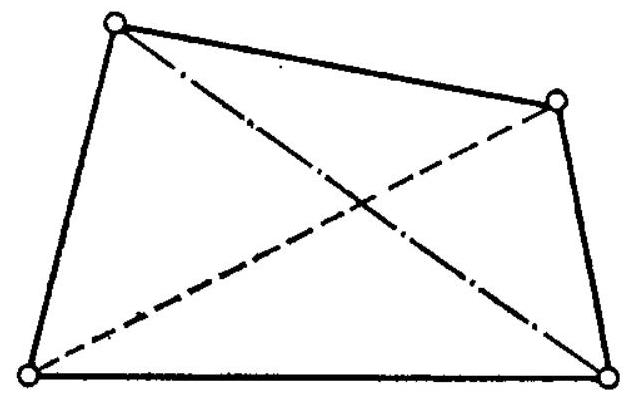
We claim that for more points, it is no longer possible to color the segments appropriately.
First, we show th... | 4 | Combinatorics | math-word-problem | Yes | Yes | olympiads | false |
Let $\alpha$ be the largest root of the equation $x^{3}-3 x^{2}+1=0$. Prove that
$$
\left[\alpha^{1993}\right] \equiv 4(\bmod 17),
$$
that is, the integer part of $\alpha^{1993}$, when divided by 17, leaves a remainder of 4. | Let $f(x)$ denote the polynomial $x^{3}-3 x^{2}+1$. Then $f(2 / 3)<0<f(0)$, and by Bolzano's theorem, $f$ has a root $\alpha_{2}$ in the interval $(0 ; 2 / 3)$. Clearly, $f(x)-f(-x)=2 x^{3}$, so $f\left(-\alpha_{2}\right)<0<f(0)$, and by Bolzano's theorem again, $f$ has a root $\alpha_{1}$ in the interval $\left(-\alph... | 5 | Algebra | proof | Yes | Yes | olympiads | false |
On a table, there are 100 piles of pebbles, containing 1, 2, ..., 100 pebbles respectively. In one step, we can reduce any number of selected piles, provided that we remove the same number of pebbles from each.
In the least number of steps, how can we remove all the pebbles from the table? | First, we prove that this can be done in seven steps; for example, in the following way.
1. Step: From the piles containing more than 63 pebbles, we remove 64. Thus, in these, at most 36 remain, and in the others, at most 63, so there is no pile with more than 63 pebbles.
2. Step: Where possible, we remove 32 pebbles.... | 7 | Number Theory | math-word-problem | Yes | Yes | olympiads | false |
How much is the integer part of the following number:
$$
\sqrt{6+\sqrt{6+\ldots+\sqrt{6}}}+\sqrt[3]{6+\sqrt[3]{6+\cdots+\sqrt[3]{6}}}
$$
where both the number of square root and cube root symbols is 100? | Let the first term of the examined sum be denoted by $A$, and the second term by $B$. Clearly,
$$
\sqrt{6}4$, hence the integer part of $A+B$ is 4.
Remarks. 1. It can be seen from the proof that the number of radicals in $A$ and $B$ is irrelevant to the result.
2. The inequality $\sqrt{6}+\sqrt[3]{6}>4$ can be prove... | 4 | Algebra | math-word-problem | Yes | Yes | olympiads | false |
A natural number's square consists of 202 digits. The first 100 digits are 1s, followed by 101 digits of 2s. Determine the last digit and the number.
Let's solve this problem step by step.
1. **Understanding the Problem:**
- The square of a natural number has 202 digits.
- The first 100 digits are 1s.
- The ... | Let the sought number be denoted by $S$, and the number consisting of 100 ones by $E$. According to the problem, in $S^{2}$, after $E$ comes twice $E$, then a two and an unknown digit, let's say $x$. Generally, if the $k$-digit number $B$ is written after the number $A$, in the resulting $\overline{A B}$ number, the pl... | 5 | Number Theory | math-word-problem | Yes | Yes | olympiads | false |
What is the largest natural number $n$ for which the rectangular parallelepipeds $T_{1}, T_{2}, \ldots, T_{n}$ can be specified such that their faces are parallel to one of the coordinate planes and for which it holds that for any subset $H$ of the set of the first $n$ natural numbers, there exists a point $P$ such tha... | A rectangular parallelepiped's $(x, y, z)$ points in space can be characterized by the conditions
$$
a \leqq x \leqq b, \quad c \leqq y \leqq d, \quad e \leqq z \leqq f
$$
Accordingly, for each rectangular parallelepiped, there is an interval on each coordinate axis. If the system $T_{1}, T_{2}, \ldots, T_{n}$ is app... | 6 | Combinatorics | math-word-problem | Yes | Yes | olympiads | false |
Let's determine for every positive integer $n$ the first digit after the decimal point in the number $\sqrt{n^{2}+n+1}$. | When $n$ takes the values $1,2,3$, then $\sqrt{3}=1.7 \ldots ; \sqrt{7}=2.6 \ldots ; \sqrt{13}=3.6 \ldots$ We will show that if $n \geq 4$, then the digit in question is 5.
Since $n^{2}<n^{2}+n+1<(n+1)^{2}$, it follows that
$$
\left[\sqrt{n^{2}+n+1}\right]=n
$$
For the digit $\alpha$ after the decimal point, we have... | 5 | Number Theory | math-word-problem | Yes | Yes | olympiads | false |
The sequence $\mathrm{Az}\left(a_{n}\right)$ is defined as follows:
$$
a_{1}=k \text { (positive integer), }
$$
$$
a_{n+1}= \begin{cases}a_{n} / 2, & \text { if } a_{n} \text { is even } \\ a_{n}+5, & \text { if } a_{n} \text { is odd. }\end{cases}
$$
For which positive integers $k$ is it true that 1 appears among t... | If $x$ is a positive integer, then $x$ is divisible by 5 if and only if $x / 2$, and $x+5$ are. This means that if $k$ is divisible by 5, then the elements of the sequence are also, so 1 does not appear among them.
Now, suppose $k$ is not divisible by 5; thus, no other element of the sequence is. The elements of the s... | 1 | Number Theory | math-word-problem | Yes | Yes | olympiads | false |
What is the sum of the roots of the equation $10^{x}+10^{1-x}=10$? | Using the identity of exponentiation, our equation can be rewritten as
$$
10^{2 x}-10 \cdot 10^{x}+10=0
$$
in terms of \(10^{x}\), it can be transformed into a quadratic equation. Based on the relationship between the roots and coefficients,
$$
10^{x_{1}} \cdot 10^{x_{2}}=10
$$
thus
$$
10^{x_{1}+x_{2}}=10, \text{ ... | 1 | Algebra | math-word-problem | Yes | Yes | olympiads | false |
The sequence $a_{0}, a_{1}, \ldots$ is defined by the recursive formula $a_{n+1}=\sin a_{n}$ starting from an arbitrary value of $a_{0}$. Is this sequence convergent, and if so, what is its limit? | Since the range of the $\sin x$ function is the closed interval $[-1,1]$, $\left|a_{1}\right|=\left|\sin a_{0}\right| \leq 1$. Let us denote $\left|a_{1}\right|$ by $x_{1}$, and starting from $x_{1}$, define the terms of the sequence by the recursion
$$
x_{n+1}=\sin x_{n}, \quad n=1,2, \ldots
$$
If $a_{1} \geq 0$, th... | 0 | Calculus | math-word-problem | Yes | Yes | olympiads | false |
For a given triangle, we construct an equilateral triangle outward and inward on each of its sides. In how many ways can 4 points be selected from the 9 points found in the figure so that they are the vertices of a parallelogram?
Would our findings remain valid if, instead of equilateral triangles, we constructed isos... | I. Let's choose the labeling of the given triangle such that its vertices $A, B, C$ are traversed in a way that the interior of the triangle is to the left of the path, i.e., $A B C$ gives a positive traversal. Let the triangles inscribed inward on the sides be $A B C_{1}, B C A_{1}, C A B_{1}$, and the outward inscrib... | 9 | Geometry | math-word-problem | Yes | Yes | olympiads | false |
Two brothers sold their flock of sheep. They sold each sheep for as many dollars as there were sheep in the flock. They shared the revenue, giving each other 10 dollars at a time. First, the older brother received 10 dollars, then the younger one, then again the older one, and so on. In the end, only less than 10 dolla... | In the birkanyaj, there were $n$ birka, so according to the problem, they received a total of $n^{2}$ tallers for them. This is how they divided it:
older sibling
10 tallers
$\vdots$
10 tallers
10 tallers younger sibling
10 tallers
$\vdots$
10 tallers
$m$ tallers $\quad(1 \leq m \leq 9$ integer $)$
Thus, $n^{... | 2 | Number Theory | math-word-problem | Yes | Yes | olympiads | false |
Let's calculate the following fraction without using a calculator or function tables:
$$
\frac{\pi-\operatorname{arctg} \frac{8}{15}}{2 \cdot \operatorname{arctg} 4}
$$
(arc tg $x$ represents the angle in the interval $\left(-\frac{\pi}{2} ; \frac{\pi}{2}\right)$ whose tangent is $x$.) | I. solution. Let's draw a right-angled triangle with legs of 8 and 15 units, the acute angle opposite the 8-unit leg is $\alpha$, the other acute angle is $\beta$, and the hypotenuse $AB = \sqrt{8^2 + 15^2} = 17$. Rotate the hypotenuse $AB$ onto the ray $CA$. In the isosceles triangle $ABD$, $AD = 17$, $\angle BDA = \a... | 1 | Algebra | math-word-problem | Yes | Yes | olympiads | false |
A radio tube has 5 connections and its socket has 5 holes. These are located at the vertices of a regular pentagon, and the tube can be placed in the socket in 5 different ways. The connections are numbered from 1 to 5. In how many ways can the holes be numbered from 1 to 5 so that in every position of the tube at leas... | The requirement in the task that in any position of the pipe, at least one outlet must be in the hole with the same number, is equivalent to the requirement that exactly one outlet must be in the hole with the same number. Indeed, if in some position of the pipe, 2 or more outlets were in the corresponding hole, then t... | 3 | Combinatorics | math-word-problem | Yes | Yes | olympiads | false |
We cut a circular piece of paper into $n$ identical sectors, and then shape each of the resulting sectors into a cone. For what value of $n$ will the total volume of the cones determined by the cone-shaped sectors be maximized? | Let the radius of the circle be $R=1$, the central angle of a sector $\frac{360^{\circ}}{n}$, and the arc length $i=\frac{2 \pi}{n}$.
The radius of the base circle of the cone is $r$. From the equation $2 r \pi=\frac{2 \pi}{n}$,
$$
r=\frac{1}{n}
$$
The height of the cone can be calculated using the Pythagorean theor... | 2 | Geometry | math-word-problem | Yes | Yes | olympiads | false |
On a circular running track, two people are running in the same direction at constant speeds. At a certain moment, runner $A$ is 10 meters ahead of runner $B$, but after $A$ runs 22 meters, $B$ catches up.
How many points on the track can $B$ later overtake $A$? | Let the speeds of the two runners be denoted by $v_{A}$ and $v_{B}$, respectively. According to the problem,
$$
\frac{v_{A}}{v_{B}}=\frac{22}{32}=\frac{11}{16}
$$
This means that while runner $A$ completes 11 laps, runner $B$ completes 16. If the time required for this is denoted by $T$, and we start observing the ev... | 5 | Algebra | math-word-problem | Yes | Yes | olympiads | false |
A box contains several slips of paper, each with a natural number written on it. We know that no matter how we pick three slips, there will be two among them such that the sum of the numbers on them is divisible by 5. What is the maximum number of slips that can have a number not divisible by 5? | Let's separate the numbers in the box that are not divisible by 5 according to the remainder they give when divided by 5. We can have the same remainder on at most two cards, because if any three of them give the same remainder \( m \) when divided by 5, then the sum of any two of them will give the same remainder as \... | 4 | Number Theory | math-word-problem | Yes | Yes | olympiads | false |
Show that the value of the following expression is constant ($n>1$, natural number).
$$
\frac{\left(1^{5}+2^{5}+3^{5}+\ldots+n^{5}\right)-\left(1^{3}+2^{3}+3^{3}+\ldots+n^{3}\right)}{\left(1^{5}+2^{5}+3^{5}+\ldots+n^{5}\right)-(1+2+3+\ldots+n)^{3}}
$$ | For the smallest possible value of $n$, for $n=2$, the value of $K$ is $(33-9) /(33-27)=4$, so we need to prove that for every positive integer $n(>1)$, $4-K$, that is,
$$
\frac{3\left(1^{5}+2^{5}+\ldots+n^{5}\right)+\left(1^{3}+2^{3}+\ldots+n^{3}\right)-4(1+2+\ldots+n)^{3}}{\left(1^{5}+2^{5}+\ldots+n^{5}\right)-(1+2+... | 4 | Algebra | proof | Yes | Yes | olympiads | false |
In a mathematical student competition, three problems were posed: $A$, $B$, and $C$. 25 students in total solved at least one of the problems. Among the students who did not solve $A$, there were twice as many who solved $B$ as those who solved $C$. One more student solved only $A$ than those who solved $A$ along with ... | We categorize the contestants who solved at least one problem into the following 5 groups:
I. those who only solved $A$,
II. those who solved $A$ and at least one other problem,
III. those who only solved $B$,
IV. those who only solved $C$,
V. those who solved both $B$ and $C$.
Thus, each of them falls into one a... | 6 | Combinatorics | math-word-problem | Yes | Yes | olympiads | false |
An abstract animal wanders on a unit-radius sphere. The length of its steps is 1.99 (this is the length of the segment defined by the two endpoints). In its journey, it cannot take a step immediately back in the direction it came from. - What is the minimum number of steps required for it to return to where it started? | I. solution. Let's denote the abstract animal by $A$, its starting point by $P$, the center of the sphere by $O$, the endpoint of its next step by $Q$, $R$, and $S$. Since the length of one step is less than the diameter of the sphere, $A$ always has somewhere to step. According to our assumption, $R$ cannot be the sam... | 4 | Geometry | math-word-problem | Yes | Yes | olympiads | false |
On a circle with a circumference of 15 units, we select a finite set of points such that from any point in this set, measured along the circumference, there is exactly one point in the set at a distance of 2 units and exactly one point at a distance of 3 units. Is it possible for the number of points in the set not to ... | A single suitable example is enough to answer the question: yes, it is possible. Draw a regular 15-sided polygon in the circle, mark one of its vertices as \(A_{1}\), one of its neighbors as \(A_{2}\), and then the subsequent vertices in this direction as \(A_{3}\), ..., \(A_{15}\). In this direction, the distance betw... | 6 | Combinatorics | math-word-problem | Yes | Yes | olympiads | false |
Let the sum of the digits of a 1995-digit number divisible by 9 be $a$. We then add the digits of $a$, and let the result be $b$. What can the sum of the digits of $b$ be? | The value of $a$ is the largest when the original number consists of 1995 nines, so $a \leq 1995 \cdot 9 = 17955$. According to this, $a$ is either a four-digit number or a five-digit number starting with 1; therefore, $b \leq 1 + 4 \cdot 9 = 37$. It is clear that the sum of the digits of $b$ is less than $3 + 9 = 12$,... | 9 | Number Theory | math-word-problem | Yes | Yes | olympiads | false |
A cube's faces are painted: two are painted white, two are painted blue, and two are painted yellow. How many differently colored cubes can we make?
We are asked to determine the number of distinct colorings of a cube where two faces are white, two are blue, and two are yellow. To solve this, we need to consider th... | I. solution. If we only consider the relative position of the white faces, there are two possible cases: the white faces are either opposite or adjacent. In the first case, hold the cube in front of us so that the white faces are horizontal. There are again two possibilities for coloring the four vertical faces, since ... | 6 | Combinatorics | math-word-problem | Yes | Yes | olympiads | false |
We know about the sequence $c_{1}, c_{2}, \ldots, c_{n}, \ldots$ that $c_{1}=0$ and for $n=1,2, \ldots$
$$
c_{n+1}=\left(\frac{n}{n+1}\right)^{2} \cdot c_{n}+\frac{6 n}{(n+1)^{2}}
$$
Prove that the limit of the sequence is 3. | Multiply (1) by $(n+1)^{2}$:
$$
(n+1)^{2} c_{n+1}=n^{2} c_{n}+6 n
$$
According to this, for the sequence $c_{n}$, the function
$$
f(n)=n^{2} c_{n}
$$
defined on the natural numbers satisfies
$$
f(n+1)-f(n)=6 n
$$
(3) gives the increments of the function $f$ for consecutive natural numbers, i.e., the values by whi... | 3 | Algebra | proof | Yes | Yes | olympiads | false |
Karcsinak has 10 identical balls, among which 5 are red, 3 are white, and 2 are green, and he also has two boxes, one of which can hold 4 balls, and the other can hold 6 balls. In how many ways can he place the balls into the two boxes? (The arrangement of the balls within the boxes is not important.) | The division of 10 balls into two parts can be achieved by specifying the color arrangement of the 4 balls that go into the smaller box, with the remaining 6 balls always going into the larger box. (Of course, we understand the problem such that, for example, 5 red balls cannot be distinguished from each other, so if w... | 11 | Combinatorics | math-word-problem | Yes | Yes | olympiads | false |
How many different (positive) prime numbers can be given such that the sum of any three of them is also a prime number? (Also provide such primes!)
Translated as requested, maintaining the original text's line breaks and format. | Let's classify the prime numbers based on the remainder they give when divided by 3. We can take at most two numbers from each class, because if three prime numbers give the same remainder when divided by 3, then their sum is divisible by 3 (and is greater than 3). If we took one from each class, their sum would also b... | 4 | Number Theory | math-word-problem | Yes | Yes | olympiads | false |
We need to write a positive integer in each cell of an infinitely large square grid paper under the following conditions. The number $n$ should appear exactly $n$ times (that is, one 1, two 2s, etc., should appear on the paper), and the difference between any two numbers in adjacent cells should be less than a given $k... | First, we show that the sought $k$ is at least 3. The cell containing the one shares an edge with four other cells, while the paper only contains two twos. Thus, a number greater than two must be placed in one of the adjacent cells, so their difference is at least 2.
Next, we show that the filling can be carried out f... | 3 | Combinatorics | math-word-problem | Yes | Yes | olympiads | false |
We have two compact wooden cubes, their edge lengths are 14 and $10 \mathrm{~cm}$. We want to cut these cubes into pieces such that the pieces can be assembled into three cubes with edge lengths of 13, 11, and $6 \mathrm{~cm}$. The cuts are only allowed along planes parallel to the faces of the cubes, and the distance ... | The dissection can be carried out without remainder because the sum of the volumes of the desired cubes is equal to the sum of the volumes of the given cubes:
$$
6^{3}+11^{3}+13^{3}=14^{3}+10^{3}
$$
 the side lines of a trapezoid,
b) the side lines of a parallelogram, if no two sides of the ori... | 1. Let the center of the incircle $k$ of triangle $ABC$ be $O$, the center of the excircle $k_a$ (which is tangent to the extension of sides $AB$ and $AC$ and the side $BC$ externally) be $O_a$, and similarly, the centers of the excircles $k_b$ and $k_c$ (tangent to sides $CA$ and $AB$ respectively) be $O_b$ and $O_c$.... | 3 | Geometry | math-word-problem | Yes | Yes | olympiads | false |
Let $x, y, z$ be real numbers such that $|x| \geq 2,|y| \geq 2,|z| \geq 2$. How small can $|x y z + 2(x + y + z)|$ be? | I. solution. We distinguish two cases.
1. case: All three numbers have the same sign. It is enough to deal with the subcase where each of them is positive. Then $x, y, z \geq 2$, so
$$
|x y z+2(x+y+z)|=x y z+2(x+y+z) \geq 8+2(2+2+2)=20
$$
2. case: Two numbers have the opposite sign of the third. Here, too, it is eno... | 4 | Algebra | math-word-problem | Yes | Yes | olympiads | false |
What is the largest positive integer $n$ for which
$$
\sin ^{n} x+\cos ^{n} x \geqq \frac{1}{n}
$$
holds for any real $x$? | $x=\pi$-re a bal oldal értéke $(-1)^{n}$, ezért $n$ csak páros szám lehet; legyen $n=2 k$.
The value of the left side at $x=\pi$ is $(-1)^{n}$, so $n$ can only be an even number; let $n=2k$.
Az $f: x \mapsto \sin ^{2 k} x+\cos ^{2 k} x$ függvény periodikus, és a periódus hossza $\frac{\pi}{2}$, hiszen
The function $... | 8 | Inequalities | math-word-problem | Yes | Yes | olympiads | false |
An isosceles triangle has a $108^{\circ}$ angle between its legs. Divide the triangle into the minimum number of acute-angled triangles. | Suppose we extend the sides of a regular pentagon from one of its vertices to the line of the opposite side, we get a triangle as described in the problem. If we connect the vertices of the pentagon to the center of the pentagon, the original triangle is divided into seven acute triangles. We will show that the origina... | 7 | Geometry | math-word-problem | Yes | Yes | olympiads | false |
What is the maximum number of acute angles that can be in an $n$-sided convex polygon? | The sum of the interior and exterior angles is $180^{\circ}$, so every acute interior angle has an exterior angle greater than $90^{\circ}$. In a convex polygon, the sum of the exterior angles is $360^{\circ}$, and only three obtuse angles can fit into this. Others have shown that if at least 4 of the $n$ angles are ac... | 3 | Geometry | math-word-problem | Yes | Yes | olympiads | false |
In triangle $ABC$, the altitude from vertex $A$ is the harmonic mean of the two segments into which this segment divides side $BC$. What is $\operatorname{tg} \beta + \operatorname{tg} \gamma$ (where $\beta$ and $\gamma$ are the angles of the triangle)? | According to the conditions of the problem, the length of the altitude drawn from vertex $A$ is $\frac{2 p q}{p+q}$, where $p$ and $q$ are the two segments into which the altitude divides the side $B C$. It also follows from the condition that $\beta$ and $\gamma$ are acute angles; therefore,
$$
\operatorname{tg} \bet... | 2 | Geometry | math-word-problem | Yes | Yes | olympiads | false |
For a single-story apartment, we know the following: a) there is at most 1 door between any two rooms; b) from any room, there is at most 1 door leading outside the apartment; c) there are 12 doors in the apartment. What is the minimum number of rooms in the apartment? | Let $n$ denote the number of rooms in the apartment. Suppose that any two rooms are adjacent and there is a door between them, and there is a door from every room to the outside of the apartment. Then there are $\frac{n(n-1)}{2}$ internal doors, since from each room $n-1$ doors lead to the others and each door has been... | 5 | Combinatorics | math-word-problem | Yes | Yes | olympiads | false |
In the unit square, we placed points such that the distance between any two is greater than $1 / 2$. Provide an upper bound for the number of points.
untranslated portion:
将上面的文本翻译成英文,请保留源文本的换行和格式,直接输出翻译结果。
Note: The untranslated portion seems to be instructions for the translation task itself and not part of the co... | A unit-sided square can be covered by 9 smaller squares, each with a side length of $1 / 3$. The diagonal of a small square is $\sqrt{2} / 3 < 0.5$, so the distance between any two points within a small square is less than $1 / 2$. Consequently, we can place at most one point in each small square, meaning that the enti... | 8 | Geometry | math-word-problem | Yes | Yes | olympiads | false |
$\mathrm{Az}$
$$
a_{n}=\frac{(n+3)^{2}+3}{n(n+1)(n+2)} \cdot \frac{1}{2^{n+1}}
$$
is a sequence defined by its general term. We form the sequence
$$
b_{n}=\sum_{k=1}^{n} a_{k}
$$
Determine the limit of the sequence $b_{n}$ as $n \rightarrow+\infty$. | I. solution. For $n=1,2,3$, respectively,
$$
\begin{array}{ll}
b_{1}=a_{1}=\frac{19}{24} & \left(=1-\frac{5}{24}=1-\frac{5}{3 \cdot 2 \cdot 2^{2}}\right) \\
b_{2}=b_{1}+a_{2}=\frac{15}{16} & \left(=1-\frac{1}{16}=1-\frac{6}{3 \cdot 4 \cdot 2^{3}}\right) \\
b_{3}=b_{2}+a_{3}=\frac{313}{320} & \left(=1-\frac{7}{320}=1-\... | 1 | Algebra | math-word-problem | Yes | Yes | olympiads | false |
We want to cut a cube with an edge length of 4 units into 64 smaller cubes, each with an edge length of 1 unit. This can be done simply with 9 cuts if the pieces resulting from the cuts are not moved apart from each other. How many cuts can this be reduced to if the pieces can be rearranged appropriately after each cut... | Since the cube is convex, we can cut it into two parts with one cut, meaning that with each cut, we can at most double the number of pieces we have. This means that we definitely need 6 cuts, because after 5 cuts, we can get at most $2^{5}=32$ pieces. Six cuts are sufficient, as shown in the figure.
$$
\text { 1985-10... | 6 | Logic and Puzzles | math-word-problem | Yes | Yes | olympiads | false |
An international committee consists of 5 members, each representing 1 of 5 states. The documents that the committee works on are stored in an armored safe. How many locks should the safe have, and how many keys should each committee member be provided with, so that access to the documents is only possible when at least... | a) Any two members of the committee cannot open the cabinet in the absence of the other three; therefore, for any pair of members, there must be at least one lock that neither of them has a key to; we call such locks the unopenable locks for the respective pair.
Two different pairs of members cannot have a common unop... | 10 | Combinatorics | math-word-problem | Yes | Yes | olympiads | false |
Let's write the integers from 1 to 6 on the six faces of a cube such that pairs of consecutive numbers - and the pair 6, 1 as well - end up on adjacent faces. How many different arrangements are possible? (We do not consider two arrangements different if one can be transformed into the other by a symmetry of the cube -... | I. solution. Hold the cube so that one of its faces is vertically in front of us and label its top, front, bottom, left, back, and right faces as $F, E, A, B, H, J$ respectively.
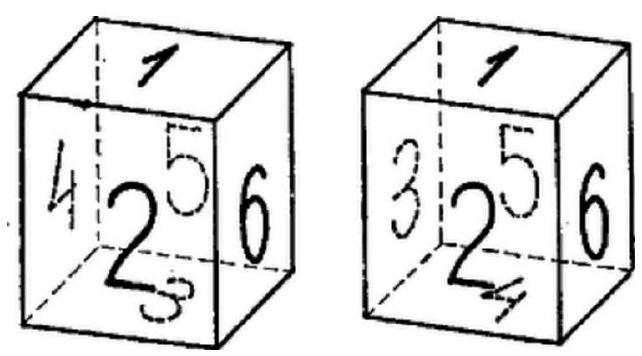
According to ... | 2 | Combinatorics | math-word-problem | Yes | Yes | olympiads | false |
Let's find the solutions of the following system of equations in the set of non-negative numbers:
$$
\begin{aligned}
x^{3}+y^{3}+3 x y & =1 \\
x^{2}-y^{2} & =1
\end{aligned}
$$
Do we get other solutions if we only assume that $x+y>0$? | I. solution. If $x \geq 0$ and $y \geq 0$, then from (1) it follows that $x \leq 1$ and $y \leq 1$, and from (2) it follows that $x \geq 1$. Thus, only $x=1$ can hold. Substituting this into (2) yields $y=0$. Substituting these values shows that this pair of numbers is also a solution to (1). Therefore, the solution to... | 10 | Algebra | math-word-problem | Yes | Yes | olympiads | false |
We know that the product $a b c$ is equal to 1. What is the value of the following expression:
$$
\frac{a}{a b+a+1}+\frac{b}{b c+b+1}+\frac{c}{c a+c+1}
$$ | We can extend the second fraction by $a$, and the third one by $a b$. Then we get the sum in the following form:
$$
\frac{a}{a b+a+1}+\frac{a b}{a b c+a b+a}+\frac{a b c}{a b c \cdot a+a b c+a b}
$$
Using the fact that $a b c=1$, the denominators of the fractions become equal, and the sum of the numerators is exactly... | 1 | Algebra | math-word-problem | Yes | Yes | olympiads | false |
A rhombus has three consecutive vertices on the sides $AB$, $BC$, and $CD$ of a given square $ABCD$. What is the area of the locus of all points that can be the fourth vertex of such a rhombus? | Let the vertices on the sides $AB$, $BC$, $CD$ of the rhombus be denoted by $P$, $Q$, $R$ respectively, and let $E$, $F$ be the midpoints of the sides $BC$, $AD$ of the square. The center $K$ of the rhombus - as the midpoint of the segment $PR$ - falls on the segment $EF$, and the fourth vertex $S$ in question is the r... | 1 | Geometry | math-word-problem | Yes | Yes | olympiads | false |
A plane intersects each side of the quadrilateral $ABCD$ at an internal point. Following a circumferential direction, we write down the ratio in which each intersection point divides the side it lies on. What will be the product of the four ratios?
---
Translate the above text into English, please keep the original t... | I. solution. Let the plane mentioned in the problem be denoted by $S$. The points of intersection of the sides of the skew quadrilateral with $S$ are $E, F, G, H$ as shown in the figure. Project the vertices of the skew quadrilateral perpendicularly onto the plane $S$, and let the projection points be $A^{\prime}, B^{\... | 1 | Geometry | math-word-problem | Yes | Yes | olympiads | false |
From city $A$, two cars start simultaneously on the same route to $B$, the first at speed $v_{1}$, the second at speed $v_{2}\left(<v_{1}\right)$. $t_{1}$ hours later, a third car starts after them and $t_{2}$ hours after overtaking the first car, it arrives in $B$. After another $t_{3}$ time, the second car also arriv... | Let the three cars be $K_{1}, K_{2}, K_{3}$, the speed of the latter $v$ (km/h), the driving time until reaching $K_{1}$ be $x$ (hours), and finally the distance $AB$ be $s$ (km). Then $K_{1}$ has driven for $t_{1}+x$ hours until its arrival, the total driving time of $K_{2}$ and $K_{3}$ is $t_{1}+x+t_{2}+t_{3}$, and $... | 2 | Algebra | math-word-problem | Yes | Yes | olympiads | false |
How many types of convex pentahedra exist? | If a polyhedron had a face that is a pentagon or has more than five sides, then the solid would have at least 6 faces. Therefore, the faces can only be triangles and quadrilaterals. Let $e$ be the number of edges, and let the number of triangular faces be $k$. Then the number of quadrilateral faces is $5-k$. Counting t... | 2 | Geometry | math-word-problem | Yes | Yes | olympiads | false |
Let's round each addend in the following expressions to $n=1,2,3, \ldots$ decimal places, and find the largest value of $n$ for which the rounded values of $K_{1}$ and $K_{2}$ are still equal. Also, examine the question for the case where the addends are rounded to the nearest unit, ten, hundred, and thousand.
$$
K_{1... | a) We bring the factor in front of the root sign of the irrational addends under the root sign, and in calculating the square root of the resulting numbers, we go to the 6th decimal place. We will see that this is enough to determine the sought value of $n$.
$$
\begin{aligned}
1842 \sqrt{2} & =\sqrt{6785928}=2604.9813... | 4 | Algebra | math-word-problem | Yes | Yes | olympiads | false |
What is the value of the sum $A+B$, if
$$
\frac{1}{A}=1-\frac{1-x}{y}, \quad \frac{1}{B}=1-\frac{y}{1-x}, \quad x=\frac{1-a}{1-\frac{1}{a}}, \quad y=1-\frac{1}{x}
$$
and $a \neq \pm 1$. | According to the third relationship, $x$ depends on $a$, and according to the fourth relationship, $y$ depends on $x$, so ultimately the value of $A+B$ is determined by the value of $a$ according to the first two relationships:
$$
\frac{1}{A}=\frac{x+y-1}{y}, \quad \frac{1}{B}=\frac{1-x-y}{1-x}=\frac{x+y-1}{x-1}
$$
T... | 1 | Algebra | math-word-problem | Yes | Yes | olympiads | false |
King Arthur's bodyguards held a knightly tournament. At the end of the tournament, it turned out that the king could find a third one for any two bodyguards who participated, who had defeated both of them. What is the minimum number of bodyguards who participated in the tournament? | Let's indulge in the idea that the king has at least two bodyguards, one of whom is $A$. This bodyguard $A$ was certainly replaced by someone, let's say $B$, and there was a bodyguard $C$ who defeated both $A$ and $B$. Now, $B$ could not have defeated $A$ and $C$, since $B$ was replaced by $C$, so this must have been a... | 7 | Logic and Puzzles | math-word-problem | Yes | Yes | olympiads | false |
Anna and Béla play the following game: Anna thinks of a quadruple of natural numbers $\left(a_{1}, a_{2}, a_{3}, a_{4}\right)$. Béla states a quadruple of natural numbers $\left(b_{1}, b_{2}, b_{3}, b_{4}\right)$. In response, Anna tells him the sum $a_{1} b_{1}+a_{2} b_{2}+$ $a_{3} b_{3}+a_{4} b_{4}$. Then Béla can st... | Two number quadruples are sufficient to guess Anna's numbers. If Béla chooses the first number quadruple as $(1,1,1,1)$ and the answer to this is a $k$-digit number, then it follows that Anna thought of a number quadruple consisting of at most $k$-digit numbers. Thus, if the second number quadruple is $1,10^{k}, 10^{2k... | 2 | Algebra | math-word-problem | Yes | Yes | olympiads | false |
For what values of the parameter $p$ will the equation
$$
\sqrt[3]{x}+\sqrt[3]{2-x}=p
$$
have exactly one solution? | Let the function on the left side of the equation be denoted by $f$. It can be seen that for all real $x$, $f(x) = f(2-x)$, so if $x_0$ is a solution, then $(2-x_0)$ is also a solution. If $x_0 \neq 1$, then $x_0 \neq 2-x_0$. The $x_0 = 1$ is a solution only when $p = 2$, so if $p \neq 2$, then (1) has an even number o... | 2 | Algebra | math-word-problem | Yes | Yes | olympiads | false |
A "nearly regular" $H_{0}$ triangle has angles of $59.5^{\circ}, 60^{\circ}$, and $60.5^{\circ}$. Consider the following sequence of triangles. Let $H_{1}$ be the pedal triangle of $H_{0}$, $H_{2}$ be the pedal triangle of $H_{1}$, and so on. Which one in the sequence will be the first obtuse triangle? | In triangle $ABC$, let $\alpha=60^{\circ}, \beta=59.5^{\circ}, \gamma=60.5^{\circ}$, and in the pedal triangle $H_{1}=A_{1} B_{1} C_{1}$, $A_{1}$ is the foot of the altitude from $A$, $B_{1}$ is the foot of the altitude from $B$, and $C_{1}$ is the foot of the altitude from $C$, and $M$ is the orthocenter.
 pentagons are there, each of whose angles is $108^{\circ}$, and among whose sides there are 1, 2, and 3 units long? | All known sides are either consecutive to each other or two of them are adjacent, and the third one is between the two other (unknown) sides.
In both cases, the construction is uniquely determined by which of the three consecutive sides we choose as the middle one, or as the one separated from the others. Thus, we nee... | 5 | Geometry | math-word-problem | Yes | Yes | olympiads | false |
Subsets and Splits
No community queries yet
The top public SQL queries from the community will appear here once available.