
problem stringlengths 15 4.7k | solution stringlengths 2 11.9k | answer stringclasses 51
values | problem_type stringclasses 8
values | question_type stringclasses 4
values | problem_is_valid stringclasses 1
value | solution_is_valid stringclasses 1
value | source stringclasses 6
values | synthetic bool 1
class |
|---|---|---|---|---|---|---|---|---|
A target board's 18 sectors are delimited by three concentric circles and three lines passing through the center, as shown in the figure. The areas of sectors marked with the same number are equal, the area of the 2 is half that of the 3. How many times larger is the area of the 4 sector compared to the 1 sector?
 \cdot 3^{x}-(x-2)\left(x^{2}-5 x+6\right)=0$ in the set of real numbers. | Solution. The quadratic expression $x^{2}-5 x+6$ can be factored into $(x-2)(x-3)$. Substituting this into the equation and factoring out $(-3)$ from $(9-3 x)$, we get
$$
-3 \cdot(x-3) \cdot 3^{x}-(x-2)(x-2)(x-3)=0
$$
Further simplifying this, we arrive at the equation
$$
(x-3)\left(-3^{x+1}-(x-2)^{2}\right)=0
$$
F... | 3 | Algebra | math-word-problem | Yes | Yes | olympiads | false |
A magician has a hundred cards, numbered from 1 to 100. He places each of them into one of three boxes - a red box, a white box, and a blue box - in such a way that each box contains at least one card.
A member of the audience selects two of the three boxes and draws one card from each, then announces the sum of the n... | Let the three boxes be $A, B$, and $C$.
$$
A=\left\{a_{1}<a_{2}<\cdots<a_{k}\right\}, B=\left\{b_{1}<b_{2}<\cdots<b_{l}\right\}, C=\left\{c_{1}<c_{2}<\cdots<c_{m}\right\}, \quad(k+l+m=100)
$$
Consider the following sums:
$\left\{a_{1}+b_{1}<a_{1}+b_{2}<\cdots<a_{1}+b_{l}<a_{2}+b_{l}<\cdots<a_{k}+b_{l}\right\}\left\{... | 12 | Combinatorics | math-word-problem | Yes | Yes | olympiads | false |
Given the sequence defined by the recursion $x_{n+1}=x_{n}^{2}-x_{n}+1$, construct the infinite series $\sum_{i=1}^{\infty} \frac{1}{x_{i}}$. What is the sum of this series if $a$ ) $x_{1}=1 / 2 ; b$ ) $x_{1}=2$ ? | Solution. The sequence is given by the recursion $x_{n+1}=f\left(x_{n}\right)$, where $f(x)=x^{2}-x+1$. The graph of the function $f$ is shown in the figure, and we have also drawn the line $y=x$, which is tangent to the curve at the point $(1 ; 1)$. From the graph, it is clear that $f(x) \geq \frac{3}{4}$, so if $x_{1... | 1 | Algebra | math-word-problem | Yes | Yes | olympiads | false |
What digit stands before the decimal point in the number $(3+\sqrt{7})^{2004}$? | Solution. Let's write the sum $(3+\sqrt{7})^{2004}+(3-\sqrt{7})^{2004}$ using the binomial theorem:
$$
\begin{aligned}
& (3+\sqrt{7})^{2004}+(3-\sqrt{7})^{2004}= \\
& =\binom{2004}{0} \cdot 3^{2004}+\binom{2004}{1} \cdot 3^{2003} \cdot \sqrt{7}+\binom{2004}{2} \cdot 3^{2002} \cdot \sqrt{7}^{2}+\ldots+ \\
& +\binom{200... | 7 | Number Theory | math-word-problem | Yes | Yes | olympiads | false |
A polynomial $p$ of degree $n$ takes the value $\frac{k}{k+1}$ at $k$ when $k=0,1, \ldots, n$. What value can $p(n+1)$ take? | Consider the polynomials $q(x)=(x+1) p(x)$ and
$$
r(x)=x+\frac{1}{(n+1)!}(0-x)(1-x) \ldots(n-x)
$$
It is clear that both are polynomials of degree at most $(n+1)$, and for $k=0,1, \ldots, n$, we have $q(k)=r(k)=k$. Additionally,
$$
r(-1)=-1+\frac{1}{(n+1)!}(0-(-1))(1-(-1)) \ldots(n-(-1))=0=q(-1)
$$
Thus, the values... | 1 | Algebra | math-word-problem | Yes | Yes | olympiads | false |
In the plane, there are 6 given points, no three of which are on the same line. How many segments must be drawn between the point pairs so that there is certainly a triangle whose vertices are among the given points? | As can be seen in Figure 1, it is not sufficient to draw 9 connecting segments. The 9 segments do not yet form a triangle whose vertices are among the given points.
It is easy to see that a total of $\frac{6 \cdot 5}{2}=15$ segments can be drawn. Let's draw 10 of these. The 10 segments have a total of 20 endpoints. If... | 10 | Combinatorics | math-word-problem | Yes | Yes | olympiads | false |
A cube has two skew edges on which a unit-length segment moves. In which position of the segments will the volume of the tetrahedron determined by the endpoints of the segments be maximal? | Let the edge of the cube be of length $a$, and let two skew edges of the cube be $A B$ and $C D$ (the points $B$ and $C$ are directly above each other). Furthermore, let the two unit-length segments be $P Q$ (on the edge $A B$) and $X Y$ (on the edge $C D$). Let's examine what happens when we move the segment $P Q$ alo... | 6 | Geometry | math-word-problem | Yes | Yes | olympiads | false |
In the plane, there are five points such that no three of them lie on the same line. Prove that among the triangles determined by them, at most seven are acute-angled. | Solution. Let's choose four points out of the five. This can be done in $\binom{5}{4}=5$ ways. The selected points (denoted by $A, B, C$, and $D$) either form the vertices of a convex or a concave quadrilateral.
In any quadrilateral, the sum of the interior angles is $360^{\circ}$. If the quadrilateral is convex, then... | 7 | Geometry | proof | Yes | Yes | olympiads | false |
Let's determine the minimum possible value of the expression
$$
4+x^{2} y^{4}+x^{4} y^{2}-3 x^{2} y^{2}
$$
where $(x, y)$ runs through the set of all real number pairs. | Apply the inequality between the arithmetic mean and the geometric mean to the numbers $1, x^{2} y^{4}$, and $x^{4} y^{2}$:
$$
\frac{1+x^{2} y^{4}+x^{4} y^{2}}{3} \geq \sqrt[3]{1 \cdot x^{2} y^{4} x^{4} y^{2}}=x^{2} y^{2}
$$
which, when rearranged, means that
$$
4+x^{2} y^{4}+x^{4} y^{2}-3 x^{2} y^{2} \geq 3
$$
It ... | 3 | Algebra | math-word-problem | Yes | Yes | olympiads | false |
For how many different values of the parameter $p$ does the system of equations
$$
x^{2}-y^{2}=0 \quad x y+p x-p y=p^{2}
$$
have exactly one solution? | Transform the first equation into a product: $(x+y)(x-y)=0$, hence $x=y$ or $x=-y$. If $x=y$, then from the second equation:
$$
\begin{aligned}
x^{2}+p x-p x & =p^{2}, \\
x^{2} & =p^{2},
\end{aligned}
$$
from which $x_{1}=p, y_{1}=p$ or $x_{2}=-p, y_{2}=-p$. Therefore, for any $p \neq 0$, the system of equations has ... | 1 | Algebra | math-word-problem | Yes | Yes | olympiads | false |
Show that the expression
$$
\frac{x}{y^{3}-1}+\frac{y}{1-x^{3}}+\frac{2(x-y)}{x^{2} y^{2}+3}
$$
has a constant value for all points where it is defined and $x+y=1$. | Solution. Due to the denominators, $x \neq 1, y \neq 1$. Since $x+y=1$, we have $x=1-y$, and $y=x-1$. Using these substitutions, we can perform the following transformations:
$$
\begin{aligned}
& \frac{x}{y^{3}-1}+\frac{y}{1-x^{3}}+\frac{2(x-y)}{x^{2} y^{2}+3}= \\
& =\frac{1-y}{(y-1)\left(y^{2}+y+1\right)}+\frac{1-x}{... | 0 | Algebra | proof | Yes | Yes | olympiads | false |
Solve the equation $2 x \lg x+x-1=0$ in the set of real numbers. (Proposed by Éva Gyanó, Budapest)
Solve the equation $2 x \lg x+x-1=0$ in the set of real numbers. (Proposed by Éva Gyanó, Budapest) | Solution. Let's rearrange the equation:
$$
2 \lg x=\frac{1}{x}-1
$$
then plot the functions on the left and right side of the equation in the same coordinate system. From the graph, we can read that both functions take the value 0 at \( x=1 \). Substitution can verify that indeed \( 2 \lg 1=0 \) and \( \frac{1}{1}-1=... | 1 | Algebra | math-word-problem | Yes | Yes | olympiads | false |
Let $f$ be a straight line, and let's draw the lines $e$ and $g$ on either side of it, each at a unit distance from $f$. Let $E, F$, and $G$ be points on the respective lines such that the triangle they form has a right angle at $F$. What is the length of the altitude from $F$ in this triangle? | Extend the segment $F G$ so that its intersection point with line $e$ is $E^{\prime}$. Since the distance between lines $e$ and $f$ is equal to the distance between lines $f$ and $g$, and since $e, f$, and $g$ are parallel, it follows that $G F = F E^{\prime}$. Thus, the triangles $E F G$ and $E F E^{\prime}$ are mirro... | 1 | Geometry | math-word-problem | Yes | Yes | olympiads | false |
In how many ways can 32 knights be placed on an $8 \times 8$ chessboard so that no two attack each other? | Solution. Let's examine the order of the fields such that by moving through them, we step on each field exactly once, in knight's moves, and return to the starting field.
| 15 | 34 | 39 | 4 | 17 | 32 | 49 | 6 |
| :---: | :---: | :---: | :---: | :---: | :---: | :---: | :---: |
| 40 | 3 | 16 | 33 | 38 | 5 | 18 | 31 |
| ... | 2 | Combinatorics | math-word-problem | Yes | Yes | olympiads | false |
We call a set of positive integers fragrant if it has at least 2 elements, and for every element, there is at least one other element such that the two elements have a common prime divisor. Let $P(n)=n^{2}+n+1$. What is the smallest positive integer $b$ for which there exists a non-negative integer $a$ such that the se... | Baran Zsuzsanna's solution. We will see that the smallest such $b$ positive integer is $b=6$.
The task is to find as few consecutive positive integers as possible such that each of their $P$ values has a common prime divisor with the $P$ value of another element. For this, we will examine what common prime divisor can... | 6 | Number Theory | math-word-problem | Yes | Yes | olympiads | false |
A sphere of unit radius can be inscribed in a tetrahedron. The tangent planes of the sphere, parallel to the faces of the tetrahedron, cut off a smaller tetrahedron from the tetrahedron. What is the sum of the radii of the spheres inscribed in these smaller tetrahedra? | Let the vertices of the tetrahedron be $A, B, C, D$, its volume $V$, its surface area $A$, and the radius of the inscribed sphere $r=1$. The plane tangent to the tetrahedron and parallel to the face $BCD$ cuts off the tetrahedron $AB_1C_1D_1$. (See the figure.) Let the radius of the sphere inscribed in this tetrahedron... | 2 | Geometry | math-word-problem | Yes | Yes | olympiads | false |
For which natural numbers $x, y$ does the following equality hold:
$$
x^{2}\left(x^{2}+y^{2}\right)=y^{100}
$$ | I. solution. The equation in the problem is quadratic in $x^{2}$, solving this (with $y$ as a parameter):
$$
x^{2}=\frac{-y^{2} \pm \sqrt{y^{4}+4 y^{100}}}{2}
$$
For $x^{2}$ to be an integer, it is necessary that $y^{4}+4 y^{100}$ is a perfect square. Since $\left(2 y^{50}\right)^{2} \leq y^{4}+4 y^{100}y^{2}$ and $y... | 0 | Number Theory | math-word-problem | Yes | Yes | olympiads | false |
For a unit cube, we place a plane on each edge such that the plane forms a $45^{\circ}$ angle with both faces that the edge belongs to and does not intersect the cube. What is the volume of the convex body bounded by these 12 planes? | I. solution. The body described in the problem can be constructed by placing a pyramid on each face of the starting cube (Figure 1). The base of these pyramids is the corresponding face of the cube, and their side faces are determined by the planes placed on the four edges of the corresponding face of the cube. Due to ... | 2 | Geometry | math-word-problem | Yes | Yes | olympiads | false |
Some people are playing paintball against each other. In a given situation, the distances between them are all different. In this case, everyone shoots at the person closest to them. What is the maximum number of people who can shoot at the same person? | Solution. We will prove that at most five can shoot at the same person.
Suppose that (at least) six shoot at the same point, $A$. Based on the diagram, let $\alpha_{i}$ denote the angle $A_{i} A A_{i+1}$. If $\alpha_{i}>60^{\circ}(1 \leq i, i \in \mathbb{N})$, then the sum of these angles would be greater than $360^{\... | 5 | Logic and Puzzles | math-word-problem | Yes | Yes | olympiads | false |
In a parallelogram $ABCD$ with an area of 2 square units, a line parallel to $AD$ intersects the perimeter of the parallelogram at points $P$ and $R$, and a line parallel to $AB$ intersects the perimeter at points $S$ and $Q$, as shown in the figure. What is the sum of the areas of triangles $AQR$, $BRS$, $DPQ$, and $C... | I. solution. Let the areas of the four small parallelograms be $t_{a}, t_{b}, t_{c}, t_{d}$, and the area of the large parallelogram be $T$.
Then, taking into account the "falling" parts, the areas of the triangles can be written as follows:
$$
\begin{array}{ll}
T_{A Q R}=T-\left(\frac{t_{c}}{2}+\frac{t_{a}+t_{b}}{2}... | 3 | Geometry | math-word-problem | Yes | Yes | olympiads | false |
What is the minimum number of edges in a 10-vertex graph where any 5 vertices have at least 2 edges between them? | Let $f(n)$ denote the minimum number of edges that must be drawn in a graph with $n$ vertices so that any 5 vertices have at least 2 edges between them. The task is to determine $f(10)$.
We claim that
$$
f(n+1) \geq \frac{n+1}{n-1} f(n)
$$
Suppose in a graph with $n+1$ points, any 5 vertices have at least 2 edges be... | 12 | Combinatorics | math-word-problem | Yes | Yes | olympiads | false |
Let $a_{1}, a_{2}, \ldots$ be a sequence of integers that has infinitely many positive and infinitely many negative elements, and for every $n$, it holds that $a_{1}, a_{2}, \ldots, a_{n}$ leave pairwise distinct remainders when divided by $n$. How many times does $2008$ appear in the sequence? | Solution. In the sequence, no integer can appear more than once: if for some $i<j$ we have $a_{i}=a_{j}$, then for $n=j$ the condition of the problem is not satisfied, since among the first $j$ elements, the $i$-th and the $j$-th (since they are equal) give the same remainder when divided by $j$. Similarly, we show tha... | 1 | Number Theory | math-word-problem | Yes | Yes | olympiads | false |
Seven robbers divide the looted gold coins in such a way that, proceeding in alphabetical order, each takes as many as the sum of the digits in the number of gold coins not yet distributed. After two complete rounds, the gold runs out. Everyone got the same amount, except for the leader, who got more. What was the lead... | After the first robber takes as many gold bars as the sum of the digits in the number of the looted gold bars, the remaining number of bars will certainly be divisible by 9, since according to the rule of divisibility by 9, the remainder of the sum of the digits when divided by 9 is the same as the remainder of the num... | 5 | Logic and Puzzles | math-word-problem | Yes | Yes | olympiads | false |
It is well known that 777-headed dragons have 9 or 13 heads on each neck. Two dragons are the same if they have the same number of necks with 9 heads. How many different 777-headed dragons are there? | I. solution. Let $x$ be the number of 9-headed necks of the 777-headed dragon, and $y$ be the number of 13-headed necks. Then $9 x+13 y=777$, where $x, y \in \mathbb{N}$.
Clearly, $13 y \leq 777$, from which $y \leq\left[\frac{777}{13}\right]=59$. Therefore, $0 \leq y \leq 59$.
$13 y=777-9 x=3(259-3 x)$. Since $3 \mi... | 7 | Combinatorics | math-word-problem | Yes | Yes | olympiads | false |
Let $n$ be a positive integer. Determine the first digit after the decimal point of the number
$$
\sum_{k=1}^{n} \frac{\sqrt{k(k+1)}}{n}
$$ | Solution. For every positive integer $k$,
$$
(k+0.4)^{2}=k^{2}+0.8 k+0.16 \leq k^{2}+0.96 k<k^{2}+k<k^{2}+k+0.25=(k+0.5)^{2}
$$
thus $k+0.4<\sqrt{k(k+1)}<k+0.5$. Therefore,
$$
\sum_{k=1}^{n} \frac{k+0.4}{n}<\sum_{k=1}^{n} \frac{\sqrt{k(k+1)}}{n}<\sum_{k=1}^{n} \frac{k+0.5}{n}
$$
Transform the two extreme sums:
$$
... | 9 | Algebra | math-word-problem | Yes | Yes | olympiads | false |
An ant is crawling from the left end of a $4 \mathrm{~m}$ long rubber band towards the right end at a constant speed, covering exactly one meter per minute. After each minute, the horizontally placed rubber band, fixed at the left end, is uniformly stretched by one meter. In which minute does the ant reach the right en... | Solution. If we look at what fraction of the rubber band the ant has covered, this ratio does not change during the uniform stretching. Since in the first minute the band is $4 \mathrm{~m}$ long, the ratio of the distance covered is $\frac{1}{4}$. In the second minute, the band is $5 \mathrm{~m}$ long, the ratio is $\f... | 7 | Logic and Puzzles | math-word-problem | Yes | Yes | olympiads | false |
Someone wrote down the integers from 1 to 1999 next to each other. What digit stands at the 1999th position? | There are 9 single-digit numbers, 90 two-digit numbers, and 900 three-digit numbers. The total number of digits is $9 + 2 \cdot 90 + 3 \cdot 900 = 2889 > 1999$.
This means that the 1999th digit must be found among the three-digit numbers. For the three-digit numbers, 1999 - $189 = 1810$ digits remain. $1810 = 603 \cdo... | 7 | Number Theory | math-word-problem | Yes | Yes | olympiads | false |
In the right-angled triangle $ABC$, the lengths of the legs $AC=3$ and $BC=4$. Point $A$ was moved to point $A_{1}$ parallel to $BC$, then point $B$ was moved to point $B_{1}$ parallel to $A_{1}C$, and finally, point $C$ was moved to point $C_{1}$ parallel to $A_{1}B_{1}$, such that the resulting triangle $A_{1}B_{1}C_... | Solution. The area of triangle $ABC$: $T_{ABC}=\frac{1}{2} \cdot 3 \cdot 4=6$. Since point $A$ is translated parallel to line $BC$, points $A_1$ and $A$ are at the same distance from line $BC$, so $T_{A_1BC}=T_{ABC}=6$. Then, point $B$ is translated parallel to line $A_1C$, so $B_1$ and $B$ are at the same distance fro... | 12 | Geometry | math-word-problem | Yes | Yes | olympiads | false |
What is the maximum number of common tangents that two ellipses can have if they share one focus? | It is known that if we connect the point of tangency $E$ of a tangent $e$ of an ellipse with the foci $F_{1}$ and $F_{2}$ of the ellipse, then the external angle bisector of the thus obtained focal radii is the tangent $e$ (Figure 1). This implies that if we reflect the focus $F_{2}$ over all the tangents of the ellips... | 2 | Geometry | math-word-problem | Yes | Yes | olympiads | false |
Let's find all the square numbers that, when written in binary, consist entirely of 1s. | If a binary number ends with 2 ones, then the remainder when divided by 4 is 3. The other place values, $2^{2}, 2^{3}, 2^{4}$, etc., are indeed divisible by 4. It is easy to see that there is no square number that leaves a remainder of 3 when divided by 4. Therefore, a square number cannot end with 2 ones in binary for... | 1 | Number Theory | math-word-problem | Yes | Yes | olympiads | false |
Solve the following equation:
$$
\frac{3 x^{3}}{x^{3}-1}-\frac{x}{x-1}=2
$$ | Solution. Due to the denominators: $x \neq 1$.
We know that $(x-1)\left(x^{2}+x+1\right)=x^{3}-1$, therefore $\frac{3 x^{3}-x\left(x^{2}+x+1\right)}{x^{3}-1}=2$.
$$
\begin{aligned}
3 x^{3}-x^{3}-x^{2}-x & =2\left(x^{3}-1\right), \\
0 & =x^{2}+x-2, \\
0 & =(x+2)(x-1),
\end{aligned}
$$
thus $x=1, x=-2$. Due to the con... | -2 | Algebra | math-word-problem | Yes | Yes | olympiads | false |
We built a large, solid cube from more than ten unit cubes, then painted all the faces of the large cube. After that, we separated from the rest those small cubes that have a painted face. Can the number of painted cubes be a multiple of the number of unpainted cubes? | Solution. To get a larger solid cube from more than 10 small cubes, we need to use at least 27 small cubes. This way, we get a $3 \times 3 \times 3$ large cube. Let's paint its faces and start removing the painted faces.
First, remove the "front" and "back" $3 \times 3$ layers. In the remaining $3 \times 3$ layer, onl... | 2 | Combinatorics | math-word-problem | Yes | Yes | olympiads | false |
Gombóc Artúr lives at 1 Édes Street, while the chocolate shop is at the other end of the street, at number $n$. Every day, Artúr follows this fitness routine: he starts in front of the house numbered 2. If he stands in front of the house numbered $k$ (where $1<k<n$), he flips an expired but fair chocolate coin. If it l... | On average, he rolls down 1 chocolate ball per day. We call an $n$-training the exercise performed on an $n$-length street, and let $f(n)$ be the average number of chocolate balls eaten. We prove by complete induction that $f(n)=1$. The statement is clearly true for $n=2$. Assuming it is true for $n=k \geq 2$, we exami... | 1 | Combinatorics | math-word-problem | Yes | Yes | olympiads | false |
The steam train travels from Zalakomár, which is 21 km away, to Kanizsa. It covers the distance in 16 minutes, starting with uniform acceleration, then traveling at a constant speed of $90 \frac{\mathrm{km}}{\mathrm{h}}$, and finally decelerating uniformly to a stop. How long does the steam train travel at $90 \frac{\m... | Let the time of acceleration be $t_{1}$, the time of deceleration be $t_{2}$, and the time during which the train traveled at $90 \frac{\mathrm{km}}{\mathrm{h}}$ be $t$. The total travel time is 16 minutes $=\frac{4}{15}$ hours. That is,
$$
t_{1}+t+t_{2}=\frac{4}{15}
$$
The average speed of the train during accelerat... | 12 | Algebra | math-word-problem | Yes | Yes | olympiads | false |
We have a $10 \mathrm{Ft}$ coin and several (at least four) $20 \mathrm{Ft}$ coins in our pocket. We take out one coin at a time randomly until the amount we have taken out is not a positive integer multiple of $30 \mathrm{Ft}$. On average, how many draws are needed for this? | Solution. Let's examine what the outcomes of the draws can be:
1.) If we draw a 10 first, then we are sure to draw a 20 second.
2.) If we draw a 20 first, then a 10 second.
3.) If we draw a 20 first, then another 20, and finally a 10. At this point, only 20s are left, so we draw one more 20 twice.
4.) The first thr... | 3 | Combinatorics | math-word-problem | Yes | Yes | olympiads | false |
What are the limits between which the area and perimeter of the rectangular cross-sections of a regular tetrahedron with a unit edge vary? | Solution. First, we show that if a plane intersects a regular tetrahedron in a quadrilateral, then the intersection is a rectangle if and only if the plane is parallel to two opposite edges of the tetrahedron. Let the intersecting plane be \( S \), and the vertices of the tetrahedron be \( A, B, C, D \). We choose the ... | 2 | Geometry | math-word-problem | Yes | Yes | olympiads | false |
A positive integer $n$ is called indivisible if from $1<k<n$ and $(k, n)=1$, it follows that $k$ is a prime number.
How many indivisible numbers greater than 2 are there? | Solution. If there exists a prime number $p$ such that $p \nmid n$ and $p < \sqrt{n}$.
$n=3$ and $n=4$ are clearly indivisible.
If $n \geq 5$, then - denoting the increasing sequence of prime numbers by $p_{1}, p_{2}, \ldots$ - the primes less than $\sqrt{n}$ are $p_{1}, p_{2}, \ldots, p_{i}$. If $n$ is an indivisibl... | 8 | Number Theory | math-word-problem | Yes | Yes | olympiads | false |
In what number system is the following multiplication correct?
$166 \cdot 56=8590$. | Solution. Let the base of the number system be $a$. Since the number 9 appears in the result, $a > 9$. Furthermore, $6 \cdot 6 = 36$ and the product ends in 0, so the base must be a divisor of 36 that is greater than 9, i.e., $12, 18, 36$. Rewrite the multiplication in the decimal system:
$$
\left(a^{2}+6 a+6\right)(5... | 12 | Number Theory | math-word-problem | Yes | Yes | olympiads | false |
A convex polyhedron has at least three pentagonal faces. What is the minimum number of faces the polyhedron can have? | Solution. Let the number of faces of the polyhedron be $\ell$, the number of edges be $e$, and the number of vertices be $c$. According to Euler's theorem for polyhedra, we know that
$$
\ell + c = e + 2
$$
Every vertex is connected by at least 3 edges, and if we count the edges along the vertices, each edge will be c... | 7 | Geometry | math-word-problem | Yes | Yes | olympiads | false |
Which are those positive integers $k$ for which $2 \cdot 3^{k}$ is a perfect number? | I. solution. A number is a perfect number if it is equal to the sum of its proper divisors. The proper divisors of $2 \cdot 3^{k}$ are $1,3, \ldots, 3^{k}, 2,2 \cdot 3, \ldots, 2 \cdot 3^{k-1}$. If it is a perfect number, the following equation can be written:
$$
1+3+\ldots+3^{k}+2+2 \cdot 3+\ldots+2 \cdot 3^{k-1}=2 \... | 1 | Number Theory | math-word-problem | Yes | Yes | olympiads | false |
On the number line, a flea is jumping. It starts from 0, the length of each jump is 1, and the next jump is in the same direction as the previous one with probability $p$, and in the opposite direction with probability $1-p$. What is the probability that it will return to 0? | Solution. Let $q$ denote the probability that the flea returns to 0. By symmetry, we can assume that it initially jumps in the positive direction. Let $r$ denote the probability that it reaches 0 from 1, if it arrived at 1 from 2.
If $p=1$, then $q=0$, it is certain that the flea will not return to 0.
From now on, le... | 1 | Combinatorics | math-word-problem | Yes | Yes | olympiads | false |
We will prove that if the expression
$$
\frac{x^{2}}{(x-y)(x-z)}+\frac{y^{2}}{(y-x)(y-z)}+\frac{z^{2}}{(z-x)(z-y)}
$$
is defined, then its value is independent of the values of $x, y$, and $z$. | Solution. Bring the expression (1) to a common denominator. The common denominator is $(x-y)(x-z)(y-z)$.
$$
\frac{x^{2}(y-z)-y^{2}(x-z)+z^{2}(x-y)}{(x-y)(x-z)(y-z)}
$$
Perform the operations in the numerator, then factor the resulting expression:
$$
\begin{aligned}
& x^{2} y-x^{2} z-y^{2} x+y^{2} z+z^{2} x-z^{2} y=x... | 1 | Algebra | proof | Yes | Yes | olympiads | false |
A $3,15,24,48, \ldots$ sequence consists of the multiples of 3 that are 1 less than a square number. What is the remainder when the 2001st term of the sequence is divided by 1000? | Let $a_{n}$ denote the $n$-th term of the sequence. For this, it holds that $a_{n}=x^{2}-1$.
If $x$ is a multiple of 3, i.e., $x=3k$, then $a_{n}=x^{2}-1=9k^{2}-1$, which is not a multiple of 3. Therefore, numbers of this form will not appear in the sequence.
For $x=3k+1$, then
$$
a_{n}=(3k+1)^{2}-1=9k^{2}+6k
$$
th... | 3 | Number Theory | math-word-problem | Yes | Yes | olympiads | false |
A plane can intersect at most how many edges of a regular 10-sided prism? | Solution. First, we show that no plane can intersect more than 12 edges of the prism. Each face of the prism is a convex polygon, which any line, and thus the intersection line of the plane of the face and any non-parallel plane, either avoids, intersects at one point, or intersects along a segment. Therefore, a plane ... | 12 | Geometry | math-word-problem | Yes | Yes | olympiads | false |
Three unit-radius circles pass through a common point. Their second intersection points are $A, B$, and $C$. What is the radius of the circle $ABC$? | Let the centers of the three circles be $A_{1}, B_{1}$, and $C_{1}$, and their common point be $P$ as shown in the figure.
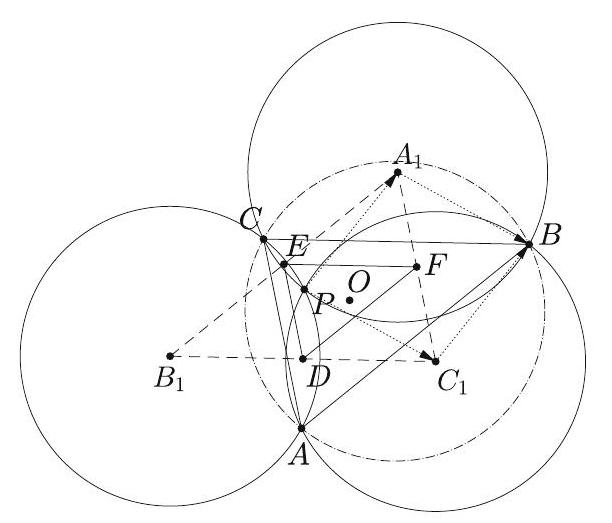
We will show that the midpoints of the segments $A A_{1}, B B_{1}, C... | 1 | Geometry | math-word-problem | Yes | Yes | olympiads | false |
We broke down 1996 into the sum of some integers. What remainder does the sum of the cubes of these numbers give when divided by 6? | For any integer $a$, $a^{3}-a=(a-1) a(a+1)$ is divisible by 6, because one of the three factors on the right side is divisible by 3, and among the three factors, there is certainly an even number.
Therefore, if $1996=a_{1}+a_{2}+\cdots+a_{n}$, then
$$
a_{1}^{3}+a_{2}^{3}+\cdots+a_{n}^{3}-1996=\left(a_{1}^{3}-a_{1}\ri... | 4 | Number Theory | math-word-problem | Yes | Yes | olympiads | false |
Let $n$ be a positive integer. Determine the sum of all fractions $\frac{1}{x y}$ for which the numbers $x$ and $y$ are relatively prime, not greater than $n$, and their sum is greater than $n$. | Solution. Let's examine the sum $\sum \frac{1}{x y}$ for a few values of $n$. For $n=1$, there is only one pair of numbers: $\frac{1}{1 \cdot 1}=1$. If $n=2$, there are two pairs of numbers $(1 ; 2)$ and $(2 ; 1)$, the sum is $\frac{1}{1 \cdot 2}+\frac{1}{2 \cdot 1}=1$. If $n=3$, there are 4 pairs of numbers, $(1 ; 3),... | 1 | Number Theory | math-word-problem | Yes | Yes | olympiads | false |
In the tangential quadrilateral $A B C D$, the intersection point of the lines $A D$ and $B C$ is $M$. The distances $M A, M B, M C$, and $M D$ form a geometric sequence in this order. Show that if the angle $B A D$ is a right angle, then the common ratio of this geometric sequence is less than 2. | We can choose the distance MA to be 1. Let $q$ be the common ratio of the geometric sequence in question. Then $M B=q, M C=q^{2}$ and $M D=q^{3}$. If $M A \geq M B$, there is nothing to prove. If $M A<2$. Then
$$
\begin{gathered}
q^{3}>2 q^{2} \\
q^{2}>2 q \\
q>2
\end{gathered}
$$
Adding these: $q^{3}+q^{2}+q>2 q^{2}... | 2 | Geometry | proof | Yes | Yes | olympiads | false |
In the Hupikék Törpikék's $1001 \times 945$ meter forest, there are 1280 pine trees with a 1 meter diameter. The dwarfs would like to mark 7 $20 \times 34$ meter tennis courts in the forest.
Is it possible to do this without cutting down a single pine tree? | Solution. To solve the problem, we will use the pigeonhole principle. In the forest, we mark out areas the size of a tennis court such that any tree can only make one of these areas impossible to realize. We cover the forest with rectangles of size $21 \mathrm{~m} \times 35 \mathrm{~m}$, with a 0.5-meter wide border. W... | 7 | Combinatorics | math-word-problem | Yes | Yes | olympiads | false |
Solve the equation
$$
\left(\frac{x}{2}\right)^{2}=\left(\frac{x+1}{3}\right)^{3}
$$ | Solution. Let's perform the indicated operations and try to factor the resulting equation:
$$
\begin{gathered}
27 x^{2}=4 x^{3}+12 x^{2}+12 x+4 \\
4 x^{3}-15 x^{2}+12 x+4=0
\end{gathered}
$$
Further transforming:
$$
\begin{aligned}
4 x^{3}-8 x^{2}-7 x^{2}+12 x+4=4 x^{2}(x-2)-7 x^{2}+14 x+4-2 x & = \\
=4 x^{2}(x-2)-7... | 2 | Algebra | math-word-problem | Yes | Yes | olympiads | false |
Given two lines that form a $36^{\circ}$ angle with each other. A grasshopper jumps back and forth from one line to the other, with each jump being of the same length. Show that it can land in at most ten different points. | Let the two lines be denoted by $e$ and $f$, and the angle between them by $\alpha$ (in the problem, $\alpha=36^{\circ}$). The signed distances from the points where the grasshopper touches to the intersection point of the lines (with the positive direction on the lines indicated as shown in Figure 1) are denoted by $a... | 10 | Geometry | proof | Yes | Yes | olympiads | false |
Let $e$ be one of the edges of a cube. How many lines are there in space that intersect exactly those 12 edges of the cube which are skew to $e$? | Solution. Let the line $e$ be the line $AB$. The lines that are skew to this one are accordingly the (dashed lines in the drawing) $CG, DH, FG$, and $EH$.

The lines passing through a point on... | 1 | Geometry | math-word-problem | Yes | Yes | olympiads | false |
An integer has two prime factors. It has 6 divisors, and the sum of its divisors is 28. Which number is this? | Solution. According to the conditions, the number is of the form $p_{1}^{n} \cdot p_{2}^{m}$, where $n$ and $m$ are positive integers and $p_{1} \neq p_{2}$ are primes. Based on the formula for the number of divisors, $(n+1)(m+1)=6$. The pair of numbers $n=2, m=1$ is the only one that satisfies the given conditions, so... | 12 | Number Theory | math-word-problem | Yes | Yes | olympiads | false |
Let
$$
a=x+\frac{1}{x}, \quad b=y+\frac{1}{y}, \quad c=x y+\frac{1}{x y} .
$$
Show that the value of the expression $a^{2}+b^{2}+c^{2}-a b c$ does not depend on $x$ and $y$. | Let's perform the squaring and multiplication in the sum:
$$
\begin{gathered}
a^{2}=x^{2}+\frac{1}{x^{2}}+2, \quad b^{2}=y^{2}+\frac{1}{y^{2}}+2, \quad c^{2}=x^{2} y^{2}+\frac{1}{x^{2} y^{2}}+2 \\
a b c=\left(x+\frac{1}{x}\right)\left(y+\frac{1}{y}\right)\left(x y+\frac{1}{x y}\right)=x^{2} y^{2}+\frac{1}{x^{2} y^{2}}... | 4 | Algebra | proof | Yes | Yes | olympiads | false |
A $10 \mathrm{~m}$ long, rectangular classroom ceiling has two lamps placed on it, which emit conical beams of light with a $90^{\circ}$ opening angle. One of the lamps is located in the center of the ceiling, and it illuminates a circle with a $6 \mathrm{~m}$ diameter on the floor. The other lamp has been rotated so t... | I. solution. The circle with a diameter of $6 \mathrm{~m}$ illuminated by the lamp in the center of the room has two endpoints of one of its diameters (points $A$ and $B$), and the lamp (point $C$) form a right-angled triangle (Figure 1).
, B(3 ; 0), C(c ; 6)$. The area of the triangle is 7. What is $c$, given that $0<c<3$? | Solution. The area of the rectangle is equal to the sum of the areas of the four triangles visible in the diagram:
$$
\begin{aligned}
& 18=\frac{3 \cdot 4}{2}+\frac{6(3-c)}{2}+\frac{2 c}{2}+7 \\
& 11=3 \cdot 2+3(3-c)+c
\end{aligned}
$$
from which \( c=2 \).
$ in the base $s+1$ number system.
---
Translate the above text into English, please keep the original text's line breaks and format, and output the translation result directly.
--... | If $s=2$, then $s-1=1$ and thus the remainder is 0. Let's assume from now on that $s>2$. Let $S_{i}$ denote the number $\underbrace{i i i \ldots i}_{i \text{-times}}$ written in the $(s+1)$-base number system.
$$
S_{i}=i \cdot \underbrace{111 \ldots 1}_{i \text{-times}}=i \cdot\left((s+1)^{i-1}+(s+1)^{i-2}+\cdots+1\ri... | 1 | Number Theory | math-word-problem | Yes | Yes | olympiads | false |
Let the elements of set $A$ be positive integers, and for any $x, y \in A, x>y$, it holds that $x-y \geq \frac{x y}{25}$. What is the maximum number of elements that set $A$ can have? | I. solution. Since $x-y \geq \frac{xy}{25}$ and $y>0$, it follows that $x>\frac{xy}{25}$, from which $25>y$. Therefore, $A$ can have only one element greater than 24.
If $x$ and $y$ are two elements of the set $A$ with $x>y$, then
$$
x-y \geq \frac{xy}{25} \quad \text{implies} \quad y \leq \frac{25x}{25+x}, \quad \te... | 9 | Number Theory | math-word-problem | Yes | Yes | olympiads | false |
What is the maximum number of sides a convex polygon can have if it can be divided into right-angled triangles with acute angles of 30 and 60 degrees? | Solution. The polygon is convex, so each of its angles is less than $180^{\circ}$. In the decomposition of the polygon into right-angled triangles, every angle is a multiple of $30^{\circ}$, so the angles of the polygon are also multiples of $30^{\circ}$, and thus each angle is at most $150^{\circ}$.
We know that the ... | 12 | Geometry | math-word-problem | Yes | Yes | olympiads | false |
What can be the length of the shortest cycle in a graph where a single vertex is not connected to all others, any two non-adjacent vertices have a common neighbor, and if the number of vertices is denoted by $n$, then the sum of the squares of the degrees is $n^{2}-n ?$ | Solution. Let the vertices of the graph be $A_{1}, A_{2}, \ldots, A_{n}$, and let the degree of $A_{i}$ be denoted by $a_{i}$. The set of vertices adjacent to $A_{i}$ is $\mathcal{B}_{i}$, and the set of vertices not adjacent to $A_{i}$ is $\mathcal{C}_{i}$. According to the problem's condition, every element of $\math... | 5 | Combinatorics | math-word-problem | Yes | Yes | olympiads | false |
We have selected 7 three-element subsets of a finite set such that any two different elements are contained in exactly one selected subset.
a) How many elements does the set have?
b) What is the maximum number of selected subsets we can choose such that no three of them contain the same element? | Let's denote the number of elements in the set by $n$. Then the number of two-element subsets of the set is $\binom{n}{2}=\frac{n(n-1)}{2}$. A selected three-element subset contains exactly $3$ two-element subsets, so $7$ three-element subsets contain a total of $7 \cdot 3=21$ different two-element subsets. Therefore, ... | 7 | Combinatorics | math-word-problem | Yes | Yes | olympiads | false |
Solve the following system of equations:
$$
\begin{aligned}
& x^{2}-4 \sqrt{3 x-2}+6=y \\
& y^{2}-4 \sqrt{3 y-2}+6=x
\end{aligned}
$$ | I. solution. The equations make sense when $x \geq \frac{2}{3}$ and $y \geq \frac{2}{3}$.
Add the equations and rearrange to 0:
$$
x^{2}+y^{2}-4 \sqrt{3 x-2}-4 \sqrt{3 y-2}+6+6-x-y=0
$$
We assume that the expression can be transformed into a sum of complete squares. In this case, the expressions $2 \cdot 2 \sqrt{3 x... | 2 | Algebra | math-word-problem | Yes | Yes | olympiads | false |
In the Shop of Merriments, a package of streamers costs $p$ percent more than a package of confetti. We could also say that a package of confetti is $q$ percent cheaper than a package of streamers. The difference between $p$ and $q$ is 90. How many packages of streamers can you get for the price of 10 packages of confe... | Let $y$ be the price of one package of streamers, and $x$ be the price of one package of confetti. Based on the problem statement, we can write the following equations:
$$
\begin{aligned}
& x\left(1+\frac{p}{100}\right)=y \\
& y\left(1-\frac{q}{100}\right)=x
\end{aligned}
$$
and
$$
|p-q|=90
$$
Let $\frac{p}{100}=a$... | 4 | Algebra | math-word-problem | Yes | Yes | olympiads | false |
A three-meter-high large painting hangs on the wall, its lower edge is one meter above the viewer's eye level. The view of the painting is more enjoyable the larger the vertical angle in which it is seen. At what distance from the wall will this angle be the largest? | I. solution. The centers of the viewing circles corresponding to the given angles in the picture are 1 + 3/2 = 2.5 meters above the viewer's eye level. The viewing angle is larger the smaller the radius of the viewing circle (Figure 1). Therefore, we need to find the viewing circle with the smallest radius that has a p... | 2 | Geometry | math-word-problem | Yes | Yes | olympiads | false |
Let's determine all positive integers $n$ for which
$$
1^{2}+2^{2}+\ldots+n^{2}=1+2+\ldots+(2 n-1)+2 n
$$ | On the left side, the sum of the squares of numbers from 1 to $n$ stands, which can be written in the following closed form:
$$
\frac{n(n+1)(2 n+1)}{6}
$$
On the right side, however, the sum of integers from 1 to $2 n$ stands, which is $\frac{2 n(2 n+1)}{2}=n(2 n+1)$.
Using these, we get the following equation:
$$
... | 5 | Algebra | math-word-problem | Yes | Yes | olympiads | false |
For what positive integer $k$ can the product of the first $k$ prime numbers be the sum of two positive cubes? | Solution. Let's find the positive integer $k$ for which
$$
2 \cdot 3 \cdot 5 \cdot \ldots \cdot p_{k}=a^{3}+b^{3}
$$
where $p_{k}$ denotes the $k$-th prime in the increasing sequence of prime numbers, and $a$ and $b$ are positive integers. If $k \geq 2$, then the primes include 3, but the entire product is only divis... | 1 | Number Theory | math-word-problem | Yes | Yes | olympiads | false |
Water can be let into a basin through four different taps. If the first and second taps are opened simultaneously, the basin fills up in 2 hours. If the second and third taps are opened at the same time, it takes 3 hours, and if the third and fourth taps are opened simultaneously, it takes 4 hours for the basin to fill... | Solution. Let $m$ be the volume of the basin and $x, y, z$, and $u$ be the amount of water flowing out from the first, second, third, and fourth taps in one hour, respectively.
According to the problem, we can write the following equations:
$$
2(x+y)=m, \quad 3(y+z)=m, \quad 4(z+u)=m
$$
Thus:
$$
x+y=\frac{m}{2}, \q... | 2 | Algebra | math-word-problem | Yes | Yes | olympiads | false |
According to problem 4283 of Lapunk B., if a $23 \times 23$ square is divided into $1 \times 1$, $2 \times 2$, and $3 \times 3$ squares, then we need at least one $1 \times 1$ square for this. Where can the $1 \times 1$ square be placed if we know that exactly one appears in the division? | Let's number the rows of the square from top to bottom and the columns from left to right, from 1 to 23.
First, color the square such that the odd-numbered rows are black and the even-numbered rows are white. Then, there are $12 \times 23$ black squares and $11 \times 23$ white squares. Every $3 \times 3$ square cover... | 9 | Combinatorics | math-word-problem | Yes | Yes | olympiads | false |
Solve the following system of equations in the set of positive numbers:
$$
\begin{aligned}
x^{4}+y^{4}-x^{2} y^{2} & =13 \\
x^{2}-y^{2}+2 x y & =1
\end{aligned}
$$ | Solution. Rearranging the first equation, we get:
$$
\left(x^{2}-y^{2}\right)^{2}=13-x^{2} y^{2}
$$
From the second equation, we have $x^{2}-y^{2}=1-2 x y$. Substituting this into the above equation: $(1-2 x y)^{2}=13-x^{2} y^{2}$. From this,
$$
0=13-x^{2} y^{2}-(1-2 x y)^{2}=-5(x y)^{2}+4 x y+12
$$
This is a quadr... | 12 | Algebra | math-word-problem | Yes | Yes | olympiads | false |
Solve the following equation:
$$
x-2=\sqrt{4-3 \sqrt{4-3 \sqrt{10-3 x}}}
$$ | Solution. Let's substitute $\sqrt{1} x$ with $(a+2)-\mathrm{t}$:
$$
a=\sqrt{4-3 \sqrt{4-3 \sqrt{10-3 a-6}}}=\sqrt{4-3 \sqrt{4-3 \sqrt{4-3 a}}}
$$
Let $f(x)=\sqrt{4-3 x}$. We are looking for the value of $a$ such that $a=f(f(f(a)))$.
If $a=f(a)$, then this is clearly true. $a=f(a)$ holds if, under the conditions $a \... | 3 | Algebra | math-word-problem | Yes | Yes | olympiads | false |
value?
In triangle $ABC$, with the usual notation, $\alpha=60^{\circ}, \beta=20^{\circ}$, and $AB=1$. What is the exact value of $\frac{1}{AC}-BC$? | I. solution. For the triangle $ABC$, the sine theorem is written twice:
$$
\frac{1}{AC}=\frac{\sin 100^{\circ}}{\sin 20^{\circ}} \quad \text { and } \quad BC=\frac{\sin 60^{\circ}}{\sin 100^{\circ}}
$$
Since $\sin 100^{\circ}=\cos 10^{\circ}$ and $\sin 20^{\circ}=\sin \left(10^{\circ}+10^{\circ}\right)=2 \sin 10^{\ci... | 2 | Geometry | math-word-problem | Yes | Yes | olympiads | false |
A group consisting of 5 girls and 5 boys, where individuals of the same gender do not know each other, and no two girls have two mutual boy friends. What is the maximum number of acquaintances among the members of the group? How does the answer change if the group consists of 7 girls and 7 boys? | First, we show that in the case of 5 boys and 5 girls, the number of acquaintances is at most 12. Suppose this is not true, and there are at least 13 acquaintances among the members. Then, by the pigeonhole principle, there are 2 girls who together know at least 6 boys. However, they cannot know more boys, as there are... | 12 | Combinatorics | math-word-problem | Yes | Yes | olympiads | false |
A gallery floor plan is a concave hexagon. We need to place guards in the room so that every point on each wall is visible from at least one guard's position. What is the maximum number of guards needed? | We will show that at most two guards are needed. One guard is not enough, for example, in the case of the hexagon shown in Figure 1, if the guard stands at a point other than $C$ in the quadrilateral $A B C F$, then they will not see the $D$ vertex; if the guard stands at a point other than $F$ in the quadrilateral $C ... | 2 | Geometry | math-word-problem | Yes | Yes | olympiads | false |
We have assembled a large cube with $n$ edge length using $n^{3}$ unit cubes. Is there an $n$ value for which the number of small cubes cut by the space diagonals of the large cube is exactly half the number of small cubes not cut by the space diagonals? | Solution. Any space diagonal of an $n \times n \times n$ cube intersects $n$ small unit cubes. This can be easily seen if we orthogonally project the cube onto the plane of its base. The projection is an $n \times n$ square, and the projections of the space diagonals are the face diagonals.
=A \cdot \frac{q+1}{q... | 2 | Number Theory | proof | Yes | Yes | olympiads | false |
Let's determine the base $x$ of the number system if the following equation holds:
$$
2016_{x}=x^{3}+2 x+342
$$ | I. solution. $x$ is a positive integer greater than 6, because the number written in base $x$ contains the digit 6. Since $2016_{x}=2 x^{3}+x+6$, we can write the following equation:
$$
\begin{aligned}
2 x^{3}+x+6 & =x^{3}+2 x+342 \\
x^{3}-x-336 & =0
\end{aligned}
$$
Let's examine the solutions of the equation in the... | 7 | Number Theory | math-word-problem | Yes | Yes | olympiads | false |
Let's determine the 73rd digit from the end of $(\underbrace{111 \ldots 1}_{112 \text{ digits}})^{2}$. | I. solution. If we perform the multiplication, then each of the partial products consists entirely of ones. If we add these, then on the last place there is $1 \mathrm{db}$, before that $2 \mathrm{db}, \ldots$, and at the 112th place from the right, 112 ones must be added. Thus, proceeding from the back, the digits of ... | 0 | Number Theory | math-word-problem | Yes | Yes | olympiads | false |
Let $x$ and $y$ be integers such that $4 x+5 y=7$. Determine the smallest value of $5|x|-3|y|$.
---
The text has been translated while preserving the original formatting and line breaks. | Solution. It is visible that $x=3, y=-1$ is a solution to the equation. Since this is a linear Diophantine equation, all solutions are of the form $x_{k}=3-5 k, y_{k}=-1+4 k$, where $k$ is any integer.
If $k$ is not positive, then $\left|x_{k}\right|>\left|y_{k}\right|$, because $x$ starts from a larger number in abso... | 1 | Number Theory | math-word-problem | Yes | Yes | olympiads | false |
The sequence $a_{n}$ is defined as follows: $a_{1}=1, a_{2 n}=a_{n}, a_{2 n+1}+a_{n}=1$. What is $a_{2006}$? | I. solution.
$$
\begin{aligned}
a_{2006} & =a_{1003}=1-a_{501}=1-\left(1-a_{250}\right)=a_{125}=1-a_{62}=1-a_{31}= \\
& =1-\left(1-a_{15}\right)=a_{15}=1-a_{7}=1-\left(1-a_{3}\right)=a_{3}=1-a_{1}=0
\end{aligned}
$$
II. solution. We will show that the sequence $a_{n}$ is equal to the sequence $b_{n}$ defined by the f... | 0 | Number Theory | math-word-problem | Yes | Yes | olympiads | false |
We have selected the vertices, the centroid, and the points that trisect the sides of an equilateral triangle. How many points can we retain from among them so that no three form an equilateral triangle? | Solution. Let's denote the points as $A, B, \ldots, J$ as shown in Figure 1. Since the triangle $ABC$ itself is equilateral, at least one of its vertices must be left out.
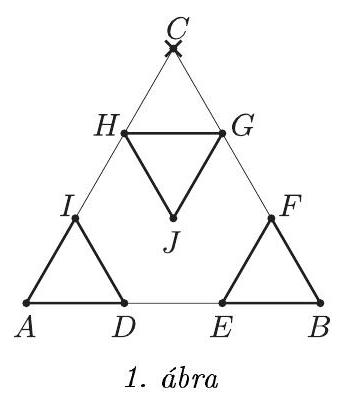
Due to the symmetri... | 6 | Combinatorics | math-word-problem | Yes | Yes | olympiads | false |
In the convex pentagon $A B C D E$, $\angle A B C = \angle C D E = 90^{\circ}, B C = C D = A E = 1, A B + E D = 1$. What is the area of the pentagon? | I. solution. Let $P$ be the point on segment $AE$ such that $AP = AB$ and thus $PE = ED$. Let $CP = d$, $\angle APC = \alpha$, and $\angle EPC = \beta$.
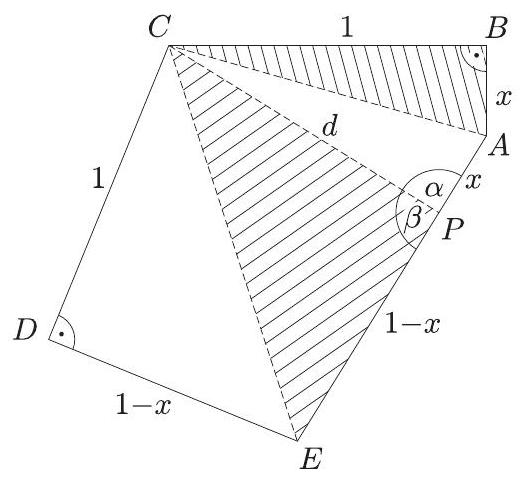
In triangles $ABC$ and $APC$, two pair... | 1 | Geometry | math-word-problem | Yes | Yes | olympiads | false |
A math competition featured four problems. 85 percent of the participants solved the first problem, 80 percent solved the second, 75 percent solved the third, and 70 percent solved the fourth. What is the minimum percentage of participants who solved all four problems? | Solution. 15 percent of the participants did not solve the first problem, 20 percent did not solve the second, 25 percent did not solve the third, and 30 percent did not solve the fourth. Thus, at most $15+20+25+30=90$ percent of the participants failed to solve at least one problem. This precisely means that at least ... | 10 | Combinatorics | math-word-problem | Yes | Yes | olympiads | false |
The secant passing through the intersection points of the circle with center $O_{1}$ and radius $4 \mathrm{~cm}$ and the circle with center $O_{2}$ and radius $6 \mathrm{~cm}$ intersects the segment $O_{1} O_{2}$ at point $T$, and we know that the length of this segment is not less than $6 \mathrm{~cm}$. The larger cir... | I. Solution. Using the notations of Figure 1. Let $A T=x$ (thus $B T=2 x$) and $T C=y$. The triangles $O_{1} T C$ and $\mathrm{O}_{2} \mathrm{TC}$ are right-angled, and we can apply the Pythagorean theorem to their sides:
$$
\begin{aligned}
(4-2 x)^{2}+y^{2}=4^{2}, & (6-x)^{2}+y^{2}=6^{2} \\
16-16 x+4 x^{2}+y^{2}=16, ... | 6 | Geometry | math-word-problem | Yes | Yes | olympiads | false |
Suppose $p$ is a non-identically 0 polynomial with integer coefficients, such that $p(n)$ is divisible by 2016 for every integer $n$. What is the minimum possible value of the sum of the absolute values of the coefficients of $p$? | Solution. The sum of the absolute values of the coefficients of such a polynomial cannot be zero, for that would mean that all coefficients are zero, but according to the problem's conditions, $p$ is not the identically zero polynomial.
If the sum is 1, then the polynomial must be of the form $p(x)= \pm x^{k}$, where ... | 2 | Number Theory | math-word-problem | Yes | Yes | olympiads | false |
The area of a sector is 100. What is the radius if the perimeter is minimized? | Solution. The perimeter of the circular segment $OAB$ is:
$$
K=2 r+r \alpha
$$
The area of the circular segment is 100 units, so:
$$
T=\frac{r^{2} \alpha}{2}=100
$$
From (1), $\alpha=\frac{K-2 r}{r}$.

Solution. Every face of the parallelepiped is a parallelogram, and opposite faces are congruent. We also know that in a parallelogram, the sum of the squares of the sides is equal to the sum o... | 8 | Geometry | math-word-problem | Yes | Yes | olympiads | false |
How many six-digit numbers of the form ababab are there, which are the product of six different prime numbers? | Solution. $\overline{a b a b a b}=10101 \cdot \overline{a b}=3 \cdot 7 \cdot 13 \cdot 37 \cdot \overline{a b}$. According to the conditions, $\overline{a b}$ is a two-digit number that is the product of two different prime numbers, none of which are $3,7,13,37$. Therefore, the possible products for $\overline{a b}$ are... | 12 | Number Theory | math-word-problem | Yes | Yes | olympiads | false |
How many zeros does the number $4^{5^{6}}+6^{5^{4}}$ end with in its decimal representation? | Solution. Let $N=4^{5^{6}}+6^{5^{4}}$. Our goal is to express $N$ in the form $N=2^{a} \cdot 5^{b} \cdot c$, where $c$ is not divisible by 5 or 2. Then $N$ will end in as many zeros as the minimum of $a$ and $b$, since 10 can be factored out of it that many times. We will solve the problem in two steps.
1. We show tha... | 5 | Number Theory | math-word-problem | Yes | Yes | olympiads | false |
Solve the equation
$$
x^{2}-8(x+3) \sqrt{x-1}+22 x-7=0
$$ | Solution. Clearly $x \geq 1$.
We assume that the left side of the equation can be written as the square of the sum of two terms. In this case, the double product can only be $8(x+3) \sqrt{x-1}$, so the two terms could be $(x+3)$ and $4 \sqrt{x-1}$. Checking:
$$
\begin{aligned}
{[(x+3)-4 \sqrt{x-1}]^{2} } & =x^{2}+6 x... | 5 | Algebra | math-word-problem | Yes | Yes | olympiads | false |
Given 2006 points on the plane. What is the maximum number of points among them that can form an acute-angled triangle with any other two points? | I. solution. There can only be one point that satisfies the condition. We show such a point system: on a unit circle centered at $O$, mark a $\frac{\pi}{2}$ length arc, and place 2005 points inside this arc. Any two of these points, together with $O$, form an isosceles triangle where the angle at $O$ is less than $90^{... | 1 | Geometry | math-word-problem | Yes | Yes | olympiads | false |
We placed 6 different dominoes in a closed chain on the table. The total number of points on the dominoes is $D$. What is the smallest possible value of $D$? (The number of points on each side of the dominoes can range from 0 to 6, and the touching sides of the dominoes must have the same number of points.)
![](https:... | Solution. The dominoes with the smallest total point values are $0-0, 0-1, 0-2, 1-1, 0-3, 1-2, 2-2, 1-3, 0-4$. The first six of these have a total of 11 points, but it is not possible to form a closed chain with them, because the 3 only appears on the 0-3 domino. Therefore, the total must be at least 12 points. This is... | 12 | Logic and Puzzles | math-word-problem | Yes | Yes | olympiads | false |
Let's find all positive integers $n$ for which $2^{n}-1$ and $2^{n+2}-1$ are both prime, and $2^{n+1}-1$ is not divisible by 7. | Solution. The remainders of the powers of 2 when divided by 7 are 1, 2, 4, 1, 2, 4, 1, and so on, repeating periodically. In the problem, three consecutive powers of 2 are involved, and we subtract 1 from each, so their remainders when divided by 7 are definitely 0, 1, 3, in some order. Therefore, there is a number amo... | 3 | Number Theory | math-word-problem | Yes | Yes | olympiads | false |
Subsets and Splits
No community queries yet
The top public SQL queries from the community will appear here once available.