
problem stringlengths 15 4.7k | solution stringlengths 2 11.9k | answer stringclasses 51
values | problem_type stringclasses 8
values | question_type stringclasses 4
values | problem_is_valid stringclasses 1
value | solution_is_valid stringclasses 1
value | source stringclasses 6
values | synthetic bool 1
class |
|---|---|---|---|---|---|---|---|---|
4. Consider the following $3 \times 2$ array formed by using the numbers $1,2,3,4,5,6$ :
$$
\left(\begin{array}{ll}
a_{11} & a_{12} \\
a_{21} & a_{22} \\
a_{31} & a_{32}
\end{array}\right)=\left(\begin{array}{ll}
1 & 6 \\
2 & 5 \\
3 & 4
\end{array}\right)
$$
Observe that all row sums are equal, but the sum of the sq... |
Solution:Consider the following extension:
$$
\left(\begin{array}{llllll}
1 & 6 & 3+6 & 4+6 & 2+(2 \cdot 6) & 5+(2 \cdot 6) \\
2 & 5 & 1+6 & 6+6 & 3+(2 \cdot 6) & 4+(2 \cdot 6) \\
3 & 4 & 2+6 & 5+6 & 1+(2 \cdot 6) & 6+(2 \cdot 6)
\end{array}\right)
$$
of
$$
\left(\begin{array}{ll}
1 & 6 \\
2 & 5 \\
3 & 4
\end{array... | 6 | Combinatorics | math-word-problem | Yes | Yes | olympiads | false |
6. Let $a, b$ be real numbers and, let $P(x)=x^{3}+a x^{2}+b$ and $Q(x)=x^{3}+b x+a$. Suppose that the roots of the equation $P(x)=0$ are the reciprocals of the roots of the equation $Q(x)=0$. Find the greatest common divisor of $P(2013!+1)$ and $Q(2013!+1)$.
|
Solution. Note that $P(0) \neq 0$. Let $R(x)=x^{3} P(1 / x)=b x^{3}+a x+1$. Then the equations $Q(x)=0$ and $R(x)=0$ have the same roots. This implies that $R(x)=b Q(x)$ and equating the coefficients we get $a=b^{2}$ and $a b=1$. This implies that $b^{3}=1$, so $a=b=1$. Thus $P(x)=x^{3}+x^{2}+1$ and $Q(x)=x^{3}+x+1$. ... | 3 | Algebra | math-word-problem | Yes | Yes | olympiads | false |
4. A box contains answer 4032 scripts out of which exactly half have odd number of marks. We choose 2 scripts randomly and, if the scores on both of them are odd number, we add one mark to one of them, put the script back in the box and keep the other script outside. If both scripts have even scores, we put back one o... |
Solution: There are three types of processes. In the first type, the scripts with odd scores decreases by 2. In the second and third types, there is no change in the number of scripts with odd scores. Hence at each step, the number of scripts with odd score decreases by 0 or 2 . Since there are 2016 scripts with odd s... | 2 | Logic and Puzzles | math-word-problem | Yes | Yes | olympiads | false |
2. Let $n$ be a natural number. Find all real numbers $x$ satsfying the equation
$$
\sum_{k=1}^{n} \frac{k x^{k}}{1+x^{2 k}}=\frac{n(n+1)}{4}
$$
|
Solution: Observe that $x \neq 0$. We also have
$$
\begin{aligned}
\frac{n(n+1)}{4}=\left|\sum_{k=1}^{n} \frac{k x^{k}}{1+x^{2 k}}\right| & \leq \sum_{k=1}^{n} \frac{k|x|^{k}}{1+x^{2 k}} \\
& =\sum_{k=1}^{n} \frac{k}{\frac{1}{|x|^{k}}+|x|^{k}} \\
& \leq \sum_{k=1}^{n} \frac{k}{2}=\frac{n(n+1)}{4}
\end{aligned}
$$
He... | 1 | Algebra | math-word-problem | Yes | Yes | olympiads | false |
2. Let $f(x)=x^{3}+a x^{2}+b x+c$ and $g(x)=x^{3}+b x^{2}+c x+a$, where $a, b, c$ are integers with $c \neq 0$. Suppose that the following conditions hold:
(a) $f(1)=0$;
(b) the roots of $g(x)$ are squares of the roots of $f(x)$.
Find the value of $a^{2013}+b^{2013}+c^{2013}$.
|
Solution. Note that $g(1)=f(1)=0$, so 1 is a root of both $f(x)$ and $g(x)$. Let $p$ and $q$ be the other two roots of $f(x)$, so $p^{2}$ and $q^{2}$ are the other two roots of $g(x)$. We then get $p q=-c$ and $p^{2} q^{2}=-a$, so $a=-c^{2}$. Also, $(-a)^{2}=(p+q+1)^{2}=p^{2}+q^{2}+1+2(p q+p+q)=-b+2 b=b$. Therefore $b... | -1 | Algebra | math-word-problem | Yes | Yes | olympiads | false |
4. The set $X$ of $N$ four-digit numbers formed from the digits $1,2,3,4,5,6,7,8$ satisfies the following condition:
for any two different digits from 1, 2, 3, 4, 5, 6, 7, 8 there exists a number in $X$ which contains both of them.
Determine the smallest possible value of $N$.
| ## Solution
Let some digit, say 1 , appear in exactly $k$ numbers from the $N$ given numbers. Hence, 1 forms at most 3 distinct pairs with the remaining 3 digits of any of these $k$ numbers. Since the total number of all distinct pairs formed by 1 and the other 7 numbers $\{2,3,4,5,6,7,8\}$ is equal to 7 , we see that... | 6 | Combinatorics | math-word-problem | Yes | Yes | olympiads | false |
7. Let $X$ be the set of all positive integers greater than or equal to 8 and let $f: X \rightarrow X$ be a function such that $f(x+y)=f(x y)$ for all $x \geq 4, y \geq 4$. If $f(8)=9$, determine $f(9)$.
|
Solution: We observe that
$$
\begin{aligned}
f(9)=f(4+5)=f(4 \cdot 5)= & f(20)=f(16+4)=f(16 \cdot 4)=f(64) \\
& =f(8 \cdot 8)=f(8+8)=f(16)=f(4 \cdot 4)=f(4+4)=f(8)
\end{aligned}
$$
Hence if $f(8)=9$, then $f(9)=9$. (This is one string. There may be other different ways of approaching $f(8)$ from $f(9)$. The importan... | 9 | Algebra | math-word-problem | Yes | Yes | olympiads | false |
1. Let $A B C D$ be a convex quadrilateral with $A B=a, B C=b, C D=c$ and $D A=d$. Suppose
$$
a^{2}+b^{2}+c^{2}+d^{2}=a b+b c+c d+d a
$$
and the area of $A B C D$ is 60 square units. If the length of one of the diagonals is 30 units, determine the length of the other diagonal.
| ## Solution
$a^{2}+b^{2}+c^{2}+d^{2}=a b+b c+c d+d a \Rightarrow(a-b)^{2}+(b-c)^{2}+(c-d)^{2}+(d-a)^{2}=0 \Rightarrow a=b=c=d$. Thus $A B C D$ is a rhombus and
$$
[A B C D]=(1 / 2)\left(d_{1} d_{2}\right)
$$
where $d_{1}$ and $d_{2}$ are the lengths of the diagonals. Hence $d_{2}=\frac{2[A B C D]}{d_{1}}=4$ units.
| 4 | Geometry | math-word-problem | Yes | Yes | olympiads | false |
2. Determine the smallest prime that does not divide any five-digit number whose digits are in a strictly increasing order.
|
Solution. Note that 12346 is even, 3 and 5 divide 12345, and 7 divides 12348. Consider a 5 digit number $n=a b c d e$ with $0a>0$ and $S=e-(d-c)-(b-a)<e \leq 10$, so $S$ is not divisible by 11 and hence $n$ is not divisible by 11. Thus 11 is the smallest prime that does not divide any five-digit number whose digits ar... | 11 | Number Theory | math-word-problem | Yes | Yes | olympiads | false |
1. Let $\mathbb{N}$ be the set of all natural numbers and $S=\left\{(a, b, c, d) \in \mathbb{N}^{4}: a^{2}+b^{2}+c^{2}=d^{2}\right\}$. Find the largest positive integer $m$ such that $m$ divides $a b c d$ for all $(a, b, c, d) \in S$.
| ## Solution
Since $d^{2} \equiv 0,1(\bmod 4)$ at most one of $a, b, c$ is odd. Therefore 4 divides $a b c d$. Also, if 3 does not divide each of $a, b$ and $c$ then
$$
d^{2}=a^{2}+b^{2}+c^{2} \equiv 1+1+1 \equiv 0 \quad(\bmod 3)
$$
Thus 3 divides $a b c d$. Therefore 12 divides $a b c d$ and if $m$ is the largest po... | 12 | Number Theory | math-word-problem | Yes | Yes | olympiads | false |
5. Suppose $P$ is an interior point of a triangle $A B C$ such that the ratios
$$
\frac{d(A, B C)}{d(P, B C)}, \quad \frac{d(B, C A)}{d(P, C A)}, \quad \frac{d(C, A B)}{d(P, A B)}
$$
are all equal. Find the common value of these ratios. [Here $d(X, Y Z)$ denotes the perpendicular distance from a point $X$ to the lin... |
Solution: Let $A P, B P, C P$ when extended, meet the sides $B C, C A, A B$ in $D, E, F$ respectively. Draw $A K, P L$ perpendicular to $B C$ with $K, L$ on $B C$.(See Fig. 3.)
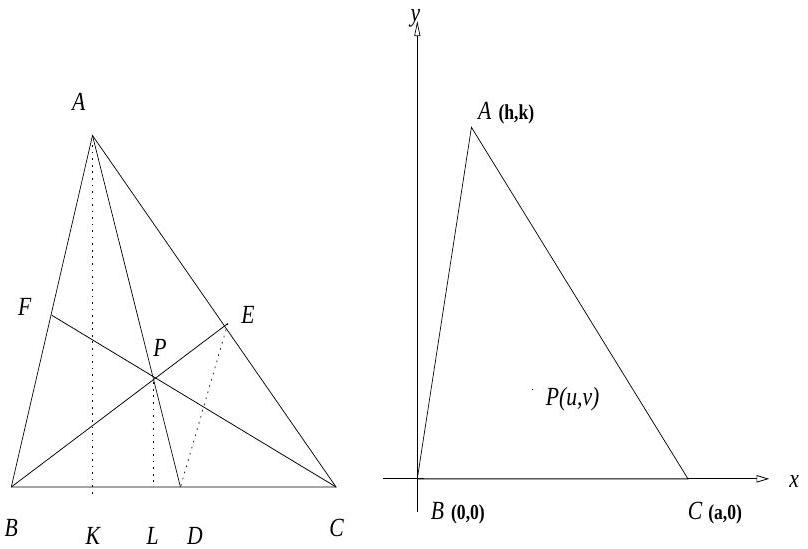
Fig. 3.
Fig. ... | 3 | Geometry | math-word-problem | Yes | Yes | olympiads | false |
7. Consider the set $X=\{1,2,3, \ldots, 9,10\}$. Find two disjoint nonempty subsets $A$ and $B$ of $X$ such that
(a) $A \cup B=X$;
(b) $\operatorname{prod}(A)$ is divisible by $\operatorname{prod}(B)$, where for any finite set of numbers $C, \operatorname{prod}(C)$ denotes the product of all numbers in $C$;
(c) the... |
Solution: The prime factors of the numbers in set $\{1,2,3, \ldots, 9,10\}$ are $2,3,5,7$. Also only $7 \in X$ has the prime factor 7 . Hence it cannot appear in $B$. For otherwise, 7 in the denominator would not get canceled. Thus $7 \in A$.
Hence
$$
\operatorname{prod}(A) / \operatorname{prod}(B) \geq 7
$$
The nu... | 7 | Number Theory | math-word-problem | Yes | Yes | olympiads | false |
2. Determine the least positive value taken by the expression $a^{3}+b^{3}+c^{3}-3 a b c$ as $a, b, c$ vary over all positive integers. Find also all triples $(a, b, c)$ for which this least value is attained.
|
Solution: We observe that
$$
\left.Q=a^{3}+b^{3}+c^{3}-3 a b c=\frac{1}{2}(a+b+c)\right)\left((a-b)^{2}+(b-c)^{2}+(c-a)^{2}\right)
$$
Since we are looking for the least positive value taken by $Q$, it follows that $a, b, c$ are not all equal. Thus $a+b+c \geq 1+1+2=4$ and $(a-b)^{2}+(b-$ $c)^{2}+(c-a)^{2} \geq 1+1+0... | 4 | Algebra | math-word-problem | Yes | Yes | olympiads | false |
2. Suppose $n \geq 0$ is an integer and all the roots of $x^{3}+\alpha x+4-\left(2 \times 2016^{n}\right)=0$ are integers. Find all possible values of $\alpha$.
|
Solution 1: Let $u, v, w$ be the roots of $x^{3}+\alpha x+4-\left(2 \times 2016^{n}\right)=0$. Then $u+v+w=0$ and $u v w=-4+\left(2 \times 2016^{n}\right)$. Therefore we obtain
$$
u v(u+v)=4-\left(2 \times 2016^{n}\right)
$$
Suppose $n \geq 1$. Then we see that $u v(u+v) \equiv 4\left(\bmod 2016^{n}\right)$. Therefo... | -3 | Algebra | math-word-problem | Yes | Yes | olympiads | false |
Problem 1. Suppose $r \geq 2$ is an integer, and let $m_{1}, n_{1}, m_{2}, n_{2}, \cdots, m_{r}, n_{r}$ be $2 r$ integers such that
$$
\left|m_{i} n_{j}-m_{j} n_{i}\right|=1
$$
for any two integers $i$ and $j$ satisfying $1 \leq i<j \leq r$. Determine the maximum possible value of $r$.
|
Solution. Let $m_{1}, n_{1}, m_{2}, n_{2}$ be integers satisfying $m_{1} n_{2}-m_{2} n_{1}= \pm 1$. By changing the signs of $m_{2}, n_{2}$ if need be, we may assume that
$$
m_{1} n_{2}-m_{2} n_{1}=1
$$
If $m_{3}, n_{3}$ are integers satisfying $m_{1} n_{3}-m_{3} n_{1}= \pm 1$, again we may assume (by changing their... | 3 | Number Theory | math-word-problem | Yes | Yes | olympiads | false |
3. Let $X=\{0,1,2,3,4,5,6,7,8,9\}$. Let $S \subseteq X$ be such that any nonnegative integer $n$ can be written as $p+q$ where the nonnegative integers $p, q$ have all their digits in $S$. Find the smallest possible number of elements in $S$.
|
Solution: We show that 5 numbers will suffice. Take $S=\{0,1,3,4,6\}$. Observe the following splitting:
| $n$ | $a$ | $b$ |
| :--- | :--- | :--- |
| 0 | 0 | 0 |
| 1 | 0 | 1 |
| 2 | 1 | 1 |
| 3 | 0 | 3 |
| 4 | 1 | 3 |
| 5 | 1 | 4 |
| 6 | 3 | 3 |
| 7 | 3 | 4 |
| 8 | 4 | 4 |
| 9 | 3 | 6 |
Thus each digit in a given non... | 5 | Number Theory | math-word-problem | Yes | Yes | olympiads | false |
3. Show that for every real number $a$ the equation
$$
8 x^{4}-16 x^{3}+16 x^{2}-8 x+a=0
$$
has at least one non-real root and find the sum of all the non-real roots of the equation.
|
Solution: Substituting $x=y+(1 / 2)$ in the equation, we obtain the equation in $y$ :
$$
8 y^{4}+4 y^{2}+a-\frac{3}{2}=0
$$
Using the transformation $z=y^{2}$, we get a quadratic equation in $z$ :
$$
8 z^{2}+4 z+a-\frac{3}{2}=0
$$
The discriminant of this equation is $32(2-a)$ which is nonnegative if and only if $... | 1 | Algebra | proof | Yes | Yes | olympiads | false |
8) Near a water source, there is a cistern with a capacity greater than 30 hectoliters, initially empty. Only two calibrated containers, one of 15 liters and one of 21 liters, are available, with which it is possible to add and remove water from the cistern. Which of the following volumes of water cannot be placed exac... | 8) The answer is (B).
By adding and removing volumes of 21 and 15 liters, I can obtain all and only the volumes (positive or null) of the type $\pm m \cdot 21 \pm n \cdot 15$ with $m, n$ integers. Since 21 and 15 are divisible by 3, I obtain only volumes divisible by 3, so I cannot have 5 liters. Note that $3=3 \cdot ... | 5 | Number Theory | MCQ | Yes | Yes | olympiads | false |
11) What is the unit digit of $1^{2}+2^{2}+3^{2}+\ldots+1996^{2}$?
(C) 4
(D) 6
(E) 8. | 11) The answer is (D).
Indeed, the unit digit of $1^{2}+2^{2}+3^{2}+\ldots+10^{2}$ is 5 (direct verification), in the same way, it can be seen that $11^{2}+12^{2}+$ $\cdots+20^{2}=(10+1)^{2}+(10+2)^{2}+\cdots+(10+10)^{2}=10 \cdot k \cdot\left(1^{2}+2^{2}+\cdots+10^{2}\right)$ has 5 as the unit digit. The same applies ... | 6 | Number Theory | MCQ | Yes | Yes | olympiads | false |
12) Let $D$ be the domain in the Cartesian plane determined by the system of inequalities below. What is the area of $D$?
(A) $\sqrt{2} \pi$
(B) $\frac{\pi}{2}$
(C) 2
(D) $\sqrt{2}$
(E) $4-\pi$.
$\left\{\begin{array}{l}x^{2}+y^{2} \leq 1 \\ (x-1)^{2}+(y-1)^{2} \geq 1 \\ (x+1)^{2}+(y+1)^{2} \geq 1\end{array}\right.$ | 12) The answer is $(\mathbf{C})$.
The points of $D$ are indeed inside the circle centered at the origin with radius 1, and outside the circles centered at $(1,1)$ and $(-1,-1)$ with radius 1. In other words, $D$ consists of the dotted points in the figure alongside.
The aforementioned figure can then clearly be "cut ... | 2 | Geometry | MCQ | Yes | Yes | olympiads | false |
19) Let $A B C$ be an equilateral triangle and $D E F$ another equilateral triangle inscribed in it with $A B$ perpendicular to $E D$. The ratio of the areas of $A B C$ and $D E F$ is
(A) $\sqrt{3}$
(B) 2
(C) $\frac{5}{2}$
(D) 3
(E) $3 \sqrt{2}$. | 19) The answer is (D).
Consider the triangles $A D E$ and $B E F$. They are equal since $D E=E F, D \widehat{A} E=E \widehat{B} F, B \widehat{E} F=180^{\circ}-90^{\circ}-$ $60^{\circ}=30^{\circ}=A \widehat{D} E$.
It follows that $A B=A E+E B=A E+A D=A E+2 \cdot A E=3 \cdot A E$ and consequently
$$
A B=3 \cdot A E=3 ... | 3 | Geometry | MCQ | Yes | Yes | olympiads | false |
4) A flea is on the number 12 of a clock face. It chooses a natural number $n$ between 1 and 12, inclusive, and starts jumping $n$ numbers on the clock face, in a clockwise direction (for example, if $n=3$, after the first jump it is on 3, after the second it is on 6, and so on). After 12 jumps, for the first time, it ... | 4. The answer is $(\mathbf{C})$.
Let's start by observing that the flea returns to 12 after a number $s$ of jumps if and only if $s \cdot n$ is a multiple of 12. If $n$ and 12 had a common divisor $d$, then in $\frac{12}{d}<12$ jumps the flea would travel $n \frac{12}{d}=12 \frac{n}{d}$ hours, and thus would return to... | 4 | Number Theory | MCQ | Yes | Yes | olympiads | false |
7) How many perfect squares divide 1600? [A perfect square is a number of the type $n^{2}$, where $n$ is a natural number. $1,4,9,16$, are examples of perfect squares.
(A) 2 ,
(B) 4 ,
(C) 8 ,
(D) 10 ,
(E) 12 . | 7. The answer is $(\mathbf{C})$.
If we factorize 1600 into prime factors, we find
$$
1600=2^{6} \cdot 5^{2} .
$$
Therefore, the divisors of 1600 are numbers that can be written in the form
$$
2^{p} \cdot 5^{q},
$$
where $p$ is an integer between 0 and 6, inclusive, and $q$ is an integer between 0 and 2, inclusive.... | 8 | Number Theory | MCQ | Yes | Yes | olympiads | false |
10) In a class, a math test was held and the average score was 7. The average score of the boys was 6.5, while that of the girls was 8. If there are 10 boys in the class, how many girls are there?
(A) 4,
(B) 5,
(C) 7
(D) 9,
(E) 11. | 10. The answer is $\mathbf{( B )}$.
Let $F$ be the number of females in the class. The average grade of the class is given by the sum of all grades divided by the number of all students in the class. The sum of the grades of the males is equal to their number multiplied by their average grade: $10 \cdot 6.5=65$. Simil... | 5 | Algebra | MCQ | Yes | Yes | olympiads | false |
15) On my blackboard, there are some positive integers, not necessarily distinct. If I add them up, I get 83, if I multiply them, I get 1024. What is the smallest of the numbers written on my blackboard?
(A) 1 ,
(B) 2 ,
(C) 4 ,
(D) 8 ,
(E) 16 . | 15. The answer is (A).
The starting observation is that $1024=2^{10}$ and therefore its divisors are the powers of 2, from the one with exponent 0, i.e., 1, to the one with exponent 10, i.e., 1024 itself. Thus, the numbers written on the board can only be among these. On the other hand, the sum of such numbers is 83, ... | 1 | Number Theory | MCQ | Yes | Yes | olympiads | false |
18) What is the second digit, from left to right, of the number $\left(10^{4}+1\right)\left(10^{2}+1\right)(10+1)$? (A) 0, (B) 1, (C) 2, (D) 3, (E) 4. | 18. The answer is $\mathbf{( B )}$.
If we expand the given product, we obtain
$$
\left(10^{4}+1\right)\left(10^{2}+1\right)(10+1)=10^{7}+10^{6}+10^{5}+10^{4}+10^{3}+10^{2}+10+1,
$$
a number with 7 digits, all equal to 1.
[Proposed by F. Poloni.] | 1 | Algebra | MCQ | Yes | Yes | olympiads | false |
20) What is the unit digit of the number: $\frac{66^{66}}{2}$?
(A) 1,
(B) 3,
(C) 6,
(D) 8,
(E) 9. | 20. The answer is $(\mathbf{D})$.
The units digit of the product of two numbers that end in 6 is 6. Therefore, the units digit of $66^{66}=66 \times 66 \times \cdots \times 66$ is 6, and the units digit of its half can be either 3 or 8. Clearly, $\frac{66^{66}}{2}=33 \times 66^{65}$ is even, so its units digit cannot ... | 8 | Number Theory | MCQ | Yes | Yes | olympiads | false |
22) Gabriele has ten cubes, of three sizes: some have a side of $3 \mathrm{~cm}$, others have a side of $4 \mathrm{~cm}$, and still others have a side of $5 \mathrm{~cm}$ (he has at least one of each type). The sum of the volumes of the ten cubes is $577 \mathrm{~cm}^{3}$. How many cubes have a side of $3 \mathrm{~cm}$... | 22. The answer is $(\mathbf{D})$.
Let $A, B$, and $C$ be the number of cubes with side lengths of $3 \mathrm{~cm}, 4 \mathrm{~cm}$, and $5 \mathrm{~cm}$, respectively. $A, B$, and $C$ are strictly positive integers that satisfy two relations:
$$
A+B+C=10, \quad 27 A+64 B+125 C=577 .
$$
The second equation is obtaine... | 5 | Number Theory | MCQ | Yes | Yes | olympiads | false |
1) In some cases, pairs of two-digit numbers have the same product as the two numbers read in reverse (for example $13 \times 62=31 \times 26$ ). How many two-digit numbers $A B$ (where $A$ and $B$ are decimal digits) are there such that $12 \times A B=21 \times B A$ ?
(A) 1
(B) 2
C) 3
(D) 4 (E) 9 | 1) The answer is (D). Since $12 \times A B$ is even, the digit $A$ must be even, and it must be $B=2 A$. Therefore, in addition to the obvious case $A=2$ which gives $12 \times 21=21 \times 12$, there are only the cases $A=4$, $A=6, A=8$ which provide $12 \times 42=21 \times 24,12 \times 63=21 \times 36,12 \times 84=21... | 4 | Algebra | MCQ | Yes | Yes | olympiads | false |
5. Six people (two wearing red shirts, two wearing blue shirts, two wearing yellow shirts) want to divide themselves into three teams of two people each to play briscola. In how many ways can they divide themselves so that the two in each team have shirts of different colors?
(A) 24
(B) 8
(C) 11
(D) 4
(E) 15 | Problem 5. The answer is (B).
The two people with red shirts cannot be on the same team; furthermore, their teammates must have shirts of different colors, otherwise, in the remaining team, there would end up being two people with shirts of the same color. One red player is therefore paired with a blue player, while t... | 8 | Combinatorics | MCQ | Yes | Yes | olympiads | false |
10. Romeo is free from work every Sunday (and no other day). Juliet works on a cruise ship: she stays at sea for 10 days, then has two days off before boarding again for another 10 days, and so on. Today, Wednesday, November 23, 2016, Juliet is on land and will board tomorrow. How many days can Romeo and Juliet spend t... | Problem 10. The answer is $\mathbf{( A )}$.
Giulietta has two days off every 12 days, and the first days off after Tuesday, November 22, and Wednesday, November 23, will be a Sunday and a Monday. The subsequent times will be Friday-Saturday, Wednesday-Thursday, Monday-Tuesday, Saturday-Sunday, Thursday-Friday, and fin... | 9 | Logic and Puzzles | MCQ | Yes | Yes | olympiads | false |
20. Given integers $n$ and $k$, with $1 \leq k \leq n$, we define a polynomial of degree $n-1$ as follows:
$$
p(x)=\frac{(x+1)(x+2) \ldots(x+n)}{(x+k)} .
$$
For example, if $n=5$ and $k=2$, we have $p(x)=(x+1)(x+3)(x+4)(x+5)$. Suppose that for a certain choice of $n$ and $k$, the coefficient of $x^{n-2}$ in the polyn... | Problem 20. The answer is (C).
The polynomial $(x+1) \ldots(x+n)$ has degree $n$, and its coefficient of degree $n-1$ is
$$
1+2+\cdots+n=n(n+1) / 2 \text { . }
$$
Consequently, the polynomial $p(x)$ has degree $n-1$, and its coefficient of degree $n-2$ is $n(n+1) / 2-k$. We then need to solve $n(n+1) / 2-k=67$. Reca... | 12 | Algebra | MCQ | Yes | Yes | olympiads | false |
1) Laura is reading a book and notices that the page number she has reached is divisible by 3, 4, and 5. What is the units digit of the next page number? (A) 1, (B) $3, \quad$ (C) 5, (D) $6, \quad$ (E) 9. | 1. The answer is $(\mathbf{A})$.
The page number Laura has reached, being divisible by 3, 4, and 5, must necessarily be divisible by their least common multiple, which is 60. All multiples of 60 end in zero, so the next page will have 1 as the units digit. | 1 | Number Theory | MCQ | Yes | Yes | olympiads | false |
15) How many real solutions does the equation
$$
|||a|+3|-2|=1 ?
$$
(A) None,
(B) one,
(C) two,
(D) three, (E) eight. | 15. The answer is $(\mathbf{B})$.
||$|a|+3|-2|=1$ means that ||$a|+3|-2$ can be equal to 1 or equal to -1, that is
$|a|+3 \mid$ is 3 or 1. Regardless of the value of $a$, its absolute value is non-negative,
so ||$a|+3| \geq 3$ in any case. Consequently, the only possibility is that ||$a|+3|=3$, from which $a=0$. The... | 0 | Algebra | MCQ | Yes | Yes | olympiads | false |
17) In the adjacent figure, let's call $Q$ the square circumscribed around the circle and $Q^{\prime}$ the square inscribed in the circle. What is the ratio between the area of $Q$ and that of $Q^{\prime}$?
(A) $\frac{\sqrt{2}}{2}$,
(B) $\sqrt{2}$,
(C) 2,
(D) $2 \sqrt{2}$,
(E) 4.
}$.
$Q^{\prime}$ is a square inscribed in the circle and can be drawn indifferently with sides parallel to those of $Q$ or with vertices at the points of contact between $Q$ and the circle.
By drawing the diagonals of $Q^{\prime}$, the square $Q$ is divided into 8 congruent isosceles r... | 2 | Geometry | MCQ | Yes | Yes | olympiads | false |
21) What is the unit digit of $17^{17}$?
(A) 1,
(B) 3,
(C) 5,
(D) 7,
(E) 9. | 21. The answer is $(\mathbf{D})$.
The unit digit of a product is determined only by the product of the unit digits of the factors. Therefore:
$17^{2}$ has the same unit digit as $7 \times 7$, which is 9;
$17^{3}$ has the same unit digit as $9 \times 7$, which is 3;
$17^{4}$ has the same unit digit as $3 \times 7$, ... | 7 | Number Theory | MCQ | Yes | Yes | olympiads | false |
4) A student has had an average of 6 and $1 / 2$ in the first four assignments. What grade must they get on the fifth to achieve an average of 7?
(B) 8 and $1 / 2$
(C) 9
(D) 10
(E) they can't do it. | 4) The answer is (C)
In the first four assignments, the student scored $4 \cdot(6+1 / 2)=26$ points in total. To have an average of 7, they must total 35 points. Therefore, in the fifth assignment, they must score 9. | 9 | Algebra | MCQ | Yes | Yes | olympiads | false |
1. What is the unit digit of the number $2023^{\left(2022^{2021}\right)}$ ?
$\begin{array}{ll}\text { (A) } 3 & \text { (B) } 9\end{array}$
(C) 7
(D) 1
(E) 5 | Problem 1. The correct answer is (D).
Since $3^{4}=81$, if $n$ is any multiple of 4, the units digit of $3^{n}$ is 1. The same will be true for any $t^{n}$, if $t$ is a natural number where the units digit is 3. Since the exponent of 2023 in the given expression, namely $2022^{2021}$, is a multiple of 4, it follows th... | 1 | Number Theory | MCQ | Yes | Yes | olympiads | false |
9. In a $3 \times 3$ table, all natural numbers from 1 to 9 are written. It is known that: the product of the numbers in the top row is 84; the product of the numbers in the left column is 16; the sum of the numbers in the middle row is equal to the sum of the numbers in the bottom row; the product of the numbers on on... | Problem 9. The correct answer is (B).
To obtain the product 84 in the top row, the three numbers must be 2, 6, and 7, or 3, 4, and 7. To obtain the product 16 in the left column, the three numbers must be $1, 2, 8$. Therefore, the top row must necessarily be formed by 2, 6, 7, and the number 2 must be in the top-left ... | 4 | Logic and Puzzles | MCQ | Yes | Yes | olympiads | false |
10. How many triples of distinct natural numbers $(a, b, c)$ are there such that the number $a$ is a divisor of $b$, the number $b$ is a divisor of $c$, and the number $c$ is a divisor of 12?
(A) 6
$\begin{array}{ll}\text { (B) } 7 & \text { (C) } 8\end{array}$
(D) 10
(E) 9 | Problem 10. The correct answer is (D).
The possible triples $(a, b, c)$ are: $\quad(1,2,4), \quad(1,2,6), \quad(1,2,12), \quad(1,3,6), \quad(1,3,12), \quad(1,4,12), \quad(1,6,12)$, $(2,4,12), \quad(2,6,12), \quad(3,6,12)$. In total, there are 10. | 10 | Number Theory | MCQ | Yes | Yes | olympiads | false |
4) You want to color the nine squares of a $3 \times 3$ chessboard in such a way that each row, each column, and each of the two diagonals do not contain more squares of the same color. What is the minimum number of colors needed?
(A) 3
(B) 4
(C) 5
(D) 6
(E) 7. | 4) The answer is $(\mathrm{C})$. With 5 colors, the problem is solvable; indeed, it is enough to arrange the colors as shown in the adjacent figure, where each of the numbers corresponds to a different color.
To prove that 5 colors are also necessary, it is enough to consider that if on the squares belonging to the di... | 5 | Combinatorics | MCQ | Yes | Yes | olympiads | false |
6) A balloon vendor has two identical helium tanks and small and large balloons. He uses all of the first tank to inflate 80 small balloons, all at the same pressure. Given that the large balloons, when inflated, have the same shape and pressure as the small ones, but a surface area 4 times larger, how many large ballo... | 6) The answer is (A). If a body is elongated (maintaining proportions) by a factor of $n$, its external surface increases by a factor of $n^{2}$ and its volume by a factor of $n^{3}$. Therefore, since the large balloons have a surface area 4 times that of the small balloons, they have been dilated by a factor of 2 and ... | 10 | Algebra | MCQ | Yes | Yes | olympiads | false |
14)
In this rectangle there is exactly one false statement. In this rectangle there are exactly two false statements.
In this rectangle there are exactly three false statements.
In this rectangle there are exactly four false statements.
How many true statements are there in the rectangle?
$\begin{array}{lllll}\te... | 14) The answer is (B). The four statements contradict each other, so at most one of them can be true, which means there are at least three false statements, including the first two for sure. Therefore, one of the last two statements must be true, and thus the fourth is false and the third is true. | 1 | Logic and Puzzles | MCQ | Yes | Yes | olympiads | false |
15) How many positive integers $n$ are there for which $8 n+50$ is a multiple of $2 n+1$?
(A) None
(B) 1 (C) 2
(D) 5
(E) 10. | 15) The answer is $\mathbf{( B )}$. Since $8 n+50=4(2 n+1)+46, 8 n+50$ is a multiple of $2 n+1$ if and only if 46 is a multiple of $2 n+1$. The only divisor of 46 of the form $2 n+1$ with $n$ positive is 23. | 1 | Number Theory | MCQ | Yes | Yes | olympiads | false |
19) Giovanni has drunk too much and starts to walk in a strange way:
- he takes 1 step forward;
- then he turns $90^{\circ}$ to the right and takes 2 steps forward;
- then he turns $90^{\circ}$ to the right and takes 1 step forward;
- then he turns $90^{\circ}$ to the left and takes 1 step backward; - after that, he s... | 19) The answer is $(\mathrm{C})$. Let "origin" be Giovanni's initial position, and "North" the direction he is facing. It is noted that after the first 5 steps (see the figure on the side), Giovanni is at the point $(1,0)$ and facing East. Therefore, every 5 steps, Giovanni is moved one step to the right and rotated $9... | 2 | Geometry | MCQ | Yes | Yes | olympiads | false |
11) Marco says: "My team was ahead of yours in the standings for all the first three rounds, and only now at the fourth have you caught up with us".
Roberto replies: "But don't forget that at the third round we drew at your place and that, unlike you, we are still undefeated". How many points does each of the two team... | 11) The answer is (D)
A team undefeated after four rounds necessarily has an even score, but 6 is not acceptable since Marco's team must have won the first match, drawn the third, and lost at least one of the other two; 4, however, is possible if the results were $\mathrm{M}=\mathrm{VSPS}, \mathrm{R}=$ PPPP ( $\mathrm... | 4 | Logic and Puzzles | MCQ | Yes | Yes | olympiads | false |
21) Let $D$ be the domain in the Cartesian plane consisting of points $(x, y)$ such that $x-[x] \leq$ $y-[y], 0 \leq x \leq 2,0 \leq y \leq 3$ (recall that $[a]$ denotes the integer part of $a$, i.e., the greatest integer less than or equal to $a$). The area of $D$ is
(A) 1
(B) 2
(C) 3
(D) 4
(E) 6. | 21) The answer is (C)
Consider the six squares of side one formed by the points $(x, y)$ such that $i \leq x \leq i+1$ and that $j \leq y \leq j+1$, with $i=0,1$ and $j=0,1$, 2. The intersection of each of these squares with $D$ is the triangle lying in the upper left part relative to the diagonal that connects the po... | 3 | Geometry | MCQ | Yes | Yes | olympiads | false |
6. Cesare owns a large number of toy soldiers, between 2000 and 2500. When he tries to arrange them in rows of 2, 3, 4, 5, 6, 7, there is always one left over. If he wants to arrange all of them in rows of the same length (greater than 1), what is the minimum length of such a row?
(A) 19
(B) 23
(C) 11
(D) 17
(E) 13 | (6) The correct answer is $(C)$.
Indeed, if $n$ is the number of soldiers of Caesar, and there is always one left over when dividing by 2, 3, 4, 5, 6, and 7, it means that $n-1$ is divisible by all these numbers; therefore, $\operatorname{lcm}(2,3,4,5,6,7)=420$ divides $n-1$. The only multiple of 420 between 2000 and ... | 11 | Number Theory | MCQ | Yes | Yes | olympiads | false |
7. Teodoro is building a sequence of right triangles, arranged as shown on the side. The first is the isosceles triangle \(A_{1} A_{2} A_{3}\), right-angled at \(A_{1}\), with legs of \(1 \, \text{cm}\). The second is \(A_{2} A_{3} A_{4}\), right-angled at \(A_{2}\), where \(A_{2} A_{4}\) is still \(1 \, \text{cm}\). T... | (7) The correct answer is $(D)$.
By the Pythagorean theorem, we have $A_{2} A_{3}=\sqrt{1^{2}+1^{2}}=\sqrt{2}$, so $A_{3} A_{4}=\sqrt{1^{2}+2}=\sqrt{3}$, and so on: $A_{n} A_{n+1}=\sqrt{1^{2}+(n-1)}=\sqrt{n}$. Therefore, $A_{100} A_{101}=10$.
Question proposed by Paolo Francini. | 10 | Geometry | MCQ | Yes | Yes | olympiads | false |
1) The sum of two numbers $a$ and $b$ is equal to zero. Knowing that there exists a number $c$ such that $a=\frac{c}{2}$ and $b=-\frac{c}{3}$, determine the value of $a$.
(A) -6 ,
(B) -3 ,
(C) -2 ,
(D) 0, (E) 2 . | 1. The answer is $(\mathbf{D})$.
It must be $a+b=0$; substituting yields $\frac{c}{2}-\frac{c}{3}=0$, that is $\frac{c}{6}=0$. The only possibility is that $c=0$. | 0 | Algebra | MCQ | Yes | Yes | olympiads | false |
5) Simone writes the number 3 on the blackboard, then erases it and replaces it with its square, 9, then erases the 9 and replaces it with its square, 81. She repeats this operation a total of 2006 times: each time she replaces the written number with its square. What is the unit digit of the last number written?
(A) 1... | 5. The answer is (A).
The first three terms of the sequence being constructed are 3, 9, 81. We have reached a term whose units digit is 1, so every time we replace the number with its square, the units digit will not change anymore: $1 \times 1=1$. All terms from the third onward will have 1 as the units digit. | 1 | Number Theory | MCQ | Yes | Yes | olympiads | false |
10) In a bag there are some marbles. Maria says: "In the bag there are three marbles in total and they are black." Luca says: "In the bag there are two black marbles and two red marbles." Giorgio says: "In the bag there are only black marbles." Knowing that only one of the three is lying, how many marbles are in the ba... | 10. The answer is $(\mathbf{C})$.
If Maria had lied, then the statement made by Luca would also be false, which is not possible since only one of the three is lying. The same conclusion is reached by assuming that Giorgio is the liar. The only possibility is that the liar is Luca: in this case, Maria's statement and G... | 3 | Logic and Puzzles | MCQ | Yes | Yes | olympiads | false |
11) Given a square $A B C D$, we connect the midpoints of the sides having a common vertex, forming a new square $E F G H$. We repeat the same operation for $E F G H$ and obtain a new square $A^{\prime} B^{\prime} C^{\prime} D^{\prime}$. What is the ratio between the area of $A B C D$ and the area of $A^{\prime} B^{\pr... | 11. The answer is $(\mathbf{C})$.
The triangles $A H E, E B F, F C G$ and $G D H$ have the same area, therefore,
$$
\begin{aligned}
\operatorname{area}(E F G H) & =\operatorname{area}(A B C D)-4 \text { area }(A E H)= \\
& =\overline{A B}^{2}-4 \frac{\overline{A E} \times \overline{A H}}{2}=\overline{A B}^{2}-\frac{1... | 4 | Geometry | MCQ | Yes | Yes | olympiads | false |
12) In how many distinct ways can the letters $L, A, P, I, S$ be arranged so that the first and last letters are vowels?
(A) $6, \quad$ (B) $8, \quad$ (C) 10
(D) 12
(E) 24. | 12. The answer is $(\mathbf{D})$.
The word contains exactly 2 vowels that will occupy the first and last positions. This can only be done in 2 ways: "A-- -I" or "I---A". The 3 consonants will be arranged in the 3 central positions; we have 3 choices for the consonant in the second position, 2 (one consonant has alread... | 12 | Combinatorics | MCQ | Yes | Yes | olympiads | false |
7. Six people (two wearing green shirts, two wearing pink shirts, two wearing gray shirts) want to divide themselves into three teams of two people each to play briscola. In how many ways can they make the division so that the two in each team have shirts of different colors?
(A) 4
(B) 11
(C) 8
(D) 24
(E) 15 | Problem 7. The answer is (C).
The two people with green jerseys cannot be on the same team; furthermore, their teammates must have jerseys of different colors, otherwise, in the remaining team, there would end up being two people with jerseys of the same color. One green player is therefore paired with a pink player, ... | 8 | Combinatorics | MCQ | Yes | Yes | olympiads | false |
10. Giulietta is free from work every Sunday (and no other day). Romeo works on a cruise ship: he stays at sea for 9 days, then has a day off before boarding again for another 9 days, and so on. Today, Wednesday, November 23, 2016, Romeo is on land and will board tomorrow. How many days can Giulietta and Romeo spend to... | Problem 10. The answer is (B).
Romeo has a day off every 10 days, and his first day off is a Wednesday. His days off fall, in order, on Wednesday, Saturday, Tuesday, Friday, Monday, Thursday, Sunday, and then start over from a Wednesday. Romeo and Juliet will meet once every 70 days, and the first time will be in 60 d... | 5 | Logic and Puzzles | math-word-problem | Yes | Yes | olympiads | false |
1. What is the hundreds digit of $5^{2017}$?
(A) 5
(B) 2
(C) 1
(D) 3
(E) 6 | (1) The correct answer is $(C)$.
It is easily seen that $5 \cdot(1000 k+125)=5000 k+625$ and that $5 \cdot(1000 k+625)=5000 k+3125=$ $1000(5 k+3)+125$. Since $5^{3}=125$, the powers with odd exponents of 5, from the third onward, will end with the digits 125, while those with even exponents will end with 625. We can c... | 1 | Number Theory | MCQ | Yes | Yes | olympiads | false |
3. Quante sono le coppie di numeri interi positivi $(m, n)$ tali che $m^{n}=2^{12}$ ?
(A) 2
(B) 1
(C) 3
(D) 6
(E) 4 |
(3) La risposta corretta è $(D)$.
Poiché l'unico divisore primo di $2^{12}$ è 2 , il numero $m$ deve essere una potenza di 2 . Se $m=2^{k}$, allora $m^{n}=\left(2^{k}\right)^{n}=2^{k n}$ e $k n=12$. Le uniche scelte per $n$ sono i sei divisori di $12: n=1,2,3,4,6,12$, che corrispondono ai valori $m=2^{12}, 2^{6}, 2^{... | 6 | Number Theory | MCQ | Yes | Yes | olympiads | false |
8. How many pairs of positive integers $(a, b)$, with $a<b$, are there such that $\operatorname{gcd}(a, b)=2$ and $\operatorname{lcm}(a, b)=60$?
(A) 0
(B) 4
(C) 3
(D) 2
(E) 6 | (8) The correct answer is $(B)$.
The product of $a$ and $b$ is $120=2^{3} \cdot 3 \cdot 5$. Since $M C D(a, b)=2$, one of the two numbers will have only one factor of 2 in its factorization, while the other will have two; the other prime factors 3 and 5 are present in the product $a b$ only once, and will therefore no... | 4 | Number Theory | MCQ | Yes | Yes | olympiads | false |
15. Caterina starts writing all positive integers, one after the other: 12345678910111213... Which digit will occupy the 2017th position?
(A) 8
(B) 5
(C) 1
(D) 7
(E) 2 | (15) The correct answer is $(D)$.
Caterina writes 9 single-digit numbers, for a total of 9 digits. Then she writes 90 two-digit numbers, those between 10 and 99 - for a total of 180 digits. At this point, she will have written 189 digits, and there will be $2017-189=1828$ digits left to write to reach the 2017th.
The... | 7 | Number Theory | MCQ | Yes | Yes | olympiads | false |
1) The integers have a mean of 6 and a sum of 18. How many integers are there? (A) 3 (B) 6
(C) 12
(D) 108
(E) cannot be determined. | 1) The answer is (A). The mean is obtained by dividing the sum of the integers by their number, conversely the number of integers can be determined by dividing their sum by the mean. In this case we have $18: 6=3$. | 3 | Algebra | MCQ | Yes | Yes | olympiads | false |
2) If $a$ and $b$ are two integers with $1 \leq b \leq 3$ then the number of fractions (in lowest terms) of the form $\frac{a}{b}$ such that $1 \leq \frac{a}{b} \leq 2$ is
(A) 4
(B) 5
$\begin{array}{ll}\text { (C) } 6 & \text { (D) } 8\end{array}$
(E) infinite. | 2) The answer is (B). The list of fractions $\frac{a}{b}$ with $a, b$ integers satisfying $1 \leq b \leq 3$ and $b \leq a \leq 2 b$ is indeed $\frac{1}{1}, \frac{2}{1}, \frac{2}{2}, \frac{3}{2}, \frac{4}{2}, \frac{3}{3}, \frac{4}{3}, \frac{5}{3}, \frac{6}{3}$ and, of these, 5 are in their simplest form. | 5 | Number Theory | MCQ | Yes | Yes | olympiads | false |
4) A family consisting of two parents and two young children wants to cross a river. Their boat can carry at most two young children or one adult. Counting both the crossings in one direction and those in the other, what is the minimum number of crossings the boat must make? (Obviously, the boat cannot cross the river ... | 4) The answer is (E). Let's denote the parents as $G^{\prime}$ and $G^{\prime \prime}$, and the children as $F^{\prime}$ and $F^{\prime \prime}$. We will show that 9 crossings are sufficient. The strategy is: (1) $F^{\prime}$ and $F^{\prime \prime}$ go; (2) $F^{\prime}$ returns; (3) $G^{\prime}$ goes; (4) $F^{\prime \p... | 9 | Logic and Puzzles | MCQ | Yes | Yes | olympiads | false |
13) In the adjacent figure, calculate $CD$ knowing that $OB=1$, $A \widehat{B} C=45^{\circ}, B \widehat{C} D=15^{\circ}$.
 | 13) The answer is (D). We notice that $D \widehat{A} B=D \widehat{C} B=15^{\circ}$, because both subtend the same arc. If we call $C^{\prime}$ the symmetric point of $C$ with respect to $O$ (which obviously lies on the circumference), we will have that $D \widehat{C^{\prime}} C=D \widehat{A C}=O \widehat{A} C-D \wideha... | 1 | Geometry | math-word-problem | Yes | Yes | olympiads | false |
20) Consider all 8-digit numbers formed using each of the digits $1,2,3,4,6,7,8,9$ exactly once. Assuming we multiply them all together, what is the unit digit of the resulting product?
(A) 0
(B) 1
(C) 4
(D) $6 \quad(\mathbf{E}) 8$ | 20) The answer is (D). Among the numbers of this type (which are 8 ! $=1 \times 2 \times 3 \times 4 \times 5 \times 6 \times 7 \times 8=40320$ ) there are 7 ! with the last digit 1, 7 ! with the last digit $2, \ldots$ and 7 ! with the last digit 9. The unit digit of their product will therefore be the same as that of t... | 6 | Number Theory | MCQ | Yes | Yes | olympiads | false |
21) A number is first doubled and then decreased by one unit. Applying this procedure 2000 times in a row results in $2^{2001}+1$. What is the starting number?
(A) 1 (B) 2
(C) 3
(D) 4 (E) 5. | 21) The answer is (C). Let $n$ be the starting number. At the first step, we get $2 n-1$, at the second step $4 n-3$, at the third step $8 n-7$, and so on. Therefore, it is possible to show by induction that at the $k$-th step we obtain $2^{k} n-2^{k}+1$, that is, $2^{k}(n-1)+1$. From the relation $2^{2000}(n-1)+1=2^{2... | 3 | Algebra | MCQ | Yes | Yes | olympiads | false |
25) For every real number $x$, let $m(x)$ be the minimum of the numbers $2x, x+1, 10-2x$. The maximum value of $m(x)$ is:
(A)
(B) 2
(C) 4 (D) 6
(E) 8. | 25) The answer is (C). Indeed, by drawing the three lines with equations $y=2 x, y=x+1$ and $y=10-2 x$, it can be seen that the graph corresponding to the equation $y=m(x)$ is a broken line that is consequently drawn. Its point of maximum ordinate is the intersection of the second and third lines, i.e., $(3,4)$, so 4 i... | 4 | Algebra | MCQ | Yes | Yes | olympiads | false |
1. For how many real numbers $x$ does the chain of inequalities $0 \leq x \leq \frac{1}{x} \leq 1$ hold?
(A) infinitely many
(B) 3
(C) none
(D) only 1
(E) 2 | (1) The correct answer is $(D)$.
The only solution is clearly $x=1$, since, if it were $01$.
Question proposed by Sandro Campigotto. | 1 | Inequalities | MCQ | Yes | Yes | olympiads | false |
6. Six men possess some coins. If the first takes 2 from the second, then he would have as many as the second would have left. If, instead, the second takes 1 from the first, then he would have three times as many as the first would have left. How many coins do the two men possess in total?
(A) 14
(B) 16
(C) 12
(D) 18
... | (6) The correct answer is $(C)$.
Let $a$ and $b$ be the number of coins, respectively, of the first and the second. The problem states that the equations $b-2=a+2$ and $b+1=3(a-1)$ hold. From these, we get $b=a+4$ and $a+5=3(a-1)$, which simplifies to $2a=8$, or $a=4$ and $b=8$. In total, the two have $4+8=12$ coins. ... | 12 | Algebra | MCQ | Yes | Yes | olympiads | false |
10. A convex octagon has 8 interior angles.
How many of them, at most, can be right angles?
(A) 4
(B) 2
(C) 3
(D) 5
(E) 1 | (10) The correct answer is $(C)$.
For each right interior angle, the exterior angle (which is its supplement) is also right. Since in any convex polygon the sum of the exterior angles is equal to a full angle, it follows that there cannot be more than 3 right angles (unless it is a rectangle, which is to be excluded i... | 3 | Geometry | MCQ | Yes | Yes | olympiads | false |
14. How many multiples of 7, between 1 and 5000, are squares of integers?
(A) 10
(B) 26
(C) 12
(D) 102
(E) 70 | (14) The correct answer is $(A)$.
A perfect square is a multiple of 7 if and only if it is of the form $(7 n)^{2}=49 n^{2}$, where $n$ is an integer. To have $49 n^{2} \leq 5000$, it is necessary that $n \leq 10$. The numbers sought are thus 10, those obtained with the expression $49 n^{2}$ for $1 \leq n \leq 10$.
Qu... | 10 | Number Theory | MCQ | Yes | Yes | olympiads | false |
3) Pietro and Paolo are celebrating their name day at a pizzeria with their friends. At the end of the dinner, the bill is divided equally among all those present, and each person should pay 12 Euros. However, with great generosity, the friends decide to treat Pietro and Paolo to dinner; the bill is divided equally amo... | 3. The answer is $(\mathbf{A})$.
Let $N$ be the number of Pietro and Paolo's friends who attend the pizza party (excluding Pietro and Paolo themselves). The dinner bill in Euros must equal both $12(N+2)$ and $16N$. Setting these two quantities equal gives $12N + 24 = 16N$, from which we find $N=6$. | 6 | Algebra | MCQ | Yes | Yes | olympiads | false |
6) For how many distinct values of the real number $b$ does the equation
$$
x^{2}+b x-16=0,
$$
have two real solutions (possibly coincident) and these are both integers?
(A) Two,
(B) three, (C) four,
(D) five
(E) six. | 6. The answer is $(\mathbf{D})$.
Given a quadratic equation that admits two real solutions and has the coefficient of the quadratic term equal to 1, the sum of the solutions coincides with the first-degree term changed in sign, and their product is equal to the constant term. Therefore, if the equation in the problem ... | 5 | Algebra | MCQ | Yes | Yes | olympiads | false |
11) $n$ and $m$ are two positive integers for which: $\sqrt[3]{45+29 \sqrt{2}}=m+n \sqrt{2}$. What is the value of $m+n$?
(A) 3 , (B) 4 ,
(C) 5 ,
(D) 6 ,
(E) 7 . | 11. The answer is $(\mathbf{B})$.
If we raise both sides of the equality to the third power, we get:
$$
45+29 \sqrt{2}=m^{3}+2 \sqrt{2} n^{3}+3 \sqrt{2} m^{2} n+6 m n^{2}=m\left(m^{2}+6 n^{2}\right)+n\left(3 m^{2}+2 n^{2}\right) \sqrt{2} \text {. }
$$
From this relation, knowing that $\sqrt{2}$ cannot be expressed a... | 4 | Algebra | MCQ | Yes | Yes | olympiads | false |
13) Let $N$ be the largest of the natural numbers $n$ that satisfy the inequality
$$
\frac{n}{n+1}<\frac{6024}{6027}
$$
What is the sum of the digits of $N$?
(A) 6, (B) 7,
(C) 8,
(D) 9,
(E) 10 | 13. The answer is $(\mathbf{D})$.
We observe that $\frac{6024}{6027}=\frac{2008}{2009}$; therefore, the inequality that must be satisfied can be written in the form
$$
\frac{2008}{2009}>\frac{n}{n+1}
$$
We then see that the inequality is true for $n=2007$ and false for $n=2008$. On the other hand, the quantity
$$
\... | 9 | Inequalities | MCQ | Yes | Yes | olympiads | false |
14) How many distinct ordered triples $(x, y, z)$ formed by positive integers (strictly greater than zero) are there such that
$$
x^{2}+2 x y+y^{2}-z^{2}=9 ?
$$
(A) None,
(B) two,
(C) three,
(D) four,
(E) more than six. | 14. The answer is $(\mathrm{D})$.
From the relation contained in the problem, we derive:
$$
(x+y)^{2}-z^{2}=9
$$
or
$$
(x+y+z)(x+y-z)=9 .
$$
Therefore, $(x+y+z)$ and $(x+y-z)$ must be divisors of 9. In particular, since $x, y$, and $z$ are positive, $(x+y+z)$ is positive, and so must $(x+y-z)$ be. The number 9 can... | 4 | Algebra | MCQ | Yes | Yes | olympiads | false |
5) A regular polygon has $n$ sides and $4 n$ diagonals. What is the value of $n$?
(A) 8
(B) 9
(C) 10
(D) 11
(E) 12. | 5) The answer is $(\mathbf{D})$.
Since in a convex polygon with $n$ sides, from each vertex there are $n-3$ diagonals, the total number of diagonals is $\frac{n(n-3)}{2}$. By setting $\frac{n(n-3)}{2}=4 n$, we get $n-3=8$, hence $n=11$. | 11 | Combinatorics | MCQ | Yes | Yes | olympiads | false |
16) Antonio and Barbara have their birthdays on the same day. Antonio turns 7 years old and, by arranging the candles appropriately, he can divide his birthday cake with three straight cuts so that each piece contains exactly one candle (see the figure next to it). Barbara manages to do the same with her cake using 4 s... | 16) The answer is (C).
Suppose we have already made $k-1$ cuts. The $k$-th cut (which we can assume is different from the previous ones) will intersect the previous cuts at a certain number $h$ of distinct points inside the cake. Then the $k$-th cut will cross $h+1$ distinct parts of the cake, dividing each of them in... | 11 | Logic and Puzzles | MCQ | Yes | Yes | olympiads | false |
24) We know that $x=0.9 \ldots$ and that $1 / x=1.1 \ldots$ (the dots indicate that the further decimal digits have been omitted). What is the digit that comes immediately after the 9 in the decimal expansion of $x$?
$\begin{array}{llll}\text { (A) } 0 & \text { (B) } 1 & \text { (C) } 9 & \text { (D) }\end{array}$
(E)... | 24) The answer is (A).
Since $\frac{1}{x}=1.1 \ldots \geq \frac{11}{10}$, we have $0.9 \leq x \leq \frac{10}{11}=0.909 \ldots$ and thus the second decimal digit is 0. | 0 | Number Theory | MCQ | Yes | Yes | olympiads | false |
16) Sia $A B C$ un triangolo equilatero e $D E F$ un altro triangolo equilatero in esso inscritto con $A B$ perpendicolare a $E D$. Il rapporto fra le aree di $A B C$ e di $D E F$ è
(A) $\sqrt{3}$
(B) 2
(C) $\frac{5}{2}$
(D) 3
(E) $3 \sqrt{2}$.
 La soluzione è (D).
Consideriamo i triangoli $A D E$ e $B E F$. Essi sono uguali poiché $D E=E F, D \widehat{A} E=E \widehat{B} F, B \widehat{E} F=180^{\circ}-90^{\circ}-$ $60^{\circ}=30^{\circ}=A \widehat{D} E$.
Ne segue $A B=A E+E B=A E+A D=A E+2 \cdot A E=3 \cdot A E$ e di conseguenza
$$
A B=3 \cdot A E=3 \c... | 3 | Geometry | MCQ | Yes | Yes | olympiads | false |
17) Alberto has a large number of weights of 1, 3, and 9 grams. Wanting to use them to balance a 16-gram chain by placing them on only one of the two plates of a balance with equal arms, in how many different ways can he choose the weights?
$\begin{array}{ll}\text { (A) } 1 & \text { (B) } 3\end{array}$
(C) 7
(D) 9
(E)... | 17) The answer is (D). If one decides to use a 9-gram weight, 3.2 of them can be used, or 0 of 3 grams (and, correspondingly, 1, 4, or 7 of 1 gram). If one decides not to use the 9-gram weight, 5, 4, 3, 2, 1, or 0 of 3 grams can be used (and correspondingly 1, 4, 7, 10, 13, 16 of 1 gram). In total, there are $3+6=9$ wa... | 9 | Combinatorics | MCQ | Yes | Yes | olympiads | false |
6) Quanti sono i numeri di tre cifre, tutte diverse da 0 , tali che comunque si permutino le loro cifre il numero che si ottiene è divisibile per quattro?
(A) 8
(B) 12
(C) 16
(D) 24
(E) 48 |
6. La risposta è $(\mathbf{A})$.
Indichiamo con $a, b$ e $c$ le cifre di un numero di tre cifre $a b c$ tale che, comunque si permutino le sue cifre, risulti divisibile per 4. Se un numero è multiplo di 4 , esso è in particolare pari, quindi $a, b$ e $c$ devono essere tutti pari, perché ciascuno di loro, a meno di un... | 8 | Number Theory | MCQ | Yes | Yes | olympiads | false |
9) A triangle has two vertices at the points with coordinates $(-4,1)$ and $(2,-1)$, and the third vertex at the point with coordinates $(1, k)$. For how many real values of $k$ is this triangle isosceles?
(A) None
(B) 1
(C) 4
(D) 5
(E) Infinite. | 9) The answer is $(\mathbf{D})$. Let $P=(-4,1), Q=(2,-1), r$ be the line $x=1$. Intersecting $r$ with the perpendicular bisector of $P Q$ yields a point $R_{1}$ such that the triangle $P Q R_{1}$ is isosceles with base $P Q$.
The circle with center $P$ and radius $P Q$ intersects the line $r$ at two points $R_{2}$ and... | 5 | Geometry | MCQ | Yes | Yes | olympiads | false |
14) How many positive integers $n$ are there for which $8 n+50$ is a multiple of $2 n+1$?
(A) None
(B) 1 (C) 2
(D) 5
(E) 10. | 14) The answer is $(\mathbf{B})$. Since $8 n+50=4(2 n+1)+46, 8 n+50$ is a multiple of $2 n+1$ if and only if 46 is a multiple of $2 n+1$. The only divisor of 46 of the form $2 n+1$ with $n$ positive is 23. | 1 | Number Theory | MCQ | Yes | Yes | olympiads | false |
18) Giovanni has drunk too much and starts to walk in a strange way: he takes 1 step forward;
then he turns $90^{\circ}$ to the right and takes 2 steps forward;
- then he turns $90^{\circ}$ to the right and takes 1 step forward;
- then he turns $90^{\circ}$ to the left and takes 1 step backward;
- after that, he star... | 18) The answer is $(\mathrm{C})$. Let "origin" be Giovanni's initial position, and "North" the direction he is facing. It is noted that after the first 5 steps (see the figure on the side), Giovanni is at the point $(1,0)$ and is facing East. Therefore, every 5 steps, Giovanni is moved one step to the right and rotated... | 2 | Geometry | MCQ | Yes | Yes | olympiads | false |
20) The polynomial $x^{4}-2 x^{3}-7 x^{2}-2 x+1$ has four real roots $a, b, c, d$. What is the value of $\frac{1}{a}+\frac{1}{b}+\frac{1}{c}+\frac{1}{d}$?
(A) -2 (B) 0
(C) -1
(D) 2
(E) none of the above values. | 20) The answer is (D). First, observe that if $\alpha$ is a root of the given polynomial, then $\frac{1}{\alpha}$ is also a root. Indeed, $\alpha$ is different from 0, and dividing by $\alpha^{4}$ yields precisely $1-\frac{2}{\alpha}-\frac{7}{\alpha^{2}}-\frac{2}{\alpha^{3}}+\frac{1}{\alpha^{4}}=0$. (This calculation c... | 2 | Algebra | MCQ | Yes | Yes | olympiads | false |
22) Consider the set $\{1,2, \ldots, 2003\}$. How many of its subsets $B$ are there such that the sum of the elements of $B$ is equal to 2007000?
(A) None exist
(B) 3
(C) 4
(D) 1002
(E) 2003. | 22) The answer is (C). The sum of the integers from 1 to $n$ is equal to $\frac{n(n+1)}{2}$, and thus the sum of all integers from 1 to 2003 is equal to 2007006. It follows that a subset of $\{1,2, \ldots, 2003\}$ is such that the sum of its elements is equal to 2007000 if, and only if, the sum of the elements of its c... | 4 | Combinatorics | MCQ | Yes | Yes | olympiads | false |
24) Enrico's powerful computer was recently infected by a virus that gradually erases all memory. Every minute, the erased region is quadrupled and then increased by 1 byte. Enrico freezes the computer when the situation is already compromised: he calculates that not only will the virus corrupt all the memory in one mi... | 24) The answer is (C). If $n$ denotes the number of compromised bytes at a certain moment, after one minute these become $4 n+1$, then $4^{2} n+4+1$, then $4^{3} n+4^{2}+4+1$, and so on, until after 14 minutes they are
$$
4^{14} n+4^{13}+\cdots+4+1=n \cdot 2^{28}+2^{26}+\cdots+2^{2}+1
$$
Double this number is $2 n \c... | 3 | Algebra | MCQ | Yes | Yes | olympiads | false |
25) On the triangle $A B C$, a pyramid with vertex $V$ and base $A B C$ is constructed. $P$ is a point on the edge $V A$ such that $B P$ and $C P$ are perpendicular to each other and are altitudes of the triangles $B A V$ and $C A V$, respectively. Knowing that $P$ divides $V A$ into two segments of length $1 \mathrm{~... | 25) The answer is (B). Since the segment $C P$ is orthogonal to both the side $V A$ and the segment $B P$, it is orthogonal to the plane containing the face $V A B$ of the pyramid. Then, considering $V A B$ as the base of the pyramid, it is easy to calculate its volume: in $V A B$, the segment $B P$ is the height relat... | 6 | Geometry | MCQ | Yes | Yes | olympiads | false |
19) We know that $x=0.9 \ldots$ and that $1 / x=1.1 \ldots$ (the dots indicate that the further decimal digits have been omitted). What is the digit that comes immediately after the 9 in the decimal expansion of $x$?
$\begin{array}{llll}\text { (A) } 0 & \text { (B) } 1 & \text { (C) } 9 & \text { (D) cannot be determ... | 19) The answer is (A).
Since $\frac{1}{x}=1.1 \ldots \geq \frac{11}{10}$, we have $0.9 \leq x \leq \frac{10}{11}=0.909 \ldots$ and thus the second decimal digit is 0. | 0 | Number Theory | MCQ | Yes | Yes | olympiads | false |
20) Knowing that between 200 and 300 (inclusive) there are exactly 13 multiples of the integer $n$, what is the value of $n$?
(A) $\leq$
(B)
(C) 8
(D) 9
(E) $\geq 10$ | 20) The answer is (C).
Let $\alpha n \geq 200$ be the first multiple and $(\alpha+12) n \leq 300$ be the last. To ensure there are no more than 13, we must have $\alpha n - n \leq 300$. The conditions that $n$ must satisfy are then:
- $\alpha n \geq 200$
- $(\alpha-1) n \leq 300$
Subtracting the first inequality fro... | 8 | Number Theory | MCQ | Yes | Yes | olympiads | false |
1) How many digits does the number $2^{3} \cdot 5^{4} \cdot 10^{5}$ have?
(A) Six,
(B) Seven,
(C) Eight,
(D) Nine,
(E) None of the above. | 1. The answer is $(\mathbf{D})$. Observe that $2^{3} \cdot 5^{4} \cdot 10^{5}=2^{3} \cdot 5^{3} \cdot 5 \cdot 10^{5}=10^{3} \cdot 5 \cdot 10^{5}=5 \cdot 10^{8}$. Therefore, the number we are considering is between $10^{8}$ and $10^{9}$, excluding the endpoints; hence it has 9 digits. | 9 | Number Theory | MCQ | Yes | Yes | olympiads | false |
9) Anyway, if you take a natural number $n$, the number $(n+2)(n+3)(2n+5)$ is divisible by:
(A) 4, (B) 6,
(C) 9
(D) 10
(E) 15. | 9. The answer is (B). Let $n$ be any natural number and let $N=(n+2)(n+3)(2 n+5) . \quad N$ is divisible by two consecutive numbers: $n+2$ and $n+3$, so it is certainly divisible by an even number and therefore is divisible by 2. Now let's prove that $N$ is also divisible by 3 and therefore is divisible by 6. If $n$ is... | 6 | Number Theory | MCQ | Yes | Yes | olympiads | false |
10) For how many ordered pairs $(a, b)$ of integers does their product equal their sum?
(A) None,
(B) one,
(C) two,
(D) four
(E) more than four. | 10. The answer is $\mathbf{( C )}$. First solution. The equality $a+b=ab$ is equivalent to $(a-1)(b-1)=1$, so the factors $a-1$ and $b-1$ must both be 1 or both be -1. The first case leads to the pair $(a=2, b=2)$; the second case leads to the pair $(a=0, b=0)$. The pairs that satisfy the required property are a total ... | 2 | Algebra | MCQ | Yes | Yes | olympiads | false |
13) Quanti sono i numeri interi maggiori o uguali a 1 e minori o uguali a 100 che sono uguali al quadrato del numero dei propri divisori positivi? (Attenzione: tra i divisori di un numero vi sono anche 1 ed il numero stesso).
(A) 0
(B) 1 ,
(C) 2 ,
(D) $3, \quad$ (E) 4 |
13. La risposta è (C). Se $N$ è un numero con la proprietà richiesta, $N$ deve essere un quadrato perfetto compreso tra 1 e 100, estremi inclusi, quindi le possibilità per $N$ sono:
$$
N=1,4,9,16,25,36,49,64,81,100
$$
Abbiamo:
$N=1, \quad$ divisori : $\{1\}$, numero di divisori: $1,1=1^{2}$
$N=4, \quad$ divisori :... | 2 | Number Theory | MCQ | Yes | Yes | olympiads | false |
14) For each integer $n$ between 10 and 99, inclusive, the product of its digits and the sum of its digits are added together, resulting in a new number $S(n)$. For how many $n$ does it happen that $S(n)=n$?
(A) 8,
(B) 9
(C) 10,
(D) 11, (E) 12 | 14. The answer is (B). If $n$ is an integer between 10 and 99, inclusive, $n$ can be written in the form: $n=10a+b$, where $a$ is the tens digit of $n$ and can vary from 1 to 9, and $b$ is the units digit and can vary from 0 to 9. $n$ has the property required by the exercise if $10a+b=ab+(a+b)$, which means $9a-ab=a(9... | 9 | Number Theory | MCQ | Yes | Yes | olympiads | false |
1. Quante sono le coppie di numeri interi positivi $(m, n)$ tali che $m^{n}=2^{24}$ ?
(A) 2
(B) 8
(C) 1
(D) 6
(E) 4 |
(1) La risposta corretta è $(B)$.
Poiché l'unico divisore primo di $2^{24}$ è 2 , il numero $m$ deve essere una potenza di 2 . Se $m=$ $2^{k}$, allora $m^{n}=\left(2^{k}\right)^{n}=2^{k n}$ e $k n=24$. Le uniche scelte per $n$ sono gli otto divisori di 24 : $n=1,2,3,4,6,8,12,24$, che corrispondono ai valori $m=2^{24}... | 8 | Number Theory | MCQ | Yes | Yes | olympiads | false |
2. Six years ago, Anna's age was five times her son Mario's age. Now, however, it is three times Mario's age. In how many years will Anna's age be twice Mario's age?
(A) 8
(B) 6
(C) 10
(D) 9
(E) 12 | (2) The correct answer is $(E)$.
Let $A$ be Anna's age and $M$ be Mario's age, then $A-6=5(M-6), A=3M$, from which $A=36, M=12$. The difference in age is 24, and Anna's age will be double that of Mario when Mario is 24 years old, which is in 12 years.
Problem proposed by Paolo Negrini. | 12 | Algebra | math-word-problem | Yes | Yes | olympiads | false |
3. The symbol $n$! denotes the product of positive integers from 1 to $n$, for example: $4 !=1 \cdot 2 \cdot 3 \cdot 4$. Consider the number $H=1 !+2 !+3 !+4 !+\ldots+2016 !+2017$! (a sum with 2017 terms). What is the tens digit of $H$?
(B) 7
(C) 1
(D) 3
(E) 6 | (3) The correct answer is $(C)$.
The number 10! is a multiple of 100, as is every $n!$ for $n>10$. The tens digit of $H$ is then obtained by summing the first nine terms $1! + 2! + 3! + 4! + 5! + 6! + 7! + 8! + 9!$. We have:
$$
1 + 2 + 6 + 24 + 120 + 720 + 5040 + 40320 + 362880 = 409113
$$
and thus the tens digit of... | 1 | Number Theory | MCQ | Yes | Yes | olympiads | false |
6. A $33 \mathrm{cl}$ bottle of orange drink is composed of $75 \%$ water and $25 \%$ orange juice. Enrica wants to replace some of the drink in this bottle with orange juice, so as to obtain a new drink that is $50 \%$ orange juice. How many cl of the initial drink must Enrica replace with orange juice?
(A) 8.25
(B) 1... | (6) The correct answer is $(E)$.
The bottle initially contains $99 / 4 \mathrm{ml}$ of water and $33 / 4 \mathrm{ml}$ of orange juice. After replacing $x \mathrm{ml}$ of the drink with orange juice, the drink will contain $99 / 4 - 3 x / 4 \mathrm{ml}$ of water. For the water to be half of the bottle's content, it mus... | 11 | Algebra | MCQ | Yes | Yes | olympiads | false |
Subsets and Splits
No community queries yet
The top public SQL queries from the community will appear here once available.