
problem stringlengths 15 4.7k | solution stringlengths 2 11.9k | answer stringclasses 51
values | problem_type stringclasses 8
values | question_type stringclasses 4
values | problem_is_valid stringclasses 1
value | solution_is_valid stringclasses 1
value | source stringclasses 6
values | synthetic bool 1
class |
|---|---|---|---|---|---|---|---|---|
Problem 9.1. Find all real numbers $a$ for which the equation $x^{2}+a x+3 a^{2}-$ $7 a-19=0$ has real roots $x_{1}$ and $x_{2}$ such that
$$
\frac{1}{x_{1}-2}+\frac{1}{x_{2}-2}=-\frac{2 a}{13}
$$
Peter Boyvalenkov | 9.1. Using Vieta's formulas we get
$$
\frac{1}{x_{1}-2}+\frac{1}{x_{2}-2}=\frac{x_{1}+x_{2}-4}{\left(x_{1}-2\right)\left(x_{2}-2\right)}=-\frac{a+4}{3 a^{2}-5 a-15}
$$
Therefore $3 a^{2}-5 a-15 \neq 0$ and
$$
\frac{a+4}{3 a^{2}-5 a-15}=\frac{2 a}{13}
$$
Hence $6 a^{3}-10 a^{2}-43 a-52=0 \Longleftrightarrow(a-4)\lef... | 4 | Algebra | math-word-problem | Yes | Yes | olympiads | false |
Problem 9.3. The sets $M=\{1,2, \ldots, 27\}$ and $A=\left\{a_{1}, a_{2}, \ldots, a_{k}\right\} \subset$ $\{1,2, \ldots, 14\}$ have the following property: every element of $M$ is either an element of $A$ or the sum of two (possibly identical) elements of $A$. Find the minimum value of $k$.
Peter Boyvalenkov | 9.3. The elements of $A$ give $\binom{k}{2}+k+k=\frac{k(k+3)}{2}$ sums of the required kind (with two different summands, two equal summands or one summand, respectively). Therefore $\frac{k(k+3)}{2} \geq 27$, whence $k \geq 6$.
If $k=6$ every element of $M$ has a unique representation. This consecutively implies $1 \... | 8 | Combinatorics | math-word-problem | Yes | Yes | olympiads | false |
Problem 12.2. Let $A B C$ be a right triangle and $D$ be a point on the hypothenuse $A B$.
a) Prove that the expression $\frac{A C^{2}}{A D+C D}+\frac{B C^{2}}{B D+C D}$ does not depend on D.
b) Let $D E(E \in A C)$ and $D F(F \in B C)$ be the bisectors of $\Varangle A D C$ and $\Varangle B D C$, respectively. Find t... | 12.2. a) Set $\Varangle B A C=\alpha$ and $\Varangle A C D=x$. We have $A C=A B \cos \alpha, B C=A B \sin \alpha$ and it follows by the Sine theorem for $\triangle A D C$ and $\triangle B D C$ that
,(1,1,0)$ and $(1,1,1)$, respectively. We shall prove that when $a=4$ the system has no integer solution.
Suppose the contrary. Then we have
$$
4-z^{2}=x^{3}+y^{3}=(x+y)\left(x^{2}-x y+y^{2}\right)=(4-z)\left(x^{2}-x y+y^{2}\right)
$$
giving (since $z=4$ does not... | 4 | Algebra | math-word-problem | Yes | Yes | olympiads | false |
Problem 11.5. The tangent lines to the circumcircle $k$ of an isosceles $\triangle A B C$, $A C=B C$, at the points $B$ and $C$ meet at point $X$. If $A X$ meets $k$ at point $Y$, find the ratio $\frac{A Y}{B Y}$.
Emil Kolev | 11.5. If $\Varangle B A Y=\alpha$ and $\Varangle A B Y=\beta$ then $\Varangle B Y X=\beta+\alpha$. Furthermore $\Varangle A C B=$ $\Varangle A Y B=180^{\circ}-\alpha-\beta$, implying $\Varangle B A C=$ $\Varangle A B C=\frac{\beta+\alpha}{2}$. Thus $\Varangle A Y C=\frac{\beta+\alpha}{2}$ and $\Varangle Y C X=\Varangle... | 2 | Geometry | math-word-problem | Yes | Yes | olympiads | false |
Problem 8.1. Let three numbers $a, b$ and $c$ be chosen so that $\frac{a}{b}=\frac{b}{c}=\frac{c}{a}$.
a.) Prove that $a=b=c$.
b.) Find the $\operatorname{sum} x+y$ if $\frac{x}{3 y}=\frac{y}{2 x-5 y}=\frac{6 x-15 y}{x}$ and the expression $-4 x^{2}+36 y-8$ has its maximum value.
| ## Solution:
a.) It is obvious that $a \neq 0, b \neq 0, c \neq 0$. The first equality gives $b^{2}=a c$, whence by multiplying both sides by $b$ we get $b^{3}=a b c$. Similarly $a^{3}=a b c$ and $c^{3}=a b c$. Hence $a^{3}=b^{3}=c^{3}$ and therefore $a=b=c$.
b.) By multiplying both the numerator and the denominator ... | 2 | Algebra | math-word-problem | Yes | Yes | olympiads | false |
Problem 8.2. In the acute triangle $\triangle A B C$ with $\angle B A C=45$ deg, $B E(E \in A C)$ and $C F(F \in A B)$ are altitudes. Let $H, M$ and $K$ be the orthocentre of $A B C$ and the midpoints of $B C$ and $A H$, respectively.
a.) Prove that the quadrangle $M E K F$ is a square.
b.) Prove that the diagonals ... | ## Solution:
a.) The segments $E M$ and $F M$ are medians to the hypotenuses of $\triangle B C E$ and $\triangle B C F$ and therefore $E M=F M=\frac{1}{2} B C$. Similarly, for $\triangle A H E$ and $\triangle A H F$ we get $E K=F K=\frac{1}{2} A H$. Since $\angle B A C=45 \mathrm{deg}$, we find that $\triangle A E B$ ... | 1 | Geometry | proof | Yes | Yes | olympiads | false |
Problem 8.3. Let 1998 points be chosen on the plane so that out of any 17 it is possible to choose 11 that lie inside a circle of diameter 1 . Find the smallest number of circles of diameter 2 sufficient to cover all 1998 points.
(We say that a circle covers a certain number of points if all points lie inside the cir... |
Solution: Consider a regular hexagon with a side of length 3 . Choose 1998 points as follows: the 6 vertices of the hexagon and 1992 points inside a circle of diameter 1 centred at the centre of the hexagon. It is clear that the above 1998 points satisfy the condition of the problem. Moreover any circle of radius 1 co... | 7 | Geometry | math-word-problem | Yes | Yes | olympiads | false |
Problem 3. Find the smallest positive integer $n$, for which there exist $n$ different positive integers $a_{1}, a_{2}, \ldots, a_{n}$ satisfying the conditions:
a) the smallest common multiple of $a_{1}, a_{2}, \ldots, a_{n}$ is 1995 ;
b) for each $i, j \in\{1,2, \ldots, n\}$ the numbers $a_{i}$ and $a_{j}$ have a ... |
Solution. Since $1995=3.5 .7 .19$ and $a_{i} / 1995$, then for all $i$
$$
a_{i}=3^{\alpha_{i}} 5^{\beta_{i}} \gamma^{\gamma_{i}} 19^{\delta_{i}}
$$
where the numbers $\alpha_{i}, \beta_{i}, \gamma_{i}, \delta_{i}$ are equal to 0 or 1 . There is no $a_{i}$ which is divisible by 9 . We have $a_{1} a_{2} \ldots a_{n}=k... | 7 | Number Theory | math-word-problem | Yes | Yes | olympiads | false |
2. Solve in $\mathbb{R}$ the equation:
$$
4^{x} \cdot 9^{\frac{1}{x}}+9^{x} \cdot 4^{\frac{1}{x}}+6^{x+\frac{1}{x}}=108
$$ | 2. If $x>0$ applying the inequality of means we have
$4^{x} \cdot 9^{\frac{1}{x}}+9^{x} \cdot 4^{\frac{1}{x}}+6^{x+\frac{1}{x}} \geq 3 \sqrt[3]{4^{x} \cdot 9^{\frac{1}{x}} \cdot 9^{x} \cdot 4^{\frac{1}{x}} \cdot 6^{x+\frac{1}{x}}}=3 \cdot 6^{x+\frac{1}{x}} \geq 3 \cdot 6^{2}=108$
and equality holds if and only if $x=... | 1 | Algebra | math-word-problem | Yes | Yes | olympiads | false |
1. Calculate
(i) $\lim _{n \rightarrow \infty}\left(\frac{1}{\sqrt{n^{2}+1}}+\frac{1}{\sqrt{n^{2}+2}}+\ldots+\frac{1}{\sqrt{n^{2}+n}}\right)$;
(ii) $\lim _{x \rightarrow \infty}\left(1+\frac{1}{[x]}\right)^{x+1}$, where $[x]$ is the integer part of $x \in \mathbb{R}$. | 1.
(i) From the double inequality $\frac{n}{\sqrt{n^{2}+n}} \leq \frac{1}{\sqrt{n^{2}+1}}+\frac{1}{\sqrt{n^{2}+2}}+\ldots+\frac{1}{\sqrt{n^{2}+n}} \leq \frac{n}{\sqrt{n^{2}+1}}, n \in \mathbb{N}^{*} \quad$ 2p and applying the "squeeze" criterion, we deduce that the limit is 1.
(ii) $x \rightarrow \infty \Rightarrow ... | 1 | Calculus | math-word-problem | Yes | Yes | olympiads | false |
## Subject 1.
$$
\text { a. } \begin{aligned}
\mathrm{a} & =2^{2 n+2} \cdot 7^{n+3}+11 \cdot 2^{2 n+5} \cdot 7^{n}+2^{2 n} \cdot 7^{n+3}-27 \cdot 2^{2 n+1} \cdot 7^{n} \\
& =2^{2 n} \cdot 2^{2} \cdot 7^{n} \cdot 7^{3}+11 \cdot 2^{2 n} \cdot 2^{5} \cdot 7^{n}+2^{2 n} \cdot 7^{n} \cdot 7^{3}-27 \cdot 2^{2 n} \cdot 2^{1}... | ## Subject 1.
a. Show that the number $a=2^{2 n+2} \cdot 7^{n+3}+11 \cdot 2^{2 n+5} \cdot 7^{n}+2^{2 n} \cdot 7^{n+3}-27 \cdot 2^{2 n+1} \cdot 7^{n}$ is divisible by 2013, for any $n \in \mathbf{N}$.
b. Find the greatest common divisor of the numbers $a=3^{\mathrm{n}+1} \cdot 7^{\mathrm{n}}+4$ and $b=3^{\mathrm{n}} \... | 1 | Number Theory | math-word-problem | Yes | Yes | olympiads | false |
Problem 1. Determine the real numbers $x \in(2, \infty)$, which are solutions to the equation
$$
\cos \left(\pi \log _{3}(x+6)\right) \cdot \cos \left(\pi \log _{3}(x-2)\right)=1
$$
Supplement to Gazeta Matematică | Solution: The hypothesis leads to $\cos \left(\pi \log _{3}(x+6)\right)=\cos \left(\pi \log _{3}(x-2)\right)= \pm 1$, so there exist $k, l \in \mathbb{Z}$, of the same parity, such that $\pi \log _{3}(x+6)=k \pi$ and $\pi \log _{3}(x-2)=l \pi$. .. 2p
We obtain the relations $x+6=3^{k}$ and $x-2=3^{l}$. By subtraction,... | 3 | Algebra | math-word-problem | Yes | Yes | olympiads | false |
## Subject III. (20 points)
Let $E_{1}=\frac{a(2 a+8)+8}{(a+4)(2 a+12)-16}$ and $E_{2}=\frac{a(a+4)+4}{a(a+1)-2}$.
a) Determine $a \in \mathbb{Z}$ such that the expressions make sense;
b) Determine $a \in \mathbb{Z}$ for which $\frac{1}{E_{1}}+\frac{1}{E_{2}} \in \mathbb{N}$;
c) Calculate $a \in \mathbb{Z}$ such th... | ## Subject III.
a) $(a+4)(2 a+12)-16=2(a+2)(a+8) ; a(a+1)-2=(a-1)(a+2) \quad \Rightarrow a \in Z \backslash\{-8,-2,1\}$
b) $\frac{1}{E_{1}}+\frac{1}{E_{2}}=\frac{2 a+7}{a+2} \in N \Rightarrow \quad a \in\{-1,-5,1\}$
c) $a=-3$ | -3 | Algebra | math-word-problem | Yes | Yes | olympiads | false |
Subject (2). Given the sets of natural numbers
\[
\begin{aligned}
& A=\{x-1,2 x-3,3 x+1,4 x-1\} \text { and } \\
& B=\{4 x-2,3 x+2,3 x-6,2 x-4\}
\end{aligned}
\]
Determine the natural values of \( x \) for which \( A=B \).
G.M.-B. nr. 11/2014 | Solution. For the two sets to be equal, they must have the same sum of their elements, which forces the equality $10 x-4=12 x-10$, i.e., $x=3$, and it only remains to verify that then $A=\{2,3,10,11\}=B$. As can be seen, this solution does not require any special assumption about $x$ (and now $x$ can be left unspecifie... | 3 | Algebra | math-word-problem | Yes | Yes | olympiads | false |
Subject (2). Consider the following natural numbers:
$$
a=1 \cdot 3 \cdot 5 \cdot 7 \cdots 27 \cdot 29 \cdot 31 \text { and } b=1 \cdot 3 \cdot 5 \cdot 7 \cdots 27 \cdot 29
$$
a) Prove that the number $a$ is divisible by 2015.
b) Find the largest natural number $n$ such that the number $a+b$ is divisible by $10^n$.
... | Solution. We have $2015=5 \cdot 13 \cdot 31$.
a) All three prime factors of 2015 are among the factors of $a$.
b) $a+b=32 b=2^{5} \cdot 5^{4} \cdot c$, where $c$ is coprime with 10; it follows that $\max n=4$.
c) We also have $c=3^{8} \cdot 7^{2} \cdot d$, where $d$ is coprime with 21 and square-free, so $a=3^{8} \cd... | 4 | Number Theory | math-word-problem | Yes | Yes | olympiads | false |
4. Consider $A B C$ a triangle and $D, E \in B C$, such that $B D=D E=E C$. Let $M, N, Q$ be the midpoints of the sides $A B, A C, B C$.
(4p) a) Determine $r \in \mathbf{R}$ such that $\overrightarrow{D M}+\overrightarrow{E N}=r \overrightarrow{Q A}$.
(3p) b) If $G_{1}, G_{2}$ are the centroids of triangles $M N D$ a... | 4. a) Correct figure
$\overrightarrow{D M}+\overrightarrow{E N}=\frac{\overrightarrow{D A}+\overrightarrow{D B}}{2}+\frac{\overrightarrow{E A}+\overrightarrow{E C}}{2}=-\frac{\overrightarrow{A D}+\overrightarrow{A E}}{2}$.
$\overrightarrow{A D}+\overrightarrow{A E}=2 \overrightarrow{A Q}=-2 \overrightarrow{Q A}$
$\o... | 1 | Geometry | proof | Yes | Yes | olympiads | false |
1. Determine $n \in \mathbb{N} *$ such that $\sqrt{2 \cdot 4 \cdot 6 \cdot \ldots \cdot (2 n) + 8} \in \mathbb{N}$.
Narcis Gabriel Turcu, Brăila | ## Solution.
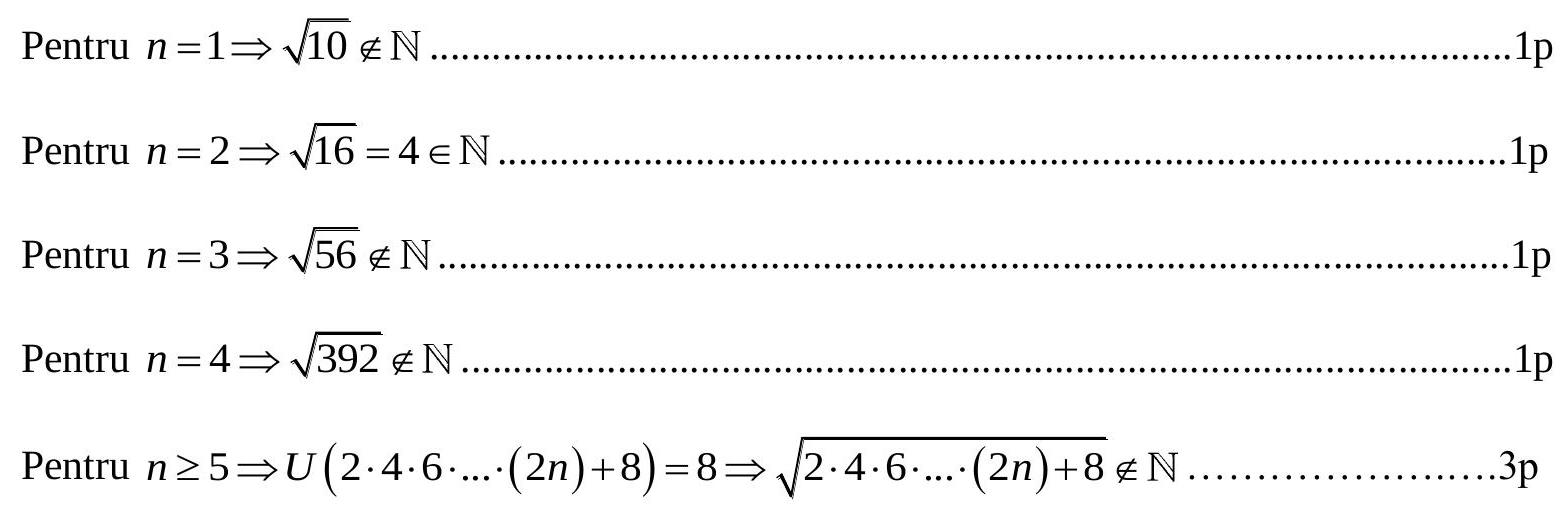
For $n=2 \Rightarrow \sqrt{16}=4 \in \mathbb{N}$ ..... $1 p$
For $n=3 \Rightarrow \sqrt{56} \notin \mathbb{N}$ ..... $1 p$
For $n=4 \Rightarrow \sqrt{392} \notin \mathbb{N}$ ...... | 2 | Number Theory | math-word-problem | Yes | Yes | olympiads | false |
Problem 3. Specify how many non-zero numbers $A$, of at most six digits, satisfy, at the same time, the conditions:
1) $A$ is even
2) $A$ is a perfect cube
3) half of $A$ is a perfect square. | Solution. Since $A$ is non-zero and a perfect cube, $A=b^{3}$ with $b \in N^{*}$. Since $A<(100)^{3}$, it follows that $b<100$. $A$ is even, so $b$ is an even number. From $b=2 c$, we get $A=8 \cdot c^{3}$, with $1 \leq c \leq 49 . A: 2=4 \cdot c^{3}=(2 \cdot c)^{2} \cdot c$ being a perfect square, leads to the conclus... | 7 | Number Theory | math-word-problem | Yes | Yes | olympiads | false |
## SUBJECT I
a) Solve the equation $x^{\log _{2} 9}=x^{2} \cdot 3^{\log _{2} x}-x^{\log _{2} 3}$
b) If $x \in[2, \infty)$, calculate $\left[\log _{[x]} x\right]$, where $[a]$ represents the integer part of $a$. | Solution:


 \cdot\left(\frac{c}{a-b}+\frac{a}{b-c}+\frac{b}{c-a}\right)$. | ## SUBJECT II
$$
\begin{gathered}
\left(\frac{a-b}{c}+\frac{b-c}{a}+\frac{c-a}{b}\right) \cdot\left(\frac{c}{a-b}+\frac{a}{b-c}+\frac{b}{c-a}\right)= \\
=\left(\frac{a-b}{a+b}+\frac{b-a-b}{a}+\frac{a+b-a}{b}\right) \cdot\left(\frac{a+b}{a-b}+\frac{b}{b-a-b}+\frac{b}{a+b-a}\right)= \\
=\left(\frac{a-b}{a+b}-1+1\right)\... | 1 | Algebra | math-word-problem | Yes | Yes | olympiads | false |
## Subject I
Determine $x, y, z \geq 0$ such that:
$$
\left\{\begin{array}{c}
\sqrt{x}+\sqrt{y}+\sqrt{z}=3 \sqrt{2} \\
2^{x^{2}+y}+2^{y^{2}+z}+2^{z^{2}+x}=192
\end{array}\right.
$$ | Solution $\sqrt{x}+\sqrt{y}+\sqrt{z}=3 \sqrt{2} \Rightarrow x+y+z+2(\sqrt{x y}+\sqrt{x z}+\sqrt{y z})=18 \Rightarrow$ $\Rightarrow 18 \leq x+y+z+(x+y)+(x+z)+(y+z) \Rightarrow x+y+z \geq 6$
$\sqrt{\frac{x^{2}+y^{2}+z^{2}}{3}} \geq \frac{x+y+z}{3} \geq 2 \Rightarrow x^{2}+y^{2}+z^{2} \geq 12$
$2^{x^{2}+y}+2^{y^{2}+z}+2... | 2 | Algebra | math-word-problem | Yes | Yes | olympiads | false |
## Subject II. (30 points)
In triangle $\triangle A B C$, the angle bisector $[A E, \mathrm{E} \in(B C)$ intersects the median $[B F], \mathrm{F} \in(A C)$, at point G.
a) Determine $a \in \mathrm{N}$, such that $\frac{B G}{G F} \cdot \frac{C E}{B E}=2^{a}$.
b) If triangles $\triangle A G F$ and $\triangle B G E$ ar... | ## Subject II. (30 points)
Correct drawing
a) $\left[A E\right.$ bisector $\Rightarrow \frac{B E}{E C}=\frac{A B}{A C}$
$\left[A G\right.$ bisector $\Rightarrow \frac{B G}{G F}=\frac{A B}{A F} \Rightarrow \frac{B G}{G F}=\frac{A B}{\frac{A C}{2}} \Rightarrow \frac{B G}{G F}=\frac{2 A B}{A C} \quad ; \quad \frac{B G}{... | 1 | Geometry | math-word-problem | Yes | Yes | olympiads | false |
Problem 2. Determine the perimeter of the scalene triangle $\mathrm{ABC}$ knowing that
$$
p^{2} \cdot \overrightarrow{G I}=(4 p-b-c) \cdot \overrightarrow{A I}+(4 p-c-a) \cdot \overrightarrow{B I}+(4 p-a-b) \cdot \overrightarrow{C I}
$$
where $\mathrm{G}$ is the centroid of $\triangle \mathrm{ABC}$, I is the incenter... | Solution:
$4 p-b-c=2 p+a, 4 p-c-a=2 p+b, 4 p-a-b=2 p+c$
The relationship from the statement becomes:
$p^{2} \cdot \overrightarrow{G I}=a \cdot \overrightarrow{A I}+b \cdot \overrightarrow{B I}+c \cdot \overrightarrow{C I}+2 p(\overrightarrow{A I}+\overrightarrow{B I}+\overrightarrow{C I})$
$1 \mathbf{p}$
$\overrig... | 12 | Geometry | math-word-problem | Yes | Yes | olympiads | false |
## Problem 1
Solve the equation in the set $\mathbb{R}$: $\log _{3}\left(8+2 x-x^{2}\right)=2^{x-1}+2^{1-x}$. | ## Problem 1

For $x \in(-2,4) \Rightarrow-\left(x^{2}+2 x+8\right) \in(0,9] \Rightarrow \log _{3}\left(-x^{2}+2 x+8\right) \leq \log _{3} 9=2 \ldots \ldots \ldots \ldots \ldots \ldots \ldots ... | 1 | Algebra | math-word-problem | Yes | Yes | olympiads | false |
## Subject II
Consider the sequence of numbers: $a_{1}=\frac{1}{11}-\frac{1}{19}, a_{2}=\frac{12}{11}-\frac{20}{19}, a_{3}=\frac{23}{11}-\frac{39}{19}, \ldots$ Prove that $a_{1}+a_{2}+a_{3}+\cdots+a_{209}$ is a natural number. | ## Subject II
Consider the sequence of numbers: $a_{1}=\frac{1}{11}-\frac{1}{19}, a_{2}=\frac{12}{11}-\frac{20}{19}, a_{3}=\frac{23}{11}-\frac{39}{19}, \ldots$ Prove that $a_{1}+a_{2}+a_{3}+\cdots+a_{209}$ is a natural number.
## Grading Scheme 1:
| $a_{1}=\frac{1}{11}-\frac{1}{19}=\frac{1+0 \cdot 11}{11}-\frac{1+0 ... | 8 | Algebra | proof | Yes | Yes | olympiads | false |
4. Consider the function $f: \mathbf{R} \rightarrow \mathbf{R}$, which satisfies the relation: $(f \circ f)(x) = x^3 + x - 8 \quad (\forall) x \in \mathbf{R}$.
Knowing that any polynomial equation $a_{n} X^{n} + a_{n-1} X^{n-1} + \cdots + a_{1} X + a_{0} = 0$ with real coefficients and odd degree $n$ has at least one ... | Subject 4. a) $h(x)=x^{3}+x-8$ is injective, it follows that $f_{0} f$ is injective, hence $f$ is injective
$.2 p$
From the hypothesis for $(\forall) \mathrm{y} \in \mathrm{R}$, the equation $\mathrm{x}^{3}+\mathrm{x}-8-\mathrm{y}=0$ has a real solution, so $\exists x \in R$,
such that $h(x)=y$, which means $h$ is sur... | 2 | Algebra | proof | Yes | Yes | olympiads | false |
4. a) Let $f(x)=A x^{3}+B x^{2}+C x+D$
According to the hypothesis, $0=\int_{-a}^{a} f(x) d x=\left.\frac{A}{4} x^{4}\right|_{-a} ^{a}+\left.\frac{B}{3} x^{3}\right|_{-a} ^{a}+\left.\frac{C}{2} x^{2}\right|_{-a} ^{a}+\left.D x\right|_{-a} ^{a}=$ $=\frac{2}{3} B a^{3}+2 D a$ from which $B a^{2}+3 D=0$
The expression $... | 4. Let $f: \mathbb{R} \rightarrow \mathbb{R}$, $f(x)=A x^{3}+B x^{2}+C x+D$, where $A, B, C, D \in \mathbb{R}$, with the property that there exists $a>0$ such that
$$
\int_{-a}^{a} f(x) d x=0
$$
a) Determine $E=f\left(-\frac{\sqrt{2}}{2} a\right)+f(0)+f\left(\frac{\sqrt{2}}{2} a\right)$
b) Show that the equation $f(... | 0 | Algebra | proof | Yes | Yes | olympiads | false |
## Subject IV.
Given the cube ABCDEFGH, where $B G \cap F C=\{P\}$ and the area of triangle DBP is equal to $25 \sqrt{3} \mathrm{~cm}^{2}$.
a) Calculate the length of the edge of the cube.
b) Determine $\tan u^{0}$, where $u^{0}$ is the measure of the angle between the lines DP and EB.
c) Calculate the value of a t... | ## Subject IV.

a) If we denote the edge of the cube with 2a, we get:
$\mathrm{BD}=2 \mathrm{a} \sqrt{2}$ (diagonal in the square $\mathrm{ABCD}$);
$B P=a \sqrt{2}$ (radius of the circumscri... | 10 | Geometry | math-word-problem | Yes | Yes | olympiads | false |
Problem 1. Let $\mathcal{F}$ be the set of continuous functions $f:[0,1] \rightarrow \mathbb{R}$, which satisfy the condition $\max _{0 \leq x \leq 1}|f(x)|=1$, and let $I: \mathcal{F} \rightarrow \mathbb{R}$,
$$
I(f)=\int_{0}^{1} f(x) \mathrm{d} x-f(0)+f(1)
$$
(a) Show that $I(f)<3$, for any $f \in \mathcal{F}$.
(b... | Solution. (a) Let $f$ be a function in $\mathcal{F}$. From the condition $\max _{0 \leq x \leq 1}|f(x)|=1$, it follows that $I(f) \leq \int_{0}^{1} 1 \, \mathrm{d} x + 1 + 1 = 3 \ldots \ldots \ldots \ldots \ldots \ldots \ldots \ldots \ldots \ldots \ldots \ldots \ldots \ldots \ldots \ldots \ldots \ldots \ldots \ldots \l... | 3 | Calculus | proof | Yes | Yes | olympiads | false |
2. Consider the quadrilateral $A B C D$ where $m(\varangle A B C)=90^{\circ},[A C] \equiv[A D]$ and $m(\Varangle B A C) \equiv m(\Varangle C A D)=20^{\circ}$. Consider the point $E \in(A C)$ such that $D E \perp A C$. Determine the measure of the angle $\Varangle E B C$. | 2. We have $\triangle A B C \equiv \triangle A E D$ (I.U.), from which $[A B] \equiv[A E] ; \quad 3 p$
Triangle $A B E$ is isosceles and $m(\angle A B E)=80^{\circ}$; 3p
We obtain $m(\angle E B C)=10^{\circ}$
$1 p$ | 10 | Geometry | math-word-problem | Yes | Yes | olympiads | false |
## Problem 4
An album costs as much as two books, and two books cost as much as three pens. If two pens, two books, and one album cost 128 lei, find the cost of an album, a book, and a pen.
Note
- Effective working time 2 hours.
- All subjects are mandatory.
- 7 points are awarded for each correctly solved problem.
... | ## Problem 4
An album $=2$ books $=3$ pens $\qquad$ $1 p$
An album + 2 books + 3 pens $=128$ lei $\qquad$ $1 p$
We replace the album and books with pens and get 8 pens $=128$ lei 1 pen $=16$ lei, 1 album $=48$ lei, 1 book $=24$ lei $\qquad$ $1 p \times 3=3 p$ | 1 | Algebra | math-word-problem | Yes | Yes | olympiads | false |
2. Calculate the sum $\frac{1}{2[\sqrt{1}]+1}+\frac{1}{2[\sqrt{2}]+1}+\cdots+\frac{1}{2[\sqrt{99}]+1}$, where $[x]$ represents the integer part of the real number $x$. | Solution and grading:
We observe that the first 3 fractions are equal to $\frac{1}{3}$, the next 5 fractions are equal to $\frac{1}{5}$. In general, we can observe that $\frac{1}{2[\sqrt{k}]+1}=\frac{1}{2 n+1}$ for any $k$ for which $[\sqrt{k}]=n$, i.e., $n \leqslant \sqrt{k}<n+1$, which is equivalent to $n^{2} \leqsl... | 9 | Number Theory | math-word-problem | Yes | Yes | olympiads | false |
## SUBIECTUL I
(4p) a) Calculaţi: $x=\sqrt{\left(\frac{12}{11}+\frac{13}{22}+\frac{14}{33}+\ldots+\frac{110}{1089}\right)-\left(1+\frac{1}{2}+\frac{1}{3}+\ldots+\frac{1}{99}\right)}$;
(3p)b)Calculaţi: $y=\left(\frac{1}{1 \bullet 4}+\frac{1}{2 \bullet 6}+\frac{1}{3 \bullet 8}+\ldots+\frac{1}{49 \bullet 100}\right)$;
| ## SUBIECTUL I
a) $11=11 \cdot 1 ; 22=11 \cdot 2, \ldots, 1089=11 \cdot 99 \quad$ (1p); $\frac{12}{11}-1=\frac{1}{11}, \frac{13}{22}-\frac{1}{2}=\frac{1}{11}, \ldots, \frac{110}{1089}-\frac{1}{99}=\frac{1}{11}$ (2p); $\sqrt{\frac{1}{11} \cdot 99}=3$ (1p);
b) $y=\frac{1}{2}\left(\frac{1}{1 \cdot 2}+\frac{1}{2 \cdot 3}+... | 3 | Algebra | math-word-problem | Yes | Yes | olympiads | false |
2. Let $A \in \mathcal{M}_{2}(\mathbb{R})$ that satisfies the relation $A^{2}+A+I_{2}=O_{2}$.
a) Find a matrix that satisfies the relation given in the statement.
b) Calculate the determinant of the matrix $A$. | 2. a) Consider the matrix $A=\left(\begin{array}{ll}a & b \\ c & d\end{array}\right)$ with $a+d=-1$ and $ad-bc=1$, for example
$A=\left(\begin{array}{cc}-1 & -1 \\ 1 & 0\end{array}\right)$
b) $A^{2}+A+I_{2}=O_{2}$ Multiplying the relation by $A-I_{2}$ results in $A^{3}-I_{2}=O_{2}$, hence $A^{3}=I_{2}$ and $\operatorn... | 1 | Algebra | math-word-problem | Yes | Yes | olympiads | false |
## SUBJECT I
Calculate:
$$
\mathrm{a}=\left\{\left[2^{3} \cdot 5^{2}+\left(25^{50}: 5^{99}+2^{2} \cdot 3\right) \cdot 5^{2}\right]: 5^{3}+2^{7}+11^{1991}:\left(11^{2}\right)^{995}\right\}:\left(3^{3}+3^{2}\right)
$$ | Solution:


$$
\begin{aligned}
& \left\{(25 \cdot 25): 5^{3}+12... | 4 | Algebra | math-word-problem | Yes | Yes | olympiads | false |
## SUBJECT III (7p)
Let $\mathrm{A}$ and $\mathrm{B}$ be two points in the plane such that $\mathrm{AB}=1 \mathrm{~m}, \mathrm{M}_{1}$ is the midpoint of the segment $[\mathrm{AB}], \mathrm{M}_{2}$ is the midpoint of the segment [AM $M_{1}$ ], $M_{3}$ is the midpoint of the segment $\left[A M_{2}\right.$ ], and so on,... | ## Subject III

a) $A B=1 \mathrm{~m}=1000 \mathrm{~mm}$
$A M_{1}=A B: 2=500 \mathrm{~mm}$
$A M_{2}=A M_{1}: 2=A B: 2^{2}=250 \mathrm{~mm}, A M_{3}=A M_{2}: 2=A B: 2^{3}=125 \mathrm{~mm}$
$A... | 10 | Geometry | math-word-problem | Yes | Yes | olympiads | false |
## Subject I. (20 points)
Determine the number of elements of the set: $A=\left\{\overline{a b c d} \left\lvert\, \frac{a+3}{b}=\frac{b-3}{c}=\frac{c+4}{d}=\frac{d-4}{a}\right.\right\}$.
Prof. Ioan Balica, Ioan Bob Gymnasium School, Cluj-Napoca | ## Subject I.
According to the property of the sequence of equal ratios, we have $\frac{a+3}{b}=\frac{b-3}{c}=\frac{c+4}{d}=\frac{d-4}{a}=\frac{a+3+b-3+c+4+d-4}{a+b+c+d}=1$.
Thus, $a+3=b$, $b-3=c$, and $c+4=d$. We obtain $c=a$ and $d=a+4$. Since $a, b, c, d$ are digits, $a \neq 0$. It follows that $a \in\{1,2,3,4,5\}... | 5 | Algebra | math-word-problem | Yes | Yes | olympiads | false |
Problem 2. Solve in the set of real numbers the equation $x+\log _{2}\left(1+\sqrt{\frac{5^{x}}{3^{x}+4^{x}}}\right)=4+\log _{1 / 2}\left(1+\sqrt{\frac{25^{x}}{7^{x}+24^{x}}}\right)$. | Solution. Note that $x=2$ is a solution.
1 point
We will show that this solution is unique. For $x>2$ we have $(3 / 5)^{x}+(4 / 5)^{x}<1$, so the left-hand side is strictly greater than 3.
On the other hand, $(7 / 25)^{x}+(24 / 25)^{x}<1$ and $\log _{1 / 2}\left(1+\sqrt{25^{x} /\left(7^{x}+24^{x}\right)}\right)<\log... | 2 | Algebra | math-word-problem | Yes | Yes | olympiads | false |
4. Let $C \in (AB)$ and points $P, M$, $T$ be the midpoints of segments $(AB), (AC)$ and $(MP)$. If $2 \cdot AC - BC = 40 \text{ cm}$, then determine the length of segment $[TC]$.
Daniela and Nicolae Stănică, Brăila | ## Solution:
Case I: $P \in(B C), T \in(M C)$
$$
\begin{aligned}
& A C=2 x, C B=2 y \Rightarrow 2 x-y=20 \\
& P C=y-x \text { and } M P=y \\
& M T=\frac{y}{2} \Rightarrow T C=x-\frac{y}{2}=\frac{2 x-y}{2}=10 \text{ cm}
\end{aligned}
$$
Cases II: $P \in(B C), T \in(C P)$ and III: $P \in(A C)$ are studied similarly an... | 10 | Geometry | math-word-problem | Yes | Yes | olympiads | false |
PROBLEM 1. Consider the distinct rational numbers $a_{1}, a_{2}, \ldots, a_{n}$, such that among any four of them, there are two whose product is -1.
a) Give an example of 6 such numbers;
b) Find the maximum value of $n$. | PROBLEM 1. Consider the distinct rational numbers $a_{1}, a_{2}, \ldots, a_{n}$, such that among any four of them, there are two whose product is -1.
a) Give an example of 6 such numbers;
b) Find the maximum value of $n$.
## Grading Rubric.
$(3 p)$
a) For example, the numbers $2, 3, 4, -\frac{1}{2}, -\frac{1}{3}, ... | 6 | Algebra | math-word-problem | Yes | Yes | olympiads | false |
2. Consider the natural number $a=1+3+3^{2}+3^{3}+\ldots+3^{2009}$.
a) Prove that the number $a$ is even.
b) Prove that the number $a$ is divisible by 13.
c) Find the remainder of the division of the number $b$ by 13, where $b=a+3^{2010}+3^{2011}$. | 2. a) The given sum has an even number of odd terms, so it is an even number.
b) Grouping the terms of the sum in threes, we obtain:
$$
a=\left(1+3+3^{2}\right)+\left(3^{3}+3^{4}+3^{5}\right)+\ldots+\left(3^{2007}+3^{2008}+3^{2009}\right)=13\left(1+3^{3}+3^{6}+\ldots+3^{2007}\right): 13
$$
c) We have that $b=1+3+\le... | 4 | Number Theory | proof | Yes | Yes | olympiads | false |
2.a) Find two natural numbers such that when divided, the quotient is 49, and the remainder is strictly greater than 4 and 294 less than the dividend.
b) Let $A=n^{2016}+(n+1)^{2016}+(n+2)^{2016}+\ldots+(n+9)^{2016}$, where $n \in \mathbb{N}$. Determine the remainder of the division of $A$ by 10. | 2.a) Let $a$ and $b$ be the two numbers. Assume $a > b$.
The conditions from the problem can be written as:
$a = 49b + r \quad (1);$
$r > 4 \quad (2)$
$r = a - 294 \quad (3)$.
From equations (1) and (3), we get $a = 49b + a - 294$, which simplifies to $49b = 294$
$\Rightarrow b = 6$. Then $r \in \{0, 1, 2, 3, 4, ... | 3 | Number Theory | math-word-problem | Yes | Yes | olympiads | false |
Problem 1. How many three-digit prime numbers can be transformed into perfect cubes by changing the order of their digits?
Mathematical Gazette | Problem 1. How many three-digit prime numbers can be transformed into perfect cubes by changing the order of their digits? Solution
The perfect cubes of three digits are: $125, 216, 343, 512$ and $729 . \ldots \ldots \ldots .1$ p Prime numbers of three digits must end with an odd digit, different from 5, and must not ... | 3 | Number Theory | math-word-problem | Yes | Yes | olympiads | false |
Problem 4. Consider a natural number $n \geq 2$ and an $n \times n$ square (see the adjacent figure). The main diagonal of this square is formed by the shaded fields. We fill the fields below the main diagonal with zeros, and in the rest of the fields (including the shaded ones) we write non-zero natural numbers. After... | Solution. a) Suppose there exists a lucky square $5 \times 5$. The sum of all sums will be $1+$ $2+\cdots+10=55$. The sum of the row sums is equal to the sum of the column sums, so the sum of all sums is even. But 55 is odd, hence there is no lucky square $5 \times 5$. $3 p$
b) Suppose a cell is occupied by a number $... | 6 | Combinatorics | math-word-problem | Yes | Yes | olympiads | false |
Problem 2. a) Point $C$ is the midpoint of segment $(A B)$, $D$ is the midpoint of $(B C)$, $E$ is the midpoint of $(C D)$, and $F$ is a point on the ray $(E B)$ such that $(E B) \equiv (B F)$. If $E B=3 \text{ cm}$, calculate $A F$. | Solution. We can denote $ED = x$ and we successively have that $CD = BD = 2x$ and $EB = BF = 3x$. Since $EB = 3$ cm, we have that $x = 1$ cm. $1$ p

Then $AF = 4$ cm + $2$ cm + $2$ cm + $3$ c... | 11 | Geometry | math-word-problem | Yes | Yes | olympiads | false |
Problem 4. Let $f:[0,1] \rightarrow[0,1]$ be an increasing function and let
$$
a_{n}=\int_{0}^{1} \frac{1+(f(x))^{n}}{1+(f(x))^{n+1}} \mathrm{~d} x, \quad n \in \mathbb{N}^{*}
$$
Show that the sequence $\left(a_{n}\right)_{n \in \mathbb{N}^{*}}$ is convergent and calculate its limit. | Solution. Clearly, $a_{n} \geq 1$ for any $n \in \mathbb{N}^{*}$. On the other hand,
$$
\begin{aligned}
a_{n}-a_{n+1} & =\int_{0}^{1}\left(\frac{1+(f(x))^{n}}{1+(f(x))^{n+1}}-\frac{1+(f(x))^{n+1}}{1+(f(x))^{n+2}}\right) \mathrm{d} x \\
& =\int_{0}^{1} \frac{(f(x))^{n}(1-f(x))^{2}}{\left(1+(f(x))^{n+1}\right)\left(1+(f... | 1 | Calculus | proof | Yes | Yes | olympiads | false |
## Problem 1:
a) Show that $3\left(x^{2}+y^{2}+z^{2}\right) \geq(x+y+z)^{2}, \forall x, y, z \in \mathbb{R}$
b) If a, b, c, d $\in(1, \infty)$, show that $\log _{a} \frac{b^{2}+c^{2}+d^{2}}{b+c+d}+\log _{b} \frac{c^{2}+d^{2}+a^{2}}{c+d+a}+\log _{c} \frac{d^{2}+a^{2}+b^{2}}{d+a+b}+$ $\log _{d} \frac{a^{2}+b^{2}+c^{2}}... | ## Problem 1:
a) $3\left(x^{2}+y^{2}+z^{2}\right) \geq(x+y+z)^{2} \Leftrightarrow(x-y)^{2}+(y-z)^{2}+(z-x)^{2} \geq$ 0 (2p)
b) Using point a) we have $\log _{a} \frac{b^{2}+c^{2}+d^{2}}{b+c+d} \geq \log _{a} \frac{b+c+d}{3} \geq \log _{a} \sqrt[3]{b c d}=$ $\frac{1}{3}\left(\log _{a} b+\log _{a} c+\log _{a} d\right)$... | 4 | Inequalities | proof | Yes | Yes | olympiads | false |
Problem 1. a) Show that $\lim _{x \rightarrow 0} \frac{\cos (\sin x)-\cos (\tan x)}{x(\tan x-\sin x)}=1$;
b) Prove that $\lim _{x \rightarrow 0}\left[\frac{2016}{x}\right]$ does not exist, where [a] represents the integer part of the real number a. | Solution:
a) Write the formula $\cos p-\cos q=-2 \sin \frac{p+q}{2} \sin \frac{p-q}{2}$ or apply it directly $\left.\mathbf{( 0 , 5 p}\right)$
$$
\begin{aligned}
& l=\lim _{x \rightarrow 0} \frac{\cos (\sin x)-\cos (\operatorname{tg} x)}{x(\operatorname{tg} x-\sin x)}=\lim _{x \rightarrow 0}\left[-2 \frac{\sin \frac{... | 1 | Calculus | proof | Yes | Yes | olympiads | false |
Problem 2. Let matrices $\mathrm{A}, \mathrm{B} \in M_{3}(\mathbf{R})$ with $A \cdot A^{t}=\mathrm{B} \cdot \mathrm{B}^{\mathrm{t}}=\mathrm{I}_{3}$. Show that $\operatorname{det}((A-B)(A+B))=0$.
Mathematical Gazette | Solution:
If $X \in M_{3}(\mathbb{R})$, then $\operatorname{det}\left(X-X^{t}\right)=0$.
Then $\operatorname{det}((A-B)(A+B))=\operatorname{det}(A-B) \cdot \operatorname{det}(A+B)=$ $\qquad$ (1p)
$=\operatorname{det}(A-B) \cdot \operatorname{det}\left((A+B)^{t}\right)=$ $\qquad$
$=\operatorname{det}\left(A \cdot A^{... | 0 | Algebra | proof | Yes | Yes | olympiads | false |
## SUBJECT 3
Calculate $\lim _{n \rightarrow \infty}\left(\left\{\sqrt{n^{2}+1}\right\}+\left\{\sqrt{n^{2}-1}\right\}\right)^{n}$, where $\{x\}$ represents the fractional part of the number $x \in R$.
Prof. Alexandru Cărnaru | ## SUBJECT 3
$\left\{\sqrt{n^{2}+1}\right\}=\sqrt{n^{2}+1}-\left[\sqrt{n^{2}+1}\right]$, but $\sqrt{n^{2}+1}=n$ because $n \leq \sqrt{n^{2}+1}n_{\varepsilon}>1$
$\lim _{n \rightarrow \infty} \sqrt{n^{2}+1}-n+\sqrt{n^{2}-1}-n+1=\lim _{n \rightarrow \infty}\left(\frac{n^{2}+1-n^{2}}{\sqrt{n^{2}+1}+n}+\frac{n^{2}-1-n^{2... | 1 | Calculus | math-word-problem | Yes | Yes | olympiads | false |
## SUBJECT 4
Let the sequence of real numbers $\left(x_{n}\right)_{n \geq 1}$, given by $x_{1}=\alpha$, with $\alpha \in \mathrm{R}^{*}, \alpha \neq 2$ and $x_{n+1}=\frac{x_{n}^{2}+2 x_{n}+2}{x_{n}^{2}+1},(\forall) n \geq 1$. Calculate:
a) $\lim _{n \rightarrow \infty} x_{n}$,
b) $\lim _{n \rightarrow \infty}\left(x_{... | ## SUBJECT 4
a) $x_{n+1}-2=\frac{2 x_{n}-x_{n}^{2}}{x_{n}^{2}+1}=\frac{x_{n}}{x_{n}^{2}+1}\left(2-x_{n}\right)$,
$\Rightarrow\left|x_{n+1}-2\right|=\left|x_{n}-2\right| \cdot\left|\frac{x_{n}}{x_{n}^{2}+1}\right| \leq \frac{1}{2}\left|x_{n}-2\right|$
$1 p$
$\Rightarrow\left|x_{n}-2\right| \leq \frac{1}{2^{n-1}}\lef... | 2 | Algebra | math-word-problem | Yes | Yes | olympiads | false |
1. task. a) Prove that the number
$$
a=\sqrt{9-\sqrt{77}} \cdot \sqrt{2} \cdot(\sqrt{11}-\sqrt{7}) \cdot(9+\sqrt{77})
$$
is a natural number!
b) Given real numbers $x$ and $y$ such that $x y=6$. Prove that if $x>2$ and $y>2$, then $x+y<5$.
Gazeta Matematică | Problem 1. a) Show that the number $a=\sqrt{9-\sqrt{77}} \cdot \sqrt{2} \cdot(\sqrt{11}-\sqrt{7}) \cdot(9+\sqrt{77})$ is a natural number.
b) Consider the real numbers $x$ and $y$ such that $x y=6$. If $x>2$ and $y>2$, show that $x+y<5$.
Gazeta Matematică
## Solution
 Prove that if there exist natural numbers $p$ and $q$ such that $\sqrt{2 p - q}$ and $\sqrt{2 p + q}$ are natural numbers, then $q$ is even!
b) How many natural numbers $p$ are there such that $\sqrt{2 p - 4030}$ and $\sqrt{2 p + 4030}$ are both natural numbers? | Problem 2. a) Show that if there exist two natural numbers $p$ and $q$ such that $\sqrt{2 p-q}$ and $\sqrt{2 p+q}$ are natural numbers, then $q$ is even.
b) Determine how many natural numbers $p$ have the property that $\sqrt{2 p-4030}$ and $\sqrt{2 p+4030}$ are simultaneously natural numbers.
## Solution
a) From th... | 4 | Number Theory | proof | Yes | Yes | olympiads | false |
Problem 2. Determine the smallest natural number $n$ such that, no matter which $n$ vertices of a cube we color red, there exists a vertex of the cube that has all three adjacent vertices red. | Solution. We will show that the sought number is 5.
Let $A B C D A^{\prime} B^{\prime} C^{\prime} D^{\prime}$ be a cube. By coloring the 4 vertices of one face of the cube in red, for example $A, B, C, D$, there is no vertex that has all three adjacent vertices red, so $n \geq 5$.
Now, for $n=5$, no matter how we col... | 5 | Combinatorics | math-word-problem | Yes | Yes | olympiads | false |
## Subject 4 .
Prof. Dan Marinescu, Hunedoara
| Details of solution | Associated marking |
| :--- | :---: |
| a) $0 \leq \int_{0}^{\pi / 4} \frac{\sin ^{n} x}{\cos ^{n-1} x} d x=\int_{0}^{\pi / 4} \operatorname{tg}^{n} x \cos x d x \leq \int_{0}^{\pi / 4} \operatorname{tg}^{n} x d x=$ | 1 point |
| $=\int_{0}^{1} \fr... | Problem 4. a) Calculate
$$
\lim _{n \rightarrow \infty} \int_{0}^{\pi / 4} \frac{\sin ^{n} x}{\cos ^{n-1} x} d x
$$
b) Consider the continuous functions $f, g:[a, b] \rightarrow(0, \infty)$, with $a, b \in \mathbb{R}, a<b$. Show that the sequence with the general term
$$
c_{n}=\int_{a}^{b} f^{n}(x) g(x) d x, \quad n... | 0 | Calculus | proof | Yes | Yes | olympiads | false |
3. (7p) Consider the sequence of real numbers $\left(x_{n}\right)_{n \circledast 1}$ with $x_{1}=1, x_{2}=2, x_{3}=3$ and $x_{n+3}=x_{n}, \forall n \in \mathbb{N}^{*}$. Calculate $\lim _{n \rightarrow \infty} \frac{x_{1}+x_{2}+\ldots+x_{n}}{n}$. | Solution. Since $x_{n+3}=x_{n}, \forall n \in \mathbb{N}^{*}$, we deduce that the sequence $\left(x_{n}\right)_{n \geqslant 1}$ is periodic with a period of 3. More precisely, we have $x_{3 n-2}=1, x_{3 n-1}=2$ and $x_{3 n}=3, \forall n \in \mathbb{N}^{*}$.
Let $y_{n}=\frac{x_{1}+x_{2}+\ldots+x_{n}}{n}$. Grouping the ... | 2 | Algebra | math-word-problem | Yes | Yes | olympiads | false |
## Problem 2.
Determine the largest natural number $n$ for which the following statement is true:
There exist $n$ distinct non-zero natural numbers $x_{1}, x_{2}, \ldots, x_{n}$ with the property that for any numbers $a_{1}, a_{2}, \ldots, a_{n} \in\{-1,0,1\}$, not all zero, the number $n^{3}$ does not divide the num... | Solution. For $n=9$ we choose $x_{1}=2^{0}, x_{2}=2^{1}, \ldots, x_{9}=2^{8}$. For any numbers $a_{1}, a_{2}, \ldots, a_{n} \in\{-1,0,1\}$, we have:
$$
\left|a_{1} x_{1}+a_{2} x_{2}+\ldots+a_{n} x_{n}\right| \leq 1+2+\ldots+2^{8}=2^{9}-1 < n^{3}$.
Let $A=\left\{x_{1}, x_{2}, \ldots, x_{n}\right\}$ be a set of $n$ dis... | 9 | Number Theory | math-word-problem | Yes | Yes | olympiads | false |
Subject 2. The arithmetic mean of the distinct natural numbers $a_{1}, a_{2}, a_{3}, \ldots, a_{2014}$, 2014, and 2016 is 2015.
a. Find the arithmetic mean of the numbers $a_{1}, a_{2}, a_{3}, \ldots, a_{2014}$.
b. If the numbers $a_{1}, a_{2}, a_{3}, \ldots, a_{2014}$ are even, show that $a_{1} \cdot a_{2} \cdot a_{... | ## Subject 2.
| a. | $\left(a_{1}+a_{2}+a_{3}+\ldots+a_{2014}+2014+2016\right): 2016=2015 \Rightarrow$ $a_{1}+a_{2}+a_{3}+\ldots+a_{2014}=2015 \cdot 2016-2016-2014 \Rightarrow$ $\left(a_{1}+a_{2}+a_{3}+\ldots+a_{2014}\right): 2014=2015$ | 3p |
| :--- | :--- | :---: |
| | Calculate the sum of the smallest 2014 disti... | 0 | Number Theory | math-word-problem | Yes | Yes | olympiads | false |
Subject 3. Determine the cardinality of the set $A=\left\{\overline{a b} \left\lvert\, \frac{16}{a^{2}+b} \in \mathbb{N}\right.\right\}$. | Subject 3.
| | $\frac{16}{a^{2}+b} \in \mathbb{N} \Rightarrow a^{2}+b \mid 16 \Rightarrow a^{2}+b \in\{1,2,4,8,16\}$ | $\mathbf{2 p}$ |
| :--- | :--- | :--- |
| | $a^{2}+b=16 \Rightarrow a=4$ and $b=0$ or $a=3$ and $b=7 \Rightarrow$ the numbers 40 and 37 | $\mathbf{1 p}$ |
| | $a^{2}+b=8 \Rightarrow a=2$ and $b=4$ ... | 8 | Number Theory | math-word-problem | Yes | Yes | olympiads | false |
## Problem 3
On the set of real numbers $\mathbb{R}$, the composition law "*" is defined with the following properties:
1) $\left(\frac{a+1}{3}\right) *\left(\frac{a}{2}\right)=1, \forall a \in \mathbb{R}$
2) $(a * b) \cdot c=(a \cdot c) *(b \cdot c), \forall a, b, c \in \mathbb{R}$.
Calculate $10 * 14$. | ## Problem 3
$10 * 14=(5 \cdot 2) *(7 \cdot 2)=(5 * 7) \cdot 2 \ldots \ldots \ldots \ldots \ldots \ldots \ldots \ldots \ldots \ldots \ldots \ldots \ldots \ldots \ldots \ldots \ldots \ldots \ldots \ldots \ldots \ldots \ldots$
In prop 1) for $a=14 \Rightarrow \frac{15}{3} * \frac{14}{2}=5 * 7=1 \Rightarrow 10 * 14=1 \cd... | 2 | Algebra | math-word-problem | Yes | Yes | olympiads | false |
Problem 3. Determine the number of elements of the set
$$
M=\left\{(x, y) \in \mathbb{N}^{*} \times \mathbb{N}^{*} \left\lvert\, \frac{1}{\sqrt{x}}-\frac{1}{\sqrt{y}}=\frac{1}{\sqrt{2016}}\right.\right\}
$$ | Solution Let $(x, y) \in M$. Since $\sqrt{2016}=12 \sqrt{14}$, we have
$$
\frac{1}{\sqrt{x}}-\frac{1}{\sqrt{y}}=\frac{1}{12 \sqrt{14}} \Leftrightarrow \frac{1}{\sqrt{14 x}}-\frac{1}{\sqrt{14 y}}=\frac{1}{2016} \Leftrightarrow \frac{1}{\sqrt{14 x}}=\frac{1}{\sqrt{14 y}}+\frac{1}{2016}
$$
By squaring, we obtain $\frac{... | 7 | Number Theory | math-word-problem | Yes | Yes | olympiads | false |
Problem 1. (a) Solve the equation $x^{2}-x+\hat{2}=\hat{0}, x \in \mathbb{Z}_{7}$.
(b) Determine the natural numbers $n \geq 2$, for which the equation $x^{2}-x+\hat{2}=\hat{0}$, $x \in \mathbb{Z}_{n}$, has a unique solution.
Mathematical Gazette | Solution. (a) Since 4 and 7 are coprime, and $\left(\mathbb{Z}_{7},+, \cdot\right)$ is a field, the given equation is equivalent to $\hat{4} x^{2}-\hat{4} x+\hat{1}=\hat{0}$, i.e., $(\hat{2} x-\hat{1})^{2}=\hat{0}$, hence $\hat{2} x=\hat{1}$, from which $x=\hat{4}$.
2 points
(b) Let $n \geq 2$ be a natural number for... | 7 | Algebra | math-word-problem | Yes | Yes | olympiads | false |
4. We have
$$
\begin{aligned}
& a_{n}=\prod_{k=2}^{n} \frac{k^{2}}{k-1}=\frac{2 \cdot 2}{1} \cdot \frac{3 \cdot 3}{2} \cdot \ldots \ldots . \cdot \frac{n \cdot n}{n-1}=\frac{n!\cdot n!}{(n-1)!}=n!\cdot n=n!\cdot[(n+1)-1]=(n+1)!-n! \\
& b_{n}=\sum_{k=2}^{n}[(k+1)!-k!]=(n+1)!-2, c_{n}=\frac{(n+1)!-2}{(n+1)!}=1-\frac{2}{... | 4. Consider the sequences of real numbers $\left(x_{n}\right)_{n \geq 2},\left(a_{n}\right)_{n \geq 2},\left(b_{n}\right)_{n \geq 2},\left(c_{n}\right)_{n \geq 2},\left(d_{n}\right)_{n \geq 2},$ with the general terms defined as follows:
$$
\begin{gathered}
x_{n}=\left(n+\frac{n}{n-1}\right) \\
a_{n}=x_{2} x_{3} \ldot... | 1 | Algebra | math-word-problem | Yes | Yes | olympiads | false |
## Subject I
a) If $m, n \in N^{*}$, find the smallest number of the form $\left|5^{2 m}-3^{n}\right|$.
b) Compare the numbers: $\frac{\sqrt{2014}^{2014}+\sqrt{2015}^{2015}}{\sqrt{2014}^{2015}+\sqrt{2015}^{2014}}$ and $\frac{\sqrt{2014}}{\sqrt{2015}}$. | ## Subject I
a) If $m, n \in N^{*}$, find the smallest number of the form $\left|5^{2 m}-3^{n}\right|$.
b) Compare the numbers: $\frac{\sqrt{2014}^{2014}+\sqrt{2015}^{2015}}{\sqrt{2014}^{2015}+\sqrt{2015}^{2014}}$ and $\frac{\sqrt{2014}}{\sqrt{2015}}$.
Scoring:
a) For $\mathrm{m}=1$ and $\mathrm{n}=3,\left|5^{2 m}-... | 2 | Number Theory | math-word-problem | Yes | Yes | olympiads | false |
1. Consider the number $a=\sqrt{7+\sqrt{13}}-\sqrt{7-\sqrt{13}}$.
a) Prove that the number $a^{2}$ is a natural number.
b) Calculate $\left(a^{3}-2 a-1\right)^{2016}$. | 1.a) $a^{2}=(\sqrt{7+\sqrt{13}}-\sqrt{7-\sqrt{13}})^{2}=7+\sqrt{13}-2 \cdot \sqrt{7+\sqrt{13}} \cdot \sqrt{7-\sqrt{13}}+7-\sqrt{13}=\ldots .1$ point $=14-2 \cdot \sqrt{7^{2}-\sqrt{13}^{2}}=14-2 \cdot 6=2 \in \mathbb{N}$............................................................ 2 points
b) $a^{3}-2 \cdot a=a \cdot\le... | 1 | Algebra | math-word-problem | Yes | Yes | olympiads | false |
## Problem 2.
Consider triangle $A B C$ with $\angle A=30^{\circ}$ and $\angle B=80^{\circ}$. On sides $A C$ and $B C$, points $D$ and $E$ are taken such that $\angle A B D \equiv \angle D B C$ and $D E \| A B$.
Determine the measure of angle $\angle E A C$.
 a) Show that $N$ is divisible by 5.
( 2 p ) b) Determine the remainder of the division of the number $N$ by 25.
( 3 p ) c) If $b$ is an even digit, show that $2^{N}$ is a perfect square.
Note: All questions are mandatory.
Time allowed: 2... | 4. a ) $N=\overline{a b} \cdot 100+60+25 \cdot \overline{a b}=125 \overline{a b}+60=$
$$
5 \cdot(25 \overline{a b}+12) \vdots 5
$$
b ) $N=125 \overline{a b}+50+10=25(5 \overline{a b}+2)+10$
$$
10<25 \Rightarrow \text{ the remainder of the division of } N \text{ by } 25 \text{ is } 10
$$
c ) b is an even digit $\Rig... | 10 | Number Theory | proof | Yes | Yes | olympiads | false |
## SUBJECT 1 (7 points)
a) Let $x, y \in \mathbb{R}$, such that $x^{2}+4 y(y+1)=4(x-1)$. Prove that $|x+2 y-1| \leq 2$.
b) Find the maximum value of the fraction $\frac{-2 a^{2}+6 a-8}{a^{2}-2 a+4}, a \in \mathbb{R}$. | ## Solution:
a) Bringing the relation to the form $(x-2)^{2}+(2 y+1)^{2}=1$. 2 points
$(x-2)^{2} \leq 1 \rightarrow|x-2| \leq 1 \Rightarrow$ and similarly for $2 y+1$ 1 point
Adding member by member the relations $-1 \leq x-2 \leq 1$ and $-1 \leq 2 y+1 \leq 1$ and finalizing. 1 point
b) $\frac{-2 a^{2}+6 a-8}{a^{2}-... | -1 | Algebra | proof | Yes | Yes | olympiads | false |
1. Determine the integer part of the number $x=\frac{1}{2^{2}}+\frac{1}{3^{2}}+\frac{1}{4^{2}}+\ldots . .+\frac{1}{2013^{2}}$.
Prof. Andronic Aurica Mihaela | Solution: It is observed that each term of the sum satisfies: $\frac{1}{2 \cdot 3}<\frac{1}{2^{2}}<\frac{1}{1 \cdot 2}$;
$\frac{1}{3 \cdot 4}<\frac{1}{3^{2}}<\frac{1}{2 \cdot 3} ; \frac{1}{4 \cdot 5}<\frac{1}{4^{2}}<\frac{1}{3 \cdot 4} ; \ldots \ldots \ldots \ldots . . \frac{1}{2013 \cdot 2014}<\frac{1}{2013^{2}}<\fra... | 0 | Number Theory | math-word-problem | Yes | Yes | olympiads | false |
1. ( 4 p ) a) Calculate $\left[(2+\sqrt{3})^{2014}+\frac{1}{(2-\sqrt{3})^{2014}}\right] \cdot \frac{(4-2 \cdot \sqrt{3})^{2014}}{2^{2013}}$
( 3 p ) b) Determine the rational numbers $a$ and $b$ such that
$$
2 a \sqrt{2}-b=a+b \sqrt{2}-3
$$ | 1. a) $\frac{(2+\sqrt{3})^{2014} \cdot(2-\sqrt{3})^{2014}+1}{(2-\sqrt{3})^{2014}} \cdot \frac{(4-2 \sqrt{3})^{2014}}{2^{2013}}=\frac{\left(2^{2}-\sqrt{3}^{2}\right)^{2014}+1}{(2-\sqrt{3})^{2014}} \cdot \frac{2^{2014}(2-\sqrt{3})^{2014}}{2^{2013}}=$
$$
\left(1^{2014}+1\right) \cdot 2=4
$$
b) $(2 a-b) \sqrt{2}=a+b-3$
... | 4 | Algebra | math-word-problem | Yes | Yes | olympiads | false |
4.a) Solve the equation: $3^{x}=2^{x}+1$.
b) Solve in $(1, \infty)$ the equation: $x^{\log _{3} 2}+1=(x-1)^{\log _{2} 3}$.
## Note:
All subjects are mandatory;
Working time: 3 hours.
## Solutions for class aX-a: | 4.a) $3^{x}=2^{x}+1 \Rightarrow\left(\frac{2}{3}\right)^{x}+\left(\frac{1}{3}\right)^{x}=1$.
We observe that $x=1$ is a solution to the equation. We show that this solution is unique.
The function $g: \mathbb{R} \rightarrow(0, \infty), g(x)=\left(\frac{2}{3}\right)^{x}+\left(\frac{1}{3}\right)^{x}$, is strictly decre... | 3 | Algebra | math-word-problem | Yes | Yes | olympiads | false |
Problem 4. Consider a natural number $n \geq 2$ and an $n \times n$ square (see the adjacent figure). The main diagonal of this square is formed by the shaded fields. We fill the fields below the main diagonal with zeros, and in the rest of the fields (including the shaded ones) we write non-zero natural numbers. After... | Solution. a) Suppose there exists a lucky square $5 \times 5$. The sum of all sums will be $1+$ $2+\cdots+10=55$. The sum of the row sums is equal to the sum of the column sums, so the sum of all sums is even. But 55 is odd, hence there is no lucky square $5 \times 5$.
b) Suppose a cell is occupied by a number $m \geq... | 6 | Combinatorics | math-word-problem | Yes | Yes | olympiads | false |
Problem 4. In a regular tetrahedron \(ABCD\), planes parallel to the faces of the tetrahedron are constructed such that each edge is divided into 6 congruent segments. These planes determine a set of 80 intersection points on the faces, edges, and inside the tetrahedron, denoted by \(V\).
Determine the maximum number ... | Solution. We can assume that the height of the tetrahedron $ABCD$ is equal to 6.
Let $k$ be the maximum number of elements in the set $W$ and $M_{1}, M_{2}, \ldots, M_{k}$ be the elements of $W$. For each $i \in \{1,2, \ldots, k\}$, we denote by $a_{i}, b_{i}, c_{i}$, and $d_{i}$ the distances from the point $M_{i}$ t... | 8 | Geometry | math-word-problem | Yes | Yes | olympiads | false |
PROBLEM 2. Let $a, b \in \mathbb{N}$, such that $\sqrt{\frac{a+5}{a+12}}, \sqrt{\frac{b+3}{b+14}} \in \mathbb{Q}$. Show that $a^{2015}+b^{2015}$ does not divide 2015. | ## PROBLEM 2.
(2p) $\sqrt{\frac{a+5}{a+12}} \in \mathbb{Q} \Rightarrow a+5=k x^{2}$ and $a+12=k y^{2}$ with $x$ and $y$ being coprime and $k \in \mathbb{N}$.
(1p) We have $k\left(y^{2}-x^{2}\right)=7 \Rightarrow k(y-x)(y+x)=7$ from which the only solution is $k=1, y=4$ and $x=3 \Rightarrow a=4$.
(3p) Similarly, it i... | 2 | Number Theory | proof | Yes | Yes | olympiads | false |
## SUBJECT IV
$A B C D E F G H$ is a regular quadrilateral prism with $A B=8 \mathrm{~cm}$ and $A E=4 \mathrm{~cm}$, and $M$ is the midpoint of the edge $(E H)$.
a) Prove that the line $A M$ is perpendicular to the line $M C$.
b) Find the length of the segment $(F N)$ knowing that $(A C M) \cap F G=\{N\}$.
c) Find ... | ## Solution:
a) From the Pythagorean theorem, we obtain: $A M=4 \sqrt{2}, A C=8 \sqrt{2}$ and $M C=4 \sqrt{6}$, and from the converse of the Pythagorean theorem, we obtain that triangle $A M C$ is right-angled at $M$
b) Let $(A M C) \cap(E F H)=d$. We get $d\|A C\| E G$ and since $E M \| G N$, it follows that
MNGE is ... | 12 | Geometry | math-word-problem | Yes | Yes | olympiads | false |
3. Consider the number $N=9+99+999+\ldots+\underbrace{999}_{2014 \text { digits }}+2014$
a) Prove that the number $N$ is divisible by 10;
b) Determine the remainder of the division of the number $N$ by 111.
Supplement to Gazeta Matematică, November 2013 | 3. a) The last digit of $N$ is 0, and from here the conclusion;
$3 p$
b) $N=10-1+100-1+1000-1+\ldots+\underbrace{1000.0}_{\text {2015 digits }}-1+2014=\underbrace{111 \ldots 110}_{2015 \text { digits }}$.
$2 p$
The number $\underbrace{111 . .1100}$ is divisible by 111, so the remainder of the division is 10.
2p
20... | 10 | Number Theory | math-word-problem | Yes | Yes | olympiads | false |
Problem 2. Consider a decomposition of the $8 \times 8$ chessboard into $p$ non-overlapping rectangles, such that each rectangle contains an integer number of squares, half of which are white, and no two rectangles have the same number of squares. Determine the maximum value of $p$. | Solution. If $p \geq 8$, the rectangles will contain, in total, at least $2+4+6+8+10+12+14+16=72$ squares, which is impossible, as the chessboard has only 64 squares.
For $p=7$ we have the possibility to decompose the board.
Here is an example: $3 \mathrm{p}$
_{n \geq 1},\left(y_{n}\right)_{n \geq 1}$ with $x_{1} \in(0,1)$ given, $x_{n+1}=x_{n}\left(1-x_{n}\right), \forall n \geq 1$ and $y_{n}=x_{1}^{2}+x_{2}^{2}+$ $\cdots+x_{n}^{2}$
a) Calculate $\lim _{n \rightarrow \infty} y_{n}$.
b) Calculate $\lim _{n \rightarrow \i... | ## Subject 3.
a) $x_{k} \in(0,1), \forall k \geq 1$ (by induction)
$$
\begin{aligned}
& \frac{x_{k+1}}{x_{k}}=1-x_{k}\left(x_{n}\right) \downarrow=>\left(x_{n}\right)_{n} \text { convergent. } \\
& x_{n}^{2}=x_{n}-x_{n+1}, \forall n \geq 1 \\
& x_{1}^{2}=x_{1}-x_{2} \\
& x_{2}^{2}=x_{2}-x_{3} \stackrel{+}{\Rightarrow... | 1 | Algebra | math-word-problem | Yes | Yes | olympiads | false |
Problem 2. Solve in the set of positive rational numbers the equation:
$$
\begin{array}{r}
\frac{x+1}{2}+\frac{x+5}{3}+\frac{x+11}{4}+\frac{x+19}{5}+\frac{x+29}{6}+\frac{x+41}{7}+\frac{x+55}{8}+\frac{x+71}{9}+\frac{x+89}{10}=45 . \\
\text { Mathematical Gazette nr. 10/2013 }
\end{array}
$$ | ## Problem 2.
We have: $1+2+3+\cdots+9=45$ (1p)
The equation can be written as:
$$
\begin{aligned}
& \left(\frac{x+1}{2}-1\right)+\left(\frac{x+5}{3}-2\right)+\left(\frac{x+11}{4}-3\right)+\left(\frac{x+19}{5}-4\right)+\left(\frac{x+29}{6}-5\right)+\left(\frac{x+41}{7}-6\right)+\left(\frac{x+55}{8}-7\right)+ \\
& \l... | 1 | Algebra | math-word-problem | Yes | Yes | olympiads | false |
Problem 3. In the regular hexagonal prism $A B C D E F A_{1} B_{1} C_{1} D_{1} E_{1} F_{1}$, we construct $P, Q$, the projections of point $A$ onto lines $A_{1} B$ and $A_{1} C$ respectively, and $R, S$, the projections of point $D_{1}$ onto lines $A_{1} D$ and $C_{1} D$ respectively.
a) Determine the measure of the a... | Solution. a) Let $T$ be the projection of point $A$ onto the line $A_{1} D$. From the properties of the regular hexagon, $D B \perp A B$, and from $A A_{1} \perp (A B C)$ we have $D B \perp A A_{1}$, so $D B \perp (A_{1} A B)$, the plane which includes the line $A P$. It follows that $A P$ is perpendicular to $D B$ and... | 0 | Geometry | proof | Yes | Yes | olympiads | false |
## Subject 3.
Processing Gazeta Matematică nr. 4/2012, prof. Vasile Berghea, Avrig
| Details of the solution | Associated grading |
| :--- | :---: |
| From the Cauchy inequality $\frac{1}{1+x_{1}}+\frac{1}{1+x_{2}}+\ldots+\frac{1}{1+x_{n}} \geq \frac{n^{2}}{n+x_{1}+x_{2}+\ldots+x_{n}}=\frac{n}{2}$ | $\mathbf{3}$ poin... | Problem 3. Determine the largest natural number $n$ for which there exist strictly positive real numbers $x_{1}, x_{2}, \ldots, x_{n}$ such that
$$
x_{1}+x_{2}+\ldots+x_{n}=n
$$
and
$$
\frac{1}{1+x_{1}}+\frac{1}{1+x_{2}}+\ldots+\frac{1}{1+x_{n}}=\frac{4 n-6}{n}
$$ | 6 | Inequalities | proof | Yes | Yes | olympiads | false |
4. a) On a circle, the natural numbers from 1 to 20 are written in order in a clockwise direction. By a step, we mean to swap the positions of any two of the 20 numbers written on the circle. What is the minimum number of steps required to rearrange these numbers successively in the counterclockwise direction?
b) What... | Subject 4, author ***
a) On a circle, natural numbers from 1 to 20 are written in order, in the clockwise direction. By a step, we mean swapping the positions of any two of these 20 numbers. What is the minimum number of steps required to rearrange these numbers in reverse order, in the counterclockwise direction?
b)... | 10 | Logic and Puzzles | math-word-problem | Yes | Yes | olympiads | false |
# PROBLEM 1
$$
\text { Calculate } \lim _{n \rightarrow \infty} n\left(\frac{1}{2}-\int_{0}^{1} \frac{x}{1+e^{-n x}} d x\right) \text {. }
$$
(Mathematical Gazette) | ## Solution:
$$
\frac{1}{2}-\int_{0}^{1} \frac{x}{1+e^{-n x}} d x=\int_{0}^{1} x d x-\int_{0}^{1} \frac{x}{1+e^{-n x}} d x=\int_{0}^{1} \frac{x d x}{1+e^{n x}} \text{. We have .......................... 2p }
$$
 Solve in $Z$ the equation: $5 \cdot(2 \cdot|3 x-4|+4)-30=10$ | Solution: $5(2|3 x-4|+4)=40 \rightarrow 2|3 x-4|+4=8 \rightarrow|3 x-4|=2 \rightarrow x=2 \in \mathbb{Z}$ and $x=\frac{2}{3} \notin \mathbb{Z}$ (2 points)
b) If $x=\sqrt{2010+(2+4+6+\cdots+4018)}$, show that $x \in \mathbf{N}$.
Solution: $x=\sqrt{2010+2(1+2+\cdots 2009)}=\sqrt{2010+2009 \cdot 2010}=\sqrt{2010 \cdot 2... | 2 | Algebra | math-word-problem | Yes | Yes | olympiads | false |
2. Consider the number $\mathrm{a}_{\mathrm{n}}=18 \underbrace{77 \ldots 7}_{\text {n times }} 889$, where $n$ is a natural number, and $\mathrm{C}_{\mathrm{n}}$ is the quotient of the division of the number $\mathrm{a}_{\mathrm{n}}$ by 13.
a) Show that $\mathrm{a}_{\mathrm{n}}$ is divisible by 13 for any $n$.
b) Det... | Solution:
a) $a_{n}=18 \cdot 10^{n+3}+7 \cdot 10^{3} \cdot\left(10^{n-1}+10^{n-2}+\cdots+10+1\right)+889=13 \cdot 10^{n+3}+13 \cdot 68+$
$7 \cdot 10^{3} \cdot \frac{10^{n}-1}{9}+5 \cdot 10^{n+3}+5$.
However, $7 \cdot 10^{3} \cdot \frac{10^{n}-1}{9}+5 \cdot 10^{n+3}+5=\frac{52 \cdot 10^{n+3}-6955}{9}=\frac{13 \cdot\l... | 8 | Number Theory | math-word-problem | Yes | Yes | olympiads | false |
1. a) $A=1-\frac{3}{2^{2}}+\frac{1}{3^{2}}-\frac{3}{4^{2}}+\frac{1}{5^{2}}-\frac{3}{6^{2}}+\ldots \ldots \ldots . .+\frac{1}{2011^{2}}-\frac{3}{2012^{2}}=$
$=\left(1+\frac{1}{2^{2}}+\frac{1}{3^{2}}+\frac{1}{4^{2}}+\frac{1}{5^{2}}+\frac{1}{6^{2}}+\ldots . .+\frac{1}{2012^{2}}\right)-4 \cdot\left(\frac{1}{2^{2}}+\frac{1... | 1. Consider the rational number $A=1-\frac{3}{2^{2}}+\frac{1}{3^{2}}-\frac{3}{4^{2}}+\frac{1}{5^{2}}-\frac{3}{6^{2}}+\ldots \ldots \ldots \ldots . .+\frac{1}{2011^{2}}-\frac{3}{2012^{2}}$.
a) Show that $\mathrm{A}=\frac{1}{1007^{2}}+\frac{1}{1008^{2}}+\frac{1}{1009^{2}}+\ldots \ldots \ldots .+\frac{1}{2012^{2}}$
b) D... | 0 | Algebra | math-word-problem | Yes | Yes | olympiads | false |
## PROBLEM 2
Knowing that $3^{6 n+12}+9^{3 n+6}+27^{2 n+4}=3^{4(n+3)+255}, n \in \mathbb{N}$.
Find the remainder of the division of A by 5, where $A=2^{n}+3^{n}+4^{n}+7^{n}$. | ## Solution:
Applying the power calculation rule we obtain $\mathrm{n}=127$
$.2 \mathrm{p}$
$A=2^{n}+3^{n}+4^{n}+7^{n}$
$U\left(2^{127}\right)=8$ $1 \mathrm{p}$
$U\left(3^{127}\right)=7$ $1 \mathrm{p}$
$U\left(4^{127}\right)=4$ $1 \mathrm{p}$
$U\left(7^{127}\right)=3$ $1 \mathrm{p}$
the last digit of A, i.e., $... | 2 | Number Theory | math-word-problem | Yes | Yes | olympiads | false |
SUBIECTUL I . If the real numbers $a^{2}+b^{2}-2 a \sqrt{2}-2 b \sqrt{3}+5=0$, prove that $\left(\frac{2}{a}+\frac{3}{b}\right) \cdot(b-a)=1$ | ## Solution:
$$
\begin{aligned}
& a^{2}+b^{2}-2 a \sqrt{2}-2 b \sqrt{3}+5=0 \Leftrightarrow(a-\sqrt{2})^{2}+(b-\sqrt{3})^{2}=0 \Rightarrow a=\sqrt{2}, b=\sqrt{3} \\
& \left(\frac{2}{a}+\frac{3}{b}\right)(b-a)=\left(\frac{2}{\sqrt{2}}+\frac{3}{\sqrt{3}}\right)(\sqrt{3}-\sqrt{2})=3-2=1
\end{aligned}
$$ | 1 | Algebra | proof | Yes | Yes | olympiads | false |
## SUBJECT 2
Let $\mathrm{x} \in \mathrm{R}$ with $|\mathrm{x}-1| \leq \frac{1}{5}$. Determine $x$ if $\sqrt[3]{(6-5 x)(4 x-3)}+\sqrt[3]{(5 x-4)(5-4 x)}=2$. Prof. Alexandru Cărnaru | ## SUBJECT 2
From $|\mathrm{x}-1| \leq \frac{1}{5}$ or $x \in\left[\frac{4}{5}, \frac{6}{5}\right]$ we obtain that all parentheses are positive
and we apply the inequality of means
$\sqrt[3]{(6-5 x)(4 x-3) \cdot 1}+\sqrt[3]{(5 x-4)(5-4 x) \cdot 1} \leq \frac{6-5 x+4 x-3+1}{3}+\frac{5 x-4+5-4 x+1}{3}=2$ $3 p$
with e... | 1 | Algebra | math-word-problem | Yes | Yes | olympiads | false |
## SUBJECT 3
Solve the equation $2 \cdot \log _{3}\left(x+\frac{2}{\sqrt[3]{x}}\right)=\sqrt{x+3}-\sqrt{x-1}$.
Prof. Niculae Cavachi | ## SUBJECT 3
The domain is $[1 ; \infty)$. We have $\sqrt{x+3}-\sqrt{x-1}=\frac{4}{\sqrt{x+3}+\sqrt{x-1}} \leq 2$, since $\sqrt{x+3}+\sqrt{x-1} \geq 2, \forall x \geq 1$ as a strictly increasing function. $3 p$ $\log _{3}\left(x+\frac{2}{\sqrt[3]{x}}\right) \leq 1 \Leftrightarrow x+\frac{2}{\sqrt[3]{x}} \leq 3$ $1 p$
... | 1 | Algebra | math-word-problem | Yes | Yes | olympiads | false |
1. Solve the equations:
(i) $\frac{1}{2^{x}}+\frac{1}{3^{x}}=\frac{1}{2^{x}+3^{x}}, x \in \mathbb{R}$.
(ii) $x+2^{x}+\log _{2} x=7, x \in(0, \infty)$. | (i) The equation is equivalent to $\left(2^{x}+3^{x}\right)^{2}=4 \cdot 2^{x} \cdot 3^{x}, n \in \mathbb{N}^{\text {* }}$
From where $2^{x}=3^{x}$ and then $x=0$
(ii) The function $f:(0, \infty) \rightarrow \mathbb{R}$ defined by $f(x)=x+2^{x}+\log _{2} x$ is a strictly increasing function.
$f(2)=7$ | 2 | Algebra | math-word-problem | Yes | Yes | olympiads | false |
3. Solve the equation:
$$
\frac{1}{\sqrt{5^{x}+12^{x}}}+\sqrt{x+7}=\frac{14}{13}+\sqrt{x+2}
$$ | 3. $\frac{1}{\sqrt{5^{x}+12^{x}}}+\sqrt{x+7}-\sqrt{x+2}=\frac{14}{13}$ or $\frac{1}{\sqrt{5^{x}+12^{x}}}+\frac{5}{\sqrt{x+7}+\sqrt{x+2}}=\frac{14}{13}$ $.2 p$
$x=2$ verifies the equation, and the function on the left side is strictly decreasing, so $x=2$ is the only solution
$5 p$ | 2 | Algebra | math-word-problem | Yes | Yes | olympiads | false |
1. Let the matrix $A_{\alpha}=\left(\begin{array}{ccc}2 \cos ^{2} \frac{\alpha}{2} & \cos \alpha & \cos \alpha \\ \cos \alpha & 2 \cos ^{2} \frac{\alpha}{2} & \cos \alpha \\ \cos \alpha & \cos \alpha & 2 \cos ^{2} \frac{\alpha}{2}\end{array}\right) \in \mathcal{M}_{3}(\mathbb{R}), \alpha \in[0,2 \pi)$.
a) Show that $A... | ## Solution.
a) Let $B=\left(\begin{array}{lll}1 & 1 & 1 \\ 1 & 1 & 1 \\ 1 & 1 & 1\end{array}\right)$. From $2 \cos ^{2} \frac{\alpha}{2}=1+\cos \alpha$, we obtain $A_{\alpha}=I_{3}+\cos \alpha \cdot B$. (1p) We have $B^{k}=3^{k-1} B, k \in \mathbb{N}^{*}$ (proof by induction). (1p)
Let $n \in \mathbb{N}^{*}$. Applyi... | 3 | Algebra | proof | Yes | Yes | olympiads | false |
1. a) Let $A \in M_{2}(\mathbb{C})$. Show that $\operatorname{det}\left(A-x I_{2}\right)=x^{2}-(\operatorname{Tr} A) x+\operatorname{det} A$, for any $x \in \mathbb{C}$.
3 points
b) If $A \in M_{2}(\mathbb{C})$ with $\operatorname{Tr} A=2$ and $\operatorname{det} A=3$, prove that:
$$
2 \cdot \operatorname{det}\left(... | 1.) a.) it is shown by direct calculation that: $\operatorname{det}\left(A-\mathrm{xI}_{2}\right)=x^{2}-(\operatorname{Tr} A) x+\operatorname{det} A$.
.3 points
b.) From the Hamilton-Cayley theorem, it follows that $\mathrm{A}^{2}-2 \mathrm{~A}+3 \mathrm{I}_{2}=\mathrm{O}_{2}$, from which $\mathrm{A}^{2}+3 \mathrm{I}... | 4 | Algebra | proof | Yes | Yes | olympiads | false |
4. Consider the sequence of natural numbers $\left(\mathrm{a}_{\mathrm{n}}\right)_{\mathrm{n} \geq 1}$, where $\mathrm{a}_{1}=2$ and $\mathrm{a}_{\mathrm{n}+1}=\frac{2 n+3-n!a_{n}}{(n+1)!}, n \geq 1$.
a.) Show that the sequence is convergent.
4 points
b.) Calculate $\lim _{n \rightarrow \infty} n \cdot \ln \left[(n-1) ... | 4.) a.) it is shown by induction that $a_{n}=\frac{n+1}{n!}$ 2 points
demonstrating that the sequence is decreasing. 1 point
$\left(a_{n}\right)_{n \geq 1}$ strictly positive, hence bounded below,
Therefore the sequence is convergent
1 point
_{n \geq 1}$ is defined by $u_{0}=\frac{11}{4}$ and $u_{n+1}=\frac{5}{2}+\sqrt{u_{n}-\frac{7}{4}}$. Show that $\left(u_{n}\right)_{n \geq 1}$ is convergent and determine its limit.
Supplement Gazeta Matematică | ## Solution.
The sequence $\left(u_{n}\right)_{n \geq 1}$ is strictly increasing (proof by induction).
The sequence $\left(u_{n}\right)_{n \geq 1}$ is bounded, specifically $u_{n} \in\left[\frac{11}{4}, 4\right], \forall n \geq 1$ (proof by induction).(2p)
Therefore, the sequence $\left(u_{n}\right)_{n \geq 1}$ is c... | 4 | Algebra | proof | Yes | Yes | olympiads | false |
SUBIECTUL IV Consider the sequence $\left(x_{n}\right)_{n \geq 1}$ defined by $x_{n+1}=x_{n}+e^{-x_{n}}, \forall \mathrm{n} \geq 1$ and $x_{0} \in \mathrm{R}$.
Show that $\lim _{n \rightarrow \infty} \frac{x_{n}}{\ln n}=1$. | Solution. From $x_{n+1}^{-} x_{n}=e^{-x_{n}}>0, \forall \mathrm{n} \geq 1$ it follows that the sequence $\left(x_{n}\right)_{n \geq 1}$ is strictly increasing................. (1 point)
If it were bounded, the sequence would have a finite limit $l \in \mathbb{R}$. Passing to the limit in the recurrence relation we get... | 1 | Calculus | proof | Yes | Yes | olympiads | false |
Problem 4. We call a set $M$ of real numbers special if it has the following properties:
(i) for any $x, y \in M, x \neq y$, the numbers $x+y$ and $x y$ are non-zero, and exactly one of them is rational;
(ii) for any $x \in M$, the number $x^{2}$ is irrational.
Find the maximum number of elements in a special set. | Solution. The maximum number requested is 4, an example of a special set with 4 elements being \( M = \{\sqrt{2}-1, \sqrt{2}+1, 2-\sqrt{2}, -2-\sqrt{2}\} \)
2 points
We will show that there are no special sets with at least 5 elements. Clearly, all elements of a special set \( M \) are irrational (it follows from the... | 4 | Number Theory | math-word-problem | Yes | Yes | olympiads | false |
4. Alina, Bogdan, Claudia, Denisa, and Eugen are playing doubles in table tennis. In each game, one of the children stands on the side while the other four play two against the other two. Each pair plays against each of the pairs formed from the remaining players exactly once.
a) How many games were played in total?
... | ## Solution:
a) Each player sits out 3 games on the sidelines: for example, when Alina sits out, Bogdan plays, in turn, in pairs with Claudia, Denisa, and Eugen, which is 3 games.
Therefore, with 5 children, each sitting out 3 games, in total,
![](https://cdn.mathpix.com/cropped/2024_06_07_41190f5fd3784decad28g-5.jp... | 4 | Combinatorics | math-word-problem | Yes | Yes | olympiads | false |
Subsets and Splits
No community queries yet
The top public SQL queries from the community will appear here once available.