
problem stringlengths 15 4.7k | solution stringlengths 2 11.9k | answer stringclasses 51
values | problem_type stringclasses 8
values | question_type stringclasses 4
values | problem_is_valid stringclasses 1
value | solution_is_valid stringclasses 1
value | source stringclasses 6
values | synthetic bool 1
class |
|---|---|---|---|---|---|---|---|---|
Problem 1. Find the last digit of the number $n=2^{0}+2^{1}+2^{2}+\ldots+2^{2014}$. | Problem 1. $u c\left(2^{x}\right) \in\{2,4,6,8\}, x \in \mathbb{N}^{*}$ ..... $.1 p$
$u c\left(2^{x}+2^{x+1}+2^{x+2}+2^{x+3}\right)=0, x \in \mathbb{N}^{*}$ ..... $.2 p$
$u c\left(2^{1}+2^{2}+2^{3}+2^{4}\right)=u c\left(2^{5}+2^{6}+2^{7}+2^{8}\right)=\ldots=u c\left(2^{2009}+2^{2010}+2^{2011}+2^{2012}\right)=0$ ..... $... | 7 | Number Theory | math-word-problem | Yes | Yes | olympiads | false |
Problem 2. If $a, b, c \in(0, \infty)$ and $a^{2}+b^{2}+c^{2}=4$, prove the inequality
$$
\frac{a^{3}}{b+3 c}+\frac{b^{3}}{c+3 a}+\frac{c^{3}}{a+3 b} \geq 1
$$ | Solution and Scoring We use the inequality between the arithmetic mean and the geometric mean. We obtain:
$\frac{16 a^{3}}{b+3 c}+a(b+3 c) \geq 2 \sqrt{\frac{16 a^{3}}{b+3 c} \cdot a(b+3 c)}=8 a^{2}$ $3 \text{p}$
Using the analogous inequalities, we get
$\frac{a^{3}}{b+3 c}+\frac{b^{3}}{c+3 a}+\frac{c^{3}}{a+3 b} \g... | 1 | Inequalities | proof | Yes | Yes | olympiads | false |
Problem 1. Vlad, Luca, and Adina bought stationery from a bookstore for a total value of 118 lei. Vlad bought 5 pens, 4 notebooks, and 3 boxes of colored pencils, Luca bought 7 pens, 3 notebooks, and 4 boxes of colored pencils, and Adina bought 8 pens, 7 notebooks, and 7 boxes of colored pencils.
Knowing that Luca pai... | Solution. We use the graphical method to find the amounts paid by each child. In the representation below, $p$ is the amount paid by Vlad:
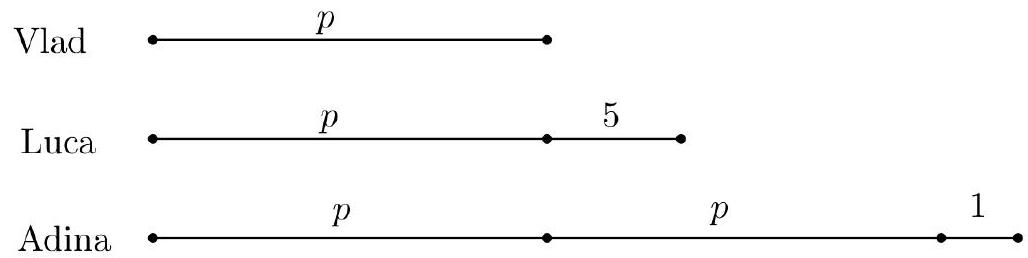
$p + p + 5 + 2p + 1 = 118$, from which $p = 28$, so... | 1 | Algebra | math-word-problem | Yes | Yes | olympiads | false |
# PROBLEM 1
a) Show that: $A=\sqrt{1+3+5+\ldots+2015} \in Q$
b) If the real numbers $a$ and $b$ satisfy the relation: $a^{2}+b^{2}-4 \sqrt{3} a-6 \sqrt{2} b+30=0$, then calculate:
$$
\mathrm{E}=\left(2 \mathrm{a}^{-1}+3 \mathrm{~b}^{-1}\right)\left(\frac{1}{b^{-1}}-\frac{1}{a^{-1}}\right)
$$ | ## Solution:
a) $1+3+5+\ldots+2015=(1+2+3+4+\ldots+2015)-(2+4+6+\ldots+2014)=$ $\qquad$
$=2015 \cdot 1008-1007 \cdot 1008=1008^{2}$
$A=\sqrt{1+3+5+\ldots+2015}=1008 \in Q \ldots \ldots . . . . . . .1$ point
b) $(a-2 \sqrt{3})^{2}+(b-3 \sqrt{2})^{2}=0 \quad$................ 1 point
$a-2 \sqrt{3}=0 \Rightarrow a=2 \sqr... | 1 | Algebra | math-word-problem | Yes | Yes | olympiads | false |
3. Consider the distinct complex numbers $z_{1}, z_{2}, z_{3}$, with equal modulus 1, such that $z_{1}+z_{2}+z_{3}=1$.
a) Show that $z_{1}, z_{2}, z_{3}$ are the affixes of the vertices of a right triangle.
b) Calculate $z_{1}^{2015}+z_{2}^{2015}+z_{3}^{2015}$.
Cătălin Ciupală | ## Solution.
a)
Method 1. Let $A(z_{1}), B(z_{2}), C(z_{3})$ be the geometric images of the complex numbers $z_{1}, z_{2}, z_{3}$. $\triangle A B C$ is inscribed in a circle of radius 1, centered at the origin. (1p)
Let $G$ be the centroid and $H$ the orthocenter of $\triangle A B C$. The affix of $G$ is $\frac{z_{1... | 1 | Algebra | proof | Yes | Yes | olympiads | false |
4. Determine the minimum value of the expression $E(a, b)=a+b+\frac{1}{a b}$, where $a, b>0$ and $a+b \leq 1$.
Romeo Ilie | ## Solution.
Method 1. $E\left(\frac{1}{2}, \frac{1}{2}\right)=5$. (1p)
$$
\begin{aligned}
& a+b+\frac{1}{a b}=(a+b)+\frac{1}{4 a b}+\frac{1}{4 a b}+\frac{1}{4 a b}+\frac{1}{4 a b}(\mathbf{2 p}) \\
& \geq 5 \cdot \sqrt[5]{\frac{a+b}{4^{4}(a b)^{4}}}(\mathbf{1} \mathbf{p}) \\
& \geq 5 \cdot \sqrt[5]{\frac{(a+b)^{8}}{4... | 5 | Algebra | math-word-problem | Yes | Yes | olympiads | false |
## SUBJECT II
Let $\left(x_{n}\right)_{n \geq 1}$ be a strictly increasing sequence of natural numbers with the property that:
$$
x_{x_{n}}=4 n+9, \forall n \in N^{*}
$$
a. Show that such a sequence exists.
b. Calculate $\lim _{n \rightarrow \infty} \frac{x_{n}}{n^{2}}$ | ## SUBJECT II
Let $\left(x_{n}\right)_{n \geq 1}$ be a strictly increasing sequence of natural numbers with the property that:
$$
x_{x_{n}}=4 n+9, \forall n \in N^{*}
$$
a. Show that such a sequence exists.
b. Calculate $\lim _{n \rightarrow \infty} \frac{x_{n}}{n^{2}}$
Proposed by Prof. Vlaicu Liviu (C.N.S.)
Grad... | 0 | Algebra | proof | Yes | Yes | olympiads | false |
## Subject 4
a) $\ln \frac{n+1}{x_{n+1}}=\frac{x_{n}}{n}+\ln \frac{n}{x_{n}}, \forall n \geq 2 \Rightarrow \ln \frac{n+1}{x_{n+1}}-\ln \frac{n}{x_{n}}=\frac{x_{n}}{n}>0, \forall n \geq 2 \Rightarrow \frac{n+1}{x_{n+1}}>\frac{n}{x_{n}} \forall n \geq 2$
Thus, $\left(\frac{x_{n}}{n}\right)_{n \geq 2}$ is a strictly dec... | ## Subject 4
Let $\left(x_{n}\right)_{n \geq 1}$ be a sequence of strictly positive real numbers defined by:
$$
x_{1}>0 \text { and } \frac{x_{1}}{1}+\frac{x_{2}}{2}+\cdots+\frac{x_{n}}{n}=\ln \frac{n+1}{x_{n+1}}, \forall n \geq 1
$$
a) Show that $\left(\frac{x_{n}}{n}\right)_{n \geq 1}$ is a convergent sequence and... | 1 | Algebra | proof | Yes | Yes | olympiads | false |
Subject 2. Solve in integers the equation: $2^{x+1}=x^{2}+x+1$.
Mathematical Gazette 1987 | Subject 2. $x \leq-2 \Rightarrow 2^{x+1} \leq \frac{1}{2}x^{2}+x+1$ (1p); verification $x=1 \mathbf{( 1 p}$ ); correct proof of the induction step (2p). | 1 | Number Theory | math-word-problem | Yes | Yes | olympiads | false |
## Subject III. (40 points)
a) Let $\left(x_{n}\right)_{n \geq 1}$ be a sequence of real numbers defined by the formula $x_{n}=\frac{\frac{1}{2015}+\frac{1}{2016}+\ldots+\frac{1}{n+2014}}{\ln (n+2015)}$.
Calculate $\lim _{n \rightarrow \infty} x_{n}$;
Prof. Raul Domsa, Liceul Teoretic „Petru Maior” Gherla
b) Consid... | ## Subject III. (40 points)
a) We use the Cesaro-Stolz criterion for \(a_{n}=\frac{1}{2015}+\frac{1}{2016}+\ldots+\frac{1}{n+2014}\) and \(b_{n}=\ln (n+2015), b_{n} \rightarrow \infty\), increasing.
\[
\lim _{n \rightarrow \infty} \frac{a_{n+1}-a_{n}}{b_{n+1}-b_{n}}=\lim _{n \rightarrow \infty} \frac{\frac{1}{n+2015}... | 1 | Calculus | math-word-problem | Yes | Yes | olympiads | false |
## Subject IV. (10 points)
Calculate the limit of the sequence $\left(x_{n}\right)_{n \geq 0}$ which satisfies the relation $x_{n+1}=\sqrt{x_{n}+45}-\sqrt{x_{n}+5}$, with $x_{0} \geq-5$.
Prof. Eugen Jecan, National College Andrei Mureşanu Dej
All problems are mandatory. 10 points are awarded by default.
SUCCESS!
E... | ## Subject IV. (10 points)
From the recurrence relation, it follows that $x_{n}>0$, for any $n \geq 1$.
We can write: $\left|x_{n+1}-4\right|=\left|\left(\sqrt{x_{n}+45}-7\right)-\left(\sqrt{x_{n}+5}-3\right)\right| \leq\left|\sqrt{x_{n}+45}-7\right|+\left|\sqrt{x_{n}+5}-3\right|=$
$=\frac{\left|x_{n}-4\right|}{\sqr... | 4 | Algebra | math-word-problem | Yes | Yes | olympiads | false |
Problem 4. A rectangular piece of paper $20 \times 19$, divided into unit squares, is cut into several square pieces, the cuts being made along the sides of the unit squares. A square piece of this kind is called an odd square if the length of its side is an odd number.
a) What is the minimum possible number of odd sq... | ## Solution and grading criteria:
a) If we denote by $k$ the number of square pieces obtained and by $x_{1}, x_{2}, \ldots, x_{k}$ their dimensions, then writing the area of the rectangle in two ways, we get $19 \cdot 20=x_{1}^{2}+x_{2}^{2}+\ldots+x_{k}^{2}$. Since $19 \cdot 20=380$ is divisible by 4, the square of an... | 4 | Combinatorics | math-word-problem | Yes | Yes | olympiads | false |
4. Consider $A B C D$ to be a rhombus with diagonals $A C=8 \text{ cm}, B D=6 \text{ cm}$. At point $N$, the midpoint of segment $A O, A C \cap B D=O$, the perpendicular $M N$ is raised to the plane of the rhombus, $M N=2 \sqrt{3} \text{ cm}$. Calculate:
(3p) a) The area of triangle $M B D$.
(4p) b) The distance from... | 4. ..... a) $\triangle M N A \ll N=90^{\circ} \Rightarrow M A=4 \mathrm{~cm}$
.(1p)
$\triangle M O A$ equilateral $\Rightarrow M O=4 \mathrm{~cm} \Rightarrow A_{\triangle M B D}=12 \mathrm{~cm}^{2}$ ..... (2p)
b) $M N \perp(A O D), N T \perp A D \Rightarrow M T \perp A D \Rightarrow d(M, A D)=M T$. ..... (1p)
$$
O R \... | 12 | Geometry | math-word-problem | Yes | Yes | olympiads | false |
Problem 2. Determine the integers $x, y$, for which
$$
5^{x}-\log _{2}(y+3)=3^{y} \text { and } 5^{y}-\log _{2}(x+3)=3^{x}
$$ | Solution. Subtracting the equalities, we obtain
$$
5^{x}+3^{x}+\log _{2}(x+3)=5^{y}+3^{y}+\log _{2}(y+3)
$$
Since the function $f(t)=5^{t}+3^{t}+\log _{2}(t+3)$ is strictly increasing, it follows that $x=y$.
For solving the equation in $Z$
$$
5^{x}=3^{x}+\log _{2}(x+3)
$$
it is observed that $x \in\{-2,-1,0\}$ do ... | 1 | Algebra | math-word-problem | Yes | Yes | olympiads | false |
1. For any two positive numbers $\mathrm{x}$ and y, consider the determinant:
$$
\Delta(x ; y)=\left|\begin{array}{lll}
x & y & y \\
y & x & y \\
y & y & x
\end{array}\right|
$$
a) Show that $\Delta(x ; y) \geq 0,(\forall) x, y \in[0, \infty)$.
b) Calculate $\lim _{x \rightarrow 1} \frac{\Delta(1 ; x)}{\sqrt{2 x^{3}... | ## Solution.
a) $\Delta(x, y)=(x+2 y)\left|\begin{array}{lll}1 & y & y \\ 1 & x & y \\ 1 & y & x\end{array}\right|$
$\Delta(x, y)=(x+2 y)(x-y)^{2}$
$\Delta(x, y) \geq 0, \forall x, y \in[0, \infty)$
b) $\Delta(1, x)=(1+2 x)(1-x)^{2}=2 x^{3}-3 x^{2}+1$
$\lim _{x \rightarrow 1} \frac{\Delta(1, x)}{\sqrt{2 x^{3}-3 x^{2}+... | 2 | Algebra | proof | Yes | Yes | olympiads | false |
2. (7p) Three children buy markers, notebooks, and pencils, each type of object being the same, and pay as follows:
- the first, for 12 markers, 8 notebooks, 8 pencils, 60 lei;
- the second, for 4 markers, 8 notebooks, 2 pencils, 30 lei;
- the third, for 8 markers, 4 notebooks, and 6 pencils, 38 lei.
Determine the pr... | 2. Comparative method: presenting the data in the form of the following scheme ................... (2p)
First child ....... 12 markers ...... 8 notebooks ...... 8 pencils ...... 60 lei
Second child ..... 4 markers ...... 8 notebooks ...... 2 pencils ...... 30 lei
Third child ..... 8 markers ...... 4 notebooks ......... | 1 | Algebra | math-word-problem | Yes | Yes | olympiads | false |
4. If $z_{1}, z_{2}, z_{3} \in \mathbb{C}$ such that $\left|z_{1}\right|=\left|z_{2}\right|=\left|z_{3}\right|=1, z_{1}^{2}+z_{2}^{2}+z_{3}^{2}=0$ and $z_{1}+z_{2}+z_{3} \neq 0$, calculate $\left|z_{1} z_{2}+z_{2} z_{3}+z_{3} z_{1}\right|$. R.M.T. $4 / 2015$ | Solution. $\left(z_{1}+z_{2}+z_{3}\right)^{2}=z_{1}^{2}+z_{2}^{2}+z_{3}^{2}+2 z_{1} z_{2}+2 z_{2} z_{3}+2 z_{1} z_{3}=2 z_{1} z_{2}+2 z_{2} z_{3}+2 z_{1} z_{3} \Rightarrow$
$$
\begin{aligned}
& \Rightarrow\left|z_{1}+z_{2}+z_{3}\right|^{2}=2\left|z_{1} z_{2}+z_{2} z_{3}+z_{1} z_{3}\right|
\end{aligned}
$$
 (3p) Show that for any real numbers $a, b$ with $a+b \geq 0$, the inequality $4\left(a^{3}+b^{3}\right) \geq(a+b)^{3}$ holds. b) (4p) The positive real numbers $x, y$ satisfy the relation $x+y=3 \sqrt[3]{x+1}+3 \sqrt[3]{y+3}$. Determine the maximum value of the sum $x+y$.
Ion Bursuc, Suceava | Solution. a) The inequality is equivalent to:
$4 a^{3}+4 b^{3} \geq a^{3}+b^{3}+3 a b(a+b) \Leftrightarrow a^{3}+b^{3} \geq a b(a+b) \Leftrightarrow(a+b)(a-b)^{2} \geq 0$, true.
b) If we denote $\sqrt[3]{x+1}=a$ and $\sqrt[3]{y+3}=b \Rightarrow x=a^{3}-1$ and $y=b^{3}-3$. The equality from the statement becomes:
$a^... | 12 | Inequalities | proof | Yes | Yes | olympiads | false |
2. Solve in $\mathrm{N}$ the equation $\left[\sqrt{n^{2}+4 n+9}\right]=3 n-4$, where $[x]$ represents the integer part of $x$.
B.M. | Solution: We have $\sqrt{(n+2)^{2}}0, \quad$ so $\quad\left[\sqrt{n^{2}+4 n+9}\right]=n+2 \quad$ for $\quad n>0$. $(4 p)$
The equation becomes $n+2=3n-4$, with the solution $n=3$.
For $n=0$ it does not verify. | 3 | Number Theory | math-word-problem | Yes | Yes | olympiads | false |
2. Consider the sequence of real numbers $\left(u_{n}\right)_{n \geq 0}$ defined by $u_{0}=\frac{11}{4}$ and $u_{n+1}=\frac{5}{2}+\sqrt{u_{n}-\frac{7}{4}}$. Show that the sequence is convergent and calculate its limit.
Gazeta Matematică | Subject 2.
| Details of Solution | Associated Scoring |
| :---: | :---: |
|  | 2p |
| Bounding: Assume $\left(u_{n}\right)_{n \geq 0}$ is bounded above by 4 ..................................... | 4 | Algebra | proof | Yes | Yes | olympiads | false |
Problem 2.
Let $A \in \mathrm{M}_{2}(\mathbb{C})$ such that $\operatorname{det}(A)=1$. Show that: $\operatorname{det}\left(A^{2}+A-I_{2}\right)+\operatorname{det}\left(A^{2}+I_{2}\right)=5$. | ## Problem 2.
Let $A \in M_{2}(\mathbb{C})$ such that $\operatorname{det} \mathbf{A}=\mathbf{1}$. Show that: $\operatorname{det}\left(A^{2}+A-I_{2}\right)+\operatorname{det}\left(A^{2}+I_{2}\right)=5$.
## Solution
If $\alpha, \beta$ are the eigenvalues of the matrix $\mathbf{A}$, then $\alpha \beta=1$
$\operatornam... | 5 | Algebra | proof | Yes | Yes | olympiads | false |
## PROBLEM 3
a) Show that $\frac{\overline{x x 9}+\overline{8 x}+7}{\overline{x 9 x}+\overline{x 6}} \in N$, where $x$ is a digit in base 10.
b) Calculate $2014-(2013 \cdot 2012+2013): 2013^{2}$. | Solution:
a)
Calculate the numerator and obtain $100 x+10 x+9+8 \cdot 10+x+7=111 x+96 \ldots . . . . .1$ point
Calculate the denominator and obtain $100 x+9 \cdot 10+x+10 x+6=111 x+96$ 1 point
 \frac{\pi}{2}, \forall k \in Z$.
(4p) a) Prove that for any natural number $n \geq 3$, the recurrence relation
$$
4 I_{n}+I_{n-2}=\frac{2}{n} \sin ^{n} a \sin n a+\frac{1}{n-1} \sin ^{n-1} a \cos (n-1) a
$$
hold... | 4. a) Consider the sequence $J_{n}=\int_{0}^{a} \sin ^{n} x \sin n x d x, \quad n \in N^{*}$.
By parts we obtain $I_{n}=\frac{1}{n} \sin ^{n} a \sin n a-\int_{0}^{a} \sin ^{n-1} x \cos x \sin n x d x$ (1) $\qquad$
Adding $I_{n}$ to (1) again we obtain $2 I_{n}=\frac{1}{n} \sin ^{n} a \sin n a-J_{n-1}$ (2).
Similarly,... | 0 | Calculus | proof | Yes | Yes | olympiads | false |
## SUBJECT III
Let $m$ be a non-zero natural number. Consider the sets:
$A=\left\{x \in N / x=2^{n}-1, n \in N^{*}, n \leq m\right\}$ and $B=\left\{y \in N / y=2^{n-1}, n \in N^{*}, n \leq m\right\}$.
a) Explain why the set $A \cap B$ cannot have more than one element.
b) Determine the number $m$ knowing that the s... | ## SUBJECT III
$\mathrm{A}=\{1,3,7,15,31,63\}$ and $B=\{1,2,4,8,16,32\}$
a) except for 1, B contains only even numbers, while A contains only odd numbers. The only common element can be 1. $1 \mathrm{p}$ Note: If the student does not fully explain but only writes that for $\mathrm{m}=1 \Rightarrow \mathrm{n}=1 \Right... | 2 | Number Theory | math-word-problem | Yes | Yes | olympiads | false |
1. a) Perform: $[0,(6)+3,(63)+0,2(37)]:\left(\frac{2}{3}+\frac{40}{11}+\frac{47}{198}\right)$.
b) Determine the value of the natural number $a$ knowing that the number $B=\frac{2}{a}+\frac{1}{3}$ is a natural number. | 1. a) $\left(\frac{2}{3}+3 \frac{7}{11}+\frac{235}{990}\right):\left(\frac{2}{3}+\frac{40}{11}+\frac{47}{198}\right)=\left(\frac{2}{3}+\frac{40}{11}+\frac{47}{198}\right):\left(\frac{2}{3}+\frac{40}{11}+\frac{47}{198}\right)=1$
$3 p$
b) We have $B=\frac{a+6}{3 a}$, so $3a$ divides $a+6$.
We obtain $a=3$
$2 p$ | 3 | Algebra | math-word-problem | Yes | Yes | olympiads | false |
4. At a point $R$ on a line, there is a robot that moves along this line to the left or right as it wishes. It is programmed to take 2 steps on the first move, 4 steps on the second move, 6 steps on the third move, and in general, $2n$ steps on the $n$-th move.
a) Describe a variant of the robot's movement such that i... | 4. a) If $S$ represents a move to the left and $D$ to the right, then one variant would be S-D-D-S
$2 p$
b) The minimum number of moves is 3, for example S-S-D
$2 p$
c) The idea is that 4 consecutive moves in the pattern S-D-D-S leave the robot in the same place. 173 gives a remainder of 3 when divided by 4, so the... | 3 | Logic and Puzzles | math-word-problem | Yes | Yes | olympiads | false |
Subject (4). Solve the equation $2^{x}+1=\left(3^{x}-1\right)^{\log _{2} 3}$.
EUGEN RADU[^2] | Solution. The domain $x \geq 0$ is forced by the fact that the exponent $\log _{2} 3$ is irrational, so the power of this exponent is not (well) defined for negative bases. Since $x=0$ is not a solution, the equation immediately transforms into the equivalent form $\log _{3}\left(2^{x}+1\right)=\log _{2}\left(3^{x}-1\r... | 1 | Algebra | math-word-problem | Yes | Yes | olympiads | false |
## SUBJECT I
a) Verify if the number
$$
a=2^{20}\left\{11^{2}: 121+3\left[\left(3^{5} \cdot 2^{3}\right)^{10}:\left(6^{30} \cdot 3^{19}\right)-2014^{0}\right]\right\}-7
$$
is divisible by 7 and 5.
b) Find the remainder of the division of the number $b=1 \cdot 2 \cdot 3 \cdot \ldots \cdot 2013+2015$ by 2014. | ## SUBJECT I
| I a) $\left(3^{5} \cdot 2^{3}\right)^{10}=3^{50} \cdot 2^{30}$ | $\mathbf{0 . 5 p}$ |
| :---: | :---: |
| $6^{30} \cdot 3^{19}=3^{49} \cdot 2^{30}$ | $\mathbf{1 p}$ |
| $\left(3^{50} \cdot 2^{30}\right):\left(3^{49} \cdot 2^{30}\right)=3$ | $\mathbf{0 . 5 p}$ |
| $2^{20}\left[11^{2}: 121+3 \cdot(3-1)\ri... | 5 | Number Theory | math-word-problem | Yes | Yes | olympiads | false |
Problem 1. Find $x$ for which
$$
\log _{2}\left(x^{2}+4\right)-\log _{2} x+x^{2}-4 x+2=0
$$ | Solution. We have $x>0$ and the equation can be equivalently written as
$$
\log _{2}\left(x+\frac{4}{x}\right)=2-(x-2)^{2}
$$
Since $x+\frac{4}{x} \geq 2 \sqrt{x \cdot \frac{4}{x}}=4$, we obtain $\log _{2}\left(x+\frac{4}{x}\right) \geq 2 \ldots \ldots \ldots \ldots \ldots \ldots$. 2 p
^{2015}$. | ## Solution. 1p by default
| The given fractions are equivalent if $\frac{7 x-5 y-3}{3 x+9 y-15}=\frac{1}{5}$ | $\mathbf{1 p}$ |
| :--- | :--- |
| $5(7 x-5 y-3)=3 x+9 y-15$ | $\mathbf{1 p}$ |
| $35 x-25 y-15=3 x+9 y-15$ | $\mathbf{1 p}$ |
| $35 x-25 y=3 x+9 y$ | $\mathbf{1 p}$ |
| $32 x=34 y \Leftrightarrow 16 x=17 y$... | 0 | Algebra | math-word-problem | Yes | Yes | olympiads | false |
Problem 1. Consider the numbers:
$$
x=1^{2}+3^{2}+5^{2}+\cdots+2015^{2} \text { and } y=2^{2}+4^{2}+6^{2}+\cdots+2016^{2}
$$
Using, if necessary, the relation $a^{2}-b^{2}=(a+b)(a-b)$, calculate the number: $A=(y-x)[y+x-(1 \cdot 2+2 \cdot 3+3 \cdot 4+\cdots+2015 \cdot 2016)]$ | ## Solution:


 $\lim _{n \rightarrow \infty}\left(\sqrt[3]{n^{3}+9 n^{2}+1}+\sqrt[3]{n^{3}-9 n^{2}+1}-2 n\right)$
b) $\lim _{n \rightarrow \infty} n \cdot\left(\sqrt[3]{n^{3}+9 n^{2}+1}+\sqrt[3]{n^{3}-9 n^{2}+1}-2 n\right)$
| ## SUBIECTUL II
a) $\lim _{n \rightarrow \infty}\left(\left(\sqrt[3]{n^{3}+9 n^{2}+1}-n\right)+\left(\sqrt[3]{n^{3}-9 n^{2}+1}-n\right)\right)(\mathbf{0 , 5 p})$
$\left.\lim _{n \rightarrow \infty}\left(\sqrt[3]{n^{3}+9 n^{2}+1}-n\right)=3 \mathbf{( 0 , 5 p}\right)$
$\lim _{n \rightarrow \infty}\left(\sqrt[3]{n^{3}-... | 0 | Calculus | math-word-problem | Yes | Yes | olympiads | false |
3. Let $\mathcal{P}$ be the set of real matrices of order 3, which have exactly one element equal to 1 on each row and each column, and the others are equal to 0.
a) Show that $\mathcal{P}$ is a non-commutative group with respect to matrix multiplication.
b) Calculate $S=\sum_{A \in \mathcal{P}}(\operatorname{det}(A)... | ## Solution.
a) Let $(S_{3}, \circ)$ be the group of permutations of order 3 and the function $f: S_{3} \rightarrow \mathcal{P}, f(\sigma)=A_{\sigma}$, where the matrix $A_{\sigma}=\left(a_{i j}^{(\sigma)}\right)_{i, j=\overline{1,3}}$ is defined by $a_{i j}^{(\sigma)}=\left\{\begin{array}{l}1, j=\sigma(i) \\ 0, j \ne... | 6 | Combinatorics | proof | Yes | Yes | olympiads | false |
3. Let the sequence $\left(x_{n}\right)_{n \in \mathbb{N}^{*}}$ be defined such that $x_{1}=1$ and $x_{n+1}=x_{n}+n$, for any $n \in \mathbb{N}^{*}$. Calculate $\lim _{n \rightarrow \infty} \sum_{k=2}^{n} \frac{1}{x_{k}-1}$. | 3. $x_{n}=1+\frac{n(n-1)}{2}$ ..... $.3 p$
$\sum_{k=2}^{n} \frac{1}{x_{k}-1}=2\left(1-\frac{1}{n}\right)$ ..... $.3 p$
$\lim _{n \rightarrow \infty} \sum_{k=2}^{n} \frac{1}{x_{k}-1}=2$ ..... $1 p$ | 2 | Algebra | math-word-problem | Yes | Yes | olympiads | false |
1. a) (3p) Factorize the number $4 n^{4}+1, n \in \mathbb{N}^{*}$.
b) (4p) Determine the integer part of the number $A=\frac{4}{5}+\frac{8}{65}+\frac{12}{325}+\ldots+\frac{4 n}{4 n^{4}+1}, n \in \mathbb{N}^{*}$.
Gazeta Matematică Nr. 10/2014 | Solution: a) $4 n^{4}+1=4 n^{4}+4 n^{2}+1-4 n^{2}=\left(2 n^{2}+1\right)^{2}-4 n^{2}=\left(2 n^{2}+1-2 n\right)\left(2 n^{2}+1+2 n\right)=\left(2 n^{2}-2 n+1\right)\left(2 n^{2}+2 n+1\right)$ b) Applying point a) we generally have: $\frac{4 k}{4 k^{4}+1}=\frac{4 k}{\left(2 k^{2}-2 k+1\right)\left(2 k^{2}+2 k+1\right)}=... | 0 | Algebra | math-word-problem | Yes | Yes | olympiads | false |
## Subject 2.
a) Determine the natural numbers $a$ that have the property that $|a-\sqrt{2}|+|a-2 \sqrt{2}|+a-3 \sqrt{2} \mid \in \mathbb{Q}$;
b) Prove that the number $N=|a-\sqrt{2}|+|a-2 \sqrt{2}|+|a-3 \sqrt{2}|+\ldots+|a-2013 \sqrt{2}|$ is irrational for any rational number $a$.
Prof. Traian Preda, Bucharest
| D... | 2. a) Determine the natural numbers $a$ that have the property that $|a-\sqrt{2}|+|a-2 \sqrt{2}|+|a-3 \sqrt{2}| \in \mathbb{Q}$;
b) Prove that the number $N=|a-\sqrt{2}|+|a-2 \sqrt{2}|+|a-3 \sqrt{2}|+\ldots+|a-2013 \sqrt{2}|$ is irrational for any rational number $a$. | 3 | Number Theory | proof | Yes | Yes | olympiads | false |
4. Study the convergence of the sequence $\left(x_{n}\right)_{n \geq 1}$, defined by $x_{1}=\sqrt{6}$, and for $n \geq 1$
$$
x_{n+1}=\sqrt{6+x_{n}}
$$ | Solution. It is shown inductively that the sequence is increasing $2 \mathrm{p}$

$
Since $a<b<c<d$ and 2, 19, 53 are prime numbers, we have $\mathrm{a}=1 ; \mathrm{b}=2 ; \mathrm{c}=19 ; \mathrm{d}=53$ and $n=1^{2014}+$ $2^{2014}+19^{2014}+53^{2014}(1 p)$
$$
U\left(1^{2014}\right)=1, U\left(2^{2014}\right)=4, U\left(19^{2014}\right)=1 \te... | 5 | Number Theory | math-word-problem | Yes | Yes | olympiads | false |
1. Find all prime numbers that are 4 less than a perfect square.
( Mathematics Manual for 8th Grade, Dana Radu and Eugen Radu, Teora Publishing ) | Subject 1.
| Solution Details | Associated Scoring |
| :---: | :---: |
|  | 2p |
| $, then $a \equiv 2(\bmod 4)$, so $a$ is not a perfect square. It is easily observed that $p=7$ is not a solution (by calculating $a$, the ... | 3 | Number Theory | math-word-problem | Yes | Yes | olympiads | false |
## PROBLEM 4
Let the points $A_{0}, A_{1}, A_{2}, \ldots, A_{n}$ be situated in this order on a line d such that $\mathrm{A}_{0} \mathrm{~A}_{1}=1 \mathrm{~cm}, \mathrm{~A}_{1} \mathrm{~A}_{2}=2 \mathrm{~cm}$, $\mathrm{A}_{2} \mathrm{~A}_{3}=2^{2} \mathrm{~cm}, \ldots, \mathrm{A}_{\mathrm{n}-1} \mathrm{~A}_{\mathrm{n}... | ## Solution:
a) $\mathrm{A}_{0} \mathrm{~A}_{\mathrm{p}}=\mathrm{A}_{0} \mathrm{~A}_{1}+\mathrm{A}_{1} \mathrm{~A}_{2}+\ldots+\mathrm{A}_{\mathrm{p}-1} \mathrm{~A}_{\mathrm{p}} \Rightarrow \mathrm{A}_{0} \mathrm{~A}_{\mathrm{p}}=1+2+2^{2}+\ldots+2^{\mathrm{p}-1}=2^{\mathrm{p}}-1$
$1 \mathrm{p}$
$2^{\mathrm{p}}-1=2047... | 11 | Number Theory | math-word-problem | Yes | Yes | olympiads | false |
# Subject I.
For any natural number $\mathrm{n}$, find the remainder of the division of the number $\mathrm{A}=5^{\mathrm{n}+4} \cdot 3^{\mathrm{n}+1}+5^{\mathrm{n}+1} \cdot 3^{\mathrm{n}+3}+3 \cdot 15^{\mathrm{n}}$ by 2013. | ## SUBJECT I
For any natural number $\mathrm{n}$, find the remainder of the division of the number $\mathrm{A}=5^{\mathrm{n}+4} \cdot 3^{\mathrm{n}+1}+5^{\mathrm{n}+1} \cdot 3^{\mathrm{n}+3}+3 \cdot 15^{\mathrm{n}}$ by 2013.
## Solution
$$
\mathrm{A}=5^{\mathrm{n}} \cdot 5^{4} \cdot 3^{\mathrm{n}} \cdot 3^{1}+5^{\ma... | 0 | Number Theory | math-word-problem | Yes | Yes | olympiads | false |
Problem 2. Solve, in the set of integers, the equation:
$$
2 x^{2}+2 y^{2}-3 x-3 y+2=0
$$
Constantin Apostol, Gazeta Matematică nr. 9/2014 | ## Solution and marking scheme
Multiplying by 2, the equality from the statement is equivalently written as $(x-3)^{2}+(y-3)^{2}+3 x^{2}+3 y^{2}=14$
Then $3 x^{2} \leq 14$, from which $|x| \leq 2$, that is $x \in\{-2,-1,0,1,2\}$
By verifying each case separately, a single solution is obtained, namely $x=y=1$ | 1 | Algebra | math-word-problem | Yes | Yes | olympiads | false |
3. Let $ABC$ be an equilateral triangle inscribed in a circle of radius 1, and let $M$ be any point on the circle. Prove that $M A^{2}+M B^{2}+M C^{2}=6$.
www.viitoriolimpici.ro | 3. Consider a reference frame with the origin at the center $O$ of the circumcircle of the triangle and denote by $m, a, b, c$ the affixes of points $M, A, B$ and $C$ respectively. Clearly, $|m|=|a|=|b|=|c|=1$ and, since triangle $ABC$ is equilateral, $a+b+c=0$. Then:
$$
\begin{gathered}
M A^{2}+M B^{2}+M C^{2}=\sum|m... | 6 | Geometry | proof | Yes | Yes | olympiads | false |
1. Given the numbers $a=\sqrt{1+3+5+7+9+11}-\sqrt{1+3+5+7+9}, b=\sqrt{1+3+5+\ldots+4029}$ and $c=\sqrt{1+3+5+\ldots+4027}$. Calculate:
a) $a^{2015}$
b) $(b-c)^{2015}$
c) $(b+c)^{a-1}$ | ## Solution:
a) $1+3+5+7+9+11=1+2+3+4+\ldots+11-(2+4+\ldots+10)=\frac{11 \cdot 12}{2}-2 \cdot \frac{5 \cdot 6}{2}=6^{2}, \ldots \ldots \ldots \ldots .1 \text{p}$ $1+3+5+7+9=1+2+3+4+\ldots+9-(2+4+\ldots+8)=5^{2}, a=\sqrt{6^{2}}-\sqrt{5^{2}}=6-5=1 \ldots \ldots \ldots \ldots . .1 \text{p}$
 Consider the positive real numbers $a, b, c, d$, such that $a b c d=1$. Calculate
$$
E=\frac{7+a}{1+a+a b+a b c}+\frac{7+b}{1+b+b c+b c d}+\frac{7+c}{1+c+c d+c d a}+\frac{7+d}{1+d+d a+d a b}
$$
GM11/2015 | 2. By amplifying the second ratio by $a$, the third by $a b$, and the fourth by $a b c$, we obtain:
$E=\frac{7+a}{1+a+a b+a b c}+\frac{(7+b) a}{a+a b+a b c+1}+\frac{(7+c) a b}{a b+a b c+1+a}+\frac{(7+d) a b c}{a b c+1+a+a b}$ $\qquad$
(4p)
$E=8$
(3p) | 8 | Algebra | math-word-problem | Yes | Yes | olympiads | false |
4. Consider the function
$$
f:[0, \infty) \rightarrow \mathbb{R}, f(x)=\int_{0}^{x} \frac{e^{t}}{t+1} d t
$$
a) Show that:
$$
\lim _{x \rightarrow \infty} f(x)=\infty
$$
b) Calculate
$$
\lim _{x \rightarrow \infty} \frac{x f(x)}{e^{x}}
$$
Note: All subjects are mandatory. Working time 3 hours.
Each subject is sc... | 4. a) Using the inequality $e^{t} \geq t+1, t \in \mathbb{R}, \int_{0}^{x} \frac{e^{t}}{t+1} d t \geq \int_{0}^{x} 1 d t=x$, thus $f(x) \geq x, \forall x \in[0, \infty)$
Since
$$
\lim _{x \rightarrow \infty} x=\infty \Rightarrow \lim _{x \rightarrow \infty} f(x)=\infty
$$
$.1 p$
b)
$$
\begin{aligned}
& \lim _{x \ri... | 1 | Calculus | proof | Yes | Yes | olympiads | false |
## PROBLEM 1
Solve in $R$ the equation:
$$
54^{x}+27^{x}+9^{x}+3^{x}=2^{x}
$$ | ## Solution:
Divide the equation by $2^{\mathrm{x}}$ and we get $27^{x}+\left(\frac{27}{2}\right)^{x}+\left(\frac{9}{2}\right)^{x}+\left(\frac{3}{2}\right)^{x}=1$.
Let the function $f(x)=27^{x}+\left(\frac{27}{2}\right)^{x}+\left(\frac{9}{2}\right)^{x}+\left(\frac{3}{2}\right)^{x}-1$. $3 p$
The function is increasin... | -1 | Algebra | math-word-problem | Yes | Yes | olympiads | false |
## PROBLEM 2
Solve the equation
$$
\log _{4}\left(5^{x}-1\right)=\log _{5}\left(4^{x}+1\right)
$$ | Solution: Condition: $5^{x}-1>0 \Rightarrow x \in(0, \infty)$
Let $\quad \log _{4}\left(5^{x}-1\right)=t \Rightarrow 5^{x}-1=4^{t}$.
$\log _{5}\left(4^{x}+1\right)=t \Rightarrow 4^{x}+1=5^{t}$.
Adding the two relations above results in $4^{x}+5^{x}=4^{t}+5^{t}$ $1 p$
Since the function $f: \square \rightarrow(0, \i... | 1 | Algebra | math-word-problem | Yes | Yes | olympiads | false |
## SUBJECT III
Let the arithmetic progression a1, a2, ..., an, ... with the ratio and the first term strictly positive.
a) Calculate the limit of the sequence (an).
b) Calculate:
$$
\lim _{n \rightarrow \infty} \frac{1}{a_{n}}\left(\frac{a_{1}}{\sqrt{a_{1}}}+\frac{a_{2}}{\sqrt{a_{1}}+\sqrt{a_{2}}}+\cdots+\frac{a_{n... | ## SUBJECT 3 -7p
$\qquad$
5p b) We use Cesaro-Stolz and the desired limit is equal to $L=\lim \left(\frac{a_{n+1}}{\sqrt{a_{1}}+\sqrt{a_{2}}+\cdots \cdot \sqrt{a_{n+1}}}\right) /\left(a_{n+1}-a... | 0 | Algebra | math-word-problem | Yes | Yes | olympiads | false |
Subject 2. Let A be a second-order matrix with real elements and $A^{t}$ the transpose matrix.
Knowing that $\operatorname{det}\left(A+A^{t}\right)=8$ and $\operatorname{det}\left(A+2 A^{t}\right)=27$. Calculate $\operatorname{det} A$.
GM 11/2014 | Solution: $A=\left(\begin{array}{ll}a & b \\ c & d\end{array}\right) \Rightarrow \operatorname{det}\left(A+A^{t}\right)=\left|\begin{array}{cc}2 a & b+c \\ b+c & 2 d\end{array}\right|=4 a d-(b+c)^{2}=4 a d-b^{2}-$ $2 b c-c^{2}=8$ $3 p$
$\operatorname{det}\left(A+2 A^{t}\right)=\left|\begin{array}{cc}3 a & b+2 c \\ 2 b... | 11 | Algebra | math-word-problem | Yes | Yes | olympiads | false |
## Problem 1.
On the set $G=(0, \infty)$, we define the composition law:
$x \circ y=2 \sqrt[n]{\left(\log _{2} x\right)^{n}+\left(\log _{2} y\right)^{n}-2^{n}}, \forall x, y \in G$, where $n \geq 3$ is an odd natural number.
a) Show that $(G, \circ)$ is an abelian group.
b) Show that the function $f:(0, \infty) \ri... | ## Solution and Scoring:
a) Associativity, $(x \circ y) \circ z=2 \sqrt[n]{\left(\log _{2} x\right)^{n}+\left(\log _{2} y\right)^{n}+\left(\log _{2} z\right)^{n}-2 \cdot 2^{n}}$ ..... $1 p$
Neutral element $e=4 \in G$ ..... $1 p$
Inverse of the element $x \in G, x^{\prime}=2 \sqrt[n]{2 \cdot 2^{n}-\left(\log _{2} x\ri... | 4 | Algebra | proof | Yes | Yes | olympiads | false |
Problem 1. Calculate: $\left(37^{2016}: 1369^{1008}\right):\left(2^{2016}-2^{2015}-\ldots-2^{2}-2-1\right)$ | ## Solution and Scoring

Perform the calculation: $\left(37^{2016}:\left(37^{2}\right)^{1008}\right):\left(2^{2016}-2^{2015}-\ldots-2^{2}-2-1\right)=\ldots \ldots .1 p$
$$
\begin{aligned}
& \... | 1 | Algebra | math-word-problem | Yes | Yes | olympiads | false |
3. (7p) Consider the sequence $\left(x_{n}\right)_{n \in N}$ with $x_{0} \geq 0, a \in(0,1)$ and $x_{n+1}=a x_{n} e^{-x_{n}}, n \in N$. Calculate
$$
\lim _{n \rightarrow \infty} x_{n} \ln \left(1+n^{3}\right)
$$
GM10/2015 | 3. We denote $\lim _{n \rightarrow \infty} x_{n} \ln \left(1+n^{3}\right)=l$ (if the limit exists)
If $x_{0}=0$, then $x_{n}=0, \forall n \in N$, so $l=0$
Let $x_{0}>0$; then (by induction) $x_{n}>0, \forall n \in N$
We have $\frac{x_{n+1}}{x_{n}}=a \cdot e^{-x_{n}}<a, \forall n \in N$, hence $x_{n} \leq a^{n} x_{0}... | 0 | Calculus | math-word-problem | Yes | Yes | olympiads | false |
2. In a math competition, out of 40 students, 25 solved the first problem, 30 solved the second problem, 35 solved the third problem, and 33 solved the fourth problem. Show that at least 3 students solved all 4 problems. | 2. $25+30+35+33=123$ solutions
If out of the 40 students, each had solved at most three problems, we would have at most 120 solutions.
$123-120=3$ students must have solved all the problems (pigeonhole principle).
Finalization | 3 | Combinatorics | proof | Yes | Yes | olympiads | false |
4. In a football match, the winning team receives 3 points, and the losing team receives 0 points. If the match ends in a draw, each team receives 1 point. With these scoring rules, a tournament is organized in which four teams participate, each team playing two matches with each of the other three. At the end, a ranki... | 4. a) Each team plays 6 matches, so in total there are (6*4):2=12 matches. 2p
b) The total points per match are 3 points when a team wins and 2 points for a draw.
$2 p$
A point is lost from the maximum possible in a draw.
$1 p$
The maximum score is 36, so 2 points were lost, meaning there were 2 draws.
## NOTE
-... | 2 | Combinatorics | math-word-problem | Yes | Yes | olympiads | false |
## SUBJECT 3
Let the number $\mathrm{n}=9+99+999+\ldots+\underbrace{99 \ldots 9}_{\text {2016 digits }}+2016$.
a) Show that the number n is divisible by 90.
b) Find the quotient and remainder of the division of $\mathrm{n}$ by 11111. | ## SUBJECT 3
$$
\begin{aligned}
& \text { a) } n=10-1+100-1+1000-1+\cdots+1 \underbrace{00 \ldots 0}-1+2016 \ldots \ldots \ldots 1 p \\
& 2016 \text { zeros } \\
& =10+100+1000+\cdots+\underbrace{100 \ldots 0}_{2016 \text { zeros }}-\underbrace{(1+1+1+\cdots 1)}_{2016 \text { digits } 1}+2016=
\end{aligned}
$$
^{10 \cdot 2016+2}$.
Andrei Caţaron | ## Solution.
The terms of the sum $A$ are of the form $(10 n+2)^{10 n+2}$, with $n \in\{1,2,3, \cdots, 2016\}$. (1p)
We denote by $u(a)$ the last digit of a natural number $a$ represented in base 10.
For $a, m \in \mathbb{N}^{*}$, such that $u(a)=2$, we have
$$
u\left(a^{m}\right)=u\left(2^{m}\right)=\left\{\begin{... | 0 | Number Theory | math-word-problem | Yes | Yes | olympiads | false |
Problem 3. Consider the prime numbers $p<q<r$ and the non-zero natural number $a<p$. The number $n$ is the smallest non-zero natural number which, when divided by $p, q$, and $r$, gives a remainder that is $a$ less than the divisor each time.
a) Determine, in terms of $p, q, r$, and $a$, the number $n$.
b) If $n=1000... | Solution: a) From the statement $n=p c_{1}+p-a$ or $n+a=p\left(c_{1}+1\right)$, from which we deduce that $p \mid n+a$.
Similarly, we deduce $q \mid n+a$ and $r \mid n+a \ldots \ldots \ldots \ldots \ldots \ldots \ldots \ldots \ldots \ldots \ldots \ldots \ldots \ldots \ldots \ldots$
Since $p, q, r$ are different prime... | 1 | Number Theory | math-word-problem | Yes | Yes | olympiads | false |
Problem 1. a) Show that the number
$$
a=\sqrt{9-\sqrt{77}} \cdot \sqrt{2} \cdot(\sqrt{11}-\sqrt{7}) \cdot(9+\sqrt{77})
$$
is a natural number.
b) Consider the real numbers $x$ and $y$ such that $xy=6$. If $x>2$ and $y>2$, show that $x+y<5$.
Mathematical Gazette | Problem 1. a) Show that the number $a=\sqrt{9-\sqrt{77}} \cdot \sqrt{2} \cdot(\sqrt{11}-\sqrt{7}) \cdot(9+\sqrt{77})$ is a natural number.
b) Consider the real numbers $x$ and $y$ such that $x y=6$. If $x>2$ and $y>2$, show that $x+y<5$.
Gazeta Matematică
## Solution
 Show that if there exist two natural numbers $p$ and $q$ such that $\sqrt{2 p - q}$ and $\sqrt{2 p + q}$ are natural numbers, then $q$ is even.
b) Determine how many natural numbers $p$ have the property that $\sqrt{2 p - 4030}$ and $\sqrt{2 p + 4030}$ are simultaneously natural numbers. | Problem 2. a) Show that if there exist two natural numbers $p$ and $q$ such that $\sqrt{2 p-q}$ and $\sqrt{2 p+q}$ are natural numbers, then $q$ is even.
b) Determine how many natural numbers $p$ have the property that $\sqrt{2 p-4030}$ and $\sqrt{2 p+4030}$ are simultaneously natural numbers.
## Solution
a) From th... | 4 | Number Theory | proof | Yes | Yes | olympiads | false |
## SUBJECT 4 (7p)
Consider a cube ABCDA'B'C'D', with side length $4 \mathrm{~cm}$, and $P$ a point inside the cube.
a) Prove that the sum of the distances from $P$ to the faces of the cube is constant.
b) Prove that the sum of the distances from $P$ to the vertices of the cube is greater than or equal to $16 \sqrt{3... | ## Solution:
a) The distances to 2 opposite faces are $\mathrm{x}$ and 4 - x, so the sum is $3 \cdot 4=12$
b) The sum of the distances to 2 diagonally opposite vertices is greater than the length of the diagonal (1p)
We have 4 pairs of vertices, so the sum is $4 \cdot 4 \sqrt{3}=16 \sqrt{3}$.
c) For simplicity, poi... | 12 | Geometry | proof | Yes | Yes | olympiads | false |
## Subject III. (20 points)
Seven is one of the numbers considered magical throughout human history: there are 7 wonders of the ancient world, 7 wonders of the Middle Ages, 7 continents, 7 seas, the rainbow has 7 colors, 7 days of the week named after the 7 Roman gods who in turn were named after the 7 planets that co... | Subject III.
$$
\begin{aligned}
& a=1+6 \cdot\left(1+7+7^{2}+\ldots+7^{776}\right)=7^{777} \\
& u\left(7^{777}\right)=7
\end{aligned}
$$
(5 points) | 7 | Number Theory | math-word-problem | Yes | Yes | olympiads | false |
## Problem 2:
a) Study whether there exists a non-monotonic sequence $\left(x_{n}\right)_{n \geqslant 1}$ such that $\lim _{n \rightarrow \infty} x_{n}=\infty$.
b) Consider the sequence $\left(x_{n}\right)_{n \geq 1}$ for which $x_{n}^{2}-2 n x_{n}+n^{2}-1 \leq 0, \forall n \geq 1$. Calculate $\lim _{n \rightarrow \i... | Problem 2:
From $\left(x_{n}-n\right)^{2} \leq 1$ we deduce $n-1 \leq x_{n} \leq n+1$. 3pts
Apply the squeeze theorem and obtain $\lim _{n \rightarrow \infty} \frac{x_{n}}{n}=1$. 4pts | 1 | Algebra | math-word-problem | Yes | Yes | olympiads | false |
## Problem 2
Consider the sequence of real numbers $\left(a_{n}\right)_{n \geq 0}$, defined by:
$$
a_{0}=0, a_{1}=1,13^{a_{n}}=12^{a_{n-1}}+5^{a_{n-2}}, \forall n \geq 2
$$
Show that the sequence $\left(a_{n}\right)_{n \geq 0}$ is convergent and determine $\lim _{n \rightarrow \infty} a_{n}$. | ## Problem 2
Consider the sequence of real numbers $\left(a_{n}\right)_{n \geq 0}$, defined by:
$$
a_{0}=0, a_{1}=1,13^{a_{n}}=12^{a_{n-1}}+5^{a_{n-2}}, \forall n \geq 2
$$
Show that the sequence $\left(a_{n}\right)_{n \geq 0}$ is convergent and determine $\lim _{n \rightarrow \infty} a_{n}$.
## Solution
$a_{0}=0,... | 2 | Algebra | proof | Yes | Yes | olympiads | false |
## Problem 3:
Let $a, b, c, d \in \mathbb{R}_{+} \backslash\{1\}$ and $x, y, z, t \in \mathbb{R}$ such that $a^{x}=b c d, b^{y}=c d a, c^{z}=d a b, d^{t}=a b c$. Prove that:
$$
\frac{1}{1+x}+\frac{1}{1+y}+\frac{1}{1+z}+\frac{1}{1+t}=1
$$
## Solution
We have $\quad x=\frac{\lg (b \cdot d)}{\lg a}$ $2 p$
$1+x=1+\fra... | ## Problem 3:
Let $a, b, c, d \in \mathbb{R}_{+} \backslash\{1\}$ and $x, y, z, t \in \mathbb{R}$ such that $a^{x}=b c d, b^{y}=c d a, c^{z}=d a b$, $d^{t}=a b c$. Prove that:
$$
\frac{1}{1+x}+\frac{1}{1+y}+\frac{1}{1+z}+\frac{1}{1+t}=1
$$ | 1 | Algebra | proof | Yes | Yes | olympiads | false |
1. For any $x, y \in[0, \infty)$, consider the determinant $\Delta(x, y)=\left|\begin{array}{lll}x & y & y \\ y & x & y \\ y & y & x\end{array}\right|$.
a) Prove that $\Delta(x, y) \geq 0$ for any $x, y \in[0, \infty)$;
b) Calculate $\lim _{x \rightarrow 1} \frac{\Delta(x, 1)}{\ln \left(x^{3}-3 x+3\right)}$. | 1. a) We obtain $\Delta=(x+2 y)(x-y)^{2} \geq 0$
b) We have $\lim _{x \rightarrow 1} \frac{\Delta(x, 1)}{\ln \left(x^{3}-3 x+3\right)}=\lim _{x \rightarrow 1} \frac{(x+2)(x-1)^{2}}{\ln \left(x^{3}-3 x+3\right)}=\lim _{x \rightarrow 1} \frac{x^{3}-3 x+2}{\ln \left(x^{3}-3 x+3\right)}=1$ | 1 | Algebra | proof | Yes | Yes | olympiads | false |
4. On a magnetic board, there are the first 16 natural numbers not divisible by 4. Elena intends to fill a rectangle with 3 rows and 5 columns with distinct numbers from the board such that the 3 row sums are equal and the 5 column sums are equal. She starts with the largest number on the board and succeeds in her goal... | Solution. a) The set of numbers on the board is
$$
A=\{1,2,3,5,6,7,9,10,11,13,14,15,17,18,19,21\}
$$
Their sum is $S_{16}=171$. Let $n$ be the unused number and $S_{15}$ the sum of the numbers placed in the 15 squares of the rectangle. We have $S_{15}=171-n$. Let $S_{c}$ be the sum of the numbers in a column and $S_{... | 6 | Logic and Puzzles | math-word-problem | Yes | Yes | olympiads | false |
2. Consider the sequence defined as follows: $x_{1}=1$,
$$
x_{n+1}=x_{n}+\frac{1}{2 x_{n}}
$$
for any $n$.
a) Find the limit of the sequence.
b) Calculate
$$
\lim _{n \rightarrow \infty} \frac{x_{n}}{\sqrt{n}}
$$ | Solution. a) The sequence is strictly increasing. If it were bounded, it would converge to a real number $L$, and we would obtain by passing to the limit $L=L+\frac{1}{2 L}$, which is absurd, so the limit is $\infty$
b) We calculate, using Stolz-Cesaro,
$$
\lim _{n \rightarrow \infty} \frac{x_{n}^{2}}{n}=\lim _{n \ri... | 1 | Algebra | math-word-problem | Yes | Yes | olympiads | false |
## Problem 1.
Consider the set $A$ of four-digit numbers that are at most equal to 2014. Determine the maximum number of elements of a subset of $A$ that contains only perfect squares, any two of which are coprime. | Solution. If $n^{2} \in A$, then $n \in\{32,33,34, \ldots, 44\}$ $3 p$
To meet the conditions stated, among the perfect squares in $A$, we will retain one perfect square that is a multiple of 4, one perfect square that is a multiple of 9 but not of 4, one perfect square that is a multiple of 25 but not of 4 or 9, etc.... | 6 | Number Theory | math-word-problem | Yes | Yes | olympiads | false |
2. Let $A \in \mathcal{M}_{n}(\mathbb{C})$, with the property $\operatorname{det}\left(A+m I_{n}\right)=m^{n} \operatorname{det}\left(A+\frac{1}{m} I_{n}\right)$, for any $m \in\{1,2, \cdots, n+$ $1\}$, where $I_{n}$ is the identity matrix of order $n$. Show that $\operatorname{det}(A)=1$. | ## Solution.
The hypothesis is transcribed as $\operatorname{det}\left(A+m I_{n}\right)=\operatorname{det}\left(m A+I_{n}\right), \forall m \in\{1,2, \cdots, n+1\} \cdot(\mathbf{2 p})$
Consider the function $f(x)=\operatorname{det}\left(A+x I_{n}\right)-\operatorname{det}\left(x A+I_{n}\right), x \in \mathbb{C}$. Acc... | 1 | Algebra | proof | Yes | Yes | olympiads | false |
4. Consider the sequence $\left(x_{n}\right)_{n \geqslant 1}$ of positive real numbers with $\lim _{n \rightarrow \infty} x_{n}=0$. Calculate $\lim _{n \rightarrow \infty} \frac{a_{n}}{n}$, where
$$
a_{n}=\sqrt{2015^{2} x_{1}^{2}+2015 x_{1} x_{2}+x_{2}^{2}}+\sqrt{2015^{2} x_{2}^{2}+2015 x_{2} x_{3}+x_{3}^{2}}+\ldots+\... | ## Solution.
Since $\left.\sqrt{2015^{2} x^{2}+2015 x y+y^{2}} \leqslant \sqrt{(2015 x+y)^{2}}=2015 x+y, \forall x, y \in \mathbb{R}_{+} \cdot \mathbf{(2 p}\right)$
Thus, we obtain $0 \leqslant a_{n} \leqslant 2016\left(x_{1}+\ldots+x_{n}\right)$, from which $0 \leqslant \frac{a_{n}}{n} \leqslant \frac{2016\left(x_{1... | 0 | Algebra | math-word-problem | Yes | Yes | olympiads | false |
Problem 1. Calculate:
a) $\lim _{x \rightarrow \infty}\left(\sqrt{\frac{1}{4} x^{2}+x+2}+\sqrt{\frac{1}{4} x^{2}+2 x+5}-\sqrt{x^{2}+x+1}\right)$;
b) $\lim _{n \rightarrow \infty} \sin \left(\pi \sqrt{n^{2}+3}\right)$. | Problem 1. Calculate:
a) $\lim _{x \rightarrow \infty}\left(\sqrt{\frac{1}{4} x^{2}+x+2}+\sqrt{\frac{1}{4} x^{2}+2 x+5}-\sqrt{x^{2}+x+1}\right)$;
b) $\lim _{n \rightarrow \infty} \sin \left(\pi \sqrt{n^{2}+3}\right)$.
## Grading Rubric.
a) The limit can also be written as:
(1p) $\lim _{x \rightarrow \infty}\left(\sq... | 0 | Calculus | math-word-problem | Yes | Yes | olympiads | false |
3. a) Prove that $\frac{x+n}{n+1} \geq \frac{n+3}{2 x+n+1}$, for any $x \in \mathbb{N}^{*}$ and $n \in \mathbb{N}$;
Determine $x \in \mathbb{N}^{*}$ that satisfies the equality
b) $\frac{x+1}{2}+\frac{x+2}{3}+\ldots+\frac{x+2013}{2014}=\frac{4}{2 x+2}+\frac{5}{2 x+3}+\ldots+\frac{2016}{2 x+2014}$. | 3. a) Through transformations, we arrive at the equivalent inequality $2\left(x^{2}-1\right)+(x-1)+3 n(x-1) \geq 0$; $\quad 4 \text{p}$
b) Using the previous point, we deduce that the only solution is $x=1$.
$3 \text{p}$ | 1 | Inequalities | proof | Yes | Yes | olympiads | false |
Problem 4. On a board, eight numbers equal to 0 are written, one after another. We call an operation the modification of four of the eight numbers as follows: two numbers increase by 3, one number increases by 2, and the fourth number increases by 1.
a) What is the minimum number of operations we need to perform to ob... | ## Solution.
a) With each operation, the sum of the numbers increases by 9. This means that after $k$ operations, the sum of the numbers on the board will be $9 \cdot k$. The sum of the smallest eight consecutive natural numbers is $0+1+2+\ldots+7=28$, which is not divisible by 9, while $1+2+3+\ldots+8=36$. Since $9 \... | 4 | Number Theory | math-word-problem | Yes | Yes | olympiads | false |
## SUBJECT 1
a) Let $\mathrm{x}, \mathrm{y} \in \mathrm{R},\left|x-\frac{1}{2}\right| \leq \frac{3}{2},\left|y-\frac{1}{2}\right| \leq \frac{3}{2}$. Given that $\sqrt{(2-x)(y+1)}+\sqrt{(2-y)(x+1)}=3$, show that $\mathrm{x}+\mathrm{y}=1$.
b) Consider the numbers $\mathrm{a}=1+\sqrt{2}+\sqrt{2^{2}}+\sqrt{2^{3}}+\ldots ... | ## SUBJECT 1
a) $\left|\mathrm{x}-\frac{1}{2}\right| \leq \frac{3}{2} \Rightarrow-1 \leq x \leq 2 \Rightarrow 2-x \geq 0, x+1 \geq 0$ $\left|\mathrm{y}-\frac{1}{2}\right| \leq \frac{3}{2} . \Rightarrow-1 \leq y \leq 2 \Rightarrow 2-y \geq 0, y+1 \geq 0$
From the inequality of means, we get $\sqrt{(2-x)(y+1)}+\sqrt{(2... | 6 | Algebra | proof | Yes | Yes | olympiads | false |
## SUBJECT 2
Find the cardinality of the set:
$$
A=\left\{\overline{a b c} / \frac{a \sqrt{2}}{\sqrt{1}+\sqrt{2}+\sqrt{3}}-\frac{b \sqrt{3}}{\sqrt{1}+\sqrt{3}+\sqrt{4}}-\frac{2 c \sqrt{8}}{\sqrt{4}+\sqrt{8}+\sqrt{12}}=\frac{-3}{\sqrt{2}} ; a \neq b \neq c\right\}
$$
Prof. Nicolae Jurubiță | ## SUBJECT 2
Rationalizing we get $a(1+\sqrt{2}-\sqrt{3})-b(\sqrt{3}-1)-c(2+2 \sqrt{2}-2 \sqrt{3})=-3 \sqrt{2} \ldots \ldots \ldots \ldots .3 p$


Consider the sequences $\left(a_{n}\right)_{n>1}$ and $\left(b_{n}\right)_{n>1}$, where: $a_{n}=\sum_{k=1}^{n} \frac{k+2}{k!+(k+1)!+(k+2)!}$ and $b_{n}=\sum_{k=1}^{n} k!(k+2)$
Required:
a) $\lim _{n \rightarrow \infty} a_{n}$;
b) $\lim _{n \rightarrow \infty}\left(2 a_{n}\right)^{b_{n}}$.
... | ## Subject IV
a) $a_{n}=\sum_{k=1}^{n} \frac{k+2}{k![1+k+1+(k+1)(k+2)]}=\sum_{k=1}^{n} \frac{1}{k!(k+2)}=\sum_{k=1}^{n} \frac{1}{k!(k+2)}=\sum_{k=1}^{n}\left[\frac{1}{(k+1)!}-\frac{1}{(k+2)!}\right]=\frac{1}{2}-\frac{1}{(n+2)!} \lim _{n \rightarrow \infty} a_{n}=\frac{1}{2}$.
(10 points)
b) Clearly $\lim _{n \righta... | 1 | Algebra | math-word-problem | Yes | Yes | olympiads | false |
## Subject I. (30 points)
Let the function $f: R \rightarrow(0, \infty), f(x)=\frac{21^{x}+1}{3^{x}+7^{x}}$.
a) Study the injectivity of the function;
b) Is the function f surjective?
c) What is the number of solutions to the equation $f(x)+f(-x)=1$?
Prof. Eugen Jecan, National College "Andrei Mureşanu" Dej | ## Subject I.
a) We have $f(-x)=\frac{\frac{1}{21^{x}}+1}{\frac{1}{3^{x}}+\frac{1}{7^{x}}}=\frac{1+21^{x}}{7^{x}+3^{x}}=f(x),(\forall) x \in R$. Therefore, the function is even and thus not injective. (10 points)
b) We will show that $f(x) \geq 1,(\forall) x \in R$. We have $f(x) \geq 1 \Leftrightarrow \frac{21^{x}+1... | 0 | Algebra | math-word-problem | Yes | Yes | olympiads | false |
## Subject II. (20 points)
Determine the real numbers $x, y, z, t$ that satisfy the relations:
$$
x-\sqrt{y}=y-\sqrt{z}=z-\sqrt{t}=t-\sqrt{x}=2 .
$$
Prof. Gheorghe Lobonț, National College "Mihai Viteazul" Turda | ## Subject II.
a) If $xy$ follows the idea from point a) and we obtain: $x>y>z>t>x$, thus a series of inequalities that cannot hold. It follows that $x=y=z=t$ and we have $x-\sqrt{y}=2 \Leftrightarrow x-\sqrt{x}=2 \Leftrightarrow x-2=\sqrt{x}$. The conditions for existence are $\left\{\begin{array}{c}x-2 \geq 0 \\ x \... | 4 | Algebra | math-word-problem | Yes | Yes | olympiads | false |
Subject 2. If a and b are real numbers such that $a^{2}+b^{2}-2 \sqrt{2} a-2 \sqrt{3} b=-5$, show that $\left(\frac{2}{a}+\frac{3}{b}\right)(b-a)=1$. | ## Subject 2.
| | $a^{2}+b^{2}-2 \sqrt{2} a-2 \sqrt{3} b=-5 \Leftrightarrow(a-\sqrt{2})^{2}+(b-\sqrt{3})^{2}=0 \Rightarrow$ | $4 p$ |
| :--- | :--- | :--- |
| $a=\sqrt{2}$ and $b=\sqrt{3}$ | $3 p$ | |
| | $\left(\frac{2}{a}+\frac{3}{b}\right)(b-a)=\left(\frac{2}{\sqrt{2}}+\frac{3}{\sqrt{3}}\right)(\sqrt{3}-\sqrt{2}... | 1 | Algebra | proof | Yes | Yes | olympiads | false |
## Problem 2
Consider the sequence $\left(x_{n}\right) \mathrm{n} \geq 1$ of positive real numbers with $\lim _{n \rightarrow \infty} \mathrm{x}_{\mathrm{n}}=0$.
Calculate:
$\lim _{n \rightarrow \infty} \frac{\sqrt{x_{1}^{2}-x_{1} x_{2}+x_{2}^{2}}+\sqrt{x_{2}^{2}-x_{2} x_{3}+x_{3}^{2}}+\cdots+\sqrt{x_{n}^{2}-x_{n} x... | ## Problem 2
Consider $a_{n}=\sqrt{x_{1}^{2}-x_{1} x_{2}+x_{2}^{2}}+\sqrt{x_{2}^{2}-x_{2} x_{3}+x_{3}^{2}}+\cdots+\sqrt{x_{n}^{2}-x_{n} x_{1}+x_{1}^{2}}, \mathrm{n} \geq 3$
$$
\begin{aligned}
& \text{Since} \sqrt{x^{2}-x y+y^{2}} \leq \sqrt{(x+y)^{2}}=\mathrm{x}+\mathrm{y}, \forall \mathrm{x}, \mathrm{y} \geq 0 \Righ... | 0 | Algebra | math-word-problem | Yes | Yes | olympiads | false |
Problem 1. Let $a_{0}, a_{1}, \ldots, a_{k}(k \geq 1)$ be real numbers such that $a_{0}+a_{1}+\ldots+a_{k}=0$. Calculate $\lim _{n \rightarrow \infty}\left(a_{0} \sqrt[3]{n}+a_{1} \sqrt[3]{n+1}+\ldots+a_{k} \sqrt[3]{n+k}\right)$. | Solution. Substitute $a_{0}=-a_{1}-a_{2}-\ldots-a_{k}$ and thus $a_{0} \sqrt[3]{n}+a_{1} \sqrt[3]{n+1}+\ldots+a_{k} \sqrt[3]{n+k}=$ $a_{1}(\sqrt[3]{n+1}-\sqrt[3]{n})+\ldots+a_{k}(\sqrt[3]{n+k}-\sqrt[3]{n})$.
However, for any $p=1,2, \ldots, k, \sqrt[3]{n+p}-\sqrt[3]{n}=\frac{n+p-n}{\sqrt[3]{(n+p)^{2}}+\sqrt[3]{(n+p) n... | 0 | Calculus | math-word-problem | Yes | Yes | olympiads | false |
3. Consider the sequence $\left(a_{n}\right)_{n \geq 1}$ defined by $a_{n}=\lim _{\mathrm{x} \rightarrow 0}\left(\frac{1^{x}+2^{x}+\cdots+n^{x}}{n}\right)^{\frac{1}{x}}$.
Calculate:
$$
\lim _{n \rightarrow \infty} \frac{\ln a_{n}}{\ln n}
$$ | 3.For $n=1$ we get $a_{1}=1$. For $n \geq 2$ it follows that
$\lim _{x \rightarrow 0}\left(\frac{1^{x}+2^{x}+\cdots+n^{x}}{n}\right)^{\frac{1}{x}}=\lim _{x \rightarrow 0}\left(1+\frac{\left(2^{x}-1\right)+\cdots+\left(n^{x}-1\right)}{n}\right)^{\frac{1}{x}}=e^{\lim _{x \rightarrow 0} \frac{\left(2^{x}-1\right)+\cdots+... | 1 | Calculus | math-word-problem | Yes | Yes | olympiads | false |
Subject 1. Given the sequence:
$$
a_{n}=\frac{(n+1)^{2}}{n(n+2)}, n=1,2,3, \ldots
$$
a) Prove that the sequence $\left(a_{n}\right)_{n \geq 1}$ is strictly decreasing, bounded, and find its limit.
b) Find the limit of the sequence $b_{n}=a_{1} a_{2} \ldots a_{n}$.
Mathematical Gazette 1965 | Subject 1. $a_{n}$ decreasing (2p); $a_{n}$ bounded (1p); $\lim a_{n}=1(\mathbf{1} \mathbf{p}) ;$ $b_{n}=\frac{2(n+1)}{n+2}(2 \mathbf{p}) ; \lim b_{n}=2(\mathbf{1} \mathbf{p})$. | 2 | Algebra | proof | Yes | Yes | olympiads | false |
PROBLEM 2. Let the numbers $x=1+2+2^{2}+\ldots+2^{2014}$ and $y=\left(27^{3}: 3^{8}+10^{10}: 10^{8}-72\right)^{403}-2015^{0}$.
a) Show that $x=2^{2015}-1$;
b) Compare the numbers $x$ and $y$;
c) Find the last digit of the number $x+y$. | ## PROBLEM 2.
$(1 p)$
a) $x=2 x-x=\left(2+2^{2}+2^{3}+\ldots+2^{2014}+2^{2015}\right)-\left(1+2+2^{2}+\ldots+2^{2014}\right)=2^{2015}-1$;
$(1 p)$
b) We have $y=31^{403}-1$
(1p) and $x=32^{403}-1$
(1p) therefore $x>y$;
(1p) c) Since $x$ is of the form $2^{4 k+3}-1(k \in \mathbb{N})$, the last digit of $x$ is $8-1=... | 7 | Number Theory | math-word-problem | Yes | Yes | olympiads | false |
PROBLEM 3. Determine how many numbers of the form $\overline{a b c}$, with distinct digits, satisfy the relation:
$$
\overline{a b a}-\overline{a a a}+17(b-a)=c^{3}
$$ | ## PROBLEM 3.
(1p) We observe that $b>a>0$
(2p) The relation from the statement is equivalent to: $10 b-10 a+17(b-a)=c^{3}$
(1p) From which we have: $27(b-a)=c^{3} \Rightarrow b-a$ is a perfect cube
(2p) But, $b-a<9 \Rightarrow b-a \in\{1,8\} \Rightarrow c^{3} \in\left\{3^{3}, 6^{3}\right\}$
(1p) Thus, $\overline{... | 7 | Number Theory | math-word-problem | Yes | Yes | olympiads | false |
4. Show that $2^{x}+3^{-x}+4^{-x}+6^{x} \geq 4, \forall x \in \mathbb{R}$.
For what values of $x$ is equality achieved?
## Grading Scale for 10th Grade | 4. Using the inequality $a+b \geq 2 \sqrt{a b}$, we get $\left(2^{x}+6^{x}\right)+\left(3^{-x}+4^{-x}\right) \geq$ $2 \sqrt{2^{x} \cdot 6^{x}}+2 \sqrt{3^{-x} \cdot 4^{-x}}=2\left(\sqrt{12^{x}}+\sqrt{12^{-x}}\right)=2\left(12^{\frac{x}{2}}+12^{\frac{-x}{2}}\right) \geq$
$\geq 2 \cdot 2 \sqrt{12^{\frac{x}{2}} \cdot 12^{... | 0 | Inequalities | proof | Yes | Yes | olympiads | false |
2. a) Find the value of the determinant $\left|\begin{array}{cccc}5 & 2 & 8 & 4 \\ 10 & 7 & 13 & 8 \\ 9 & 8 & 43 & 5 \\ 91 & 12 & 48 & 85\end{array}\right|$.
b) Let $a, b, c$ be the lengths of the sides $BC, AC, AB$ of triangle $ABC$. Show that the value of the determinant $\Delta=\left|\begin{array}{ccc}-a & a-2 c \c... | ## Solution.

$=1 \cdot 3 \cdot 11 \cdot 61=2013$
b) Multiplying the first row of $\Delta$ by $a$, the second by $b$, and the third by $c$, we get:
$a b c \cdot \Delta=\left|\begin{array}{c... | 0 | Algebra | proof | Yes | Yes | olympiads | false |
3. Let $f: \mathbb{R} \rightarrow (0, \infty)$ be a surjective and increasing function.
a) Show that $\lim _{x \rightarrow \infty} f(x)=\infty$.
b) Calculate $\lim _{n \rightarrow \infty} \frac{f(1)+f^{2}(2)+f^{3}(3)+\ldots+f^{n}(n)}{f^{n}(n)}$.
Dan Popescu, Suceava | Solution.
a) We show that for any $\varepsilon>0$ there exists $\delta_{\varepsilon}>0$ such that $f(x)>\varepsilon, \forall x \in\left(\delta_{\varepsilon}, \infty\right)$. Let $\varepsilon>0$ be arbitrary. From the surjectivity hypothesis, there exists $x_{\varepsilon}$ such that $f\left(x_{\varepsilon}\right)=\vare... | 1 | Calculus | proof | Yes | Yes | olympiads | false |
2. a) Determine the maximum value of the expression
$$
E(x)=\frac{5 x^{2}+10 \sqrt{3} x+23}{x^{2}+2 \sqrt{3} x+4}, \quad x \in \mathbb{R}
$$
b) Determine \( x, y \in \mathbb{R} \) that satisfy the relation:
$$
\begin{array}{r}
5 x^{2}+10 \sqrt{3} x+23=\left(x^{2}+2 \sqrt{3} x+4\right)\left(2 y^{2}+4 \sqrt{6} y+20\ri... | 2.a) $E(x)=\frac{5\left(x^{2}+2 \sqrt{3} x+4\right)+3}{x^{2}+2 \sqrt{3} x+4}=5+\frac{3}{(x+\sqrt{3})^{2}+1}$
Since $(x+\sqrt{3})^{2} \geq 0$, the maximum value is achieved for $x+\sqrt{3}=0$ and is equal to 8. $2 p$
b) The relation can be written in the equivalent form
$$
\frac{5 x^{2}+10 \sqrt{3} x+23}{x^{2}+2 \sqr... | 8 | Algebra | math-word-problem | Yes | Yes | olympiads | false |
Subject (1). Determine the natural number $a=\frac{p+q}{r}+\frac{q+r}{p}+\frac{r+p}{q}$, where $p, q$, and $r$ are positive prime numbers.
## LUCIAN PETRESCU | Solution. If $p=q=r$ then $a=6$. If $p=q \neq r$ then we must have $p r \mid 2\left(p^{2}+r^{2}\right)$, so $p \mid 2 r^{2}$ and $r \mid 2 p^{2}$, which is impossible. If $p, q, r$ are distinct then we must have $p q r \mid p q(p+q)+q r(q+r)+r p(r+p)$, so $p \mid q r(q+r)$, $q \mid r p(r+p)$, $r \mid p q(p+q)$, which m... | 6 | Number Theory | math-word-problem | Yes | Yes | olympiads | false |
## Subject (1).
b) Fill in the free cell in Line 1 with the appropriate number so that the numbers written in this line follow the rule according to which the other three lines are filled. ......................................................... 3 points
| Line 1 | 5 | 8 | $?$ | 6 |
| :--- | :---: | :---: | :---: | ... | Solution. There is no solution! Or, if you want, the intended solution is probably to "observe" that the sum of the numbers in Line k is $31k$, with $2 \leq k \leq 4$; then the missing element in Line 1 will be $31-(5+8+6)=12$. But unfortunately, there are infinitely many conceivable "rules" - choosing the one above is... | 12 | Logic and Puzzles | math-word-problem | Yes | Yes | olympiads | false |
## Problem 1
Determine the smallest sum of the digits of the number $3 n^{2}+n+1$, where $n \in \mathbb{N}, n \geq 2$. | ## Solution (Prof. Cristian Mangra, Bucharest):
For $n=8$, we obtain the number 201 which has the sum of digits 3.
We will show that numbers of the form $3 n^{2}+n+1$ cannot have the sum of digits equal to 1 or 2. Since numbers of the form $3 n^{2}+n+1$ are odd, they cannot be written as $10^{k}$ or $2 \cdot 10^{k}$,... | 3 | Number Theory | math-word-problem | Yes | Yes | olympiads | false |
6. In a book with page numbers from 1 to 100 , some pages are torn off. The sum of the numbers on the remaining pages is 4949. How many pages are torn off?
|
Solution: Suppose $r$ pages of the book are torn off. Note that the page numbers on both the sides of a page are of the form $2 k-1$ and $2 k$, and their sum is $4 k-1$. The sum of the numbers on the torn pages must be of the form
$$
4 k_{1}-1+4 k_{2}-1+\cdots+4 k_{r}-1=4\left(k_{1}+k_{2}+\cdots+k_{r}\right)-r
$$
Th... | 3 | Number Theory | math-word-problem | Yes | Yes | olympiads | false |
6. Find all positive integers $n$ such that $3^{2 n}+3 n^{2}+7$ is a perfect square.
|
Solution: If $3^{2 n}+3 n^{2}+7=b^{2}$ for some natural number $b$, then $b^{2}>3^{2 n}$ so that $b>3^{n}$. This implies that $b \geq 3^{n}+1$. Thus
$$
3^{2 n}+3 n^{2}+7=b^{2} \geq\left(3^{n}+1\right)^{2}=3^{2 n}+2 \cdot 3^{n}+1
$$
This shows that $2 \cdot 3^{n} \leq 3 n^{2}+6$. If $n \geq 3$, this cannot hold. One ... | 2 | Number Theory | math-word-problem | Yes | Yes | olympiads | false |
4. Suppose 100 points in the plane are coloured using two colours, red and white, such that each red point is the centre of a circle passing through at least three white points. What is the least possible number of white points?
|
Solution: Let $n$ be the number of white points. Then we can draw at most $\binom{n}{3}$ circles. Thus the number of white and red points together is at most $n+\binom{n}{3}$. We observe that
$$
9+\binom{9}{3}=93, \quad 10+\binom{10}{3}=130
$$
Thus $n \geq 10$. We show that $n=10$ works.
Take any 10 points such tha... | 10 | Geometry | math-word-problem | Yes | Yes | olympiads | false |
6. Show that for all real numbers $x, y, z$ such that $x+y+z=0$ and $x y+y z+z x=-3$, the expression $x^{3} y+y^{3} z+z^{3} x$ is a constant.
|
Solution: Consider the equation whose roots are $x, y, z$ :
$$
(t-x)(t-y)(t-z)=0
$$
This gives $t^{3}-3 t-\lambda=0$, where $\lambda=x y z$. Since $x, y, z$ are roots of this equation, we have
$$
x^{3}-3 x-\lambda=0, y^{3}-3 y-\lambda=0, z^{3}-3 z-\lambda=0
$$
Multiplying the first by $y$, the second by $z$ and th... | -9 | Algebra | proof | Yes | Yes | olympiads | false |
5. Three nonzero real numbers $a, b, c$ are said to be in harmonic progression if $\frac{1}{a}+\frac{1}{c}=\frac{2}{b}$. Find all three-term harmonic progressions $a, b, c$ of strictly increasing positive integers in which $a=20$ and $b$ divides $c$.
|
Solution: Since $20, b, c$ are in harmonic progression, we have
$$
\frac{1}{20}+\frac{1}{c}=\frac{2}{b}
$$
which reduces to $b c+20 b-40 c=0$. This may also be written in the form
$$
(40-b)(c+20)=800
$$
Thus we must have $20<b<40$ or, equivalently, $0<40-b<20$. Let us consider the factorisation of 800 in which one... | 5 | Algebra | math-word-problem | Yes | Yes | olympiads | false |
5. Let $A B C$ be a triangle. Let $E$ be a point on the segment $B C$ such that $B E=2 E C$. Let $F$ be the mid-point of $A C$. Let $B F$ intersect $A E$ in $Q$. Determine $B Q / Q F$.
|
Solution: Let $C Q$ and $E T$ meet $A B$ in $S$
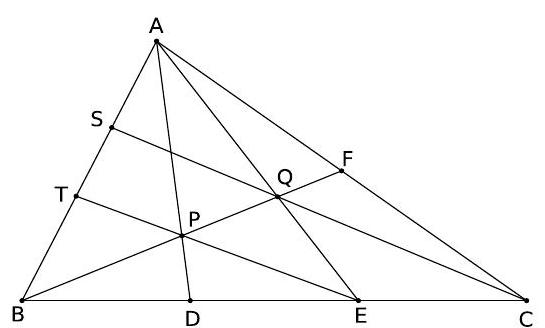
and $T$ respectively. We have
$$
\frac{[S B C]}{[A S C]}=\frac{B S}{S A}=\frac{[S B Q]}{[A S Q]}
$$
Using componendo by dividendo, we obtain
... | 4 | Geometry | math-word-problem | Yes | Yes | olympiads | false |
Subsets and Splits
No community queries yet
The top public SQL queries from the community will appear here once available.