
problem stringlengths 15 4.7k | solution stringlengths 2 11.9k | answer stringclasses 51
values | problem_type stringclasses 8
values | question_type stringclasses 4
values | problem_is_valid stringclasses 1
value | solution_is_valid stringclasses 1
value | source stringclasses 6
values | synthetic bool 1
class |
|---|---|---|---|---|---|---|---|---|
\section*{Problem 1 - 291041}
Given are three lines \(g, h, j\) in a plane; no two of these lines are parallel to each other; no point in the plane lies on all three lines. Furthermore, a length \(a\) is given.
For each such specification of \(g, h, j, a\), the number of all circles \(c\) that satisfy the following c... | }
I. If a circle \(c\) satisfies conditions (1) and (2), then: If \(M\) is the center and \(r\) is the radius of \(c\), then \(M\) has the distance
\[
s=\sqrt{r^{2}-\left(\frac{a}{2}\right)^{2}}
\]
from each of the lines \(g, h, j\). This follows from the theorem that the perpendicular from \(M\) to a chord bisects ... | 4 | Geometry | math-word-problem | Yes | Yes | olympiads | false |
\section*{Problem 4 - 311044}
For each natural number \(n\), let \(\bar{n}\) be the number that is represented by the same sequence of digits in base 10 as \(n\) is in base 9.
Show that there exists a natural number \(k\) such that for every pair \((m ; n)\) of natural numbers with \(m>100\) and \(n-m>k\), the inequa... | }
We first show the following
Lemma: If the natural number \(n\) ends with exactly \(\ell \in \mathbb{Z}_{\geq 0}\) Eights in its representation in base 9, then \(\overline{n+1}-\bar{n}=\frac{10^{k}-1}{9}+1\).
Proof: In the representation of the number \(n+1\) in base 9, the last \(k\) digits are all zero, while the... | 8 | Number Theory | proof | Yes | Yes | olympiads | false |
\section*{Problem 6 - 311046}
Let \(q\) be the larger of the two solutions to the equation \(x^{2}-4 x+1=0\).
Determine the last digit (units place) in the decimal digit representation of the number \(\left[q^{1992}\right]\).
Hint: If \(z\) is a real number, the integer \(g\) such that \(g \leq z < g+1\) is denoted ... | }
The solutions of the equation \(x^{2}-4 x+1=0\) are \(p=2-\sqrt{3}\) and \(q=2+\sqrt{3}\). For the numbers \(a_{n}=p^{n}+q^{n}\) \((n=0,1,2,3, \ldots)\), it holds that \(a_{n}>0\) as well as
\[
\begin{gathered}
a_{0}=2, \quad a_{1}=4, \quad a_{2}=4-4 \sqrt{3}+3+4+4 \sqrt{3}+3=14 \quad \text { and } \\
a_{n+2}-4 a_{... | 1 | Algebra | math-word-problem | Yes | Yes | olympiads | false |
\section*{Exercise 1 - 321021}
Determine the smallest natural number \(z\) that has exactly four divisors \(t_{1}, t_{2}, t_{3}, t_{4}\) with \(1<t_{1}<t_{2}<t_{3}<\) \(t_{4}<z\)! | }
If the natural number \(z\) has the prime factorization
\[
z=p_{1}^{a_{1}} \cdot p_{2}^{a_{2}} \cdot \ldots \cdot p_{n}^{a_{n}}
\]
where the \(p_{i}(i=1,2, \ldots, n)\) are distinct prime factors and the \(a_{i}\) are their frequencies in the factorization, then the number of divisors \(t\) of \(z\) (including 1 a... | 12 | Number Theory | math-word-problem | Yes | Yes | olympiads | false |
\section*{Exercise 1 - 341021}
a) How many different distributions of the numbers \(1,2, \ldots, 6\) on the six side faces of a cube are there in total?
b) How many different distributions among these satisfy the additional condition that for each pair of opposite side faces, the numbers on these two faces sum to 7?
... | }
a) We take a cube and label its faces so that each of the numbers from 1 to 6 appears exactly once.
We place the cube so that 1 is on the top face, which leaves 5 possibilities for which number is on the bottom face. Then we rotate the cube around the vertical axis so that the smallest of the four adjacent faces po... | 2 | Combinatorics | math-word-problem | Yes | Yes | olympiads | false |
\section*{Exercise 2 - V01102}
Determine the limit of the function:
\[
\lim _{x \rightarrow 0} \frac{(1-x)^{6} \sin 3 x-\sin 3 x}{3 x^{2}}
\] | }
For \(x=0\) an indeterminate form \(\frac{0}{0}\) arises. According to l'Hôpital's rule, the limit in this case is given by
\[
\lim _{x \rightarrow 0} \frac{f(x)}{g(x)}=\lim _{x \rightarrow 0} \frac{f^{\prime}(x)}{g^{\prime}(x)}
\]
Twice differentiating the numerator and the denominator (not using the quotient rul... | -6 | Calculus | math-word-problem | Yes | Yes | olympiads | false |
\section*{Task 1 - V11121}
In soil investigations in agrochemistry, the so-called stepwise dilution is applied. One washes \(1 \mathrm{~cm}^{3}\) of a soil sample \((x)\) with \(10 \mathrm{~cm}^{3}\) of chemically pure water \((y)\). From the resulting mixture, one takes \(1 \mathrm{~cm}^{3}\) and washes it again with... | }
a) With \(x=1 \mathrm{~cm}^{3}, y=10 \mathrm{~cm}^{3}, x+y=11 \mathrm{~cm}^{3}\) the ratio is 1:10 and for the mixing ratio \(1: 2000000\) we get:
\[
\left(\frac{1}{11}\right)^{n}=\frac{1}{2000000} \quad ; \quad n=\frac{\log (2000000)}{\log (11)} \approx 6
\]
b)
\[
n_{B a k}=\frac{10000000}{2000000}=5
\] | 5 | Algebra | math-word-problem | Yes | Yes | olympiads | false |
\section*{Problem 6 - V01206}
Which digit stands in the units place of the sum
\[
11^{6}+14^{6}+16^{6}
\] | }
Since we are only interested in the units place of the summands, we follow \(\bmod 10\)
\[
\left(11^{6}+14^{6}+16^{6}\right) \quad \bmod 10 \equiv\left(1^{6}+4^{6}+6^{6}\right) \quad \bmod 10
\]
It is \(4^{6}=4096\), so \(4^{6} \bmod 10 \equiv 6 \bmod 10\) and it is \(6^{6}=6^{3} \cdot 6^{3}=216 \cdot 216\), so \(... | 3 | Number Theory | math-word-problem | Yes | Yes | olympiads | false |
\section*{Problem 5 - 031225}
Two shepherds sell a number of animals, each of which brings in as many groschen as the number of animals. They distribute the proceeds as follows:
The first shepherd receives 10 groschen, the second 10 groschen, then again the first 10 groschen, the second 10 groschen, and so on. After ... | }
The revenue for an animal is \(n\) groschen, thus \(n\) animals are sold and the shepherds receive a total of \(n^{2}\) groschen for their animals.
After each distribution round (the first shepherd receives 10 groschen, the second shepherd also receives 10 groschen), the remaining amount decreases by 20 groschen.
... | 6 | Number Theory | math-word-problem | Yes | Yes | olympiads | false |
\section*{Task 1 - 041231}
In a mathematical circle, six participants agree on a real number \(a\), which the seventh participant, who had left the room beforehand, is supposed to determine. Upon his return, he receives the following information:
1. \(a\) is a rational number.
2. \(a\) is an integer that is divisible ... | }
Assuming that statement 2 is true, then statement 1 is also true. However, this is impossible according to the above condition. Therefore, statement 1 is true and statement 2 is false.
Since statement 1 is true, statement 3 is false and statement 4 is true. \(a\) is thus one of the numbers
\[
\ldots,-35,-21,-7,7,21... | 7 | Number Theory | math-word-problem | Yes | Yes | olympiads | false |
\section*{Problem 2 - 061212}
In a plane, five points are given, no three of which lie on a straight line. Any two of these points are connected by either a red or a blue line in such a way that no three of these lines form a triangle of the same color.
a) Prove:
(1.) From each of the five given points, exactly two ... | }
Since in the problem statement the words "red" and "blue" can be interchanged without changing the problem, it suffices to prove all claims for the red segments.
a) 1. Let the given points be \(A, B, C, D, E\). If we assume that three red segments, e.g., \(AB, AC, AD\), originate from point \(A\), then the segments ... | 12 | Combinatorics | proof | Yes | Yes | olympiads | false |
\section*{Problem 1 - 061231}
In the same plane, let \(n\) points \((n>2)\) be distributed such that for each of them, there is only one nearest neighbor among the others. For each of these \(n\) points, the vector starting from it and ending at its nearest neighbor, and only this vector, is drawn.
Determine the maxi... | }
The maximum possible number is 5.
To demonstrate this, let's first assume there are 6 points \(P_{1}\) to \(P_{6}\), each of whose nearest point is a different point \(Q\).
W.L.O.G., let the points be labeled such that the vectors from \(P_{i}\) to \(Q\) are encountered in ascending order when moving in a mathemat... | 5 | Combinatorics | math-word-problem | Yes | Yes | olympiads | false |
\section*{Problem 3 - 071233}
What are the last two digits of the number \(7^{7^{7^{7}}}-7^{7^{7}}\) ? | }
It is
\[
\begin{array}{lll}
7^{1} \equiv 7 & (\bmod 100) & 7^{2} \equiv 49 \quad(\bmod 100) \\
7^{3} \equiv 43 \quad(\bmod 100) & 7^{4} \equiv 1 \quad(\bmod 100)
\end{array}
\]
thus
\[
7^{4 k} \equiv 1 \quad(\bmod 100) \quad 7^{4 k-1} \equiv 43 \quad(\bmod 100)
\]
where \(k\) is any non-zero natural number. Now,... | 0 | Number Theory | math-word-problem | Yes | Yes | olympiads | false |
\section*{Task 1 - 081211}
At the European Championships for women's rowing in August 1966, the GDR, as the most successful country, received 37 points, and the USSR received 36.5 points. Both countries received exactly one of the three medals awarded in each of the 5 disciplines: Single Sculls, Double Sculls, "Coxed ... | }
The USSR has 36.5 points; it must have received a medal in at least one discipline with a non-integer point value. This is only the case for silver medals in the "Coxed Fours" and "Double Fours."
Since there are only two such medals, the GDR can now have received a maximum of one of them. However, this would result... | 3 | Logic and Puzzles | math-word-problem | Yes | Yes | olympiads | false |
\section*{Exercise 1 - 081221}
Give all prime numbers \(p\) for which both \(p+10\) and \(p+14\) are also prime numbers! | }
Let \(a \in \{0,1,2\}\) be the remainder of \(p\) when divided by 3.
If \(a=1\), then \(p+14\) is divisible by 3 and since \(p+14>3\), it is not a prime number.
If \(a=2\), then similarly \(p+10\) is divisible by 3 and is not a prime number. Therefore, \(p\) must be divisible by 3, so \(p=3\).
Then \(p+10=13, p+1... | 3 | Number Theory | math-word-problem | Yes | Yes | olympiads | false |
\section*{Problem 1 - 101211}
In a parent-teacher meeting, exactly 18 fathers and exactly 24 mothers were present, with at least one parent of each student in the class attending.
Of exactly 10 boys and exactly 8 girls, both parents were present for each. For exactly 4 boys and exactly 3 girls, only the mother was pr... | }
According to 3., 1 or 2 single fathers were present, so 16 or 17 fathers (out of the 18 present) were with the mother (4).
According to 2., at most 7 mothers were alone, so out of the total 24 mothers, at least 17 mothers were with the father (5).
From these two statements (4) and (5), it follows that there are ex... | 4 | Combinatorics | math-word-problem | Yes | Yes | olympiads | false |
\section*{Problem 6 - 101236}
Let \(M_{1}\) be the set of all points whose coordinates \(x, y\) in a plane rectangular Cartesian coordinate system satisfy the following inequalities (\(x, y\) real):
\[
\begin{array}{r}
y \geq 0 \\
y-2 x \leq 1 \\
y+2 x \leq 1
\end{array}
\]
Furthermore, let \(n\) be a positive integ... | }
a) The set \(M_{1}\) consists of all points of the shaded triangular area, including the boundary points. The sets \(B_{1}, B_{2}, B_{3}, B_{4}\) each consist of all points inside the drawn rectangles (thus excluding the respective boundary points).
 Each line has exactly three stops.
(2) Each line has exactly one stop in common with every other line.
(3) It is possible to reach any stop from any other stop with... | }
In the following, it is assumed that the starting and ending stops of a bus line are added to the three stops that exist according to (1). Each bus line, therefore, runs from the starting stop with exactly one intermediate stop to the end stop. In the following considerations, different letters stand for different s... | 7 | Combinatorics | math-word-problem | Yes | Yes | olympiads | false |
\section*{Problem 5 - 121235}
Determine whether there exist regular n-gons for which the difference between the lengths of the longest and the shortest diagonals is equal to the side length of the n-gon.
If such n-gons exist, provide all natural numbers \(n(n \geq 4)\) for which this is true. | }
O.B.d.A. let the side length of the n-gon be 1. The shortest diagonal spanning two sides is \(d_{2}\). Then,
\[
1n \quad ; \quad d_{m}>\frac{n}{\pi}
\]
If \(n \geq 10\), then \(d_{m}>3\) and thus (1) is not satisfied. By sketching an 8-gon, the diagonals can be calculated quite easily using the Pythagorean theorem... | 9 | Geometry | math-word-problem | Yes | Yes | olympiads | false |
\section*{Problem 1 - 121241}
Determine whether among all pairs \((a, b)\) of positive real numbers, there exist such pairs for which
\[
f(a, b)=\frac{a^{4}}{b^{4}}+\frac{b^{4}}{a^{4}}-\frac{a^{2}}{b^{2}}-\frac{b^{2}}{a^{2}}+\frac{a}{b}+\frac{b}{a}
\]
attains a minimum value. If so, then this minimum value should be... | }
Due to the symmetry of the function, instead of \(f(a, b)\), we can consider \(g(x)=x^{4}+\frac{1}{x^{4}}-x^{2}-\frac{1}{x^{2}}+x+\frac{1}{x}\) with \(x:=\frac{a}{b}>0\). It holds that
\[
\begin{aligned}
g(x)-x-\frac{1}{x} & =\left(x^{2}+\frac{1}{x^{2}}\right)^{2}-\left(x+\frac{1}{x}\right)^{2} \\
& =\left(x^{2}+\f... | 2 | Inequalities | math-word-problem | Yes | Yes | olympiads | false |
\section*{Problem 6B - 121246B}
In the plane, let two non-intersecting circles \(k_{1}\) and \(k_{2}\) and a point \(A\) outside both circles be given.
We are looking for an equilateral triangle \(\triangle A B C\) such that \(B\) lies on \(k_{1}\) and \(C\) lies on \(k_{2}\).
a) Justify and describe a construction ... | Assume there exists a \(B \in k_{1}\) and a \(C \in k_{2}\) with \(A B=B C=C A\), then I obtain the point \(C\), if \(B\) is already fixed, by rotating the segment \(A B\) around \(A\) by \(60^{\circ}\).
If I choose an arbitrary point \(B\) on \(k_{1}\) and rotate \(A B\) around \(A\) by \(60^{\circ}\), it is likely t... | 4 | Geometry | math-word-problem | Yes | Yes | olympiads | false |
\section*{Task 2 - 131222}
Each of the 41 students in a class had to participate in exactly three track and field running events.
Each of these students had to start once on lanes 1, 2, and 3.
Student A claims that due to these rules alone, there must be at least seven students in the class whose sequence of startin... | }
Application of the Pigeonhole Principle:
If \(n\) objects are distributed among \(k\) sets, where \(n, k>0\), then there is at least one set that contains at least \(\left\lceil\frac{n}{k}\right\rceil\) objects. (\(\left\lceil\frac{n}{k}\right\rceil\) denotes the smallest integer \(g\) such that \(g \geq \frac{n}{k... | 7 | Combinatorics | math-word-problem | Yes | Yes | olympiads | false |
\section*{Problem 1 - 151221}
a) Investigate whether there exist natural numbers \(n\) such that in the expansion formed according to the binomial theorem
\[
(a+b)^{n}=c_{0} a^{n}+c_{1} a^{n-1} \cdot b+c_{2} a^{n-2} \cdot b^{2}+\ldots+c_{n} b^{n}
\]
the coefficients \(c_{0}, c_{1}, c_{2}\) have the sum \(c_{0}+c_{1}... | }
a) For fixed \(n\), we have \(c_{0}=\binom{n}{0}=1\), \(c_{1}=\binom{n}{1}=n\), and \(c_{2}=\binom{n}{2}=\frac{1}{2} n(n-1)\). Therefore, the equation
\[
1+n+\frac{1}{2} n(n-1)=79
\]
needs to be solved. After multiplying by 2 and subtracting 79, we obtain the quadratic equation
\[
n^{2}+n+156=0
\]
This can be so... | 12 | Algebra | math-word-problem | Yes | Yes | olympiads | false |
\section*{Problem 2 - 171232}
For every integer \(a\), determine all real solutions \(x\) of the equation
\[
x^{4}+x^{3}+a^{2} x^{2}+x+1=0
\] | }
The equation can be transformed as follows:
\[
x^{4}+x^{3}+a^{2} x^{2}+x+1=x^{3} \cdot(x+1)+a^{2} x^{2}+(x+1)=\left(x^{3}+1\right) \cdot(x+1)+a^{2} x^{2}
\]
\((x+1)\) is negative if and only if \(x\) is less than -1 \((x+1<0 \Leftrightarrow x<-1)\).
\(\left(x^{3}+1\right)\) is also negative if and only if \(x\) i... | -1 | Algebra | math-word-problem | Yes | Yes | olympiads | false |
\section*{Exercise 2 - 171242}
Let \(g\) and \(h\) be the functions defined on the (two-element) set \(\{1, -1\}\) as follows:
\[
\begin{aligned}
& g(1)=1, \quad g(-1)=-1 \\
& h(1)=-1, \quad h(-1)=1
\end{aligned}
\]
Furthermore, let \(f_{1}, f_{2}, f_{3}, f_{4}, f_{5}, f_{6}, f_{7}\) be functions, some of which are ... | }
First, we observe that each of the given functions is already determined if one knows their functional value at exactly one argument. Therefore, it immediately follows that \(f_{6} \equiv f_{7} \equiv g\) and \(f_{1} \equiv h\), which means that Equation (5) is equivalent to
\[
\left(f_{2} \circ \cdots \circ f_{5}\... | 4 | Logic and Puzzles | proof | Yes | Yes | olympiads | false |
## Aufgabe 1 - 181241
Man ermittle alle ganzen Zahlen $a$ mit der Eigenschaft, dass zu den Polynomen
$$
\begin{aligned}
& f(x)=x^{12}-x^{11}+3 x^{10}+11 x^{3}-x^{2}+23 x+30 \\
& g(x)=x^{3}+2 x+a
\end{aligned}
$$
ein Polynom $h(x)$ so existiert, dass für alle reellen $x$ die Gleichung $f(x)=g(x) \cdot h(x)$ gilt.
|
Zu den gegebenen Polynomen $f(x)$ und $g(x)$ gibt es genau zwei eindeutig bestimmte Polynome $h(x)$ und $q(x)$ derart, dass $f(x)=g(x) \cdot h(x)+q(x)$ für alle reellen $x$ gilt und $q(x)$ das Nullpolynom ist oder kleineren Grad als $g(x)$ hat.
Durch Polynomdivision erhält man
$$
\begin{gathered}
f(x)=g(x)\left[x^{... | 3 | Algebra | math-word-problem | Yes | Yes | olympiads | false |
## Task 6B - 181246B
a) Let $M$ be the set of all triples $(x, y, z)$ of real numbers for which the following inequalities (1) to (5) are satisfied:
$$
\begin{aligned}
55 x + z & \leq 54 \\
55 y + z & \leq 54 \\
55 x - 4 z & \geq 4 \\
55 y - 4 z & \geq 4 \\
z & \geq -1
\end{aligned}
$$
Investigate whether there exis... | a) Let $x, y, z$ be real numbers that satisfy inequalities (1) to (5). Then, due to (3) and (1),
$$
4 z - 55 x \leq -4 ; \quad z + 55 x \leq 54 \quad \text{thus} \quad 5 z \leq 40 \rightarrow z \leq 10
$$
Due to (5), it follows that $-1 \leq z \leq 10$ (7). Now, from (1) and (3),
$$
\frac{4 + 4 z}{55} \leq x \leq \f... | 3 | Inequalities | math-word-problem | Yes | Yes | olympiads | false |
## Task 6B - 191246B
In a dark room, there are 20 individual gloves of the same size, namely
- 5 white gloves for the right hand
- 5 white gloves for the left hand
- 5 black gloves for the right hand
- 5 black gloves for the left hand
Two gloves are considered a matching pair if and only if they are of the same colo... | According to the given information, we have four groups of 5 gloves each of the following types:
- WL (=white and for left hand)
- WR (=white and for right hand)
- SL (=black and for left hand)
- SR (=black and for right hand)
In a draw of $k$ gloves, i.e., after $k$ "draws," success occurs if and only if two gloves ... | 7 | Combinatorics | math-word-problem | Yes | Yes | olympiads | false |
## Task 2 - 201232
Let $f$ be the function defined by
$$
f(x)=x^{4}-(x+1)^{4}-(x+2)^{4}+(x+3)^{4}
$$
where the domain of $f$ is
a) the set of all integers,
b) the set of all real numbers.
Investigate, for both case a) and case b), whether the function $f$ attains a minimum value, and determine, if applicable, thi... | From the representation
$$
f(x)=\left(\left(x+\frac{3}{2}\right)-\frac{3}{2}\right)^{4}-\left(\left(x+\frac{3}{2}\right)-\frac{1}{2}\right)^{4}-\left(\left(x+\frac{3}{2}\right)+\frac{1}{2}\right)^{4}+\left(\left(x+\frac{3}{2}\right)+\frac{3}{2}\right)^{4}
$$
we see that $f$ is axis-symmetric with respect to $x=-\frac... | 10 | Algebra | math-word-problem | Yes | Yes | olympiads | false |
## Task 5 - 211235
37 cards, each of which is colored red on one side and blue on the other, are laid on a table so that exactly 9 of them show their blue side on top.
Now, in work steps, cards are to be flipped, and in each individual work step, exactly 20 of the 37 cards are to be flipped.
Investigate whether it i... | a) We identify a card with its red side up as 1 and a card with its blue side up as -1. Then, in the initial situation, the sum of all cards is $s=9 \cdot(-1)+(37-9) \cdot 1=19$. If all cards showed their red side, the sum would be $r=37 \cdot 1=37$.
Flipping a card changes the sum of the cards by $\pm 2$: Either a re... | 2 | Combinatorics | math-word-problem | Yes | Yes | olympiads | false |
## Task 2 - 221222
Investigate whether among all triangles for which the side lengths $a, b, c$ satisfy the relationships $a \leq 1 \mathrm{~cm} \leq b \leq 2 \mathrm{~cm} \leq c \leq 3 \mathrm{~cm}$, there is a triangle with the maximum possible area.
If this is the case, determine this area. | According to the trigonometric area formula
$$
A=\frac{1}{2} a b \sin \gamma
$$
for a triangle with side lengths $a$ and $b$, and the included angle $\gamma$, $A$ obviously takes its maximum under the consideration of the constraints
$$
a \in(0,1], b \in[1,2], \gamma \in(0, \pi)
$$
for
$$
a=1, b=2, \gamma=\frac{\p... | 1 | Geometry | math-word-problem | Yes | Yes | olympiads | false |
## Task 2 - 221232
Determine for all 30-tuples $\left(a_{1}, a_{2}, \ldots, a_{30}\right)$ of (not necessarily distinct) positive integers $a_{i}(i=1, \ldots, 30)$, which satisfy
$$
\sum_{i=1}^{30} a_{i}=1983
$$
the greatest value that the greatest common divisor $d$ of the numbers $a_{i}$ can take. | Since all $a_{i}$ are naturally divisible by $d$, this also applies to their sum 1983 with the prime factorization $1983=3 \cdot 661$, i.e., it must be
$$
d \in\{1,3,661,1983\}
$$
Since $d=1983$ and $d=661$ can obviously be ruled out with 30 positive summands, the next to consider in terms of a maximum is $d=3$, and ... | 3 | Number Theory | math-word-problem | Yes | Yes | olympiads | false |
## Task 4 - 231224
Determine all natural numbers $n$ for which the number $2^{n}+5$ is a perfect square. | If $2^{n}+5$ is a square number, then $n$ must be even, because for an odd $n$
$$
2^{n}+5=4^{\frac{n-1}{2}} 2+5 \equiv(-1)^{\frac{n-1}{2}} 2 \equiv \pm 2 \quad \bmod 5
$$
would hold, meaning $2^{n}+5$ would then be a quadratic non-residue modulo 5, a contradiction!
For an even $n$, however, $2^{n}=k^{2}$ with $k=2^{... | 2 | Number Theory | math-word-problem | Yes | Yes | olympiads | false |
## Task 2 - 231242
a) Prove that there exists a set $M$ with the following properties (1), (2), (3), (4):
(1) Every element of $M$ is a natural number.
(2) The smallest element of $M$ is the number 1.
(3) The largest element of $M$ is the number 100.
(4) Every element of $M$ except the number 1 is the sum of two e... | a) Choose $M=\{1,2,4,8,16,32,64,96,100\}$.
b) The $M$ given in a) already has the smallest possible number of elements. Proof: Consider a set $M$ that satisfies the conditions of the problem statement, and denote its elements in ascending order by $a_{1}, a_{2}, \ldots$.
$a_{6}$ is at most 32, so $a_{7}<100$, hence $... | 9 | Number Theory | proof | Yes | Yes | olympiads | false |
## Task 3 - 241213
Determine all real numbers $x$ for which $2 x-3,5 x-14$ and $\frac{2 x-3}{5 x-14}$ are integers. | For a real number $x$, if the numbers
$$
g=2 x-3 \quad ; \quad h=5 x-14 \quad \text { and } \quad k=\frac{2 x-3}{5 x-14}=\frac{g}{h}
$$
are integers, then from (1) and (2),
$$
5 g=10 x-15 \quad ; \quad 2 h=10 x-28
$$
and therefore
$$
5 g-2 h=13
$$
Considering the equation $g=h k$ derived from (3), we get
$$
(5 k... | 3 | Algebra | math-word-problem | Yes | Yes | olympiads | false |
## Task 4 - 271214
Determine the remainder when the sum $s=1^{5}+2^{5}+3^{5}+\ldots+1987^{5}$ is divided by 25! | For every natural number $a$, there exist natural numbers $m$ and $r$ with $0 \leq r \leq 4$ such that $n=5 m+r$. It holds that:
$$
(5 m+r)^{5}=5^{5} \cdot m^{5}+5 \cdot 5^{4} \cdot m^{4} \cdot r+10 \cdot 5^{3} \cdot m^{3} \cdot r^{2}+10 \cdot 5^{2} \cdot m^{3} \cdot r^{3}+5 \cdot 5 \cdot m \cdot r^{4}+r^{5}
$$
Conse... | 8 | Number Theory | math-word-problem | Yes | Yes | olympiads | false |
## Task 6B - 281246B
Determine the maximum number of squares with side length 1 that can fit into a given square with side length 1.99, without extending beyond its edges and without overlapping each other. | The sought maximum number is 1.
Let $ABCD$ be the given square with side length 1.99. Clearly, one can place a square of side length 1 within $ABCD$. However, it is not possible to place two such squares, because any two such squares within $ABCD$ would overlap.
To prove this, we show that any square of side length 1... | 1 | Geometry | math-word-problem | Yes | Yes | olympiads | false |
## Task 3B - 331233B
For each integer $n$ with $n \geq 0$, let $f_{n}$ be the function defined by
$$
f_{n}(x)=x^{3}+(n+3) \cdot x^{2}+2 n \cdot x-\frac{n}{n+1}
$$
for all real $x$.
Determine all integers $n$ with $n \geq 0$ for which the following holds:
All roots of $f_{n}$ lie in an interval of length 3. | The function $f(x)$ behaves in principle as follows:

This means that at the "outer" zeros $x_{\min}$ and $x_{\max}$, the slope is positive. For $n=0$, it is immediately clear that the zero... | 0 | Algebra | math-word-problem | Yes | Yes | olympiads | false |
## Task 4 - 341234
Determine the smallest natural number $n$ with $n \geq 2$ and the following property ( $\left.{ }^{*}\right)$ :
$(*)$ In every set of $n$ natural numbers, there are (at least) two numbers whose sum or whose difference is divisible by 7. | For $n=4$ (and thus also for $n=2,3$), one can still easily find such an $n$-element subset $M$ of $\mathbb{N}$, for example, $M=\{0,1,2,3\}$. If $x, y \in M$ and $x \neq y$, then for them $0 < |x - y| < 4$, and thus $|x - y|$ is not divisible by 7.
To show that this is no longer possible for $n > 4$, consider the pa... | 5 | Number Theory | math-word-problem | Yes | Yes | olympiads | false |
## Task 1
In front of the circus tent, students from a first grade class are standing.
The children have lined up in pairs. The teacher gives out 2 admission tickets at a time. She distributes four times 2 tickets to the girls and five times 2 tickets to the boys.
Questions:
a) How many girls want to go to the circ... | a) 8 girls ; b) 10 boys ; c) 18 children. | 8 | Logic and Puzzles | math-word-problem | Yes | Yes | olympiads | false |
## Task 3
The next day, the children are talking about the animal performances. Klaus and Inge are arguing.
Klaus says: "There were 2 lions and twice as many horses, in addition to 4 cats and half as many dogs."
Inge, on the other hand, says: "I saw 4 horses and half as many lions, 2 dogs and twice as many cats."
Q... | There are 12 animals, both children are right.
### 10.1.2 2nd Round 1965, Class 1 | 12 | Logic and Puzzles | math-word-problem | Yes | Yes | olympiads | false |
## Task 1
On the meadow stands a carousel. It has 6 seats.
Mrs. Müller comes with 11 children from the kindergarten. All children are only allowed to ride the carousel once.
How many children can ride for the first time in the second round? | $11-6=5 ; 5$ children can only ride the carousel in the 2nd round. | 5 | Combinatorics | math-word-problem | Yes | Yes | olympiads | false |
## Task 2
In the chalk box, there are white and blue chalk. Together, there are 6 pieces.
There are twice as many pieces of white chalk as blue chalk.
Take 6 sticks and try to figure out how many pieces of each kind are in the box. | In the chalk box, there are 4 pieces of white chalk and 2 pieces of blue chalk. | 4 | Algebra | math-word-problem | Yes | Yes | olympiads | false |
## Task 1
The school garden is getting a new wire fence. There is always 1 meter between one post and the next. 8 meters have already been completed.
How many posts have been used so far? | 9 piles were used. | 9 | Geometry | math-word-problem | Yes | Yes | olympiads | false |
## Task 1
What is the number?
If I subtract a number from 12, I get 7. Calculate! | The number is 5 . | 5 | Algebra | math-word-problem | Yes | Yes | olympiads | false |
## Task 2
Two birds are sitting on a branch $8 \mathrm{~m}$ apart.
Now one bird hops 1 meter towards the other. The other bird then hops 2 meters towards the first.
How far apart are the two birds now? | The birds are now 5 meters apart. | 5 | Logic and Puzzles | math-word-problem | Yes | Yes | olympiads | false |
## Task 2
14 Pioneers were at the puppet theater and are taking the bus home. First, 5 Pioneers get off and then another 4.
How many Pioneers are still on the bus? | $14-5-4=5$
### 10.7 9th Olympiad 1971
### 10.7.1 1st Round 1971, Class 1 | 5 | Logic and Puzzles | math-word-problem | Yes | Yes | olympiads | false |
## Task 1
At the cross-country race, 8 runners wore white sports shirts. 4 runners wore blue sports shirts. How many runners started the cross-country race? | $8+4=12, 12$ runners started. | 12 | Other | math-word-problem | Yes | Yes | olympiads | false |
## Task 2
Gabi Seyfert was 19 years old at the last Olympic Games. The youngest figure skater was 11 years old.
How many years older was Gabi than the youngest skater? | $11+x=19 ; x=8$. Gabi was 8 years older. | 8 | Other | math-word-problem | Yes | Yes | olympiads | false |
## Task 3
Draw a line segment that is $4 \mathrm{~cm}$ long!
Then draw a line segment that is $9 \mathrm{~cm}$ long!
By how many centimeters is the first line segment shorter than the second? Write the equation! | $9-4=5$ or $4+5=9$ or $4+x=9 ; x=5$
### 10.9.2 2nd Round 1973, Class 1 | 5 | Geometry | math-word-problem | Yes | Yes | olympiads | false |
## Task 2
Subtract 7 from 19!
a) Write down the equation!
b) Justify your solution with the basic problem!
a) $19-7=12$; b) $9-7=2$ | ### 10.10 12th Olympiad 1974
### 10.10.1 1st Round 1974, Class 1 | 12 | Number Theory | math-word-problem | Yes | Yes | olympiads | false |
## Task 1
All pioneers compete in good deeds for the Day of the Republic. Class 1a has collected 12 marks worth of recyclables.
Class $1 \mathrm{~b}$ achieved 5 marks less.
How many marks did Class $1 \mathrm{~b}$ donate? | $12-5=7$. Class $1 \mathrm{~b}$ donated 7 marks. | 7 | Algebra | math-word-problem | Yes | Yes | olympiads | false |
Task 1
$$
4+5+3
$$
$$
\begin{array}{rr}
4+5+3 & 7+8+2 \\
13-6-3 & 16-9-1
\end{array}
$$ | $4+5+3=12 ; 7+8+2=17 ; 13-6-3=4 ; 16-9-1=6$ | 12 | Logic and Puzzles | math-word-problem | Yes | Yes | olympiads | false |
## Task 2
Draw two line segments:
the 1st line segment $\overline{A B}=8 \mathrm{~cm}$, the 2nd line segment $\overline{C D}$ should be $2 \mathrm{~cm}$ shorter than the line segment $\overline{A B}$! | Line segment $\overline{C D}=6 \text{~cm}$
### 10.12 14th Olympiad 1976
### 10.12.1 1st Round 1976, Class 1 | 6 | Geometry | math-word-problem | Yes | Yes | olympiads | false |
## Task 3
In Class 1a, 6 Young Pioneers receive a book for good learning. In Class 1b, an equal number of Young Pioneers receive a book for good learning.
How many Young Pioneers receive a book? | $6+6=12 ; 12$ Young Pioneers receive a book.
### 10.12.2 2nd Round 1976, Class 1 | 12 | Other | math-word-problem | Yes | Yes | olympiads | false |
## Task 2
Subtract the number 5 from 9! Write down the equation for this! | $9-5=4$
### 10.13 15th Olympiad 1977
### 10.13.1 1st Round 1977, Class 1 | 4 | Algebra | math-word-problem | Yes | Yes | olympiads | false |
## Task 4
Peter has three sisters. His father gives each child in the family two books.
How many books does the father give his children? | $2+2+2+2=8$. The father gives 8 books to his children.
### 10.13.2 2nd Round 1977, Class 1 | 8 | Logic and Puzzles | math-word-problem | Yes | Yes | olympiads | false |
## Task 4
From class 1a, 3 Pioneers receive certificates for good performance. An equal number of Pioneers from class 1b also receive certificates.
How many Pioneers will be awarded? | $3+3=6$. Six pioneers were awarded.
### 10.14.2 2nd Round 1978, Class 1 | 6 | Combinatorics | math-word-problem | Yes | Yes | olympiads | false |
## Task 6
Determine the number that is 7 less than 14! Write an equation! | $14-7=7$. The number is 7.
### 10.16.2 2nd Round 1980, Class 1 | 7 | Algebra | math-word-problem | Yes | Yes | olympiads | false |
## Task 4
Calculate the difference between the numbers 10 and 2. | $10-2=8$. The difference is 8.
### 10.18 20th Olympiad 1982
### 10.18.1 1st Round 1982, Class 1 | 8 | Logic and Puzzles | math-word-problem | Yes | Yes | olympiads | false |
## Task 5
All 20 Young Pioneers of Class 1a, who are participating in the ABC Action "Sniffing Nose," meet at the school in the afternoon.
16 Young Pioneers are already there, how many are still missing? | $16+4=20$ or $16+x=20$ or $20-x=16: x=4$. 4 Young Pioneers are still missing. | 4 | Other | math-word-problem | Yes | Yes | olympiads | false |
## Aufgabe 2
$$
\begin{array}{ll}
2+2+2 & 5+5-5 \\
8+0-8 & 9-2-6
\end{array}
$$
|
$2+2+2=6 ; 5+5-5=5 ; 8+0-8=0 ; 9-2-6=1$
| 0 | Algebra | math-word-problem | Yes | Yes | olympiads | false |
## Task 1
What number must you subtract from 20 to get 18? | $20-x=18 ; x=2$ | 2 | Algebra | math-word-problem | Yes | Yes | olympiads | false |
## Task 1
A Young Pioneer is playing with 3 dice. One die shows 5 points, the second die shows 1 point. How many points does the third die show if all the dice together show 10 points? | $10-5-1=4$. The third die shows 4 points. | 4 | Logic and Puzzles | math-word-problem | Yes | Yes | olympiads | false |
## Task 5
Which number would you write in the box? Justify!
$$
2,4,6, \square, 10,12
$$ | The number 8 is to be placed at this position because each subsequent number is derived from the preceding number by adding 2.
### 10.24 26th Olympiad 1988
### 10.24.1 1st Round 1988, Class 1 | 8 | Number Theory | math-word-problem | Yes | Yes | olympiads | false |
## Task 6
Peter has 12 pennies, Annett gives him enough so that he has 20 pennies.
How much money does Annett give? Write an equation. | Annett gives 8 pennies. $12+8=20$
### 10.26 28th Olympiad 1990
### 10.26.1 1st Round 1990, Class 1 | 8 | Algebra | math-word-problem | Yes | Yes | olympiads | false |
## Task 2
A class estimates the length of a path on the schoolyard to be $28 \mathrm{~m}$. Two boys measure this path. They lay a measuring tape of $20 \mathrm{~m}$ length once and then measure another $12 \mathrm{~m}$.
By how many meters did the students overestimate? | $20+12-28=4$. The students are off by $4 \mathrm{~m}$. | 4 | Geometry | math-word-problem | Yes | Yes | olympiads | false |
## Task 1
Bernd comes to Wolfgang at 2 PM. They work on their school assignments until 4 PM.
When they want to play more, Bernd says: "I can only stay for three hours!" How long can Bernd and Wolfgang still play? | You can still play for 1 hour. | 1 | Other | math-word-problem | Yes | Yes | olympiads | false |
## Task 2
Calculate the difference between the product and the sum of the numbers 9 and 2. | $9 \cdot 2=18,9+2=11,18-11=7$. The difference is 7.
### 11.4 5th Olympiad 1967
### 11.4.1 1st Round 1967, Class 2 | 7 | Algebra | math-word-problem | Yes | Yes | olympiads | false |
## Task 1
Subtract from 17 three times the same number, so that you get 8!
What is the number? | The number is 3, since $17-3 \cdot 3=8$. | 3 | Algebra | math-word-problem | Yes | Yes | olympiads | false |
Task $1 \mathrm{Zu}$ a number $a$ add four times the number 4! The sum of these numbers is 21. What is the number $a$? | $a+4 \cdot 4=21$ results in $a=5$. | 5 | Algebra | math-word-problem | Yes | Yes | olympiads | false |
## Task 4
What is the smallest two-digit number? | The smallest two-digit number is 10.
### 11.6.2 2nd Round 1969, Class 2 | 10 | Number Theory | math-word-problem | Yes | Yes | olympiads | false |
## Task 3
Gudrun is also going to the Pioneer meeting. Her group consists of 23 Young Pioneers. They are distributed among three compartments. In 2 compartments, there are 8 Pioneers each.
How many Pioneers are sitting in the third compartment? | In the third compartment sit 7 Pioneers. | 7 | Logic and Puzzles | math-word-problem | Yes | Yes | olympiads | false |
## Task 1
Uwe's Pioneer group is accommodated with families during the Pioneer meeting. The 18 girls in the group are placed with families that each take in 3 Pioneers. The 14 boys in the group are placed with families that each take in 2 Pioneers.
a) In how many families were the girls accommodated?
b) In how many ... | a) In 6 families, the girls were taken in.
b) In 7 families, the boys were taken in. | 7 | Logic and Puzzles | math-word-problem | Yes | Yes | olympiads | false |
## Task 2
A skyscraper is also being built. In 6 hours, the crane lifts 30 slabs into place.
How many slabs will the crane lift into place in one hour? | $30: 6=5$. In one hour, the crane lifts 5 plates into the air. | 5 | Algebra | math-word-problem | Yes | Yes | olympiads | false |
## Task 5
Mr. Müller has manufactured 16 chair legs.
How many chairs can he build? | $16: 4=4$ He can build 4 chairs. | 4 | Other | math-word-problem | Yes | Yes | olympiads | false |
## Aufgabe 1
a) $43+21+36 ; \quad 100-43-57 ; \quad 33+57-17$
b) $7 \cdot 5-5 \cdot 7 ; \quad 3 \cdot 1-0 \cdot 2 ; \quad 9 \cdot 2+9 \cdot 5$
c) $20: 2 ; \quad 24: 4 ; \quad 27: 3$
|
a) $43+21+36=100 ; 100-43-57=0 ; 33+57-17=75$
b) $7 \cdot 5-5 \cdot 7=0 ; 3 \cdot 1-0 \cdot 2=3 ; 9 \cdot 2+9 \cdot 5=63$
c) $20: 2=10 ; 24: 4=6 ; 27: 3=9$
| 3 | Algebra | math-word-problem | Yes | Yes | olympiads | false |
## Task 4
To become hard-boiled, 3 eggs need to cook for 5 minutes.
How long do you need to cook 6 eggs? | Even 6 eggs must be boiled for 5 minutes.
### 11.18 19th Olympiad 1981
### 11.18.1 1st Round 1981, Class 2 | 5 | Other | math-word-problem | Yes | Yes | olympiads | false |
## Task 3
What number must you subtract from 89 to get 81? Form an equation! | $89-8=81$. One must subtract the 8. | 8 | Algebra | math-word-problem | Yes | Yes | olympiads | false |
## Task 2
Susanne estimated the length of the schoolyard to be $60 \mathrm{~m}$. Steffen and Ulf measure. They lay out a measuring tape of $20 \mathrm{~m}$ length twice and then measure another $14 \mathrm{~m}$.
By how many meters did Susanne overestimate? | Susanne miscalculated by 6 meters. | 6 | Other | math-word-problem | Yes | Yes | olympiads | false |
## Task 3
Calculate the quotient of the numbers 45 and 5. | $$
45: 5=9
$$ | 9 | Algebra | math-word-problem | Yes | Yes | olympiads | false |
## Task 3
$1 \mathrm{~m}=\ldots \mathrm{cm} ; \quad 40 \mathrm{~mm}=\ldots \mathrm{cm} ; \quad 10 \mathrm{~cm}=\ldots \mathrm{dm}$ | $1 \mathrm{~m}=100 \mathrm{~cm} ; 40 \mathrm{~mm}=4 \mathrm{~cm} ; 10 \mathrm{~cm}=1 \mathrm{dm}$
$1 \mathrm{~m}=100 \mathrm{~cm} ; 40 \mathrm{~mm}=4 \mathrm{~cm} ; 10 \mathrm{~cm}=1 \mathrm{dm}$
The text above is already in a form that uses standard metric units and symbols which are the same in English. However, if... | 1 | Other | math-word-problem | Yes | Yes | olympiads | false |
## Task 2
Divide the sum of the numbers 24 and 16 by 5. | $(24+16): 5=8$
$(24+16): 5=8$
The translation is the same as the original text because it consists of a mathematical expression which is universal and does not change in translation. However, if you intended to have the expression explained in English, it would be:
$(24+16) \div 5 = 8$
This means that the sum of 2... | 8 | Algebra | math-word-problem | Yes | Yes | olympiads | false |
## Task 2
Petra estimates the length of the kindergarten garden to be $50 \mathrm{~m}$. Ivo and Mario measure this distance. They lay out a measuring tape of $20 \mathrm{~m}$ length twice and then measure another $12 \mathrm{~m}$.
By how many meters did Petra overestimate? | $2 \cdot 20+12=52 \mathrm{~m}$; Petra miscalculated by 2 meters. | 2 | Geometry | math-word-problem | Yes | Yes | olympiads | false |
## Task 1
A bear can live to be 50 years old, a fox can live to be one fifth of that; a wolf can live 5 years longer than a fox.
How old can a wolf, how old can a fox become? | A fox can live for 10 years and a wolf can live for 15 years. | 10 | Algebra | math-word-problem | Yes | Yes | olympiads | false |
## Task 6
All 21 students in class 2b participated in a waste collection. 15 students collected waste paper and 18 students collected glass.
How many students collected both waste paper and glass? | 12 students collected old paper and glasses, because $15+18=33$ and $33-21=12$.
### 11.24.2 2nd Round 1987, Class 2 | 12 | Combinatorics | math-word-problem | Yes | Yes | olympiads | false |
## Task 3
How many squares do you find in this drawing?
And how many triangles are there?
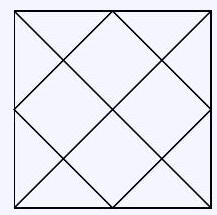 | There are 6 squares and 20 triangles. | 6 | Logic and Puzzles | math-word-problem | Yes | Yes | olympiads | false |
## Task 1
Write down the largest three-digit number. What number do you need to add to this number to get 1000? | The largest three-digit number is 999. To it, one must add 1 to get 1000. | 1 | Number Theory | math-word-problem | Yes | Yes | olympiads | false |
## Task 6
In a family, there are six sons. Each son has a sister. How many children does the family have? | The family has 7 children.
### 12.10 21st Olympiad 1981
### 12.10.1 1st Round 1981, Class 3 | 7 | Logic and Puzzles | math-word-problem | Yes | Yes | olympiads | false |
## Task 6
How many squares and how many triangles does this figure contain?
 | There are 6 squares and 12 triangles.
### 12.10.2 2nd Round 1981, Class 3 | 6 | Geometry | math-word-problem | Yes | Yes | olympiads | false |
## Task 2
Write down the largest three-digit number. What number do you need to add to this number to get 1000? | The largest three-digit number is 999. To it, one must add 1 to get 1000. | 1 | Number Theory | math-word-problem | Yes | Yes | olympiads | false |
## Task 4
$$
7 \text{ km} = \text{m}, \quad 2 \text{ h} = \quad \text{min}, \quad 7 \text{ cm} = \quad \text{mm}, \quad 3 \text{ kg} = \text{g}
$$ | $7 \mathrm{~km}=7000 \mathrm{~m} ; 2 \mathrm{~h}=120 \mathrm{~min} ; 7 \mathrm{~cm}=70 \mathrm{~mm} ; 3 \mathrm{~kg}=3000 \mathrm{~g}$
$7 \text{ km} = 7000 \text{ m}; 2 \text{ h} = 120 \text{ min}; 7 \text{ cm} = 70 \text{ mm}; 3 \text{ kg} = 3000 \text{ g}$ | 7 | Other | math-word-problem | Yes | Yes | olympiads | false |
## Task 1
For the renovation of a large residential building, a total of 36 masons, roofers, and electricians are employed. One fourth of all workers are electricians. There are 16 masons on the construction site.
How many roofers and electricians are working on the construction site? | The fourth part of 36 is 9. 36 - 9 electricians - 16 masons $=11$. On the construction site, there are 9 electricians and 11 roofers. | 9 | Algebra | math-word-problem | Yes | Yes | olympiads | false |
## Task 5
Marion missed the start of a running competition and started as the last runner. However, after overtaking Birgit, Karin, Carola, Gabi, and Katja, she still managed to finish third.
How many girls participated in the race? | Since she overtook 5 runners and only two finished ahead of her, there were $5+1+2=8$ runners. | 8 | Logic and Puzzles | math-word-problem | Yes | Yes | olympiads | false |
## Task 3
Four teams are competing in a tournament. Each team plays against every other team once.
How many games will be played in total? Justify your answer.
You can also create a table to determine the result. | Each team must play three games. In total, 6 games will be played.
 | 6 | Combinatorics | math-word-problem | Yes | Yes | olympiads | false |
## Task 7
Five soldiers start polishing their boots at the same time. Cleaning, polishing, and making a pair of boots shine takes exactly 12 minutes.
When will all the soldiers be finished with the boot polishing? | After 12 minutes
### 13.12 21st Olympiad 1983
### 13.12.1 1st Round 1983, Class 4 | 12 | Other | math-word-problem | Yes | Yes | olympiads | false |
## Task 2
Subtract from 3182100 the product of the numbers 56823 and 56. By how much is the difference greater than 10? | $56823 \cdot 56 = 3182088 ; 3182100 - 3182088 = 12$. The difference is 2 greater than 10. | 2 | Algebra | math-word-problem | Yes | Yes | olympiads | false |
## Task 1
## Calculate!
$2 \mathrm{~km} 730 \mathrm{~m}+520 \mathrm{~m}, \quad 3 \mathrm{t} 650 \mathrm{~kg}-760 \mathrm{~kg}, \quad 6 \mathrm{~m} 283 \mathrm{~mm}+940 \mathrm{~mm}$ | $2 \mathrm{~km} 730 \mathrm{~m}+520 \mathrm{~m}=3 \mathrm{~km} 250 \mathrm{~m}, \quad 3 \mathrm{t} 650 \mathrm{~kg}-760 \mathrm{~kg}=2 \mathrm{t} 890 \mathrm{~kg}, \quad 6 \mathrm{~m} 283 \mathrm{~mm}+940 \mathrm{~mm}$ $=7 \mathrm{~m} 223 \mathrm{~mm}$
$2 \text{ km } 730 \text{ m} + 520 \text{ m} = 3 \text{ km } 250 \... | 3 | Other | math-word-problem | Yes | Yes | olympiads | false |
## Task 7
An animal has two right and two left legs, two legs in front and two at the back.
How many legs does it have? | The animal has 4 legs.
### 13.13 24th Olympics 1986
### 13.13.1 1st Round 1986, Class 4 | 4 | Logic and Puzzles | math-word-problem | Yes | Yes | olympiads | false |
## Task 2
Tanja thinks of a number, triples it, and adds 25. Her result is 40. What number did Tanja think of? Set up an equation for this calculation. | $x \cdot 3+25=40$, i.e., the thought number is 5.
### 13.14 25th Olympiad 1987
### 13.14.1 1st Round 1987, Class 4 | 5 | Algebra | math-word-problem | Yes | Yes | olympiads | false |
Subsets and Splits
No community queries yet
The top public SQL queries from the community will appear here once available.