
problem stringlengths 15 4.7k | solution stringlengths 2 11.9k | answer stringclasses 51
values | problem_type stringclasses 8
values | question_type stringclasses 4
values | problem_is_valid stringclasses 1
value | solution_is_valid stringclasses 1
value | source stringclasses 6
values | synthetic bool 1
class |
|---|---|---|---|---|---|---|---|---|
Problem 5. Given a triangle $ABC$ with $\measuredangle CBA=20^{\circ}, \measuredangle ACB=40^{\circ}$ and $\overline{AD}=2 \text{~cm}$, where $D$ is the intersection point of the angle bisector of the angle at vertex $A$ and side $BC$. Determine the difference $\overline{BC}-\overline{AB}$. | Solution. On side $BC$, we choose a point $E$ such that $\measuredangle AEB=80^{\circ}$. Then $\measuredangle BAE=80^{\circ}$, so triangle $ABE$ is isosceles, i.e., $\overline{AB}=\overline{AE}$. Triangle $AEC$ is isosceles because $\measuredangle EAC=40^{\circ}$, so $\overline{AE}=\overline{CE}$.
, the following table is derived
 face, so the remaining 3 faces (invisible) have $14-3=11$ dots.
## V section | 11 | Logic and Puzzles | math-word-problem | Yes | Yes | olympiads | false |
Problem 1. During the school year, Kosta took several math tests and scored a certain number of points. If Kosta scores 89 points on the next math test, then the average number of points earned from the tests will be 91. However, if on the next test he scores 64, then the average number of points will be 86. How many m... | Solution. Let $n$ be the number of math tests taken so far, and $x$ be the total number of points earned from these tests. If on the next math test Costa scores 89 points, then the total number of points earned will be $x+89$, and the number of tests will be $n+1$. According to this, we get the equation $\frac{x+89}{n+... | 4 | Algebra | math-word-problem | Yes | Yes | olympiads | false |
Problem 5. The length of segment $A B$ is 2 cm longer than the length of segment $C D$. If the length of segment $C D$ is tripled, and the length of segment $A B$ is increased by $10 \mathrm{~cm}$, equal segments will be obtained. What are the lengths of segments $A B$ and $C D$? | Solution. From the drawing, it is clear that when the segment $CD$ is tripled, we have increased it by 2 of its lengths, and this increase is $2+10=12 \mathrm{~cm}$.

Therefore,
$$
\overline{C... | 6 | Algebra | math-word-problem | Yes | Yes | olympiads | false |
Task 1. The distance between telephone poles on a street 1600 m long was 80 m. Due to a certain need, they were rearranged so that the new distance between the poles is 50 m. How many poles remained in the same place after the rearrangement? | Solution. Since $\operatorname{LCM}(80,50)=400$, we get that the unexchanged poles will be those at the first position and every $400 \mathrm{~m}$. Therefore, the total number of unexchanged poles will be $1+1600: 400=5$. | 5 | Geometry | math-word-problem | Yes | Yes | olympiads | false |
Task 2. What is $\frac{31}{71}$ of the number
$$
\frac{1-\frac{1}{3}:\left(2+\frac{1}{6}\right)}{3 \frac{2}{5}+\frac{10-\frac{1}{4}}{3}: \frac{5}{8}} \cdot 8 \frac{3}{5}-\frac{1.5 \cdot \frac{15}{4} \cdot 2.5+\frac{3}{5-\frac{2}{3}}}{1+\frac{1}{7}+\frac{6}{\frac{12}{11} \cdot\left(\frac{8}{3}-\frac{7}{4}\right) \cdot ... | Solution. Let's first calculate the value of the given expression. We have:
$$
\begin{aligned}
& \frac{1-\frac{1}{3}:\left(2+\frac{1}{6}\right)}{3 \frac{2}{5}+\frac{10-\frac{1}{4}}{3}: \frac{5}{8}} \cdot 8 \frac{3}{5}-\frac{1.5: \frac{15}{4} \cdot 2.5+\frac{3}{5-\frac{2}{3}}}{1+\frac{1}{7}+\frac{6}{\frac{12}{11} \cdot... | 0 | Algebra | math-word-problem | Yes | Yes | olympiads | false |
Problem 3. If the lengths of two sides of a triangle are $6 \mathrm{~cm}$ and $12 \mathrm{~cm}$, and the angle between them is $120^{\circ}$, what is the length of the angle bisector of that angle? | Solution. Let $AM$ be the bisector of $\measuredangle BAC = 120^{\circ}$ (see diagram). Then
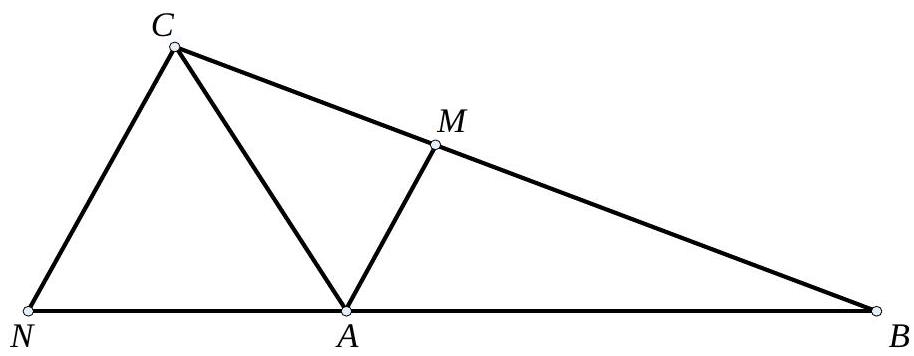
$\measuredangle BAM = \measuredangle MAC = 60^{\circ}$. Let $N$ be a point on the extension of sid... | 4 | Geometry | math-word-problem | Yes | Yes | olympiads | false |
Task 1. We have two jugs, one holds exactly 3 liters, and the other holds exactly 5 liters. Can we measure exactly 4 liters using the two jugs? | Solution. First, we fill the 3-liter jug and pour it into the 5-liter jug, leaving room for 2 more liters. Then, we fill the 3-liter jug again and use it to fill the 5-liter jug, which means that 1 liter will remain in the 3-liter jug. We empty the full 5-liter jug and pour the 1 liter from the 3-liter jug into it. Fin... | 4 | Logic and Puzzles | math-word-problem | Yes | Yes | olympiads | false |
Problem 3. At a training, there were 225 children and 105 balls. The children were divided into groups with an equal number of children, and the trainers distributed the balls to each group so that each group received an equal number of balls. How many groups were formed and how many balls were distributed to each? How... | Solution. First, we find the common divisors of the numbers 225 and 105, which are the numbers $1, 3, 5$, and 15. These represent the number of groups formed. Therefore, the problem has 4 solutions: 1 group of 225 students receiving 105 balls, 3 groups of $225: 3=75$ students each, with each group receiving $105: 3=35$... | 4 | Number Theory | math-word-problem | Yes | Yes | olympiads | false |
Problem 3. A sequence of numbers is formed in the following way: the first is the number 7, then each subsequent term is obtained from the sum of the digits of its square increased by 1. Thus, the second term is the number 14, because
$$
7^{2}=49,4+9+1=14
$$
the third term is the number 17, because
$$
14^{2}=196,1+9... | Solution. The first few members of the sequence are: $7,14,17,20,5,8,11,5,8$, $11, \ldots$. From the first four members, the triplet 5, 8, 11 repeats periodically, so we have: $2002-4=1998=3 \cdot 666$, which means that the number at the 2002nd position is 11. | 11 | Number Theory | math-word-problem | Yes | Yes | olympiads | false |
3. A cyclist is moving from place A to place B, and halfway between A and B is place C. The cyclist covered the distance from A to C in 4 hours, traveling at a speed of $18 \mathrm{~km}$ per hour. How many hours will it take the cyclist to cover the distance from place C to B, if he travels at a speed of $12 \mathrm{~k... | Solution. The distance from place A to place C is $4 \cdot 18=72 \mathrm{~km}$. From the condition of the problem, the distance from $\mathrm{C}$ to $\mathrm{B}$ is the same as the distance from A to C, so the distance from C to B is $4 \cdot 18=72 \mathrm{~km}$. Since the traveler moved at a speed of $12 \mathrm{~km}$... | 6 | Algebra | math-word-problem | Yes | Yes | olympiads | false |
4. Without calculating the product: 1.2.3.4.5.6.7.8.9.10.11$\cdot$12.13, find its last two digits. | Solution. Let's consider the product 1.2.3.4.5.6.7.8.9.10.11.12.13. Since $2 \cdot 5=10$, and the product contains the factor 10, we get: $1 \cdot 3 \cdot 4 \cdot 6 \cdot 7 \cdot 8 \cdot 9 \cdot 11 \cdot 12 \cdot 13 \cdot 100$ which means the last two digits of the product are zeros.
## V section | 0 | Number Theory | math-word-problem | Yes | Yes | olympiads | false |
Problem 2. In class 4-b, there were 24 students. Each student can choose whether to study the subjects of informatics and German. 15 students study informatics, 12 study German, and 8 students do not study either informatics or German. How many students from class 4-b study both informatics and German at the same time? | Solution. Out of 24 students in the class, 8 do not study either informatics or German. This means $24-8=16$ students have chosen at least one of the subjects. Since 15 study informatics and 12 study German, which totals $15+12=27$, we get that $27-16=11$ students study both subjects. | 11 | Combinatorics | math-word-problem | Yes | Yes | olympiads | false |
Problem 3. Martin is 3 times younger than his father, and together they are 44 years old. In how many years will Martin be 2 times younger than his father. | Solution. First method. Let the age of Martin be denoted by $x$, and the age of his father by $y$. From the condition, we have $x+y=44, y=3x$, from which it follows that $x+3x=44$, i.e., $4x=44$, so $x=11$. From this, $y=33$. Let the number of years after which Martin will be half the age of his father be $z$. Then $2(... | 11 | Algebra | math-word-problem | Yes | Yes | olympiads | false |
Problem 3. The set $M$ consists of all prime divisors of the number 2310. How many elements does the set of all numbers obtained as the product of exactly two elements of the set $M$ have? | Solution. The prime divisors of the number 2310 are 2, 3, 5, 7, and 11, and their product is exactly 2310. Therefore, $M=\{2,3,5,7,11\}$, and the set of pairwise products of elements from $M$ is the set $A=\{6,10,14,22$, $15,21,33,35,55,77\}$, which has 10 elements. Thus, the desired number is 10. | 10 | Number Theory | math-word-problem | Yes | Yes | olympiads | false |
Problem 3. At a tennis tournament, 5 tennis players participated. Each player played one game with each of the other players.
a) How many games were played in total at the tournament?
b) How many games did each of the players play? | Solution. Let's denote the players with the letters $A, B, C, D$ and $E$. Player $A$ played 4 games with the other four players: $B, C, D$ and $E$. Player $B$ played 4 games with players $A$ (this game has already been counted), $C, D$ and $E$. Player $C$ played four games with players $A, B$ (these games have already ... | 4 | Combinatorics | math-word-problem | Yes | Yes | olympiads | false |
Task 1. Dragan bought 5 tokens for shooting with an air gun. For each accurate guess, he gets 2 more tokens. How many times did he hit the target if he shot a total of 17 times. | Solution. Dragan has 5 tokens, and to play 17 times he used 17 tokens. This means he earned $17-5=12$ new tokens. For each hit, he gets two tokens, which means he hit the target exactly $12: 2=6$ times. | 6 | Algebra | math-word-problem | Yes | Yes | olympiads | false |
Problem 5. Determine all natural numbers $n$ such that the numbers $3 n-4, 4 n-5$, and $5 n-3$ are prime numbers. | Solution. The sum of the numbers $3 n-4, 4 n-5$, and $5 n-3$ is an even number, so one of them must be an even number. The number $4 n-5$ cannot be even because $4 n$ is even and 5 is odd. Therefore, the numbers $3 n-4$ and $5 n-3$ can only be even. Since 2 is the only even prime number, it can be $3 n-4=2$ or $5 n-3=2... | 2 | Number Theory | math-word-problem | Yes | Yes | olympiads | false |
Problem 3. A sequence of natural numbers starts with the number 6. Each subsequent term in the sequence is obtained by the following rule: if the term $a$ is an even number, then the next term is $\frac{1}{2} a$, and if the term $a$ is an odd number, then the next term in the sequence is $3 a+1$. What is the 2018th ter... | Solution. Let's write down the first members of the sequence. We have:
$63105168421421 \ldots$
Thus, starting from the 6th term, 42 1 repeats cyclically. We observe that at the 7th, 10th, 13th, etc., positions, there will be 4, i.e., at positions whose order number when divided by 3 gives a remainder of 1, there will... | 2 | Number Theory | math-word-problem | Yes | Yes | olympiads | false |
Problem 4. Ivan started watching a movie at 20 hours and 20 minutes. During the movie, there were two breaks for advertisements. The first break lasted 3 minutes and the second break lasted 4 minutes. The movie ended at 22 hours and 37 minutes. How long would the movie have lasted without advertisements? | Solution. From 22 hours and 37 minutes, we subtract 20 hours and 20 minutes, which gives us 2 hours and 17 minutes. Then from them, we will subtract $3+4=7$ minutes for the advertisement break, so we get that the movie lasts 2 hours and 10 minutes. | 2 | Logic and Puzzles | math-word-problem | Yes | Yes | olympiads | false |
Problem 1. Given a right-angled triangle $ABC$ with the right angle at vertex $C$. Let point $P$ be the midpoint of side $\overline{AB}$ and suppose $\measuredangle PCA=90^{\circ}$, $\measuredangle BCP=30^{\circ}$, $\overline{AC}=3 \text{~cm}$. Find the length of side $\overline{BC}$. | Solution. We complete triangle $ABC$ to parallelogram $AECB$. Then, $\measuredangle AEC = 30^{\circ}$, which means that triangle $AEC$ is half of some equilateral triangle, so

$$
\overline{... | 6 | Geometry | math-word-problem | Yes | Yes | olympiads | false |
Problem 5. A multiple-choice test consists of 20 questions. For each correctly solved problem, 8 points are awarded, and for each incorrectly solved problem, 5 points are deducted. If no answer is circled for a question, 0 points are given for it. A student ends up with 13 points. How many problems did the student solv... | Solution. Let $x$ be the number of correctly solved problems, $y$ be the number of incorrectly solved problems, and $z$ be the number of problems on which the student did not answer at all. According to the conditions of the problem, we obtain the system
$$
\left\{\begin{array}{l}
x+y+z=20 \\
8 x-5 y=13
\end{array}\ri... | 6 | Algebra | math-word-problem | Yes | Yes | olympiads | false |
Problem 1. The arithmetic mean of four numbers is 20. After adding one more number, the arithmetic mean of the five numbers will be 18. What is the added number? | Solution. Since the arithmetic mean of the four numbers is 20, the sum of the four numbers is 80, that is
$$
x_{1}+x_{2}+x_{3}+x_{4}=80
$$
The arithmetic mean of the five numbers is 18, that is
$$
x_{1}+x_{2}+x_{3}+x_{4}+x_{5}=5 \cdot 18, \text { i.e. } 80+x_{5}=90
$$
From this, $x_{5}=10$. | 10 | Algebra | math-word-problem | Yes | Yes | olympiads | false |
Problem 1. How many four-digit numbers have a sum of digits equal to 3? | Solution. The baryte numbers are written with the digits: $0,1,2$ and 3 . These are the numbers: 3000, 2100, 2010, 2001, 1110, 1101, 1011, 1200, 1020, 1002. | 10 | Number Theory | math-word-problem | Yes | Yes | olympiads | false |
Problem 1. Sasho thought of a number and multiplied it by 7 and by 16. He added the obtained products and got the number 230. Which number did Sasho think of? | Solution. Let's denote the number that Sasha thought of as $x$. If the number is multiplied by 7 and by 16, the resulting numbers are $7 x$ and $16 x$. If we add the obtained products, we get: $7 x+16 x=230 ; 23 x=230$; $x=230: 23 ; x=10$. The number that Sasha thought of is 10. | 10 | Algebra | math-word-problem | Yes | Yes | olympiads | false |
Problem 2. A group of students went to the park to relax. If 6 students sit on each bench, then there is no place for two of them, but if 7 students sit on each bench, then 3 seats remain empty. How many benches were there in the park and how many students were in the group? | Solution. Let $x$ be the number of benches in the park. If 6 students sit on each bench, then the number of students is $6 x+2$, since two have no place. If, on the other hand, 7 students sit on each bench, then the number of students will be $7 x-3$, since 3 places remain empty. Since the number of students is the sam... | 5 | Algebra | math-word-problem | Yes | Yes | olympiads | false |
Problem 3. In $\triangle A B C$ the lengths of the sides are natural numbers, and the length of the smallest side is $2 \mathrm{~cm}$. Find the area of $\triangle A B C$ if
$$
h_{c}=h_{a}+h_{b}
$$ | Solution. Obviously $h_{c}$ is the largest height, so $c$ is the smallest side, i.e., $c=2 \text{ cm}$. From the formulas for the area of a triangle, we have
$$
h_{a}=\frac{2 P}{a}, h_{b}=\frac{2 P}{b}, h_{c}=\frac{2 P}{c}
$$
and if we substitute in the equation $h_{c}=h_{a}+h_{b}$, we get
$$
\frac{1}{c}=\frac{1}{a}... | 4 | Geometry | math-word-problem | Yes | Yes | olympiads | false |
Problem 3. Philip bought 100 candies at a price of 5 candies for 7 denars, and then sold them all at a price of 2 candies for 3 denars. How many denars did Philip earn? | Solution. Philip bought 100 candies for (100:5) $\cdot$7 = 140 denars, and for them, he received (100:2)$\cdot$3=150 denars. According to this, Philip earned $150-140=10$ denars. | 10 | Algebra | math-word-problem | Yes | Yes | olympiads | false |
Problem 2. Determine the value of $\frac{1}{x^{2}+1}+\frac{1}{y^{2}+1}+\frac{2}{x y+1}$, if $x \neq y$ and $\frac{1}{x^{2}+1}+\frac{1}{y^{2}+1}=\frac{2}{x y+1}$. | Solution. The given equation can be written in the form
$$
\begin{aligned}
& \frac{1}{x^{2}+1}-\frac{1}{x y+1}=\frac{1}{x y+1}-\frac{1}{y^{2}+1} \\
& \frac{x(y-x)}{\left(x^{2}+1\right)(x y+1)}=\frac{y(y-x)}{\left(y^{2}+1\right)(x y+1)}
\end{aligned}
$$
Since $x \neq y$ and $x y+1 \neq 0$, we obtain the equation $\fra... | 2 | Algebra | math-word-problem | Yes | Yes | olympiads | false |
Task 4. The arithmetic mean of ten different natural numbers is 12.5. What is the greatest possible value of the smallest of these numbers? Explain your answer. | Solution. Let the given numbers be $a_{1}<a_{2}<\ldots<a_{10}$. Their arithmetic mean is $\frac{a_{1}+a_{2}+\ldots+a_{10}}{10}=12.5$ from which it follows that
$$
a_{1}+a_{2}+\ldots+a_{10}=125
$$
Since the numbers $a_{1}, a_{2}, \ldots, a_{10}$ are natural, we have
$$
a_{2} \geq a_{1}+1, a_{3} \geq a_{2}+1 \geq a_{1... | 8 | Number Theory | math-word-problem | Yes | Yes | olympiads | false |
Problem 2. Duorites are creatures that have two horns, while heptorites have 7 horns. In one herd, there were both types of creatures. Together, they had 16 horns. How many duorites and heptorites were there in this herd? | Solution. If the herd consists of 8 duors, then they would have $8 \cdot 2=16$ horns, which is not possible since according to the condition, there is at least one heptor in the herd. Therefore, the number of duors in it is less than or equal to 7. The total number of duors cannot be equal to or greater than 5, because... | 1 | Logic and Puzzles | math-word-problem | Yes | Yes | olympiads | false |
Task 1. Determine the unit digit of the sum
$$
1+1 \cdot 2+1 \cdot 2 \cdot 3+1 \cdot 2 \cdot 3 \cdot 4+1 \cdot 2 \cdot 3 \cdot 4 \cdot 5+\ldots+1 \cdot 2 \cdot 3 \cdot \ldots \cdot 2017
$$ | Solution. In the given sum, all addends, except the first four, have the numbers 2 and 5 as factors. This means that the unit digit of all addends, except the first four, is 0, so the unit digit of the sum coincides with the unit digit of
$$
1+1 \cdot 2+1 \cdot 2 \cdot 3+1 \cdot 2 \cdot 3 \cdot 4=1+2+6+24=33
$$
i.e.,... | 3 | Number Theory | math-word-problem | Yes | Yes | olympiads | false |
Problem 4. Find all prime numbers $p$ for which $p^{2}+2 p+11$ and $p^{2}+p+13$ are prime numbers. | Solution. For $p=2$ we have $4+4+11=19$ and $4+2+13=19$. Therefore, one solution is $p=2$.
For $p=3$ we have $9+6+11=26=2 \cdot 13$, so $p=3$ is not a solution to the problem.
If $p>3$, then $p$ is of the form $p=6k \pm 1$. Let $p=6k+1$. Then
$$
p^{2}+p+13=(6k+1)^{2}+6k+1+13=36k^{2}+18k+15=3\left(12k^{2}+6k+5\right)... | 2 | Number Theory | math-word-problem | Yes | Yes | olympiads | false |
Problem 1. In one class, there are 24 students. In this class, the number of boys is equal to $\frac{3}{5}$ of the number of girls. How many boys and how many girls are there in the class? | Solution. First method. Since the number of boys is $\frac{3}{5}$ of the number of girls, we conclude that for every 3 boys, there are 5 girls. Therefore, the students in this class can be divided into groups of $3+5=8$ children. This means we have $24: 8=3$ such groups. In each group, there are 3 boys and 5 girls, whi... | 9 | Algebra | math-word-problem | Yes | Yes | olympiads | false |
Problem 2. The distance between telephone poles on a street 1600 m long was 80 m. Due to the planting of new trees on the street, the poles were relocated so that the new distance between the poles is 50 m. How many poles remained in the same place after the relocation? | Solution. Since $\operatorname{LCM}(50,80)=400$, and the first pole remains in its place, we get that the total number of poles that are not moved is $1+1600: 400=1+4=5$ poles. | 5 | Number Theory | math-word-problem | Yes | Yes | olympiads | false |
Problem 3. In the school, there are 50 teachers, of whom 29 drink coffee, 28 drink tea, and 16 do not drink either coffee or tea. How many teachers drink only coffee, and how many drink only tea? | Solution. Since 16 teachers do not drink either coffee or tea, we get that $50-16=34$ teachers drink either coffee or tea. However, 28 teachers drink tea, and 29 drink coffee, so $(28+29)-34=57-34=23$ teachers drink
. The bounded area is a square with diagonal $d=2$, so the required area is $P=\frac{d^{2}}{2}=2$ sq.units.
+(y+4)+(y+6)+(y+8)}{5}$, $\frac{75}{100} y=\frac{y+x}{2}$, from which by simplification we obtain ... | 4 | Algebra | math-word-problem | Yes | Yes | olympiads | false |
Task 1. In the first barn, there are 1999 more apples than in the second barn. In which barn will there be more apples and by how many, if we transfer 1000 apples from the first barn to the second barn. | Solution. If the second basket has $x$ apples, then the first one has $x+1999$. After the transfer, the first will have $x+999$, and the second will have $x+1000$. It follows that the second one has one more apple. | 1 | Algebra | math-word-problem | Yes | Yes | olympiads | false |
Task 3. A square with an area of $36 \mathrm{~cm}^{2}$ is given. Determine the length of the rectangle which has a width of 3 cm and the same perimeter as the square. | Solution. The area of the square is $P=36 \mathrm{~cm}^{2}$, from which it follows that the side of the square is $6 \mathrm{~cm}$, and its perimeter is $L_{k}=4 \cdot 6=24 \mathrm{~cm}$. Then, if in the perimeter equation of the rectangle we substitute $L_{p}=24 \mathrm{~cm}$ and $b=3 \mathrm{~cm}$, we get $L_{p}=2 a+... | 9 | Geometry | math-word-problem | Yes | Yes | olympiads | false |
Problem 4. Blagoya participated in a lottery where each ticket is marked with a three-digit number. He bought all the tickets marked with numbers where the product of the tens and units digits is equal to 12, and the sum of these two digits differs from the hundreds digit by 1. How many tickets and with which numbers d... | Solution. Let $D$ denote the tens digit and $E$ the units digit. According to the problem, the product of the tens digit and the units digit is 12, so the possible pairs $(D, E)$ are: $(6,2),(2,6),(3,4),(4,3)$.
The sum $D+E$ of the first two pairs is 8, so in this case, the hundreds digit can be 7 or 9. Therefore, Bla... | 8 | Logic and Puzzles | math-word-problem | Yes | Yes | olympiads | false |
Task 5. Elena and Desanka together have six 50 denar coins and four 100 denar banknotes. In how many ways can they equally divide the money. | Solution. Elena and Desanka together have $6 \cdot 50 + 4 \cdot 100 = 700$ denars, so each of them should receive $700 : 2 = 350$ denars. Let $x$ be the number of 50 denar coins, and $y$ be the number of 100 denar banknotes that Elena received. Then $50x + 100y = 350$, or $x + 2y = 7$, where $x \in \{0, 1, 2, 3, 4, 5, ... | 3 | Combinatorics | math-word-problem | Yes | Yes | olympiads | false |
2. Pavel took several matches and put them in the matchbox, then started making figures in the form of hexagons and octagons. The length of the side of each figure was equal to the length of one match. From all 168 matches, Pavel made exactly 23 figures. How many hexagons did Pavel make? | Solution. If all the figures are hexagons, then the number of matches used will be $23 \cdot 6=138$, i.e., Pavel will not use $168-138=30$ matches. When making an octagon, two more matches are used compared to making a hexagon. Therefore, the number of octagons is 30:2=15. Finally, Pavel made $23-15=8$ hexagons. | 8 | Number Theory | math-word-problem | Yes | Yes | olympiads | false |
5. The numbers $1,2,3, \ldots, 16$ are written on slips of paper, one number per slip. Kosta, without looking, sequentially draws one slip at a time, until the product of the numbers written on any two of the drawn slips is a perfect square. What is the maximum number of slips Kosta can draw without the product of any ... | Solution. The prime numbers less than 16 are 2, 3, 5, 7, 11, and 13. Clearly, the product of any two of them is not a perfect square. If we add the number 1 to these numbers, then the product of any two numbers from the set \{1, 2, 3, 5, 7, 11, 13\} is not a perfect square. Furthermore, the numbers less than 16 that ca... | 11 | Number Theory | math-word-problem | Yes | Yes | olympiads | false |
3. Let $a^{2}+b^{2}=1, c^{2}+d^{2}=1$ and $a c+b d=0$. Determine the value of the expression $a b+c d$? | Solution. First method. From $a^{2}+b^{2}=1$, it follows that $a$ and $b$ cannot both be zero simultaneously. Without loss of generality, we can assume that $a \neq 0$. Then $c=-\frac{b d}{a}$. We have
$$
1=c^{2}+d^{2}=\frac{b^{2} d^{2}}{a^{2}}+d^{2}=\frac{d^{2}\left(a^{2}+b^{2}\right)}{a^{2}}=\frac{d^{2}}{a^{2}}
$$
... | 0 | Algebra | math-word-problem | Yes | Yes | olympiads | false |
1. Determine the value of the parameter $n$ such that for every point $(x, y)$ on the graph of the function $y=-x+n$, the following equations hold: $y=\frac{5}{x}$ and $y^{2}=6-x^{2}$. Then, calculate the area of the region in the plane formed by the coordinate axes and the graph of the function. | Solution. From the condition $y^{2}=6-x^{2}$, we have $x^{2}+y^{2}=6$, and from $y=\frac{5}{x}$, we get $x y=5, x \neq 0$. By squaring $y=-x+n$, we obtain
$$
x^{2}+y^{2}+2 x y=n^{2}
$$
Accordingly, $n^{2}=6+10$, and thus $n= \pm 4$. Therefore, we obtain two functions $y=-x+4$ and $y=-x-4$. For each of them, the part ... | 8 | Algebra | math-word-problem | Yes | Yes | olympiads | false |
5. The lengths of the diagonals of a trapezoid are 3 and 5, and the segment connecting the midpoints of the bases is 2 units long. Calculate the area of the trapezoid. | Solution. From point $C$, we draw a line parallel to the diagonal BD. The intersection of this line with the line on which the base $AB$ lies is marked as $M$. Triangles $ACD$ and $BMC$ have equal bases ($\overline{BM}=\overline{CD}=b$) and heights, so $P_{\triangle ACD}=P_{\triangle BMC}$. Therefore, $P_{ABCD}=P_{\tri... | 6 | Geometry | math-word-problem | Yes | Yes | olympiads | false |
5. Aneta and Viktor are playing a game. The game starts with Aneta saying a number from 1 to 7. Then Viktor adds that number to another number from 1 to 7 and says the sum. Aneta, in turn, adds the number Viktor said to another number from 1 to 7 and says the sum, and this process alternates until one of them says the ... | Solution. Aneta will win this game if she reaches the number 92 (then Victor would get 93, 94, ..., 98, or 99, and clearly Aneta, adding 7, 6, ..., 2, or 1, would say the number 100). To definitely say the number 92, in the previous step, Aneta needs to say the number 84, or previously say 76, etc. Since $92=11 \cdot 8... | 4 | Logic and Puzzles | math-word-problem | Yes | Yes | olympiads | false |
3. Find the digit in the thousands place of the number
$$
2 \cdot 7^{2009}+6 \cdot 7^{2008}+3 \cdot 7^{2007}-7^{2006}
$$ | Solution. We have
$$
\begin{aligned}
n & =2 \cdot 7^{2009}+6 \cdot 7^{2008}+3 \cdot 7^{2007}-7^{2006} \\
& =7^{2006}\left(2 \cdot 7^{3}+6 \cdot 7^{2}+3 \cdot 7-1\right) \\
& =7^{2004} \cdot 7^{2} \cdot 1000 \\
& =\left(7^{4}\right)^{501} \cdot 49 \cdot 1000 \\
& =2401^{501} \cdot 49 \cdot 1000
\end{aligned}
$$
Since ... | 9 | Number Theory | math-word-problem | Yes | Yes | olympiads | false |
3. One working day, $40\%$ of the students from the first shift in a primary school bought a bagel for lunch, $36\%$ of the students bought a sandwich, and the rest bought a croissant.
In the second shift at the same school:
- the number of students who bought a croissant for lunch is $37.5\%$ higher than the number ... | Solution. Let's denote with $x$ the total number of students from the first shift. For dinner, they bought: a bagel $0.4 x$ students; a sandwich 0.36 students; and a croissant $(1-(0.4+0.36)) x=0.24 x$ students.
In the second shift, croissants were bought by: $0.24 x+0.375 \cdot 0.24 x=0.33 x$ students; sandwiches wer... | 6 | Algebra | math-word-problem | Yes | Yes | olympiads | false |
1. A group of girls and boys collected 1700 denars for their friend's birthday gift. The girls contributed 200 denars each, and the boys contributed 300 denars each. How many girls and how many boys were there, if the group had an odd number of members. | Solution. Let $d$ be the number of girls and $m$ be the number of boys. We have
$$
300 m+200 d=170 S \text { i.e. } 3 d+2 m=17
$$
Then we get $2 d=17-3 m$. $m$ can take values from 1 to 5, and since $2 d$ is even, $m$ can be 1, 3, and 5. If $m=1, d=7, m+d=8$; if $m=3, d=4, m+d=7$; if $m=5, d=1, m+d=6$. Since $m+d$ is... | 3 | Algebra | math-word-problem | Yes | Yes | olympiads | false |
3. A teacher and his students set off by bus to a Republican Mathematics Competition. Out of the 52 seats on the bus, they sat on seats whose numbers are consecutive natural numbers whose sum is 54. How many students did the teacher take with him if only one of the seat numbers on which they sat is a prime number? | Solution. First method. In the bus, there are seats numbered from 1 to 52. Among them, the prime numbers are: $2,3,5,7,11,13,17,19,23,29,31$, $37,41,43$ and 47. From these numbers, we need to find one such that when added to its predecessors and successors, the sum is 54. With the numbers $2,3,5,7,11$, $23,29,31,37,41,... | 3 | Number Theory | math-word-problem | Yes | Yes | olympiads | false |
2. Solve the equation in the set of prime numbers
$$
3 p^{2}+3 p=166+q
$$ | Solution. First method. We have $3 p^{2}+3 p=166+q$, i.e., $3 p(p+1)=166+q$. Clearly, $p(p+1)$ is an even number, i.e., $2 \mid p(p+1)$, and since $2 \mid 166$, it follows that $2 \mid q$. But from the condition, $q$ is prime, so we get that $q=2$. Now it easily follows that $p(p+1)=56$, from which $p=7$.
Second metho... | 7 | Number Theory | math-word-problem | Yes | Yes | olympiads | false |
4. Can the interior of a convex dodecagon be divided into ten triangles by drawing some of its diagonals, such that no two have a common interior, and four of these dividing triangles are enclosed triangles, and the following condition holds: If a real number different from zero is written in each triangle and the numb... | Solution. The division of the dodecagon is unique and is given in the diagram. Let $a_{1}, a_{2}, \ldots, a_{10}$ be non-zero real numbers written in the divided triangles. From the condition of the problem, we have
$$
a_{7}=a_{1} \cdot a_{6} \cdot a_{10}, a_{8}=a_{2} \cdot a_{3} \cdot a_{10}, a_{9}=a_{4} \cdot a_{5} ... | 1 | Geometry | math-word-problem | Yes | Yes | olympiads | false |
3. For the numbers $x$ and $y, 0<x<y$, the equation $x^{2}+4 y^{2}=5 x y$ holds. Calculate the value of the expression $\frac{x+2 y}{x-2 y}$. | Solution. From the equalities $(x+2 y)^{2}=x^{2}+4 y^{2}+4 x y=9 x y \quad$ and $(x-2 y)^{2}=x^{2}+4 y^{2}-4 x y=x y$ we obtain that $\left(\frac{x+2 y}{x-2 y}\right)^{2}=9$, i.e., $\frac{x+2 y}{x-2 y}= \pm 3$. From $00$, and from $x<2 x<2 y$ it follows that $x-2 y<0$. Therefore, $\frac{x+2 y}{x-2 y}<0$, and hence $\fr... | -3 | Algebra | math-word-problem | Yes | Yes | olympiads | false |
3. Three students agreed to share 11 identical rolls for dinner. For this occasion, Trajko brought 5 rolls, Vangel brought 6 rolls, and Jordan brought 11 denars. How should these 11 denars be distributed between Trajko and Vangel, so that all three students equally share the costs of the dinner? | Solution. Since Jordan paid his share of the dinner, the dinner for the three of them costs 33 denars. This means each roll costs 3 denars. Consequently, Trajko's five rolls are worth 15 denars, and he dined for 11 denars. We conclude that Trajko should take 4 denars, and Vangel the remaining 7 denars. | 4 | Logic and Puzzles | math-word-problem | Yes | Yes | olympiads | false |
4. The seller has a certain number of live chicks. The first buyer asked to buy half of all the chicks and one more chick. Naturally, he was served. The next buyer asked for half of the remaining chicks and one more chick. He was also served. The third buyer also received half of the remaining chicks and one more chick... | Solution. First method. Let there be a total of x chickens. The first buyer bought: $\frac{x}{2}+\frac{1}{2}$, and the remaining are $x-\left(\frac{x}{2}+\frac{1}{2}\right)=\frac{x}{2}-\frac{1}{2}$ chickens. The second buyer bought: $\frac{1}{2}\left(\frac{x}{2}-\frac{1}{2}\right)+\frac{1}{2}=\frac{x}{4}+\frac{1}{4}$, ... | 7 | Logic and Puzzles | math-word-problem | Yes | Yes | olympiads | false |
1. Let $a, b$ and $c$ be non-zero real numbers and
$$
a+\frac{b}{c}=b+\frac{c}{a}=c+\frac{a}{b}=1
$$
Calculate the value of the expression $a b+b c+c a$. | Solution. From the given equality, by direct calculation we obtain
$$
\begin{aligned}
& a+\frac{b}{c}=1 \Rightarrow a c+b=c \Rightarrow a c=c-b \\
& b+\frac{c}{a}=1 \Rightarrow a b+c=a \Rightarrow a b=a-c \\
& c+\frac{a}{b}=1 \Rightarrow c b+a=b \Rightarrow c b=b-a
\end{aligned}
$$
If we add the last equalities, we g... | 0 | Algebra | math-word-problem | Yes | Yes | olympiads | false |
1. The natural number $n$ when divided by 2 has a remainder $a$, when divided by 4 has a remainder $b$, and when divided by 6 has a remainder $c$. If $a+b+c=9$, determine the remainder when the number $n$ is divided by 12. | Solution. The number $n$ can be written in the form $n=2p+a, 0 \leq a \leq 1$, $n=4q+b, \quad 0 \leq b \leq 3$ and $n=6r+c, \quad 0 \leq a \leq 1$. From this, it follows that $0 \leq a+b+c \leq 9$. Since $a+b+c=9$ it follows that $a=1, b=3$ and $c=5$. Then $n+1=2p+2=4q+4=6r+6$. Thus $n+1$ is divisible by 2, 4, and 6, a... | 11 | Number Theory | math-word-problem | Yes | Yes | olympiads | false |
2. Ana and Bojan agree to play such a game: First, Ana says a number from 1 to 7 (including 1 and 7), then Bojan adds one of the numbers between 1 and 7 (including 1 and 7) to the number said and states the sum, then Ana does the same, and so on. The winner is the one who first says the number 100. Can Ana be sure that... | Solution. Ana will be sure of victory if she manages to say 92 first, as Bojan can say at most 99, and then she will say 100. This means Ana needs to say 92, 84, 76, ..., so she should start with the number 4, and then always say a number that is 8 greater (which is possible, since Bojan can add at most 7, and Ana can ... | 4 | Logic and Puzzles | math-word-problem | Yes | Yes | olympiads | false |
VII.4. In trapezoid ABCD, diagonal AC is perpendicular to leg BC and is the angle bisector of the angle at vertex A. Calculate the length of the base AB, if $\triangle \mathrm{ABC}=60^{\circ}$, and the perimeter of the trapezoid is $\mathbf{25 cm}$. | Solution: Since AC is the bisector of angle A, we have: $\triangle \mathrm{DAC}=\triangle \mathrm{CAB}$, and $\triangle \mathrm{DCA}=\triangle \mathrm{CAB}$ - as alternate interior angles. It follows that $\triangle D A C=\triangle D C A$, i.e., $\triangle A D C$ is isosceles, $\overline{\mathrm{AD}}=\overline{\mathrm{... | 10 | Geometry | math-word-problem | Yes | Yes | olympiads | false |
3. A certain number of boys and girls went camping during the summer break. They planned an ecological action that they would finish in 29 days if each child worked evenly - working the same part of the job in any given days. The boys worked a bit faster; in the same time, 2 boys do as much work as 3 girls. Fortunately... | Solution. Let's assume that at the beginning there were $a$ boys and $b$ girls. Daily they complete $\frac{1}{29}$ of the work. Therefore, in the first three days, $\frac{3}{29}$ of the work is completed. Since boys work 1.5 times faster, the situation is the same as if these $a$ boys were replaced by $1.5 a$ girls, i.... | 5 | Algebra | math-word-problem | Yes | Yes | olympiads | false |
1. What digit does $1 \cdot 2 \cdot \ldots \cdot 99-1 \cdot 3 \cdot 5 \cdot \ldots \cdot 99$ end with? | Solution. $1 \cdot 2 \cdot \ldots .99$ has a ten in the multiplication and therefore ends in 0. The number $1 \cdot 3 \cdot 5 \cdot \ldots .99$ is odd because all are odd and has a five in the product, so it ends in 5. Therefore, the given product $1 \cdot 2 \cdot \ldots .99 - 1 \cdot 3 \cdot 5 \cdot \ldots .99$ ends i... | 5 | Number Theory | math-word-problem | Yes | Yes | olympiads | false |
1. Calculate the expression with mixed numbers
$895231755 \frac{234}{357118} \cdot 895231754 \frac{234}{357118}-895231756 \frac{234}{357118} \cdot 895231753 \frac{234}{357118}$ | Solution. If we set $a=895231755 \frac{234}{357118}$, then the expression to be calculated can be written in the following way:
$$
a(a-1)-(a+1)(a-2)=a^{2}-a-\left(a^{2}-2 a+a-2\right)=2
$$
so the result we are looking for is 2. | 2 | Algebra | math-word-problem | Yes | Yes | olympiads | false |
3. On each of 25 sheets of paper, one of the numbers 1 or -1 is written. The number -1 is written 13 times. It is allowed to remove two sheets and replace them with a sheet on which the product of the removed numbers is written. The procedure is repeated 24 times. What number is written on the last sheet of paper? | Solution. If two leaves with the same numbers are removed, a leaf with the number 1 is added. If two leaves with different numbers are removed, a leaf with the number -1 is added. We can observe that the product of all numbers, when performing the procedure of discarding two numbers and replacing them with the product,... | -1 | Logic and Puzzles | math-word-problem | Yes | Yes | olympiads | false |
4. The segments $\overline{A C}$ and $\overline{B D}$ intersect at point $O$. The perimeter of triangle $A B C$ is equal to the perimeter of triangle $A B D$, and the perimeter of triangle $A C D$ is equal to the perimeter of triangle $B C D$. Find the length of segment $\overline{A O}$, if $\overline{B O}=10$ cm. | Solution. Since $L_{\triangle A B C}=L_{\triangle A B D}$, we have
$$
\overline{A C}+\overline{B C}=\overline{A D}+\overline{B D}
$$
and since $L_{\triangle A C D}=L_{\triangle B C D}$, we have
$$
\overline{A C}+\overline{A D}=\overline{B C}+\overline{B D}
$$
We rewrite the second equation as
$$
\overline{A C}-\ov... | 10 | Geometry | math-word-problem | Yes | Yes | olympiads | false |
2. Several brothers divided a certain amount of gold coins. The first brother took 100 gold coins and $\frac{1}{6}$ of the remainder. The second brother took 200 gold coins and $\frac{1}{6}$ of the new remainder, and so on. The last brother took whatever was left. It turned out that each brother took an equal number of... | Solution. The first brother received $100+\frac{1}{6}(\mathrm{x}-100)$ gold coins, and the second brother received: $200+\frac{1}{6}\left(x-200-100-\frac{1}{6}(x-100)\right)$ gold coins. Since all the brothers received the same number of gold coins, we have $100+\frac{1}{6}(x-100)=200+\frac{1}{6}\left(x-200-100-\frac{1... | 5 | Algebra | math-word-problem | Yes | Yes | olympiads | false |
3. Given $\triangle A B C$ in which the lengths of the sides are consecutive natural numbers. The median from vertex $A$ is perpendicular to the angle bisector of the angle at vertex $B$. Calculate the perimeter of triangle $\triangle A B C$. | Solution. Let $D$ and $E$ be the intersection points of the median from $A$ and the angle bisector from $B$, with sides $BC$ and $AC$ respectively. From $\triangle ABD$ it follows that $\overline{AB} = \overline{BD}$, because $BE$ is the angle bisector of $\measuredangle B$, and it intersects $AD$ at a right angle. Thu... | 9 | Geometry | math-word-problem | Yes | Yes | olympiads | false |
3. The sum of the digits of the number $9^{2014}$ is $a$. The sum of the digits of $a$ is $b$, and the sum of the digits of $b$ is $c$. Determine the number $c$. | Solution. From 9|9014 it follows that $9 \mid a$. From $9^{2014}<10^{2014}$ it follows that $a<2015 \cdot 9=18135$. From 9|a and $a<18135$ it follows that $9 \mid b$ and $b<5 \cdot 9=45$. From $9 \mid b$ and $b<45$ it follows that $9 \mid c$ and $c<2 \cdot 9=18$. Finally, $c=9$. | 9 | Number Theory | math-word-problem | Yes | Yes | olympiads | false |
4. In the game "clock", at the beginning, the arrow points to one of the numbers from 1 to 7 (drawing on the right). In each step, the arrow moves in the direction of the clock hands by as many fields as the number written in the field before the start of the step. For example, in the drawing, the arrow points to the n... | Solution. Let's create a table where we will enter the current and next position of the arrow, and then a table where we will enter the current and previous position of the arrow. We have
| Current position | Next position |
| :---: | :---: |
| 1 | 2 |
| 2 | 4 |
| 3 | 6 |
| 4 | 1 |
| 5 | 3 |
| 6 | 5 |
| 7 | 7 |
| ... | 5 | Logic and Puzzles | math-word-problem | Yes | Yes | olympiads | false |
5. For the distinct real numbers $a, b, c$, it holds that
$$
\frac{a^{2}}{(b-c)^{2}}+\frac{b^{2}}{(c-a)^{2}}+\frac{c^{2}}{(a-b)^{2}}=2
$$
Calculate
$$
\frac{a}{b-c}+\frac{b}{c-a}+\frac{c}{a-b}
$$ | Solution. We introduce the substitutions
$$
x=\frac{a}{b-c}, y=\frac{b}{c-a}, z=\frac{c}{a-b}
$$
Then the condition of the problem takes the form $x^{2}+y^{2}+z^{2}=2$, and the sum we are looking for is $x+y+z$. Let us note that
$$
\begin{gathered}
x+1=\frac{a+b-c}{b-c}, y+1=\frac{b+c-a}{c-a}, z+1=\frac{c+a-b}{a-b} ... | 0 | Algebra | math-word-problem | Yes | Yes | olympiads | false |
2. For delivering the mail, the postman uses a bicycle. From the post office to location $A$ is $48 \mathrm{~km}$. The first $10 \mathrm{~km}$ of the route is flat, the next $10 \mathrm{~km}$ is uphill, then $6 \mathrm{~km}$ is flat again, and the remaining part of the route is downhill, inclined at the same angle as t... | Solution. Let $x$ be the speed at which the postman drives through the valley. The valley distance from the post office to point $A$ is $48-(10+10+6)=22 \mathrm{~km}$. The postman took $\frac{10}{8}+\frac{10}{3}+\frac{6}{8}+\frac{22}{x}$ hours to travel from the post office to point $A$. The same route from point $A$ t... | 10 | Algebra | math-word-problem | Yes | Yes | olympiads | false |
3. The base of a right quadrilateral prism is a rhombus with an area of $\frac{2}{3} k^{2}$, $k>0$. The smaller diagonal section of the prism is a square with an area of $k^{2}$.
a) Express the surface area and volume of the prism in terms of $k$.
b) For what value of $k$ are the numerical values of the surface area ... | Solution. From the fact that the smaller diagonal cross-section of the prism is a square with area $k^{2}$, it follows that the height of the prism $H=k$ and the smaller diagonal of its base $d_{1}=k$. The base of the prism is a rhombus with area $B=\frac{2}{3} k^{2}$, from which we get $\frac{2}{3} k^{2}=\frac{d_{1} \... | 7 | Geometry | math-word-problem | Yes | Yes | olympiads | false |
2. At the mathematics competition, 140 students participated. For each student, the competition organizer provided one juice box. The juices were packed in boxes of 16, 17, or 40. How many juices were there of each type? Explain! | Solution: Let there be $x$ boxes with 16 juices each, $y$ boxes with 17, and $z$ boxes with 40 juices. Then $16 x+17 y+40 z=140$. Since 16, 40, and 140 are divisible by 4, it follows that $17 y$ is also divisible by 4. But 4 is not a divisor of 17, so we conclude that 4 is a divisor of $y$, i.e., $y=4 k$. Then $16 x+17... | 2 | Number Theory | math-word-problem | Yes | Yes | olympiads | false |
5. Around a round table, there are 11 chairs, and at the beginning, 10 children are sitting whose chairs, in the direction of the clock hands, are marked with numbers from 1 to 10. Pavel needs to join them. Once everyone is seated around the table, the children play an elimination game: they start counting in the direc... | Solution. When Pavel sits down, there will be 11 children at the table. We renumber the chairs around the table in the direction of the clock hands, so that the chair previously marked with the number 1 is again marked with the number 1. We start counting as described in the game and cross out every thirteenth number. ... | 7 | Logic and Puzzles | math-word-problem | Yes | Yes | olympiads | false |
1. Determine the greatest value of the natural number $n$ such that the number $39^{n}$ is a divisor of the number 39! Explain your answer. | Solution. We have $39=3 \cdot 13$. In the number 39!, the prime number 13 appears as a divisor of 13, 26, and 39. Therefore, the greatest value of the number $n$ is 3. | 3 | Number Theory | math-word-problem | Yes | Yes | olympiads | false |
3. In 2018, Pavel will be as many years old as the sum of the digits of the year he was born. How old is Pavel? | Solution. If Pavel was born in the 20th century, then according to the condition of the problem, we get the following equation:
$$
\begin{aligned}
& 2018-\overline{19 a b}=1+9+a+b \\
& 2018-1900-10 a-b=10+a+b \\
& 11 a+2 b=108
\end{aligned}
$$
This equation has no solution such that $a$ and $b$ are single-digit numbe... | 10 | Number Theory | math-word-problem | Yes | Yes | olympiads | false |
1. If $x, y$ are natural numbers for which $x-y-\frac{1}{x}+\frac{1}{y}=0$, calculate the value of the expression $\left(\frac{x}{y}\right)^{2018}+\left(\frac{y}{x}\right)^{2018}$. | Solution. First method. If we multiply the given equation by xy, we get $x^{2} y+x=x y^{2}+y$, i.e., $x(x y+1)=y(x y+1)$. Since the numbers are natural, it follows that $x y+1 \neq 0$. Therefore, $x=y$. According to this, $\left(\frac{x}{y}\right)^{2018}+\left(\frac{y}{x}\right)^{2018}=2$.
Second method. The equation ... | 2 | Algebra | math-word-problem | Yes | Yes | olympiads | false |
1. A square with a side length of $12 \mathrm{~cm}$ is given. Find the dimensions of all different rectangles whose side lengths are different natural numbers, and whose area is equal to the area of the given square. Which of the obtained rectangles has the largest, and which has the smallest perimeter? | Solution. The rectangle has the same area as the given square, so the area of the rectangle is $144 \mathrm{~cm}^{2}$. We factorize the number 144 into divisors, i.e., $144=2^{4} \cdot 3^{2}$, and form all possible pairs of different natural numbers whose product is 144. This gives us 6 rectangles with sides: 2 and 72,... | 1 | Geometry | math-word-problem | Yes | Yes | olympiads | false |
1. Solve the equation
$$
\sqrt{x^{2}+x}+\sqrt{1+\frac{1}{x^{2}}}=\sqrt{x+3}
$$ | Solution. From the given equation by squaring follows the equation
$$
\left(x-\frac{1}{x}\right)^{2}+2 \sqrt{\left(x^{2}+x\right)\left(1+\frac{1}{x^{2}}\right)}=0
$$
From this, it follows that $x-\frac{1}{x}=0$, i.e., $x=1$ or $x=-1$. By direct verification, we find that $x=1$ is not a solution to the original equati... | -1 | Algebra | math-word-problem | Yes | Yes | olympiads | false |
4. Determine the largest integer $k$ with the following property: no matter how the numbers $1,2, \ldots, 64$ are written in the cells of an $8 \times 8$ board, there exist two adjacent cells such that the difference between the numbers written in these cells is not less than $k$. (Two cells are adjacent if they share ... | Solution. In the table shown in the right diagram, the numbers $1,2,3, \ldots, 64$ are written in the cells such that the difference between any two adjacent numbers is not greater than 9. This means that $k \leq 9$.
We will prove that $k=9$. No matter how the numbers are written in the cells of the table from the cel... | 9 | Combinatorics | math-word-problem | Yes | Yes | olympiads | false |
1. Determine the value of the expression
$$
S=\frac{1}{1+x+x y}+\frac{1}{1+y+y z}+\frac{1}{1+z+z x}
$$
if for the real numbers $x, y, z$ it holds that $x y z=1$. | Solution. We have
$$
\begin{aligned}
S & =\frac{1}{1+x+x y}+\frac{1}{1+y+y z}+\frac{1}{1+z+z x} \\
& =\frac{z}{z+x z+x y z}+\frac{x z}{x z+x y z+x y z^{2}}+\frac{1}{1+z+z x} \\
& =\frac{z}{1+z+x z}+\frac{x z}{1+z+x z}+\frac{1}{1+z+z x}=1
\end{aligned}
$$
provided that the expression $S$ is defined. | 1 | Algebra | math-word-problem | Yes | Yes | olympiads | false |
4. Determine the smallest natural number $n$ for which there exists a set
$$
M \subset\{1,2, \ldots, 100\}
$$
of $n$ elements that satisfies the conditions:
a) 1 and 100 belong to the set $M$,
b) for every $a \in M \backslash\{1\}$, there exist $x, y \in M$ such that $a=x+y$. | Solution. Let $M=\left\{a_{1}, a_{2}, \ldots, a_{n}\right\} \subset\{1,2, \ldots, 100\}$, where
$$
1=a_{1}8$, or $n \geq 9$. If $a_{k}=50$ for some index $k$, then from $a_{5}+a_{6} \leq 487$, i.e., $k \geq 8$, so $n \geq 9$. It is straightforward to verify that for the sets
$$
\begin{aligned}
& M_{1}=\{1,2,4,6,10,20... | 9 | Combinatorics | math-word-problem | Yes | Yes | olympiads | false |
4. In the plane, there is a set $S$ of $n$ points ( $n>2$ ) with the property: if $A, B \in S$, then there exists $C \in S$ such that triangle $A B C$ is equilateral. How many can the number $n$ be? | Solution. Let us choose points $A, B \in S$ such that the distance $AB$ is as large as possible. Let point $C \in S$ be such that triangle $ABC$ is equilateral. We will prove that the set $S$ cannot contain more than three points, i.e., that $n=3$.
We construct circles with centers at $A$,
, each with its own switch. It is allowed to change the state of exactly 13 light bulbs simultaneously. Initially, some of the light bulbs are on, and some are off.
a) Is it possible to turn off all the light bulbs?
b) What is the minimum number of steps to turn off all the light ... | Solution. a) It can. If the number of lit bulbs at the beginning is greater than 13, then by turning off 13 bulbs each time, we can always reach a state where we have fewer than 13 lit bulbs. Clearly, in this case, it is sufficient to solve the problem assuming that $n=14$. Let's first assume that only one bulb is lit.... | 9 | Combinatorics | math-word-problem | Yes | Yes | olympiads | false |
2. If $a, b, c$ are the sides of triangle $ABC$, and $\alpha, \beta, \gamma$ are its angles, prove the equality
$$
\left(\frac{b}{c}+\frac{c}{b}\right) \cos \alpha+\left(\frac{a}{b}+\frac{b}{a}\right) \cos \gamma+\left(\frac{a}{c}+\frac{c}{a}\right) \cos \beta=3
$$ | Solution. From the cosine theorem, we have:
$$
\cos \alpha=\frac{b^{2}+c^{2}-a^{2}}{2 b c}, \cos \beta=\frac{c^{2}+a^{2}-b^{2}}{2 c a}, \cos \lambda=\frac{a^{2}+b^{2}-c^{2}}{2 a b}
$$
Therefore,
$$
\begin{aligned}
\left(\frac{b}{c}\right. & \left.+\frac{c}{b}\right) \cos \alpha+\left(\frac{a}{b}+\frac{b}{a}\right) \... | 3 | Geometry | proof | Yes | Yes | olympiads | false |
1. Solve the equation
$$
\sqrt{5 x+1}-2 \sqrt{4-x}+\sqrt{5} \sqrt{x+2}=\sqrt{61-4 x}
$$ | Solution. The given equation is equivalent to the equation
$$
\sqrt{5 x+1}+\sqrt{5 x+10}=\sqrt{61-4 x}+\sqrt{16-4 x}
$$
where all expressions are defined for $-\frac{1}{5} \leq x \leq 4$. Let us denote
$$
f(x)=\sqrt{5 x+1}+\sqrt{5 x+10}, g(x)=\sqrt{61-4 x}+\sqrt{16-4 x}
$$
Then $f(3)=g(3)=9$. For $-\frac{1}{5} \leq... | 3 | Algebra | math-word-problem | Yes | Yes | olympiads | false |
2. The broken line, where each segment has a length of 3 and whose vertices belong to the vertices of a cube with an edge of 2, connects two of the most distant vertices of that cube. What is the smallest number of segments that such a broken line can have? | Solution. Let the broken line start at vertex $A$ and end at vertex $C^{\prime}$. The sphere with radius 3 and center at $A$ intersects the surface of the cube in three arcs: $K L, L N, N K$, where $K, L, N$ are the midpoints of the edges $B^{\prime} C^{\prime}, C^{\prime} D^{\prime}, C^{\prime} C$, respectively, as sh... | 6 | Geometry | math-word-problem | Yes | Yes | olympiads | false |
1. Prove that for every $a \in [5,10]$ the equality holds
$$
\sqrt{a+3-4 \sqrt{a-1}}+\sqrt{a+8-6 \sqrt{a-1}}=1
$$ | Solution. If $5 \leq a \leq 10$, then $2 \leq \sqrt{a-1} \leq 3$ and
$$
\begin{aligned}
\sqrt{a+3-4 \sqrt{a-1}}+\sqrt{a+8-6 \sqrt{a-1}} & =\sqrt{(\sqrt{a-1}-2)^{2}}+\sqrt{(\sqrt{a-1}-3)^{2}} \\
& =|\sqrt{a-1}-2|+|\sqrt{a-1}-3| \\
& =\sqrt{a-1}-2+3-\sqrt{a-1}=1
\end{aligned}
$$ | 1 | Algebra | proof | Yes | Yes | olympiads | false |
2. For which values of the parameter $a$ is the difference of the roots of the equation
$$
2 x^{2}-(a+1) x+(a-1)=0
$$
equal to their product? | Solution. Let $x_{1}$ and $x_{2}$ be the roots of the given equation. According to Vieta's formulas, we have
$$
x_{1}+x_{2}=\frac{a+1}{2}, x_{1} x_{2}=\frac{a-1}{2}
$$
By the condition of the problem, we have $x_{1}-x_{2}=x_{1} x_{2}$, so, solving the system
$$
\left\{\begin{array}{l}
x_{1}+x_{2}=\frac{a+1}{2} \\
x_... | 2 | Algebra | math-word-problem | Yes | Yes | olympiads | false |
2A. If $\frac{1}{a}+\frac{1}{c}=\frac{2}{b}$ and $a c>0$, then $\frac{a+b}{2 a-b}+\frac{c+b}{2 c-b} \geq 4$. Prove! | Solution. We have, $\frac{1}{a}+\frac{1}{c}=\frac{2}{b} \Rightarrow \frac{a+c}{a c}=\frac{2}{b} \Rightarrow b=\frac{2 a c}{a+c}$. According to this,
$$
\begin{aligned}
\frac{a+b}{2 a-b}+\frac{c+b}{2 c-b} & =\frac{a+\frac{2 a c}{a+c}}{2 a-\frac{2 a c}{a+c}}+\frac{c+\frac{2 a c}{a+c}}{2 c-\frac{2 a c}{a+c}}=\frac{a^{2}+... | 4 | Inequalities | proof | Yes | Yes | olympiads | false |
4. Determine the largest natural number less than the value of the expression $\underbrace{\sqrt{6+\sqrt{6+\cdots \sqrt{6}}}}_{2001 \text { roots }}+\underbrace{\sqrt[3]{6+\sqrt[3]{6+\cdots \sqrt[3]{6}}}}_{2001 \text { roots }}$, given that $\sqrt[3]{6}>1.8$. | Solution. Since $\sqrt{6}>2.4$ and $\sqrt[3]{6}>1.8$, we get
$$
4.2<\sqrt{6}+\sqrt[3]{6}<\sqrt[3]{6+\sqrt[3]{6+\ldots+\sqrt[3]{6}}+\sqrt{6+\sqrt{6+\ldots+\sqrt{6}}}}
$$
On the other hand, we have:
$$
\sqrt{6+\sqrt{6+\ldots+\sqrt{6}}}<\sqrt{6+\sqrt{6+\ldots+\sqrt{6+3}}}=3
$$
and
$$
\sqrt[3]{6+\sqrt[3]{6+\ldots+\sqr... | 4 | Algebra | math-word-problem | Yes | Yes | olympiads | false |
1B. The binomial coefficients of the second, third, and fourth terms in the expansion of the binomial $(1+x)^{n}$ form an arithmetic progression. Calculate $n$. | Solution. We have $\binom{n}{2}-\binom{n}{1}=\binom{n}{3}-\binom{n}{2}$. By rearranging, we get $n^{2}-9 n+14=0$. The solutions are $n_{1}=7$ and $n_{2}=2$, but for $n_{2}=2$ the problem does not make sense. Therefore, $n=7$. | 7 | Combinatorics | math-word-problem | Yes | Yes | olympiads | false |
4. Calculate the value of the expression
$$
\left(\frac{1+i}{\sqrt{2}}\right)^{n+4}+\left(\frac{1-i}{\sqrt{2}}\right)^{n+4}+\left(\frac{1+i}{\sqrt{2}}\right)^{n}+\left(\frac{1-i}{\sqrt{2}}\right)^{n},
$$
( i is the imaginary unit). | Solution. Let's denote the expression by $A$. Then
$$
A=\left(\frac{1+i}{\sqrt{2}}\right)^{n}\left[\left(\frac{1+i}{\sqrt{2}}\right)^{4}+1\right]+\left(\frac{1-i}{\sqrt{2}}\right)\left[\left(\frac{1-i}{\sqrt{2}}\right)^{4}+1\right]
$$
Let's calculate the expressions inside the brackets:
$$
\left(\frac{1+i}{\sqrt{2}}... | 0 | Algebra | math-word-problem | Yes | Yes | olympiads | false |
Subsets and Splits
No community queries yet
The top public SQL queries from the community will appear here once available.