
problem stringlengths 15 4.7k | solution stringlengths 2 11.9k | answer stringclasses 51
values | problem_type stringclasses 8
values | question_type stringclasses 4
values | problem_is_valid stringclasses 1
value | solution_is_valid stringclasses 1
value | source stringclasses 6
values | synthetic bool 1
class |
|---|---|---|---|---|---|---|---|---|
## Problem 6
(a) A and B move clockwise with equal angular speed along circles center $\mathrm{P}$ and $\mathrm{Q}$ respectively. $\mathrm{C}$ moves continuously so that $\mathrm{AB}=\mathrm{BC}=\mathrm{CA}$. Establish $\mathrm{C}$ 's locus and speed. *(b) $\mathrm{ABC}$ is an equilateral triangle and $\mathrm{P}$ sat... | ## Solution
(a) Represent A, B as complex numbers $\mathrm{z}_{1}+\mathrm{w}_{1} \mathrm{e}^{\mathrm{it}}, \mathrm{z}_{2}+\mathrm{w}_{2} \mathrm{e}^{\mathrm{it}}$. Then $\mathrm{C}$ is $\left(\mathrm{z}_{1}+\mathrm{w}_{1} \mathrm{e}^{\mathrm{it}}\right)+\left(\mathrm{z}_{2}+\right.$ $\left.\mathrm{w}_{2} \mathrm{e}^{\... | 5 | Geometry | math-word-problem | Yes | Yes | olympiads | false |
## Problem 9
Given a number with 1998 digits which is divisible by 9 . Let $x$ be the sum of its digits, let y be the sum of the digits of $\mathrm{x}$, and $\mathrm{z}$ the sum of the digits of $\mathrm{y}$. Find $\mathrm{z}$.
| ## Solution
$\mathrm{x} \leq 9 \cdot 1998=17982$. Hence $\mathrm{y} \leq$ the greater of $1+7+9+9+9=35$ and $9+9+9+9=36$. But 9 divides the original number and hence also $\mathrm{x}, \mathrm{y}$ and $\mathrm{z}$. Hence $\mathrm{z}=9$.
| 9 | Number Theory | math-word-problem | Yes | Yes | olympiads | false |
## Problem 11
The triangle $\mathrm{ABC}$ satisfies $0 \leq \mathrm{AB} \leq 1 \leq \mathrm{BC} \leq 2 \leq \mathrm{CA} \leq 3$. What is the maximum area it can have?
| ## Solution
If we ignore the restrictions of $\mathrm{CA}$, then the maximum area is 1 , achieved when $\mathrm{AB}$ is perpendicular to $\mathrm{BC}$. But in this case CA satisfies the restrictions.
| 1 | Geometry | math-word-problem | Yes | Yes | olympiads | false |
\section*{Problem 3}
Reduce each of the first billion natural numbers (billion \(=10^{9}\) ) to a single digit by taking its digit sum repeatedly. Do we get more 1 s than \(2 \mathrm{~s}\) ?
| \section*{Solution}
Taking digit sums repeatedly gives the remainder after dividing the number by 9 , or 9 if the number is exactly divisible by \(9.10^{9}-1=9 n\), and for any \(\mathrm{r}>=0\) the nine consecutive numbers \(9 \mathrm{r}+1,9 \mathrm{r}+2, \ldots, 9 \mathrm{r}+9\) include just one number giving remain... | 1 | Number Theory | math-word-problem | Yes | Yes | olympiads | false |
\section*{Problem 8}
Find all natural numbers \(n\) such that \(\mathrm{n}^{2}\) does not divide \(\mathrm{n}!\).
| \section*{Solution}
Answer: \(\mathrm{n}=4\) or prime.
If \(\mathrm{n}=\mathrm{rs}\), with \(12\), then \(r<2 r<n\), and hence \(n^{2}\) divides \(n!\). This covers all possibilities except \(n=4\) or \(n=\) prime, and it is easy to see that in these cases \(n^{2}\) does not divide \(n!\).
| 4 | Number Theory | math-word-problem | Yes | Yes | olympiads | false |
\section*{Problem 13}
What is the smallest number of tetrahedrons into which a cube can be partitioned?
| \section*{Solution}
Answer: 5.
Tetrahedral faces are triangular, so each cube face requires at least two tetrahedral faces. So at least 12 tetrahedral faces are needed in all. At most three faces of a tetrahedron can be mutually orthogonal (and no two faces can be parallel), so at most 3 faces from each tetrahedron c... | 5 | Geometry | math-word-problem | Yes | Yes | olympiads | false |
\section*{Problem 6}
The difference between the longest and shortest diagonals of the regular n-gon equals its side. Find all possible \(n\).
| \section*{Solution}
Answer: \(\mathrm{n}=9\).
For \(\mathrm{n}7\) the side has length \(2 R \sin \pi / n\), the shortest diagonal has length \(2 R \sin 2 \pi / n\), and the longest diagonal has length \(2 R\) for \(n\) even and \(2 R \cos \pi / 2 n\) for \(n\) odd (where \(R\) is the radius of the circumcircle). Thus... | 9 | Geometry | math-word-problem | Yes | Yes | olympiads | false |
\section*{Problem 5}
What is the smallest positive integer a such that we can find integers \(\mathrm{b}\) and \(\mathrm{c}\) so that \(\mathrm{ax}^{2}+\mathrm{bx}\) \(+\mathrm{c}\) has two distinct positive roots less than 1 ?
| \section*{Solution}
\(4 \mathrm{x}^{2}-4 \mathrm{x}+1=(2 \mathrm{x}-1)^{2}\), which has the double root \(1 / 2\). So it remains to consider \(\mathrm{a}=1,2,3\).
-b/a is the sum of the roots, so \(\mathrm{b}\) is negative. c/a is the product of the roots, so \(\mathrm{c}\) is positive. If \(\mathrm{a}=1\), then the ... | 4 | Algebra | math-word-problem | Yes | Yes | olympiads | false |
\section*{Problem 9}
Every city in a certain state is directly connected by air with at most three other cities in the state, but one can get from any city to any other city with at most one change of plane. What is the maximum possible number of cities?
| \section*{Solution}
Answer: 10.
Take a particular city X. At most 3 cities are directly connected to X. Each of those is directly connected to at most 2 other cities (apart from \(\mathrm{X}\) ). So \(\mathrm{X}\) is connected with at most one change to at most 9 other cities. Thus the maximum number is at most 10 .
... | 10 | Combinatorics | math-word-problem | Yes | Yes | olympiads | false |
\section*{Problem 3}
What is the greatest number of sides of a convex polygon that can equal its longest diagonal?
| \section*{Solution}
Answer: 2, except for the equilateral triangle.
It is easy to find two. Take the two sides to be \(\mathrm{AB}\) and \(\mathrm{AC}\) with angle \(\mathrm{BAC}=60 \mathrm{deg}\), and take the other vertices on the minor arc of the circle center \(\mathrm{A}\) radius \(\mathrm{AB}\) between \(\mathr... | 2 | Geometry | math-word-problem | Yes | Yes | olympiads | false |
\section*{Problem 2}
Find the smallest positive integer which can be represented as \(36^{\mathrm{m}}-5^{\mathrm{n}}\).
\section*{Answer}
11
| \section*{Solution}
Obviously \(11=36^{1}-5^{2}\), and we guess that this is the best possible. We cannot have \(36^{\mathrm{m}}-5^{\mathrm{n}}=\) \(\mathrm{k}\), where 2,3 or 5 divides \(\mathrm{k}\) (because then 2 would divide \(5^{\mathrm{n}}\) and similarly in the other cases). So the only possible values of \(\m... | 11 | Number Theory | math-word-problem | Yes | Yes | olympiads | false |
\section*{Problem 17}
\(\mathrm{S}\) is a set of integers. Its smallest element is 1 and its largest element is 100. Every element of S except 1 is the sum of two distinct members of the set or double a member of the set. What is the smallest possible number of integers in \(\mathrm{S}\) ?
\section*{Answer}
| \section*{Solution}
Let \(n=M(n)+m(n)\), where \(M(n) \geq m(n)\). Put \(M^{1}(n)=M(n), M^{2}(n)=M(M(n))\) etc. Then \(\mathrm{M}(100) \geq 50, \mathrm{M}^{2}(100) \geq 25, \mathrm{M}^{3}(100) \geq 13, \mathrm{M}^{4}(100) \geq 7, \mathrm{M}^{5}(100) \geq 4, \mathrm{M}^{6}(100) \geq 2\) (and obviously \(n>M(n)\) ), so ... | 9 | Number Theory | math-word-problem | Yes | Yes | olympiads | false |
\section*{Problem 20}
\(\mathrm{x}\) is a real number. Define \(\mathrm{x}_{0}=1+\sqrt{ }(1+\mathrm{x}), \mathrm{x}_{1}=2+\mathrm{x} / \mathrm{x}_{0}, \mathrm{x}_{2}=2+\mathrm{x} / \mathrm{x}_{1}, \ldots, \mathrm{x}_{1985}=2+\) \(\mathrm{x} / \mathrm{x}_{1984}\). Find all solutions to \(\mathrm{x}_{1985}=\mathrm{x}\).... | \section*{Solution}
If \(\mathrm{x}=0\), then \(\mathrm{x}^{1985}=2 \neq \mathrm{x}\). Otherwise we find \(\mathrm{x}_{1}=2+\mathrm{x} /(1+\sqrt{ }(1+\mathrm{x}))=2+(\sqrt{ }(1+\mathrm{x})-1)=1+\) \(\sqrt{ }(1+x)\). Hence \(x_{1985}=1+\sqrt{ }(1+x)\). So \(x-1=\sqrt{ }(1+x)\). Squaring, \(x=0\) or 3 . We have already ... | 3 | Algebra | math-word-problem | Yes | Yes | olympiads | false |
\section*{Problem 19}
A polygonal line connects two opposite vertices of a cube with side 2 . Each segment of the line has length 3 and each vertex lies on the faces (or edges) of the cube. What is the smallest number of segments the line can have?
\section*{Answer \(\quad 6\)}
| \section*{Solution}
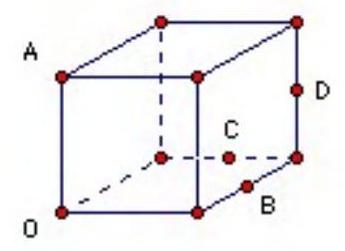
Suppose one endpoint of a segment length 3 is at A. Evidently the other end could be at the edge midpoints B, C, D. It could also be on the circular arc connecting B and... | 6 | Geometry | math-word-problem | Yes | Yes | olympiads | false |
\section*{Problem 18}
\(p(x)\) is the cubic \(x^{3}-3 x^{2}+5 x\). If \(h\) is a real root of \(p(x)=1\) and \(k\) is a real root of \(p(x)=5\), find \(h+k\)
| \section*{Solution}
Put \(y=2-h\), where \(p(h)=1\), then \((2-y)^{3}-3(2-y)^{2}+5(2-y)-1=0\), so \(8-12 y+6 y^{2}-y^{3}-12+12 y-\) \(3 y^{2}+10-5 y-1=0\), or \(y^{3}-3 y^{2}+5 y=5\), or \(p(y)=5\). So if \(h\) is a root of \(p(h)=1\), then there is a root \(k\) of \(p(k)=5\) such that \(h+k=2\). To complete the proof... | 2 | Algebra | math-word-problem | Yes | Yes | olympiads | false |
\section*{Problem 4}
Given an infinite sheet of square ruled paper. Some of the squares contain a piece. A move consists of a piece jumping over a piece on a neighbouring square (which shares a side) onto an empty square and removing the piece jumped over. Initially, there are no pieces except in an \(\mathrm{mxn}\) r... | \section*{Solution}
Obviously \(1 \times 2\) and \(2 \times 2\) can be reduced to 1 . Obviously \(3 \times 2\) can be reduced to 2 . Note that pieces on the four \(\mathrm{X}\) squares can be reduced to a single \(\mathrm{X}\) provided that the square \(\mathrm{Y}\) is empty (call this the L move):
```
. . Y . . X .... | 2 | Combinatorics | math-word-problem | Yes | Yes | olympiads | false |
\section*{Problem 11}
A cinema has its seats arranged in \(\mathrm{n}\) rows \(\mathrm{x} \mathrm{m}\) columns. It sold \(\mathrm{mn}\) tickets but sold some seats more than once. The usher managed to allocate seats so that every ticket holder was in the correct row or column. Show that he could have allocated seats s... | \section*{Solution}
Suppose it is not possible. Take any person, label him \(\mathrm{P}_{1}\). Suppose he should be in seat \(\mathrm{S}_{1}\). If seat \(S_{1}\) is vacant, then we can just move him to \(S_{1}\), so \(S_{1}\) must be occupied by someone. Call him \(\mathrm{P}_{2}\). Continue, so that we get a sequence... | 1 | Combinatorics | proof | Yes | Yes | olympiads | false |
\section*{Problem 20}
Find all integers \(\mathrm{k}>1\) such that for some distinct positive integers \(\mathrm{a}, \mathrm{b}\), the number \(\mathrm{k}^{\mathrm{a}}+1\) can be obtained from \(\mathrm{k}^{\mathrm{b}}+1\) by reversing the order of its (decimal) digits.
\section*{Answer}
\(\mathrm{k}=3,3^{3}+1=28,3^... | \section*{Solution}
\(\mathrm{k}=10\) does not work because \(\mathrm{k}^{\mathrm{a}}+1\) is a palindrome. If \(\mathrm{k}>10\), then for \(\mathrm{a}10\left(\mathrm{k}^{\mathrm{a}}+1\right)\). So \(\mathrm{k}^{\mathrm{b}}+1\) has more digits than \(\mathrm{k}^{\mathrm{a}}+1\). So we only need to consider \(\mathrm{k}... | 3 | Number Theory | math-word-problem | Yes | Yes | olympiads | false |
## Problem 5
A point inside an equilateral triangle with side 1 is a distance $\mathrm{a}, \mathrm{b}, \mathrm{c}$ from the vertices. The triangle $\mathrm{ABC}$ has $\mathrm{BC}=\mathrm{a}, \mathrm{CA}=\mathrm{b}, \mathrm{AB}=\mathrm{c}$. The sides subtend equal angles at a point inside it. Show that sum of the dista... | ## Solution
Let $\mathrm{D}$ be the point inside $\mathrm{ABC}$, so that $\angle \mathrm{ADB}=\angle \mathrm{BDC}=120^{\circ}$. The key is to start from $\mathrm{ABC}$ and to rotate the triangle $\mathrm{BDC}$ through $60^{\circ}$ away from the triangle $\mathrm{ADB}$. After that everything is routine.
Suppose $\math... | 1 | Geometry | proof | Yes | Yes | olympiads | false |
## Problem 1
For which positive integers $\mathrm{a}, \mathrm{b}$ does $\left(\mathrm{x}^{\mathrm{a}}+\ldots+\mathrm{x}+1\right)$ divide $\left(\mathrm{x}^{\mathrm{ab}}+\mathrm{x}^{\mathrm{ab}-\mathrm{b}}+\ldots+\mathrm{x}^{2 b}+\mathrm{x}^{\mathrm{b}}+1\right)$ ?
| ## Solution
Answer: $\mathrm{a}+1$ and $\mathrm{b}$ relatively prime.
The question is when $\left(\mathrm{x}^{\mathrm{a}+1}-1\right) /(\mathrm{x}-1)$ divides $\left(\mathrm{x}^{\mathrm{b}(a+1)}-1\right) /\left(\mathrm{x}^{\mathrm{b}}-1\right)$ or when $\left(\mathrm{x}^{\mathrm{a}+1}-1\right)\left(\mathrm{x}^{\mathrm... | +1 | Algebra | math-word-problem | Yes | Yes | olympiads | false |
## Problem 4
A convex polygon has $\mathrm{n}$ sides. Each vertex is joined to a point $\mathrm{P}$ not in the same plane. If $\mathrm{A}, \mathrm{B}, \mathrm{C}$ are adjacent vertices of the polygon take the angle between the planes PBA and PBC. The sum of the $n$ such angles equals the sum of the $\mathrm{n}$ angles... | ## Solution
$\mathrm{n}=3$ is certainly possible. For example, take $\angle \mathrm{APB}=\angle \mathrm{APC}=\angle \mathrm{BPC}=90^{\circ}$ (so that the lines $\mathrm{PA}, \mathrm{PB}, \mathrm{PC}$ are mutually perpendicular). Then the three planes through $\mathrm{P}$ are also mutually perpendicular, so the two sum... | 3 | Geometry | proof | Yes | Yes | olympiads | false |
## Problem 2
Define $f_{1}(x)=\sqrt{ }\left(x^{2}+48\right)$ and $f_{n}(x)=\sqrt{ }\left(x^{2}+6 f_{n-1}(x)\right)$. Find all real solutions to $f_{n}(x)=2 x$.
| ## Solution
Answer: For each $\mathrm{n}, \mathrm{x}=4$ is the only solution.
Obviously $\mathrm{x}=4$ is a solution. Since $\mathrm{f}_{\mathrm{n}}(\mathrm{x})>=0$, any solution must be non-negative. So we restrict attention to $\mathrm{x} \geq 0$.
Suppose $x2 x$. For $n=1$, the claim is equivalent to $4 x^{2}x^{2}... | 4 | Algebra | math-word-problem | Yes | Yes | olympiads | false |
## Problem 3
Let $\mathrm{S}$ be the set of functions $\mathrm{f}$ defined on reals in the closed interval $[0,1]$ with non-negative real values such that $\mathrm{f}(1)=1$ and $\mathrm{f}(\mathrm{x})+\mathrm{f}(\mathrm{y}) \leq \mathrm{f}(\mathrm{x}+\mathrm{y})$ for all $\mathrm{x}, \mathrm{y}$ such that $\mathrm{x}+... | ## Solution
Answer: $\mathrm{k}=2$.
Consider the function $f(x)=0$ for $0 \leq x \leq 1 / 2,1$ for $1 / 21 / 2$, then $2 x>1$, so $f(x)<2 x$. If $x$ $\leq 1 / 2$, choose $\mathrm{n} \geq 1$, so that $1 / 2^{n+1}<\mathrm{x} \leq 1 / 2^{n}$. Then $2^{\mathrm{n}} \mathrm{f}(\mathrm{x}) \leq \mathrm{f}\left(2^{n^{n}} \ma... | 2 | Inequalities | math-word-problem | Yes | Yes | olympiads | false |
## Problem A1
The sets $\left\{a_{1}, a_{2}, \ldots, a_{999}\right\}$ and $\left\{b_{1}, b_{2}, \ldots, b_{999}\right\}$ together contain all the integers from 1 to 1998 . For each $\mathrm{i}$, $\left|a_{i}-b_{i}\right|=1$ or 6 . For example, we might have $a_{1}=18, a_{2}=1, b_{1}=17, b_{2}=7$. Show that $\sum_{1}^{... | ## Solution
If $\left|a_{i}-b_{i}\right|=6$, then $a_{i}$ and $b_{i}$ have the same parity, so the set of such $a_{i}$ and $b_{i}$ contains an even number of odd numbers. But if $\left|a_{i}-b_{i}\right|=1$, then $a_{i}$ and $b_{i}$ have opposite parity, so each such pair includes just one odd number. Hence if the num... | 9 | Number Theory | proof | Yes | Yes | olympiads | false |
## Problem B2
Prove that for any positive reals $x, y, z$ we have $(2 x+y+z)^{2}\left(2 x^{2}+(y+z)^{2}\right)+(2 y+z+x)^{2}\left(2 y^{2}+(z+x)^{2}\right)+$ $(2 \mathrm{z}+\mathrm{x}+\mathrm{y})^{2}\left(2 \mathrm{z}^{2}+(\mathrm{x}+\mathrm{y})^{2}\right) \leq 8$
| ## Solution
If the inequality holds for $\mathrm{x}, \mathrm{y}, \mathrm{z}$, then it also holds for $\mathrm{kx}, \mathrm{ky}, \mathrm{kz}$, so it is sufficient to prove the result for $x+y+z=3$. The first term becomes $(x+3)^{2} /\left(2 x^{2}+(3-x)^{2}\right)=(1 / 3)\left(x^{2}+6 x+9\right) /\left(x^{2}-2 x+3\right... | 8 | Inequalities | proof | Yes | Yes | olympiads | false |
## Problem B2
The function $\mathrm{f}(\mathrm{n})$ is defined on the positive integers and takes non-negative integer values. It satisfies (1) $f(m n)=f(m)+f(n),(2) f(n)=0$ if the last digit of $n$ is 3 , (3) $f(10)=0$. Find $\mathrm{f}(1985)$.
| ## Solution
If $\mathrm{f}(\mathrm{mn})=0$, then $\mathrm{f}(\mathrm{m})+\mathrm{f}(\mathrm{n})=0($ by $(1))$. But $\mathrm{f}(\mathrm{m})$ and $\mathrm{f}(\mathrm{n})$ are non-negative, so $\mathrm{f}(\mathrm{m})=\mathrm{f}(\mathrm{n})=$ 0 . Thus $f(10)=0$ implies $f(5)=0$. Similarly $f(3573)=0$ by (2), so $f(397)=0$... | 0 | Number Theory | math-word-problem | Yes | Yes | olympiads | false |
## Problem B2
$A$ and $B$ are opposite corners of an $n \times n$ board, divided into $n^{2}$ squares by lines parallel to the sides. In each square the diagonal parallel to $\mathrm{AB}$ is drawn, so that the board is divided into $2 \mathrm{n}^{2}$ small triangles. The board has $(n+1)^{2}$ nodes and large number of... | ## Solution
The diagram above shows that $\mathrm{n}=2$ is possible (the path is AHEFGHCDIHB). Now suppose $\mathrm{n}$ $>2$.
Note that if $\mathrm{X}$ is any vertex except $\mathrm{A}$ or $\mathrm{B}$, then an even number of segments with endpoint $\mathrm{X}$ must be in the path.
Let $\mathrm{F}$ be the bottom lef... | 2 | Combinatorics | math-word-problem | Yes | Yes | olympiads | false |
## Problem B2
$\mathrm{P}_{1}, \mathrm{P}_{2}, \ldots, \mathrm{P}_{\mathrm{n}}$ are points in the plane and $\mathrm{r}_{1}, \mathrm{r}_{2}, \ldots, \mathrm{r}_{\mathrm{n}}$ are real numbers such that the distance between $P_{i}$ and $P_{j}$ is $r_{i}+r_{j}$ (for $i$ not equal to $j$ ). Find the largest $n$ for which ... | ## Solution
Answer: $\mathrm{n}=4$.
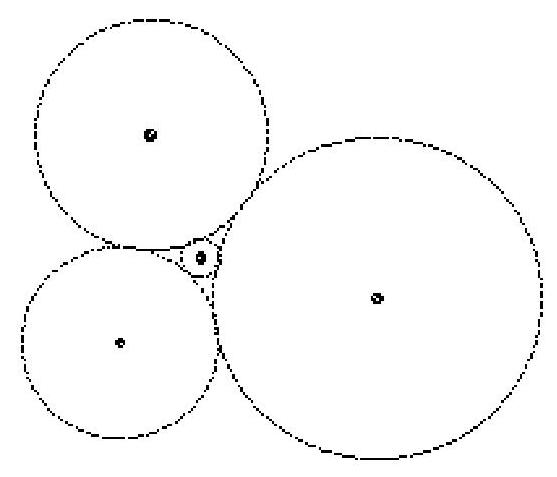
Draw a circle radius $r_{i}$ at $P_{i}$. Then each pair of circles must touch. But that is possible iff $n \leq 4$.
| 4 | Geometry | math-word-problem | Yes | Yes | olympiads | false |
1. Determine the minimum and maximum value of the function $f(x)=\frac{x^{2}}{a x^{4}+b}$, where $a, b>0$, and then determine for which values of the argument $x$ they are achieved. | Solution 1. Clearly $x^{2} \geq 0$, and from the condition $a, b>0$ it follows that $a x^{4}+b>0$. Therefore $f(x) \geq 0$, so the minimum value of the function is $f(x)=0$ and it is achieved only for $x=0$.
From the inequality between the arithmetic and geometric mean for the positive numbers $a x^{4}$ and $b$ we get... | 0 | Algebra | math-word-problem | Yes | Yes | olympiads | false |
3. Let $T$ be an arbitrary point inside triangle $ABC$ and let $A_{1}, B_{1}, C_{1}$ be the intersections of the lines $AT, BT, CT$ with the sides $BC, CA, AB$, respectively. Prove that $\frac{\overline{AT}}{\overline{A_{1}T}} \cdot \frac{\overline{BT}}{\overline{B_{1}T}} \cdot \frac{\overline{CT}}{\overline{C_{1}T}} \... | Solution. Let $P$ be the area of triangle $ABC$, and $P_{1}, P_{2}, P_{3}$ be the areas of triangles $BCT, CAT, ABT$, respectively. Triangles $ABC$ and $BCT$ share a common side, so their areas are related as the corresponding heights, i.e., $\frac{P}{P_{1}}=\frac{h}{h^{\prime}}$. Let $N$ be the foot of the altitude in... | 8 | Inequalities | proof | Yes | Yes | olympiads | false |
1. The sum of 5 natural numbers is 1982. What is the greatest value that their greatest common divisor can take? | Solution. Let $a_{1}, a_{2}, a_{3}, a_{4}, a_{5}$ be those numbers and let $d$ be their greatest common divisor. Then $a_{i}=k_{i} d, i=1,2,3,4,5$ and, therefore,
$$
d\left(k_{1}+k_{2}+k_{3}+k_{4}+k_{5}\right)=1982
$$
i.e.
$$
d s=2 \cdot 991
$$
where $s=k_{1}+k_{2}+k_{3}+k_{4}+k_{5}$.
Since $s \geq 5$, we have: $s... | 2 | Number Theory | math-word-problem | Yes | Yes | olympiads | false |
4. Let $A$ and $B$ be $n$-digit numbers, where $n$ is odd, which give the same remainder $r \neq 0$ when divided by $k$. Find at least one number $k$, which does not depend on $n$, such that the number $C$, obtained by appending the digits of $A$ and $B$, is divisible by $k$. | Solution. Let $A=k a+r, B=k b+r, 0<r<k$; then we have:
$$
C=10^{n} A+B=10^{n}(k a+r)+(k b+r)=k\left(10^{n} a+b\right)+\left(10^{n}+1\right) r .
$$
The number $C$ is divisible by $k$ if and only if the number $10^{n}+1$ is divisible by $k$. Since $n=2 m+1$, we have
$$
10^{n}+1=10^{2 m+1}+1=(10+1)\left(10^{2 m}-10^{m-... | 11 | Number Theory | math-word-problem | Yes | Yes | olympiads | false |
3. Find the smallest value of the expression $\left|36^{m}-5^{n}\right|$, where $m$ and $n$ are natural numbers. | Solution. We consider two cases:
a) $36^{m}>5^{n}$. The last digit of the number $36^{m}-5^{n}$ is 1. Let $36^{m}-5^{n}=1$. Then $5^{n}=\left(6^{m}+1\right)\left(6^{m}-1\right)$, which is not possible, since 5 is not a divisor of $6^{m}+1$.
Let $36^{m}-5^{n}=11$. Obviously, for $m=1, n=2$ the equality is satisfied.
b)... | 11 | Number Theory | math-word-problem | Yes | Yes | olympiads | false |
2. Find the smallest natural number $n>1$ with the following property: there exists a set $M$ of $n$ points in the plane such that every line $AB (A, B \in M)$ is parallel to some other line $CD (C, D \in M)$. | Solution. It is obvious that $n \neq 2,3$. Similarly, there does not exist a set $M$ of four points in the plane with the desired property, because in any quadrilateral, the diagonal is not parallel to the other diagonal, nor to any side.
The set $M$ consisting of the vertices of a regular pentagon has the desired pro... | 5 | Combinatorics | math-word-problem | Yes | Yes | olympiads | false |
4. Solve the equation
$$
2^{x^{5}}+4^{x^{4}}+256^{4}=3 \cdot 16^{x^{3}}
$$ | Solution. If $x<0$, the right side of the equation is less than 3, while the left side is greater than $256^{4}$, so the equation has no solution $x_{0}<0$.
Let $x \geq 0$. From the inequality between the arithmetic and geometric means, applied twice, we get
$$
\begin{aligned}
2^{x^{5}}+4^{x^{4}}+256^{4} & =2^{x^{5}}... | 2 | Algebra | math-word-problem | Yes | Yes | olympiads | false |
4. On each field of the chessboard, a number is written. The sum of the numbers written on any four fields that form a knight's path (in the shape of the letter Г) is constant. How many different numbers are written on the board? Explain your answer. | Solution. Let's consider an arbitrary $3 \times 3$ section of the table (see diagram). According to the condition of the problem, it follows that $a_{1}+a_{4}+a_{5}+a_{6}=a_{4}+a_{5}+a_{6}+a_{3}$, from which it follows that $a_{1}=a_{3}$. Similarly, it can be shown that $a_{4}=a_{6}, a_{7}=a_{9}=a_{3}=a_{1}$, and $a_{2... | 2 | Logic and Puzzles | math-word-problem | Yes | Yes | olympiads | false |
1. Solve the equation $\sqrt{x^{2}+x}+\sqrt{1+\frac{1}{x^{2}}}=\sqrt{x+3}$. | Solution. For the domain, we get $D=[-3,-1] \cup(0,+\infty)$. Then,
$$
\begin{aligned}
& x^{2}+x+1+\frac{1}{x^{2}}+2 \sqrt{x^{2}+x} \sqrt{1+\frac{1}{x^{2}}}=x+3 \\
& x^{2}-2+\frac{1}{x^{2}}+2 \sqrt{(x+1) \frac{x^{2}+1}{x}}=0 \\
& \left(x-\frac{1}{x}\right)^{2}+2 \sqrt{(x+1) \frac{x^{2}+1}{x}}=0
\end{aligned}
$$
From ... | -1 | Algebra | math-word-problem | Yes | Yes | olympiads | false |
1. The point $P$ lies on the inscribed circle $k$ of the equilateral triangle $A B C$. If the length of the side of the triangle is 2, prove that
$$
\overline{P A}^{2}+\overline{P B}^{2}+\overline{P C}^{2}=5
$$ | Solution. We set up a coordinate system with the origin at the center of the inscribed circle, and the x-axis parallel to one side of the triangle.
Then $A\left(0, \frac{2}{\sqrt{3}}\right), B\left(-1,-\frac{1}{\sqrt{3}}\right)$ and $C\left(1,-\frac{1}{\sqrt{3}}\right)$. The radius of the inscribed circle is $r=\frac{... | 5 | Geometry | proof | Yes | Yes | olympiads | false |
1. Calculate the value of the expression
$$
A=\frac{1}{a(a-b)(a-c)}+\frac{1}{b(b-a)(b-c)}+\frac{1}{c(c-a)(c-b)}
$$
if $abc=1$ and $a \neq b \neq c \neq a$. | Solution. We have
$$
\begin{aligned}
A & =\frac{b c(b-c)-a c(a-c)+a b(a-b)}{a b c(a-b)(a-c)(b-c)}=\frac{b^{2} c-b c^{2}-a^{2} c+a c^{2}+a^{2} b-a b^{2}}{a b c(a-b)(a-c)(b-c)} \\
& =\frac{b^{2}(c-a)-b\left(c^{2}-a^{2}\right)+a c(c-a)}{a b c(a-b)(a-c)(b-c)}=\frac{(c-a)\left[b^{2}-b(c+a)+a c\right]}{a b c(a-b)(a-c)(b-c)}... | 1 | Algebra | math-word-problem | Yes | Yes | olympiads | false |
4. Out of 43 coins arranged in a row, 8 coins are facing "tails" up, and 35 are facing "heads" up. In one step, any 20 coins can be flipped. Is it possible after a finite number of steps for all the coins to be facing "heads" up? In the minimum number of steps, how is this possible? Explain your answer! | Solution. Let in the first step $x$ "tails" turn into "heads". Then 20-x "heads" will turn into "tails". After this step, the number of "tails" and "heads" is:
$$
\begin{aligned}
& \text { "tails": }(8-x)+(20-x)=28-2 x, \\
& \text { "heads": } x+(35-(20-x))=2 x+15
\end{aligned}
$$
In this way, after the first step, w... | 2 | Logic and Puzzles | math-word-problem | Yes | Yes | olympiads | false |
3. Find the largest natural number $n$, for which the number 999...99 (with 999 nines) is divisible by $9^{n}$.
---
The text has been translated from Macedonian to English while preserving the original formatting and structure. | Solution. We write the number 999... 99 (with 999 nines) as $10^{999}-1$ and then factor it as follows
$$
\begin{aligned}
10^{999}-1= & \left(10^{666}+10^{333}+1\right)\left(10^{333}-1\right) \\
& =\left(10^{666}+10^{333}+1\right)\left(10^{222}+10^{111}+1\right)\left(10^{111}-1\right) \\
& =\left(10^{666}+10^{333}+1\r... | 2 | Number Theory | math-word-problem | Yes | Yes | olympiads | false |
4. At the end of a chess tournament, it was determined that each participant had earned exactly half of their points playing against the competitors who finished in the last three places. How many participants were there in the tournament?
(Each participant played one game against each of the other participants. A win... | Solution. Let $n$ participants take part in the tournament. The last three participants played three matches among themselves and shared three points. These three points are half of the points they earned in the end, so the other half of their points were earned in matches against the remaining $n-3$ participants. This... | 9 | Logic and Puzzles | math-word-problem | Yes | Yes | olympiads | false |
3. Find all natural numbers $n$ with the following property: for every positive divisor $d$ of $n$, the number $d+1$ is a divisor of $n+1$. | Solution. If $n$ is an odd prime number or one, the divisors of $n$ are 1 and $n$, but then $n+1$ will be an even number for which $1+1=2$ and $n+1$ are certainly its divisors.
If $n$ is an even number, then $n+1$ will be an odd number and $1+1=2$ will not be a divisor of $n+1$, while one is a divisor of $n$, so $n$ c... | 1 | Number Theory | math-word-problem | Yes | Yes | olympiads | false |
2. Determine all real solutions of the equation
$$
2^{x}+3^{x}-4^{x}+6^{x}-9^{x}=1
$$ | Solution. Let $2^{x}=a$ and $3^{x}=b$. The equation transforms into
$$
1+a^{2}+b^{2}-a-b-a b=0
$$
which is equivalent to the equation
$$
(1-a)^{2}+(a-b)^{2}+(b-1)^{2}=0
$$
From the last equation, it follows that $a=b=1$, from which we get that $x=0$. | 0 | Algebra | math-word-problem | Yes | Yes | olympiads | false |
4. Let $f(t)=\sqrt{1+t^{2}}-t$. Calculate the value of the expression
$$
f(x) f(y)+f(y) f(z)+f(z) f(x)
$$
if $x>0, y>0, z>0$ and $x y+y z+z x=1$. | Solution. We introduce trigonometric substitutions
$$
x=\operatorname{ctg} \alpha, y=\operatorname{ctg} \beta, \quad z=\operatorname{ctg} \gamma
$$
where $\alpha, \beta, \gamma$ are acute angles. From the condition of the problem, it follows that the equality holds
$$
\operatorname{ctg} \alpha \operatorname{ctg} \be... | 1 | Algebra | math-word-problem | Yes | Yes | olympiads | false |
3. Let $f(x)$ be a polynomial with integer coefficients, for which
$$
f(0)=23, f\left(x_{1}\right)=f\left(x_{2}\right)=f\left(x_{3}\right)=\ldots=f\left(x_{n}\right)=2014
$$
for some distinct $x_{1}, x_{2}, \ldots, x_{n}$. Find the maximum value of $n$. | Solution. Define $g(x)=f(x)-2014$. If $f\left(x_{i}\right)=2014$, then $x_{i}$ is a zero of $g(x)$, so $g(x)=\prod_{i=1}^{n}\left(x-x_{i}\right) q(x)$ for some polynomial $q(x)$ with integer coefficients, where $n$ is the maximum number of $x_{i}$. Substituting $x=0$ into $g(x)$, we get
$$
g(0)=-1991=-11 \cdot 181=\pr... | 4 | Algebra | math-word-problem | Yes | Yes | olympiads | false |
2. Two workers, working simultaneously, complete a certain task in one day. When they work one after the other, each working for as many hours as the fraction of the work they complete in one day, then $k$ parts of the work would be completed. How much time does each worker need to complete the work alone? | Solution. Let the first worker complete the work in $x$ units of time; then the second worker will complete the work in $\frac{x}{x-1}$ units of time. According to the condition of the problem, we have
$$
\frac{1}{x^{2}}+\frac{(x-1)^{2}}{x^{2}}=\frac{1}{k}
$$
from which we get
$$
(k-1) x^{2}-2 k x+2 k=0
$$
The solu... | 2 | Algebra | math-word-problem | Yes | Yes | olympiads | false |
3. In the middle of one of the side edges of a cube, there is an ant. If the ant moves along the side faces at a speed of 6, and along the bases at $5 \sqrt{2}$, find the number of different paths (up to symmetry) for the ant to reach the middle of the opposite edge as quickly as possible. | Solution. Let the ant be at the midpoint $M$ of edge $A A_{1}$, and it needs to reach the midpoint $R$ of edge $C C_{1}$ (see diagram). Clearly, one of the shortest paths from $M$ to $R$ is the path $M N R$, where $N$ is the midpoint of edge $B B_{1}$. By this path, the ant will reach $R$ in time $t=\frac{2 a}{6}=\frac... | 2 | Combinatorics | math-word-problem | Yes | Yes | olympiads | false |
1. Determine all real numbers $m$ for which the equation
$$
x^{4}-(3 m+2) x^{2}+m^{2}=0
$$
has 4 real roots that are consecutive terms of an arithmetic progression. | Solution. Let $a_{1}, a_{2}, a_{3}, a_{4}$ be consecutive terms of an arithmetic progression, roots of the equation
$$
x^{4}-(3 m+2) x^{2}+m^{2}=0
$$
If $2 b$ is the difference of the progression and $s=\frac{a_{2}+a_{3}}{2}$ then $a_{1}=s-3 b, a_{2}=s-b$, $a_{3}=s+b, a_{4}=s+3 b$.
Using Vieta's formulas, from $a_{1... | 6 | Algebra | math-word-problem | Yes | Yes | olympiads | false |
2. The barrel is filled with 100% alcohol. From the barrel, two liters of alcohol are removed and the same amount of distilled water is added. The procedure is repeated once more, i.e., two liters of the solution are removed and two liters of distilled water are added. In this way, the barrel contains 36% alcohol. How ... | Solution. Let there be $x$ liters of alcohol in the barrel at the beginning, which is also the total amount of solution in the barrel. When we pour out 2 liters of alcohol and add 2 liters of water, there will be $x-2$ liters of pure alcohol in the barrel, which is $\frac{100(x-2)}{x}$ percent alcohol. The total amount... | 5 | Algebra | math-word-problem | Yes | Yes | olympiads | false |
2. Determine all natural numbers $n$ for which $3^{2 n+1}-2^{2 n+1}-6^{n}$ is a prime number. | Solution. We have
$$
3^{2 n+1}-2^{2 n+1}-6^{n}=3 \cdot 3^{2 n}-2 \cdot 2^{2 n}-3^{n} \cdot 2^{n}=3 \cdot\left(3^{n}\right)^{2}-2 \cdot\left(2^{n}\right)^{2}-3^{n} \cdot 2^{n}
$$
We introduce the substitution $3^{n}=a$ and $2^{n}=b$, and we get
$$
3 a^{2}-2 b^{2}-a b=3 a^{2}-3 a b+2 a b-2 b^{2}=3 a(a-b)+2 b(a-b)=(a-b... | 1 | Number Theory | math-word-problem | Yes | Yes | olympiads | false |
1. In the set of real numbers, solve the equation
$$
\log _{1997}\left(\sqrt{1+x^{2}}+x\right)=\log _{1996}\left(\sqrt{1+x^{2}}-x\right)
$$ | Solution. Let $x>0$. Then $\sqrt{x^{2}+1}+x>1$, so $\log \left(\sqrt{x^{2}+1}+x\right)>0$. On the other hand, $\sqrt{x^{2}+1}-x=\frac{1}{\sqrt{x^{2}+1}+x}>0$, which is a solution to the given equation. Similarly, it can be shown that there is no real number $x<0$ that is a solution to the given equation. By direct veri... | 0 | Algebra | math-word-problem | Yes | Yes | olympiads | false |
3. Determine the largest natural number less than the number
$$
\sqrt{6+\sqrt{6+\ldots+\sqrt{6}}}+\sqrt[3]{6+\sqrt[3]{6+\ldots+\sqrt[3]{6}}}
$$
knowing that $\sqrt[3]{6}>1.6$. | Solution. Knowing that $\sqrt{6}>2.4$ and $\sqrt[3]{6}>1.6$, we get
$$
4<\sqrt{6}+\sqrt[3]{6}<\sqrt{6+\sqrt{6+\ldots+\sqrt{6}}}+\sqrt[3]{6+\sqrt[3]{6+\ldots+\sqrt[3]{6}}}
$$
On the other hand
$$
\begin{aligned}
& \sqrt{6+\sqrt{6+\ldots+\sqrt{6}}}<\sqrt{6+\sqrt{6+\ldots+\sqrt{6+3}}}=3 \\
& \sqrt[3]{6+\sqrt[3]{6+\ldot... | 4 | Algebra | math-word-problem | Yes | Yes | olympiads | false |
1. Find the ratio $k=\frac{M}{B}$, where $M$ is the lateral surface area of the cone, and $B$ is the area of its base, given that the volume of the cone is twice the volume of the inscribed sphere in it. | Solution. Let $H, s$ and $r$ be the height, slant height, and radius of the base of the cone, respectively, and let $R$ be the radius of the inscribed sphere. From the similarity of the triangles in the diagram, we have:
$$
\frac{r}{s}=\frac{R}{H-R}
$$
From this, since $H=\sqrt{s^{2}-r^{2}}$, we get $R=r \sqrt{\frac{... | 3 | Geometry | math-word-problem | Yes | Yes | olympiads | false |
2. Let $M$ be an internal point of triangle $A B C$ and let $A M \cap B C=\left\{A_{1}\right\}$, $B M \cap C A=\left\{B_{1}\right\}$ and $C M \cap A B=\left\{C_{1}\right\}$. Prove that
$$
\frac{\overline{A M}}{\bar{A}_{1} M}+\frac{\overline{B M}}{\overline{B_{1} M}}+\frac{\overline{C M}}{\overline{C_{1} M}} \geq 6
$$ | Solution. Let $S$ be the area of $\triangle ABC$, and $S_{1}, S_{2}, S_{3}$ be the areas of $\triangle MBC, \triangle MCA, \triangle MAB$ respectively. Triangles $ABC$ and $MBC$ have the same base, so it follows that
$$
\overline{A A_{1}}: \overline{M A_{1}}=S: S_{1}=\left(S_{1}+S_{2}+S_{3}\right): S_{1}
$$
From this... | 6 | Inequalities | proof | Yes | Yes | olympiads | false |
1. Find the real number $m$ such that the equation
$$
\left(x^{2}-2 m x-4\left(m^{2}+1\right)\right)\left(x^{2}-4 x-2 m\left(m^{2}+1\right)\right)=0
$$
has exactly three distinct real roots. | Solution. The given equation is equivalent to the system of equations
$$
\left[\begin{array}{l}
x^{2}-2 m x-4\left(m^{2}+1\right)=0 \\
x^{2}-4 x-2 m\left(m^{2}+1\right)=0
\end{array}\right.
$$
The discriminant of the first equation is
$$
D_{1}=4\left(5 m^{2}+4\right)
$$
and of the second
$$
D_{2}=4\left(4+2 m\left... | 3 | Algebra | math-word-problem | Yes | Yes | olympiads | false |
1. Calculate the sum $S=S_{1}+S_{2}$, where $S_{1}$ and $S_{2}$ are given by
$$
S_{1}=\frac{1}{\log _{\operatorname{tg} 1^{\circ}} 2}+\frac{2}{\log _{\operatorname{tg} 2^{\circ}} 2^{2}}+\ldots+\frac{44}{\log _{\operatorname{tg} 44^{\circ}} 2^{44}} \text { and } S_{2}=\frac{46}{\log _{\operatorname{tg} 46^{\circ}} 2^{4... | Solution. Using the property of logarithms $\log _{x} a^{k}=k \log _{x} a$, the sum
$$
\begin{aligned}
S & =S_{1}+S_{2} \\
& =\frac{1}{\log _{\operatorname{tg} 1^{\circ}} 2}+\frac{2}{\log _{\operatorname{tg} 2^{\circ}} 2^{2}}+\ldots+\frac{44}{\log _{\operatorname{tg} 44^{\circ}} 2^{44}}+\frac{46}{\log _{\operatorname{... | 0 | Algebra | math-word-problem | Yes | Yes | olympiads | false |
4. If for the real numbers $x$ and $y$ the equality $(x+5)^{2}+(y-12)^{2}=14^{2}$ holds, find the smallest value of the expression $x^{2}+y^{2}$ and determine for which values of $x$ and $y$ this value is achieved. | Solution. The given equation is equivalent to the equation
$$
\left(\frac{x+5}{14}\right)^{2}+\left(\frac{y-12}{14}\right)^{2}=1
$$
therefore there exists $\theta \in[0,2 \pi)$ such that $\frac{x+5}{14}=\cos \theta, \frac{y-12}{14}=\sin \theta$. Therefore,
$$
\begin{aligned}
x^{2}+y^{2} & =(14 \cos \theta-5)^{2}+(14... | 1 | Algebra | math-word-problem | Yes | Yes | olympiads | false |
1. Solve the equation
$$
\sqrt{x^{2}+x}+\sqrt{1+\frac{1}{x^{2}}}=\sqrt{x+3}
$$
in the set of real numbers. | Solution. The domain of the equation is
$$
D=\left\{x \mid x^{2}+x \geq 0, x \neq 0, x \geq-3\right\}=[-3,-1] \cup(0,+\infty)
$$
By framing the equation, we get:
$$
x^{2}+x+1+\frac{1}{x^{2}}+2 \sqrt{\left(x^{2}+x\right)\left(1+\frac{1}{x^{2}}\right)}=x+3
$$
from which we have
$$
x^{2}-2+\frac{1}{x^{2}}+2 \sqrt{(x+... | -1 | Algebra | math-word-problem | Yes | Yes | olympiads | false |
3. Let $x, y, z$ be real numbers.
a) Prove that if $x+y+z=0$, then
$$
|\cos x|+|\cos y|+|\cos z| \geq 1
$$
b) Determine the smallest possible value of the expression
$$
|\cos x|+|\cos y|+|\cos z|+|\cos (x-y)|+|\cos (y-z)|+|\cos (z-x)| \text {. }
$$ | Solution. a) Using the addition formulas, the triangle inequality, properties of absolute value, and the inequalities $|\sin a| \leq 1,|\cos a| \leq 1$, we get
$$
\begin{aligned}
1 & =|\cos (x+y+z)|=|\cos x \cos (y+z)-\sin x \sin (y+z)| \\
& \leq|\cos x| \cdot|\cos (y+z)|+|\sin x| \cdot|\sin (y+z)| \\
& \leq|\cos x|+|... | 2 | Algebra | proof | Yes | Yes | olympiads | false |
2. Determine the remainder of the division of the number $3^{100}$ by 13. | Solution. We have $3^{3}=2 \cdot 13+1$, i.e., $3^{3}=13 k+1$. Therefore,
$$
3^{3} \cdot 3^{3}=(13 k+1)^{2}=169 k^{2}+26 k+1=13\left(13 k^{2}+2\right)+1=13 m+1
$$
Then,
$$
\begin{aligned}
3^{3} \cdot 3^{3} \cdot 3^{3} & =(13 k+1)(13 m+1)=169 k m+13 k+13 m \\
& =13(13 k m+k+m)+1=13 n+1
\end{aligned}
$$
and so on. Wit... | 3 | Number Theory | math-word-problem | Yes | Yes | olympiads | false |
2. a) Calculate
$$
(a-b)\left(a^{4}+a^{3} b+a^{2} b^{2}+a b^{3}+b^{4}\right)
$$
b) Using the equality obtained in a), determine a prime number $p$ such that $2 p^{2}+1=k^{5}$, where $k$ is a natural number. | Solution. a) We have:
$$
\begin{aligned}
& (a-b)\left(a^{4}+a^{3} b+a^{2} b^{2}+a b^{3}+b^{4}\right)= \\
& \quad=a^{5}+a^{4} b+a^{5} b^{2}+a^{2} b^{3}+a b^{4}-a^{4} b-a^{3} b^{2}-a^{2} b^{3}-a b^{4}-b^{5} \\
& \quad=a^{5}-b^{5}
\end{aligned}
$$
b) From $2 p^{2}+1=k^{5}$ we get $2 p^{2}=k^{5}-1$, so according to a) we... | 11 | Algebra | math-word-problem | Yes | Yes | olympiads | false |
1. In how many ways can the number 1991 be written as a sum of consecutive natural numbers? | Solution. Let
$$
n+(n+1)+\ldots+(n+k)=1991
$$
Then
$$
(k+1) n+\frac{k(k+1)}{2}=1991, \text { i.e. }(k+1)(2 n+k)=2 \cdot 11 \cdot 181
$$
Now, since $(k+1)(2 n+k)=2 \cdot 11 \cdot 181>k^{2}$, we get $k<64$, so $k+1 \in\{2,11,22\}$.
a) If $k+1=2$, then $k=1$ and $995+996=1991$.
b) If $k+1=11$, then $k=10$, so $2 n+1... | 3 | Number Theory | math-word-problem | Yes | Yes | olympiads | false |
2. The natural number $a$ is not divisible by 5. Determine the remainder obtained when the number $a^{4}$ is divided by the number 5. | Solution. A number a that is not divisible by 5 can be written in the form $5 k \pm 1$ or $5 k \pm 2$. We have
$$
\begin{aligned}
& a^{2}=(5 k \pm 1)^{2}=25 k^{2} \pm 10 k+1=5\left(5 k^{2} \pm 2 k\right)+1=5 m+1 \text { or } \\
& a^{2}=(5 k \pm 2)^{2}=25 k^{2} \pm 20 k+4=5\left(5 k^{2} \pm 4 k\right)+4=5 n+4
\end{alig... | 1 | Number Theory | math-word-problem | Yes | Yes | olympiads | false |
1. One sixth of the total quantity of a certain commodity is sold at a profit of $20 \%$, and half of the total quantity of the same commodity is sold at a loss of $10 \%$. By what percentage profit should the remainder of the commodity be sold to cover the loss? | Solution. Let $k$ be the total quantity of goods, and $c$ be the planned price. From the condition of the problem, we get the equation
$$
\frac{k}{6} \cdot 0.2 c + \frac{k}{3} \cdot x c = \frac{k}{2} \cdot 0.1 c
$$
where $x$ is the desired percentage. The solution to this equation is $x = 0.05 = 5\%$. | 5 | Algebra | math-word-problem | Yes | Yes | olympiads | false |
1. Two boats start from places $A$ and $B$ heading towards each other. Each of them, when they reach one place, turns back to the other place. The first time the boats met was $5 \mathrm{~km}$ from $A$, and the second time was $3 \mathrm{~km}$ from $B$. Determine the distance from $A$ to $B$. | Solution. Let the distance from $A$ to $B$ be denoted by $x$, the speeds of the boats by $v^{\prime}$ and $v^{\prime \prime}$, the time to the first meeting by $t^{\prime}$, and the time from the first to the second meeting by $t^{\prime \prime}$. From the condition of the problem, we get
$$
v^{\prime} t^{\prime}=5, v... | 12 | Algebra | math-word-problem | Yes | Yes | olympiads | false |
3. A brigade of tractor drivers needs to plow two fields, such that the area of one field is twice as large as the area of the other field. On the first day, all the tractor drivers plowed the first field. On the second day, half of the brigade completed the plowing of the first (larger) field, while the other half of ... | Solution. Let there be $x$ tractor drivers in the brigade. From the conditions of the problem, it follows that for plowing the first field, $x+\frac{x}{2}$ workdays of one tractor driver are needed, and for plowing the second field, $\frac{x}{2}+2$ workdays of one tractor driver are needed. Now, since the first field i... | 8 | Algebra | math-word-problem | Yes | Yes | olympiads | false |
1. In the room, there are several people who know at least one of the three languages: English, French, and German. One-sixth of them know English, one-sixth know German, one-seventh know French, four know English and German, three know German and French, two know French and English, and one knows all three languages. ... | Solution. The problem is most simply solved using a Venn diagram. If we denote by $A, \Phi$, and $\Gamma$ the sets of students who speak English, French, and German, respectively, then from the conditions of the problem, we easily obtain the diagram shown in the figure on the right. According to this, in the room there... | 11 | Combinatorics | math-word-problem | Yes | Yes | olympiads | false |
2. A student thought of a number, appended 2 to it from the right, and added 14 to the resulting number. To the number thus obtained, he appended 3 from the right and added 52 to the resulting number. When the number thus obtained was divided by 60, the quotient was 6 more than the thought number, and the remainder of ... | Solution. Let $x$ be the thought number. The student first obtained the number $10 x+2$, then the number $10 x+16$, and then the number $10(10 x+16)+3$ and finally obtained the number $10(10 x+16)+3+52=10(10 x+16)+55$. When the last number was divided by 60, the quotient was $x+6$ and the remainder was $10 x+x=11 x$. A... | 5 | Number Theory | math-word-problem | Yes | Yes | olympiads | false |
5. In a $100 \times 100$ table, ten thousand numbers are written arbitrarily. Let $a_{1}$ denote the sum of the numbers in the first column, $a_{2}$ the sum of the numbers in the second column, and so on, with $a_{100}$ the sum of the numbers in the hundredth column. Furthermore, let $b_{1}$ denote the sum of the numbe... | Solution. The given expression can be written in the form
$$
\left(a_{1}+a_{2}+\ldots+a_{100}\right)-\left(b_{1}+b_{2}+\ldots+b_{100}\right)
$$
and it is equal to zero, because the sum in the first parentheses is the sum of all 10000 numbers (the sum of the columns), and the sum in the second parentheses is also equa... | 0 | Algebra | math-word-problem | Yes | Yes | olympiads | false |
1. The pond is filled with 100% alcohol. We remove 2 l of alcohol and add the same amount of distilled water. This procedure is repeated once more, i.e., we remove 2 l of the mixture and add 2 l of distilled water. In this way, the pond contains a 36% alcohol solution. How many liters of solution does this pond hold? | Solution. When we pour out 2 liters from $x$ liters of alcohol and add 2 liters of water to the solution, there will be $x-2$ liters of alcohol, i.e., we will get a solution with $\frac{100(x-2)}{x}$ percent alcohol. The total amount of pure alcohol after the second transfer will be $x-2-2 \frac{x-2}{x}$ liters, and ac... | 5 | Algebra | math-word-problem | Yes | Yes | olympiads | false |
1. The base of a right quadrilateral prism is a rhombus with an area of $\frac{2}{3} k^{2}$. The smaller diagonal section of the prism is a square with an area of $k^{2}$. a) Calculate the surface area and volume of the prism expressed in terms of $k$.
b) Determine $k$ if the numerical values of the surface area and v... | Solution. From the area of the smaller diagonal section, we conclude that the smaller diagonal of the rhombus and the height have a length of $k$ (see the diagram on the right). From the area of the rhombus, we obtain the unknown diagonal:
$$
\frac{d k}{2}=\frac{2}{3} k^{2}, \text { i.e., } d=\frac{4}{3} k
$$
The sid... | 7 | Geometry | math-word-problem | Yes | Yes | olympiads | false |
5. Let $n$ be an arbitrary number written with 2000 digits and divisible by 9. Let the sum of the digits of the number $n$ be denoted by $a$, the sum of the digits of $a$ be denoted by $b$, and the sum of the digits of $b$ be denoted by $c$. Determine the number $c$. | Solution. The sum of the digits of the number $n$ is divisible by 9 and is not greater than $2000 \cdot 9=18000$, i.e., $a \leq 18000$. The sum of the digits $b$ of the number $a$ is divisible by 9 and is not greater than 36 (for $a=9999$ it is equal to 36), i.e., $b \leq 36$. The sum of the digits $c$ of the number $b... | 9 | Number Theory | math-word-problem | Yes | Yes | olympiads | false |
1. For what values of $x, y, z$ does the expression $x^{2}+y^{2}+z^{2}-12 y-14 z+90$ have the minimum value? Determine that value. | Solution. We obtain sequentially
$$
\begin{aligned}
x^{2}+y^{2}+z^{2}-12 y-14 z+90 & =x^{2}+y^{2}-12 y+z^{2}-14 z+90 \\
& =x^{2}+(y-6)^{2}+(z-7)^{2}+5 \geq 5
\end{aligned}
$$
According to this, the smallest possible value of the given expression is 5, and it is achieved for $x=0, y=6, z=7$. | 5 | Algebra | math-word-problem | Yes | Yes | olympiads | false |
2. If $a^{2}+a+1=0$, determine the value of the expression
$$
a^{1987}+\frac{1}{a^{1987}}
$$ | Solution. If $a^{2}+a+1=0$, then $a \neq 1$, so we multiply the given equation by $a-1$ to get $(a-1)\left(a^{2}+a+1\right)=0$, i.e., $a^{3}-1=0$, which means $a^{3}=1$. Therefore, $a^{1987}=\left(a^{3}\right)^{662} a=1^{662} a=1 \cdot a=a$, so
$$
a^{1987}+\frac{1}{a^{1987}}=a+\frac{1}{a}
$$
From the condition $a^{2}... | -1 | Algebra | math-word-problem | Yes | Yes | olympiads | false |
5. Let $ABCD$ be an arbitrary convex quadrilateral with area 3. On side $AB$, points $M$ and $N$ are taken such that $AM = MN = NB$, and on side $CD$, points $P$ and $Q$ are taken such that $CP = PQ = QD$. Prove that quadrilateral $MNPQ$ has area 1. | Solution. Triangles $A N Q$ and $N M Q$ have equal bases, $A M = M N$, and a common corresponding height, so they have equal areas (denoted by $P^{\prime}$ on the diagram). For similar reasons, the areas of triangles $C P N$ and $P Q N$ are also equal, denoted by $P^{\prime \prime}$.

$$
If $6 \mid n$... | 12 | Number Theory | math-word-problem | Yes | Yes | olympiads | false |
1. Determine all natural numbers $n$ such that $9^{n}-7$ can be represented as a product of at least two consecutive natural numbers. | Solution. The product of three consecutive natural numbers is divisible by 3, and $9^{n}-7 \equiv 2(\bmod 3)$, so we conclude that $9^{n}-7$ cannot be written as the product of three consecutive numbers.
Let $9^{n}-7=m(m+1)$ for some natural number $m$. The last equation is equivalent to the equation
$$
4 \cdot 9^{n}... | 1 | Number Theory | math-word-problem | Yes | Yes | olympiads | false |
5. Find the largest natural number $n$ for which there exist $n$ lines in space passing through the same point and the angles between any two of them are equal. (The angle between two intersecting lines is defined to be the smaller of the two angles formed by the lines). | Solution. If you are parallel to the vectors
$$
\begin{aligned}
& \left(\frac{1}{\sqrt{5}}, 0, \frac{2}{\sqrt{5}}\right),\left(\frac{1}{\sqrt{5}}, \sqrt{\frac{5+\sqrt{5}}{10}}, \frac{5-\sqrt{5}}{10}\right),\left(\frac{1}{\sqrt{5}},-\sqrt{\frac{5+\sqrt{5}}{10}}, \frac{5-\sqrt{5}}{10}\right) \\
& \left(\frac{1}{\sqrt{5}... | 6 | Geometry | math-word-problem | Yes | Yes | olympiads | false |
2. Determine all natural numbers $n$ such that
$$
\left(n^{3}+39 n-2\right) n!+17 \cdot 21^{n}+5
$$
is a perfect square. | Solution. Let us denote
$$
a_{n}=\left(n^{3}+39 n-2\right) n!+17 \cdot 21^{n}+5
$$
If $n \geq 4$, then 8|n!. Furthermore, $a_{n} \equiv 5^{n}+5(\bmod 8)$.
If $n$ is even, then $5^{n} \equiv 1(\bmod 8)$, so $a_{n} \equiv 6(\bmod 8)$. However, all perfect squares have remainders 0, 1, or 4 when divided by 8. Therefore... | 1 | Number Theory | math-word-problem | Yes | Yes | olympiads | false |
1. In the set of integers, solve the equation
$$
x^{4}+2 y^{4}+4 z^{4}+8 t^{4}=16 x y z t
$$ | Solution. Let us assume that $(x, y, z, t)$ is a solution to the given equation. Clearly, $2 \mid x$, i.e., $x=2a$ and if we substitute in (1), and then divide by 2, we get $y^{4}+2z^{4}+4t^{4}+8a^{4}=16ayzt$. But this means that $2 \mid y$, i.e., $y=2b$ and if we substitute in the previous equation, and then divide by... | 0 | Number Theory | math-word-problem | Yes | Yes | olympiads | false |
2. Let $a, b, c, d$ be positive real numbers such that $a b c d=1$. Prove that
$$
\frac{1}{b c+c d+d a-1}+\frac{1}{c d+d a+a b-1}+\frac{1}{d a+a b+b c-1}+\frac{1}{a b+b c+c d-1} \leq 2
$$ | Solution. First method. We have
$$
\begin{aligned}
(1+b c+c d+d a)(1+a b) & =1+b c+c d+d a+a b+a b^{2} c+a b c d+a^{2} b d \\
& =2+a b+b c+c d+d a+\frac{b}{d}+\frac{a}{c} \\
& \geq 2+a b+b c+c d+d a+2 \sqrt{\frac{a b}{c d}} \\
& =2+2 a b+a b+b c+c d+d a
\end{aligned}
$$
i.e.
$$
1+b c+c d+d a \geq 2+\frac{a b+b c+c d... | 2 | Inequalities | proof | Yes | Yes | olympiads | false |
1. Determine all prime numbers of the form $1+2^{p}+3^{p}+\ldots+p^{p}$ where $p$ is a prime number. | Solution. First method. For $p=2$, we get the number $1+2^{2}=5$, which is a prime number. Let $p>2$, that is, let $p$ be an odd number. Then the number
$$
1+2^{p}+\ldots+p^{p}=\left(1^{p}+(p-1)^{p}\right)+\left(2^{p}+(p-2)^{p}\right)+\ldots+\left(\left(\frac{p-1}{2}\right)^{p}+\left(\frac{p+1}{2}\right)^{p}\right)+p^... | 5 | Number Theory | math-word-problem | Yes | Yes | olympiads | false |
2. Rampо wrote down several different natural numbers and divided their sum by their product. Then, he erased the smallest of the written numbers and again divided the sum of the remaining numbers by their product. It turned out that the second result was three times larger than the first. Which number did Rampо erase? | Solution. Let $a$ be the deleted number, $S$ be the sum of the remaining numbers, and $P$ be their product. Then
$$
\frac{3(a+S)}{a P}=\frac{S}{P} \text {, i.e., } \frac{1}{3}=\frac{1}{a}+\frac{1}{S} \text { . }
$$
Clearly, $a>3$. Furthermore, since $a<S$ we have
$$
\frac{1}{3}<\frac{1}{a}+\frac{1}{a}=\frac{2}{a}
$$... | 4 | Number Theory | math-word-problem | Yes | Yes | olympiads | false |
1. Let $S$ be the set of natural numbers $n$ such that each of the numbers $n+1, n+3, n+4, n+5, n+6$, and $n+8$ is composite. Determine the largest number $k$ with the property: For every $n \in S$ in the set
$$
\{n, n+1, n+2, n+3, n+4, n+5, n+6, n+7, n+8, n+9\}
$$
there are at least $k$ consecutive composite numbers | Solution. We will prove that $k=7$.
If $n=87$ then
$$
\{n+1, n+3, n+4, n+5, n+6, n+8\}=\{88,90,91,92,93,95\}
$$
are all composite numbers, so $S \neq \varnothing$. In the set
$$
\{n, n+1, n+2, \ldots, n+9\}=\{88,89,90, \ldots, 96\}
$$
the longest sequence of consecutive composite numbers has length 7. Therefore, $... | 7 | Number Theory | math-word-problem | Yes | Yes | olympiads | false |
2. Let $x, y$ be real numbers such that
$$
x^{2}+y^{2}=2 \text{ and }\left(x^{3}+y^{3}\right)^{2}=8
$$
Calculate the value of the expression $x^{4}+y^{4}$. | Solution. We have:
$$
\begin{aligned}
& 8=\left(x^{2}+y^{2}\right)^{3}=x^{6}+y^{6}+3 x^{2} y^{2}\left(x^{2}+y^{2}\right)=x^{6}+y^{6}+6 x^{2} y^{2} \\
& 8=\left(x^{3}+y^{3}\right)^{2}=x^{6}+y^{6}+2 x^{3} y^{3}
\end{aligned}
$$
so
$$
6 x^{2} y^{2}-2 x^{3} y^{3}=0
$$
or
$$
x^{2} y^{2}(3-x y)=0
$$
If $x=0$, then $y^{... | 4 | Algebra | math-word-problem | Yes | Yes | olympiads | false |
4. A ten-digit natural number $n=\overline{a_{9} a_{8} a_{7} a_{6} a_{5} a_{4} a_{3} a_{2} a_{1} a_{0}}$ is written with different digits and is divisible by 11.
a) If $S_{1}=a_{1}+a_{3}+a_{5}+a_{7}+a_{9}$ and $S_{2}=a_{0}+a_{2}+a_{4}+a_{6}+a_{8}$, prove that either $S_{1}$ or $S_{2}$ is divisible by 7.
b) Suppose in... | Solution. a) From the divisibility criterion for 11, we have $11 \mid S_{2}-S_{1}$. Furthermore, since
$$
\begin{aligned}
& S_{2}-S_{1} \leq 9+8+7+6+5-(4+3+2+1+0)=25 \text { and } \\
& S_{2}-S_{1} \geq 4+3+2+1+0-(9+8+7+6+5)=-25
\end{aligned}
$$
we get $S_{2}-S_{1} \in\{-22,-11,0,11,22\}$. Now, $S_{1}+S_{2}=45$ and si... | 6 | Number Theory | proof | Yes | Yes | olympiads | false |
2. For a natural number $n$, we will say it is superprime if the difference between any two of its consecutive positive divisors is a prime number. Determine all superprime numbers. | Solution. Clearly, the numbers $n=1$ and $n=3$ are super-prime, which we verify by direct inspection.
We will prove that there are no other super-prime numbers. Let $n \geq 2$ be a super-prime number. Let $d$ be the smallest natural divisor of $n$, different from 1. If $d$ is not a prime number, then $d=ab$, where $1<... | 3 | Number Theory | math-word-problem | Yes | Yes | olympiads | false |
4. Given the number $2009^{2009^{2009}}$, written in the decimal number system. In one step, we perform the following operation: we erase the first and last digit and add their sum to the number that remains after erasing the first and last digit.
a) If after a finite number of steps a two-digit number remains, can th... | Solution. We use the following known results:
Property 1. Every natural number when divided by 3 and 9 gives the same remainder as the sum of its digits.
Property 2. The square of a natural number when divided by 3 gives a remainder of 0 or 1.
We will prove the following property.
Property 3. The remainder when div... | 5 | Number Theory | math-word-problem | Yes | Yes | olympiads | false |
1. On the board, the numbers $1, 2, \ldots, 2009$ are written. Several of them are erased and instead, the remainder of the sum of the erased numbers when divided by 13 is written on the board. After a certain number of repetitions of this procedure, only three numbers remain on the board, two of which are 99 and 999. ... | Solution. Let the third number be $x$. It is clear that at each step, the remainder of the sum of the numbers on the board when divided by 13 does not change.
Since
$$
1+2+3+\ldots+2009=\frac{2009 \cdot 2010}{2}=1005 \cdot 2009
$$
i.e., it has a remainder of 2 when divided by 13, we conclude that $99+999+x$ must hav... | 9 | Number Theory | math-word-problem | Yes | Yes | olympiads | false |
2. Given are two circles $k_{1}$ and $k_{2}$ with centers $P$ and $R$ respectively, which touch each other externally at point $A$. Let $p$ be their common tangent, which does not pass through $A$, and touches $k_{1}$ and $k_{2}$ at points $B$ and $C$, respectively. The line $P R$ intersects the line $B C$ at point $E$... | Solution. Let the radius of $k_{1}$ be $r$, and of $k_{2}$ be $t$, and let the common tangent of $k_{1}$ and $k_{2}$ at point $A$ intersect line $B C$ at $G$. Note that $\overline{A G}=\overline{B G}=\overline{C G}$, as tangent segments. We also have
$$
\measuredangle A P B=180^{\circ}-\measuredangle A G B=\measuredan... | 6 | Geometry | math-word-problem | Yes | Yes | olympiads | false |
4. Let $x, y, z$ be positive real numbers such that $x y z=1$. Prove that
$$
\frac{x^{9}+y^{9}}{x^{6}+x^{3} y^{3}+y^{6}}+\frac{y^{9}+z^{9}}{y^{6}+y^{3} z^{3}+z^{6}}+\frac{z^{9}+x^{9}}{z^{6}+z^{3} x^{3}+x^{6}} \geq 2
$$ | Solution. From the inequality between the arithmetic and geometric means, we have
$$
a^{6}+a^{3} b^{3}+b^{6} \geq 3 \sqrt[3]{a^{9} b^{9}}=3 a^{3} b^{3}
$$
Now, from inequality (1), we have:
$$
\frac{a^{9}+b^{9}}{a^{6}+a^{3} b^{3}+b^{6}}=a^{3}+b^{3}-\frac{2 a^{3} b^{3}\left(a^{3}+b^{3}\right)}{a^{6}+a^{3} b^{3}+b^{6}... | 2 | Inequalities | proof | Yes | Yes | olympiads | false |
2. Let $S$ be a subset of $\{1,2, \ldots, 9\}$ such that the sums of any two elements of $S$ are distinct. For example, the set $\{1,2,3,5\}$ has this property, but the set $\{1,2,3,4,5\}$ does not, because $\{2,3\}$ and $\{1,4\}$ both sum to 5. What is the maximum number of elements that $S$ can contain? | Solution. It is easily verified that $\{1,2,3,5,8\}$ satisfies the condition of the problem.
We will prove that $S$ cannot contain more than 5 elements.
Suppose $S$ contains at least six elements. Then the smallest possible sum of pairs is 3, and the largest $8+9=17$, i.e., the possible sums are
$$
3,4,5, \ldots, 17... | 5 | Combinatorics | math-word-problem | Yes | Yes | olympiads | false |
Problem 3. Jana asked Philip how much the fish his father caught weighed. Philip replied: The head together with the tail weighs $3 \mathrm{~kg}$, the head together with the body weighs $7 \mathrm{~kg}$, and the body together with the tail weighs $8 \mathrm{~kg}$. How much does the fish weigh? | Solution. First method. If we add the given weights, then in the sum, the weights of the head, tail, and body will each be counted twice. According to this, the weight of the fish is half of the calculated sum.
According to this, if $x$ is the weight of the fish, then $x=18: 2=9 \text{ kg}$.
Second method. Let $G$ be... | 9 | Algebra | math-word-problem | Yes | Yes | olympiads | false |
Problem 5. Given trapezoid $ABCD$ with bases $\overline{AB}=16 \text{~cm}, \overline{CD}=8 \text{~cm}$. The sum of angles $ABC$ and $BAD$ is $90^{\circ}$. If $M$ and $N$ are the midpoints of sides $AB$ and $CD$ respectively, calculate the length of segment $MN$. | Solution. Let $P$ and $S$ be points on side $A B$ such that $N P \| A D$ and $N S \| B C$. Triangle $P N S$ is a right triangle, with a right angle at vertex $N$ because
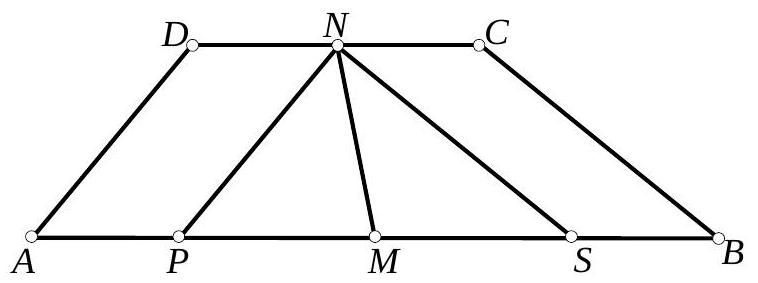
$$
\measuredangle P... | 4 | Geometry | math-word-problem | Yes | Yes | olympiads | false |
Problem 5. In each circle of the diagram, one of the numbers $1,2,3,4$ and 5 must be written, so that the sum of the numbers in the three vertical circles is equal to the sum of the numbers in the three horizontal circles. How many solutions does the problem have? | Solution. From the set $\{1,2,3,4,5\}$, two subsets need to be chosen such that they have an empty intersection, and the sums of the elements in each of them are equal. This can be done in the following ways:
![](https://cdn.mathpix.com/cropped/2024_06_05_1cb7beb611b796adc950g-02.jpg?height=295&width=1079&top_left_y=8... | 3 | Combinatorics | math-word-problem | Yes | Yes | olympiads | false |
Problem 3. Martin has three containers, two of which hold exactly $3 l$ and $5 l$, while the third contains $10 \mathrm{l}$ of milk. He needs to measure out exactly $4 l$ of milk using the three containers.
Can Martin do this, and if so, how? | Solution. It can be done. A 10 l can will fill the 3 l can. Then, the milk from the 3 l can will be poured into the 5 l can. Again, the 10 l can will fill the 3 l can. From the 3 l can, the 5 l can will be topped up. In the 3 l can, 1 l will remain. The milk from the 5 l can will be poured back into the 10 l can. The r... | 4 | Logic and Puzzles | math-word-problem | Yes | Yes | olympiads | false |
Task 1. The set $M$ consists of all prime divisors of the number 2310. How many numbers are the product of exactly two elements of the set $M$? | Solution. The prime divisors of the number 2310 are 2, 3, 5, 7, and 11, and their product is exactly 2310. Therefore, $M=\{2,3,5,7,11\}$, and the set of pairwise products of elements from $M$ is the set
$$
A=\{6,10,14,22,15,21,33,35,55,77\}
$$
and it has 10 elements. Therefore, the desired number is 10. | 10 | Number Theory | math-word-problem | Yes | Yes | olympiads | false |
Problem 2. Bojan, Mirko, and Zdravko had a bag with marbles. Bojan added to the bag as many marbles as there were in the bag and one more marble. Then, Mirko added to the bag twice as many marbles as there were in the bag at that moment plus three marbles. Finally, Zdravko added three times as many marbles as there wer... | Solution. Let there be $x$ candies in the bag at the beginning. When Bojan added candies to the bag, there were
$$
x+x+1=2 x+1
$$
candies in it. When Mirko added the candies, there were
$$
2 x+1+4 x+2+3=6 x+6
$$
candies in the bag. Finally, when Zdravko added the candies to the bag, there were
$$
6 x+6+18 x+18+5=2... | 5 | Algebra | math-word-problem | Yes | Yes | olympiads | false |
Subsets and Splits
No community queries yet
The top public SQL queries from the community will appear here once available.