
problem stringlengths 15 4.7k | solution stringlengths 2 11.9k | answer stringclasses 51
values | problem_type stringclasses 8
values | question_type stringclasses 4
values | problem_is_valid stringclasses 1
value | solution_is_valid stringclasses 1
value | source stringclasses 6
values | synthetic bool 1
class |
|---|---|---|---|---|---|---|---|---|
The area of the triangular region bounded by the $x$-axis, the $y$-axis and the line with equation $y=2 x-6$ is one-quarter of the area of the triangular region bounded by the $x$-axis, the line with equation $y=2 x-6$ and the line with equation $x=d$, where $d>0$. What is the value of $d$ ?
(A) 9
(B) 6
(C) 8
(D) $3+3 ... | The line with equation $y=2 x-6$ has $y$-intercept -6 .
Also, the $x$-intercept of $y=2 x-6$ occurs when $y=0$, which gives $0=2 x-6$ or $2 x=6$ which gives $x=3$.
Therefore, the triangle bounded by the $x$-axis, the $y$-axis, and the line with equation $y=2 x-6$ has base of length 3 and height of length 6 , and so h... | 9 | Geometry | MCQ | Yes | Yes | olympiads | false |
The expression $\frac{2+4}{1+2}$ is equal to
(A) 0
(B) 1
(C) 2
(D) 4
(E) 5 | Evaluating, $\frac{2+4}{1+2}=\frac{6}{3}=2$.
ANSWER: (C) | 2 | Algebra | MCQ | Yes | Yes | olympiads | false |
The ones (units) digit of 542 is 2 . When 542 is multiplied by 3 , the ones (units) digit of the result is
(A) 9
(B) 3
(C) 5
(D) 4
(E) 6 | Since $542 \times 3=1626$, the ones digit of the result is 6 .
Note that the ones digit of a product only depends on the ones digits of the numbers being multiplied, so we could in fact multiply $2 \times 3$ and look at the ones digit of this product.
ANSWER: (E) | 6 | Number Theory | MCQ | Yes | Yes | olympiads | false |
Some of the $1 \times 1$ squares in a $3 \times 3$ grid are shaded, as shown. What is the perimeter of the shaded region?
(A) 10
(B) 14
(C) 8
(D) 18
(E) 20
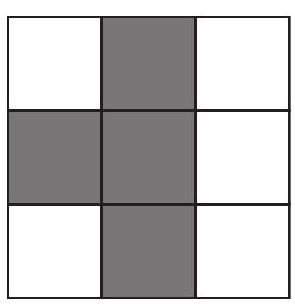 | The top, left and bottom unit squares each contribute 3 sides of length 1 to the perimeter.
The remaining square contributes 1 side of length 1 to the perimeter.
Therefore, the perimeter is $3 \times 3+1 \times 1=10$.
Alternatively, the perimeter includes 3 vertical right sides, 3 vertical left sides, 2 horizontal t... | 10 | Geometry | MCQ | Yes | Yes | olympiads | false |
If $3 x+4=x+2$, the value of $x$ is
(A) 0
(B) -4
(C) -3
(D) -1
(E) -2 | If $3 x+4=x+2$, then $3 x-x=2-4$ and so $2 x=-2$, which gives $x=-1$.
ANSWER: (D) | -1 | Algebra | MCQ | Yes | Yes | olympiads | false |
If $x=2$ and $y=x^{2}-5$ and $z=y^{2}-5$, then $z$ equals
(A) -6
(B) -8
(C) 4
(D) 76
(E) -4 | Since $x=2$ and $y=x^{2}-5$, then $y=2^{2}-5=4-5=-1$.
Since $y=-1$ and $z=y^{2}-5$, then $z=(-1)^{2}-5=1-5=-4$.
ANsWer: (E) | -4 | Algebra | MCQ | Yes | Yes | olympiads | false |
The line with equation $y=2 x-6$ is reflected in the $y$-axis. What is the $x$-intercept of the resulting line?
(A) -12
(B) 6
(C) -6
(D) -3
(E) 0 | Solution 1
To find the $x$-intercept of the original line, we set $y=0$ to obtain $0=2 x-6$ or $2 x=6$ and so $x=3$.
When the line is reflected in the $y$-axis, its $x$-intercept is reflected in the $y$-axis to become $x=-3$.
## Solution 2
When a line is reflected in the $y$-axis, its slope changes signs (that is, ... | -3 | Algebra | MCQ | Yes | Yes | olympiads | false |
In the diagram, $P Q$ is a diameter of the circular base of the cylinder. $R S$ is a diameter of the top face of the cylinder and is directly above $P Q$, as shown. Point $U$ is on the circumference of the top face, halfway between $R$ and $S$. Point $T$ is on the cylinder and is directly above $P$. Suppose that $Q S=m... | Let $O$ be the centre of the top face of the cylinder and let $r$ be the radius of the cylinder.
We need to determine the value of $Q T^{2}$.
Since $R S$ is directly above $P Q$, then $R P$ is perpendicular to $P Q$.
This means that $\triangle T P Q$ is right-angled at $P$.
Since $P Q$ is a diameter, then $P Q=2 r$... | 9 | Geometry | MCQ | Yes | Yes | olympiads | false |
The value of $\frac{20-20}{20+20}$ is
(A) 0
(B) 1
(C) 10
(D) -2
(E) 2 | Simplifying, $\frac{20-20}{20+20}=\frac{0}{40}=0$.
ANswer: (A) | 0 | Algebra | MCQ | Yes | Yes | olympiads | false |
When $x=3$ and $y=4$, the value of $x y-x$ is
(A) 3
(B) 4
(C) 12
(D) 9
(E) 15 | When $x=3$ and $y=4$, we get $x y-x=3 \times 4-3=12-3=9$.
Alternatively, $x y-x=x(y-1)=3 \times 3=9$.
ANSWER: (D) | 9 | Algebra | MCQ | Yes | Yes | olympiads | false |
The volume of a rectangular prism is 21 . Its length, width and height are all different positive integers. The sum of its length, width and height is
(A) 11
(B) 13
(C) 15
(D) 9
(E) 17 | Suppose that the length, width and height of the prism are the positive integers $a, b$ and $c$. Since the volume of the prism is 21 , then $a b c=21$.
We note that each of $a, b$ and $c$ is a positive divisor of 21 .
The positive divisors of 21 are 1, 3, 7, and 21, and the only way to write 21 as a product of three ... | 11 | Number Theory | MCQ | Yes | Yes | olympiads | false |
A multiple choice test has 10 questions on it. Each question answered correctly is worth 5 points, each unanswered question is worth 1 point, and each question answered incorrectly is worth 0 points. How many of the integers between 30 and 50 , inclusive, are not possible total scores?
(A) 2
(B) 3
(C) 4
(D) 6
(E) 5 | For each of the 10 questions, each correct answer is worth 5 points, each unanswered question is worth 1 point, and each incorrect answer is worth 0 points.
If 10 of 10 questions are answered correctly, the total score is $10 \times 5=50$ points.
If 9 of 10 questions are answered correctly, either 0 or 1 questions ca... | 6 | Number Theory | MCQ | Yes | Yes | olympiads | false |
How many positive integers $n \leq 20000$ have the properties that $2 n$ has 64 positive divisors including 1 and $2 n$, and $5 n$ has 60 positive divisors including 1 and $5 n$ ?
(A) 4
(B) 5
(C) 3
(D) 2
(E) 6 | We will use the result that if a positive integer $N$ has prime factorization $N=p_{1}^{a_{1}} p_{2}^{a_{2}} \cdots p_{k}^{a_{k}}$ for some distinct prime numbers $p_{1}, p_{2}, \ldots, p_{k}$ and positive integers $a_{1}, a_{2}, \ldots, a_{k}$, then $N$ has exactly $\left(a_{1}+1\right)\left(a_{2}+1\right) \cdots\left... | 4 | Number Theory | MCQ | Yes | Yes | olympiads | false |
The expression $2 \times 0+1-9$ equals
(A) -8
(B) -6
(C) -7
(D) -11
(E) 0 | Evaluating, $2 \times 0+1-9=0+1-9=-8$.
ANSWER: (A) | -8 | Algebra | MCQ | Yes | Yes | olympiads | false |
The expression $\left(2 \times \frac{1}{3}\right) \times\left(3 \times \frac{1}{2}\right)$ equals
(A) $\frac{1}{6}$
(B) $\frac{1}{5}$
(C) 1
(D) 5
(E) 6 | Re-arranging the order of the numbers being multiplied,
$$
\left(2 \times \frac{1}{3}\right) \times\left(3 \times \frac{1}{2}\right)=2 \times \frac{1}{2} \times 3 \times \frac{1}{3}=\left(2 \times \frac{1}{2}\right) \times\left(3 \times \frac{1}{3}\right)=1 \times 1=1
$$
ANSWer: $(\mathrm{C})$ | 1 | Algebra | MCQ | Yes | Yes | olympiads | false |
The line with equation $y=x+4$ is translated down 6 units. The $y$-intercept of the resulting line is
(A) 6
(B) 4
(C) 10
(D) -6
(E) -2 | The line with equation $y=x+4$ has a $y$-intercept of 4 .
When the line is translated 6 units downwards, all points on the line are translated 6 units down.
This moves the $y$-intercept from 4 to $4-6=-2$.
ANSWER: (E) | -2 | Algebra | MCQ | Yes | Yes | olympiads | false |
The three numbers $2, x$, and 10 have an average of $x$. What is the value of $x$ ?
(A) 5
(B) 4
(C) 7
(D) 8
(E) 6 | Since the average of $2, x$ and 10 is $x$, then $\frac{2+x+10}{3}=x$.
Multiplying by 3 , we obtain $2+x+10=3 x$.
Re-arranging, we obtain $x+12=3 x$ and then $2 x=12$ which gives $x=6$.
ANSWER: (E) | 6 | Algebra | MCQ | Yes | Yes | olympiads | false |
If $(p q)(q r)(r p)=16$, then a possible value for $p q r$ is
(A) 0
(B) 2
(C) 4
(D) 8
(E) 16 | Since $(p q)(q r)(r p)=16$, then $p q q r r p=16$ or $p p q q r r=16$ which gives $p^{2} q^{2} r^{2}=16$.
Thus, $(p q r)^{2}=16$ and so $p q r= \pm 4$.
Using the given answers, $p q r$ is positive and so $p q r=4$.
ANswer: (C) | 4 | Algebra | MCQ | Yes | Yes | olympiads | false |
In the diagram, the line segments $P Q$ and $P R$ are perpendicular. The value of $s$ is
(A) 6
(B) 9
(C) 10
(D) 12
(E) 9.5
 | The slope of line segment $P R$ is $\frac{2-1}{0-4}$ which equals $-\frac{1}{4}$.
Since $\angle Q P R=90^{\circ}$, then $P Q$ and $P R$ are perpendicular.
This means that the slopes of $P Q$ and $P R$ have a product of -1 .
Since the slope of $P R$ is $-\frac{1}{4}$, then the slope of $P Q$ is 4 .
Since the "run" o... | 10 | Geometry | MCQ | Yes | Yes | olympiads | false |
Seven friends are riding the bus to school:
- Cha and Bai are on 2 different buses.
- Bai, Abu and Don are on 3 different buses.
- Don, Gia and Fan are on 3 different buses.
- Abu, Eva and Bai are on 3 different buses.
- Gia and Eva are on 2 different buses.
- Fan, Cha and Gia are on 3 different buses.
- Cha and Eva a... | Here is one way in which the seven friends can ride on four buses so that the seven restrictions are satisfied:
| Bus 1 | Bus 2 | Bus 3 | Bus 4 |
| :---: | :---: | :---: | :---: |
| Abu | Bai | Don | Gia |
| Cha | Fan | Eva | |
At least 3 buses are needed because of the groups of 3 friends who must all be on differe... | 4 | Logic and Puzzles | MCQ | Yes | Yes | olympiads | false |
If $3 \times n=6 \times 2$, then $n$ equals
(A) 6
(B) 2
(C) 9
(D) 5
(E) 4 | Since $3 \times n=6 \times 2$, then $3 n=12$ or $n=\frac{12}{3}=4$.
ANSWER: (E) | 4 | Algebra | MCQ | Yes | Yes | olympiads | false |
In the diagram, 3 of the $1 \times 1$ squares that make up the $4 \times 5$ grid are shaded. How many additional $1 \times 1$ squares need to be shaded so that one-half of all of the $1 \times 1$ squares are shaded?
(A) 5
(B) 9
(C) 7
(D) 6
(E) 8
 | 7 | Combinatorics | math-word-problem | Yes | Yes | olympiads | false |
The number of integer values of $x$ for which $\frac{3}{x+1}$ is an integer is
(A) 4
(B) 3
(C) 5
(D) 1
(E) 6 | The problem is equivalent to determining all values of $x$ for which $x+1$ is a divisor of 3 .
The divisors of 3 are $3,-3,1,-1$.
If $x+1=3,-3,1,-1$, then $x=2,-4,0,-2$, respectively. There are 4 such values.
ANSWER: (A)
# | 4 | Number Theory | MCQ | Yes | Yes | olympiads | false |
Including the endpoints, how many points on the line segment joining $(-9,-2)$ and $(6,8)$ have coordinates that are both integers?
(A) 2
(B) 7
(C) 16
(D) 11
(E) 6 | Solution 1
The line segment with endpoints $(-9,-2)$ and $(6,8)$ has slope $\frac{8-(-2)}{6-(-9)}=\frac{10}{15}=\frac{2}{3}$.
This means that starting at $(-9,-2)$ and moving "up 2 and right 3" (corresponding to the rise and run of 2 and 3) repeatedly will give other points on the line that have coordinates which are... | 6 | Number Theory | MCQ | Yes | Yes | olympiads | false |
A ladder has 5 rungs. Elisabeth can climb up by 1 or 2 rungs at a time. In how many different ways can she climb up to the fifth rung of the ladder?
(A) 10
(B) 9
(C) 7
(D) 6
(E) 8 | Elisabeth climbs a total of 5 rungs by climbing either 1 or 2 rungs at a time.
Since there are only 5 rungs, then she cannot climb 2 rungs at a time more than 2 times.
Therefore, she must climb 2 rungs either 0,1 or 2 times.
If she climbs 2 rungs 0 times, then each step consists of 1 rung and so she climbs 1,1,1,1,1... | 8 | Combinatorics | math-word-problem | Yes | Yes | olympiads | false |
If $\frac{x-y}{x+y}=5$, then $\frac{2 x+3 y}{3 x-2 y}$ equals
(A) 1
(B) 0
(C) $\frac{2}{3}$
(D) $\frac{15}{2}$
(E) $\frac{12}{5}$ | Since $\frac{x-y}{x+y}=5$, then $x-y=5(x+y)$.
This means that $x-y=5 x+5 y$ and so $0=4 x+6 y$ or $2 x+3 y=0$.
Therefore, $\frac{2 x+3 y}{3 x-2 y}=\frac{0}{3 x-2 y}=0$.
(A specific example of $x$ and $y$ that works is $x=3$ and $y=-2$.
This gives $\frac{x-y}{x+y}=\frac{3-(-2)}{3+(-2)}=\frac{5}{1}=5$ and $\frac{2 x+... | 0 | Algebra | MCQ | Yes | Yes | olympiads | false |
In the diagram, each of $p, q, r, s, t, u, v$ is to be replaced with 1,2 or 3 so that $p, q$ and $r$ are all different, $q, s$ and $t$ are all different, and $r, u$ and $v$ are all different. What is the maximum possible value of $s+t+u+v$ ?
(A) 8
(B) 9
(C) 11
(D) 7
(E) 10
 represents the product of the integers from 1 to $n$. For example, $4 !=(1)(2)(3)(4)$ or $4 !=24$. If $x$ and $y$ are integers and $\frac{30 !}{36^{x} 25^{y}}$ is equal to an integer, what is the maximum possible value of $x+y$ ?
(A) 10
(B) 47
(C) 1... | For the given expression to be equal to an integer, each prime factor of the denominator must divide out of the product in the numerator.
In other words, each prime number that is a factor of the denominator must occur as a factor at least as many times in the numerator as in the denominator.
We note that $25=5^{2}$ ... | 10 | Number Theory | MCQ | Yes | Yes | olympiads | false |
There are more than 1000000 ways in which $n$ identical black socks and $2 n$ identical gold socks can be arranged in a row so that there are at least 2 gold socks between any 2 black socks. The sum of the digits of the smallest possible value of $n$ is
(A) 9
(B) 10
(C) 11
(D) 12
(E) 13 | Since there must be at least 2 gold socks $(G)$ between any 2 black socks $(B)$, then we start by placing the $n$ black socks with exactly 2 gold socks in between each pair:
## $B G G B G G B G G B \cdots B G G B$
Since there are $n$ black socks, then there are $n-1$ "gaps" between them and so $2(n-1)$ or $2 n-2$ gol... | 9 | Combinatorics | MCQ | Yes | Yes | olympiads | false |
The value of $\frac{5^{2}-9}{5-3}$ is
(A) 4
(B) 2
(C) $\frac{1}{2}$
(D) 8
(E) -2 | Evaluating, $\frac{5^{2}-9}{5-3}=\frac{25-9}{2}=\frac{16}{2}=8$.
Alternatively, we note that $5^{2}-9=5^{2}-3^{2}=(5-3)(5+3)$ and so
$$
\frac{5^{2}-9}{5-3}=\frac{(5-3)(5+3)}{5-3}=5+3=8
$$
ANSWER: (D) | 8 | Algebra | MCQ | Yes | Yes | olympiads | false |
The mean (average) of the three integers $p, q$ and $r$ is 9 .
The mean of the two integers $s$ and $t$ is 14 .
The mean of the five integers $p, q, r, s$, and $t$ is
(A) 11
(B) 11.5
(C) 12
(D) 10
(E) 13 | Since the mean of $p, q$ and $r$ is 9 , then $\frac{p+q+r}{3}=9$ and so $p+q+r=27$.
Since the mean of $s$ and $t$ is 14 , then $\frac{s+t}{2}=14$ or $s+t=28$.
Therefore, the mean of the five integers is $\frac{p+q+r+s+t}{5}=\frac{(p+q+r)+(s+t)}{5}=\frac{27+28}{5}$, which equals 11.
ANSWER: (A) | 11 | Algebra | MCQ | Yes | Yes | olympiads | false |
Two lines with slopes $\frac{1}{4}$ and $\frac{5}{4}$ intersect at $(1,1)$. What is the area of the triangle formed by these two lines and the vertical line $x=5$ ?
(A) 5
(B) 10
(C) 8
(D) 12
(E) 15 | We start by drawing a graph that includes the point $(1,1)$, the lines with slopes $\frac{1}{4}$ and $\frac{5}{4}$ that pass through this point, the vertical line with equation $x=5$, and the horizontal line $y=1$ (which passes through $(1,1)$ and is perpendicular to the vertical line with equation $x=5$ ). We label th... | 8 | Geometry | MCQ | Yes | Yes | olympiads | false |
The integers 1 to 6 are to be inserted into the grid shown. No two integers that differ by 1 may be in squares that share an edge. If the 1 is inserted as shown, how many different integers can be placed in the box labelled $x$ ?
(A) 1
(B) 3
(C) 5
(D) 0
(E) 2
-(2+1)$ is
(A) 8
(B) 3
(C) 1
(D) 5
(E) 2 | Evaluating, $(3+2)-(2+1)=5-3=2$.
ANSWER: (E) | 2 | Algebra | MCQ | Yes | Yes | olympiads | false |
The expression $\sqrt{5^{2}-4^{2}}$ is equal to
(A) 1
(B) 2
(C) 3
(D) 4
(E) 9 | Evaluating, $\sqrt{5^{2}-4^{2}}=\sqrt{25-16}=\sqrt{9}=3$.
ANswer: $(\mathrm{C})$ | 3 | Algebra | MCQ | Yes | Yes | olympiads | false |
If the line that passes through the points $(2,7)$ and $(a, 3 a)$ has a slope of 2 , the value of $a$ is
(A) $\frac{5}{2}$
(B) 10
(C) 3
(D) $\frac{11}{5}$
(E) $\frac{12}{5}$ | Since the slope of the line through points $(2,7)$ and $(a, 3 a)$ is 2 , then $\frac{3 a-7}{a-2}=2$.
From this, $3 a-7=2(a-2)$ and so $3 a-7=2 a-4$ which gives $a=3$.
ANSWER: (C) | 3 | Algebra | MCQ | Yes | Yes | olympiads | false |
Grace writes a sequence of 20 numbers. The first number is 43 and each number after the first is 4 less than the number before it, so her sequence starts $43,39,35, \ldots$. How many of the numbers that Grace writes are positive?
(A) 11
(B) 9
(C) 13
(D) 15
(E) 12 | Solution 1
We write out the numbers in the sequence until we obtain a negative number:
$$
43,39,35,31,27,23,19,15,11,7,3,-1
$$
Since each number is 4 less than the number before it, then once a negative number is reached, every following number will be negative.
Thus, Grace writes 11 positive numbers in the sequenc... | 11 | Algebra | math-word-problem | Yes | Yes | olympiads | false |
The points $(-1, q)$ and $(-3, r)$ are on a line parallel to $y=\frac{3}{2} x+1$. What is the value of $r-q$ ?
(A) 3
(B) $\frac{4}{3}$
(C) $-\frac{3}{4}$
(D) $-\frac{4}{3}$
(E) -3 | The line with equation $y=\frac{3}{2} x+1$ has slope $\frac{3}{2}$.
Since the line segment joining $(-1, q)$ and $(-3, r)$ is parallel to the line with equation $y=\frac{3}{2} x+1$, then the slope of this line segment is $\frac{3}{2}$.
Therefore, $\frac{r-q}{(-3)-(-1)}=\frac{3}{2}$ or $\frac{r-q}{-2}=\frac{3}{2}$.
T... | -3 | Algebra | MCQ | Yes | Yes | olympiads | false |
In the diagram, $\triangle P Q R$ is isosceles with $P Q=P R$ and $\triangle P R S$ is isosceles with $P S=S R=x$. Also, the perimeter of $\triangle P Q R$ is 22 , the perimeter of $\triangle P R S$ is 22 , and the perimeter of $P Q R S$ is 24 . What is the value of $x$ ?
(A) 7.5
(B) 6.5
(C) 7
(D) 6
(E) 8
-(22-2 x)=4 x-22$.
 represents the product of the integers from 1 to $n$. For example, $4 !=(1)(2)(3)(4)$ or $4 !=24$. The ones (units) digit of the sum $1 !+2 !+3 !+4 !+5 !+6 !+7 !+8 !+9 !+10$ ! is
(A) 1
(B) 3
(C) 5
(D) 7
(E) 9 | We note that
$$
\begin{gathered}
1 !=1 \quad 2 !=(1)(2)=2 \quad 3 !=(1)(2)(3)=6 \\
4 !=(1)(2)(3)(4)=24 \quad 5 !=(1)(2)(3)(4)(5)=120
\end{gathered}
$$
Thus, $1 !+2 !+3 !+4 !+5 !=1+2+6+24+120=153$.
Now for each positive integer $n \geq 5$, the ones digit of $n$ ! is 0 :
One way to see this is to note that we obtain ... | 3 | Number Theory | MCQ | Yes | Yes | olympiads | false |
For how many integers $n$ is $72\left(\frac{3}{2}\right)^{n}$ equal to an integer?
(A) 2
(B) 3
(C) 4
(D) 5
(E) 6
## Part C: Each correct answer is worth 8. | First, we calculate the value of $72\left(\frac{3}{2}\right)^{n}$ for each integer from $n=-3$ to $n=4$, inclusive:
$$
\begin{array}{lc}
72\left(\frac{3}{2}\right)^{-3}=72 \cdot \frac{2^{3}}{3^{3}}=72 \cdot \frac{8}{27}=\frac{64}{3} & 72\left(\frac{3}{2}\right)^{-2}=72 \cdot \frac{2^{2}}{3^{2}}=72 \cdot \frac{4}{9}=32... | 6 | Algebra | MCQ | Yes | Yes | olympiads | false |
If $(2)(3)(4)=6 x$, what is the value of $x$ ?
(A) 2
(B) 6
(C) 12
(D) 3
(E) 4 | Since $(2)(3)(4)=6 x$, then $6(4)=6 x$. Dividing both sides by 6 , we obtain $x=4$.
ANSWER: (E) | 4 | Algebra | MCQ | Yes | Yes | olympiads | false |
At 2 p.m., Sanjay measures the temperature to be $3^{\circ} \mathrm{C}$. He measures the temperature every hour after this until 10 p.m. He plots the temperatures that he measures on the graph shown. At what time after 2 p.m. does he again measure a temperature of $3^{\circ} \mathrm{C}$ ?
(A) 9 p.m.
(B) 5 p.m.
(C) 8 p.... | The line representing a temperature of $3^{\circ}$ is the horizontal line passing halfway between $2^{\circ}$ and $4^{\circ}$ on the vertical axis.
There are two data points on this line: one at 2 p.m. and one at 9 p.m.
The required time is 9 p.m.
ANswer: (A) | 9 | Other | MCQ | Yes | Yes | olympiads | false |
If $2 n+5=16$, the expression $2 n-3$ equals
(A) 8
(B) 10
(C) 18
(D) 14
(E) 7 | Since $2 n+5=16$, then $2 n-3=(2 n+5)-8=16-8=8$.
Alternatively, we could solve the equation $2 n+5=16$ to obtain $2 n=11$ or $n=\frac{11}{2}$.
From this, we see that $2 n-3=2\left(\frac{11}{2}\right)-3=11-3=8$.
ANSWER: (A) | 8 | Algebra | MCQ | Yes | Yes | olympiads | false |
In the $4 \times 4$ grid shown, each of the four symbols has a different value. The sum of the values of the symbols in each row is given to the right of that row. What is the value of
(A) 5
(B) 6
(C) 7
(D) 8
(E) 9
| $\odot$ | $\triangle$ | $\triangle$ | $\odot$ | 26 |
| :---: | :---: | :---: | :---: | :---: |
| $\tri... | From the second row, $\triangle+\Delta+\triangle+\triangle=24$ or $4 \triangle=24$, and so $\triangle=6$.
From the first row, $\odot+\triangle+\Delta+\odot=26$ or $2 \odot+2 \triangle=26$.
Since $\triangle=6$, then $2 \odot=26-12=14$, and so $\odot=7$.
From the fourth row, $\square+\odot+\square+\triangle=33$.
Sinc... | 5 | Logic and Puzzles | MCQ | Yes | Yes | olympiads | false |
The value of $\frac{8+4}{8-4}$ is
(A) 2
(B) 3
(C) 4
(D) 5
(E) 6 | Simplifying, $\frac{8+4}{8-4}=\frac{12}{4}=3$.
ANSWER: (B) | 3 | Algebra | MCQ | Yes | Yes | olympiads | false |
In the diagram, $\triangle P Q R$ is an equilateral triangle. If $P Q=4 x$ and $P R=x+12$, what is the value of $x ?$
(A) 48
(B) 16
(C) 4
(D) 32
(E) 12
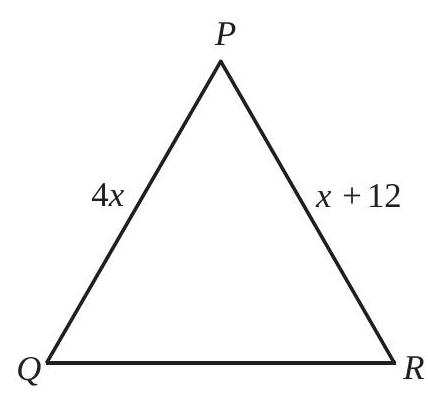 | Since $\triangle P Q R$ is equilateral, then $P Q=Q R=R P$.
Therefore, $4 x=x+12$ or $3 x=12$ and so $x=4$.
ANSWER: (C) | 4 | Geometry | MCQ | Yes | Yes | olympiads | false |
If $a(x+b)=3 x+12$ for all values of $x$, then $a+b$ equals
(A) 12
(B) 15
(C) 8
(D) 7
(E) 13 | Solution 1
Since $a(x+b)=3 x+12$ for all $x$, then $a x+a b=3 x+12$ for all $x$.
Since the equation is true for all $x$, then the coefficients on the left side must match the coefficients on the right side.
Therefore, $a=3$ and $a b=12$, which gives $3 b=12$ or $b=4$.
Finally, $a+b=3+4=7$.
## Solution 2
Since $a(... | 7 | Algebra | MCQ | Yes | Yes | olympiads | false |
When $5^{35}-6^{21}$ is evaluated, the units (ones) digit is
(A) 1
(B) 9
(C) 2
(D) 5
(E) 6 | First, we note that $5^{35}-6^{21}$ is a positive integer, since
$$
5^{35}-6^{21}=\left(5^{5}\right)^{7}-\left(6^{3}\right)^{7}=3125^{7}-216^{7}
$$
and $3125>216$.
Second, we note that any positive integer power of 5 has a units digit of 5 . Since $5 \times 5=25$ and this product has a units digit of 5 , then the un... | 9 | Number Theory | MCQ | Yes | Yes | olympiads | false |
In the addition shown, the letters $X, Y$, and $Z$ each represent a different non-zero digit. The digit $X$ is
(A) 1
(B) 2
(C) 7
(D) 8
(E) 9
$X X X$
| $Y$ | $Y$ |
| :--- | :--- | :--- |
$\begin{array}{r}+Z Z Z \\ \hline Z Y Y X\end{array}$ | We start by analyzing the given sum as if we were performing the addition
by hand. Doing this, we would start with the units column.
Here, we see that the units digit of the sum $X+Y+Z$ is $X$.
Thus, the units digit of $Y+Z$ must be 0 .
| | | 1 | |
| ---: | ---: | ---: | ---: |
| | $X$ | $X$ | |
| | $Y$ | $Y$... | 8 | Logic and Puzzles | MCQ | Yes | Yes | olympiads | false |
A cone is filled with water. Two solid spheres are placed in the cone as shown in the diagram and water spills out. (The spheres are touching each other, each sphere touches the cone all of the way around, and the top of the top sphere is level with the top of the cone.) The larger sphere has radius twice that of the s... | Let the radius of the smaller sphere be $r$.
Thus, the radius of the larger sphere is $2 r$.
We determine expressions for the height and radius of the cone in terms of $r$ and use these to help solve the problem.
By symmetry, the centres of the two spheres $(Q$ of the smaller sphere and $O$ of the larger sphere) lie... | 6 | Geometry | MCQ | Yes | Yes | olympiads | false |
The value of $\frac{5-2}{2+1}$ is
(A) 3
(B) 1
(C) -1
(D) -5
(E) 5 | Simplifying, $\frac{5-2}{2+1}=\frac{3}{3}=1$.
ANSWER: (B) | 1 | Algebra | MCQ | Yes | Yes | olympiads | false |
The average of 1,3 and $x$ is 3 . What is the value of $x$ ?
(A) 4
(B) 5
(C) 2
(D) 3
(E) 1 | Since the average of three numbers equals 3 , then their sum is $3 \times 3=9$.
Therefore, $1+3+x=9$ and so $x=9-4=5$.
ANSWER: (B) | 5 | Algebra | MCQ | Yes | Yes | olympiads | false |
The value of $(-1)^{3}+(-1)^{2}+(-1)$ is
(A) 2
(B) 1
(C) -3
(D) -1
(E) -2 | Since -1 raised to an even exponent equals 1 and -1 raised to an odd exponent equals -1 , then $(-1)^{3}+(-1)^{2}+(-1)=-1+1-1=-1$.
Alternatively, we write
$$
(-1)^{3}+(-1)^{2}+(-1)=(-1)(-1)(-1)+(-1)(-1)+(-1)=1(-1)+1-1=-1+1-1=-1
$$
ANSWER: (D) | -1 | Algebra | MCQ | Yes | Yes | olympiads | false |
The equation $y=a x^{2}+b x+c$ was used to create the table of values below:
$$
\begin{array}{l|l|l|}
x & 0 & 1 \\
\hline y & 8 & 9
\end{array}
$$
What is the value of $a+b$ ?
(A) -2
(B) 1
(C) 3
(D) 5
(E) -5 | From the table of values, when $x=0, y=8$, and so $8=a \cdot 0^{2}+b \cdot 0+c$ or $c=8$.
From the table of values, when $x=1, y=9$, and so $9=a \cdot 1^{2}+b \cdot 1+c$ or $a+b+c=9$.
Since $a+b+c=9$ and $c=8$, then $a+b+8=9$ or $a+b=1$.
ANswer: (B) | 1 | Algebra | MCQ | Yes | Yes | olympiads | false |
If $(-1)(2)(x)(4)=24$, then $x$ equals
(A) 4
(B) -3
(C) -1
(D) 2
(E) -4 | Since $(-1)(2)(x)(4)=24$, then $-8 x=24$ or $x=\frac{24}{-8}=-3$.
ANswer: (B) | -3 | Algebra | MCQ | Yes | Yes | olympiads | false |
When a number is tripled, then decreased by 5 , the result is 16 . What is the original number?
(A) 3
(B) 5
(C) 7
(D) 9
(E) 11 | Solution 1
To get back to the original number, we undo the given operations.
We add 5 to 16 to obtain 21 and then divide by 3 to obtain 7 .
These are the "inverse" operations of decreasing by 5 and multiplying by 3 .
## Solution 2
Suppose that the original number is $x$.
After tripling and decreasing by 5 , the r... | 7 | Algebra | MCQ | Yes | Yes | olympiads | false |
The expression $\sqrt{13+\sqrt{7+\sqrt{4}}}$ is equal to
(A) 7
(B) 8
(C) 6
(D) 4
(E) 5 | We evaluate from the inside towards the outside:
$$
\sqrt{13+\sqrt{7+\sqrt{4}}}=\sqrt{13+\sqrt{7+2}}=\sqrt{13+\sqrt{9}}=\sqrt{13+3}=\sqrt{16}=4
$$
ANSwER: (D) | 4 | Algebra | MCQ | Yes | Yes | olympiads | false |
When 100 is divided by 12 , the remainder is 4 .
When 100 is divided by a positive integer $x$, the remainder is 10 .
When 1000 is divided by $x$, the remainder is
(A) 10
(B) 100
(C) 0
(D) 1
(E) 90 | Solution 1
When a number $n$ is divided by $x$, the remainder is the difference between $n$ and the largest multiple of $x$ less than $n$. When 100 is divided by a positive integer $x$, the remainder is 10 . This means that $100-10=90$ is exactly divisible by $x$. It also means that $x$ is larger than 10 , otherwise t... | 10 | Number Theory | MCQ | Yes | Yes | olympiads | false |
The value of $6+4 \div 2$ is
(A) 5
(B) 6
(C) 7
(D) 8
(E) 9 | Calculating, $6+4 \div 2=6+2=8$.
ANSWER: (D) | 8 | Algebra | MCQ | Yes | Yes | olympiads | false |
If $x+\sqrt{25}=\sqrt{36}$, then $x$ equals
(A) 1
(B) 2
(C) 3
(D) 4
(E) 11 | Since $x+\sqrt{25}=\sqrt{36}$, then $x+5=6$ or $x=1$.
ANSWER: (A) | 1 | Algebra | MCQ | Yes | Yes | olympiads | false |
The mean (average) of 5 consecutive integers is 9 . What is the smallest of these 5 integers?
(A) 4
(B) 5
(C) 6
(D) 7
(E) 8 | Solution 1
Since the mean of five consecutive integers is 9 , then the middle of these five integers is 9 .
Therefore, the integers are $7,8,9,10,11$, and so the smallest of the five integers is 7 .
## Solution 2
Suppose that $x$ is the smallest of the five consecutive integers.
Then the integers are $x, x+1, x+2,... | 7 | Algebra | MCQ | Yes | Yes | olympiads | false |
The value of $\frac{10^{2}-10}{9}$ is
(A) 10
(B) 1
(C) 7
(D) 2009
(E) 11 | Calculating, $\frac{10^{2}-10}{9}=\frac{100-10}{9}=\frac{90}{9}=10$.
ANSWER: (A) | 10 | Algebra | MCQ | Yes | Yes | olympiads | false |
The graph shows the number of hours Deepit worked over a three day period. What is the total number of hours that he worked on Saturday and Sunday?
(A) 2
(B) 4
(C) 6
(D) 8
(E) 10 | On Saturday, Deepit worked 6 hours. On Sunday, he worked 4 hours. Therefore, he worked $6+4=10$ hours in total on Saturday and Sunday.
ANswer: (E) | 10 | Other | MCQ | Yes | Yes | olympiads | false |
If $3(-2)=\nabla+2$, then $\nabla$ equals
(A) -2
(B) 0
(C) -8
(D) -6
(E) -4 | Since $3(-2)=\nabla+2$, then $-6=\nabla+2$ so $\nabla=-6-2=-8$.
ANswer: (C) | -8 | Algebra | MCQ | Yes | Yes | olympiads | false |
If Francis spends $\frac{1}{3}$ of his day sleeping, $\frac{1}{4}$ of his day studying and $\frac{1}{8}$ of his day eating, how many hours in the day does he have left?
(A) 4
(B) 6
(C) 5
(D) 7
(E) 9 | Solution 1
Since there are 24 hours in a day, Francis spends $\frac{1}{3} \times 24=8$ hours sleeping.
Also, he spends $\frac{1}{4} \times 24=6$ hours studying, and $\frac{1}{8} \times 24=3$ hours eating.
The number of hours that he has left is $24-8-6-3=7$ hours.
## Solution 2
Francis spends $\frac{1}{3}+\frac{1}... | 7 | Algebra | MCQ | Yes | Yes | olympiads | false |
A line with slope equal to 1 and a line with slope equal to 2 intersect at the point $P(1,6)$, as shown. The area of $\triangle P Q R$ is
(A) 6
(B) 9
(C) 12
(D) 15
(E) 18
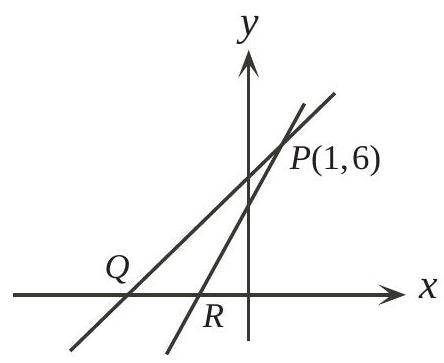 | The slope of line segment $Q P$ is 1 . Since the "rise" of $Q P$ is 6 units, then the "run" of $Q P$ should also be 6 units. Therefore, $Q$ is 6 units horizontally to the left of $P$, and so has coordinates $(-5,0)$.
The slope of line segment $R P$ is 2 . Since the rise of $R P$ is 6 units, then the run of $R P$ is $\... | 9 | Geometry | MCQ | Yes | Yes | olympiads | false |
Suppose that $a, b$ and $c$ are three numbers with
$$
\begin{aligned}
a+b & =3 \\
a c+b & =18 \\
b c+a & =6
\end{aligned}
$$
The value of $c$ is
(A) 2
(B) 11
(C) 3
(D) 6
(E) 7 | Solution 1
If we add the second and third equations, we obtain
$$
\begin{aligned}
a c+b+b c+a & =18+6 \\
c(a+b)+(a+b) & =24 \\
(c+1)(a+b) & =24
\end{aligned}
$$
From the first given equation, $a+b=3$ and so we get $(c+1)(3)=24$ or $c+1=8$. Thus, $c=7$.
## Solution 2
From the first equation, $b=3-a$. (We could solv... | 7 | Algebra | MCQ | Yes | Yes | olympiads | false |
What is the value of $3^{2}-2^{2}+1^{2}$ ?
(A) 8
(B) -2
(C) 10
(D) -5
(E) 6 | Calculating, $3^{2}-2^{2}+1^{2}=9-4+1=6$.
ANSWER: (E) | 6 | Algebra | MCQ | Yes | Yes | olympiads | false |
$\frac{\sqrt{25-16}}{\sqrt{25}-\sqrt{16}}$ is equal to
(A) 2
(B) 3
(C) 4
(D) 5
(E) 6 | Calculating, $\frac{\sqrt{25-16}}{\sqrt{25}-\sqrt{16}}=\frac{\sqrt{9}}{5-4}=\frac{3}{1}=3$.
ANswer: (B) | 3 | Algebra | MCQ | Yes | Yes | olympiads | false |
The 5 -digit number $5228 \square$ is a multiple of 6 . Which digit is represented by $\square$ ?
(A) 0
(B) 3
(C) 4
(D) 6
(E) 8 | Since $5228 \square$ is a multiple of 6 , then it must be a multiple of 2 and a multiple of 3 .
Since it is a multiple of 2 , the digit represented by $\square$ must be even.
Since it is a multiple of 3 , the sum of its digits is divisible by 3 .
The sum of its digits is $5+2+2+8+\square=17+\square$.
Since $\square... | 4 | Number Theory | MCQ | Yes | Yes | olympiads | false |
If $\frac{40}{x}-1=19$, then $x$ is equal to
(A) -1
(B) $\frac{1}{2}$
(C) 1
(D) 2
(E) -2 | Since $\frac{40}{x}-1=19$, then $\frac{40}{x}=20$.
Thus, $x=2$, since the number that we must divide 40 by to get 20 is 2 .
ANswer: (D) | 2 | Algebra | MCQ | Yes | Yes | olympiads | false |
The first term of a sequence is 20 .
If a term in the sequence is $t$ and $t$ is even, the next term is $\frac{1}{2} t$.
If a term in the sequence is $t$ and $t$ is odd, the next term is $3 t+1$.
Therefore, the first three terms in the sequence are 20, 10, 5 .
What is the 10th term of the sequence?
(A) 2
(B) 4
(C) ... | The third term is odd $(t=5)$, so the fourth term is $3(5)+1=16$, which is even.
Thus, the fifth term is $\frac{1}{2}(16)=8$, which is even.
Thus, the sixth term is $\frac{1}{2}(8)=4$, which is even.
Thus, the seventh term is $\frac{1}{2}(4)=2$, which is even.
Thus, the eighth term is $\frac{1}{2}(2)=1$, which is o... | 2 | Number Theory | MCQ | Yes | Yes | olympiads | false |
If $x$ and $y$ are integers with $(y-1)^{x+y}=4^{3}$, then the number of possible values for $x$ is
(A) 8
(B) 3
(C) 4
(D) 5
(E) 6 | The number $4^{3}$ equals 64 .
To express 64 as $a^{b}$ where $a$ and $b$ are integers, we can use $64^{1}, 8^{2}, 4^{3}, 2^{6},(-2)^{6}$, and $(-8)^{2}$. We make a table to evaluate $x$ and $y$ :
| $y-1$ | $x+y$ | $y$ | $x$ |
| :---: | :---: | :---: | :---: |
| 64 | 1 | 65 | -64 |
| 8 | 2 | 9 | -7 |
| 4 | 3 | 5 | -2... | 6 | Algebra | MCQ | Yes | Yes | olympiads | false |
If $3 x-2 x+x=3-2+1$, then $x$ equals
(A) 0
(B) 1
(C) 2
(D) 3
(E) 4 | If $3 x-2 x+x=3-2+1$, then $2 x=2$ or $x=1$.
ANSWER: (B) | 1 | Algebra | MCQ | Yes | Yes | olympiads | false |
The mean (average) of 6,9 and 18 is equal to the mean (average) of 12 and $y$. What is the value of $y$ ?
(A) 22
(B) 21
(C) 10
(D) 11
(E) 5 | The mean of 6,9 and 18 is $\frac{6+9+18}{3}=\frac{33}{3}=11$.
Since the mean of 12 and $y$ is thus 11 , then the sum of 12 and $y$ is $2(11)=22$, so $y=10$.
ANSWER: (C) | 10 | Algebra | MCQ | Yes | Yes | olympiads | false |
In the diagram, triangles $A B C$ and $C B D$ are isosceles. The perimeter of $\triangle C B D$ is 19 , the perimeter of $\triangle A B C$ is 20 , and the length of $B D$ is 7 . What is the length of $A B$ ?
(A) 5
(B) 6
(C) 7
(D) 8
(E) 9
=12$ or $B C=6$.
Since the perimeter of $\triangle A B C$ is $20, B C=6$, and $A C=B C$, then $A B+6+... | 8 | Geometry | MCQ | Yes | Yes | olympiads | false |
The first term in a sequence is $x$. Each of the following terms is obtained by doubling the previous term and then adding 4 . If the third term is 52 , then $x$ equals
(A) 7
(B) 8
(C) 9
(D) 10
(E) 11
## Part B: Each correct answer is worth 6. | Solution 1
To get from one term to the next, we double and add 4 .
Since the first term is $x$, the second term is $2 x+4$.
Since the second term is $2 x+4$, the third term is $2(2 x+4)+4=4 x+12$.
Since the third term equals 52 , then $4 x+12=52$ so $4 x=40$ or $x=10$.
## Solution 2
To get from one term to the ne... | 10 | Algebra | MCQ | Yes | Yes | olympiads | false |
If $\frac{3}{x-3}+\frac{5}{2 x-6}=\frac{11}{2}$, then the value of $2 x-6$ is
(A) 2
(B) 12
(C) 6
(D) 8
(E) 10 | Using a common denonimator, $\frac{3}{x-3}+\frac{5}{2 x-6}=\frac{6}{2 x-6}+\frac{5}{2 x-6}=\frac{11}{2 x-6}$.
Therefore, $\frac{11}{2 x-6}=\frac{11}{2}$, so $2 x-6=2$.
ANSWER: (A) | 2 | Algebra | MCQ | Yes | Yes | olympiads | false |
On an island there are two types of inhabitants: Heroes who always tell the truth and Villains who always lie. Four inhabitants are seated around a table. When each is asked "Are you a Hero or a Villain?", all four reply "Hero". When asked "Is the person on your right a Hero or a Villain?", all four reply "Villain". Ho... | First, we note that no matter how many Heroes are present, all four would always reply "Hero" when asked "Are you a Hero or a Villain?". (This is because Heroes will tell the truth and answer "Hero" and Villains will lie and answer "Hero".)
When each is asked "Is the person on your right a Hero or a Villain?", all fou... | 2 | Logic and Puzzles | MCQ | Yes | Yes | olympiads | false |
In the diagram, the four points have coordinates $A(0,1)$, $B(1,3), C(5,2)$, and $D(4,0)$. What is the area of quadrilateral $A B C D$ ?
(A) 9
(B) 3
(C) 6
(D) $\sqrt{85}$
(E) $2 \sqrt{5}+2 \sqrt{17}$
 and a vertical line through $C$ (meeting the $x$-axis at $Q$ ). Suppose the point of intersection of these two lines is $R$.
<3^{4015}$ ?
(A) 2
(B) 3
(C) 6
(D) 8
(E) 9
## Part C: Each correct answer is worth 8. | Since $3\left(n^{2007}\right)<3^{4015}$, then $n^{2007}<\frac{3^{4015}}{3}=3^{4014}$.
But $3^{4014}=\left(3^{2}\right)^{2007}=9^{2007}$ so we have $n^{2007}<9^{2007}$.
Therefore, $n<9$ and so the largest integer $n$ that works is $n=8$.
ANSWER: (D) | 8 | Algebra | MCQ | Yes | Yes | olympiads | false |
In a soccer league with 6 teams $(P, Q, R, S, T, W)$, each team must eventually play each other team exactly once. So far, $P$ has played one match, $Q$ has played 2 matches, $R$ has played 3 matches, $S$ has played 4 matches, and $T$ has played 5 matches. How many matches has $W$ played so far?
(A) 1
(B) 2
(C) 3
(D) 4... | Since $T$ has played 5 matches so far, then $T$ has played $P, Q, R, S$, and $W$ (ie. each of the other teams).
Since $P$ has played only 1 match and has played $T$, then $P$ has played no more matches.
Since $S$ has played 4 matches and has not played $P$, then $S$ must have played each of the remaining 4 teams (nam... | 3 | Combinatorics | MCQ | Yes | Yes | olympiads | false |
Five positive integers are listed in increasing order. The difference between any two consecutive numbers in the list is three. The fifth number is a multiple of the first number. How many different such lists of five integers are there?
(A) 3
(B) 4
(C) 5
(D) 6
(E) 7 | Suppose the first integer in the list is $n$.
Then the remaining four integers are $n+3, n+6, n+9$, and $n+12$.
Since the fifth number is a multiple of the first, then $\frac{n+12}{n}=\frac{n}{n}+\frac{12}{n}=1+\frac{12}{n}$ is an integer. Since $1+\frac{12}{n}$ is an integer, then $\frac{12}{n}$ is an integer, or $n... | 6 | Number Theory | MCQ | Yes | Yes | olympiads | false |
In the diagram, four squares of side length 2 are placed in the corners of a square of side length 6 . Each of the points $W, X, Y$, and $Z$ is a vertex of one of the small squares. Square $A B C D$ can be constructed with sides passing through $W, X, Y$, and $Z$. The maximum possible distance from $A$ to $P$ is closes... | Since $\angle W A X=90^{\circ}$ regardless of the position of square $A B C D$, then $A$ always lies on the semi-circle with diameter $W X$.
The centre of this semi-circle is the midpoint, $M$, of $W X$.
To get from $P$ to $M$, we must go up 4 units and to the left 3 units (since $W X=2$ ), so $P M^{2}=3^{2}+4^{2}=25... | 6 | Geometry | MCQ | Yes | Yes | olympiads | false |
The value of $43-41+39-37+35-33+31-29$ is
(A) 8
(B) 6
(C) 10
(D) 12
(E) 16 | We determine the value of this expression, by calculating each difference first, so
$$
43-41+39-37+35-33+31-29=2+2+2+2=8
$$
ANSWER: (A) | 8 | Algebra | MCQ | Yes | Yes | olympiads | false |
If $a=-3$ and $b=2$, the value of $a(b-3)$ is
(A) 1
(B) 2
(C) 3
(D) 4
(E) 5 | When $a=-3$ and $b=2$, we have $a(b-3)=(-3)(2-3)=(-3)(-1)=3$.
ANSWER: (C) | 3 | Algebra | MCQ | Yes | Yes | olympiads | false |
In the four term sequence $0.001,0.02,0.4, x$, each term after the first is found by multiplying the previous term by the same number. What is the value of $x$ ?
(A) 0.8
(B) 8
(C) 80
(D) 8.8
(E) 0.08 | To determine the number by which we multiply the third term to obtain the fourth term, we can divide the second term by the first term. Doing this, we get $\frac{0.02}{0.001}=20$.
(We can check that this is also equal to the third term divided by the second term.) Therefore, the fourth term is $20(0.4)=8$.
ANswer: (B... | 8 | Algebra | MCQ | Yes | Yes | olympiads | false |
If $\frac{6}{x+1}=\frac{3}{2}$, then $x$ equals
(A) 1
(B) 2
(C) 3
(D) 4
(E) 5 | Solution 1
Rewriting $\frac{3}{2}$ as $\frac{6}{4}$, we see that $\frac{6}{x+1}=\frac{6}{4}$ and so comparing denominators, $x+1=4$ or $x=3$.
Solution 2
Since $\frac{6}{x+1}=\frac{3}{2}$, then cross-multiplying, we obtain $2(6)=3(x+1)$ or $12=3 x+3$ or $3 x=9$ or $x=3$.
Solution 3
Inverting both sides of the equat... | 3 | Algebra | MCQ | Yes | Yes | olympiads | false |
The line $y=-\frac{3}{4} x+9$ crosses the $x$-axis at $P$ and the $y$-axis at $Q$. Point $T(r, s)$ is on line segment $P Q$. If the area of $\triangle P O Q$ is three times the area of $\triangle T O P$, then the value of $r+s$ is
(A) 7
(B) 10
(C) 11
(D) 14
(E) 18
$.
To determine the $x$-intercept, we set $y=0$, and so obtain $0=-\frac{3}{4} x+9$ or $\frac{3}{4} x=9$ or $x=12$. Thus, $P$ has coordinates $(12,0)$.
Therefore, the area of $\triangle P O Q$ is $\frac{1}{2}(12)(9)=... | 11 | Geometry | MCQ | Yes | Yes | olympiads | false |
If $p, q$ and $r$ are positive integers and $p+\frac{1}{q+\frac{1}{r}}=\frac{25}{19}$, then $q$ equals
(A) 1
(B) 2
(C) 3
(D) 4
(E) 5 | Solution 1
We know $p+\frac{1}{q+\frac{1}{r}}=\frac{25}{19}=1+\frac{6}{19}=1+\frac{1}{\frac{19}{6}}=1+\frac{1}{3+\frac{1}{6}}$.
Therefore, comparing the two fractions, $p=1, q=3$ and $r=6$.
## Solution 2
Since $p, q$ and $r$ are positive integers, then $q+\frac{1}{r}$ is at least 1 , so $\frac{1}{q+\frac{1}{r}}$ is... | 3 | Algebra | MCQ | Yes | Yes | olympiads | false |
A positive integer is called multiplicatively perfect if it is equal to the product of its proper divisors. For example, 10 is multiplicatively perfect since its proper divisors are 1,2 and 5 , and it is true that $1 \times 2 \times 5=10$. How many multiplicatively perfect integers are there between 2 and 30 ?
(A) 9
(B... | Suppose that $n$ is a multiplicatively perfect positive integer.
If $n$ can be written as $n=a \times b$ with $a$ and $b$ different positive integers, neither equal to 1 , then $n$ cannot have any other proper divisors other than 1 , since $n=1 \times a \times b$, so any other proper divisors would make this product t... | 9 | Number Theory | MCQ | Yes | Yes | olympiads | false |
When 45 is divided by 7 , the remainder is 3 . What is the remainder when 70 is divided by 17 ?
(A) 1
(B) 12
(C) 15
(D) 2
(E) 11 | The largest multiple of 17 less than 70 is 68 . Therefore, $70=4(17)+2$, so the remainder is 2 .
ANSWER: (D) | 2 | Number Theory | MCQ | Yes | Yes | olympiads | false |
$\quad$ If $\frac{3}{x+10}=\frac{1}{2 x}$, then $x$ equals
(A) $\frac{1}{2}$
(B) 10
(C) -4
(D) 2
(E) -8 | Since $\frac{3}{x+10}=\frac{1}{2 x}$, then cross-multiplying, we get $6 x=x+10$ or $5 x=10$ or $x=2$.
ANSWER: (D) | 2 | Algebra | MCQ | Yes | Yes | olympiads | false |
In the diagram, the line segment has slope $-\frac{3}{2}$.
The value of $b$ is
(A) 10
(B) 12
(C) 6
(D) 16
(E) 20
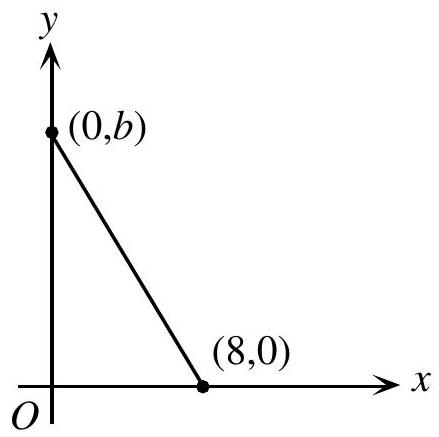 | Solution 1
Since the slope is $-\frac{3}{2}$, then for every 2 units we move to the right along the line, we must move 3 units down.
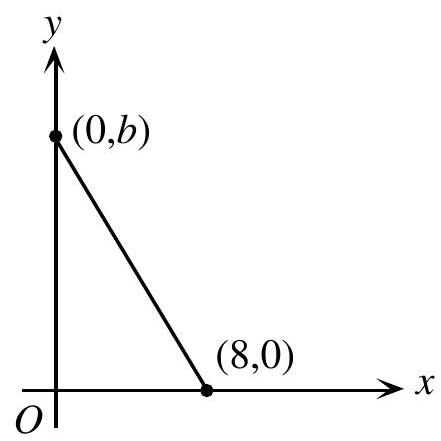
To get from $(0, b)$ to $(8,0)$, we move 8 units right... | 12 | Algebra | MCQ | Yes | Yes | olympiads | false |
Jack went running last Saturday morning. He ran the first $12 \mathrm{~km}$ at $12 \mathrm{~km} / \mathrm{h}$ and the second $12 \mathrm{~km}$ at $6 \mathrm{~km} / \mathrm{h}$. Jill ran the same route at a constant speed, and took the same length of time as Jack. Jill's speed in $\mathrm{km} / \mathrm{h}$ was
(A) 8
(B)... | Jack ran a total of $24 \mathrm{~km}$.
Since he ran the first $12 \mathrm{~km}$ at $12 \mathrm{~km} / \mathrm{h}$, then it took him 1 hour to run the first $12 \mathrm{~km}$.
Since he ran the second $12 \mathrm{~km}$ at $6 \mathrm{~km} / \mathrm{h}$, then it took him 2 hours to run the second $12 \mathrm{~km}$.
Ther... | 8 | Algebra | MCQ | Yes | Yes | olympiads | false |
If $x$ is a positive integer less than 100 , how many values of $x$ make $\sqrt{1+2+3+4+x}$ an integer?
(A) 6
(B) 7
(C) 8
(D) 9
(E) 10 | To make $\sqrt{1+2+3+4+x}$ an integer, we need $1+2+3+4+x=10+x$ to be a perfect square.
So we can rephrase the question as "For how many positive integers $x$ less than 100 is $10+x$ a perfect square?".
Since $x$ is between 1 and 99 , then $10+x$ is between 11 and 109 .
There are 7 perfect squares in this interval: ... | 7 | Number Theory | MCQ | Yes | Yes | olympiads | false |
In Yacleyland, the unit of money used is called the Yacley. There are only two denominations of paper money: the 17 Yacley bill and the 5 Yacley bill. How many different combinations of these bills total 453 Yacley?
(A) 3
(B) 4
(C) 5
(D) 6
(E) 7 | We start by determining the combination of these bills totalling 453 Yacleys which uses the fewest 17 Yacley bills.
To do this, we notice that since we can use as many 5 Yacley bills as we'd like, then any multiple of 17 less than 453 which ends in a 5 or an 8 can be "topped up" to 453 Yacleys using 5 Yacley bills.
T... | 5 | Number Theory | MCQ | Yes | Yes | olympiads | false |
The value of $2^{2}+1^{2}+0^{2}+(-1)^{2}+(-2)^{2}$ is
(A) 5
(B) -6
(C) 3
(D) 6
(E) 10 | Calculating each term,
$$
2^{2}+1^{2}+0^{2}+(-1)^{2}+(-2)^{2}=4+1+0+1+4=10
$$
Answer: (E) | 10 | Algebra | MCQ | Yes | Yes | olympiads | false |
If $x+1-2+3-4=5-6+7-8$, the value of $x$ is
(A) -2
(B) -1
(C) 0
(D) 1
(E) 2 | Since $x+1-2+3-4=5-6+7-8$, then simplifying both sides we get $x-2=-2$ so $x=0$.
Answer: (C) | 0 | Algebra | MCQ | Yes | Yes | olympiads | false |
Subsets and Splits
No community queries yet
The top public SQL queries from the community will appear here once available.