
problem stringlengths 15 4.7k | solution stringlengths 2 11.9k | answer stringclasses 51
values | problem_type stringclasses 8
values | question_type stringclasses 4
values | problem_is_valid stringclasses 1
value | solution_is_valid stringclasses 1
value | source stringclasses 6
values | synthetic bool 1
class |
|---|---|---|---|---|---|---|---|---|
If $3^{2}+3^{2}+3^{2}=3^{a}$, the value of $a$ is
(A) 2
(B) 3
(C) 4
(D) 6
(E) 8 | Solution 1
$3^{2}+3^{2}+3^{2}=3 \times 3^{2}=3^{1} \times 3^{2}=3^{3}$. Thus, $a=3$.
## Solution 2
$3^{2}+3^{2}+3^{2}=9+9+9=27$, so $3^{a}=27$ and so $a=3$, since $3^{3}=27$.
Answer: (B) | 3 | Algebra | MCQ | Yes | Yes | olympiads | false |
In the diagram, $O$ is the centre of each circle. The circumferences of the circles are $24 \pi$ and $14 \pi$. $B$ is a point on the outer circle and $O B$ intersects the inner circle at $A$. The length of $A B$ is
(A) $\sqrt{10}$
(B) 5
(C) 7
(D) $10 \pi$
(E) 3
 0
(B) 1
(C) 3
(D) 7
(E) 9
| $2 x$ | 3 | 2 |
| :---: | :---: | :---: |
| | | -3 |
| 0 | $x$ | | | The sum of the numbers in the $1^{\text {st }}$ row is $2 x+5$, so the sum of the numbers in any row, column or diagonal is also $2 x+5$.
Therefore, the entry in the $2^{\text {nd }}$ row, $1^{\text {st }}$ column must be 5 , using the $1^{\text {st }}$ column.
Thus, the entry in the $2^{\text {nd }}$ row, $2^{\text ... | 3 | Logic and Puzzles | MCQ | Yes | Yes | olympiads | false |
The number of positive integers $x$ with $x \leq 60$ such that each of the rational expressions
$$
\frac{7 x+1}{2}, \frac{7 x+2}{3}, \frac{7 x+3}{4}, \cdots, \frac{7 x+300}{301}
$$
is in lowest terms (i.e. in each expression, the numerator and denominator have no common factors) is
(A) 1
(B) 2
(C) 3
(D) 4
(E) 5 | We start by rewriting each expression so that each has the same numerator:
$$
\begin{aligned}
& \frac{7 x+1}{2}=\frac{2+(7 x-1)}{2}=1+\frac{7 x-1}{2} \\
& \frac{7 x+2}{3}=\frac{3+(7 x-1)}{3}=1+\frac{7 x-1}{3} \\
& \frac{7 x+300}{301}=\frac{301+(7 x-1)}{301}=1+\frac{7 x-1}{301}
\end{aligned}
$$
For each of these expre... | 3 | Number Theory | MCQ | Yes | Yes | olympiads | false |
The value of $\frac{3-(-3)}{2-1}$ is
(A) 2
(B) 0
(C) 3
(D) 6
(E) -3 | Evaluating,
$$
\frac{3-(-3)}{2-1}=\frac{6}{1}=6
$$ | 6 | Algebra | MCQ | Yes | Yes | olympiads | false |
The integer closest to the value of $\frac{3}{2} \times \frac{4}{9}+\frac{7}{2}$ is
(A) 3
(B) 4
(C) 5
(D) 6
(E) 7 | We could use a calculator to determine the value of the expression and then round to the nearest integer. Alternatively, we can calculate the value of the expression by hand:
$$
\frac{3}{2} \times \frac{4}{9}+\frac{7}{2}=\frac{12}{18}+\frac{7}{2}=\frac{12}{18}+\frac{63}{18}=\frac{75}{18}=\frac{25}{6}=4+\frac{1}{6}
$$
... | 4 | Algebra | MCQ | Yes | Yes | olympiads | false |
There are 2 girls and 6 boys playing a game. How many additional girls must join the game so that $\frac{5}{8}$ of the players are girls?
(A) 6
(B) 3
(C) 5
(D) 8
(E) 7
Part B: Each correct answer is worth 6. | Solution 1
When $\frac{5}{8}$ of the players are girls then $\frac{3}{8}$ of the players will be boys. Since the number of boys playing is 6 (and does not change), then after the additional girls join, there must be 16 players in total for $\frac{3}{8}$ of the players to be boys. Since there were 8 players initially, ... | 8 | Algebra | MCQ | Yes | Yes | olympiads | false |
Let $N=10^{3}+10^{4}+10^{5}+10^{6}+10^{7}+10^{8}+10^{9}$. The sum of the digits of $N$ is
(A) 12
(B) 1
(C) 6
(D) 9
(E) 7 | $\quad$ Since $N$ is written out as a sum of powers of 10 , then $N$ can be written as 1111111000 , and so the sum of the digits is 7 .
ANSWER: (E) | 7 | Number Theory | MCQ | Yes | Yes | olympiads | false |
The points $A(a, 1), B(9,0)$ and $C(-3,4)$ lie on a straight line. The value of $a$ is
(A) 3
(B) $\frac{8}{3}$
(C) $\frac{7}{2}$
(D) 6
(E) $\frac{5}{2}$ | Solution 1
To get from point $B$ to point $C$, we go to the left 12 units and up 4 . Therefore, for each unit up, we have gone 3 to the left.
To get from $B$ to $A$, we must go up 1 , and since $A$ is on $B C$, then we must have gone 3 to the left from 9 , ie. $a=9-3=6$.
## Solution 2
Since the three points lie on ... | 6 | Algebra | MCQ | Yes | Yes | olympiads | false |
Carly takes three steps to walk the same distance as Jim walks in four steps. Each of Carly's steps covers 0.5 metres. How many metres does Jim travel in 24 steps?
(A) 16
(B) 9
(C) 36
(D) 12
(E) 18 | Since the distance covered by Jim in 4 steps is the same as the distance covered by Carly in 3 steps, then the distance covered by Jim in 24 steps is the same as the distance covered by Carly in 18 steps.
Since each of Carly's steps covers $0.5 \mathrm{~m}$, she then covers $9 \mathrm{~m}$ in 18 steps, ie. Jim covers ... | 9 | Algebra | MCQ | Yes | Yes | olympiads | false |
The value of $\frac{\left(4^{2003}\right)\left(3^{2002}\right)}{\left(6^{2002}\right)\left(2^{2003}\right)}$ is
(A) 1
(B) 2
(C) 12
(D) 4
(E) $\frac{1}{2}$ | Using exponent laws to write all of the factors as product of powers of 2 and 3 ,
$\frac{\left(4^{2003}\right)\left(3^{2002}\right)}{\left(6^{2002}\right)\left(2^{2003}\right)}=\frac{\left(\left(2^{2}\right)^{2003}\right)\left(3^{2002}\right)}{\left((2 \cdot 3)^{2002}\right)\left(2^{2003}\right)}=\frac{\left(2^{4006}\... | 2 | Algebra | MCQ | Yes | Yes | olympiads | false |
$\angle B A C$ is said to be "laceable" if distinct points $X_{1}, X_{2}, \ldots, X_{2 n}$ can be found so that
- $X_{2 k-1}$ is on $A C$ for each value of $k$,
- $X_{2 k}$ is on $A B$ for each value of $k$, and
- $A X_{1}=X_{1} X_{2}=X_{2} X_{3}=\cdots=X_{2 n-1} X_{2 n}=X_{2 n} A$.
^{2}-\left(2^{2}+3^{2}\right)$ is
(A) 12
(B) 0
(C) 30
(D) 16
(E) -3 | Evaluating,
$$
\begin{aligned}
(2+3)^{2}-\left(2^{2}+3^{2}\right) & =5^{2}-(4+9) \\
& =25-13 \\
& =12
\end{aligned}
$$
ANSWER: (A) | 12 | Algebra | MCQ | Yes | Yes | olympiads | false |
The numerical value of $2^{-2} \times 2^{-1} \times 2^{0} \times 2^{1} \times 2^{2}$ is
(A) 4
(B) 1
(C) 0
(D) $\frac{1}{4}$
(E) $\frac{1}{2}$ | Using exponent laws,
$$
2^{-2} \times 2^{-1} \times 2^{0} \times 2^{1} \times 2^{2}=2^{-2-1+0+1+2}=2^{0}=1
$$
Alternatively,
$$
2^{-2} \times 2^{-1} \times 2^{0} \times 2^{1} \times 2^{2}=\frac{1}{4} \times \frac{1}{2} \times 1 \times 2 \times 4=1
$$
ANSWER: (B) | 1 | Algebra | MCQ | Yes | Yes | olympiads | false |
If the point $(-2,4)$ is on a line with slope $\frac{1}{2}$, then the $y$-intercept of this line is
(A) 5
(B) -4
(C) 3
(D) 0
(E) 8 | Since the line has slope $\frac{1}{2}$, then for every 2 units we move to the right, the line rises by 1 unit. Therefore, $(-2+2,4+1)=(0,5)$ lies on the line. Thus the $y$-intercept is 5 . | 5 | Algebra | MCQ | Yes | Yes | olympiads | false |
Faruq subtracted 5 from a number and then divided by 4 . Next, he subtracted 4 from the original number and then divided by 5 . He got the same final answer both times. The original number was
(A) 4
(B) 15
(C) 9
(D) 20
(E) -9
## Part B: Each correct answer is worth 6. | Let the original number be $x$. Then
$$
\begin{aligned}
\frac{x-5}{4} & =\frac{x-4}{5} \\
5(x-5) & =4(x-4) \\
5 x-25 & =4 x-16 \\
x & =9
\end{aligned}
$$
ANSWER: (C) | 9 | Algebra | MCQ | Yes | Yes | olympiads | false |
In the grid shown, it is only possible to travel along an edge in the direction indicated by the arrow. The number of different paths from $A$ to $F$ is
(A) 9
(D) 6
(B) 5
(C) 3
(E) 4
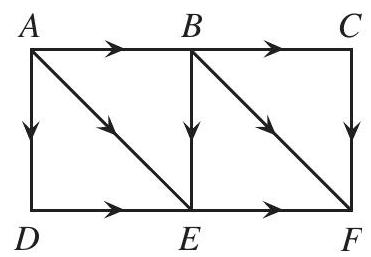 | From $A$, we can travel to $D, E$ or $B$.
If we travel $A \rightarrow D$, we must then go $D \rightarrow E \rightarrow F$, following the arrows.
If we travel $A \rightarrow E$, we must then go $E \rightarrow F$.
If we travel $A \rightarrow B$, we can then travel from $B$ to $E, C$ or $F$.
From $E$ or $C$, we must t... | 5 | Combinatorics | MCQ | Yes | Yes | olympiads | false |
In how many ways can 75 be expressed as the sum of two or more consecutive positive integers?
(A) 1
(B) 2
(C) 3
(D) 4
(E) 5 | When we add up a number of consecutive integers, the sum of these integers will be equal to the number of integers being added times the average of the integers being added.
Let $N$ be the number of consecutive integers being added, and let $A$ be the average of the consecutive integers being added. Thus, $N A=75$.
B... | 5 | Number Theory | MCQ | Yes | Yes | olympiads | false |
A lattice point is a point $(x, y)$ where both $x$ and $y$ are integers For how many different integer values of $k$ will the two lines $k x-5 y+7=0$ and $k^{2} x-5 y+1=0$ intersect at a lattice point?
(A) 1
(B) 2
(C) 3
(D) 4
(E) 5 | Subtracting the first equation from the second,
$$
\begin{aligned}
k^{2} x-k x-6 & =0 \\
\left(k^{2}-k\right) x & =6 \\
{[k(k-1)] x } & =6
\end{aligned}
$$
Since we want both $k$ and $x$ to be integers, then $k(k-1)$ is a factor of 6 , ie. is equal to one of $\pm 1, \pm 2, \pm 3, \pm 6$. Now $k(k-1)$ is the product o... | 2 | Algebra | MCQ | Yes | Yes | olympiads | false |
The value of $\frac{5(6)-3(4)}{6+3}$ is
(A) 1
(B) 2
(C) 6
(D) 12
(E) 31 | The value of $\frac{5(6)-3(4)}{6+3}$ is
(A) 1
(B) 2
(C) 6
(D) 12
(E) 31
## Solution
By evaluating the numerator and denominator we have,
$$
\frac{5(6)-3(4)}{6+3}=\frac{30-12}{9}=\frac{18}{9}=2
$$
ANSWER: (B) | 2 | Algebra | MCQ | Yes | Yes | olympiads | false |
If $\left[\left(10^{3}\right)\left(10^{x}\right)\right]^{2}=10^{18}$, the value of $x$ is
(A) $\sqrt{2}$
(B) 12
(C) 6
(D) 1
(E) 3 | If $\left[\left(10^{3}\right)\left(10^{x}\right)\right]^{2}=10^{18}$, the value of $x$ is
(A) $\sqrt{2}$
(B) 12
(C) 6
(D) 1
(E) 3
## Solution
If we simplify using laws of exponents, we will have,
$$
\begin{gathered}
\left(10^{3+x}\right)^{2}=10^{18} \\
10^{6+2 x}=10^{18}
\end{gathered}
$$
In order that the left and... | 6 | Algebra | MCQ | Yes | Yes | olympiads | false |
When a positive integer $N$ is divided by 60 , the remainder is 49 . When $N$ is divided by 15 , the remainder is
(A) 0
(B) 3
(C) 4
(D) 5
(E) 8 | When a positive integer $N$ is divided by 60 , the remainder is 49 . When $N$ is divided by 15 , the remainder is
(A) 0
(B) 3
(C) 4
(D) 5
(E) 8
## Solution
This problem can be done in a number of ways. The easiest way is to consider that if $N$ is divided by 60 to achieve a remainder of 49 , it must be a number of th... | 4 | Number Theory | MCQ | Yes | Yes | olympiads | false |
How many five-digit positive integers, divisible by 9 , can be written using only the digits 3 and 6 ?
(A) 5
(B) 2
(C) 12
(D) 10
(E) 8 | How many five-digit positive integers, divisible by 9 , can be written using only the digits 3 and 6 ?
(A) 5
(B) 2
(C) 12
(D) 10
(E) 8
## Solution
If a five-digit number is composed of only 3's and 6's, there are just two cases to consider because these are the only ways that the digital sum can be a multiple of 9 .
... | 10 | Combinatorics | MCQ | Yes | Yes | olympiads | false |
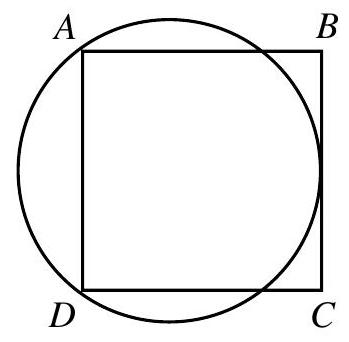
Square $A B C D$ with side length 2 is inscribed in a circle, as shown. Using each side of the square as a diameter, semicircular arcs are drawn. The area of the shaded region outside the circle and inside the semi-circles is
(A) $\pi$
(B) 4
(C) $2 \pi-2$
(D) $\pi+1$
(E) $2 \pi-4$
 $\pi$
(B) 4
(C) $2 \pi-2$
(D) $\pi+1$
(E) $2 \pi-4$
$ and radius 12 , and the other with centre $B(2,-1)$ and radius 6 ?
(A) 1
(B) 2
(C) 3
(D) 4
(E) 5 | What is the shortest distance between two circles, the first having centre $A(5,3)$ and radius 12 , and the other with centre $B(2,-1)$ and radius 6 ?
(A) 1
(B) 2
(C) 3
(D) 4
(E) 5
## Solution
We start by drawing the two circles where the larger circle has centre $A(5,3)$ and the smaller circle has centre $B(2,-1)$. ... | 1 | Geometry | MCQ | Yes | Yes | olympiads | false |
A farmer has 7 cows, 8 sheep and 6 goats. How many more goats should be bought so that half of her animals will be goats?
(A) 18
(B) 15
(C) 21
(D) 9
(E) 6 | A farmer has 7 cows, 8 sheep and 6 goats. How many more goats should be bought so that half of her animals will be goats?
(A) 18
(B) 15
(C) 21
(D) 9
(E) 6
## Solution 1
If the cows and sheep were themselves goats we would have 15 goats. This means that she would need nine extra goats.
## Solution 2
Let the number o... | 9 | Algebra | MCQ | Yes | Yes | olympiads | false |
A positive integer is to be placed in each box. The product of any four adjacent integers is always 120. What is the value of $x$ ?
| | | 2 | | | 4 | | | $x$ | | | 3 | | |
| :--- | :--- | :--- | :--- | :--- | :--- | :--- | :--- | :--- | :--- | :--- | :--- | :--- | :--- |
(A) 1
(B) 2
(C) 3
(D) 4
(E) 5 | A positive integer is to be placed in each box. The product of any four adjacent integers is always 120. What is the value of $x$ ?
| | | 2 | | | 4 | | $x$ | | | | 3 | | |
| :--- | :--- | :--- | :--- | :--- | :--- | :--- | :--- | :--- | :--- | :--- | :--- | :--- | :--- |
(A) 1
(B) 2
(C) 3
(D) 4
(E) 5
## So... | 5 | Number Theory | MCQ | Yes | Yes | olympiads | false |
An ant walks inside a $18 \mathrm{~cm}$ by $150 \mathrm{~cm}$ rectangle. The ant's path follows straight lines which always make angles of $45^{\circ}$ to the sides of the rectangle. The ant starts from a point $X$ on one of the shorter sides. The first time the ant reaches the opposite side, it arrives at the midpoint... | An ant walks inside a $18 \mathrm{~cm}$ by $150 \mathrm{~cm}$ rectangle. The ant's path follows straight lines which always make angles of $45^{\circ}$ to the sides of the rectangle. The ant starts from a point $X$ on one of the shorter sides. The first time the ant reaches the opposite side, it arrives at the midpoint... | 3 | Geometry | MCQ | Yes | Yes | olympiads | false |
The left most digit of an integer of length 2000 digits is 3 . In this integer, any two consecutive digits must be divisible by 17 or 23 . The 2000th digit may be either ' $a$ ' or ' $b$ '. What is the value of $a+b$ ?
(A) 3
(B) 7
(C) 4
(D) 10
(E) 17 | The left most digit of an integer of length 2000 digits is 3 . In this integer, any two consecutive digits must be divisible by 17 or 23 . The 2000th digit may be either ' $a$ ' or ' $b$ '. What is the value of $a+b$ ?
(A) 3
(B) 7
(C) 4
(D) 10
(E) 17
## Solution
We start by noting that the two-digit multiples of 17 a... | 7 | Number Theory | MCQ | Yes | Yes | olympiads | false |
In the diagram, $A B$ and $A C$ have equal lengths. What is the value of $k$ ?
(A) -3
(D) -7
(B) -4
(C) -5
(E) -8
 | In the diagram, $A B$ and $A C$ have equal lengths. What is the value of $k$ ?
(A) -3
(B) -4
(C) -5
(D) -7
(E) -8

## Solution
Since $A B=A C=8,5-k=8$
$$
k=-3
$$
ANSWER: (A) | -3 | Geometry | MCQ | Yes | Yes | olympiads | false |
The units digit in the product $\left(5^{2}+1\right)\left(5^{3}+1\right)\left(5^{23}+1\right)$ is
(A) 0
(B) 1
(C) 2
(D) 5
(E) 6 | The units digit in the product $\left(5^{2}+1\right)\left(5^{3}+1\right)\left(5^{23}+1\right)$ is
(A) 0
(B) 1
(C) 2
(D) 5
(E) 6
## Solution
Since $5^{2}, 5^{3}$ and $5^{23}$ all end in 5 , then $5^{2}+1,5^{3}+1$ and $5^{23}+1$ all end in 6 . When we multiply these three numbers together their product must also end in... | 6 | Number Theory | MCQ | Yes | Yes | olympiads | false |
A chocolate drink is $6 \%$ pure chocolate, by volume. If 10 litres of pure milk are added to 50 litres of this drink, the percent of chocolate in the new drink is
(A) 5
(B) 16
(C) 10
(D) 3
(E) 26 | A chocolate drink is $6 \%$ pure chocolate, by volume. If 10 litres of pure milk are added to 50 litres of this drink, the percent of chocolate in the new drink is
(A) 5
(B) 16
(C) 10
(D) 3
(E) 26
## Solution
If $6 \%$ of the 50 litres is pure chocolate, this means that there will be three litres of pure chocolate in... | 5 | Algebra | MCQ | Yes | Yes | olympiads | false |
A number is Beprisque if it is the only natural number between a prime number and a perfect square (e.g. 10 is Beprisque but 12 is not). The number of two-digit Beprisque numbers (including 10) is
(A) 1
(B) 2
(C) 3
(D) 4
(E) 5 | A number is Beprisque if it is the only natural number between a prime number and a perfect square (e.g. 10 is Beprisque but 12 is not). The number of two-digit Beprisque numbers (including 10) is
(A) 1
(B) 2
(C) 3
(D) 4
(E) 5
## Solution
We start with the observation that it is necessary to consider only the odd per... | 5 | Number Theory | MCQ | Yes | Yes | olympiads | false |
The sum of all values of $x$ that satisfy the equation $\left(x^{2}-5 x+5\right)^{x^{2}+4 x-60}=1$ is
(A) -4
(B) 3
(C) 1
(D) 5
(E) 6 | The sum of all values of $x$ that satisfy the equation $\left(x^{2}-5 x+5\right)^{x^{2}+4 x-60}=1$ is
(A) -4
(B) 3
(C) 1
(D) 5
(E) 6
## Solution
We consider the solution in three cases.
Case 1 It is possible for the base to be 1.
Therefore, $x^{2}-5 x+5=1$
$x^{2}-5 x+4=0$
$$
(x-1)(x-4)=0
$$
Therefore $x=1$ or $x... | 3 | Algebra | MCQ | Yes | Yes | olympiads | false |
If $x=2$ is a solution of the equation $q x-3=11$, the value of $q$ is
(A) 4
(B) 7
(C) 14
(D) -7
(E) -4 | If $x=2$ is a solution of the equation $q x-3=11$, the value of $q$ is
(A) 4
(B) 7
(C) 14
(D) -7
(E) -4
## Solution
If $x=2$ is a solution of $q x-3=11$, then
$$
\begin{aligned}
q(2)-3 & =11 \\
2 q & =14 \\
q & =7
\end{aligned}
$$
ANSWER: (B) | 7 | Algebra | MCQ | Yes | Yes | olympiads | false |
The vertices of a triangle have coordinates $(1,1),(7,1)$ and $(5,3)$. What is the area of this triangle?
(A) 12
(B) 8
(C) 6
(D) 7
(E) 9 | The vertices of a triangle have coordinates $(1,1),(7,1)$ and $(5,3)$. What is the area of this triangle?
(A) 12
(B) 8
(C) 6
(D) 7
(E) 9
## Solution
Draw the triangle on the coordinate axes. This triangle has a base of 6 and a height of 2 . Its area is $\frac{1}{2}(6)(2)=6$.
 The number of such integers is
(A) 1
(B) 2
(C) 3
(D) 4
(E) 5
Part B: Each question is worth 6 credits. | The sum of the digits of a five-digit positive integer is 2. (A five-digit integer cannot start with zero.) The number of such integers is
(A) 1
(B) 2
(C) 3
(D) 4
(E) 5
## Solution
If the sum of the digits of a five-digit positive integer is 2 , then the only possible integers are 20 000, 11 000, 10 100, 10 010, and ... | 5 | Number Theory | MCQ | Yes | Yes | olympiads | false |
If $x+y+z=25, x+y=19$ and $y+z=18$, then $y$ equals
(A) 13
(B) 17
(C) 12
(D) 6
(E) -6 | If $x+y+z=25, x+y=19$ and $y+z=18$, then $y$ equals
(A) 13
(B) 17
(C) 12
(D) 6
(E) -6
## Solution
We are given that $x+y+z=25$ (1)
$$
\begin{aligned}
& x+y=19 \\
& y+z=18
\end{aligned}
$$
Add equations (2) and (3) to get $x+2 y+z=37$ (4). Subtract equation (1) from equation (4) to get $y=12$.
ANSWER: (C) | 12 | Algebra | MCQ | Yes | Yes | olympiads | false |
If $N=\left(7^{p+4}\right)\left(5^{q}\right)\left(2^{3}\right)$ is a perfect cube, where $p$ and $q$ are positive integers, the smallest possible value of $p+q$ is
(A) 5
(B) 2
(C) 8
(D) 6
(E) 12 | If $N=\left(7^{p+4}\right)\left(5^{q}\right)\left(2^{3}\right)$ is a perfect cube, where $p$ and $q$ are positive integers, the smallest possible value of $p+q$ is
(A) 5
(B) 2
(C) 8
(D) 6
(E) 12
## Solution
In order for $N$ to be a perfect cube, each prime factor of $N$ must have an exponent that is divisible by 3. S... | 5 | Number Theory | MCQ | Yes | Yes | olympiads | false |
Mr. Anderson has more than 25 students in his class. He has more than 2 but fewer than 10 boys and more than 14 but fewer than 23 girls in his class. How many different class sizes would satisfy these conditions?
(A) 5
(B) 6
(C) 7
(D) 3
(E) 4 | Mr. Anderson has more than 25 students in his class. He has more than 2 but fewer than 10 boys and more than 14 but fewer than 23 girls in his class. How many different class sizes would satisfy these conditions?
(A) 5
(B) 6
(C) 7
(D) 3
(E) 4
## Solution
Let $b$ represent the number of boys and $g$ represent the numb... | 6 | Number Theory | math-word-problem | Yes | Yes | olympiads | false |
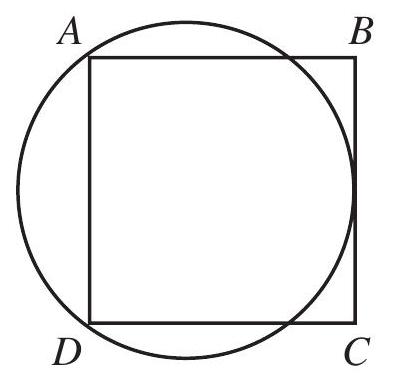
Each side of square $A B C D$ is 8 . A circle is drawn through $A$ and $D$ so that it is tangent to $B C$. What is the radius of this circle?
(A) 4
(B) 5
(C) 6
(D) $4 \sqrt{2}$
(E) 5.25
Pa... | Each side of square $A B C D$ is 8 . A circle is drawn through $A$ and $D$ so that it is tangent to $B C$. What is the radius of this circle?
(A) 4
(B) 5
(C) 6
(D) $4 \sqrt{2}$
(E) 5.25
##... | 5 | Geometry | MCQ | Yes | Yes | olympiads | false |
When Betty substitutes $x=1$ into the expression $a x^{3}-2 x+c$ its value is -5 . When she substitutes $x=4$ the expression has value 52 . One value of $x$ that makes the expression equal to zero is
(A) 2
(B) $\frac{5}{2}$
(C) 3
(D) $\frac{7}{2}$
(E) 4 | When Betty substitutes $x=1$ into the expression $a x^{3}-2 x+c$ its value is -5 . When she substitutes $x=4$ the expression has value 52 . One value of $x$ that makes the expression equal to zero is
(A) 2
(B) $\frac{5}{2}$
(C) 3
(D) $\frac{7}{2}$
(E) 4
## Solution
When $x=1$, we are told that $a(1)^{3}-2(1)+c=-5$, o... | 2 | Algebra | MCQ | Yes | Yes | olympiads | false |
The value of $(1)^{10}+(-1)^{8}+(-1)^{7}+(1)^{5}$ is
(A) 0
(B) 1
(C) 2
(D) 16
(E) 4 | Solution
$$
\begin{aligned}
(1)^{10}+(-1)^{8}+(-1)^{7}+(1)^{5} & =1+1-1+1 \\
& =2
\end{aligned}
$$
ANSWER: (C) | 2 | Algebra | MCQ | Yes | Yes | olympiads | false |
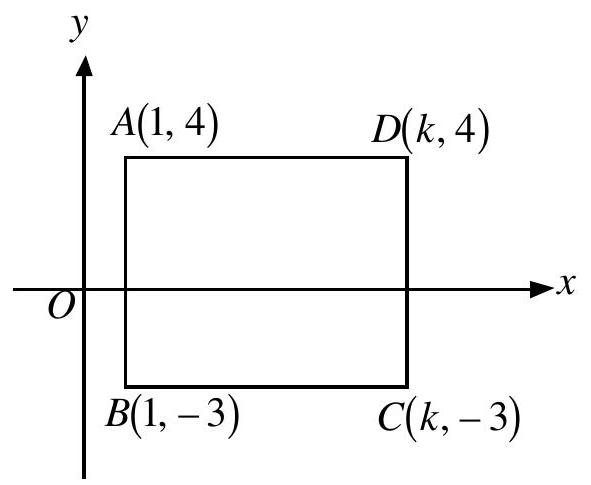
In the diagram, rectangle $A B C D$ has area 70 and $k$ is positive. The value of $k$ is
(A) 8
(B) 9
(C) 10
(D) 11
(E) 12
 | Solution
In rectangle $A B C D$, side $A B$ has length $4-(-3)=7$. Since the area of the rectangle is 70 , the length of side $A D$ must be $\frac{70}{7}=10$.
Thus, the value of $k$ is $1+10=11$.
ANSWER: (D)
# | 11 | Geometry | MCQ | Yes | Yes | olympiads | false |
The sum of seven consecutive integers is 77. The smallest of these integers is
(A) 5
(B) 7
(C) 8
(D) 11
(E) 14 | Solution
Since the sum of the seven integers is 77 , their average is $\frac{77}{7}=11$. Because there is an odd number of consecutive integers, 11 is the middle integer and the smallest is 8 . ANSWER: (C) | 8 | Algebra | MCQ | Yes | Yes | olympiads | false |
If $\frac{30}{7}=x+\frac{1}{y+\frac{1}{z}}$, where $x, y$, and $z$ are positive integers, then what is the value of $x+y+z$ ?
(A) 13
(B) 9
(C) 11
(D) 37
(E) 30 | Solution
$$
\begin{aligned}
4+\frac{2}{7} & =4+\frac{1}{\left(\frac{7}{2}\right)} \\
& =4+\frac{1}{3+\frac{1}{2}}
\end{aligned}
$$
Rewrite $\frac{30}{7}$ as
By comparison, $x=4, y=3$ and $z=2$.
Thus, $x+y+z=9$. | 9 | Algebra | MCQ | Yes | Yes | olympiads | false |
In a convex polygon, exactly five of the interior angles are obtuse. The largest possible number of sides for this polygon is
(A) 7
(B) 8
(C) 9
(D) 10
(E) 11 | Solution
Since exactly five interior angles are obtuse, then exactly five exterior angles are acute and the remaining angles must be obtuse. Since we want the maximum number of obtuse angles, assume that the five acute exterior angles have a sum less than 90r. Since obtuse angles are greater than 90 r, we can only hav... | 8 | Geometry | MCQ | Yes | Yes | olympiads | false |
The value of $2^{3}-2+3$ is
(A) 2
(B) 7
(C) 9
(D) 10
(E) 12 | Evaluating, $2^{3}-2+3=2 \times 2 \times 2-2+3=8-2+3=9$.
ANSwer: (C) | 9 | Algebra | MCQ | Yes | Yes | olympiads | false |
If $\frac{1}{3}$ of $x$ is equal to 4 , then $\frac{1}{6}$ of $x$ is equal to
(A) 3
(B) 4
(C) 2
(D) $\frac{7}{6}$
(E) $\frac{4}{3}$ | Since $\frac{1}{3}$ of $x$ is equal to 4 , then $x$ is equal to $3 \times 4$ or 12 . Thus, $\frac{1}{6}$ of $x$ is equal to $12 \div 6=2$.
Alternatively, since $\frac{1}{6}$ is one-half of $\frac{1}{3}$, then $\frac{1}{6}$ of $x$ is equal to one-half of $\frac{1}{3}$ of $x$, which is $4 \div 2$ or 2.
ANSWER: (C) | 2 | Algebra | MCQ | Yes | Yes | olympiads | false |
The decimal representation of $\frac{1}{11}$ is $0.09090909 \ldots$
Another way to write this decimal representation is $0 . \overline{09}$.
Similarly, $0 . \overline{125}$ represents the number $0.125125125 \ldots$
The decimal representation of $\frac{1}{7}$ is $0 . \overline{142857}$.
In the decimal representatio... | The digits to the right of the decimal place in the decimal represenation of $\frac{1}{7}$ occur in blocks of 6 , repeating the block of digits 142857 .
Since $16 \times 6=96$, then the 96th digit to the right of the decimal place is the last in one of these blocks; that is, the 96th digit is 7 .
This means that the ... | 8 | Number Theory | MCQ | Yes | Yes | olympiads | false |
The value of $\frac{1}{2}+\frac{2}{4}+\frac{4}{8}+\frac{8}{16}$ is
(A) $\frac{1}{4}$
(B) $\frac{1}{2}$
(C) 0
(D) 4
(E) 2 | In the given sum, each of the four fractions is equivalent to $\frac{1}{2}$.
Therefore, the given sum is equal to $\frac{1}{2}+\frac{1}{2}+\frac{1}{2}+\frac{1}{2}=2$.
ANSWER: (E) | 2 | Algebra | MCQ | Yes | Yes | olympiads | false |
Which of the following numbers is closest to -3.4 ?
(A) -4
(B) -3
(C) 0
(D) 3
(E) 4 | On a number line, -3.4 is between -4 and -3 .
This means that -3.4 is closer to -4 and -3 than to any of 0,3 or 4 , and so the answer must be -4 or -3 .
If we start at -3 and move in the negative direction (that is, to the left), we reach -3.4 after moving 0.4 units.
It then takes an additional 0.6 units to move in ... | -3 | Number Theory | MCQ | Yes | Yes | olympiads | false |
Robyn has 4 tasks to do and Sasha has 14 tasks to do. In order for Robyn and Sasha to do the same number of tasks, how many of Sasha's tasks should Robyn do?
(A) 6
(B) 4
(C) 5
(D) 7
(E) 2 | Between them, Robyn and Sasha have $4+14=18$ tasks to do.
If each does the same number of tasks, each must do $18 \div 2=9$ tasks. This means that Robyn must do $9-4=5$ of Sasha's tasks.
ANSWER: $(\mathrm{C})$ | 5 | Algebra | MCQ | Yes | Yes | olympiads | false |
The line with equation $y=2 x+b$ passes through the point $(-4,0)$. The value of $b$ is
(A) $\frac{1}{2}$
(B) 1
(C) 2
(D) 4
(E) 8 | Since the line with equation $y=2 x+b$ passes through the point $(-4,0)$, the coordinates of the point must satisfy the equation of the line.
Substituting $x=-4$ and $y=0$ gives $0=2(-4)+b$ and so $0=-8+b$ which gives $b=8$.
ANsWER: (E) | 8 | Algebra | MCQ | Yes | Yes | olympiads | false |
On the map shown, there are a number of routes from Mathville to Algebratown.

Each route must travel along the roads in the direction marked by the arrows. The total number of routes from M... | We label Mathville as $M$, Algebratown as $A$, and the other intersection points of roads as shown.

There is 1 route from $M$ to each of $C$ and $B: M \rightarrow C$ and $M \rightarrow B$.... | 8 | Combinatorics | MCQ | Yes | Yes | olympiads | false |
How many of the integers $19,21,23,25,27$ can be expressed as the sum of two prime numbers?
(A) 3
(B) 4
(C) 1
(D) 2
(E) 5 | We note that all of the given possible sums are odd, and also that every prime number is odd with the exception of 2 (which is even).
When two odd integers are added, their sum is even.
When two even integers are added, their sum is even.
When one even integer and one odd integer are added, their sum is odd.
Theref... | 3 | Number Theory | MCQ | Yes | Yes | olympiads | false |
Point $Q$ is on a line segment between $P$ and $R$, as shown. If $P R=12$ and $P Q=3$, what is the length of $Q R$ ?

(A) 6
(B) 10
(C) 8
(D) 9
(E) 4 | Since $Q$ is between $P$ and $R$, then $P Q+Q R=P R$.
Since $P R=12$ and $P Q=3$, then $Q R=P R-P Q=12-3=9$.
ANSWER: (D) | 9 | Geometry | MCQ | Yes | Yes | olympiads | false |
What number should be placed in the $\square$ to make the equation $\frac{1}{2}=\frac{\square}{8}$ true?
(A) 1
(B) 2
(C) 4
(D) 6
(E) 7 | The fraction $\frac{4}{8}$ is equivalent to the fraction $\frac{1}{2}$.
Therefore, the number 4 should be placed in the $\square$.
ANSWER: $(\mathrm{C})$ | 4 | Algebra | MCQ | Yes | Yes | olympiads | false |
If $m+1=\frac{n-2}{3}$, what is the value of $3 m-n$ ?
(A) -1
(B) -5
(C) -3
(D) -9
(E) -7 | Since $m+1=\frac{n-2}{3}$, then $3(m+1)=n-2$.
This means that $3 m+3=n-2$ and so $3 m-n=-2-3=-5$.
ANSWER: (B) | -5 | Algebra | MCQ | Yes | Yes | olympiads | false |
Trains arrive at Pascal Station every $x$ minutes, where $x$ is a positive integer. Trains arrive at Pascal Station at many different times, including at 10:10 a.m., 10:55 a.m., and 11:58 a.m. Which of the following is a possible value of $x$ ?
(A) 9
(B) 7
(C) 10
(D) 5
(E) 11 | The length of time between 10:10 a.m. and 10:55 a.m. is 45 minutes.
The length of time between 10:55 a.m. and 11:58 a.m. is 1 hour and 3 minutes, or 63 minutes. Since trains arrive at each of these times and we are told that trains arrive every $x$ minutes, then both 45 and 63 must be multiples of $x$. (In other words... | 9 | Number Theory | MCQ | Yes | Yes | olympiads | false |
Three cubes have edge lengths $3 \mathrm{~cm}, 12 \mathrm{~cm}$, and $x \mathrm{~cm}$. The average volume of the three cubes is $700 \mathrm{~cm}^{3}$. The value of $x$, rounded to the nearest integer, is
(A) 6
(B) 10
(C) 8
(D) 9
(E) 7 | Since the average volume of three cubes is $700 \mathrm{~cm}^{3}$, their total volume is $3 \times 700 \mathrm{~cm}^{3}$ or $2100 \mathrm{~cm}^{3}$.
The volume of a cube with edge length $s \mathrm{~cm}$ is $s^{3} \mathrm{~cm}^{3}$.
Therefore, $3^{3}+12^{3}+x^{3}=2100$ and so $27+1728+x^{3}=2100$ or $x^{3}=345$.
Sin... | 7 | Algebra | MCQ | Yes | Yes | olympiads | false |
If $2 x+6=16$, the value of $x+4$ is
(A) 7
(B) 8
(C) 9
(D) 15
(E) 13 | Solution 1
Since $2 x+6=16$, then $\frac{2 x+6}{2}=\frac{16}{2}$ and so $x+3=8$.
Since $x+3=8$, then $x+4=(x+3)+1=8+1=9$.
Solution 2
Since $2 x+6=16$, then $2 x=16-6=10$.
Since $2 x=10$, then $\frac{2 x}{2}=\frac{10}{2}$ and so $x=5$.
Since $x=5$, then $x+4=5+4=9$.
ANSWER: (C) | 9 | Algebra | MCQ | Yes | Yes | olympiads | false |
When two positive integers are multiplied, the result is 24 . When these two integers are added, the result is 11 . When the smaller integer is subtracted from the larger integer, the result is
(A) 2
(B) 3
(C) 4
(D) 5
(E) 6 | The positive divisor pairs of 24 are:
1 and $24 \quad 2$ and $12 \quad 3$ and $8 \quad 4$ and 6
Of these, the pair whose sum is 11 is 3 and 8 .
The difference between these two integers is $8-3=5$.
ANsWer: (D) | 5 | Algebra | MCQ | Yes | Yes | olympiads | false |
The value of $\frac{2^{4}-2}{2^{3}-1}$ is
(A) 1
(B) 0
(C) $\frac{7}{4}$
(D) $\frac{4}{3}$
(E) 2 | We note that $2^{3}=2 \times 2 \times 2=8$ and $2^{4}=2^{3} \times 2=16$.
Therefore, $\frac{2^{4}-2}{2^{3}-1}=\frac{16-2}{8-1}=\frac{14}{7}=2$.
Alternatively, $\frac{2^{4}-2}{2^{3}-1}=\frac{2\left(2^{3}-1\right)}{2^{3}-1}=2$.
ANSWER: (E) | 2 | Algebra | MCQ | Yes | Yes | olympiads | false |
A positive integer $n$ is a multiple of 7 . The square root of $n$ is between 17 and 18 . How many possible values of $n$ are there?
(A) 2
(B) 3
(C) 4
(D) 5
(E) 6 | Since the square root of $n$ is between 17 and 18 , then $n$ is between $17^{2}=289$ and $18^{2}=324$.
Since $n$ is a multiple of 7 , we need to count the number of multiples of 7 between 289 and 324 . Since $41 \times 7=287$ and $42 \times 7=294$, then 294 is the smallest multiple of 7 larger than 289 . Since $46 \ti... | 5 | Number Theory | MCQ | Yes | Yes | olympiads | false |
Each of the following 15 cards has a letter on one side and a positive integer on the other side.
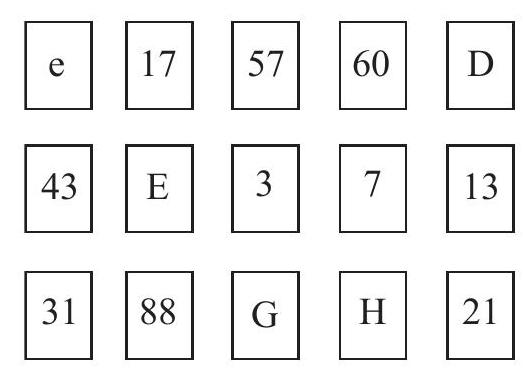
What is the minimum number of cards that need to be turned over to check if the following ... | Each card fits into exactly one of the following categories:
(A) lower case letter on one side, even integer on the other side
(B) lower case letter on one side, odd integer on the other side
(C) upper case letter on one side, even integer on the other side
(D) upper case letter on one side, odd integer on the othe... | 3 | Logic and Puzzles | MCQ | Yes | Yes | olympiads | false |
Ali, Bea, Che, and Deb compete in a checkers tournament. Each player plays each other player exactly once. At the end of each game, either the two players tie or one player wins and the other player loses. A player earns 5 points for a win, 0 points for a loss, and 2 points for a tie. Exactly how many of the following ... | Since there are 4 players in the tournament and each player plays each other player once, then each player plays 3 games.
Since each win earns 5 points and each tie earns 2 points, the possible results for an individual player are:
- 3 wins, 0 losses, 0 ties: 15 points
- 2 wins, 0 losses, 1 tie: 12 points
- 2 wins, 1... | 1 | Combinatorics | MCQ | Yes | Yes | olympiads | false |
The expression $2 \times 3+2 \times 3$ equals
(A) 10
(B) 20
(C) 36
(D) 12
(E) 16 | Evaluating, $2 \times 3+2 \times 3=6+6=12$.
ANSWER: (D) | 12 | Algebra | MCQ | Yes | Yes | olympiads | false |
The perimeter of a square is 28 . What is the side length of this square?
(A) 9
(B) 6
(C) 8
(D) 4
(E) 7 | Since a square has four equal sides, the side length of a square equals one-quarter of the perimeter of the square.
Thus, the side length of a square with perimeter 28 is $28 \div 4=7$.
ANswer: (E) | 7 | Geometry | MCQ | Yes | Yes | olympiads | false |
In the diagram, each of $\triangle Q P T, \triangle Q T S$ and $\triangle Q S R$ is an isosceles, right-angled triangle, with $\angle Q P T=\angle Q T S=\angle Q S R=90^{\circ}$. The combined area of the three triangles is 56. If $Q P=P T=k$, what is the value of $k$ ?
(A) $\sqrt{2}$
(B) 1
(C) 4
(D) 2
(E) $2 \sqrt{2}$
... | By the Pythagorean Theorem,
$$
Q T^{2}=Q P^{2}+P T^{2}=k^{2}+k^{2}=2 k^{2}
$$
Since $Q T>0$, then $Q T=\sqrt{2} k$.
Since $\triangle Q T S$ is isosceles, then $T S=Q T=\sqrt{2} k$.
By the Pythagorean Theorem,
$$
Q S^{2}=Q T^{2}+T S^{2}=(\sqrt{2} k)^{2}+(\sqrt{2} k)^{2}=2 k^{2}+2 k^{2}=4 k^{2}
$$
Since $Q S>0$, th... | 4 | Geometry | MCQ | Yes | Yes | olympiads | false |
What is the units (ones) digit of the integer equal to $5^{2019}-3^{2019}$ ?
(A) 0
(B) 2
(C) 4
(D) 6
(E) 8 | The units digit of $5^{2019}$ is 5 .
This is because the units digit of any power of 5 is 5 .
To see this, we note that the first few powers of 5 are
$$
5^{1}=5 \quad 5^{2}=25 \quad 5^{3}=125 \quad 5^{4}=625 \quad 5^{5}=3125 \quad 5^{6}=15625
$$
The units digit of a product of integers depends only on the units dig... | 8 | Number Theory | MCQ | Yes | Yes | olympiads | false |
In the diagram, the number line between 0 and 5 is divided into 20 equal parts. The numbers $S$ and $T$ are marked on the line. What is the value of $S+T$ ?

(A) 5.25
(B) 5.5
(C) 4.5
(D) 4.7... | The section of the number line between 0 and 5 has length $5-0=5$.
Since this section is divided into 20 equal parts, the width of each part is $\frac{5}{20}=\frac{1}{4}=0.25$.
Since $S$ is 5 of these equal parts to the right of 0 , then $S=0+5 \times 0.25=1.25$.
Since $T$ is 5 of these equal parts to the left of 5 ... | 5 | Geometry | MCQ | Yes | Yes | olympiads | false |
In the diagram, the circle graph shows how a baby polar bear spent 24 hours. How many hours did it spend playing?
(A) 6
(B) 7
(C) 8
(D) 9
(E) 10
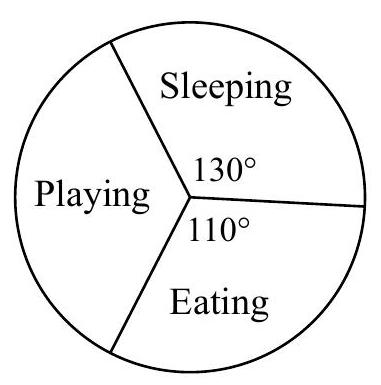 | The complete central angle of a circle measures $360^{\circ}$.
This means that the angle in the circle graph associated with Playing is $360^{\circ}-130^{\circ}-110^{\circ}$ or $120^{\circ}$.
A central angle of $120^{\circ}$ represents $\frac{120^{\circ}}{360^{\circ}}=\frac{1}{3}$ of the total central angle.
This me... | 8 | Other | MCQ | Yes | Yes | olympiads | false |
In the list $7,9,10,11,18$, which number is the average (mean) of the other four numbers?
(A) 9
(B) 18
(C) 7
(D) 11
(E) 10 | The average of the numbers $7,9,10,11$ is $\frac{7+9+10+11}{4}=\frac{37}{4}=9.25$, which is not equal to 18 , which is the fifth number.
The average of the numbers $7,9,10,18$ is $\frac{7+9+10+18}{4}=\frac{44}{4}=11$, which is equal to 11 , the remaining fifth number.
We can check that the averages of the remaining t... | 11 | Algebra | MCQ | Yes | Yes | olympiads | false |
Suppose that $p$ and $q$ are two different prime numbers and that $n=p^{2} q^{2}$. The number of possible values of $n$ with $n<1000$ is
(A) 5
(B) 6
(C) 4
(D) 8
(E) 7 | We note that $n=p^{2} q^{2}=(p q)^{2}$.
Since $n<1000$, then $(p q)^{2}<1000$ and so $p q<\sqrt{1000} \approx 31.6$.
Finding the number of possible values of $n$ is thus equivalent to finding the number of positive integers $m$ with $1 \leq m \leq 31<\sqrt{1000}$ that are the product of two prime numbers.
The prime ... | 7 | Number Theory | MCQ | Yes | Yes | olympiads | false |
In Mrs. Warner's class, there are 30 students. Strangely, 15 of the students have a height of $1.60 \mathrm{~m}$ and 15 of the students have a height of $1.22 \mathrm{~m}$. Mrs. Warner lines up $n$ students so that the average height of any four consecutive students is greater than $1.50 \mathrm{~m}$ and the average he... | We refer to the students with height $1.60 \mathrm{~m}$ as "taller" students and to those with height $1.22 \mathrm{~m}$ as "shorter" students.
For the average of four consecutive heights to be greater than $1.50 \mathrm{~m}$, the sum of these four heights must be greater than $4 \times 1.50 \mathrm{~m}=6.00 \mathrm{~... | 9 | Combinatorics | MCQ | Yes | Yes | olympiads | false |
The value of $\frac{4 \times 3}{2+1}$ is
(A) 4
(B) 7
(C) 3
(D) 6
(E) 5 | Evaluating, $\frac{4 \times 3}{2+1}=\frac{12}{3}=4$.
ANSWER: (A) | 4 | Algebra | MCQ | Yes | Yes | olympiads | false |
If the symbol
| p | q |
| :--- | :--- |
| r | s |
is defined by $p\times s - q\times r$, then the value of
| 4 | 5 |
| :--- | :--- |
| 2 | 3 |
is
(A) -3
(B) -2
(C) 2
(D) 3
(E) 14 | From the definition, | 4 | 5 |
| :--- | :--- |
| 2 | 3 |$=4 \times 3-5 \times 2=12-10=2$.
ANsweR: (C) | 2 | Algebra | MCQ | Yes | Yes | olympiads | false |
If $x=3, y=2 x$, and $z=3 y$, then the average of $x, y$ and $z$ is
(A) 6
(B) 7
(C) 8
(D) 9
(E) 10 | Since $x=3$ and $y=2 x$, then $y=2 \times 3=6$.
Since $y=6$ and $z=3 y$, then $z=3 \times 6=18$.
Therefore, the average of $x, y$ and $z$ is $\frac{x+y+z}{3}=\frac{3+6+18}{3}=9$.
ANSWER: (D) | 9 | Algebra | MCQ | Yes | Yes | olympiads | false |
The value of $\frac{20+15}{30-25}$ is
(A) 1
(B) 5
(C) 2
(D) 7
(E) 0 | Evaluating, $\frac{20+15}{30-25}=\frac{35}{5}=7$.
ANswER: (D) | 7 | Algebra | MCQ | Yes | Yes | olympiads | false |
If $8+6=n+8$, then $n$ equals
(A) 14
(B) 22
(C) 6
(D) -2
(E) 9 | Since $8+6=n+8$, then subtracting 8 from both sides, we obtain $6=n$ and so $n$ equals 6 . Alternatively, since the order in which we add two numbers does not change the sum, then $8+6=6+8$ and so $n=6$.
ANSWER: (C) | 6 | Algebra | MCQ | Yes | Yes | olympiads | false |
How many triples $(a, b, c)$ of positive integers satisfy the conditions $6 a b=c^{2}$ and $a<b<c \leq 35$ ?
(A) 10
(B) 8
(C) 6
(D) 7
(E) 9 | Since the left side of the given equation is a multiple of 6 , then the right side, $c^{2}$, is also a multiple of 6 .
Since $c^{2}$ is a multiple of 6 , then $c^{2}$ is a multiple of 2 and a multiple of 3 .
Since 2 and 3 are different prime numbers, then the positive integer $c$ itself must be a multiple of 2 and a ... | 8 | Number Theory | MCQ | Yes | Yes | olympiads | false |
At 2 p.m., Sanjay measures the temperature to be $3^{\circ} \mathrm{C}$. He measures the temperature every hour after this until 10 p.m. He plots the temperatures that he measures on the graph shown. At what time after 2 p.m. does he again measure a temperature of $3^{\circ} \mathrm{C}$ ?
(A) 9 p.m.
(B) 5 p.m.
(C) 8 p.... | The line representing a temperature of $3^{\circ}$ is the horizontal line passing halfway between $2^{\circ}$ and $4^{\circ}$ on the vertical axis.
There are two data points on this line: one at 2 p.m. and one at 9 p.m.
The required time is 9 p.m.
ANSWER: (A)
# | 9 | Other | MCQ | Yes | Yes | olympiads | false |
In the subtraction shown, $X$ and $Y$ are digits. What is the value of $X+Y$ ?
(A) 15
(B) 12
(C) 10
(D) 13
(E) 9 | We rearrange the given subtraction to create the addition statement $45+8 Y=1 X 2$.
Next, we consider the units digits.
From the statement, the sum $5+Y$ has a units digit of 2 . This means that $Y=7$. This is the only possibility. Therefore, we have $45+87=1 X 2$.
But $45+87=132$, so $X=3$.
Therefore, $X+Y=3+7=10$... | 10 | Number Theory | MCQ | Yes | Yes | olympiads | false |
In the $4 \times 4$ grid shown, each of the four symbols has a different value. The sum of the values of the symbols in each row is given to the right of that row. What is the value of
(A) 5
(B) 6
(C) 7
(D) 8
(E) 9
| $\odot$ | $\triangle$ | $\triangle$ | $\bigcirc$ | 26 |
| :---: | :---: | :---: | :---: | :---: |
| $\... | From the second row, $\triangle+\Delta+\triangle+\triangle=24$ or $4 \triangle=24$, and so $\triangle=6$.
From the first row, $\odot+\triangle+\triangle+\odot=26$ or $2 \odot+2 \triangle=26$.
Since $\triangle=6$, then $2 \odot=26-12=14$, and so $\odot=7$.
From the fourth row, $\square+\mathcal{\odot}+\square+\triang... | 5 | Logic and Puzzles | MCQ | Yes | Yes | olympiads | false |
The graph shows the mass, in kilograms, of Jeff's pet Atlantic cod, given its age in years. What is the age of the cod when its mass is $15 \mathrm{~kg}$ ?

(A) 3
(B) 7
(C) 4
(D) 6
(E) 5 | A mass of $15 \mathrm{~kg}$ is halfway between $10 \mathrm{~kg}$ and $20 \mathrm{~kg}$ on the vertical axis. The point where the graph reaches $15 \mathrm{~kg}$ is halfway between 6 and 8 on the horizontal axis.
Mass of Jeff's Pet Atlantic Cod
 3
(B) 4
(C) 5
(D) 6
(E) 7
 3
(B) 5
(C) 6
(D) 8
(E) 12 | We note that $64=4 \times 4 \times 4$.
Thus, $64^{2}=64 \times 64=4 \times 4 \times 4 \times 4 \times 4 \times 4$.
Since $4^{n}=64^{2}$, then $4^{n}=4 \times 4 \times 4 \times 4 \times 4 \times 4$ and so $n=6$.
ANswer: (C) | 6 | Algebra | MCQ | Yes | Yes | olympiads | false |
The value of $\frac{1+(3 \times 5)}{2}$ is
(A) 2
(B) 3
(C) 6
(D) 8
(E) 16 | Using the correct order of operations, $\frac{1+(3 \times 5)}{2}=\frac{1+15}{2}=\frac{16}{2}=8$.
ANSWER: (D) | 8 | Algebra | MCQ | Yes | Yes | olympiads | false |
If $y=1$ and $4 x-2 y+3=3 x+3 y$, what is the value of $x$ ?
(A) -2
(B) 0
(C) 2
(D) 4
(E) 8 | Substituting $y=1$ into the second equation, we obtain $4 x-2(1)+3=3 x+3(1)$.
Simplifying, we obtain $4 x-2+3=3 x+3$ or $4 x+1=3 x+3$.
Therefore, $4 x-3 x=3-1$ or $x=2$.
ANswer: (C) | 2 | Algebra | MCQ | Yes | Yes | olympiads | false |
Seven students shared the cost of a $\$ 26.00$ pizza. Each student paid either $\$ 3.71$ or $\$ 3.72$. How many students paid $\$ 3.72$ ?
(A) 1
(B) 3
(C) 5
(D) 4
(E) 2 | We can rephrase the given information by saying that each of the seven students paid $\$ 3.71$ and some of the students paid an extra $\$ 0.01$.
Since $7 \times \$ 3.71=\$ 25.97$ and the pizza cost $\$ 26.00$ in total, then the students who paid the extra $\$ 0.01$ each must make up the final $\$ 0.03$ of the cost of ... | 3 | Number Theory | MCQ | Yes | Yes | olympiads | false |
The operation $\nabla$ is defined by $g \nabla h=g^{2}-h^{2}$. For example, $2 \nabla 1=2^{2}-1^{2}=3$. If $g>0$ and $g \nabla 6=45$, the value of $g$ is
(A) 39
(B) 6
(C) 81
(D) 3
(E) 9 | Using the definition of the operation, $g \nabla 6=45$ gives $g^{2}-6^{2}=45$.
Thus, $g^{2}=45+36=81$.
Since $g>0$, then $g=\sqrt{81}=9$.
ANswer: (E) | 9 | Algebra | MCQ | Yes | Yes | olympiads | false |
In the diagram, points $R$ and $S$ lie on $Q T$. Also, $\angle P T Q=62^{\circ}, \angle R P S=34^{\circ}$, and $\angle Q P R=x^{\circ}$. What is the value of $x$ ?
(A) 11
(B) 28
(C) 17
(D) 31
(E) 34
+34^{\circ}=180^{\circ}$ or $2(\angle P R S)=146^{\circ}$ or $\angle P R S=73^{\circ}... | 11 | Geometry | MCQ | Yes | Yes | olympiads | false |
When $x=-2$, the value of $(x+1)^{3}$ is
(A) -1
(B) -8
(C) -5
(D) 1
(E) -3 | When $x=-2$, we have $(x+1)^{3}=(-2+1)^{3}=(-1)^{3}=-1$.
ANSWER: (A) | -1 | Algebra | MCQ | Yes | Yes | olympiads | false |
The number of odd integers between $\frac{17}{4}$ and $\frac{35}{2}$ is
(A) 4
(B) 5
(C) 6
(D) 7
(E) 8 | We note that $\frac{17}{4}=4 \frac{1}{4}$ and $\frac{35}{2}=17 \frac{1}{2}$.
Therefore, the integers between these two numbers are the integers from 5 to 17, inclusive. The odd integers in this range are $5,7,9,11,13,15$, and 17 , of which there are 7 .
ANSWER: (D) | 7 | Number Theory | MCQ | Yes | Yes | olympiads | false |
Each of the integers 1 to 7 is to be written, one in each circle in the diagram. The sum of the three integers in any straight line is to be the same. In how many different ways can the centre circle be filled?
(A) 1
(B) 2
(C) 3
(D) 4
(E) 5

Let $S$ be sum of the integers in any straight line.
Therefore, $S=a+g+d=b+g+e=c+g+f$.
Thus, $3 S=(a+g+d)+(b+g+e)+(c+g+f)=a+b+c+d+e+f+3 g$... | 3 | Combinatorics | MCQ | Yes | Yes | olympiads | false |
Let $n$ be the largest integer for which $14 n$ has exactly 100 digits. Counting from right to left, what is the 68 th digit of $n$ ?
(A) 1
(B) 2
(C) 4
(D) 5
(E) 8 | The largest integer with exactly 100 digits is the integer that consists of 100 copies of the digit 9 . This integer is equal to $10^{100}-1$.
Therefore, we want to determine the largest integer $n$ for which $14 n \leq 10^{100}-1$.
This is the same as trying to determine the largest integer $n$ for which $14 n<10^{1... | 1 | Number Theory | MCQ | Yes | Yes | olympiads | false |
The value of $\sqrt{3^{3}+3^{3}+3^{3}}$ is
(A) 3
(B) 9
(C) 27
(D) 81
(E) 243 | Since $3^{3}=3 \times 3 \times 3=3 \times 9=27$, then
$$
\sqrt{3^{3}+3^{3}+3^{3}}=\sqrt{27+27+27}=\sqrt{81}=9
$$
ANsWER: (B) | 9 | Algebra | MCQ | Yes | Yes | olympiads | false |
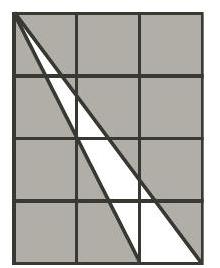
Twelve 1 by 1 squares form a rectangle, as shown. What is the total area of the shaded regions?
(A) 8
(B) 9
(C) 10
(D) 11
(E) 12
 | Solution 1
The total area of the rectangle is $3 \times 4=12$.
The total area of the shaded regions equals the total area of the rectangle (12) minus the area of the unshaded region.
The unshaded region is a triangle with base of length 1 and height 4; the area of this region is $\frac{1}{2}(1)(4)=2$.
Therefore, th... | 10 | Geometry | MCQ | Yes | Yes | olympiads | false |
If $10 \%$ of $s$ is $t$, then $s$ equals
(A) $0.1 t$
(B) $0.9 t$
(C) $9 t$
(D) $10 t$
(E) $90 t$ | The percentage $10 \%$ is equivalent to the fraction $\frac{1}{10}$.
Therefore, $t=\frac{1}{10} s$, or $s=10 t$.
ANswer: (D) | 10 | Algebra | MCQ | Yes | Yes | olympiads | false |
Subsets and Splits
No community queries yet
The top public SQL queries from the community will appear here once available.