
problem stringlengths 15 4.7k | solution stringlengths 2 11.9k | answer stringclasses 51
values | problem_type stringclasses 8
values | question_type stringclasses 4
values | problem_is_valid stringclasses 1
value | solution_is_valid stringclasses 1
value | source stringclasses 6
values | synthetic bool 1
class |
|---|---|---|---|---|---|---|---|---|
If $x$ and $y$ are positive integers with $3^{x} 5^{y}=225$, then $x+y$ equals
(A) 7
(B) 4
(C) 5
(D) 3
(E) 8 | Since $15^{2}=225$ and $15=3 \cdot 5$, then $225=15^{2}=(3 \cdot 5)^{2}=3^{2} \cdot 5^{2}$.
Therefore, $x=2$ and $y=2$, so $x+y=4$.
ANSWER: (B)
# | 4 | Number Theory | MCQ | Yes | Yes | olympiads | false |
A music test included 50 multiple choice questions. Zoltan's score was calculated by
- adding 4 points for each correct answer,
- subtracting 1 point for each incorrect answer, and
- adding 0 points for each unanswered question.
Zoltan answered 45 of the 50 questions and his score was 135 points. The number of questi... | Solution 1
Zoltan answered 45 questions.
If all of his answers had been correct, his score would have been $45(4)=180$ points.
Since his score was 135 points, then he lost $180-135=45$ points.
For each incorrect answer, he lost 5 points compared to a correct answer, since a correct answer adds 4 points and an incor... | 9 | Algebra | MCQ | Yes | Yes | olympiads | false |
In the diagram, the line segment with endpoints $P(-4,0)$ and $Q(16,0)$ is the diameter of a semi-circle. If the point $R(0, t)$ is on the circle with $t>0$, then $t$ is
(A) 6
(B) 10
(C) 8
(D) 9
(E) 7
$ and $Q(16,0)$ are endpoints of a diameter of the semi-circle, then the length of the diameter is $16-(-4)=20$.
Since a diameter of the semi-circle has length 20 , then the radius of the semi-circle is $\frac{1}{2}(20)=10$. Also, the centre $C$ is the midpoint of diameter $P Q$ and so has coordinates $\... | 8 | Geometry | MCQ | Yes | Yes | olympiads | false |
There are two values of $k$ for which the equation $x^{2}+2 k x+7 k-10=0$ has two equal real roots (that is, has exactly one solution for $x$ ). The sum of these values of $k$ is
(A) 0
(B) -3
(C) 3
(D) -7
(E) 7 | The equation $x^{2}+2 k x+7 k-10=0$ has two equal real roots precisely when the discriminant of this quadratic equation equals 0 .
The discriminant, $\Delta$, equals
$$
\Delta=(2 k)^{2}-4(1)(7 k-10)=4 k^{2}-28 k+40
$$
For the discriminant to equal 0 , we have $4 k^{2}-28 k+40=0$ or $k^{2}-7 k+10=0$ or $(k-2)(k-5)=0$... | 7 | Algebra | MCQ | Yes | Yes | olympiads | false |
What is the value of $\frac{15-3^{2}}{3}$ ?
(A) 2
(B) 4
(C) 12
(D) 48
(E) 3 | Evaluating the numerator first, we obtain $\frac{15-3^{2}}{3}=\frac{15-9}{3}=\frac{6}{3}=2$.
ANSWER: (A) | 2 | Algebra | MCQ | Yes | Yes | olympiads | false |
If $x=2$, then $(x+2-x)(2-x-2)$ equals
(A) -12
(B) 4
(C) 0
(D) 12
(E) -4 | When $x=2$, we have $(x+2-x)(2-x-2)=(2+2-2)(2-2-2)=(2)(-2)=-4$.
Alternatively, we could simplify $(x+2-x)(2-x-2)$ to obtain $(2)(-x)$ or $-2 x$ and then substitute $x=2$ to obtain a result of $-2(2)$ or -4 .
ANswer: (E) | -4 | Algebra | MCQ | Yes | Yes | olympiads | false |
Two positive integers $x$ and $y$ have $x y=24$ and $x-y=5$. The value of $x+y$ is
(A) 10
(B) 11
(C) 12
(D) 13
(E) 14 | The positive integer divisors of 24 are $1,2,3,4,6,8,12,24$.
The pairs of divisors that give a product of 24 are $24 \times 1,12 \times 2,8 \times 3$, and $6 \times 4$.
We want to find two positive integers $x$ and $y$ whose product is 24 and whose difference is 5 .
Since $8 \times 3=24$ and $8-3=5$, then $x=8$ and ... | 11 | Algebra | MCQ | Yes | Yes | olympiads | false |
In the diagram, $P Q R S$ is a square with side length 8 . Points $T$ and $U$ are on $P S$ and $Q R$ respectively with $Q U=T S=1$. The length of $T U$ is closest to
(A) 8.5
(B) 9.9
(C) 10
(D) 10.6
(E) 11.3

Since $T W R S$ has three right angles (at $W, R$ and $S$ ), then it must be a rectangle.
Therefor... | 10 | Geometry | MCQ | Yes | Yes | olympiads | false |
If $10^{x} \cdot 10^{5}=100^{4}$, what is the value of $x$ ?
(A) 1
(B) 35
(C) 11
(D) $\frac{4}{5}$
(E) 3 | Since $100=10^{2}$, then $100^{4}=\left(10^{2}\right)^{4}=10^{8}$.
Therefore, we must solve the equation $10^{x} \cdot 10^{5}=10^{8}$, which is equivalent to $10^{x+5}=10^{8}$.
Thus, $x+5=8$ or $x=3$.
ANSWER: (E) | 3 | Algebra | MCQ | Yes | Yes | olympiads | false |
How many positive integers $n$ between 10 and 1000 have the property that the sum of the digits of $n$ is 3 ?
(A) 10
(B) 8
(C) 6
(D) 9
(E) 7 | We note that the sum of the digits of 1000 is not 3. Every other positive integer in the given range has two or three digits.
For the sum of the digits of an integer to be 3, no digit can be greater than 3 .
If a two-digit integer has sum of digits equal to 3 , then its tens digit is 1,2 or 3 . The possible integers ... | 9 | Number Theory | MCQ | Yes | Yes | olympiads | false |
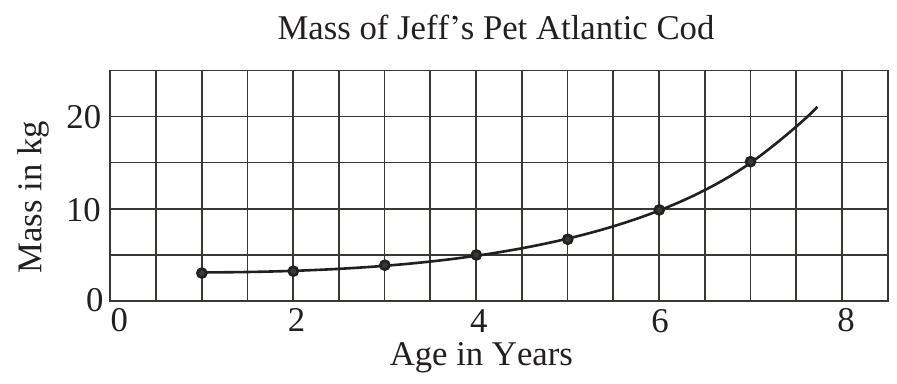
The graph shows the mass, in kilograms, of Jeff's pet Atlantic cod, given its age in years. What is the age of the cod when its mass is $15 \mathrm{~kg}$ ?
(A) 3
(B) 7
(C) 4
(D) 6
(E) 5 | A mass of $15 \mathrm{~kg}$ is halfway between $10 \mathrm{~kg}$ and $20 \mathrm{~kg}$ on the vertical axis.
The point where the graph reaches $15 \mathrm{~kg}$ is halfway between 6 and 8 on the horizontal axis.
Mass of Jeff's Pet Atlantic Cod
 6
(B) $\frac{62}{3}$
(C) 13
(D) 15
(E) $\frac{46}{5}$ | Since $x=11, y=8$ and $2 x+3 z=5 y$, then $2 \times 11+3 z=5 \times 8$ or $3 z=40-22$.
Therefore, $3 z=18$ and so $z=6$.
ANsWer: (A)
# | 6 | Algebra | MCQ | Yes | Yes | olympiads | false |
Megan and Shana race against each other with the winner of each race receiving $x$ gold coins and the loser receiving $y$ gold coins. (There are no ties and $x$ and $y$ are integers with $x>y>0$.) After several races, Megan has 42 coins and Shana has 35 coins. Shana has won exactly 2 races. The value of $x$ is
(A) 3
(B... | Suppose that Megan and Shana competed in exactly $n$ races.
Since Shana won exactly 2 races, then Megan won exactly $n-2$ races.
Since Shana won 2 races and lost $n-2$ races, then she received $2 x+(n-2) y$ coins.
Thus, $2 x+(n-2) y=35$.
Since Megan won $n-2$ races and lost 2 races, then she received $(n-2) x+2 y$ ... | 4 | Algebra | MCQ | Yes | Yes | olympiads | false |
If $3-5+7=6-x$, then $x$ equals
(A) -3
(B) -1
(C) 1
(D) 11
(E) 15 | Simplifying the left side of the equation, we obtain $5=6-x$.
Therefore, $x=6-5=1$.
ANSWER: (C) | 1 | Algebra | MCQ | Yes | Yes | olympiads | false |
If $x=2$ and $v=3 x$, then the value of $(2 v-5)-(2 x-5)$ is
(A) 2
(B) 8
(C) -2
(D) -7
(E) 6 | Since $v=3 x$ and $x=2$, then $v=3 \cdot 2=6$.
Therefore, $(2 v-5)-(2 x-5)=(2 \cdot 6-5)-(2 \cdot 2-5)=7-(-1)=8$.
ANsWER: (B) | 8 | Algebra | MCQ | Yes | Yes | olympiads | false |
If $\left(2^{a}\right)\left(2^{b}\right)=64$, then the mean (average) of $a$ and $b$ is
(A) 12
(B) $\frac{5}{2}$
(C) $\frac{3}{2}$
(D) 3
(E) 8
Part B: Each correct answer is worth 6. | Since $\left(2^{a}\right)\left(2^{b}\right)=64$, then $2^{a+b}=64$, using an exponent law.
Since $64=2^{6}$, then $2^{a+b}=2^{6}$ and so $a+b=6$.
Therefore, the average of $a$ and $b$ is $\frac{1}{2}(a+b)=3$.
ANSWER: (D) | 3 | Algebra | MCQ | Yes | Yes | olympiads | false |
The product of the roots of the equation $(x-4)(x-2)+(x-2)(x-6)=0$ is
(A) 20
(B) 48
(C) 10
(D) 96
(E) 2 | Solution 1
Since the two terms have a common factor, then we factor and obtain $(x-2)((x-4)+(x-6))=0$. This gives $(x-2)(2 x-10)=0$.
Therefore, $x-2=0$ (which gives $x=2$ ) or $2 x-10=0$ (which gives $x=5$ ).
Therefore, the two roots of the equation are $x=2$ and $x=5$. Their product is 10 .
## Solution 2
We expan... | 10 | Algebra | MCQ | Yes | Yes | olympiads | false |
If $y=77$, then $\frac{7 y+77}{77}$ is equal to
(A) 8
(B) 12
(C) 78
(D) 84
(E) 540 | If $y=77$, then $\frac{7 y+77}{77}=\frac{7 y}{77}+\frac{77}{77}=\frac{7(77)}{77}+1=7+1=8$.
ANSWER: (A) | 8 | Algebra | MCQ | Yes | Yes | olympiads | false |
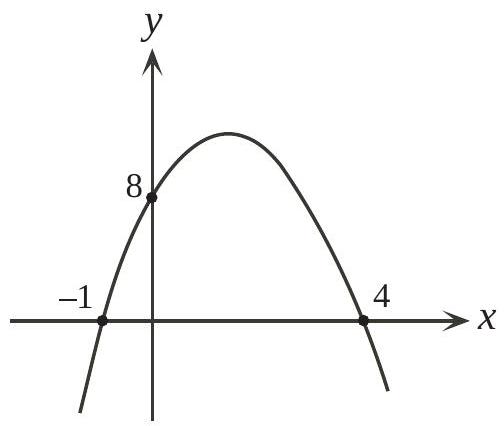
In the diagram, the parabola has $x$-intercepts -1 and 4 , and $y$-intercept 8. If the parabola passes through the point $(3, w)$, what is the value of $w$ ?
(A) 4
(B) 5
(C) 6
(D) 7
(E) 8
 | Solution 1
A parabola is symmetric about its axis of symmetry.
Since the $x$-intercepts of the given parabola are $x=-1$ and $x=4$, then the axis of symmetry of the parabola is $x=\frac{-1+4}{2}=\frac{3}{2}$.
Since the point $(3, w)$ is $\frac{3}{2}$ units to the right of the axis of symmetry, then its $y$-coordinat... | 8 | Algebra | MCQ | Yes | Yes | olympiads | false |
Xavier, Yolanda, and Zixuan have a total of $\$ 50$. The ratio of the amount Xavier has to the total amount Yolanda and Zixuan have is $3: 2$. Yolanda has $\$ 4$ more than Zixuan. How much does Zixuan have?
(A) $\$ 16$
(B) $\$ 8$
(C) $\$ 14$
(D) $\$ 13$
(E) $\$ 30$ | Since Xavier, Yolanda and Zixuan have $\$ 50$ in total, and the ratio of the amount that Xavier has to the amount that the other two have is $3: 2$, then Xavier has $\frac{3}{5}$ of the total, or $\frac{3}{5} \times \$ 50=\$ 30$. Therefore, Yolanda and Zixuan together have $\$ 50-\$ 30=\$ 20$.
We know that Yolanda has... | 8 | Algebra | MCQ | Yes | Yes | olympiads | false |
A $4 \times 4$ square piece of paper is cut into two identical pieces along its diagonal. The resulting triangular pieces of paper are each cut into two identical pieces.
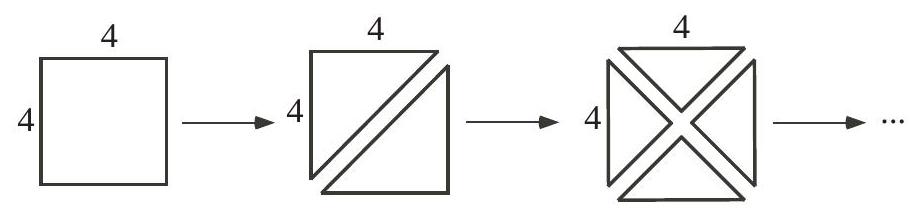
Each of the four ... | We label the stages in this process as Stage 0 (a square), Stage 1 (2 triangles), Stage 2 (4 triangles), Stage 3 (8 triangles), and Stage 4 (16 triangles).
We want to determine the length of the longest edge of one of the 16 triangles in Stage 4. At Stage 1, we have two right-angled isosceles triangles with legs of le... | 2 | Geometry | MCQ | Yes | Yes | olympiads | false |
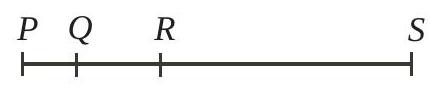
In the diagram, points $P, Q, R$, and $S$ are arranged in order on a line segment. If $P Q=1, Q R=2 P Q$ and $R S=3 Q R$, then the length of $P S$ is
(A) 7
(B) 6
(C) 9
(D) 8
(E) 10
 | Solution 1
Since $P Q=1$ and $Q R=2 P Q$, then $Q R=2$.
Since $Q R=2$ and $R S=3 Q R$, then $R S=3(2)=6$.
Therefore, $P S=P Q+Q R+R S=1+2+6=9$.
## Solution 2
From the given information,
$$
P S=P Q+Q R+R S=P Q+Q R+3 Q R=P Q+4 Q R=P Q+4(2 P Q)=9 P Q
$$
Thus, $P S=9(1)=9$.
ANswer: (C) | 9 | Algebra | MCQ | Yes | Yes | olympiads | false |
If $u=-6$ and $x=\frac{1}{3}(3-4 u)$, then $x$ equals
(A) -23
(B) -7
(C) 9
(D) 2
(E) 25 | Substituting, $x=\frac{1}{3}(3-4 u)=\frac{1}{3}(3-4(-6))=\frac{1}{3}(3+24)=\frac{1}{3}(27)=9$.
ANSWER: (C) | 9 | Algebra | MCQ | Yes | Yes | olympiads | false |
If $2 x^{2}=9 x-4$ and $x \neq 4$, then the value of $2 x$ is
(A) 4
(B) 1
(C) -1
(D) 0
(E) 2
## Part B: Each correct answer is worth 6. | Since $2 x^{2}=9 x-4$, then $2 x^{2}-9 x+4=0$.
Factoring, we obtain $(2 x-1)(x-4)=0$.
Thus, $2 x=1$ or $x=4$.
Since $x \neq 4$, then $2 x=1$.
ANSWER: (B) | 1 | Algebra | MCQ | Yes | Yes | olympiads | false |
In the diagram, $P Q R S$ is a rectangle with $P Q=5$ and $Q R=3 . \quad P R$ is divided into three segments of equal length by points $T$ and $U$. The area of quadrilateral $S T Q U$ is
(A) $\frac{17}{3}$
(B) 5
(C) $\frac{5}{2}$
(D) $\frac{\sqrt{34}}{3}$
(E) $\sqrt{34}$
(Q R)=\frac{1}{2}(5)(3)=\frac{15}{2}$.
Since $P T=T U=U R$, then the areas of $\triangle P T Q, \triangle T U Q$ and $\triangle U R Q$ are equal. (These triangles have bases $P T, T U$ an... | 5 | Geometry | MCQ | Yes | Yes | olympiads | false |
A rectangle is divided into four smaller rectangles, labelled W, X, Y, and Z, as shown. The perimeters of rectangles $\mathrm{W}, \mathrm{X}$ and $\mathrm{Y}$ are 2, 3 and 5 , respectively. What is the perimeter of rectangle $\mathrm{Z}$ ?
(A) 6
(B) 7
(C) 4
(D) 8
(E) 7.5
| $W$ | $X$ |
| :---: | :---: |
| $Y$ | $Z$ | | Label the lengths of the vertical and horizontal segments as $a, b, c, d$, as shown.
| $c$ | $d$ |
| :---: | :---: |
| $\mathrm{W}$ | $\mathrm{X}$ |
| $\mathrm{W}$ | $\mathrm{Y}$ |
| $\mathrm{Y}$ | $\mathrm{Z}$ |
Rectangle $\mathrm{W}$ is $b$ by $c$, so its perimeter is $2 b+2 c$, which equals 2 .
Rectangle $\mathrm... | 6 | Geometry | MCQ | Yes | Yes | olympiads | false |
In the diagram, $P Q=Q R=R S=S P=S Q=6$ and $P T=R T=14$. The length of $S T$ is
(A) $4 \sqrt{10}-3$
(B) 11
(C) $7 \sqrt{3}-3$
(D) 10
(E) $\sqrt{232-84 \sqrt{3}}$
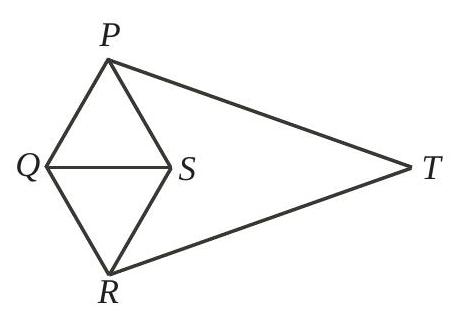 | Solution 1
First, we note that $\triangle P Q S$ and $\triangle R Q S$ are equilateral.
Join $P$ to $R$. Since $P Q R S$ is a rhombus, then $P R$ and $Q S$ bisect each other at their point of intersection, $M$, and are perpendicular.
Note that $Q M=M S=\frac{1}{2} Q S=3$.
 11
(B) -10
(C) 9
(D) -9
(E) 10 | Solution 1
Since the problem asks us to find the value of $\frac{x-z}{y-z}$, then this value must be the same no matter what $x, y$ and $z$ we choose that satisfy $\frac{x-y}{z-y}=-10$.
Thus, if we can find numbers $x, y$ and $z$ that give $\frac{x-y}{z-y}=-10$, then these numbers must give the desired value for $\fr... | 11 | Algebra | MCQ | Yes | Yes | olympiads | false |
If $3 \times 2+8=\nabla+5$, then $\nabla$ equals
(A) 14
(B) 25
(C) 19
(D) 17
(E) 9 | Since $3 \times 2+8=\nabla+5$, then $\nabla=6+8-5=9$.
ANSWER: (E) | 9 | Algebra | MCQ | Yes | Yes | olympiads | false |
$\quad 1-4(3-1)^{-1}$ is equal to
(A) -1
(B) $-\frac{3}{2}$
(C) 9
(D) 6
(E) $\frac{11}{3}$ | Since $a^{-1}=\frac{1}{a}$, then $1-4(3-1)^{-1}=1-4\left(2^{-1}\right)=1-\frac{4}{2}=1-2=-1$.
ANSWER: (A) | -1 | Algebra | MCQ | Yes | Yes | olympiads | false |
The number of integers $x$ for which the value of $\frac{-6}{x+1}$ is an integer is
(A) 8
(B) 9
(C) 2
(D) 6
(E) 7 | Since $x$ is an integer, then $x+1$ is an integer.
Since $\frac{-6}{x+1}$ is to be integer, then $x+1$ must be a divisor of -6 .
Thus, there are 8 possible values for $x+1$, namely $-6,-3,-2,-1,1,2,3$, and 6 .
This gives 8 possible values for $x$, namely $-7,-4,-3,-2,0,1,2$, and 5 .
ANSWER: (A) | 8 | Number Theory | MCQ | Yes | Yes | olympiads | false |
If $2^{x}=15$ and $15^{y}=32$, the value of $x y$ is
(A) 5
(B) 8
(C) 16
(D) 6
(E) 4 | Since $2^{x}=15$ and $15^{y}=32$, then $\left(2^{x}\right)^{y}=32$ or $2^{x y}=32$.
Since $2^{5}=32$, then $x y=5$.
ANSWER: (A) | 5 | Algebra | MCQ | Yes | Yes | olympiads | false |
The value of $\frac{1^{2}+2^{2}+3^{2}+4^{2}}{1 \times 2 \times 3}$ is
(A) 110
(B) 22
(C) $\frac{50}{3}$
(D) 5
(E) 14 | Calculating, $\frac{1^{2}+2^{2}+3^{2}+4^{2}}{1 \times 2 \times 3}=\frac{1+4+9+16}{6}=\frac{30}{6}=5$.
ANSWER: (D) | 5 | Algebra | MCQ | Yes | Yes | olympiads | false |
In the diagram, the circles with centres $P$, $Q$ and $R$ have radii 3,2 and 1 respectively. Each circle touches the other two as shown. The area of $\triangle P Q R$ is
(A) 12
(B) 6
(C) 7.5
(D) 10
(E) 4
 4 minutes, 48 second... | Since Bridget runs the second lap at $\frac{9}{10}$ of Ainslee's speed, then it takes her $\frac{10}{9}$ as long to run the lap, or $\frac{10}{9}(72)=10(8)=80$ seconds.
(If the lap length is $d$ and Ainslee's speed is $v$, then the amount of time that Ainslee takes is $t=\frac{d}{v}$ and so the amount of time that Bri... | 4 | Algebra | math-word-problem | Yes | Yes | olympiads | false |
The value of $\frac{36-12}{12-4}$ is
(A) 6
(B) 9
(C) 1
(D) 31
(E) 3 | Calculating, $\frac{36-12}{12-4}=\frac{24}{8}=3$.
ANswer: (E) | 3 | Algebra | MCQ | Yes | Yes | olympiads | false |
The product of three positive integers is 42 . The sum of two of these integers is 9 . The third integer is
(A) 1
(B) 7
(C) 6
(D) 3
(E) 2 | Solution 1
If the sum of two positive integers is 9 , the possible pairs are 1 and 8,2 and 7,3 and 6 , and 4 and 5 .
Of these pairs, the only one in which each number is a divisor of 42 is 2 and 7 .
Since the three positive integers have a product of 42 , then two of them must be 2 and 7 , so
the third is $42 \div(2... | 3 | Number Theory | MCQ | Yes | Yes | olympiads | false |
Two positive integers $a$ and $b$ have the property that if $a$ is increased by $25 \%$, the result will be greater than five times the value of $b$. What is the minimum possible value for $a+b$ ?
(A) 3
(B) 6
(C) 10
(D) 9
(E) 21 | When $a$ is increased by $25 \%$, the result is $1.25 a$ or $\frac{5}{4} a$.
Thus, we would like $\frac{5}{4} a>5 b$ or $5 a>20 b$ or $a>4 b$.
We would like to find the smallest possible positive integers $a$ and $b$ that satisfy this inequality. (If $a$ and $b$ are as small as possible, then their sum $a+b$ will be ... | 6 | Algebra | MCQ | Yes | Yes | olympiads | false |
In the diagram, $A(2,2)$ and $C(8,4)$ are two of the vertices of an isosceles right-angled triangle $A B C$. If the vertex $B$ is located on the $x$-axis and $\angle A B C=90^{\circ}$, the $x$-coordinate of $B$ is
(A) 3
(B) 4
(C) 5
(D) 6
(E) 7
$ and $C$ has coordinates $(8,4)$, then the midpoint of $A C$ is $\left(\frac{1}{2}(2+8), \frac{1}{2}(4+2)\right)=(5,3)$ and the slope of $A C$ is $\frac{4-2}{8-2}=\frac{1}{3}$.
Therefore, the slope of t... | 6 | Geometry | MCQ | Yes | Yes | olympiads | false |
If $2 x+3 x+4 x=12+9+6$, then $x$ equals
(A) 6
(B) 3
(C) 1
(D) $\frac{1}{3}$
(E) $10 \frac{1}{2}$ | Since $2 x+3 x+4 x=12+9+6$, then $9 x=27$ or $x=3$.
ANSWER: (B) | 3 | Algebra | MCQ | Yes | Yes | olympiads | false |
The value of $\frac{4^{3}}{10^{2}-6^{2}}$ is
(A) 1
(B) 0.5
(C) -35.36
(D) 1.5
(E) 4 | Calculating each of the numerator and denominator first, $\frac{4^{3}}{10^{2}-6^{2}}=\frac{64}{100-36}=\frac{64}{64}=1$. | 1 | Algebra | MCQ | Yes | Yes | olympiads | false |
What is the smallest positive integer $p$ for which $\sqrt{2^{3} \times 5 \times p}$ is an integer?
(A) 2
(B) 5
(C) 10
(D) 1
(E) 20 | If $\sqrt{2^{3} \times 5 \times p}$ is an integer, then $2^{3} \times 5 \times p$ is a perfect square.
For $2^{3} \times 5 \times p$ to be a perfect square, each prime factor must occur an even number of times.
For $p$ to be as small as possible, $p$ must have at least one factor of 2 and at least one factor of 5 .
... | 10 | Number Theory | MCQ | Yes | Yes | olympiads | false |
In the diagram, two rectangles intersect at exactly two points, $A$ and $B$. The maximum possible finite number of points of intersection of any two rectangles is
(A) 3
(B) 4
(C) 12
(D) 8
(E) 6
 -4
(B) $-\frac{1}{3}$
(C) $\frac{2}{3}$
(D) 2
(E) 6 | Solution 1
Since $\frac{a}{b}=3$, then $a=3 b$. Since $\frac{b}{c}=2$, then $b=2 c$.
Since $a=3 b$ and $b=2 c$, then $a \stackrel{c}{=} 6 c$.
Therefore, $\frac{a-b}{c-b}=\frac{6 c-2 c}{c-2 c}=\frac{4 c}{-c}=-4$.
## Solution 2
We divide the numerator and denominator of the given expression by $b$ to obtain $\frac{a... | -4 | Algebra | MCQ | Yes | Yes | olympiads | false |
If $\left(2^{4}\right)\left(3^{6}\right)=9\left(6^{x}\right)$, what is the value of $x$ ?
(A) 2
(B) 3
(C) 4
(D) 216
(E) 8 | Solution 1
The left side of the given equation equals $\left(2^{4}\right)\left(3^{6}\right)=16(729)=11664$.
Thus, $9\left(6^{x}\right)=11664$ or $6^{x}=1296$.
Since $6^{4}=1296$, then $x=4$.
Solution 2
Rearranging the left side, $\left(2^{4}\right)\left(3^{6}\right)=\left(2^{4}\right)\left(3^{4}\right)\left(3^{2}\... | 4 | Algebra | MCQ | Yes | Yes | olympiads | false |
A bag contains eight yellow marbles, seven red marbles, and five black marbles. Without looking in the bag, Igor removes $N$ marbles all at once. If he is to be sure that, no matter which choice of $N$ marbles he removes, there are at least four marbles of one colour and at least three marbles of another colour left in... | Solution 1
Suppose that Igor has removed some balls from the bag, and the remaining balls do not satisfy the required condition. What is the maximum number of balls that can remain? In order to not satisfy the required condition, either there are not 4 balls of any colour (so the maximum number is 9 balls, ie. 3 of ea... | 7 | Combinatorics | MCQ | Yes | Yes | olympiads | false |
If $\sqrt{4+9+x^{2}}=7$, then a possible value for $x$ is
(A) 6
(B) 2
(C) 4
(D) 36
(E) 0 | Since $\sqrt{4+9+x^{2}}=7$, then $4+9+x^{2}=7^{2}$ or $13+x^{2}=49$ or $x^{2}=36$.
Therefore, the possible values for $x$ are $x= \pm 6$. Therefore, the answer is (A).
ANSwer: (A) | 6 | Algebra | MCQ | Yes | Yes | olympiads | false |
A circle is drawn so that no part of it lies outside a regular hexagon. If such a circle does not touch all six sides of the hexagon, what is the maximum number of sides that it could touch?
(A) 1
(B) 2
(C) 3
(D) 4
(E) 5 | After fiddling around for a few minutes, we can see that the answer should be 2 sides. While we can convince ourselves that the answer is 2 , how can we justify this mathematically? This turns out to be tricky.
Consider hexagon $A B C D E F$ and a circle contained entirely inside it.
-10^{2}}$ is
(A) 100
(B) 2
(C) 10
(D) 1
(E) 11 | Calculating,
$$
\frac{10}{10(11)-10^{2}}=\frac{10}{110-100}=1
$$
Answer: (D) | 1 | Algebra | MCQ | Yes | Yes | olympiads | false |
$\sqrt{4^{0}+4^{2}+4^{3}}$ equals
(A) 9
(B) 13
(C) 14
(D) 32
(E) 64 | $\sqrt{4^{0}+4^{2}+4^{3}}=\sqrt{1+16+64}=\sqrt{81}=9$
Answer: (A) | 9 | Algebra | MCQ | Yes | Yes | olympiads | false |
If $x=2-4+6$ and $y=1-3+5$, then $x-y$ equals
(A) 0
(B) 1
(C) 5
(D) 3
(E) -1 | First, we determine that $x=4$ and $y=3$. Therefore, $x-y=1$. | 1 | Algebra | MCQ | Yes | Yes | olympiads | false |
When $x=\frac{1}{5}$, the value of the expression $\frac{x^{2}-4}{x^{2}-2 x}$ is
(A) 0.4
(B) -0.52
(C) -5
(D) 10
(E) 11 | Solution 1
We first simplify the expression:
$$
\frac{x^{2}-4}{x^{2}-2 x}=\frac{(x+2)(x-2)}{x(x-2)}=\frac{x+2}{x}=\frac{x}{x}+\frac{2}{x}=1+\frac{2}{x}
$$
(We can cancel the factor of $x-2$ since $x$ is not equal to 2.)
Substituting $x=\frac{1}{5}$, we get $1+\frac{2}{\left(\frac{1}{5}\right)}=1+10=11$.
## Solutio... | 11 | Algebra | MCQ | Yes | Yes | olympiads | false |
An increasing sequence is formed so that the difference between consecutive terms is a constant. If the first four terms of this sequence are $x, y, 3 x+y$, and $x+2 y+2$, then the value of $y-x$ is
(A) 2
(B) 3
(C) 4
(D) 5
(E) 6 | Since the difference between consecutive terms is constant, then the difference between the third and fourth terms is equal to the difference between the first and second terms, or
$$
\begin{aligned}
(x+2 y+2)-(3 x+y) & =y-x \\
y-2 x+2 & =y-x \\
2 & =x
\end{aligned}
$$
Thus, we can rewrite the sequence as $2, y, y+6$... | 6 | Algebra | MCQ | Yes | Yes | olympiads | false |
If $k$ is the smallest positive integer such that $\left(2^{k}\right)\left(5^{300}\right)$ has 303 digits when expanded, then the sum of the digits of the expanded number is
(A) 11
(B) 10
(C) 8
(D) 7
(E) 5 | Since we would like the product to have 303 digits, then we would like this product to be greater than $10^{302}$ but less than $10^{303}$.
We will start by trying $k=300$. In this case, $\left(2^{k}\right)\left(5^{300}\right)=\left(2^{300}\right)\left(5^{300}\right)=10^{300}$, so we want $k$ to be bigger than 300 .
... | 11 | Number Theory | MCQ | Yes | Yes | olympiads | false |
If $a=5$ and $a^{2}+a b=60$, the value of $b$ is
(A) 7
(B) 4
(C) 2
(D) 10
(E) 30 | Substituting the given value of $a$, we obtain
$$
\begin{aligned}
a^{2}+a b & =60 \\
25+5 b & =60 \\
5 b & =35 \\
b & =7
\end{aligned}
$$
ANSWER: (A) | 7 | Algebra | MCQ | Yes | Yes | olympiads | false |
In the diagram, the numbers 1 to 10 are placed around a circle. Sandy crosses out 1 , then 4 , and then 7 . Continuing in a clockwise direction, she crosses out every third number of those remaining, until only two numbers are left. The sum of these two numbers is
(A) 13
(D) 14
(B) 10
(E) 17
(C) 8
 6
(B) 3
(C) 5
(D) 8
(E) 7 | Solution 1
When $\frac{5}{8}$ of the players are girls then $\frac{3}{8}$ of the players will be boys. Since the number of boys playing is 6 (and does not change), then after the additional girls join, there must be 16 players in total for $\frac{3}{8}$ of the players to be boys. Since there were 8 players initially, ... | 8 | Algebra | MCQ | Yes | Yes | olympiads | false |
Carly takes three steps to walk the same distance as Jim walks in four steps. Each of Carly's steps covers 0.5 metres. How many metres does Jim travel in 24 steps?
(A) 16
(B) 9
(C) 36
(D) 12
(E) 18
Part B: Each correct answer is worth 6. | Since the distance covered by Jim in 4 steps is the same as the distance covered by Carly in 3 steps, then the distance covered by Jim in 24 steps is the same as the distance covered by Carly in 18 steps.
Since each of Carly's steps covers $0.5 \mathrm{~m}$, then she covers $9 \mathrm{~m}$ in 18 steps, ie. Jim covers ... | 9 | Logic and Puzzles | MCQ | Yes | Yes | olympiads | false |
If $x+y=1$ and $x-y=3$, what is the value of $2^{x^{2}-y^{2}}$ ?
(A) 4
(B) 8
(C) 2
(D) 16
(E) 32 | Solution 1
Since $x+y=1$ and $x-y=3$, then $x^{2}-y^{2}=(x-y)(x+y)=3$, and so $2^{x^{2}-y^{2}}=2^{3}=8$.
## Solution 2
Since $x+y=1$ and $x-y=3$, then adding these two equations, we obtain $2 x=4$ or $x=2$. Substituting this value for $x$ back into the first equation we see that $y=1$.
Therefore, $2^{x^{2}-y^{2}}=2... | 8 | Algebra | MCQ | Yes | Yes | olympiads | false |
A sequence of numbers has 6 as its first term, and every term after the first is defined as follows: If a term, $t$, is even, the next term in the sequence is $\frac{1}{2} t$. If a term, $s$, is odd, the next term is $3 s+1$. Thus, the first four terms in the sequence are $6,3,10,5$. The 100th term is
(A) 1
(B) 2
(C) 3... | In order to get a better feel for this sequence we should write out the first few terms (and hope we spot a pattern!). We'll use the notation $t_{n}$ for the $n$th term in the sequence; that is, $t_{1}$ is the first term, $t_{2}$ is the second term, and so on.
So we have:
$$
\begin{aligned}
& t_{1}=6, t_{2}=\frac{1}{... | 4 | Number Theory | MCQ | Yes | Yes | olympiads | false |
The set $\{1,4, n\}$ has the property that when any two distinct elements are chosen and 2112 is added to their product, the result is a perfect square. If $n$ is a positive integer, the number of possible values for $n$ is
(A) 8
(B) 7
(C) 6
(D) 5
(E) 4 | According to the requirements, the three quantities $4+2112=2116, n+2112$, and $4 n+2112$ must be perfect squares.
Now $2116=46^{2}$ (a perfect square), so the conditions say that we must have $n+2112=x^{2}$ and $4 n+2112=y^{2}$ for some positive integers $x$ and $y$. Since $n$ is a positive integer, then each of $x$ ... | 7 | Algebra | MCQ | Yes | Yes | olympiads | false |
$\frac{3^{3}+3}{2^{2}+2}$ is equal to
(A) 3
(B) 6
(C) 2
(D) $\frac{3}{2}$
(E) 5 | Evaluating,
$\frac{3^{3}+3}{2^{2}+2}=\frac{27+3}{4+2}=\frac{30}{6}=5$.
ANSWER: (E) | 5 | Algebra | MCQ | Yes | Yes | olympiads | false |
A rectangle is divided into four smaller rectangles. The areas of three of these rectangles are 6, 15 and 25, as shown. The area of the shaded rectangle is
(A) 7
(B) 15
(D) 16
(E) 10
(C) 12
| 6 | 15 |
| :--- | :--- |
| | 25 | | We can determine the area of the shaded region by guessing the side lengths of the various rectangles. Let us suppose that the top left rectangle has a width of 2 and a height of 3. Then the top right rectangle has a width of 5 , since its height is also 3 . Thus, we can conclude that the height of the bottom right rec... | 10 | Geometry | MCQ | Yes | Yes | olympiads | false |
A line passing through the points $(0,-2)$ and $(1,0)$ also passes through the point $(7, b)$. The numerical value of $b$ is
(A) 12
(B) $\frac{9}{2}$
(C) 10
(D) 5
(E) 14 | The slope of the line is
$$
\frac{-2-0}{0-1}=2
$$
and its $y$-intercept is -2 (from the first point given), so it has equation $y=2 x-2$.
Substituting in the point $(7, b)$, we obtain $b=2(7)-2=12$.
ANSWER: (A) | 12 | Algebra | MCQ | Yes | Yes | olympiads | false |
In a sequence of positive numbers, each term after the first two terms is the sum of all of the previous terms. If the first term is $a$, the second term is 2 , and the sixth term is 56, then the value of $a$ is
(A) 1
(B) 2
(C) 3
(D) 4
(E) 5 | Using the rules for forming the sequence, the third term is $a+2$ and the fourth term is
$a+2+(a+2)=2(a+2)$. Similarly, the fifth term is $4(a+2)$ and the sixth term is $8(a+2)$. But the sixth term is 56 , so $8(a+2)=56$ or $a+2=7$ or $a=5$.
ANSWER: (E) | 5 | Algebra | MCQ | Yes | Yes | olympiads | false |
If $2^{a} 3^{b}=8\left(6^{10}\right)$, where $a$ and $b$ are integers, then $b-a$ equals
(A) 0
(B) 23
(C) -13
(D) -7
(E) -3 | We rewrite the right side using exponent laws:
$$
\begin{aligned}
2^{a} 3^{b} & =8\left(6^{10}\right) \\
& =2^{3}\left([(2)(3)]^{10}\right) \\
& =2^{3}\left(2^{10} 3^{10}\right) \\
& =2^{13} 3^{10}
\end{aligned}
$$
and so $a=13$ and $b=10$, which tells us that $b-a=-3$.
ANSWER: (E) | -3 | Algebra | MCQ | Yes | Yes | olympiads | false |
In the diagram, $Y Q Z C$ is a rectangle with $Y C=8$ and $C Z=15$. Equilateral triangles $A B C$ and $P Q R$, each with side length 9, are positioned as shown with $R$ and $B$ on sides $Y Q$ and $C Z$, respectively. The length of $A P$ is
(A) 10
(B) $\sqrt{117}$
(C) 9
(D) 8
(E) $\sqrt{72}$
 and then shifting it... | 10 | Geometry | MCQ | Yes | Yes | olympiads | false |
The lengths of all six edges of a tetrahedron are integers. The lengths of five of the edges are 14, 20, 40,52 , and 70. The number of possible lengths for the sixth edge is
(A) 9
(B) 3
(C) 4
(D) 5
(E) 6 | The important fact to remember to solve this problem is that if $a, b, c$ are the side lengths of a triangle, then $a+b>c, a+c>b$, and $b+c>a$. This is called the "Triangle Inequality". We can simplify this slightly by saying that if $a, b, c$ are the side lengths of a triangle with $a \leq b \leq c$, then we need $a+b... | 6 | Geometry | MCQ | Yes | Yes | olympiads | false |
If $\sqrt{5+11-7}=\sqrt{5+11}-\sqrt{x}$, then the value of $x$ is
(A) 1
(B) 7
(C) -7
(D) 49
(E) 4 | If $\sqrt{5+11-7}=\sqrt{5+11}-\sqrt{x}$, then the value of $x$ is
(A) 1
(B) 7
(C) -7
(D) 49
(E) 4
## Solution
$$
\begin{aligned}
\sqrt{5+11-7} & =\sqrt{5+11}-\sqrt{x} \\
\sqrt{9} & =\sqrt{16}-\sqrt{x} \\
3 & =4-\sqrt{x} \\
\sqrt{x} & =1 \\
x & =1
\end{aligned}
$$
ANSWER: (A) | 1 | Algebra | MCQ | Yes | Yes | olympiads | false |
When a positive integer $N$ is divided by 60 , the remainder is 49 . When $N$ is divided by 15 , the remainder is
(A) 0
(B) 3
(C) 4
(D) 5
(E) 8
## Part B: Each correct answer is worth 6. | When a positive integer $N$ is divided by 60 , the remainder is 49 . When $N$ is divided by 15 , the remainder is
(A) 0
(B) 3
(C) 4
(D) 5
(E) 8
## Solution
This problem can be done in a number of ways. The easiest way is to consider that if $N$ is divided by 60 to achieve a remainder of 49 , it must be a number of th... | 4 | Number Theory | MCQ | Yes | Yes | olympiads | false |
The last digit (that is, the units digit) of $(2002)^{2002}$ is
(A) 4
(B) 2
(C) 8
(D) 0
(E) 6 | The last digit (that is, the units digit) of $(2002)^{2002}$ is
(A) 4
(B) 2
(C) 8
(D) 0
(E) 6
## Solution
The units digit of $(2002)^{2002}$ is the same as the units digit of $2^{2002}$, since the first three digits of 2002 do not affect the units digit.
We write out the first few powers of 2 and check for the units... | 4 | Number Theory | MCQ | Yes | Yes | olympiads | false |
Cindy leaves school at the same time every day. If she cycles at $20 \mathrm{~km} / \mathrm{h}$, she arrives home at $4: 30$ in the afternoon. If she cycles at $10 \mathrm{~km} / \mathrm{h}$, she arrives home at 5:15 in the afternoon. At what speed, in $\mathrm{km} / \mathrm{h}$, must she cycle to arrive home at 5:00 i... | Cindy leaves school at the same time every day. If she cycles at $20 \mathrm{~km} / \mathrm{h}$, she arrives home at 4:30 in the afternoon. If she cycles at $10 \mathrm{~km} / \mathrm{h}$, she arrives home at 5:15 in the afternoon. At what speed, in $\mathrm{km} / \mathrm{h}$, must she travel to arrive home at 5:00 in ... | 12 | Algebra | MCQ | Yes | Yes | olympiads | false |
A sequence $t_{1}, t_{2}, \ldots, t_{n}, \ldots$ is defined as follows:
$$
\begin{aligned}
& t_{1}=14 \\
& t_{k}=24-5 t_{k-1}, \text { for each } k \geq 2
\end{aligned}
$$
For every positive integer $n, t_{n}$ can be expressed as $t_{n}=p \cdot q^{n}+r$, where $p, q$ and $r$ are constants. The value of $p+q+r$ is
(A)... | A sequence $t_{1}, t_{2}, \ldots, t_{n}, \ldots$ is defined as follows:
$$
\begin{aligned}
& t_{1}=14 \\
& t_{k}=24-5 t_{k-1}, \text { for each } k \geq 2
\end{aligned}
$$
For every positive integer $n$, $t_{n}$ can be expressed as $t_{n}=p \cdot q^{n}+r$, where $p, q$ and $r$ are constants. The value of $p+q+r$ is
(... | -3 | Algebra | MCQ | Yes | Yes | olympiads | false |
The square of 9 is divided by the cube root of 125 . What is the remainder?
(A) 6
(B) 3
(C) 16
(D) 2
(E) 1 | The square of 9 is divided by the cube root of 125 . What is the remainder?
(A) 6
(B) 3
(C) 16
(D) 2
(E) 1
## Solution
The square of 9 is 81 and the cube root of 125 is 5 . When 81 is divided by 5 , the quotient is 16 and the remainder is 1 .
Since $81=5 \times 16+1$, the remainder is 1 .
ANSWER: (E) | 1 | Algebra | MCQ | Yes | Yes | olympiads | false |
In a school referendum, $\frac{3}{5}$ of a student body voted 'yes' and $28 \%$ voted 'no'. If there were no spoiled ballots, what percentage of the students did not vote?
(A) $72 \%$
(B) $40 \%$
(C) $32 \%$
(D) $12 \%$
(E) $88 \%$ | In a school referendum, $\frac{3}{5}$ of a student body voted 'yes' and $28 \%$ voted 'no'. If there were no spoiled ballots, what percentage of the students did not vote?
(A) $72 \%$
(B) $40 \%$
(C) $32 \%$
(D) $12 \%$
(E) $88 \%$
## Solution
Since $\frac{3}{5}$ or $60 \%$ of the students voted 'yes' and $28 \%$ vot... | 12 | Algebra | MCQ | Yes | Yes | olympiads | false |
If $x(x(x+1)+2)+3=x^{3}+x^{2}+x-6$ then $x$ is equal to
(A) 11
(B) -9
(C) -4 or 3
(D) -1 or 0
(E) -2
## Part B: Each correct answer is worth 6. | If $x(x(x+1)+2)+3=x^{3}+x^{2}+x-6$ then $x$ is equal to
(A) 11
(B) -9
(C) -4 or 3
(D) -1 or 0
(E) -2
## Solution
$$
\begin{aligned}
x(x(x+1)+2)+3 & =x\left(x^{2}+x+2\right)+3 \\
& =x^{3}+x^{2}+2 x+3
\end{aligned}
$$
Since $x^{3}+x^{2}+2 x+3=x^{3}+x^{2}+x-6$
$$
\begin{aligned}
2 x+3 & =x-6 \\
x & =-9
\end{aligned}
$... | -9 | Algebra | MCQ | Yes | Yes | olympiads | false |
If the expression $15^{6} \times 28^{5} \times 55^{7}$ was evaluated, it would end with a string of consecutive zeros. How many zeros are in this string?
(A) 10
(B) 18
(C) 26
(D) 13
(E) 5 | If the expression $15^{6} \times 28^{5} \times 55^{7}$ was evaluated, it would end with a string of consecutive zeros. How many zeros are in this string?
(A) 10
(B) 18
(C) 26
(D) 13
(E) 5
## Solution
A zero at the end of a number results from the product of 2 and 5 . The number of zeros at the end of a number equals ... | 10 | Number Theory | MCQ | Yes | Yes | olympiads | false |
If $P=3^{2000}+3^{-2000}$ and $Q=3^{2000}-3^{-2000}$ then the value of $P^{2}-Q^{2}$ is
(A) $3^{4000}$
(B) $2 \times 3^{-4000}$
(C) 0
(D) $2 \times 3^{4000}$
(E) 4 | If $P=3^{2000}+3^{-2000}$ and $Q=3^{2000}-3^{-2000}$ then the value of $P^{2}-Q^{2}$ is
(A) $3^{4000}$
(B) $2 \times 3^{-4000}$
(C) 0
(D) $2 \times 3^{4000}$
(E) 4
Solution 1
$$
\begin{aligned}
P^{2}-Q^{2} & =(P+Q)(P-Q)=\left[\left(3^{2000}+3^{-2000}\right)+\left(3^{2000}-3^{-2000}\right)\right]\left[\left(3^{2000}+3... | 4 | Algebra | MCQ | Yes | Yes | olympiads | false |
An ant walks inside a $18 \mathrm{~cm}$ by $150 \mathrm{~cm}$ rectangle. The ant's path follows straight lines which always make angles of $45^{\circ}$ to the sides of the rectangle. The ant starts from a point $X$ on one of the shorter sides. The first time the ant reaches the opposite side, it arrives at the mid-poin... | An ant walks inside a $18 \mathrm{~cm}$ by $150 \mathrm{~cm}$ rectangle. The ant's path follows straight lines which always make angles of $45^{\circ}$ to the sides of the rectangle. The ant starts from a point $X$ on one of the shorter sides. The first time the ant reaches the opposite side, it arrives at the mid-poin... | 3 | Geometry | MCQ | Yes | Yes | olympiads | false |
Two circles of radius 10 are tangent to each other. A tangent is drawn from the centre of one of the circles to the second circle. To the nearest integer, what is the area of the shaded region?
(A) 6
(D) 9
(B) 7
(C) 8
(E) 10
 6
(B) 7
(C) 8
(D) 9
(E) 10
 3
(B) 7
(C) 4
(D) 10
(E) 17 | The left most digit of an integer of length 2000 digits is 3 . In this integer, any two consecutive digits must be divisible by 17 or 23 . The 2000th digit may be either ' $a$ ' or ' $b$ '. What is the value of $a+b$ ?
(A) 3
(B) 7
(C) 4
(D) 10
(E) 17
## Solution
We start by noting that the two-digit multiples of 17 a... | 7 | Number Theory | MCQ | Yes | Yes | olympiads | false |
The value of $(\sqrt{25}-\sqrt{9})^{2}$ is
(A) 26
(B) 16
(C) 34
(D) 8
(E) 4 | The value of $(\sqrt{25}-\sqrt{9})^{2}$ is
(A) 26
(B) 16
(C) 34
(D) 8
(E) 4
Solution
$(\sqrt{25}-\sqrt{9})^{2}=(5-3)^{2}=4$
ANSWER: (E) | 4 | Algebra | MCQ | Yes | Yes | olympiads | false |
Turning a screwdriver $90^{\circ}$ will drive a screw $3 \mathrm{~mm}$ deeper into a piece of wood. How many complete revolutions are needed to drive the screw $36 \mathrm{~mm}$ into the wood?
(A) 3
(B) 4
(C) 6
(D) 9
(E) 12 | Turning a screwdriver $90^{\circ}$ will drive a screw $3 \mathrm{~mm}$ deeper into a piece of wood. How many complete revolutions are needed to drive the screw $36 \mathrm{~mm}$ into the wood?
(A) 3
(B) 4
(C) 6
(D) 9
(E) 12
## Solution
One complete revolution of the screw driver, $360^{\circ}$, will drive it $12 \mat... | 3 | Algebra | MCQ | Yes | Yes | olympiads | false |
A value of $x$ such that $(5-3 x)^{5}=-1$ is
(A) $\frac{4}{3}$
(B) 0
(C) $\frac{10}{3}$
(D) $\frac{5}{3}$
(E) 2 | A value of $x$ such that $(5-3 x)^{5}=-1$ is
(A) $\frac{4}{3}$
(B) 0
(C) $\frac{10}{3}$
(D) $\frac{5}{3}$
(E) 2
## Solution
Since $(-1)^{5}=-1,5-3 x=-1$ or $x=2$.
ANWSER: (E) | 2 | Algebra | MCQ | Yes | Yes | olympiads | false |
The number of solutions $(P, Q)$ of the equation $\frac{P}{Q}-\frac{Q}{P}=\frac{P+Q}{P Q}$, where $P$ and $Q$ are integers from 1 to 9 inclusive, is
(A) 1
(B) 8
(C) 16
(D) 72
(E) 81 | The number of solutions $(P, Q)$ of the equation $\frac{P}{Q}-\frac{Q}{P}=\frac{P+Q}{P Q}$, where $P$ and $Q$ are integers from 1 to 9 inclusive, is
(A) 1
(B) 8
(C) 16
(D) 72
(E) 81
## Solution
If we simplify the rational expression on the left side of the equation and then factor the resulting numerator as a differe... | 8 | Algebra | MCQ | Yes | Yes | olympiads | false |
Two circles $C_{1}$ and $C_{2}$ touch each other externally and the line $l$ is a common tangent. The line $m$ is parallel to $l$ and touches the two circles $C_{1}$ and $C_{3}$. The three circles are mutually tangent. If the radius of $C_{2}$ is 9 and the radius of $C_{3}$ is 4 , what is the radius of $C_{1}$ ?
 10... | 12 | Geometry | MCQ | Yes | Yes | olympiads | false |
Given that $n$ is an integer, for how many values of $n$ is $\frac{2 n^{2}-10 n-4}{n^{2}-4 n+3}$ an integer?
(A) 9
(B) 7
(C) 6
(D) 4
(E) 5
 | Given that $n$ is an integer, for how many values of $n$ is $\frac{2 n^{2}-10 n-4}{n^{2}-4 n+3}$ an integer?
(A) 9
(B) 7
(C) 6
(D) 4
(E) 5
## Solution
We start by dividing $n^{2}-4 n+3$ into $2 n^{2}-10 n-4$.
$$
\begin{array}{r}
2 \\
n ^ { 2 } - 4 n + 3 \longdiv { 2 n ^ { 2 } - 1 0 n - 4 } \\
\frac{2 n^{2}-8 n+6}{-2... | 5 | Algebra | MCQ | Yes | Yes | olympiads | false |
On a rectangular table 5 units long and 2 units wide, $a$ ball is rolled from point $P$ at an angle of $45^{\circ}$ to $P Q$ and bounces off $S R$. The ball continues to bounce off the sides at $45^{\circ}$ until it reaches $S$. How many bounces of the ball are required?
(A) 9
(B) 8
(C) 7
(D) 5
(E) 4
 $\frac{-13}{12}$
(B) $\frac{-12}{13}$
(C) -4
(D) 4
(E) -9 | Three straight lines, $l_{1}, l_{2}$ and $l_{3}$, have slopes $\frac{1}{2}, \frac{1}{3}$ and $\frac{1}{4}$, respectively. All three lines have the same $y$-intercept. If the sum of the $x$-intercepts of the three lines is 36 , then the $y$-intercept is
(A) $\frac{-13}{12}$
(B) $\frac{-12}{13}$
(C) -4
(D) 4
(E) -9
## S... | -4 | Algebra | MCQ | Yes | Yes | olympiads | false |
Using only digits 1, 2, 3, 4, and 5, a sequence is created as follows: one 1, two 2's, three 3's, four 4's, five 5 's, six 1's, seven 2's, and so on.
The sequence appears as: $1,2,2,3,3,3,4,4,4,4,5,5,5,5,5,1,1,1,1,1,1,2,2, \ldots$.
The 100th digit in the sequence is
(A) 1
(B) 2
(C) 3
(D) 4
(E) 5 | Using only digits $1,2,3,4$, and 5 , a sequence is created as follows: one 1 , two 2 's, three 3 's, four 4's, five 5 's, six 1's, seven 2's, and so on.
The sequence appears as: $1,2,2,3,3,3,4,4,4,4,5,5,5,5,5,1,1,1,1,1,1,2,2, \ldots$.
The 100th digit in the sequence is
(A) 1
(B) 2
(C) 3
(D) 4
(E) 5
## Solution
The ... | 4 | Number Theory | MCQ | Yes | Yes | olympiads | false |
The value of $(1)^{10}+(-1)^{8}+(-1)^{7}+(1)^{5}$ is
(A) 0
(B) 4
(C) 1
(D) 16
(E) 2 | Solution
$$
\begin{aligned}
(1)^{10}+(-1)^{8}+(-1)^{7}+(1)^{5} & =1+1-1+1 \\
& =2
\end{aligned}
$$ | 2 | Algebra | MCQ | Yes | Yes | olympiads | false |
Three of the vertices of a parallelogram are $(0,1),(1,2)$, and $(2,1)$. The area of the parallelogram is
(A) 1
(B) 2
(C) $\sqrt{2}$
(D) $2 \sqrt{2}$
(E) 4 | Solution
There are three possible locations for the fourth vertex, but each resulting parallelogram has the same area.
Locating the fourth vertex at $(3,2)$ yields a parallelogram with base 2 and height 1 . Its area is $(2)(1)=2$.
 5
(B) $\frac{5}{6}$
(C) $\frac{10}{3}$
(D) $\frac{5}{4}$
(E) 10 | Solution
The largest value of $\frac{x^{2}}{2 y}$ will occur when the numerator is largest and the denominator is smallest.
Since $10 \leq x \leq 20$, the largest value of $x^{2}$ is $(20)^{2}=400$. Similarly, since $40 \leq y \leq 60$, the smallest value of $2 y$ is $2(40)=80$.
Thus, the largest value of $\frac{x^{... | 5 | Algebra | MCQ | Yes | Yes | olympiads | false |
If $f(x)=p x+q$ and $f(f(f(x)))=8 x+21$, and if $p$ and $q$ are real numbers, then $p+q$ equals
(A) 2
(B) 3
(C) 5
(D) 7
(E) 11 | Solution
Using $f(x)=p x+q$, calculate the following:
$$
\begin{aligned}
f(f(x)) & =f(p x+q) \\
& =p(p x+q)+q \\
& =p^{2} x+p q+q
\end{aligned}
$$
and
$$
\begin{aligned}
f(f(f(x))) & =f\left(p^{2} x+p q+q\right) \\
& =p\left(p^{2} x+p q+q\right)+q \\
& =p^{3} x+p^{2} q+p q+q
\end{aligned}
$$
Equate this to $8 x+21... | 5 | Algebra | MCQ | Yes | Yes | olympiads | false |
Kiyana gives half of her 24 grapes to a friend. How many grapes does she give away?
(A) 2
(B) 4
(C) 6
(D) 12
(E) 48 | Half of 24 is $24 \div 2=12$. Kiyana gives her friend 12 grapes.
ANswER: (D) | 12 | Logic and Puzzles | MCQ | Yes | Yes | olympiads | false |
Square $W X Y Z$ is divided into 100 small identical squares. Some small squares are shaded and some are unshaded, as shown. How many more of the small squares need to be shaded so that $75 \%$ of the area of $W X Y Z$ is shaded?
(A) 3
(B) 4
(C) 5
(D) 6
(E) 7
 | 3 | Geometry | MCQ | Yes | Yes | olympiads | false |
Suppose $n$ is a number such that the mean (average) of the list of numbers $2,9,4, n, 2 n$ is equal to 6 . What is the value of $n$ ?
(A) 9
(B) 12
(C) 10
(D) 5
(E) 6 | The given list, $2,9,4, n, 2 n$ contains 5 numbers.
The average of these 5 numbers is 6 , and so the sum of the 5 numbers is $5 \times 6=30$.
That is, $2+9+4+n+2 n=30$ or $15+3 n=30$, and so $3 n=15$ or $n=5$.
ANSWER: (D) | 5 | Algebra | MCQ | Yes | Yes | olympiads | false |
Each number from 1 to 6 replaces one of the letters $P, Q, R, S, T$, and $U$. The sum of $P$ and $Q$ is 5 and the difference between $R$ and $S$ is 5 . If $T$ is greater than $U$, what number replaces the letter $T$ ?
(A) 4
(B) 6
(C) 2
(D) 3
(E) 5 | The sum of $P$ and $Q$ is equal to 5 , and so $P$ and $Q$ are (in some order) either equal to 1 and 4 , or they are equal to 2 and 3.
The difference between $R$ and $S$ is equal to 5 , and so $R$ and $S$ must be (in some order) equal to 1 and 6 .
Since $R$ and $S$ are equal to 1 and 6 , then neither $P$ nor $Q$ can b... | 5 | Logic and Puzzles | MCQ | Yes | Yes | olympiads | false |
How many pairs of positive integers $a$ and $b$ satisfy the equation $\frac{a}{7}+\frac{2}{b}=1$ ?
(A) 4
(B) 1
(C) 0
(D) 5
(E) 2
Part C: Each correct answer is worth 8. | Since $a$ and $b$ are positive integers, then each of $\frac{a}{7}$ and $\frac{2}{b}$ is greater than 0 .
The sum of $\frac{a}{7}$ and $\frac{2}{b}$ is equal to 1 , and so each is less than 1 .
Since $\frac{a}{7}$ is greater than 0 and less than 1 , then the possible values of $a$ are $1,2,3,4,5,6$.
By substituting ... | 2 | Algebra | MCQ | Yes | Yes | olympiads | false |
The graph shows the forecast wind speed (in $\mathrm{km} / \mathrm{h}$ ) during a 7 -day period. Jack can sail alone only when the forecast wind speed is less than $20 \mathrm{~km} / \mathrm{h}$. During this 7-day period, on how many days will Jack be able to sail alone?
(A) 4
(B) 6
(C) 1
(D) 2
(E) 5
 | 4 | Other | MCQ | Yes | Yes | olympiads | false |
Subsets and Splits
No community queries yet
The top public SQL queries from the community will appear here once available.