| --- |
| license: other |
| license_name: pev-bench-research-nc |
| license_link: LICENSE.md |
| language: [en, zh] |
| pretty_name: Pev-Bench |
| size_categories: [1K<n<10K] |
| task_categories: [text-classification, multiple-choice] |
| tags: [personal-agent, memory, decision-making, calibration, privacy, synthetic, llm-rendered] |
| gated: auto |
| extra_gated_prompt: >- |
| Records quote public product/restaurant reviews (Amazon Reviews 2023, Google Local 2021) and Enron emails, whose |
| authors did not license them to us. Access is for non-commercial research only (CC-BY-NC-4.0 for our contributions; |
| third-party text under its owners' terms; see LICENSE.md). Names and user ids are pseudonymized with a published key, |
| which is reversible. Do not attempt to identify, contact or profile the people behind reviews or emails. The |
| Claude Opus 5.5-rendered half of TEST (test_b) is for evaluation only and must not be used for training. |
| Removal requests: research@envloop.ai. |
| extra_gated_fields: |
| I agree to non-commercial research use only and to the terms in the license file: checkbox |
| I will not attempt to identify, contact or profile people quoted in the records: checkbox |
| configs: |
| - config_name: train |
| data_files: |
| - split: train |
| path: train.jsonl |
| - config_name: val |
| data_files: |
| - split: validation |
| path: val.jsonl |
| - config_name: dev |
| data_files: |
| - split: dev |
| path: dev.jsonl |
| - config_name: test |
| data_files: |
| - split: test |
| path: [test_a.jsonl, test_b.jsonl] |
| - split: test_a |
| path: test_a.jsonl |
| - split: test_b |
| path: test_b.jsonl |
| --- |
| |
| # Pev-Bench |
|
|
| [Paper (PDF)](pev.pdf) · |
| [Code](https://github.com/EnvLoop/Pev) · |
| [Model](https://huggingface.co/EnvLoop/Pev-27B-LoRA) · |
| [Leaderboard](https://huggingface.co/spaces/EnvLoop/Pev-Leaderboard) · |
| [Collection](https://huggingface.co/collections/EnvLoop/pev-6abf32b6b1940477ad4c52c3) |
|
|
| **Pev-Bench**: decision records for a personal agent with long-term memory (MUSE-style), built from **real |
| public behaviour** plus **synthetic personal rules**, rendered into natural text by an LLM and verified against a |
| structured knowledge base. Each record is one `state` (memory, current requests, candidate actions, sometimes 1k–6k |
| tokens of distractor text) with 1–3 typed questions and their labels. Code, pre-registration and the technical report |
| are in the [Pev repository](https://github.com/EnvLoop/Pev); the model trained on it is |
| [Pev-27B](https://huggingface.co/EnvLoop/Pev-27B-LoRA). Authors: EnvLoop Research (research@envloop.ai). |
|
|
|
|
| ## Results on Pev-Bench |
|
|
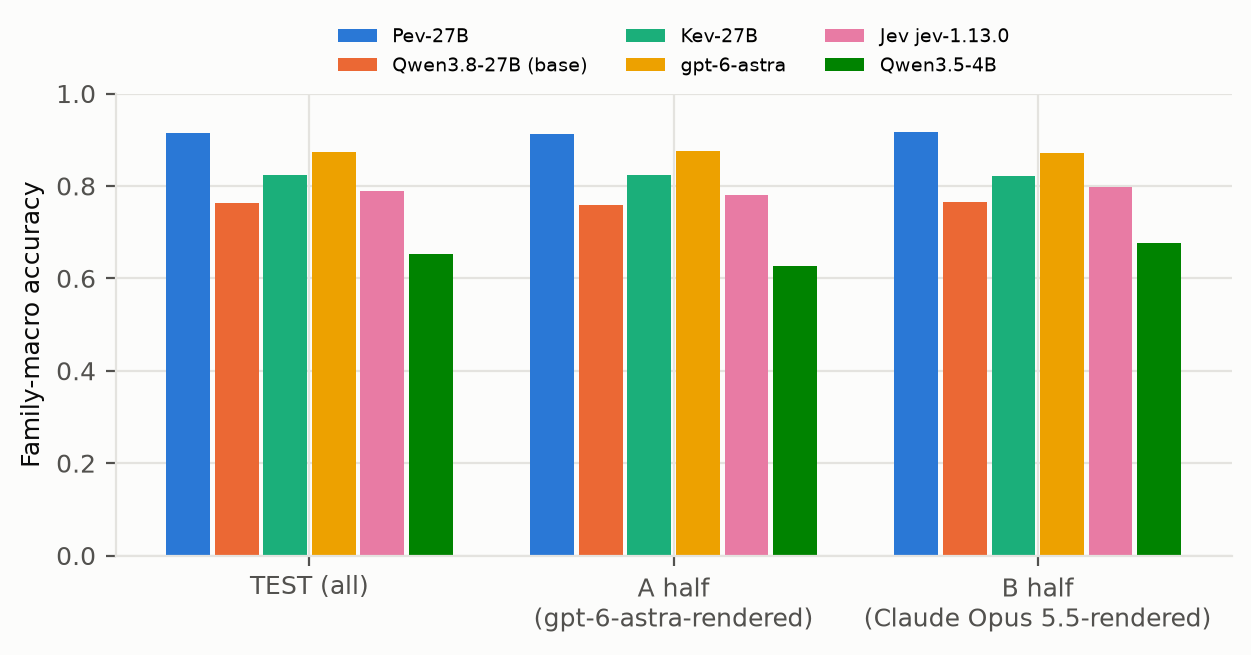
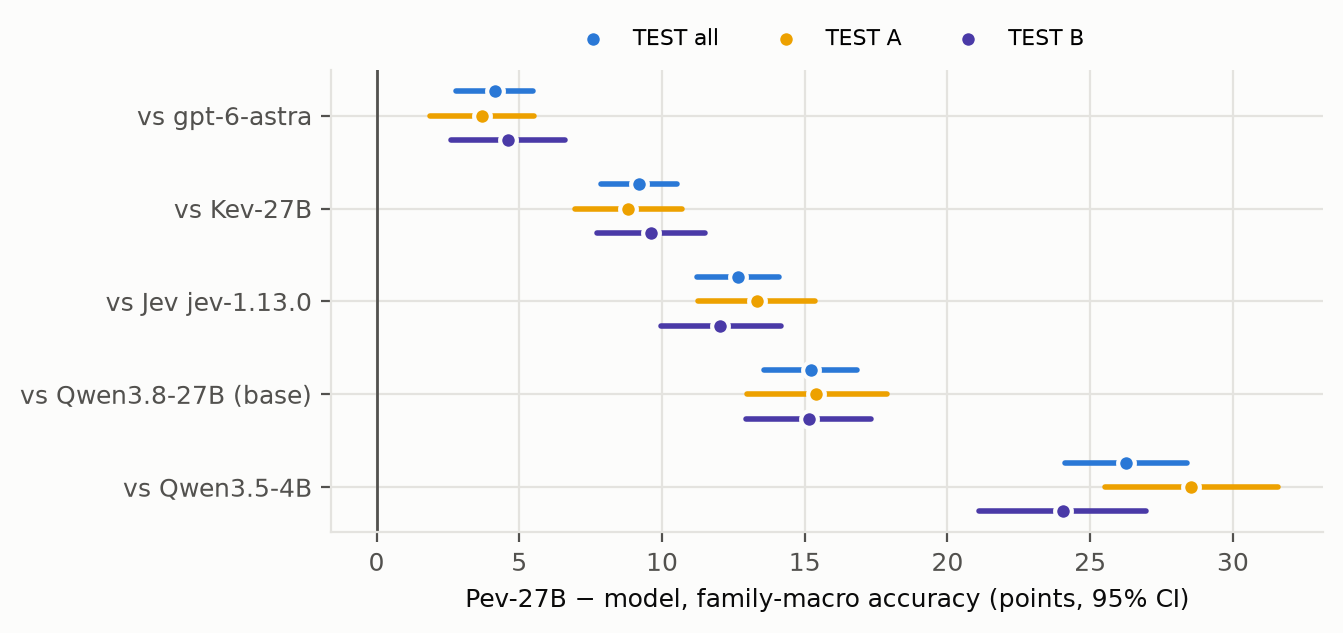
| Each model was run once on TEST (720 new users, 980 states, 2,156 scorable questions); full tables in the [model card](https://huggingface.co/EnvLoop/Pev-27B-LoRA) and the technical report. |
|
|
|  |
|
|
| *TEST family-macro accuracy per model, overall and per renderer half (A: gpt-6-astra, B: Claude Opus 5.5).* |
|
|
|  |
|
|
| *Pev-27B minus each model on TEST, family-macro accuracy with paired 95% CIs, overall and per half.* |
|
|
|  |
|
|
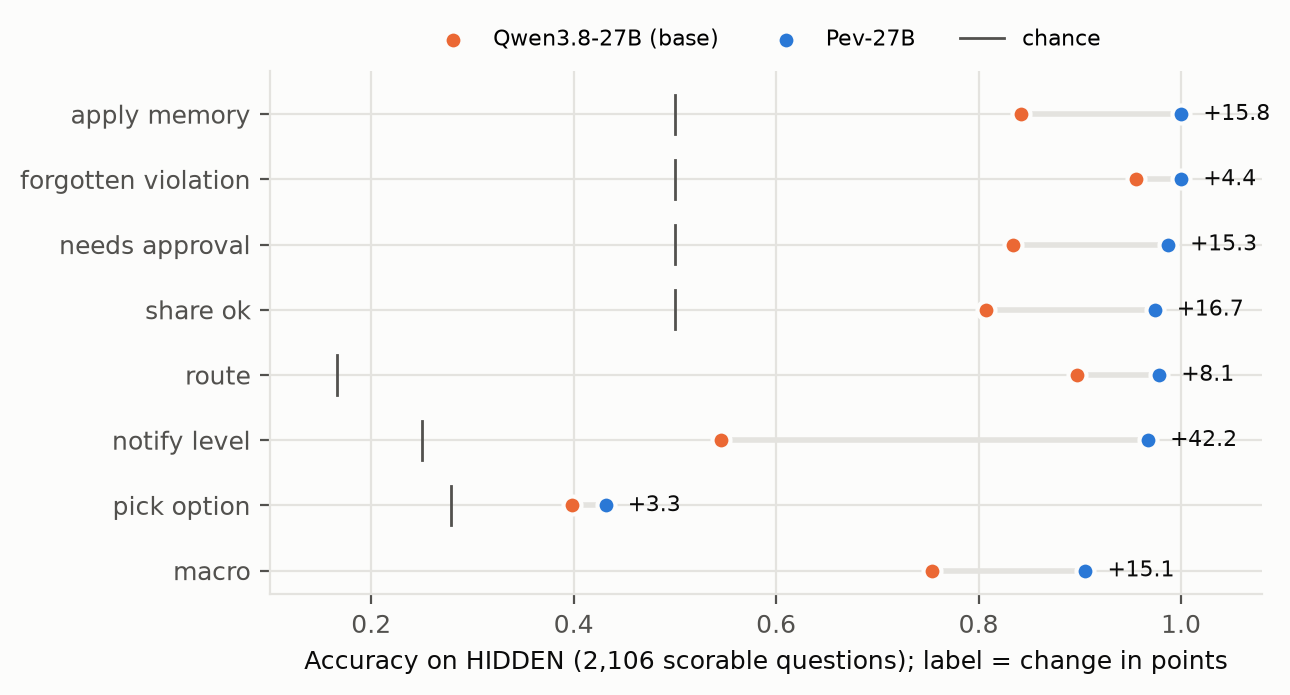
| *Per-family accuracy on HIDDEN for the base model (orange) and Pev-27B (blue), with chance marks.* |
|
|
|  |
|
|
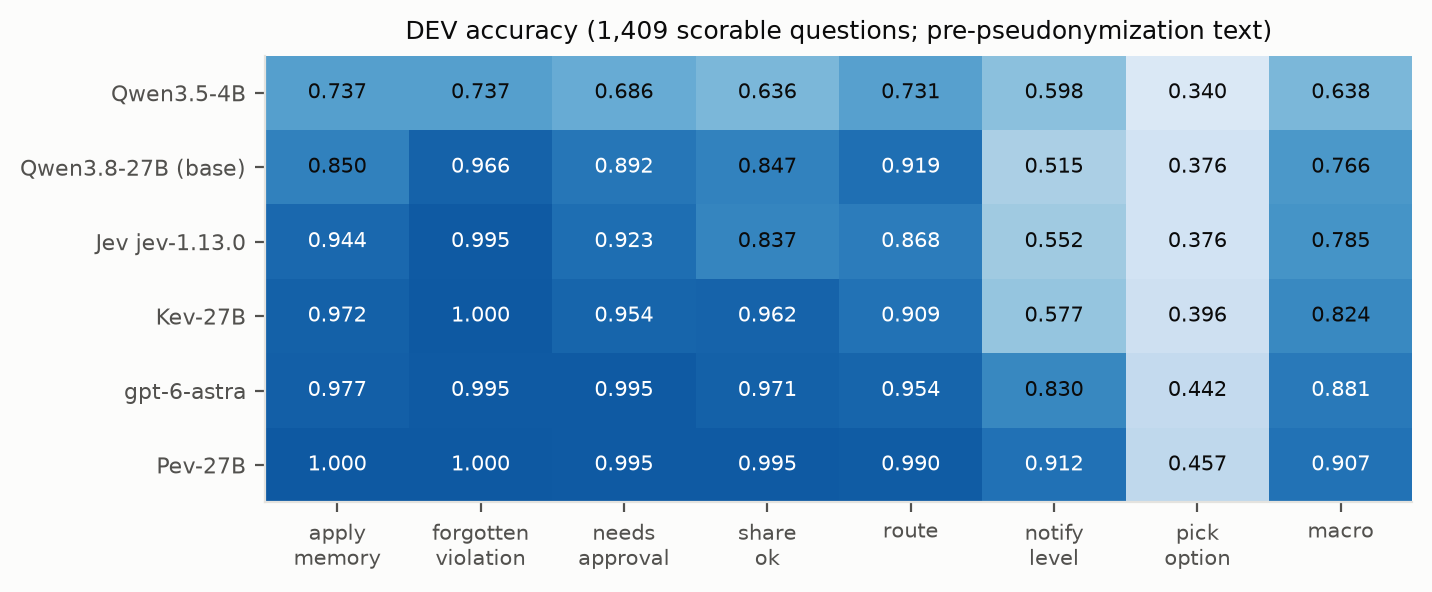
| *DEV accuracy per family and predictor.* |
|
|
| ## Splits |
|
|
| | Split | Records (states) | Questions | Scorable (unique label) | Users | Renderer | Use | |
| |---|---|---|---|---|---|---| |
| | `train` | 1,970 | 5,001 | 4,341 | 1,331 | gpt-6-astra | training (Pev-Bench part only; see "General mix") | |
| | `val` | 357 | 897 | 784 | 251 | gpt-6-astra | temperature / threshold fitting, hill-climbing analysis | |
| | `dev` | 630 | 1,626 | 1,409 | 428 | gpt-6-astra | model selection (scores only during development) | |
| | `test` (`test_a`, `test_b`) | 980 (490 + 490) | 2,506 (1,252 + 1,254) | 2,156 (1,073 + 1,083) | 654 of 720 (325 + 329) | A: gpt-6-astra, B: Claude Opus 5.5 | final comparison, one run per model; **evaluation only** | |
|
|
| Users are disjoint across splits (split by user id before any generation). The one-shot HIDDEN gate set used during |
| development is not released. Questions per family are balanced by construction (labels, answer positions). "Users" |
| counts distinct pseudonymous users that appear in records (TEST drew 720 new users; 654 appear in a kept record). |
|
|
| Also included: `general_mix_ids.jsonl` — for each of the 1,747 Kev general-mix records the adapter was trained on (not |
| redistributed, see below): source, revision, row, question count, text/row/record SHA-256 and position in the original |
| training file, so a rebuild with `scripts/general_mix.py` can be checked. |
|
|
| **TEST** was built by an independent builder after the model was frozen (amendment 6 of the pre-registration): |
| 720 users not in any other split, the same generator and public styles as DEV, half the users rendered by gpt-6-astra |
| (`test_a`, ids `muse/test-a/…`) and half by Claude Opus 5.5 under the same rendering contract (`test_b`, |
| `muse/test-b/…`). It was pseudonymized **before** any model was scored; `cat test_a.jsonl test_b.jsonl` is |
| byte-identical to the scored file (SHA-256 `131d092796bb518b3134eef5ca9fe3f86ec9b6ae5535de6483f8e47a25e279a3`). |
| `pick_option` on TEST has a residual "priciest" shortcut (0.347 vs a chance of 0.276; A +10.9, B +2.9 points), reported |
| next to every `pick_option` result (amendment 7). |
|
|
| ## Format |
|
|
| ```json |
| {"id": "muse/val/12/4", |
| "state": "Current time=21/11/2021 15:16\n\ntype: memory\n...", |
| "questions": {"pick_option": {"type": "choice", "instructions": "...", "criteria": {"<option>": "<description>", "...": "..."}, |
| "label": "<option>", "src": "muse/pick_option"}, |
| "share_ok": {"type": "noul", "criteria": {"true": "...", "false": "..."}, "label": true, "...": "..."}, |
| "notify_level": {"type": "score", "criteria": ["silent: ...", "digest: ...", "notify: ...", "interrupt: ..."], |
| "label": 2, "soft_label": {"0": 0.3333, "1": 0.3333, "2": 0.3333}, "...": "..."}}, |
| "meta": {"user_id": "<pseudonym>", "state_id": "val/12/4", "families": {"...": "..."}, |
| "anchors": {"<qid>": {"required": ["<verbatim evidence>"], "forbidden": []}}, |
| "variants": {"<qid>": "clean | override | removed | buried+..."}, |
| "render": {"model": "gpt-6-astra", "style_id": "pub-kv-log", "prompt_sha256": "..."}, |
| "release": {"anonymized": true, "replacements": {"person_name": 3}}}} |
| ``` |
|
|
| `meta.release.anonymized: true` marks a record that went through the pseudonymization pass (the field name predates |
| the wording; the records are pseudonymized, not anonymized). `meta.render.model` is `gpt-6-astra` or |
| `claude-opus-5-5`. |
|
|
| Labels follow Kev: choice = option name, yes/no = `true`/`false`, score = zero-based level. A `soft_label` whose |
| maximum is tied marks an *ambiguous* question (evidence removed): it counts only for Brier/ECE/NLL, never for accuracy |
| or training. `meta.anchors` lists the verbatim evidence each label rests on; every record passed the anchor check. |
|
|
| ## How it was built |
|
|
| 1. **Sources** (normalised by `scripts/acquire/`): Amazon Reviews 2023 (5 categories) and Google Local 2021 (food |
| businesses in DC, DE, RI) for real users' histories; OpenFlights for airports/routes; the Enron corpus (20,000 |
| sampled emails, addresses/phones/URLs scrubbed) as distractor text. |
| 2. **Knowledge base**: per user, the first 60% of the time-ordered history becomes memory (with facts extracted from |
| the review text, verbatim evidence required), later interactions are real choices. **Synthetic, seeded per user**: |
| approval rules, privacy levels, contacts (fictional names at `example.com`), calendar, notification rules, |
| forget requests, connected services. |
| 3. **Questions**: 7 deterministic families read only the KB (labels never come from an LLM or from any model's |
| correctness). Hard variants: preference overrides, removed evidence (soft labels), buried evidence. |
| 4. **Rendering**: gpt-6-astra turns the structured state into natural text in one of 9 public styles (key-value |
| logs, chat, email threads, journals, Chinese notes, …); every required anchor must appear verbatim and every |
| forbidden anchor must be absent, or the state is dropped. TEST-B uses Claude Opus 5.5 with the same contract. |
| 5. **Validity**: oracle, null baselines (majority, constant position, shuffled labels) and shortcut baselines per |
| family; known residual shortcuts in `pick_option` are reported (DEV centroid +2.5, HIDDEN medoid +3.3, TEST |
| "priciest" +7.1 points over chance). |
| 6. **Release export**: `personal-decisions export-release` (below). |
|
|
| ## Pseudonymization |
|
|
| Names and user ids are **pseudonymized for readability and consistency**; this is not anonymization. The key is |
| published (`release/pseudonym_key.txt` in the code repository) so the export is exactly reproducible from the public |
| source datasets; the mapping is therefore reversible. All source data were already public. |
|
|
| - `meta.user_id` = HMAC-SHA256(key, internal id)[:16]. |
| - Person names detected in states and instructions -> keyed pseudonyms of the same shape, consistently within and |
| across records; emails, phones, URLs and street addresses -> `[EMAIL]`/`[PHONE]`/`[URL]`/`[ADDRESS]`. |
| - Options, labels and soft labels are never changed; anchors are rewritten consistently and re-checked. |
| - Effect: 7,054 names in `train`, 1,218 in `val`, 2,071 in `dev`, 2,081 + 1,635 in `test_a` + `test_b`, almost all |
| inside Enron distractor emails (per-file receipts in `docs/DATA.md` of the code repository). |
| - Limits: the name detector is rule-based. Strings it still flags after the pass ("residual detections": train 10 |
| names + 1 address, val 4, dev 2, test 7) were reviewed for TEST: none is an unreplaced name of a real person (a |
| pseudonym next to an adjacent capitalised word, or a product name). Its recall is limited: names written "Last, |
| First" (frequent in Enron distribution lists), all-capital names and names outside its first-name list are **not** |
| replaced. They occur almost only in the Enron distractor text, a public corpus. |
|
|
| > The DEV/VAL numbers in the technical report and the results were computed on the **pre-pseudonymization** text. |
| > The released `val`/`dev` are the pseudonymized versions (options and labels unchanged), so re-running on them may |
| > differ slightly. The headline comparisons are on `test`, which was pseudonymized **before** scoring (released TEST == scored TEST). |
|
|
| ## General mix (not included) |
|
|
| The released adapter was also trained on 1,860 general decision questions from Kev's `evals/decision-v2/train.jsonl` |
| (commit `0fe8fc97`). Those rows contain text from AG News, Amazon-multi, Banking77, BoolQ, DBpedia-14, IMDB, MNLI, |
| SST-5, TREC and Yelp under their own terms (several forbid redistribution), so they are **not** in this dataset; |
| `scripts/general_mix.py` rebuilds them (seed 20261004, leakage audit included). |
|
|
| ## Personal and sensitive information |
|
|
| - Records quote real public reviews verbatim (about 62% of records) and real Enron emails (buried distractors in about |
| 25% of records). A web search for a quoted review can find the original post and its author's public profile. Do |
| not attempt to identify people. |
| - **Everything about a user other than their reviews is synthetic**: approval thresholds, privacy settings, contacts, |
| calendars, notification rules and forget requests were generated from a seed, not observed. Nothing in a record |
| says anything true about the real reviewer beyond what their public reviews say. |
| - Removal requests: research@envloop.ai. We remove a user's or an email's records on request and publish a new |
| revision. |
|
|
| ## Licensing and attribution |
|
|
| Research use only, gated (see `LICENSE.md`): |
|
|
| - Our contributions (structure, labels, synthetic rules, rendered wording): **CC-BY-NC-4.0**. |
| - Third-party text quoted in the records remains under its owners' terms: Amazon Reviews 2023 and Google Local 2021 |
| (UCSD McAuley Lab, released for research), Enron corpus (CMU research release). |
| - Contains information from [OpenFlights](https://openflights.org/data.php), made available under the Open Database |
| License (ODbL 1.0); the records are a Produced Work of it. The derived airport/route tables are not distributed; |
| `scripts/acquire/openflights.py` and `personal-decisions build` rebuild them. |
| - Rendered by gpt-6-astra (TRAIN, VAL, DEV and TEST-A) and Claude Opus 5.5 (TEST-B). `val`, `dev` and `test` are |
| evaluation splits; **TEST-B (`test_b.jsonl`) is for evaluation only and must not be used to train models.** |
| |
| ## Citation |
| |
| ```bibtex |
| @techreport{envloop_pev, |
| title = {Pev: A Calibrated Fast-Decision Model for Personal Agents}, |
| author = {{EnvLoop Research}}, |
| institution = {EnvLoop}, |
| url = {https://github.com/EnvLoop/Pev} |
| } |
| ``` |
| |
| Please also cite the data sources and models listed under [References](#references). Contact and removal |
| requests: research@envloop.ai. |
| |
| ## References |
| |
| - Y. Hou, J. Li, Z. He, A. Yan, X. Chen, J. McAuley. |
| [Bridging Language and Items for Retrieval and Recommendation](https://arxiv.org/abs/2403.03952). 2024. |
| Amazon Reviews 2023 ([dataset page](https://amazon-reviews-2023.github.io/)). |
| - J. Li, J. Shang, J. McAuley. |
| [UCTopic: Unsupervised Contrastive Learning for Phrase Representations and Topic Mining](https://aclanthology.org/2022.acl-long.426/). |
| ACL 2022 (Google Local). |
| - A. Yan, Z. He, J. Li, T. Zhang, J. McAuley. |
| [Personalized Showcases: Generating Multi-Modal Explanations for Recommendations](https://dl.acm.org/doi/10.1145/3539618.3592036). |
| SIGIR 2023 (Google Local). |
| - B. Klimt, Y. Yang. |
| [The Enron Corpus: A New Dataset for Email Classification Research](https://doi.org/10.1007/978-3-540-30115-8_22). |
| ECML 2004. |
| - OpenFlights. [Airport, airline and route data](https://openflights.org/data.php). ODbL 1.0. |
| - J. Palmer. [Kev: Small Jev-like decision models you can train and run yourself](https://github.com/jaredpalmer/kev). |
| - Qwen Team. [Qwen3.8-27B](https://huggingface.co/Qwen/Qwen3.8-27B). Hugging Face model card. |
| |


