
problem stringlengths 15 4.7k | solution stringlengths 2 11.9k | answer stringclasses 51
values | problem_type stringclasses 8
values | question_type stringclasses 4
values | problem_is_valid stringclasses 1
value | solution_is_valid stringclasses 1
value | source stringclasses 6
values | synthetic bool 1
class |
|---|---|---|---|---|---|---|---|---|
In a production of Hamlet, several roles are paired, for example, Gertrude and the Queen in the Play can be played by two actors. Before the performance, they decide by drawing lots which of the two will play the Queen in the Play and which will play Gertrude on that day. Similar lotteries decide for the other pairs as... | I. solution. The probability that in $n$ performances, the person does not see the role pairing from a pair of roles that they like is $\frac{1}{2^{n}}$, because there are $2^{n}$ ways to assign the roles, and only one case occurs where the role they have already seen is always drawn. Therefore, the probability that th... | 5 | Combinatorics | math-word-problem | Yes | Yes | olympiads | false |
A plane passes through a point $P$ in space. Three lines also pass through $P$. Construct a plane through $P$ that makes the same angle with each of the three lines. | First, we construct a plane $S$ that makes the same angle with each line but does not pass through the point $P$. If we translate this plane so that it passes through $P$, we get the desired plane.
Assume that the three lines are not in the same plane. Measure a given segment $d$ from $P$ in some direction on each lin... | 4 | Geometry | math-word-problem | Yes | Yes | olympiads | false |
Find the ratio of the area of triangle $A B C$ to the area of triangle $A^{\prime} B^{\prime} C^{\prime}$, if the midpoints of segments $A A^{\prime}, B B^{\prime}, C C^{\prime}$ are $B^{\prime}, C^{\prime}, A^{\prime}$ respectively? | I. solution. Connect points $C$ and $B^{\prime}$. Since $B^{\prime}$ bisects $A A^{\prime}$, $C B^{\prime}$ bisects the area of triangle $A A^{\prime} C$, and since $A^{\prime}$ bisects $C C^{\prime}$, $B^{\prime} A^{\prime}$ bisects the area of triangle $C B^{\prime} C^{\prime}$.
The area of triangle $A A^{\prime} C$... | 7 | Geometry | math-word-problem | Yes | Yes | olympiads | false |
For what value of the real parameter $v$ does the system of equations
$$
\begin{aligned}
x+y+z & =v \\
x+v y+z & =v \\
x+y+v^{2} z & =v^{2}
\end{aligned}
$$
have no solution? | Solution. If $v=0$, then from equation (2) we get $x=-z$, and from equation (3) we get $x=-y$, which is only possible if $x=y=z=0$. We can assume that $v \neq 0$.
Subtract (1) from (2), we get
$$
y(v-1)=0
$$
From this, if $v=1$, we arrive at the following system of equations:
$$
\begin{aligned}
& x+y+z=1 \\
& x+y+z... | -1 | Algebra | math-word-problem | Yes | Yes | olympiads | false |
In this sentence, the number of numbers occurring 1 time is $a_{1}$, the number of numbers occurring 2 times is $a_{2}$, $\ldots$, the number of numbers occurring 2013 times is $a_{2013}$. Determine the numbers $a_{1}, a_{2}, \ldots, a_{2013}$ so that we get a true statement. In how many ways can we do this? | Solution. For easier formulation, let's introduce the notation $b_{i}=i$ ( $1 \leqslant i \leqslant 2013$ ), so the problem can be restated as follows: the number of numbers that occur $b_{1}$ times is $a_{1}$, the number of numbers that occur $b_{2}$ times is $a_{2}$, and so on. If $a_{n}=1$, then - since all $b_{i}$ ... | 3 | Combinatorics | math-word-problem | Yes | Yes | olympiads | false |
Given a circle $k$ with diameter $AB$, let $C$ be any point on the circle $k$ different from $A$ and $B$. Drop a perpendicular from $C$ to the diameter $AB$, and let the foot of the perpendicular on $AB$ be $D$, and the second intersection point of the perpendicular with the circle $k$ be $E$. The circle centered at $C... | Solution. Using the notation in the figure, $CD = CP = CQ = r$, so by the inscribed angle theorem, $\angle CEP = \angle CEQ = \alpha$. Therefore, in $\triangle PEQ$, $EC$, and thus $EM$ is the angle bisector.
=x^{6}-6 x+5$ using a computer program.
Based on the graph, it can be guessed that the function has a root, possibly a multiple root, at $x=1$. Let's check the value of the function at $x=1$: $f(1)=0$. Indeed, $x=1$ is a root of the equation, so we can factor out $(x-1)$ from ... | 1 | Algebra | math-word-problem | Yes | Yes | olympiads | false |
The graph of the function $y=|x-1|+|x+1|$ and the line $y=c$ enclose a region with an area of 30. What is the value of the constant $c$? | The graph of the function consists of three parts. Between -1 and 1, it is a horizontal segment $y=2, x$, and to the left of -1 and to the right of +1, there is a ray on each side. The line $y=c$ is parallel to the $x$-axis, and since $c>2$, it forms a symmetric trapezoid with the two lines. The graph of the function i... | 8 | Algebra | math-word-problem | Yes | Yes | olympiads | false |
Consider the following two sets of numbers:
$$
A=\left\{\frac{3 n-4}{5 n-3}: n \in \mathbb{Z}\right\} \quad \text { and } \quad B=\left\{\frac{4 k-3}{7 k-6}: k \in \mathbb{Z}\right\} \text {. }
$$
How many elements does the set $A \cap B$ have? | Solution. It is easy to check that if
$$
\frac{3 n-4}{5 n-3}=\frac{3 n^{\prime}-4}{5 n^{\prime}-3}
$$
then $n=n^{\prime}$, meaning that for different values of $n$, we get different elements of set $A$. A similar statement holds for set $B$.
Therefore, we need to determine how many pairs of integers $(n, k)$ satisfy... | 8 | Number Theory | math-word-problem | Yes | Yes | olympiads | false |
What is the maximum number of sides of a convex polygon that has no two adjacent obtuse angles? | We know that the sum of the exterior angles of a convex polygon is $360^{\circ}$, which means there can be at most 4 exterior angles that are not less than $90^{\circ}$, otherwise their sum would exceed $360^{\circ}$.
If the polygon has 4 exterior angles of $90^{\circ}$, then it is a rectangle. This meets the conditio... | 6 | Geometry | math-word-problem | Yes | Yes | olympiads | false |
How many positive integers of at most $n$ digits are there whose square ends in the same $n$ digits (possibly with some leading zeros)? | I. solution. To simplify the discussion, we first solve the problem for non-negative integers (thus allowing 0).
We prove by complete induction that for every positive integer $n$, there exist exactly four non-negative integers whose squares end in the same $n$ digits, and among these four numbers, two are 0 and 1, wh... | 3 | Number Theory | math-word-problem | Yes | Yes | olympiads | false |
We create a random sequence using the digits $0, 1, 2$. For sequences of what length will the probability be at least $61 \%$ that all three digits appear in the sequence? | Solution. The number of sequences of length $n$ using a single digit is 3, and the number of sequences using exactly two different digits is $\binom{3}{2}\left(2^{n}-2\right)$; thus,
$$
p_{n}=\frac{3+3\left(2^{n}-2\right)}{3^{n}}=\frac{2^{n}-1}{3^{n-1}}
$$
is the probability that in a sequence of length $n$, at least... | 5 | Combinatorics | math-word-problem | Yes | Yes | olympiads | false |
A fair coin is flipped until we get at least one head and one tail. What is the expected value of the number of flips? | I. solution. The number of necessary throws is exactly $n$ if the first $n-1$ throws are heads and the $n$-th is tails - the probability of this is $\left(\frac{1}{2}\right)^{n-1} \cdot \frac{1}{2}=\left(\frac{1}{2}\right)^{n}$, or if the first $(n-1)$ throws are tails and the $n$-th is heads - the probability of this ... | 3 | Combinatorics | math-word-problem | Yes | Yes | olympiads | false |
What is the exact value of $2^{\log _{6} 18} \cdot 3^{\log _{6} 3}$? | Apply the known identities of logarithms and exponentiation, as well as the definition of logarithms:
$$
2^{\log _{6} 18}=2^{\log _{6} 3 \cdot 6}=2^{\log _{6} 3+\log _{6} 6}=2^{\log _{6} 3+1}=2 \cdot 2^{\log _{6} 3}
$$
Substituting this into (1), we get
$$
2 \cdot 2^{\log _{6} 3} \cdot 3^{\log _{6} 3}=2 \cdot 6^{\lo... | 6 | Algebra | math-word-problem | Yes | Yes | olympiads | false |
What is the smallest natural number $k$ for which the following statement is true? "If a tetrahedron has $k$ edges with an angle of $60^{\circ}$, then the tetrahedron must be regular." | A tetrahedron is regular if every face is an equilateral triangle, and the dihedral angles are also equal. We will show that the smallest such $k$ number is seven. If $k=6$, it is possible for the tetrahedron to have two faces that are equilateral triangles, and these two faces, for example, enclose a $90^{\circ}$ angl... | 7 | Geometry | math-word-problem | Yes | Yes | olympiads | false |
How many such square columns are there, in which the edge length measured in cm is an integer, and the surface area measured in $\mathrm{cm}^{2}$ is the same as the volume measured in $\mathrm{cm}^{3}$? | Let the base side of the square column be $a$, and its height be $m$. Then
$$
V=a^{2} m \quad \text { and } \quad F=2 a^{2}+4 a m
$$
From the equality of the surface area and the volume:
$$
a^{2} m=2 a^{2}+4 a m
$$
Rearranging the equation and dividing both sides by $a \neq 0$:
$$
a m-2 a-4 m=0
$$
Adding 8 to bot... | 4 | Geometry | math-word-problem | Yes | Yes | olympiads | false |
Find the length of the shortest segment that bisects the area of a triangle with sides 3, 4, and 5. | Solution. First, we generally provide a lower estimate for the length of a segment that bisects the area of a triangle. If the segment $P Q$ bisects the area of triangle $A B C$, then at least one of the two parts of the original triangle is a triangle (both parts will be triangles if the segment $P Q$ contains one of ... | 2 | Geometry | math-word-problem | Yes | Yes | olympiads | false |
Let $A$ be a ten-billion digit, positive number divisible by nine. The sum of the digits of $A$ is $B$, the sum of the digits of $B$ is $C$. What is the sum of the digits of $C$? | It is clear that the sum of the digits of a positive number is also positive; it is also well known that if a number is divisible by nine, the sum of its digits is also divisible by nine. Consequently, the number $B$ is divisible by nine, as is $C$, and indeed the sum of the digits of $C$, $D$, is also divisible by nin... | 9 | Number Theory | math-word-problem | Yes | Yes | olympiads | false |
A week-old set's three-element subsets need to be colored such that if the intersection of two subsets is empty, then their colors differ. How many colors do we need at least? | Solution. 1. Three colors are sufficient for the desired coloring. Let the 7-element set be $\{1,2,3,4,5,6,7\}$. The color of the 3-element subsets containing 1 is red, those containing 2 but not 1 are blue, and the rest are yellow. Then any two red subsets contain the element 1, so they cannot be disjoint. Similarly, ... | 3 | Combinatorics | math-word-problem | Yes | Yes | olympiads | false |
Solve the following equation:
$$
\frac{3 x+3}{\sqrt{x}}=4+\frac{x+1}{\sqrt{x^{2}-x+1}} .
$$ | Solution. $\sqrt{x}$ appears in the denominator, so $x>0$, furthermore, $x^{2}-x+1$ takes positive values for all real $x$, since
$$
x^{2}-x+1=\left(x-\frac{1}{2}\right)^{2}+\frac{3}{4}
$$
To estimate the left-hand side expression, we use that for $a>0$, $a+\frac{1}{a} \geq 2$. Let's rewrite the left side of the equa... | 1 | Algebra | math-word-problem | Yes | Yes | olympiads | false |
Péter took one of each of the stamps worth $1, 2, 3, \ldots, 37$ forints from his stamp collection. He would like to group these stamps so that the sum of the face values of the stamps in each group is the same. In how many different ways can he do this? | The sum of the face values of all the stamps is $S=\frac{37 \cdot(1+37)}{2}=19 \cdot 37=703$.
This sum is the product of two prime numbers, which means that Peter can put all the stamps in 1 group, in which case the sum of the face values is 703. Clearly, it is not possible to put the 37 stamps into 703 groups, and it... | 2 | Combinatorics | math-word-problem | Yes | Yes | olympiads | false |
Let's find those prime numbers $p$ for which the number $p^{2}+11$ has exactly 6 positive divisors. | I. solution. We know that if the prime factorization of a positive integer $n$ is $p_{1}^{\alpha_{1}} \cdot p_{2}^{\alpha_{2}} \cdots \cdots p_{n}^{\alpha_{n}}$, then the number of positive divisors of the number is: $d(n)=\left(\alpha_{1}+1\right)\left(\alpha_{2}+1\right) \ldots\left(\alpha_{n}+1\right)$.
A number wi... | 3 | Number Theory | math-word-problem | Yes | Yes | olympiads | false |
At the end-of-year concert of a music school, four violinists performed. Whenever one of them was not playing, they took a seat among the audience. In at least how many pieces did the violinists perform, if each of them had the opportunity to watch any of their (violinist) colleagues from the auditorium? | We claim that at least 4 performances are necessary for each violinist to hear every other violinist from the audience. First, we show that 3 performances are not sufficient. Let the violinists be denoted by $A, B, C$, and $D$. It is not possible for each performance to feature only one violinist, as one would be left ... | 4 | Combinatorics | math-word-problem | Yes | Yes | olympiads | false |
What digit can the positive integer $n \geq 3$ end with, if $n+n^{2}+\ldots+n^{2 n-3}-4$ is a prime number? | Solution. Let $S=n+n^{2}+\ldots+n^{2 n-3}-4$. If $n=3$, then $2 \cdot 3-3=3$ and $3+3^{2}+3^{3}-4=35$, which is not a prime. Therefore, the value of $S$ is at least 35.
If $n$ is even, then $S$ will be an even number greater than 35, which cannot be a prime. Therefore, $n$ must be odd. The remainder of $n$ when divide... | 5 | Number Theory | math-word-problem | Yes | Yes | olympiads | false |
Solve the following system of equations:
$$
\begin{aligned}
x^{2}+7 y+2 & =2 z+4 \sqrt{7 x-3} \\
y^{2}+7 z+2 & =2 x+4 \sqrt{7 y-3} \\
z^{2}+7 x+2 & =2 y+4 \sqrt{7 z-3}
\end{aligned}
$$ | Solution. Let's add the three equations, then rearrange!
$$
\begin{gathered}
x^{2}+7 y+2+y^{2}+7 z+2+z^{2}+7 x+2= \\
=2 z+4 \sqrt{7 x-3}+2 x+4 \sqrt{7 y-3}+2 y+4 \sqrt{7 z-3} \\
\left(x^{2}-2 x+1\right)+\left(y^{2}-2 y+1\right)+\left(z^{2}-2 z+1\right)+(7 x-3-4 \sqrt{7 x-3}+4)+ \\
+(7 y-3-4 \sqrt{7 y-3}+4)+(7 z-3-4 \s... | 1 | Algebra | math-word-problem | Yes | Yes | olympiads | false |
Let's determine the minimum and maximum value of the expression $\sqrt{x-2}+\sqrt{3-x}$. | Solution. The number under the square root cannot be negative, so $2 \leq x \leq 3$. The value of the square root is also non-negative, so it is sufficient to determine the smallest and largest values of $y^{2}=(\sqrt{x-2}+\sqrt{3-x})^{2}$.
Let $\sqrt{x-2}=u$ and $\sqrt{3-x}=v$, then according to the identity $(u+v)^{... | 1 | Algebra | math-word-problem | Yes | Yes | olympiads | false |
Consider four parallel lines on the plane, denoted as $a, b, c$, and $d$. We know that the distance between $a$ and $b$ is 1, the distance between $b$ and $c$ is 3, and the distance between $c$ and $d$ is also 1. Consider the rectangles whose vertices each lie on one of these four lines. How do we obtain the rectangle ... | Solution. Let the vertices of the rectangle on lines $a, b, c$, and $d$ be $A, B, C$, and $D$ respectively. Draw perpendiculars from points $B$ and $C$ to line $a$, and let their feet be $E$ and $F$ (figure).
}{n}
$$ | I. solution. It is known that the sum of the first $n$ positive integers is $\frac{n(n+1)}{2}$, and the sum of their squares is $\frac{n(n+1)(2 n+1)}{6}$. Using this, the sum can be transformed as follows:
$$
\begin{aligned}
\sum_{k=1}^{n} \frac{k(k+1)}{n} & =\frac{1}{n} \sum_{k=1}^{n} k^{2}+k=\frac{1}{n} \cdot\left(\... | 6 | Algebra | math-word-problem | Yes | Yes | olympiads | false |
The F. 3279. problem's little brother is setting out on a journey again. Now it is hopping between the points of a circle of radius $r$ and a line that does not pass through the center of the circle, from the circle to the line, and then back to the circle. Prove that with jumps of length $r$, it can reach at most 8 po... | I. solution. In the following diagram, the grasshopper's starting point is $A_{1}$, and its further 7 stopping points are visible: $B_{1}$, $A_{2}$, $B_{2}$, $A_{3}$, $B_{3}$, $A_{4}$, and $B_{4}$. The diagram shows a case where the grasshopper does not jump back to where it was before. We want to figure out where the ... | 8 | Geometry | proof | Yes | Yes | olympiads | false |
Given the function
$$
f(x)=\frac{(x+a)^{2}}{(a-b)(a-c)}+\frac{(x+b)^{2}}{(b-a)(b-c)}+\frac{(x+c)^{2}}{(c-a)(c-b)}
$$
where $a, b$, and $c$ are distinct real numbers. Determine the range of the function. | I. solution. After bringing to a common denominator $(a \neq b, a \neq c, b \neq c)$:
$$
\begin{aligned}
f(x)= & \frac{(b-c)(x+a)^{2}-(a-c)(x+b)^{2}+(a-b)(x+c)^{2}}{(a-b)(a-c)(b-c)}= \\
= & \frac{b x^{2}+2 a b x+a^{2} b-c x^{2}-2 a c x-a^{2} c-a x^{2}-2 a b x-a b^{2}}{(a-b)(a-c)(b-c)}+ \\
& +\frac{c x^{2}+2 b c x+b^{2... | 1 | Algebra | math-word-problem | Yes | Yes | olympiads | false |
A $p$ real parameter value determines how many roots the equation
$$
2 x^{2}-10 p x+7 p-1=0
$$
has in the interval $(-1 ; 1)$. | Solution. The discriminant of the polynomial
$$
D=100 p^{2}-8(7 p-1)=4\left(25 p^{2}-14 p+2\right)=4\left[\left(5 p-\frac{14}{10}\right)^{2}+\frac{4}{100}\right]>0
$$
indicates that the equation has solutions for all values of the parameter $p$.
Let's examine the function $f(x)=2 x^{2}-10 p x+7 p-1$ on the interval ... | 3 | Algebra | math-word-problem | Yes | Yes | olympiads | false |
A convex quadrilateral has three sides of lengths $1 \mathrm{~cm}, 4 \mathrm{~cm}$, and $8 \mathrm{~cm}$, and its diagonals are perpendicular to each other. What could be the length of the fourth side? | Solution. Let the sides of the quadrilateral be denoted by $a, b, c$, and $d$, and the segments created by the intersection of the diagonals by $x, y, u$, and $v$, as shown in the figure.
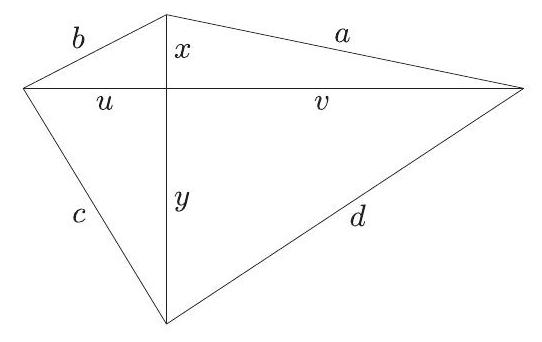
We ... | 7 | Geometry | math-word-problem | Yes | Yes | olympiads | false |
How many positive integers can be written in place of $n$, if 2004n is a divisor of 2004! ? [2004! denotes the product of integers from 1 to 2004.] | Solution. The prime factorization of 2004 is: $2004=2^{2} \cdot 3 \cdot 167$, so if $2004^{n}$ is a divisor of 2004!, then $2^{2 n} \cdot 3^{n} \cdot 167^{n}$ must also be a divisor of 2004!. The critical point is $167^{n}$, because 167 is the largest prime factor, and thus it appears the least number of times in the p... | 12 | Number Theory | math-word-problem | Yes | Yes | olympiads | false |
In a $3 \times 3$ table, we placed a 1-forint coin heads up in each cell. What is the minimum number of coins we need to flip so that there are neither three heads nor three tails in a row (row, column, diagonal)? | Solution. Consider three rows of the table. They have no common part, and each of them must contain at least one head. This means that we must flip at least 3 coins, and these must be placed in different rows and, similarly, in different columns. If there were no heads in any corner, then only the positions marked on t... | 4 | Logic and Puzzles | math-word-problem | Yes | Yes | olympiads | false |
Two unit-radius circles intersect at points $A$ and $B$. One of their common tangents touches the circles at points $E$ and $F$. What can be the radius of a circle that passes through points $E, F$, and $A$? | Solution. Let the centers of the unit circles be denoted by $O_{1}, O_{2}$, the center of the circle passing through points $E, F$, and $A$ by $O_{3}$, its radius by $r$, and let $A$ be the intersection point of the unit circles closer to the tangent $E F$. We know that $E O_{1} \perp E F$ and similarly $O_{3} A \perp ... | 1 | Geometry | math-word-problem | Yes | Yes | olympiads | false |
A sequence of positive numbers is not necessarily consecutive terms $a, b$, and $c$. We know that
$$
\frac{c-b}{a}+\frac{a-c}{b}+\frac{b-a}{c}=0
$$
Find the difference of the arithmetic sequence. | Solution. Multiply by $a b c$ (where $a, b, c$ are positive):
$$
b c^{2}-b^{2} c+a^{2} c-a c^{2}+a b^{2}-a^{2} b=0
$$
which can also be written as $(a-b)(c-a)(b-c)=0$.
A product is exactly zero if and only if at least one of its factors is 0; therefore, at least two of the three elements are equal. The arithmetic se... | 0 | Algebra | math-word-problem | Yes | Yes | olympiads | false |
A convex polyhedron has faces that are either pentagons or hexagons, and exactly three edges extend from each vertex. How many pentagonal faces does the polyhedron have? Give an example of such a polyhedron. | Let the number of pentagonal faces of the polyhedron be $n$, and the number of hexagonal faces be $k$. According to Euler's well-known theorem, for every convex polyhedron, $l + c = e + 2$, where $l$ is the number of faces, $c$ is the number of vertices, and $e$ is the number of edges. Based on this theorem, we try to ... | 12 | Geometry | math-word-problem | Yes | Yes | olympiads | false |
What integer can be the sum of the diagonals' lengths of a rhombus with a side length of 2? | Solution. Let the lengths of the diagonals of the rhombus be $e$ and $f$. The diagonals bisect each other at right angles, so the triangle $A M B$ in the diagram is a right triangle, and we can apply the Pythagorean theorem, which gives
$$
\left(\frac{e}{2}\right)^{2}+\left(\frac{f}{2}\right)^{2}=2^{2}, \quad \text { ... | 5 | Geometry | math-word-problem | Yes | Yes | olympiads | false |
Solve the equation in the set of positive numbers:
$$
\frac{x \cdot 2014^{\frac{1}{x}}+\frac{1}{x} \cdot 2014^{x}}{2}=2014
$$ | Solution. By substitution, we can verify that $x=1$ is a solution to the equation. In the following, we will show that for all other positive real numbers,
$$
\frac{x \cdot 2014^{\frac{1}{x}}+\frac{1}{x} \cdot 2014^{x}}{2}>2014
$$
Let's write the arithmetic and geometric mean inequality for the positive numbers $a=x ... | 1 | Algebra | math-word-problem | Yes | Yes | olympiads | false |
In the convex quadrilateral $A B C D$, the midpoints of sides $B C$ and $C D$ are $E$ and $F$ respectively. The segments $A E, E F$, and $A F$ divide the quadrilateral into four triangles whose areas are four consecutive integers. What is the maximum possible area of triangle $A B D$? | Let's use Figure 1. Let the areas of the triangles \( ABE, AEF, AFD, FEC \) be the positive integers \( n, n+1, n+2, n+3 \) (not necessarily in this order). Then \( T_{ABCD} = 4n + 6 \). Since \( T_{ABCD} = T_{ABD} + T_{BCD} \), \( T_{ABD} \) is maximized precisely when \( T_{BCD} \) is minimized.
=3(... | 4 | Algebra | math-word-problem | Yes | Yes | olympiads | false |
Let $a$ and $b$ be positive integers that are relatively prime, and let $A=8a+3b$ and $B=3a+2b$. The greatest common divisor of $A$ and $B$ is not 1. What is the greatest common divisor of $A$ and $B$? | Solution. Let $d$ be the greatest common divisor of $A$ and $B$. If $d \mid A$ and $d \mid B$, then $d \mid 8B - 3A = 7b$, and $d \mid 2A - 3B = 7a$.
We have found that $d$ is a common divisor of $7a$ and $7b$. Considering that $a$ and $b$ are coprime, the greatest common divisor of $7a$ and $7b$ is 7. (This follows f... | 7 | Number Theory | math-word-problem | Yes | Yes | olympiads | false |
In the triangle $ABC$, point $D$ is given on the extension of side $CA$ beyond $A$, and point $E$ is given on the extension of side $CB$ beyond $B$, such that $AB = AD = BE$. The angle bisectors from $A$ and $B$ of triangle $ABC$ intersect the opposite sides at points $A_1$ and $B_1$, respectively. What is the area of ... | Solution. Let the sides of triangle $ABC$ be $a, b$, and $c$ with the angle at $C$ being $\gamma$. Then the area of the triangle $T = ab \cdot \frac{\sin \gamma}{2}$.
According to the Angle Bisector Theorem, $CA_1 = \frac{ab}{b+c}$ and $CB_1 = \frac{ba}{a+c}$, so the area of triangle $A_1CB_1$ is
$$
T_{1} = \frac{(ab... | 6 | Geometry | math-word-problem | Yes | Yes | olympiads | false |
For a real number $x$, $\{x\}+\left\{x^{-1}\right\}=1$. Determine
$$
\left\{x^{2001}\right\}+\left\{x^{-2001}\right\}
$$
value. | Let's solve the problem for an arbitrary exponent $n$ instead of 2001.
Considering that the given and the desired expressions have a similar form, let's examine when $\{a\}+\left\{\frac{1}{a}\right\}$ can be an integer. Given $0 \leq\{a\}<1$ and $0 \leq\left\{\frac{1}{a}\right\}<1$, the sum can be either 1 or 0. The l... | 1 | Number Theory | math-word-problem | Yes | Yes | olympiads | false |
A regular triangle is rotated in a positive direction around its center, first by $3^{\circ}$, then by $9^{\circ}$, and then by $27^{\circ}$, and in the $k$-th step by $3^{k}$ degrees. How many different positions can the triangle take as a result of these rotations? | The first three transformations result in a $3^{\circ}$, a $3+9=12^{\circ}$, and a $3+9+27=39^{\circ}$ rotation, respectively; these place the equilateral triangle in different positions, distinct from the initial position. However, the result of four consecutive transformations (relative to the position after the $k$-... | 4 | Geometry | math-word-problem | Yes | Yes | olympiads | false |
Once upon a math class, a student incorrectly performed the squaring of $(a+2 b-3)^{2}$, and the result was $a^{2}+$ $4 b^{2}-9$. At the teacher's request, to verify, the student substituted a natural number for $a$ and $b$. After the substitution, the result turned out to be correct. Which numbers could the student ha... | Solution. Let's compare the two results:
$$
a^{2}+4 a b+4 b^{2}-6 a-12 b+9=a^{2}+4 b^{2}-9
$$
After simplification, we get
$$
4 a b-6 a-12 b+18=0
$$
Find the values of $a$ and $b$ (integers) for which the equality holds.
Transform into a product:
$$
2 a(2 b-3)-6(2 b-3)=(2 a-6)(2 b-3)=0
$$
The second factor is od... | 3 | Algebra | math-word-problem | Yes | Yes | olympiads | false |
Given two points on the sphere and the circle $k$, which passes through exactly one of the two points. How many circles are there on the sphere that pass through both points and are tangent to $k$? | I. Solution. We will show that exactly one such circle exists.
Let $\mathcal{G}$ be the surface of the sphere, $A$ the point on $k$ where it touches, $B$ the other given point, $\mathcal{S}$ the plane containing $k$, and $e$ the tangent line to the circle $k$ at $A$ in the plane $\mathcal{S}$. Since $\mathcal{G} \cap ... | 1 | Geometry | math-word-problem | Yes | Yes | olympiads | false |
On a chessboard, a pawn is located on B8 and another on G8, while a knight is on B1. What is the minimum number of moves required for the knight to capture both pawns? (The pawns do not move in between.)
 We add an even number of consecutive numbers. In this case, the stated condition is only satisfied if the number of numbers is divisible by 4 (i.e., we add 4, 8, 12... | 2 | Number Theory | math-word-problem | Yes | Yes | olympiads | false |
We build a tower from $2 \times 1$ dominoes in the following way. First, we arrange 55 dominoes to cover a $10 \times 11$ rectangle; this will be the first level of the tower. On top of this, we build further levels, each containing 55 dominoes, making sure that each level fits precisely on top of the previous one. The... | Solution. Let's call the 10-unit long side of the rectangle covered by the tower horizontal, and the 11-unit long side vertical. The property of the tower described in the problem means that the $10 \times 11$ rectangle, when divided into $(1 \times 1)$ squares, has a domino in the tower that covers exactly any two adj... | 5 | Combinatorics | math-word-problem | Yes | Yes | olympiads | false |
We will prove that $\sqrt[3]{\sqrt{5}+2}-\sqrt[3]{\sqrt{5}-2}$ is a rational number. | I. solution. With the notation $x=\sqrt[3]{\sqrt{5}+2}-\sqrt[3]{\sqrt{5}-2}$:
$$
x^{3}=(\sqrt{5}+2)-(\sqrt{5}-2)-3 \sqrt[3]{\sqrt{5}+2} \cdot \sqrt[3]{\sqrt{5}-2} \cdot(\sqrt[3]{\sqrt{5}+2}-\sqrt[3]{\sqrt{5}-2})
$$
based on the identity $(a-b)^{3}=a^{3}-b^{3}-3 a b(a-b)$.
Since $(\sqrt{5}+2)(\sqrt{5}-2)=1$, after si... | 1 | Algebra | proof | Yes | Yes | olympiads | false |
Let $\alpha(n)$ denote the measure of the interior angles of a regular $n$-gon. What is $n$ if $\alpha(n+3)-\alpha(n)=\alpha(n)-\alpha(n-2)$? | For a regular polygon with $n$ sides, the sum of the interior angles is $(n-2) \cdot 180^{\circ}$, so the measure of one angle is
$$
\begin{aligned}
\alpha(n) & =\frac{(n-2) \cdot 180^{\circ}}{n} ; \quad \text { and thus } \\
\alpha(n+3) & =\frac{(n+3-2) \cdot 180^{\circ}}{n+3} \\
\alpha(n-2) & =\frac{(n-2-2) \cdot 18... | 12 | Geometry | math-word-problem | Yes | Yes | olympiads | false |
Let the centroid of triangle $ABC$ be $S$, the midpoint of segment $AS$ be $H$, and the midpoint of side $AB$ be $Q$. The line through $H$ parallel to $BC$ intersects side $AB$ at $P$ and line $CQ$ at $R$. What is the ratio of the areas of triangles $PQR$ and $APH$? | Let $A S$ be the line and $B C$ the segment intersecting at point $F$. Since $S$ is the centroid of triangle $A B C$, $F$ is the midpoint of segment $B C$. Since $P H$ is parallel to $B F$, triangles $A P H$ and $A B F$ are similar. The similarity ratio is $1: 3$, because $H$ bisects segment $A S$, and $S$ trisects seg... | 1 | Geometry | math-word-problem | Yes | Yes | olympiads | false |
How many positive integers $n$ are there such that the geometric and harmonic means of $n$ and 2015 are both integers? | Solution. $2015=5 \cdot 13 \cdot 31$. The fact that $\sqrt{2015 n}$ is an integer is equivalent to all prime powers in the canonical form of $2015 n$ having even exponents. This implies that $n=2015 k^{2}$, where $k$ is a positive integer.
Consider the harmonic mean. Using that $n=2015 k^{2}$, transform the following ... | 5 | Number Theory | math-word-problem | Yes | Yes | olympiads | false |
A fisherman put the three largest fish, which accounted for $35 \%$ of the total weight of his daily catch, into the freezer. The three smallest fish, which together made up $\frac{5}{13}$ of the remaining part, were taken by the cat, and the rest were frozen for lunch. How many fish did the fisherman catch? | Let the total weight of the catch be $M$. The total weight of the three largest fish placed in the deep freezer is: $0.35 M$.
The total weight of the three smallest fish - which the cat took away - is $\frac{5}{13}$ of the remaining part, that is,
$$
\frac{5}{13}(M-0.35 M)=0.25 M
$$
The total weight of the fish cook... | 10 | Algebra | math-word-problem | Yes | Yes | olympiads | false |
In the triangle $ABC$, we divided each side into $p$ equal parts, where $p$ is a prime number. Then, from each side, we connected one of the division points to the opposite vertex of the triangle in such a way that these three lines intersect at a single point. Determine the possible values of $p$. | Solution. Suppose that on the side $AB$, we connect the $c$-th division point from $A$, on the side $BC$, the $a$-th division point from $B$, and on the side $CA$, the $b$-th division point from $C$, to the vertices $C$, $A$, and $B$ respectively, where $a$, $b$, and $c$ are positive integers less than $p$. According t... | 2 | Geometry | math-word-problem | Yes | Yes | olympiads | false |
One morning at school, consecutive integers starting from 1 were written on the board up to a certain number. The troublemaker erased one of the numbers carefully. The whole incident would have been forgotten if someone hadn't noted that the arithmetic mean of the remaining numbers was $\frac{45}{4}$. Let's try to figu... | The numbers written on the board:
$$
1, \quad 2, \quad \ldots, \quad n-1, \quad n
$$
Let the erased number be denoted by $x$. The sum of the first $n$ natural numbers, $S_{n}$, is given by the well-known formula $S_{n}=\frac{n(n+1)}{2}$. Subtract the erased number from the sum, and write the arithmetic mean of the re... | 6 | Algebra | math-word-problem | Yes | Yes | olympiads | false |
Solve the equation $\left(x^{2}+y^{2}\right)^{3}=\left(x^{3}-y^{3}\right)^{2}$ on the set of real numbers. | Solution. By expanding the parentheses, rearranging the equation to zero, and performing factorizations, we obtain:
$$
\begin{aligned}
x^{6}+y^{6}+3 x^{4} y^{2}+3 x^{2} y^{4} & =x^{6}+y^{6}-2 x^{3} y^{3} \\
3 x^{4} y^{2}+3 x^{2} y^{4}+2 x^{3} y^{3} & =0 \\
x^{2} y^{2}\left(3 x^{2}+3 y^{2}+2 x y\right) & =0 \\
x^{2} y^... | 0 | Algebra | math-word-problem | Yes | Yes | olympiads | false |
Solve the following system of equations:
$$
\begin{gathered}
\frac{x^{2}+x y+y^{2}}{x^{2}-x y+y^{2}}=3 \ldots \\
x^{3}+y^{3}=2 \ldots
\end{gathered}
$$ | 1)-ból $\quad \frac{(x+y)^{2}-x y}{(x+y)^{2}-3 x y}=3$.
After removing the fraction and rearranging:
$$
(x+y)^{2}=4 x y \ldots
$$
which means
$$
(x-y)^{2}=0 \text{, so } x=y \text{. }
$$
2)-by substituting
$$
2 x^{3}=2, \quad x=1=y \text{. }
$$
Winter Miksa (Kegyesrendi g. V. o. Szeged.)[^0]
[^0]: $11 x^{2}... | 11 | Algebra | math-word-problem | Yes | Yes | olympiads | false |
The route from $B$ to $C$ starts with a $3 \mathrm{~km}$ ascent, then proceeds horizontally for $5 \mathrm{~km}$, and finally reaches its destination via a $6 \mathrm{~km}$ descent, which has the same gradient as the first section. A traveler set out from $B$ and, turning back halfway, returned to $B$ after 3 hours and... | I. Solution: In the first trip, the traveler also covered a distance equal to $BC$, that is, $14 \mathrm{~km}$, since they returned to $B$ from halfway. Thus, this trip can be easily compared with the other two. The traveler covered $3-3 \mathrm{~km}$ uphill and downhill, and $8 \mathrm{~km}$ horizontally in the first ... | 4 | Algebra | math-word-problem | Yes | Yes | olympiads | false |
In space, let $a$ and $b$ be intersecting lines, and $c$ and $d$ be any lines that are skew to each other and also skew to both $a$ and $b$. Determine a line that intersects all four lines. | The sought line $t$ is either 1) incident to the plane $[a b]$ or 2) the intersection point $(a b)=K$. Apart from these two cases, which do not exclude each other, no other case is possible.
1) Let the intersection points of the lines $c$ and $d$ with the plane $[a b]$ be $P$ and $Q$, respectively. The line $P Q=t_{1}... | 2 | Geometry | math-word-problem | Yes | Yes | olympiads | false |
How many sides does that polygon have, in which the number of diagonals is 33 more than the number of sides? | If the number of pages is $n$, then
$$
\frac{n(n-3)}{2}=n+33
$$
or
$$
n^{2}-5 n-66=0
$$
from which the positive value of $n$ is 11.
The problem was also solved by: Bauer E., Breuer P., Dénes M., Döri V., Engler J., Erdős V., Fried E., Grün E., Grünwald M., Klein G., Köhler I., Koffer B., Lendvai D., Lengyel K., Ne... | 11 | Geometry | math-word-problem | Yes | Yes | olympiads | false |
$$
\begin{array}{ll}
1^{\circ} . & \frac{\sin 3 \alpha+\sin \alpha}{\cos 3 \alpha-\cos \alpha}+\operatorname{ctg} \alpha=? \\
2^{\circ} . & \frac{\sin 3 \alpha-\sin \alpha}{\cos 3 \alpha+\cos \alpha}-\operatorname{tg} \alpha=?
\end{array}
$$
| $1^{\circ} . \quad \frac{\sin 3 \alpha+\sin \alpha}{\cos 3 \alpha-\cos \alpha}+\operatorname{ctg} \alpha=\frac{2 \sin \frac{3 \alpha+\alpha}{2} \cos \frac{3 \alpha-\alpha}{2}}{-2 \sin \frac{3 \alpha+\alpha}{2} \sin \frac{3 \alpha-\alpha}{2}}+\operatorname{ctg} \alpha=-\frac{\cos \alpha}{\sin \alpha}+\operatorname{ctg} ... | 0 | Algebra | math-word-problem | Yes | Yes | olympiads | false |
Among 13 completely identical coins, there is one fake coin whose weight does not match the others. What is the minimum number of weighings required to determine which coin is the fake using a balance scale? | Divide the coins into groups of 4, 4, and 5. Let's denote these groups as $a, b, c$. First, place $a$ and $b$ on the scale. If the scale balances, we can assume that $a$ is the lighter. In this case, the counterfeit coin is either in $a$ and is lighter, or in $b$ and is heavier.
In this scenario, assign a number to ea... | 3 | Logic and Puzzles | math-word-problem | Yes | Yes | olympiads | false |
Let's write down the natural numbers after the decimal point in sequence:
$$
0,123456789101112 \ldots
$$
Determine the ten-thousandth digit of this decimal. | In the decimal number system, there are 9 single-digit, 90 two-digit, 900 three-digit, 9000 four-digit... natural numbers. Up to the four-digit numbers, this amounts to $9 \cdot 1 + 90 \cdot 2 + 900 \cdot 3 + 9000 \cdot 4 = 38889$ digits. The $40000 - 38889 = 1111$ digits form 222 five-digit numbers, with one digit rem... | 1 | Number Theory | math-word-problem | Yes | Yes | olympiads | false |
We have two gears. By connecting them, the ratio of the rotational speeds of the driving and driven gears (the transmission ratio) is $7: 9$ or $9: 7$. By replacing one of the gears with a gear that has 3 fewer teeth and the other with a gear that has 3 more teeth, the transmission ratio becomes $1: 3$ or $3: 1$. - Whi... | The ratio of the number of revolutions of the two wheels (over the same time period) being $7:9$ means that there is a positive integer $k$ such that the number of teeth on the first wheel is $9k$, and on the second wheel, it is $7k$. Indeed, with $63k$ teeth passing, the first wheel makes 7 complete revolutions, and t... | 1 | Algebra | math-word-problem | Yes | Yes | olympiads | false |
A capital of $4\%$ accrues interest for 2 years and 5 months. How long will it take for this capital to accrue the same amount of interest at $3 \frac{3}{4}\%$?
untranslated portion:
Valamely tőke $4 \%$ mellett 2 évig és 5 hónapig kamatozik. Mennyi idő alatt hajt e tôke $3 \frac{3}{4} \%$ mellett ugyanannyi kamatot?... | $$
\frac{t \cdot 4.29}{1200}=\frac{t \cdot 3 \frac{3}{4} \cdot x}{1200}
$$
from which $x=2$ years 6 months 28 days.
The problem was solved by: Bánó L., Felhőssy J., Füstös P., Freund E., Heimlich P., Jánosy Gy., Jurenák L., Kiss J., Klein Gy., Petrik Sarolta, Reich Z., Sárközy E., Szabó J., Schuster Gy., Steiger J. | 2 | Algebra | math-word-problem | Yes | Yes | olympiads | false |
Show that:
$$
\frac{7 x-5 y}{3 x+2 y}+\frac{5 x-8 y}{3 x-2 y}-\frac{x-9 y}{3 x+2 y}-\frac{8 x-10 y}{3 x-2 y}=1
$$ | The given expression can also be written as:
$$
\begin{gathered}
\frac{7 x-5 y-x+9 y}{3 x+2 y}+\frac{5 x-8 y-8 x+10 y}{3 x-2 y}= \\
=\frac{6 x+4 y}{3 x+2 y}+\frac{-3 x+2 y}{3 x-2 y}=2-1=1
\end{gathered}
$$
Number of solutions: 25.
(Zoltán Harsányi, Eger.) | 1 | Algebra | proof | Yes | Yes | olympiads | false |
What is the value of the following fraction:
$1234321234321 \cdot 2468642468641-1234321234320$
$\overline{1234321234320 \cdot 2468642468641+1234321234321}$. | Notice that all occurring numbers can be easily expressed, for example, by the second term of the numerator. $1234321234320=$ with the notation $a$, the value of the fraction is:
$$
\frac{(a+1)(2 a+1)-a}{a(2 a+1)+(a+1)}=\frac{2 a^{2}+2 a+1}{2 a^{2}+2 a+1}=1
$$
(Thus, it would be unnecessary to carry out the lengthy o... | 1 | Algebra | math-word-problem | Yes | Yes | olympiads | false |
Given a circle $k$, a point $P$, and a segment $d$ with its direction. Construct a triangle $ABC$ inside $k$ such that the side $AB$ is parallel and equal to $d$, and the angle bisector of $\angle ACB$ passes through $P$. | The side $AB$ of the sought triangle will be a chord of length $d$ of the circle $k$. It is known that the set of lines (geometric locus) that cut out chords of a given length $d$ from a given circle $k$ are the tangents of a circle $k'$ concentric with $k$ - provided that $d$ is less than the diameter $2r$ of $k$. For... | 4 | Geometry | math-word-problem | Yes | Yes | olympiads | false |
To be proven, if $a+b+c=0$, then
$$
\left(\frac{a-b}{c}+\frac{b-c}{a}+\frac{c-a}{b}\right)\left(\frac{c}{a-b}+\frac{a}{b-c}+\frac{b}{c-a}\right)=9
$$ | I. Solution: Our theorem to be proven can also be written as:
$$
\begin{gathered}
3+\frac{c}{a-b}\left(\frac{b-c}{a}+\frac{c-a}{b}\right)+\frac{a}{b-c}\left(\frac{a-b}{c}+\frac{c-a}{b}\right)+ \\
+\frac{b}{c-a}\left(\frac{a-b}{c}+\frac{b-c}{a}\right)=9
\end{gathered}
$$
or
$$
\begin{gathered}
\frac{c}{a-b} \cdot \fr... | 9 | Algebra | proof | Yes | Yes | olympiads | false |
The hands of a clock overlap how many times, form a right angle, and a straight angle with each other in one hour, and how many times in 12 hours? | Suppose the two hands overlap and will overlap again after $x$ minutes. During this time, the minute hand will make one full revolution and advance another $x-60$ minutes, so
$$
x-60=\frac{x}{12}
$$
from which
$$
x=65 \frac{5}{11}
$$
that is, the hands overlap every $65 \frac{5}{11}$ minutes, so 11 times in 12 hour... | 11 | Geometry | math-word-problem | Yes | Yes | olympiads | false |
2 boys and 3 girls went on a trip. Both the boys and the girls carried equally weighted backpacks, and the 5 backpacks together weighed 44 $\mathrm{kg}$. On the way - so that 1 girl could always rest - the boys carried the girls' backpacks, one each on their backs and one together, in their hands, while the girls took ... | The weight of the girl's backpack is evenly distributed among the other four hikers. Among them, the girls carry more by the amount that the boys' backpacks are heavier, so each boy's backpack is $1/4$ part heavier than the girls'. Thus, the total weight of the 5 backpacks is 5 and a half times the weight of a girl's b... | 8 | Algebra | math-word-problem | Yes | Yes | olympiads | false |
Consider on the first projection plane two points $A$ and $B$. Construct a transversal line $a$ and $b$ through each of these points such that:
1) the angle between the two lines is $30^{\circ}$,
2) the angle between the first projections of the lines is also $30^{\circ}$,
3) the angle between the planes of the line... | The first traces of the lines are points $A$ and $B$, so the first trace line of the plane is the line $|A B|$. The first dihedral angle of the plane is $90^{\circ}$, which means the sought lines can lie in two planes: $S_{1}$ and $S_{2}$. Since $\widehat{a b}=\widehat{a^{\prime} b^{\prime}}=30^{\circ}$, the intersecti... | 8 | Geometry | math-word-problem | Yes | Yes | olympiads | false |
$$
\frac{1}{4}(\sqrt{5}-1) \cdot \sqrt{6+2 \sqrt{5}}=?
$$
| $$
\begin{gathered}
\frac{1}{4}(\sqrt{5}-1) \cdot \sqrt{6+2 \sqrt{5}}=\frac{1}{4} \sqrt{(\sqrt{5}-1)^{2}(6+2 \sqrt{5})}= \\
\quad=\frac{1}{4} \sqrt{(6-2 \sqrt{5})(6+2 \sqrt{5})}=\frac{1}{4} \sqrt{16}=1
\end{gathered}
$$
(Kirchknopf Ervin, Budapest.)
Megoldások száma: 44.
| 1 | Algebra | math-word-problem | Yes | Yes | olympiads | false |
$\sin (\alpha+\beta) \sin (\alpha-\beta)-(\sin \alpha+\sin \beta)(\sin \alpha-\sin \beta)=?$ | $$
\begin{gathered}
\sin (\alpha+\beta) \sin (\alpha-\beta)=(\sin \alpha \cos \beta+\cos \alpha \sin \beta)(\sin \alpha \cos \beta-\cos \alpha \sin \beta)= \\
=\sin ^{2} \alpha \cos ^{2} \beta-\cos ^{2} \alpha \sin ^{2} \beta=\sin ^{2} \alpha\left(1-\sin ^{2} \beta\right)-\left(1-\sin ^{2} \alpha\right) \sin ^{2} \beta... | 0 | Algebra | math-word-problem | Yes | Yes | olympiads | false |
We have two perpendicular lines - like the axes of an ellipse - and a tangent $(t)$ with its point of tangency $(T)$. Construct the endpoints of the ellipse's axes $(A, B, C, D)$! How many solutions are there? | Let the tangent touch one of the axes at $P$; draw a circle over the diameter $\overline{O P}$ and project $T$ perpendicularly onto this circle in the direction of $|O P|$. $\overline{O T_{1}}$ is the radius of the affine circle from which we obtain $\overline{A B}$ and $\overline{C D}$ as shown in the figure. There is... | 1 | Geometry | math-word-problem | Yes | Yes | olympiads | false |
In triangle $ABC$, the feet of the altitudes are $A^{\prime}, B^{\prime}, C^{\prime}$; the points symmetric to these with respect to the midpoints of the sides are $A^{\prime \prime}, B^{\prime \prime}, C^{\prime \prime} ;$ show that:
$$
\frac{5{\overline{A^{\prime} B^{\prime}}}^{2}-{\overline{A^{\prime \prime} B^{\pr... | It is known that in the pedal triangle $A^{\prime} B^{\prime} C^{\prime}$ (see: K. M. L. IV. 45. page)
$$
A^{\prime} B^{\prime}=c^{\prime}=c \cos \gamma
$$
or
$$
c^{\prime 2}=c^{2} \cos ^{2} \gamma
$$
 and simplify the expression under b) as much as possible;
a) $\left(1-\cos 15^{\circ}\right)\left(1+\sin 75^{\circ}\right)+\cos 75^{\circ} \cos 15^{\circ} \operatorname{cotg} 15^{\circ}$
b) $\sin \left(45^{\circ}-\alpha\right)-\cos \left(30^{\circ}+\alpha\right)+\sin... | Sure, here is the translation:
---
When calculating the two expressions, we use the relationships between the trigonometric functions of complementary angles.
$$
\text { a) } \begin{gathered}
\left(1-\cos 15^{\circ}\right)\left(1+\sin 75^{\circ}\right)+\cos 75^{\circ} \cos 15^{\circ} \operatorname{cotg} 15^{\circ}= ... | 1 | Algebra | math-word-problem | Yes | Yes | olympiads | false |
Someone leaves 46800 frts to their children in such a way that this amount would be divided equally among them. However, before the inheritance is divided, two children die, which results in each of the remaining children receiving 1950 frts more than they would have otherwise. Question: How many children were there? | If the number of children is $x$, then each receives $\frac{46800}{x}$ frt; if two children die, each receives $\frac{46800}{x-2}$ frt, which is 1950 frt more than before; $x$ is thus obtained from the following equation:
$$
\frac{46800}{x}+1950=\frac{46800}{x-2}
$$
Rearranging the equation, we get:
$$
x^{2}-2 x-48=... | 8 | Algebra | math-word-problem | Yes | Yes | olympiads | false |
Let's determine $x$ such that
$$
\begin{gathered}
1^{4}+2^{4}+\cdots+x^{4}=1+2 \cdots+x+1^{2}+2^{2}+\cdots+x^{2}+ \\
+1^{3}+2^{3}+\cdots+x^{3}
\end{gathered}
$$ | The sum of the second, third, and fourth powers of natural numbers (K. M. L. VIII. 42.):
$$
\begin{gathered}
1^{2}+2^{2}+3^{2} \ldots+x^{2}=\frac{x(x+1)(2 x+1)}{6} \\
1^{3}+2^{3}+3^{3} \ldots+x^{3}=\frac{x^{2}(x+1)^{2}}{4} \\
1^{4}+2^{4}+3^{4} \ldots+x^{4}=\frac{x(x+1)(2 x+1)\left(3 x^{2}+3 x-1\right)}{30}
\end{gather... | 2 | Algebra | math-word-problem | Yes | Yes | olympiads | false |
Let's calculate the value of the expression under a) and simplify the expressions under b) and c):
a) $0.027^{-\frac{1}{3}}-\left(-\frac{1}{6}\right)^{-2}+256^{0.75}+0.25^{0}+(-0.5)^{-5}-3^{-1}$.
b) $\left[\frac{\left(a^{\frac{3}{4}}-b^{\frac{3}{4}}\right)\left(a^{\frac{3}{4}}+b^{\frac{3}{4}}\right)}{a^{\frac{1}{2}}-b^... | a) Our sum can also be written as:
$$
\begin{aligned}
& \sqrt[3]{\frac{1000}{27}}-(-6)^{2}+(\sqrt[4]{256})^{3}+1+(-2)^{5}-\frac{1}{3}= \\
&= \frac{10}{3}-36+64+1-32-\frac{1}{3}=0
\end{aligned}
$$
b) Let's denote the first factor by $A$ and the second by $B$, then
$$
\begin{aligned}
A= & \frac{\left(a^{\frac{1}{2}}\r... | 0 | Algebra | math-word-problem | Yes | Yes | olympiads | false |
Let's determine $p$ such that in the equation
$$
x^{2}+(2-p) x-p-3=0
$$
the sum of the squares of the roots is as small as possible. | If the roots of the equation are \(x_{1}\) and \(x_{2}\), then
$$
x_{1}^{2}+x_{2}^{2}=\left(x_{1}+x_{2}\right)^{2}-2 x_{1} x_{2}=(p-2)^{2}+2 p+6
$$
or, rearranged,
$$
x_{1}^{2}+x_{2}^{2}=p-2 p+10
$$
But the function
$$
a x^{2}+b x+c
$$
attains its minimum value when \(x=-\frac{b}{2 a}\), so the sum of the squares... | 9 | Algebra | math-word-problem | Yes | Yes | olympiads | false |
In what number system is there an equality of the form $24=4 \cdot 6$ between three consecutive even or odd numbers? | In the $b$ number system, a number $a$ is to be found such that: $a b+(a+2)=(a+2)(a+4), b=\left(a^{2}+5 a+6\right) / a$. This implies that $a$ must be a divisor and thus $a$ is either 1, 2, 3, or 6. Accordingly, $b$ is either 12, 10, 10, or 12.
In the decimal system, such numbers are 24 and 35. In the duodecimal syste... | 12 | Number Theory | math-word-problem | Yes | Yes | olympiads | false |
Let's calculate the value of the following expression:
$$
\frac{1+x}{1+\sqrt{1+x}}+\frac{1-x}{1-\sqrt{1-x}} \quad \text { if } \quad x=\frac{\sqrt{3}}{2}
$$ | First solution. Let
$$
\sqrt{1+x}=a \quad \text { and } \quad \sqrt{1-x}=b
$$
then
$$
(a-b)^{2}=(\sqrt{1+x}-\sqrt{1-x})^{2}=2-2 \sqrt{1-x^{2}}=2-2 \sqrt{1-\frac{3}{4}}=1
$$
thus
$$
a-b=1
$$
Furthermore,
$$
a^{2}+b^{2}=(1+x)+(1-x)=2
$$
and
$$
a b=\frac{a^{2}+b^{2}-(a-b)^{2}}{2}=\frac{1}{2}
$$
Therefore,
$$
\b... | 1 | Algebra | math-word-problem | Yes | Yes | olympiads | false |
$B$ and $C$ cities are $20 \mathrm{~km}$ apart along the $D$ river. Trains run on a railway along the bank at a speed of $30 \mathrm{~km} /$ hour. Trains depart from $B$ to $C$ at 8:20 and 10:20, and from $C$ to $B$ at 10:00, arriving at 11:50. There is also an afternoon ferry service from $B$ to $C$ and back, and the ... | The train's travel time is 40 minutes, so it arrives in $C$ at 9 and 11 o'clock, and departs from $C$ at 9:20 and 11:10 (the traffic can be handled by a single train). It is not possible for the boat to meet the train on the same route, because then they would travel the entire route together, the boat's speed would be... | 11 | Algebra | math-word-problem | Yes | Yes | olympiads | false |
$A$ says to $B$: "Take any number. Write its digits in reverse order and subtract the smaller number from the larger one. Multiply this difference by any number. In the resulting product, cross out any non-zero digit of your choice, and tell me the truncated number." $B$'s response: 35407, to which $A$ says that the cr... | The general form of a number in the decimal system is
$$
a_{0} 10^{n}+a_{1} 10^{n-1}+\ldots+a_{n-2} 10^{2}+a_{n-1} 10+a_{n}
$$
which can also be written as
$$
\begin{gathered}
a_{0}\left(10^{n}-1\right)+a_{1}\left(10^{n-1}-1\right)+\ldots+a_{n-2}\left(10^{2}-1\right)+a_{n-1}(10-1)+ \\
+a_{0}+a_{1}+a_{2}+\ldots+a_{n-... | 8 | Number Theory | math-word-problem | Yes | Yes | olympiads | false |
Using the method from the previous task, show that
$$
\sqrt{x+2+2 \sqrt{x+1}}-\sqrt{x+2-2 \sqrt{x+1}}
$$
is a rational number. | Let $\sqrt{x+2+2 \sqrt{x+1}}=\sqrt{a}+\sqrt{b}$.
By squaring, $\quad x+2+2 \sqrt{x+1}=a+b+2 \sqrt{a b}$,
thus $\quad x+2=a+b \quad$ and $\quad x+1=a b$.
Therefore, $a$ and $b$ are the roots of the equation $\quad u^{2}-(x+2) u+(x+1)=0$.
These are $u_{1,2}=\frac{x+2 \pm \sqrt{(x+2)^{2}-4(x+1)}}{2}=\frac{x+2 \pm x}{2... | 2 | Algebra | proof | Yes | Yes | olympiads | false |
Solve the following equation:
$$
\frac{1}{\sqrt{2+x}-\sqrt{2-x}}+\frac{1}{\sqrt{2+x}+\sqrt{2-x}}=1
$$ | Multiplying the equation by the product of the two denominators, we obtain
$$
\sqrt{2+x}+\sqrt{2-x}+\sqrt{2+x}-\sqrt{2-x}=(2+x)-(2-x)
$$
which simplifies to
$$
2 \sqrt{2+x}=2 x
$$
and thus
$$
\sqrt{2+x}=x
$$
Squaring and rearranging,
$$
x^{2}-x-2=0
$$
from which
$$
x_{1}=2, \quad\left[x_{2}=-1\right]
$$
By su... | 2 | Algebra | math-word-problem | Yes | Yes | olympiads | false |
Two workers, $A$ and $B$, completed a certain job; $A$ received 30 pengő, and $B$ received 14 pengő, given that $B$ worked 3 fewer days than $A$.
If $A$ had worked 2 fewer days and $B$ had worked 5 more days, they would have received the same amount. How many days did each work on the job, and what was their daily wag... | Let the number of workdays of $A$ be $x$; thus, the daily wage of $A$ is $\frac{30}{x}$.
The number of workdays of $B$ is $x-3$, and the daily wage of $B$ is $\frac{14}{x-3}$.
If $A$ works for two days less, the earnings are $\frac{30}{x}(x-2)$.
If $B$ works for five more days $(x-3+5=x+2)$, the earnings are $\frac{... | 10 | Algebra | math-word-problem | Yes | Yes | olympiads | false |
What is the value of angle $x$, if
$$
\operatorname{tg} 54^{\circ} \cdot \operatorname{tg}\left(45^{\circ}-x\right)=1
$$ | From the given equation
$$
\operatorname{tg}\left(45^{\circ}-x\right)=\frac{1}{\operatorname{tg} 54^{\circ}}=\operatorname{ctg} 54^{\circ}=\operatorname{tg} 36^{\circ}
$$
it follows that
$$
45^{\circ}-x=36^{\circ}
$$
from which
$$
x=9^{\circ}
$$
(Imre Deutsch, Györr.)
Number of solutions: 24. | 9 | Algebra | math-word-problem | Yes | Yes | olympiads | false |
What is the last non-zero digit of the product of the first hundred natural numbers?
Translate the above text into English, please keep the original text's line breaks and format, and output the translation result directly. | The only difficulty is caused by factors divisible by 5, which, when multiplied by an appropriate even number, result in a number ending in 0. If we factorize the product into prime factors, this difficulty does not arise.
I. Solution: Among the first 100 numbers, there are 50 even numbers, of which 25 are also divisi... | 4 | Number Theory | math-word-problem | Yes | Yes | olympiads | false |
A tank can be filled with water through two pipes. One pipe can fill the tank in 3 hours, and both pipes together can fill the tank in 1 hour and 12 minutes. How many hours does it take to fill the tank if only the second pipe is used? | In 1 hour and 12 minutes, or 1.2 hours, the first pipe fills $\frac{2}{5}$ of the tank, which implies that the second pipe fills $\frac{3}{5}$ of the tank in the same 1.2 hours. Therefore, the entire tank is filled by the second pipe in
$$
\frac{1.2}{3} \cdot 5=2 \text { hours. }
$$ | 2 | Algebra | math-word-problem | Yes | Yes | olympiads | false |
A gear wheel has 12 teeth on the smaller wheel and 32 teeth on the larger one. Due to a manufacturing defect, one tooth on the small wheel and one gap on the large wheel are faulty, causing them to rattle when they meet. How often will we hear the rattling if the time for one revolution of the large wheel is 3 seconds?... | Between any two clicks, both wheels make an integer number of revolutions, since the meeting always occurs at the same place. Therefore - measuring time in terms of one tooth's rotation - the time between any two clicks is a multiple of both 12 and 32. The repetition interval is the least common multiple of these, whic... | 9 | Number Theory | math-word-problem | Yes | Yes | olympiads | false |
Let's determine the last two digits of the number
$$
7^{9^{9^{9}}}
$$ | A product of a number of the form $4k+1$ and another number of the same form: $(4k+1)(4l+1) = 16kl + 4k + 4l + 1$, is a number of the same form. This implies that every power of $4k+1$ is of the same form, so $9^{9^9} = (4 \cdot 2 + 1)^{9^9} = 4k + 1$.
$$
7^{9^{9^9}} = 7^{7^{k+1}} = 7 \cdot (7^4)^k = 7 \cdot 2401^k
$$... | 7 | Number Theory | math-word-problem | Yes | Yes | olympiads | false |
In a triangle, the base is $4 \mathrm{~cm}$ larger than the corresponding height. If we increase both the base and the height by $12 \mathrm{~cm}$, we get a triangle whose area is five times the area of the original triangle. What are the base and height of the original triangle? | Let the base of the triangle be $a$, then its height is $m=a-4$. According to the problem,
$$
(a+12)(a+8)=5 a(a-4)
$$
or
$$
a^{2}-10 a-24=0
$$
from which the positive root is: $a=12 \text{ cm}$, so $m=8 \text{ cm}$.
(Leó Spitzer, Budapest.)
The problem was also solved by: Bauer E., Breuer P., Dénes M., Döri V., E... | 12 | Algebra | math-word-problem | Yes | Yes | olympiads | false |
In how many ways can four married couples sit around a round table so that two women do not sit next to each other? How many arrangements are possible if we want to ensure that neither two spouses, nor two women, nor two men sit next to each other? | $1^{\circ}$. First, we seat the four ladies. These can be seated around the table in 3! ways. Then we place the gentlemen, so that one man is placed between each two ladies. Since the gentlemen can be seated in 44 ways, the total number of arrangements is
$$
3!4!=144
$$
$2^{\circ}$. Again, we first place the ladies. ... | 12 | Combinatorics | math-word-problem | Yes | Yes | olympiads | false |
Subsets and Splits
No community queries yet
The top public SQL queries from the community will appear here once available.