
problem stringlengths 15 4.7k | solution stringlengths 2 11.9k | answer stringclasses 51
values | problem_type stringclasses 8
values | question_type stringclasses 4
values | problem_is_valid stringclasses 1
value | solution_is_valid stringclasses 1
value | source stringclasses 6
values | synthetic bool 1
class |
|---|---|---|---|---|---|---|---|---|
In a certain right-angled triangle, the sum of the hypotenuse and one of the legs is $c+b=14 \text{~cm}, \operatorname{tg} \frac{\alpha}{2}=\frac{1}{2}$, where $\alpha$ is the angle opposite the leg $a$. Calculate the lengths of the sides of the triangle without using trigonometric tables. | I. solution: Using the known formula
$$
\operatorname{tg} \frac{\alpha}{2}=\sqrt{\frac{1-\cos \alpha}{1+\cos \alpha}}
$$
we have
$$
\operatorname{tg}^{2} \frac{\alpha}{2}=\frac{1}{4}=\frac{1-\cos \alpha}{1+\cos \alpha}=\frac{1-\frac{b}{c}}{1+\frac{b}{c}}=\frac{c-b}{c+b}=\frac{c-b}{14}
$$
from which
$$
c-b=\frac{14... | 7 | Geometry | math-word-problem | Yes | Yes | olympiads | false |
In the equilateral triangle $ABC$, the side length is $52 \, \text{m}$. From the vertices $A$ and $B$ of the triangle, a point starts moving simultaneously along the side $AC$ at a speed of $3 \, \text{m} / \text{sec}$ and along the side $BC$ at a speed of $4 \, \text{m} / \text{sec}$, respectively, and heads towards $... | Let $t$ be the time in seconds after which the position of the point starting from $A$ is $P$, and the position of the point starting from $B$ is $Q$. Denote the projection of $Q$ onto the line $AC$ as $R$ (Figure 4).
(x+3)-6(x+2)^{2}=-(x+2)(x+3) .
$$
By performing the multiplicat... | 3 | Algebra | math-word-problem | Yes | Yes | olympiads | false |
Two numbers have the divisors 12, 20, 45; their least common multiple is 4320. Determine such pairs of numbers! | Let the pair of sought numbers be denoted by $A, B$. These are multiples of the least common multiple (LCM) of 12, 20, and 45, which is 180. Therefore,
\[
A=180a, \quad B=180b
\]
The LCM of $A$ and $B$ is 4320, which includes 180 as one of its divisors, as well as all common and non-common divisors of $a$ and $b$. Th... | 11 | Number Theory | math-word-problem | Yes | Yes | olympiads | false |
A courier departs from $A$ towards $B$; at the same time, another courier departs from $B$ towards $A$. They meet after 8 hours. How many $\mathrm{km}$ does each courier travel per hour, if the distance from $A$ to $B$ is $176 \mathrm{~km}$ and it takes one courier 1 hour longer to travel $60 \mathrm{~km}$ than it take... | If one courier does it in $x$ hours, then the other does it in $x+1$ hours, covering $60 \mathrm{~km}$. Therefore, they cover $\frac{60}{x}$ and $\frac{60}{x+1}$ km per hour, respectively, so
$$
8 \cdot \frac{60}{x} + 8 \cdot \frac{60}{x+1} = 176
$$
or, rearranged,
$$
11 x^{2} - 49 x - 60 = 0
$$
Since the positive ... | 12 | Algebra | math-word-problem | Yes | Yes | olympiads | false |
Show that
$$
\operatorname{tg} 20^{\circ} \cdot \operatorname{tg} 40^{\circ} \cdot \operatorname{tg} 60^{\circ} \cdot \operatorname{tg} 80^{\circ}=3
$$ | $$
\begin{gathered}
\operatorname{tg} 22^{\circ} \operatorname{tg} 40^{\circ} \operatorname{tg} 60^{\circ} \operatorname{tg} 80^{\circ}=\operatorname{tg} 60^{\circ} \operatorname{tg} 20^{\circ} \cdot \operatorname{tg}\left(60^{\circ}-20^{\circ}\right) \operatorname{tg}\left(60^{\circ}+20^{\circ}\right)= \\
=\sqrt{3} \o... | 3 | Algebra | proof | Yes | Yes | olympiads | false |
A crew of rowers travels $3.5 \mathrm{~km}$ downstream and the same distance upstream in a total of 1 hour and 40 minutes in a river. The speed of the river current is $2 \mathrm{~km}$ per hour. How far would the rowing team travel in 1 hour in still water? | 1 hour 40 minutes $=\frac{5}{3}$ hours.
If the rowing team travels at a speed of $x \mathrm{~km}$ per hour in still water, then their speed downstream in flowing water is $x+2$, and upstream is $x-2$ (km per hour).
$$
3.5 \mathrm{~km} \text{ downstream takes } \frac{3.5}{x+2}, \text{ and upstream takes } \frac{3.5}{x... | 5 | Algebra | math-word-problem | Yes | Yes | olympiads | false |
For what value of $\lambda$ does the equation
$$
\lambda x^{2}+4 x y+y^{2}-4 x-2 y-3=0
$$
represent a pair of lines? | I. Solution: The given equation will represent a pair of lines if, when solving for $y$ as a function of $x$, we obtain two linear equations in $y$. Therefore, let's rearrange the equation in terms of powers of $y$ and solve for $y$:
$$
y^{2}+2 y(2 x-1)+x(\lambda x-4)-3=0
$$
from which
$$
\begin{gathered}
y=\frac{-2... | 4 | Algebra | math-word-problem | Yes | Yes | olympiads | false |
What are the sides of a rectangle, from which, by cutting off $3 \mathrm{~cm}$ from its length and $2 \mathrm{~cm}$ from its width, we get a square whose area is half of the rectangle's area? | If the side of the square is $x$, then according to the problem,
$$
(x+2)(x+3)=2 x^{2},
$$
or
$$
x^{2}-5 x-6=(x+1)(x-6)=0
$$
from which the positive value of $x$ is: $x=6$, so the length of the rectangle is $9 \mathrm{~cm}$, and the width is $8 \mathrm{~cm}$.
(Klein Adolf, Székesfehérvár.)
Number of solutions: 32... | 6 | Geometry | math-word-problem | Yes | Yes | olympiads | false |
Someone wanted to gift 6 liters of wine from a 12-liter jug that is full of wine. However, they only have a 7-liter and a 5-liter jug for measuring. How can they fill the 7-liter jug with 6 liters of wine? | The following table shows a solution:
| 12-letter | 7-letter | 5-letter |
| :---: | :---: | :---: |
| 12 | 0 | 0 |
| 5 | 7 | 0 |
| 5 | 2 | 5 |
| 10 | 2 | 0 |
| 10 | 0 | 2 |
| 3 | 7 | 2 |
| 3 | 4 | 5 |
| 8 | 4 | 0 |
| 8 | 0 | 4 |
| 1 | 7 | 4 |
| 1 | 6 | 5 |
| 6 | 6 | 0 |
(György Ballai, Budapest.)
Number of solutions... | 6 | Logic and Puzzles | math-word-problem | Yes | Yes | olympiads | false |
Show that
$$
\sqrt{2+\sqrt{3}} \cdot \sqrt[3]{\frac{\sqrt{2}(5-3 \sqrt{3)}}{2}}=1
$$ | $$
\begin{aligned}
& \sqrt{2+\sqrt{3}} \cdot \sqrt[3]{\frac{\sqrt{2}(5-3 \sqrt{3)}}{2}}=\sqrt[6]{(2+\sqrt{3})^{3}} \cdot \sqrt[6]{\frac{\left(5-3 \sqrt{3)\right)^{2}}}{2}}= \\
& =\sqrt[6]{26+15 \sqrt{3}} \sqrt[6]{26-15 \sqrt{3}}=\sqrt[6]{676-675}=1
\end{aligned}
$$
Number of solutions: 15. | 1 | Algebra | proof | Yes | Yes | olympiads | false |
We will prove that $\sqrt[3]{25+5 \sqrt{20}}+\sqrt[3]{25-5 \sqrt{20}}=5$.
---
The translation is provided as requested, maintaining the original formatting and line breaks. | I. Solution. Let
thus
$$
\sqrt[3]{25+5 \sqrt{20}}=x, \quad \sqrt[3]{25-5 \sqrt{20}}=y
$$
and
$$
x^{3}+y^{3}=25+5 \sqrt{20}+25-5 \sqrt{20}=50 \ldots
$$
$$
x y=\sqrt[3]{25^{2}-25 \cdot 20}=\sqrt[3]{125}=5 \ldots
$$
However,
$$
x^{3}+y^{3}=(x+y)^{3}-3 x y(x+y)=(x+y)^{3}-15(x+y)=50
$$
that is,
$$
x+y=u \quad \text... | 5 | Algebra | proof | Yes | Yes | olympiads | false |
$$
\frac{b c}{(a-c)(a-b)}+\frac{a c}{(b-c)(b-a)}+\frac{a b}{(c-a)(c-b)}=?
$$
| $$
\begin{gathered}
S=\frac{b c}{(a-c)(a-b)}+\frac{a c}{(b-c)(b-a)}+\frac{a b}{(c-a)(c-b)}= \\
=\frac{b c(b-c)-a c(a-c)+a b(a-b)}{(a-b)(a-c)(b-c)}
\end{gathered}
$$
De
$$
\begin{gathered}
(a-b)(a-c)(b-c)=a^{2} b-a b^{2}+b^{2} c-b c^{2}+c^{2} a-c a^{2}= \\
b c(b-c)-a c(a-c)+a b(a-b)
\end{gathered}
$$
s így
$$
S=1
$$... | 1 | Algebra | math-word-problem | Yes | Yes | olympiads | false |
Given are the intersection points of a certain rectangle's sides with a line, and the length of one of its sides; construct this rectangle. When can this problem be solved and in how many ways, if it is solvable? | Given the 6 distances determined by points $E, F, G$, and $H$, we draw a semicircle over one of them, for example, $GH$; from point $G$, we draw an arc with the given side $AB = CD = a$, which intersects the semicircle at point $K$.
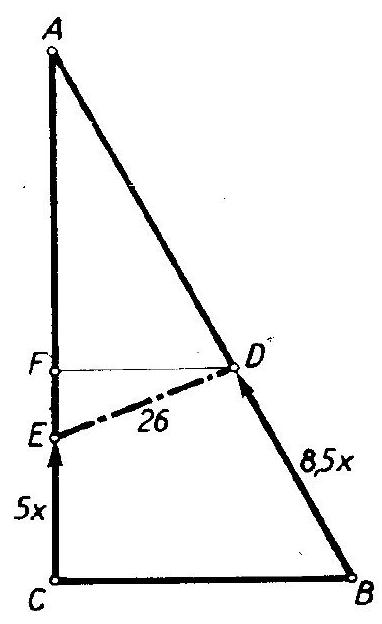
=18^{2}
$$
or
$$
x^{2}+27 x-324=0
$$
from which the positive root $x=9$, so the part of the secant outside the circle is $9 \mathrm{~cm}$.
(Miksa Lusztig, Pécs.)
Number of solutions: 22. | 9 | Geometry | math-word-problem | Yes | Yes | olympiads | false |
In the plane $s$, find a point which is at a distance $m$ from a given line $a$ and from a given plane $s_{1}$. | Solution. The sought point lies on three geometric places: one geometric place is the given plane $s$; the other is a cylinder whose axis is the line $a$ and the radius of its base circle is $m$; the third is a plane $s_{2}$, which is at a distance $m$ from the plane $s_{1}$ and is parallel to it.
Accordingly, the poi... | 4 | Geometry | math-word-problem | Yes | Yes | olympiads | false |
$$
\left[\left(\frac{a-b}{x+x}\right)^{-3}\right]^{2}\left[\left(\frac{x-y}{b-a}\right)^{-2}\right]^{3}\left[\left(\frac{x-y}{x+y}\right)^{-2}\right]^{-3}=?
$$ | The given expression can also be written as:
$$
\begin{gathered}
{\left[\left(\frac{x+y}{a-b}\right)^{3}\right]^{2}\left[\left(\frac{b-a}{x-y}\right)^{2}\right]^{3}\left[\left(\frac{x-y}{x+y}\right)^{2}\right]^{3}=} \\
\left(\frac{x+y}{a-b}\right)^{6}\left(\frac{b-a}{x-y}\right)^{6}\left(\frac{x-y}{x+y}\right)^{6}=\le... | 1 | Algebra | math-word-problem | Yes | Yes | olympiads | false |
For the solution to problem 1085, let's determine the maximum possible area of a quadrilateral with side lengths \(a=1, b=3, c=6, d=8\) units. - Show that the maximum area enclosed by the given sides is the same regardless of the order of the sides.
[^0]: ${ }^{1}$ K. M. L. 23 (1961) 130. o. | Let the sides of the quadrilateral $\mathrm{ABCD}$ be $A B=a, B C=b, C D=c, D A=d$, one of its diagonals $B D=f$, the opposite angles $\angle B A D=\alpha, \angle B C D=\gamma$, and its area $t$.
.
Let the foot of the perpendicular from ... | 4 | Geometry | math-word-problem | Yes | Yes | olympiads | false |
Simplify the following expression to its simplest form:
$$
\left(\frac{x+\left(x^{2}-y\right)^{\frac{1}{2}}}{2\left(x+y^{\frac{1}{2}}\right)}\right)^{\frac{1}{2}}+\left(\frac{x-\left(x^{2}-y\right)^{\frac{1}{2}}}{2\left(x+y^{\frac{1}{2}}\right)}\right)^{\frac{1}{2}}
$$ | Let's denote the given expression by $z$. First of all, we need to ensure that $z$ makes sense in the realm of real numbers.
To make sense of the $\frac{1}{2}$ exponents, we must assume that their bases are non-negative, that is, that
a) in the denominators, $y \geq 0$
b) in the second term of the numerators, $x^{2}... | 1 | Algebra | math-word-problem | Yes | Yes | olympiads | false |
On the table, 100 matchsticks lie. $A$ and $B$ take turns to remove at least one and at most seven matchsticks. The one who takes the last matchstick from the table wins. Is it true or not that the starting player always wins if they play correctly? | I. Solution: Let $A$ be the starting player. If $A$ leaves 8 matches to the opponent last, that is, $A$ takes the 92nd match and stops here, then $A$ has secured the 100th match as well. Similarly, if $A$ stops at the 84th match, $A$ has secured the 92nd and thus the 100th match. It is clear that $A$ will surely win if... | 4 | Combinatorics | math-word-problem | Yes | Yes | olympiads | false |
With a brief calculation, determine the value of the following product:
$$
\frac{6 \cdot 27^{12}+2 \cdot 81^{9}}{8000000^{2}} \cdot \frac{80 \cdot 32^{3} \cdot 125^{4}}{9^{19}-729^{6}}
$$ | Factoring into prime factors and swapping the two denominators:
$$
\begin{gathered}
\frac{2 \cdot 3 \cdot\left(3^{3}\right)^{12}+2 \cdot\left(3^{4}\right)^{9}}{\left(3^{2}\right)^{19}-\left(3^{6}\right)^{6}} \cdot \frac{2^{4} \cdot 5 \cdot\left(2^{5}\right)^{3} \cdot\left(5^{3}\right)^{4}}{\left(2^{3} \cdot 2^{6} \cdo... | 10 | Algebra | math-word-problem | Yes | Yes | olympiads | false |
Let's calculate as simply as possible the value of
$$
a^{3}+b^{3}+3\left(a^{3} b+a b^{3}\right)+6\left(a^{3} b^{2}+a^{2} b^{3}\right)
$$
if $a+b=1$. | The expression $K$ can be transformed in various ways. We will present a few methods.
I. Solution. Using known identities, factoring, and then immediately writing 1 instead of the factor $a+b$, the value of the given expression $K$ is found to be 1:
$$
\begin{gathered}
K=(a+b)\left(a^{2}-a b+b^{2}\right)+3 a b\left(a... | 1 | Algebra | math-word-problem | Yes | Yes | olympiads | false |
$$
\sqrt{7+4 \sqrt{3}}+\sqrt{7-4 \sqrt{3}}=?
$$ | I. solution. The question is about a positive number and its square:
$$
\begin{gathered}
(\sqrt{7+4 \sqrt{3}}+\sqrt{7-4 \sqrt{3}})^{2}=7+4 \sqrt{3}+2 \sqrt{(7+4 \sqrt{3})(7-4 \sqrt{3})}+ \\
+7-4 \sqrt{3}=14+2 \sqrt{49-48}=16
\end{gathered}
$$
thus, the value of the expression is $\sqrt{16}=4$.
II. solution. We can n... | 4 | Algebra | math-word-problem | Yes | Yes | olympiads | false |
Determine $x$ from the condition that the integer of the form $5^{x}$ is preceded by the number 7812500, which has no common divisor with $5^{x}$. | A number that is divisible by 5 and less than $5^{x}$ is $5^{x-1}$. The
$$
5^{x}-5^{x-1}=4 \cdot 5^{x-1}
$$
difference gives the number of numbers that do not share a common divisor with $5^{x}$. Thus:
$$
\begin{gathered}
4 \cdot 5^{x-1}=7812000 \\
5^{x-1}=1953125=5^{9}
\end{gathered}
$$
From this, it follows that
... | 10 | Number Theory | math-word-problem | Yes | Yes | olympiads | false |
Adva van két (kívülről vagy belülről) érintkező kör. Szerkesszük meg a közös érintőn azt a pontot, amelyből a két körhöz húzott, egy-egy - a közös érintőtól különböző - érintő egymásra merőleges.
Given are two circles that are tangent (either externally or internally). Construct the point on the common tangent from wh... | Let's first deal with the case when the two circles touch externally. Imagine the problem as solved (see the figure).

Let $P_{1}$ be a point on one of the common tangents from which a perpend... | 8 | Geometry | math-word-problem | Yes | Yes | olympiads | false |
The perimeter of a certain right-angled triangle is $30 \mathrm{~cm}$, the height corresponding to the hypotenuse is $m_{c}=6 \mathrm{~cm}$. What are the lengths of the sides of the triangle? | Let the legs be $a$ and $b$, and the hypotenuse $c$. According to the problem,
\[
\begin{gathered}
a+b+c=30 \\
a^{2}+b^{2}=c^{2}
\end{gathered}
\]
and the double area of the triangle is
\[
a b=m_{c} \cdot c=6 c
\]
From (1), (2), and (3),
\[
30-c=a+b=\sqrt{a^{2}+b^{2}+2 a b}=\sqrt{c^{2}+12 c}
\]
thus,
\[
\begin{g... | 10 | Geometry | math-word-problem | Yes | Yes | olympiads | false |
$1^{\circ}$. Show that the roots of the equation
$$
x^{2}+(\lambda-2) x-(\lambda+3)=0
$$
are real for any (real) value of $\lambda$.
$2^{\circ}$. Express the sum of the squares of the roots as a function of $\lambda$!
$3^{\circ}$. Determine the value of $\lambda$ so that the sum of the squares of the roots is equal... | $1^{0}$. The discriminant of the equation
$$
(\lambda-2)^{2}+4(\lambda+3)=\lambda^{2}+16
$$
is positive for any real value of $\lambda$, so the roots are real and distinct.
$2^{0}$. The sum of the squares of the roots
$$
x_{1}^{2}+x_{2}^{2}=\left(x_{1}+x_{2}\right)^{2}-2 x_{1} x_{2}=(2-\lambda)^{2}-2(\lambda+3)=\la... | 9 | Algebra | math-word-problem | Yes | Yes | olympiads | false |
The following expressions should be simplified to their simplest form:
$$
\frac{\sqrt[4]{4}}{\sqrt[6]{8}}, \quad \sqrt[n-1]{\frac{a}{\sqrt[n]{a}}}
$$ | $$
\begin{aligned}
& \frac{\sqrt[4]{4}}{\sqrt[6]{8}}=\frac{\sqrt[4]{2^{2}}}{\sqrt[6]{2^{3}}}=\frac{\sqrt{2}}{\sqrt{2}}=1
\end{aligned}
$$

(Riesz Marcel, Gyôr.) | 1 | Algebra | math-word-problem | Yes | Yes | olympiads | false |
We will prove that
$$
\sqrt{7+\sqrt{24}}-\sqrt{7-\sqrt{24}}
$$
is an integer. | I. Solution: The expressions under the square roots can be transformed as follows: $7+\sqrt{24}=6+2 \sqrt{6}+1=(\sqrt{6}+1)^{2}$, and similarly $7-\sqrt{24}=(\sqrt{6}-1)^{2}$. Since $\sqrt{6}>1$, taking the positive value of the square roots,
$$
\sqrt{7+\sqrt{24}}-\sqrt{7-\sqrt{24}}=(\sqrt{6}+1)-(\sqrt{6}-1)=2
$$
whi... | 2 | Algebra | proof | Yes | Yes | olympiads | false |
Oly pontok keresendók, melyek egy az első képsíkra merőlegesen álló egyenestől $m$, egy megadott ponttól $n$ és adott síktól $p$ távolságra vannak.
Points are sought which are at a distance $m$ from a line perpendicular to the first image plane, at a distance $n$ from a given point, and at a distance $p$ from a given ... | Let the given line be $a$, the point $A$, and the plane $s$. - The sought points lie on three geometric places in space, namely (a) on the surface of the cylinder whose axis is $a$ and the radius of its base circle is $m$; (b) on the surface of the sphere whose center is $A$ and radius is $n$; and (c) on the planes, ea... | 8 | Geometry | math-word-problem | Yes | Yes | olympiads | false |
1.
$$
\frac{\cos 3 \alpha-\cos \alpha}{2 \sin \alpha \cdot \sin 2 \alpha}=?
$$
2.
$$
\frac{\sin 3 \alpha+\sin \alpha}{2 \cos \alpha \cdot \sin 2 \alpha}=?
$$
| 1.
$$
\frac{\cos 3 \alpha-\cos \alpha}{2 \sin \alpha \sin 2 \alpha}=\frac{-2 \sin \frac{3 \alpha+\alpha}{2} \sin \frac{3 \alpha-\alpha}{2}}{2 \sin \alpha \sin 2 \alpha}=\frac{2 \sin 2 \alpha \sin \alpha}{2 \sin \alpha \sin 2 \alpha}=-1
$$
2.
$$
\frac{\sin 3 \alpha+\sin \alpha}{2 \cos \alpha \sin 2 \alpha}=\frac{2 ... | 1 | Algebra | math-word-problem | Yes | Yes | olympiads | false |
Show that
$$
\sqrt{7+2 \sqrt{6}}-\sqrt{7-2 \sqrt{6}}=2
$$ | $$
(\sqrt{7+2 \sqrt{6}}-\sqrt{7-2 \sqrt{6}})^{2}=7+2 \sqrt{6}+2 \sqrt{49-4 \cdot 6}+7-2 \sqrt{6}=14-2 \cdot 5=4=2^{2}
$$
therefore
$$
\sqrt{7+2 \sqrt{6}}-\sqrt{7-2 \sqrt{6}}=2
$$
(Basch Rudolf, Budapest.)
Number of solutions: 35. | 2 | Algebra | proof | Yes | Yes | olympiads | false |
Show that
$$
\sqrt{2+\sqrt{3}} \cdot \sqrt[3]{\frac{\sqrt{2}(3 \sqrt{3}-5)}{2}}=1
$$ | I. Solution: Both factors of the left-hand side product are real and positive (since $3 \sqrt{3}>5$), so it is enough to show that the sixth power of the left-hand side is 1.
$$
\begin{gathered}
(2+\sqrt{3})^{3}\left[\frac{\sqrt{2}(3 \sqrt{3}-5)}{2}\right]^{2}=(8+12 \sqrt{3}+18+3 \sqrt{3}) \frac{2(27-30 \sqrt{3}+25)}{... | 1 | Algebra | proof | Yes | Yes | olympiads | false |
For what value of $\lambda$ does there exist a pair of values $x, y$ that satisfy the following system of equations:
$$
x^{2}+y^{2}=8 x+6 y ; \quad 9 x^{2}+y^{2}=6 y ; \quad y^{2}+9=\lambda x+6 y+\lambda
$$
What is the geometric meaning of this problem? | Let's transform our equations into the following form:
$$
\begin{aligned}
& y^{2}-6 y=8 x-x^{2} \\
& y^{2}-6 y=-9 x^{2} \\
& y^{2}-6 y=\lambda(x+1)-9
\end{aligned}
$$
The solutions to the system of equations (1) and (2) are to be determined, and we will examine for which values of $\lambda$ these solutions satisfy eq... | 9 | Algebra | math-word-problem | Yes | Yes | olympiads | false |
A totó requires tipping 12 matches, in each case with the symbols $\gg 1 \ll, » 2 \ll$ or $\gg \mathrm{x} \ll$. What is the expected number of correct tips if we fill out the ticket randomly (e.g., by drawing lots) so that each of the three possibilities has an equal chance for every match? | I. solution: The probability of exactly $k$ (and only $k$) hits
$$
\left(\frac{1}{3}\right)^{k}\left(\frac{2}{3}\right)^{12-k} \quad \text { where } \quad k=0,1,2, \ldots, 12
$$
Since $k$ hits can occur in $\binom{12}{k}$ ways out of 12, the probability of exactly $k$ hits (in any order) is
$$
v_{k}=\left(\frac{1}{3... | 4 | Combinatorics | math-word-problem | Yes | Yes | olympiads | false |
A 25-year-old person entered into a contract with an insurance company, which would pay 10,000 francs to their family in the event of their death, obligating themselves to pay a premium of 450 francs semi-annually in advance. At what age did they die if the insurance company lost 1000 francs when paying out the insured... | If the number of half-years is $n$, then according to the problem:
$$
450 q^{n}+450 q^{n-1}+\ldots+450 q=9000
$$
or
$$
450 g \frac{q^{n-1}}{q-1}=9000
$$
if $p=5\%$, then $q=1.025$ and $n=16$; hence, the person lived for another 8 years.
The problem was solved by: Krausz B., Krisztián Gy., Pollák N., Sasvári G. | 8 | Algebra | math-word-problem | Yes | Yes | olympiads | false |
Prove that
$$
\sqrt[5]{409 \sqrt{7}+1082}-\sqrt[5]{409 \sqrt{7}-1082}=4
$$ | I. solution: Let's try to express the roots in the form $t \sqrt{7}+u$, where $t$ and $u$ are rational numbers. In other words: find pairs of rational numbers $t, u$ and $v, w$ such that
$$
(t \sqrt{7}+u)^{5}=409 \sqrt{7}+1082, \quad(v \sqrt{7}+w)^{5}=409 \sqrt{7}-1082
$$
According to the identity
$$
\begin{gathered... | 4 | Algebra | proof | Yes | Yes | olympiads | false |
Let's find an integer such that the difference between its fifth power and three times its square is equal to 216. | According to the problem:
$$
x^{5}-3 x^{2}=216
$$
or
$$
x^{2}\left(x^{3}-3\right)=216
$$
Since 216 is divisible by 3, either $x^{2}$ or $x^{3}-3$ must also be divisible by 3; one condition would otherwise encompass the other. However, $x$ can only be 3, because for any multiple of 3 greater than 3, $x^{5}-3 x^{2}$ ... | 3 | Algebra | math-word-problem | Yes | Yes | olympiads | false |
Construct the three altitudes of a given triangle with as few construction steps as possible! Count as one step the drawing of a visible line: a circle, an arc, a straight line; do not count as a step the selection of the compass width, the placement of the compass point, or the appropriate alignment of the ruler (alth... | I. Solution: Using the usual notation, let us construct, for example, the reflection of vertex $B, C$ over the sides $C A$ and $A B$, respectively, denoted as $B_{1}$ and $C_{1}$. Thus, the intersection point $M$ of $B B_{1}$ and $C C_{1}$, and the line connecting the orthocenter with $A$ gives the altitudes. For $B_{1... | 7 | Geometry | math-word-problem | Yes | Yes | olympiads | false |
Solve the following equation:
$$
2^{x+1}+2^{x+2}+2^{x+3}=3^{x+1}-3^{x+2}+3^{x+3}
$$ | By factoring out $2^{x+1}$ from the left side and $3^{x+1}$ from the right side, we get
$$
2^{x+1}(1+2+4)=3^{x+1}(1-3+9)
$$
which simplifies to
$$
2^{x+1}=3^{x+1}
$$
This can also be written as
$$
2 \cdot 2^{x}=3 \cdot 3^{x}
$$
or
$$
\left(\frac{2}{3}\right)^{x}=\frac{3}{2}=\left(\frac{2}{3}\right)^{-1}
$$
From... | -1 | Algebra | math-word-problem | Yes | Yes | olympiads | false |
In a semicircle constructed over the diameter $A A^{\prime}=2 r$, the trapezoid $A M M^{\prime} A^{\prime}$ must be placed such that
$$
A M+M M^{\prime}+M^{\prime} A^{\prime}=2 l
$$
is satisfied. The distance $x=O P$ must be calculated, where $O$ is the center of the circle and $P$ is the projection of $M$ on the dia... | If $I$ is the midpoint of $M M^{\prime}$, then $M M^{\prime}=2 M I=2 O P=2 x$. From the right triangle $A M A^{\prime}$,

Since $M^{\prime} A^{\prime}=A M$, our conditional equation can be wri... | 3 | Geometry | math-word-problem | Yes | Yes | olympiads | false |
Show that
$$
\frac{1^{3}+2^{3}+3^{3}+\ldots+n^{3}-\left(1^{5}+2^{5}+3^{5}+\ldots+n^{5}\right)}{(1+2+3+\ldots+n)^{3}-\left(1^{5}+2^{5}+3^{5}+\ldots+n^{5}\right)}=4
$$
if $n$ is an integer and greater than 1. | It is known that in the Mathematical Exercise Book, p. 64:
\[
\begin{gathered}
1^{3}+2^{3}+3^{3}+\ldots+n^{3}=\left[\frac{n(n+1)}{2}\right]^{2} \\
1^{5}+2^{5}+3^{5}+\ldots+n^{5}=\left[\frac{n(n+1)}{2}\right]^{2} \cdot \frac{2 n^{2}+2 n-1}{3}
\end{gathered}
\]
and
\[
(1+2+3+\ldots+n)^{3}=\left[\frac{n(n+1)}{2}\right]... | 4 | Algebra | proof | Yes | Yes | olympiads | false |
The lengths of the sides of a rectangle, expressed in cm, are two different integers. Its perimeter is the same number of cm as the number of $\mathrm{cm}^{2}$ of its area. What are the lengths of the sides? | I. solution: Let the two sides of the rectangle be $x$ and $y$ integers, where $x \neq y$.
According to the problem,
$$
x y=2 x+2 y
$$
from which
$$
x y-2 x-2 y=0, \quad x y-2 x-2 y+4=4
$$
thus
$$
(x-2)(y-2)=4
$$
Therefore, $x-2$ and $y-2$ are two different divisors of 4. For positive integers $x$ and $y$, the t... | 3 | Algebra | math-word-problem | Yes | Yes | olympiads | false |
Inscribe a triangle in a given triangle, whose sides are parallel to given directions.
Translate the above text into English, please retain the line breaks and format of the source text, and output the translation result directly. | Let's consider the problem as solved and mark the vertices of the inscribed triangle in $\triangle ABC$ as $A_{1}, B_{1}$, and $C_{1}$. We draw a line parallel to $A_{1} C_{1}$ through $A$, which intersects $BC$ at $D$. Through $D$ and parallel to $C_{1} B_{1}$, and through $A$ and parallel to $A_{1} B_{1}$, we draw li... | 6 | Geometry | math-word-problem | Yes | Yes | olympiads | false |
A number can be factored into two factors whose difference is 6, and the sum of their fourth powers is 272. Which number is this? | I. Solution: If we denote the smaller factor by $x$, then the other factor is $x+6$, and according to the requirement,
$$
x^{4}+(x+6)^{4}=272
$$
However, our equation becomes more symmetrical if we choose the arithmetic mean of the factors as the unknown. Denoting this by $z$, the two factors are $z-3$ and $z+3$, so
... | -8 | Algebra | math-word-problem | Yes | Yes | olympiads | false |
Eight 1 Ft coins, one of which is fake. It's a very good counterfeit, differing from the others only in that it is lighter. Using a balance scale, how can you find the fake 1 Ft coin in 2 weighings? | We put 3 1 Ft coins on one side and 3 on the other. If one side is lighter, we take the coins from that side and put them on the scale one by one. If one is lighter, it is the fake one; if they are the same, then the third one is the fake. If, however, the 3-3 coins on the first measurement had the same weight, the fak... | 2 | Logic and Puzzles | math-word-problem | Yes | Yes | olympiads | false |
Observe that
$$
\left|\begin{array}{ll}
1 & 2 \\
1 & 2
\end{array}\right|=1 ; \quad\left|\begin{array}{ccc}
1 & 1 & 1 \\
1 & 2 & 2 \\
1 & 2 & 3
\end{array}\right|=1
$$
as a generalization, show that if the element $a_{ik}$ of the $n$-th order determinant is equal to the smaller of the numbers $i$ and $k$, (or the com... | I. solution: The form of the $n$-th order determinant that satisfies the conditions of the problem is as follows:
$$
D=\left|\begin{array}{cccccccc}
1 & 1 & 1 & 1 & . & . & . & 1 \\
1 & 2 & 2 & 2 & . & . & . & 2 \\
1 & 2 & 3 & 3 & . & . & . & 3 \\
1 & 2 & 3 & 4 & . & . & . & 4 \\
. & . & . & . & . & . & . & . \\
1 & 2... | 1 | Algebra | proof | Yes | Yes | olympiads | false |
Show that
$$
\operatorname{tg} 15^{\circ}+\operatorname{ctg} 15^{\circ}=4
$$ | $$
\begin{gathered}
\operatorname{tg} 15^{\circ}+\operatorname{ctg} 15^{\circ}=\frac{\sin 15^{\circ}}{\cos 15^{\circ}}+\frac{\cos 15^{\circ}}{\sin 15^{\circ}}=\frac{\sin ^{2} 15^{\circ}+\cos ^{2} 15^{\circ}}{\sin 15^{\circ} \cos 15^{\circ}}= \\
=\frac{2}{2 \sin 15^{\circ} \cos 15^{\circ}}=\frac{2}{\sin 30^{\circ}}=\fra... | 4 | Algebra | proof | Yes | Yes | olympiads | false |
$\mathrm{Az}$
$$
x^{2}-5 x+q=0 \quad \text { and } \quad x^{2}-7 x+2 q=0
$$
in these equations, determine $q$ so that one of the roots of the second equation is twice as large as one of the roots of the first equation. | If the roots of the first equation are $x_{1}$ and $x_{2}$, and the roots of the second equation are $x_{3}$ and $x_{4}$, then
$$
\begin{gathered}
x_{1} x_{2}=q, \quad x_{3} x_{4}=2 q \\
x_{1}+x_{2}=5, \quad x_{3}+x_{4}=7
\end{gathered}
$$
Let
$$
x_{3}=2 x_{1}
$$
then
$$
2 x_{1} x_{4}=2 q=2 x_{1} x_{2}
$$
which m... | 6 | Algebra | math-word-problem | Yes | Yes | olympiads | false |
Prove that:
$$
\operatorname{tg} 9^{\circ}-\operatorname{tg} 27^{\circ}-\operatorname{tg} 63^{\circ}+\operatorname{tg} 81^{\circ}=4
$$ | $$
\begin{gathered}
\operatorname{tg} 9^{\circ}-\operatorname{tg} 27^{\circ}-\operatorname{tg} 63^{\circ}+\operatorname{tg} 81^{\circ}=\operatorname{tg} 9^{\circ}+\frac{1}{\operatorname{tg} 9^{\circ}}-\left(\operatorname{tg} 27^{\circ}+\frac{1}{\operatorname{tg} 27^{\circ}}\right)= \\
=\frac{\sin ^{2} 9^{\circ}+\cos ^{... | 4 | Algebra | proof | Yes | Yes | olympiads | false |
In a certain study group, the equation
$$
\frac{x+7}{x-8}-6=\frac{5 x-55}{7-x}
$$
is solved as follows:
$$
\begin{gathered}
\frac{x+7-6(x-8)}{x-8}=\frac{5 x-55}{7-x} \\
\frac{-5 x+55}{x-8}=\frac{5 x-55}{7-x} \\
\frac{5 x-55}{8-x}=\frac{5 x-55}{7-x}
\end{gathered}
$$
When they reached this point, a member of the stu... | $\mathrm{Az}$
$$
\frac{5 x-55}{8-x}=\frac{5 x-55}{7-x}
$$
does not imply that the denominators are equal, but rather that the values of the identical numerators must each be 0. Therefore, neither $A$ nor $B$ is correct.
The denominators can never be equal, which is why the numerators must each vanish separately, and... | 11 | Algebra | math-word-problem | Yes | Yes | olympiads | false |
For which value of the parameter $k$ can the expression
$$
(3 k-2) x(x+k)+k^{2}(k-1)
$$
be written in the form $(a x+b)^{2}$? | The task is to find such values of $k$ for which there exist suitable $a$ and $b$ such that the following identity holds for all values of $x$:
$$
(3 k-2) x(x+k)+k^{2}(k-1) \equiv(a x+b)^{2}
$$
or, reduced to 0 and arranged according to the powers of $x$:
$$
\left(3 k-2-a^{2}\right) x^{2}+[k(3 k-2)-2 a b] x+k^{2}(k-... | 2 | Algebra | math-word-problem | Yes | Yes | olympiads | false |
Solve the following equations:
a) $2+\frac{5}{4 x}-\frac{15}{4 x(8 x+3)}=\frac{2(7 x+1)}{7 x-3}$,
b) $\frac{2}{x}+\frac{1}{x^{2}}-\frac{7+10 x}{x^{2}\left(x^{2}+7\right)}=\frac{2}{x+\frac{3}{x+\frac{4}{x}}}$. | a) Assuming that none of $x, 8 x+3, 7 x-3$ are zero, multiplying both sides of the equation by $4 x(8 x+3)(7 x-3)$
$$
8 x(8 x+3)(7 x-3)+5(8 x+3)(7 x-3)-15(7 x-3)=8 x(7 x+1)(8 x+3)
$$
Transforming into a polynomial and rearranging
$$
24 x^{2}-216 x=0, \quad \text { or } \quad x^{2}-9 x=0
$$
Since the value $x=0$ is ... | 4 | Algebra | math-word-problem | Yes | Yes | olympiads | false |
Solve the following equation:
$$
\sqrt{2 x+3}+\sqrt{5 x+1}=\sqrt{12 x+13} .
$$ | In the equation, by convention, the square roots always represent only one value, the positive one. Squaring both sides:
$$
2 x+3+5 x+1+2 \sqrt{(2 x+3)(5 x+1)}=12 x+13
$$
After simplification:
$$
2 \sqrt{(2 x+3)(5 x+1)}=5 x+9 \ldots
$$
Emphasizing that $5 x+9>0$, we square again:
$$
40 x^{2}+68 x+12=25 x^{2}+90 x+... | 3 | Algebra | math-word-problem | Yes | Yes | olympiads | false |
Simplify the following expression to its simplest form:
$$
\frac{\cot \alpha+\cot \beta}{\cot \alpha-\cot \beta}+\frac{\sin (\alpha+\beta)}{\sin (\alpha-\beta)}
$$ | It can be easily shown for either of the two terms of our sum that it is equal to the other term with the opposite sign, and thus the value of our sum is 0.
For example,
$$
\frac{\operatorname{cotg} \alpha+\operatorname{cotg} \beta}{\operatorname{cotg} \alpha-\operatorname{cotg} \beta}=\frac{\frac{\cos \alpha}{\sin \... | 0 | Algebra | math-word-problem | Yes | Yes | olympiads | false |
The line $y=-\frac{1}{2} x+4$ is intersected by the line $y=m x$ at point $M$. The projection of $M$ on the $X$-axis is $N$. Let's examine and graph the variation of the area of $\Delta O M N$ as $m$ varies from 0 to $+\infty$.
| I. Solution. The line $y=-\frac{1}{2} x+4$ intersects the $X$-axis at point $A(x=8, y=0)$ and the $Y$-axis at point $B(x=0, y=4)$. These two points determine the line.
$y=m x$ represents a line passing through the origin. If $m=0$, it coincides with the $X$-axis. As $m$ varies from 0 to $+\infty$, the line $y=m x$ rot... | 4 | Geometry | math-word-problem | Yes | Yes | olympiads | false |
What is the remainder when the expression $x^{11}+x^{7}+x^{4}+x^{2}+x$ is divided by $(x-1)$? | Our expression can be transformed as follows:
$$
\begin{array}{r}
x^{11}-1+x^{7}-1+x^{4}-1+x^{2}-1+x-1+5= \\
(x-1)\left(x^{10}+x^{9}+x^{8}+x^{7}+x^{6}+x^{5}+x^{4}+x^{3}+x^{2}+x+1\right)+ \\
+(x-1)\left(x^{6}+x^{5}+x^{4}+x^{3}+x^{2}+x+1\right)+ \\
+(x-1)\left(x^{3}+x^{2}+x+1\right)+ \\
+(x-1)(x+1)+ \\
+(x-1) \cdot 1+5=... | 5 | Algebra | math-word-problem | Yes | Yes | olympiads | false |
Prove that
$$
\frac{(1+\operatorname{tg} \alpha)(1+\operatorname{tg} \beta)(1+\operatorname{tg} \gamma)}{1+\operatorname{tg} \alpha \operatorname{tg} \beta \operatorname{tg} \gamma}=2
$$
if $\alpha+\beta+\gamma=45^{\circ}$. | $$
\begin{gathered}
(1+\operatorname{tg} \alpha)(1+\operatorname{tg} \beta)(1+\operatorname{tg} \gamma)= \\
=1+\operatorname{tg} \alpha+\operatorname{tg} \beta+\operatorname{tg} \gamma+\operatorname{tg} \alpha \operatorname{tg} \beta+\operatorname{tg} \beta \operatorname{tg} \gamma+\operatorname{tg} \gamma \operatornam... | 2 | Algebra | proof | Yes | Yes | olympiads | false |
Determine the sequence whose terms simultaneously form an arithmetic and geometric progression. | Let the sequence be
$$
a-d, \quad a, \quad a+d
$$
If these three terms also form a geometric sequence, then simultaneously
$$
\frac{a-d}{a}=\frac{a}{a+d}
$$
or
$$
a^{2}-d^{2}=a^{2}
$$
from which
$$
d=0
$$
Thus, the only sequence that satisfies the given conditions is one where all terms are equal. In such a seq... | 0 | Algebra | math-word-problem | Yes | Yes | olympiads | false |
To be calculated $\lim _{x \rightarrow \infty}\left(\sqrt{x^{2}+2 x+1}+\sqrt{x^{2}+4 x+1}-\sqrt{4 x^{2}+1}\right)$. | We have already seen (for example, in problem 1300, in the 8th issue of this year¹), that if $a>0$, then the asymptotes of the hyperbola given by
$$
y=\sqrt{a x^{2}+b x+c}, \quad \text { or } \quad y^{2}-a x^{2}-b x-c=0
$$
are given by the equations: $y= \pm \sqrt{a}\left(x+\frac{b}{2 a}\right)$.
We can now rephrase... | 3 | Calculus | math-word-problem | Yes | Yes | olympiads | false |
Let $a, b, c$ be integers such that $a^{2}+b^{2}=c^{2}$. Show that there exists a non-zero integer $d$ such that the equation $(a+d)^{2}+(b+d)^{2}=(c+d)^{2}$ also holds. Based on this, write down the positive integer solutions of the equation $x^{2}+y^{2}=z^{2}$ that can be derived in one step from the equality $9+16=2... | The sought $d$ can be calculated from the equation
$$
(a+d)^{2}+(b+d)^{2}=(c+d)^{2}
$$
The terms not containing $d$ cancel out, and by rearranging,
$$
d^{2}+2 d(a+b-c)=d[d-2(c-a-b)]=0
$$
Here, $d \neq 0$, so the second factor is 0, and thus
$$
d=2(c-a-b)
$$
is the sought number, assuming it is non-zero. It is obv... | 3 | Number Theory | proof | Yes | Yes | olympiads | false |
A $180 \mathrm{~cm}$ high, horizontally based, cylindrical fuel tank is equipped with a tap at the bottom and a filling nozzle at the top. The latter can fill the tank in 1 hour. If we open both the filling nozzle and the tap for 5 minutes, the fuel level in the tank rises by $10 \mathrm{~cm}$. How long will it take to... | If both pipes are open, the level rises by $10 \mathrm{~cm}$ in 5 minutes, so in 1 hour with both pipes open, the gasoline level rises by 120 cm. Since the filling pipe raises the level by $180 \mathrm{~cm}$ in 1 hour, the outflow pipe must lower it by $180-120=60 \mathrm{~cm}$ in 1 hour. Therefore, the entire $180 \ma... | 3 | Algebra | math-word-problem | Yes | Yes | olympiads | false |
$$
\begin{gathered}
\sqrt{2+\sqrt{3}}, \sqrt{2+\sqrt{2+\sqrt{3}}}, \sqrt{2+\sqrt{2+\sqrt{2+\sqrt{3}}}} \\
\sqrt{2-\sqrt{2+\sqrt{2+\sqrt{3}}}}
\end{gathered}
$$
Multiply the following nested radicals together:
$$
\begin{gathered}
\sqrt{2+\sqrt{3}}, \sqrt{2+\sqrt{2+\sqrt{3}}}, \sqrt{2+\sqrt{2+\sqrt{2+\sqrt{3}}}} \\
\sq... | We perform the multiplication in the following order:
$$
\begin{aligned}
& \sqrt{2-\sqrt{2+\sqrt{2+\sqrt{3}}}} \cdot \sqrt{2+\sqrt{2+\sqrt{2+\sqrt{3}}}} \cdot \sqrt{2+\sqrt{2+\sqrt{3}}} \cdot \sqrt{2+\sqrt{3}}= \\
& =\sqrt{2-\sqrt{2+\sqrt{3}}} \cdot \sqrt{2+\sqrt{2+\sqrt{3}} \cdot \sqrt{2+\sqrt{3}}}=\sqrt{2-\sqrt{3}} ... | 1 | Algebra | math-word-problem | Yes | Yes | olympiads | false |
$\frac{\operatorname{ctg} \alpha+\operatorname{ctg} \beta}{\operatorname{ctg} \alpha-\operatorname{ctg} \beta}+\frac{\sin (\alpha+\beta)}{\sin (\alpha-\beta)}=?$ | $$
\begin{aligned}
\frac{\operatorname{ctg} \alpha+\operatorname{ctg} \beta}{\operatorname{ctg} \alpha-\operatorname{ctg} \beta} & =\frac{\frac{\cos \alpha}{\sin \alpha}+\frac{\cos \beta}{\sin \beta}}{\frac{\cos \alpha}{\sin \alpha}-\frac{\cos \beta}{\sin \beta}}=\frac{\cos \alpha \sin \beta+\sin \alpha \cos \beta}{\co... | 0 | Algebra | math-word-problem | Yes | Yes | olympiads | false |
A car's front wheels make 6 more revolutions than the rear wheels over a distance of $120 \mathrm{~m}$; if the circumference of the front wheels were a quarter larger, and that of the rear wheels a fifth larger, the excess in the number of revolutions would be 4 instead of 6. What is the circumference of the wheels? | Let the circumference of the front wheels be $x$, and that of the rear wheels be $y$. The number of revolutions of the front wheels over a 120-meter distance is $\frac{120}{x}$, and that of the rear wheels is $\frac{120}{y}$.
If the circumference of the front wheels is increased by a quarter, i.e., $\frac{5}{4} x$, th... | 4 | Algebra | math-word-problem | Yes | Yes | olympiads | false |
Two vendors are selling apples at the market. Each has 30 apples; one sells three apples for two kreuzers, the other two apples for two kreuzers. After selling the apples, the first vendor asks the other for 30 kreuzers of revenue and says to him: Today we sold 60 apples and earned 50 kreuzers. Tomorrow I will give you... | On the first day, they got an average of $\frac{5}{6}$ krt for an apple, and on the second day, $\frac{4}{5}$ krt, so $60\left(\frac{5}{6}-\frac{4}{5}\right)=2$ krt cheaper for the 60 apples.
Number of solutions 33. | 2 | Logic and Puzzles | math-word-problem | Yes | Yes | olympiads | false |
Solve the following equation:
$$
\frac{\frac{2 x+1}{2 x-1}-1}{1-\frac{2 x-1}{2 x+1}}+\frac{\frac{2 x+1}{2 x-1}-2}{2-\frac{2 x-1}{2 x+1}}+\frac{\frac{2 x+1}{2 x-1}-3}{3-\frac{2 x-1}{2 x+1}}
$$ | I. solution: The values of the denominators that are 0 must be excluded, because otherwise our equation would be meaningless. So, $2 x \pm 1 \neq 0$, that is, $x \neq \pm \frac{1}{2}$
$1-\frac{2 x-1}{2 x+1}=\frac{2}{2 x+1} \neq 0$ always holds; $2-\frac{2 x-1}{2 x+1}=\frac{2 x+3}{2 x+1} \neq 0$,
that is, $x \neq-\fra... | -3 | Algebra | math-word-problem | Yes | Yes | olympiads | false |
Simplify the following fraction as much as possible:
$$
\frac{(x+y-z)^{3}}{(x+y)(z-x)(z-y)}
$$
given that $z^{3}=x^{3}+y^{3}$. | Our expression only makes sense if
$$
x+y \neq 0, \quad z-x \neq 0, \quad z-y \neq 0
$$
Our expression can also be written as:
$$
\begin{gathered}
\frac{(x+y)^{3}-3(x+y)^{2} z+3(x+y) z^{2}-z^{3}}{(x+y)(z-x)(z-y)}= \\
=\frac{x^{3}+y^{3}+3 x y(x+y)-3(x+y)^{2} z+3(x+y) z^{2}-z^{3}}{(x+y)(z-x)(z-y)}
\end{gathered}
$$
S... | 3 | Algebra | math-word-problem | Yes | Yes | olympiads | false |
How many possible nets does a cube have, and what are they? (Networks that can be transformed into each other are not considered different.)
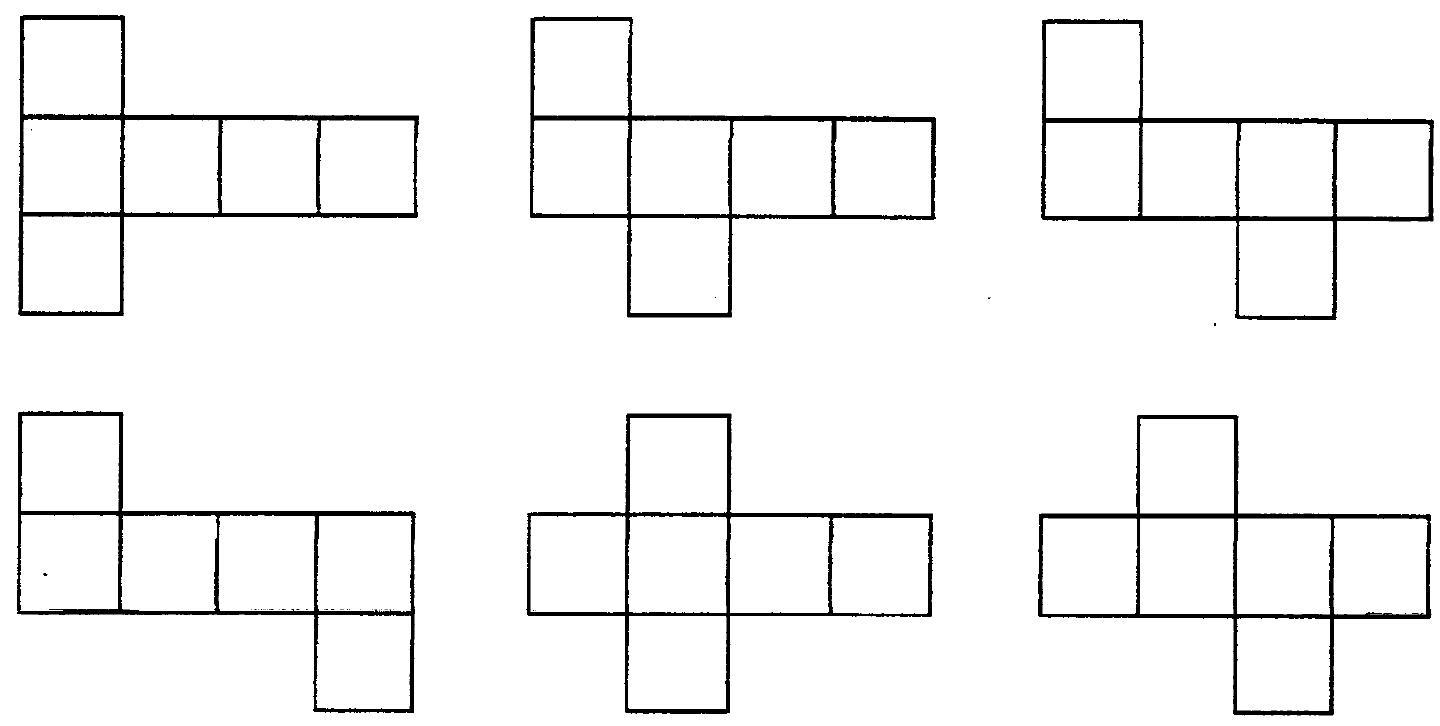
Translating the question as requested, while maintaining the original formatting and structure. | 1. 4 flaps are arranged in a row (1 edge is common) for example, flaps 1, 2, 3, 4 and flaps 5, 6 are placed on two sides of them. The possible nets are:
There are no more. Flaps 5 and 6 cann... | 11 | Geometry | math-word-problem | Yes | Yes | olympiads | false |
What is the remainder when 74 to the 600th power is divided by 9? | $$
74^{600}=(72+2)^{600}=72^{600}+\binom{600}{1} 72^{599} \cdot 2+\ldots+\binom{600}{599} 72 \cdot 2^{599}+2^{600}
$$
Except for the last term, every term is divisible by 9.
But the last term
$$
2^{600}=\left(2^{6}\right)^{100}=(63+1)^{100}
$$
Again, by the binomial theorem, it is obvious that only the last term \(... | 1 | Number Theory | math-word-problem | Yes | Yes | olympiads | false |
Let's calculate the sum of the following series:
$$
\frac{1}{1}+\frac{2}{2}+\frac{3}{4}+\frac{4}{8}+\frac{5}{16}+\ldots+\frac{n}{2^{n-1}}
$$
What does the sum approach as the number of terms grows beyond any bound? | Bring the terms to a common denominator:
$$
\frac{1 \cdot 2^{n-1}+2 \cdot 2^{n-2}+3 \cdot 2^{n-3}+\ldots+(n-1) 2+n}{2^{n-1}}
$$
For now, let's focus on the numerator. We break down the individual terms as follows: $2 \cdot 2^{n-2}=2^{n-2}+2^{n-2}, 3 \cdot 2^{n-3}=$ $2^{n-3}+2^{n-3}+2^{n-3}$, etc., and rearrange the e... | 4 | Algebra | math-word-problem | Yes | Yes | olympiads | false |
Ha az $A B C$ háromszög síkjában fekvő tetszőleges $P$ pontból a háromszög oldalaival párhuzamosokat rajzolunk, melyek az oldalakat az $A_{1}, A_{2}, B_{1}, B_{2}, C_{1}$ és $C_{2}$ pontokban metszik, akkor
$$
\frac{A_{1} A_{2}}{B C}+\frac{B_{1} B_{2}}{A C}+\frac{C_{1} C_{2}}{A B}=2
$$
If from any point $P$ in the pl... | Let $A P, B P$ and $C P$ intersect the sides $B C, A C$, and $A B$ at $A^{\prime}, B^{\prime}$, and $C^{\prime}$ respectively. Based on the similar triangles formed:
$$
\frac{A_{1} A_{2}}{B C}=\frac{P A}{A A^{\prime}}, \quad \frac{B_{1} B_{2}}{A C}=\frac{P B}{B B^{\prime}}, \quad \frac{C_{1} C_{2}}{A B}=\frac{P C}{C C... | 2 | Geometry | proof | Yes | Yes | olympiads | false |
There is a sphere $(O, r)$, a line $(g)$, and two distances $(a, b)$. Construct a line $(e)$ that is parallel to the first image plane and intersects $g$ at $X$, the sphere at $Y, Z$ such that $\overline{X Y}=a$ and $\overline{Y Z}=b$. | If a chord $b=\overline{Y Z}$ of a sphere is of length $b$, then this chord is tangent to the sphere centered at $O$ with radius $\varrho=\sqrt{r^{2}-\frac{b^{2}}{4}}$. The points $X$ on this chord for which $\overline{X Y}=a$ are points on a sphere centered at $O$ with radius $R=\sqrt{\varrho^{2}+\left(\frac{b}{2}+a\r... | 8 | Geometry | math-word-problem | Yes | Yes | olympiads | false |
Show that $\sqrt[3]{9+4 \sqrt{5}}+\sqrt[3]{9-4 \sqrt{5}}$ is a (rational) integer! | Let
$$
x=\sqrt[3]{9+4 \sqrt{5}}, \quad y=\sqrt[3]{9-4 \sqrt{5}}
$$
Then
$$
\begin{gathered}
x^{3}+y^{3}=(9+4 \sqrt{5})+(9-4 \sqrt{5})=19 \ldots \\
x y=\sqrt[3]{81-(4 \sqrt{5})^{2}}=\sqrt[3]{81-80}=1 \ldots
\end{gathered}
$$
Now
$$
x^{3}+y^{3}=(x+y)^{3}-3 x y(x+y)=z^{3}-3 z
$$
if we use the substitution $x+y=z$ an... | 3 | Algebra | proof | Yes | Yes | olympiads | false |
Solve the following equation:
$$
\frac{a-x}{a+x}+\frac{b-x}{b+x}=\frac{a+x}{a-x}+\frac{b+x}{b-x} .
$$ | By moving the terms on the right side of our equation to the left side, we obtain:
$$
\left(\frac{a-x}{a+x}-\frac{a+x}{a-x}\right)+\left(\frac{b-x}{b+x}-\frac{b+x}{b-x}\right)=0
$$
or
$$
\frac{(a-x)^{2}-(a+x)^{2}}{a^{2}-x^{2}}+\frac{(b-x)^{2}-(b+x)^{2}}{b^{2}-x^{2}}=0
$$
After performing the indicated operations in... | 0 | Algebra | math-word-problem | Yes | Yes | olympiads | false |
A rectangle has one of its diagonals $26 \mathrm{~cm}$. If we rotate the rectangle around one of its sides, a cylinder is formed. A plane perpendicular to the side of this cylinder is inscribed, and its total surface area is $2720 \mathrm{~cm}^{2}$. What is the height of the cylinder and the radius of its base? | Let the height of the cylinder be $m, \mathrm{~s}$ and the radius of its base be $r$. The surface area of the lateral surface
$$
8 r^{2}+8 r m=2720
$$
or
$$
r^{2}+r m=341
$$
and
$$
r^{2}+m^{2}=26^{2}=676
$$
If we solve for $m$ from (1) and substitute it into (2), we get the following equation:
$$
r^{4}-678 r^{2}... | 10 | Geometry | math-word-problem | Yes | Yes | olympiads | false |
In the plane, let there be a parabola. Let its vertex be $O$ and an arbitrary point on it be $M$. We draw a perpendicular to the line $OM$ at point $O$, and draw a line parallel to the axis of the parabola through point $M$. Determine the geometric locus of the intersection point of the two lines as $M$ runs along the ... | I. Solution: Consider the parabola with its directrix $i$ and focus $F$, and let the projection of $F$ onto $i$ be $F'$. Then the vertex $O$ of the parabola is the midpoint of the segment $F F'$, and the axis $t$ is the line $F F'$.
 \cdot\left(\frac{1}{\sqrt{2}}+\frac{1}{\sqrt{2}+\sqrt{4}}+\ldots+\frac{1}{\sqrt{n^{2}-2}+\sqrt{n^{2}}}\right)=45
$$ | From the second factor, it can be seen that $n$ can only be an even number. We simplify each factor in the product on the left side of the equation by rationalizing the denominators in the individual terms. The common denominator in the first factor is 1, and in the second factor, it is 2. We perform the simplification... | 10 | Algebra | math-word-problem | Yes | Yes | olympiads | false |
The $ABCD$ square-shaped field, measuring 19.36 hectares, has a point $E$ on the $AD$ side, 110 meters from $D$, to which a straight path leads from $B$. Antal and Béla are having a race. Antal starts from point $A$, and Béla from point $B$, both starting at the same time and running at a constant speed towards the com... | The area of the square is $19.36 \mathrm{ha} = 193600 \mathrm{~m}^{2}$, so its side $AB = \sqrt{193600} = 400 \mathrm{~m}$. Therefore, $AE = AD - DE = 440 - 110 = 330 \mathrm{~m}$, and thus, according to the Pythagorean theorem, $BE = \sqrt{440^{2} + 330^{2}} = \sqrt{4^{2} \cdot 110^{2} + 3^{2} \cdot 110^{2}} = \sqrt{2... | 8 | Geometry | math-word-problem | Yes | Yes | olympiads | false |
Let's find all prime numbers $p$ for which $p^{2}+2$ is also a prime number. | $p^{2}+2=(p-1) \cdot(p+1)+3$. This is divisible by 3 if $p$ is not 3, because then, since $p$ is a prime number, it cannot be divisible by 3, so either the number before it or the number after it, which is the first term, is always divisible by 3. A prime number can only be so if it equals 3, that is, if $p=1$. However... | 3 | Number Theory | math-word-problem | Yes | Yes | olympiads | false |
Show that if in every vertex of a convex polyhedron, 3 edges meet, and every face is a pentagon or a hexagon, then the number of pentagonal faces is $122^{1}$[^0]
[^0]: ${ }^{1}$ We can use Euler's theorem for convex polyhedra; according to this, if the number of faces, edges, and vertices of the polyhedron are $l... | Let the number of pentagonal faces of the polyhedron be $x$, and the number of hexagonal faces be $y$. There are no other types of faces, so the number of faces is: $l=x+y$. Imagine that we construct a model of the polyhedron from its individual faces. Originally, the pentagonal faces have a total of $5x$ sides, and th... | 12 | Geometry | proof | Yes | Yes | olympiads | false |
Let's perform the following operations:
$$
(a+b-c-d)^{2}-(c+d-a-b)^{2}
$$ | $$
(a+b-c-d)^{2}-(c+d-a-b)^{2}=(a+b-c-d)^{2}-(a+b-c-d)^{2}=0
$$
Number of solutions: 20. | 0 | Algebra | math-word-problem | Yes | Yes | olympiads | false |
Let's determine the sign of the following numbers:
$$
\sqrt{2}+\sqrt{2-\sqrt{3}}-\sqrt{2+\sqrt{3}}, \quad \sqrt{6}-\sqrt{2-\sqrt{3}}-\sqrt{2+\sqrt{3}}
$$ | In both expressions, the 2nd and 3rd terms under the square root are so-called "related" expressions, whose product is rational, precisely equal to 1. Therefore, it is expected that if we write our expressions in the form
$$
\sqrt{2}-(\sqrt{2+\sqrt{3}}-\sqrt{2-\sqrt{3}}), \quad \sqrt{6}-(\sqrt{2+\sqrt{3}}+\sqrt{2-\sqr... | 0 | Algebra | math-word-problem | Yes | Yes | olympiads | false |
For how many elements is it true that the number of repetitive 3-class variations is 225 greater than the number of variations without repetition? | Let the number of sought elements be denoted by $n$. According to the problem,
$$
V_{n}^{i, 3} n=V_{n}^{3}+225
$$
Since $V_{n}^{i, 3}=n^{3}$ and $V_{n}^{3}=n(n-1)(n-2)$, we have
$$
n^{3}=n(n-1)(n-2)+225
$$
which means
$$
n^{3}=n^{3}-3 n^{2}+2 n+225
$$
or
$$
3 n^{2}-2 n-225=0
$$
from which
$$
n_{1}=9 \quad\left... | 9 | Combinatorics | math-word-problem | Yes | Yes | olympiads | false |
A ship sails from Catania (north latitude $b=37^{\circ} 30^{\prime}$, longitude from Paris $l=12^{\circ} 40^{\prime}$) to Alexandria by the shortest route (north latitude $b_{1}=31^{\circ} 30^{\prime}$, longitude $l_{1}=33^{\circ} 8^{\prime}$); how long did it take to complete this journey if the ship traveled at a spe... | The essence of the task essentially matches problem 991, except that instead of the 15-hour difference, we need to use the difference in longitudes, \( l_{1} - l = 20^{\circ} 28' \). The distance traveled by the ship is \( 1987.5 \, \text{km} \), and the sought time is 4 days 11 hours 25 minutes.
(Losonczy István, Fiu... | 4 | Other | math-word-problem | Yes | Yes | olympiads | false |
How many sides does a polygon have if it has 33 more diagonals than sides? | The number of diagonals of an $n$-sided polygon is $\frac{n(n-3)}{2}$, so according to the problem,
$$
\frac{n(n-3)}{2}=n+33
$$
or
$$
n^{2}-5 n-66=0
$$
from which the positive value of $n$ is 11. | 11 | Geometry | math-word-problem | Yes | Yes | olympiads | false |
Simplify the following expression as much as possible:
$$
\left(\frac{\sqrt{1+a}}{\sqrt{1+a}-\sqrt{1-a}}+\frac{1-a}{\sqrt{1-a^{2}}-1+a}\right)\left(\sqrt{\frac{1}{a^{2}}-1}-\frac{1}{a}\right)
$$
where $0<a<1$. | Let's denote the two terms of the first factor by $A$ and $B$, and the second factor by $C$. Then, by rationalizing the denominators, we have
$$
\begin{aligned}
& A=\frac{\sqrt{1+a}(\sqrt{1+a}+\sqrt{1-a})}{(1+a)-(1-a)}=\frac{1+a+\sqrt{1-a^{2}}}{2 a} \\
& B=\frac{(1-a)\left[\sqrt{1-a^{2}}+(1-a)\right]}{1-a^{2}-(1-a)^{2... | -1 | Algebra | math-word-problem | Yes | Yes | olympiads | false |
$$
(\sqrt{2}-1) \cdot \sqrt[4]{17+12 \sqrt{2}}=?
$$
| $$
\begin{aligned}
& (\sqrt{2}-1) \cdot \sqrt[4]{17+12 \sqrt{2}}=\sqrt[4]{(\sqrt{2}-1)^{4}(17+12 \sqrt{2})}= \\
= & \sqrt[4]{(17-12 \sqrt{2})(17+12 \sqrt{2})}=\sqrt[4]{17^{2}-2 \cdot 12^{2}}=\sqrt[4]{1}=1
\end{aligned}
$$
Megoldások száma: 15.
| 1 | Algebra | math-word-problem | Yes | Yes | olympiads | false |
Let's write down the consecutive terms of the sequence of natural numbers next to each other. Determine the 10000th digit of this number sequence. | The number of digits in the first 1000 numbers is $9 \cdot 1 + 90 \cdot 2 + 900 \cdot 3 + 4 = 2893$. Therefore, we still need to write $10000 - 2893 = 7107$ digits. Thus, we can add the numbers from 1001 to 2776, totaling 7104 digits, and the first three digits of the number 2777; hence, the 10000th digit is 7.
(Erdös... | 7 | Number Theory | math-word-problem | Yes | Yes | olympiads | false |
Let's determine the greatest common divisor of all numbers that can be written in the form $(a-b)(c-d)(a-c)(b-d)(a-d)(b-c)$, where $a, b, c, d$ are arbitrary natural numbers. | We denote the product by $N$. The numbers $a, b, c, d$ can be of two types in terms of divisibility by 2: $2k$ or $2k+1$. Among these four numbers, at least two are of the same parity, and then the other two are also of the same type. But the difference between numbers of the same type is even, so in this case, $N$ has... | 12 | Number Theory | math-word-problem | Yes | Yes | olympiads | false |
In space, there are two non-parallel planes: $\mathbf{S}$ and $\mathbf{S}_{2}$, as well as two parallel lines: $a \| b$ and a point $P$. Construct a line $e$ passing through point $P$ that forms equal angles with the given planes and is equidistant from the given lines. (It is sufficient to submit a description of the ... | 1.) The geometric locus of lines in space that form equal angles with the given planes $\mathbf{S}_{1}, \mathbf{S}_{2}$ consists of all lines that are parallel to one of the two angle bisector planes of $\mathbf{S}_{1}$ and $\mathbf{S}_{2}$.
2.) The geometric locus of lines in space that are equidistant from the paral... | 4 | Geometry | math-word-problem | Yes | Yes | olympiads | false |
To be calculated
$$
a^{3}+b^{3}+3\left(a^{3} b+a b^{3}\right)+6\left(a^{3} b^{2}+a^{2} b^{3}\right)
$$
value, if $a+b=1$. | I. solution: Let's denote our expression by $N$. Multiply the sum of the first two terms by $(a+b)=1$:
$$
\begin{aligned}
N & =\left(a^{3}+b^{3}\right)(a+b)+3 a^{3} b+3 a b^{3}+6 a^{2} b^{2}(a+b)= \\
& =a^{4}+a^{3} b+a b^{3}+b^{4}+3 a^{3} b+3 a b^{3}+6 a^{2} b^{2}= \\
& =a^{4}+4 a^{3} b+6 a^{2} b^{2}+4 a b^{3}+b^{4}=(... | 1 | Algebra | math-word-problem | Yes | Yes | olympiads | false |
$$
\sin \left(45^{\circ}-\alpha\right)-\cos \left(30^{\circ}+\alpha\right)+\sin ^{2} 30^{\circ}-\cos \left(45^{\circ}+\alpha\right)+\sin \left(60^{\circ}-\alpha\right)+\sin ^{2} 60^{\circ}=?
$$
| $$
\begin{aligned}
& \cos \left(45^{\circ}+\alpha\right)=\sin \left[90^{\circ}-\left(45^{\circ}+\alpha\right)\right]=\sin \left(45^{\circ}-\alpha\right) \\
& \cos \left(30^{\circ}+\alpha\right)=\sin \left[90^{\circ}-\left(30^{\circ}+\alpha\right)\right]=\sin \left(60^{\circ}-\alpha\right)
\end{aligned}
$$
tehát
$$
\b... | 1 | Algebra | math-word-problem | Yes | Yes | olympiads | false |
Is the number $6^{1962}+1$ divisible by 31? | I. solution. $1962=6 \cdot 327$, therefore the given numerical expression can be written as:
$$
(6)^{327}-1^{327}+2
$$
The first two terms are divisible by the difference of the bases, which can be transformed as follows:
$$
6^{6}-1=\left(6^{3}\right)^{2}-1=\left(6^{3}-1\right)\left(6^{3}+1\right)=215 \cdot 217=215 ... | 2 | Number Theory | math-word-problem | Yes | Yes | olympiads | false |
Let's determine the base of the number system in which 12551 can be written as 30407. | If $x$ is the sought base, then
$$
\begin{gathered}
3 x^{4}+0 \cdot x^{3}+4 x^{2}+0 \cdot x+7=12551 \\
3 x^{4}-4 x^{2}-12544=0
\end{gathered}
$$
from which
$$
x^{2}= \pm 64
$$
so the real and positive value of $x$ is: 8.
(Ede Grün, Pécs.)
The problem was also solved by: Baján A., Bauer E., Breuer P., Czigler I., ... | 8 | Number Theory | math-word-problem | Yes | Yes | olympiads | false |
$\frac{\sin \alpha \sin (\alpha+\beta)+\cos \alpha \cos (\alpha+\beta)}{\cos \beta}=?$ | $$
\begin{gathered}
\frac{\sin \alpha \sin (\alpha+\beta)+\cos \alpha \cos (\alpha+\beta)}{\cos \beta}= \\
\frac{\sin ^{2} \alpha \cos \beta+\sin \alpha \cos \alpha \sin \beta+\cos ^{2} \alpha \cos \beta-\cos \alpha \sin \alpha \sin \beta}{\cos \beta}= \\
=\frac{\sin ^{2} \alpha \cos \beta+\cos ^{2} \alpha \cos \beta}{... | 1 | Algebra | math-word-problem | Yes | Yes | olympiads | false |
The points $A_{1}, A_{2}, A_{3}, A_{4}, A_{5}$ divide the circumference of a unit circle into five equal parts; prove that the equality
$$
{\overline{A_{1} A_{2}}}^{2}+{\overline{A_{1} A_{3}}}^{2}=5
$$
holds between the chords $A_{1} A_{2}$ and $A_{1} A_{3}$.
![](https://cdn.mathpix.com/cropped/2024_05_02_f76e8183bb... | I. solution. $A_{1} A_{2} A_{3} A_{4}$ is a cyclic quadrilateral, so by Ptolemy's theorem:
$$
A_{1} A_{2} \cdot A_{3} A_{4} + A_{1} A_{4} \cdot A_{2} A_{3} = A_{1} A_{3} \cdot A_{2} A_{4}
$$
However,
$$
A_{3} A_{4} = A_{2} A_{3} = A_{1} A_{2}
$$
and
$$
A_{1} A_{4} = A_{2} A_{4} = A_{1} A_{3}
$$
thus
$$
A_{1} A_{... | 5 | Geometry | proof | Yes | Yes | olympiads | false |
Subsets and Splits
No community queries yet
The top public SQL queries from the community will appear here once available.