
problem stringlengths 15 4.7k | solution stringlengths 2 11.9k | answer stringclasses 51
values | problem_type stringclasses 8
values | question_type stringclasses 4
values | problem_is_valid stringclasses 1
value | solution_is_valid stringclasses 1
value | source stringclasses 6
values | synthetic bool 1
class |
|---|---|---|---|---|---|---|---|---|
Let's simplify the expression
$$
\frac{(a-b)^{2}}{(b-c)(c-a)}+\frac{(b-c)^{2}}{(c-a)(a-b)}+\frac{(c-a)^{2}}{(a-b)(b-c)}
$$ | # I. Solution:
$$
\frac{(a-b)^{2}}{(b-c)(c-a)}+\frac{(b-c)^{2}}{(c-a)(a-b)}+\frac{(c-a)^{2}}{(a-b)(b-c)}
$$
brought to a common denominator
$$
\frac{(a-b)^{3}+(b-c)^{3}+(c-a)^{3}}{(a-b)(b-c)(c-a)}
$$
transforming the binomial expression into a polynomial and performing the simplification, the fraction becomes
$$
\... | 3 | Algebra | math-word-problem | Yes | Yes | olympiads | false |
In addition to the simplifying assumptions described in Exercise 547, what are the time intervals that elapse between new moon, first quarter, full moon, last quarter, and the next new moon? (Quarter phases occur when the centers of the Sun, Earth, and Moon form a right-angled triangle, with the right angle at the cent... | At the time of the quarter moons, the directions from the Earth (more precisely: from its center) to the Moon and the Sun form an angle $\gamma$ such that $\cos \gamma = r / R$, where $r$ and $R$ are the radii of the Moon's orbit and the Earth's orbit, respectively. From this, $\cos \gamma = 0.00256$, $\gamma = 89^{\ci... | 7 | Other | math-word-problem | Yes | Yes | olympiads | false |
A tourist group rented a car for 220 koronas. At the moment of departure, one more passenger joined them, so that each passenger had to pay 2 koronas less. How many passengers were there originally? | Let the number of tourists be $x$; then each one gets $220: x$ korona. If one more passenger joins them, then each one gets $220 : (x+1)$ korona, which is 2 less than the previous amount. The equation, whose roots include $x$, is as follows:
$$
\frac{220}{x}=\frac{220}{x+1}+2
$$
After appropriate rearrangement, this ... | 10 | Algebra | math-word-problem | Yes | Yes | olympiads | false |
Around a circle, 12 fields are arranged. Among these, four adjacent fields are occupied by 4 different figures: a red, a yellow, a green, and a blue one in sequence. Each figure can be moved by jumping over four adjacent fields to land on the fifth, provided that this field is not already occupied by another figure.
A... | For now, let's not worry about the rule that a figure cannot move over a square occupied by another figure, in which case 12 (one-way) steps will touch every square once. A similar but simpler case can be achieved if we modify the task so that instead of jumping over four squares, each figure steps to an adjacent squar... | 4 | Combinatorics | math-word-problem | Yes | Yes | olympiads | false |
$\sin ^{2} 30^{\circ}+\operatorname{tg} 30^{\circ} \operatorname{tg} 120^{\circ}+\sin ^{2} 120^{\circ}=?$
| $$
\begin{gathered}
\sin ^{2} 30^{\circ}+\operatorname{tg} 30^{\circ} \operatorname{tg} 120^{\circ}+\sin ^{2} 60^{\circ}=\sin ^{2} 30^{\circ}+\cos ^{2} 30^{\circ}-\operatorname{tg} 30^{\circ} \operatorname{tg} 60^{\circ}= \\
=1-\operatorname{tg} 30^{\circ} \operatorname{ctg} 30^{\circ}=1-1=0 .
\end{gathered}
$$
(Stein... | 0 | Algebra | math-word-problem | Yes | Yes | olympiads | false |
In the plane of triangle $A B C$, we take a point $P$ and connect it with the vertices of the triangle. The lines $P A, P B$, and $P C$ intersect the sides of the triangle at points $A_{1}, B_{1}$, and $C_{1}$. Show that
$$
\frac{P A}{A A_{1}}+\frac{P B}{B B_{1}}+\frac{P C}{C C_{1}}=2
$$ | The triangles $B P C$ and $B A C$ have a common base; therefore, their areas are in the ratio of the corresponding heights. However, the ratio of the heights can be replaced by the ratio of the distances $P A_{1}$ and $A A_{1}$, which is why:
$$
\frac{B P C \triangle}{A B C \triangle}=\frac{A A_{1}-P A}{A A_{1}}=1-\fr... | 2 | Geometry | proof | Yes | Yes | olympiads | false |
Consider a triangle $ABC$ and a point $P$ inside it. Construct a parallelogram inscribed in the triangle such that its diagonals intersect at point $P$. (We only consider this parallelogram to be inscribed if all four of its vertices lie on the perimeter of the triangle, meaning no vertex lies on the extension of any s... | Imagine the task as solved. The result - the parallelogram is centrally symmetric to the intersection point $P$ of the diagonals. Reflect the given $A B C \triangle$ over $P$. The parallelogram remains unchanged, as the reflection maps it onto itself; the sides of the reflected triangle $A^{\prime} B^{\prime} C^{\prime... | 3 | Geometry | math-word-problem | Yes | Yes | olympiads | false |
In a mathematics competition, 30 students participated. Among them,
the 1st problem was solved by 20,
the 2nd problem was solved by 16,
the 3rd problem was solved by 10,
the 1st and 2nd problems were solved by 11,
the 1st and 3rd problems were solved by 7,
the 2nd and 3rd problems were solved by 5,
all three pro... | I. solution: Thirty students participated in the competition. If each solver had solved only one problem, then the number of students who did not solve the problem ($n$) would be obtained by subtracting the sum of the number of solvers of the 1st, 2nd, and 3rd problems from the total number of participants. In our case... | 3 | Combinatorics | math-word-problem | Yes | Yes | olympiads | false |
On a farm - where there are more horses than ducks - the number of cows is one third of the total number of horses and ducks. The sum of the heads and legs of ducks and horses is 100. How many cows are on the farm? | I. Solution: Let the number of horses be $x$, the number of ducks $y$, and the number of cows $z(x>z)$.
According to the problem,
$$
z=\frac{x+y}{3}
$$
and
$$
x+4 x+y+2 y=100
$$
Rearranging equation (2) and using the value of (1), we get
$$
2 x+3(x+y)=2 x+9 z=100
$$
from which
$$
x=\frac{100-9 z}{2}=50-4 z-\fra... | 8 | Algebra | math-word-problem | Yes | Yes | olympiads | false |
Legyen
$$
\begin{aligned}
a+b+c & =0 \\
A+B+C & =0 \\
\frac{a}{A}+\frac{b}{B}+\frac{c}{C} & =0
\end{aligned}
$$
Mennyi az
$$
a A^{2}+b B^{2}+c C^{2}
$$
kifejezés értéke?
| I. megoldás: Jelöljük a keresett kifejezés értékét $X$-szel. Mivel (2) alapján $A=-(B+C), B=-(A+C)$ és $C=-(A+B)$, azért
$$
\begin{gathered}
X=a A^{2}+b B^{2}+c C^{2}=-[a A(B+C)+b B(A+C)+c C(A+B)]= \\
=-a A B-a A C-b B A-b B C-c C A-c C B= \\
=-A B(a+b)-B C(b+c)-C A(c+a)
\end{gathered}
$$
De (1)-ből $a+b=-c, b+c=-a, ... | 0 | Algebra | math-word-problem | Yes | Yes | olympiads | false |
Let's construct the projections of a cylinder, which is tangent to two given planes and the first trace (circle) of the projection axis. (How many solutions are possible?) | 1. Solution. Let's construct the base circle of the cylinder, that is, draw a tangent circle between the axis and the two first traces. Once the base circle of the cylinder is established, we need to find the direction of its generators. However, the generators are parallel to lines that are parallel to both planes.
!... | 4 | Geometry | math-word-problem | Yes | Yes | olympiads | false |
By performing the square root operation, determine the value of $x$ for which $x^{4}+6 x^{3}+11 x^{2}+3 x+31$ becomes a perfect square. | | $\sqrt{\left(x^{4}+6 x^{3}+11 x^{2}\right.}$ $-x^{4}$ | $+3 x+31)$ | $=x^{2}+3 x+1$ |
| :---: | :---: | :---: |
| $6 x^{3}+11 x^{2}$ $-6 x^{3} \pm 9 x^{2}$ | | $:\left(2 x^{2}+3 x\right) 3 x$ |
| | $2 x^{2}+3 x+31$ $-2 x^{2} \pm 6 x \pm 1$ | $:\left(2 x^{2}+6 x+1\right) \cdot 1$ |
The expression under the squar... | 10 | Algebra | math-word-problem | Yes | Yes | olympiads | false |
Let's prove that
$$
f_{c}=\sqrt{a b-c_{1} c_{2}}
$$
where $f_{c}$ is the length of the internal angle bisector from vertex $C$ of $\triangle ABC$, $a$ and $b$ are the sides of the triangle extending from vertex $C$, and $c_{1}$ and $c_{2}$ are the segments on side $c$ created by $f_{c}$. Based on this, calculate the ... | Below, $f_{c}$ is abbreviated as $f$.
I. Solution: The notation is shown in Figure 1.

Figure 1
By the Law of Cosines for $\triangle ACD$ and $\triangle BCD$:
$$
c_{1}^{2}=a^{2}+f^{2}-2 a f... | 6 | Geometry | proof | Yes | Yes | olympiads | false |
Let $A_{1}, A_{2}, A_{3}, A_{4}, A_{5}$ be points that divide the circumference of a unit circle into five equal parts; prove that the following equality holds between the chords $A_{1} A_{2}$ and $A_{1} A_{3}$:
$$
\left(A_{1} A_{2} \cdot A_{1} A_{3}\right)^{2}=5
$$ | Given that $\angle A_{2} O A_{1} = 72^{\circ}$ and $\angle D O A_{1} = 36^{\circ}$, therefore
\[
\begin{gathered}
\left(A_{1} A_{2} \cdot A_{1} A_{3}\right)^{2}=\left(2 \sin 36^{\circ} \cdot 2 \sin 72^{\circ}\right)^{2}= \\
=\left(4 \sqrt{\frac{1-\cos 72^{\circ}}{2}} \cdot \sqrt{1-\cos 72^{\circ}}\right)^{2}=8\left(1-... | 5 | Geometry | proof | Yes | Yes | olympiads | false |
Solve the following equation:
$$
2^{x+3}+4^{x+1}=320 .
$$ | Our equation can also be written as:
$$
8 \cdot 2^{x} + 4 \cdot 2^{2 x} = 320
$$
from which
$$
2^{x} = -1 \pm 9
$$
and thus the usable value of $x$ is 3.
(István Hegedűs, Hódmezővásárhely.)
Number of solutions: 52. | 3 | Algebra | math-word-problem | Yes | Yes | olympiads | false |
Let's determine $m$ such that
$$
2 x^{4}+4 a x^{3}-5 a^{2} x^{2}-3 a^{3} x+m a^{4}
$$
is divisible by $(x-a)$. | If we divide the given expression by $(x-a)$, then we obtain:
$$
\begin{gathered}
2 x^{4}+4 a x^{3}-5 a^{2} x^{2}-3 a^{3} x+m a^{4}= \\
=\left(2 x^{3}+6 a x^{2}+a^{2} x-2 a^{3}\right)(x-a)+m a^{4}-2 a^{4}
\end{gathered}
$$
thus, our expression is divisible by $(x-a)$ if
$$
m a^{4}-2 a^{4}=0, \quad \text { that is, i... | 2 | Algebra | math-word-problem | Yes | Yes | olympiads | false |
From a certain community $C$, a car departs at 7:58 AM at a speed of $60 \mathrm{~km} /$ hour heading east on a straight national road towards community $B$. At 8:00 AM, a cyclist departs from the same place heading north on a national road at a speed of 18 $\mathrm{km} /$ hour towards community $A$, which is 10 $\math... | Let the sought time be $8+x$ hours and let the car be at point $A_{1}$, the cyclist at point $B_{1}$, and the pedestrian at point $C_{1}$ (see Figure 1).

According to the problem, in kilomete... | 8 | Algebra | math-word-problem | Yes | Yes | olympiads | false |
$A$ and $B$ are gambling with 2 dice. If the roll results in an odd number of points, $A$ receives from $B$ an amount of forints equal to the number of points. If the roll results in an even number of points, however, $B$ receives from $A$ an amount of forints equal to the number of points, except if the roll is 2, in ... | With two dice, the number of all possible throws is $6 \cdot 6=36$ (or $V_{6}^{i, 2}$). Out of these 36 throws, 2 (and 12) can occur in 1 way, 3 (and 11) in 2 ways, 4 (and 10) in 3 ways, 5 (and 9) in 4 ways, 6 (and 8) in 5 ways, and finally 7 in 6 ways.
Thus, the expected value of $A$'s winnings after one throw is
$$... | 2 | Combinatorics | math-word-problem | Yes | Yes | olympiads | false |
$$
\left(\frac{1+x}{1-x}-\frac{1-x}{1+x}\right)\left(\frac{3}{4 x}+\frac{x}{4}-x\right)=?
$$
| $$
\begin{gathered}
\left(\frac{1+x}{1-x}-\frac{1-x}{1+x}\right)\left(\frac{3}{4 x}+\frac{x}{4}-x\right)=\frac{4 x}{1-x^{2}}\left(\frac{3}{4 x}-\frac{3 x}{4}\right)= \\
=3 \frac{x}{1-x^{2}}\left(\frac{1}{x}-x\right)=3 \frac{x}{1-x^{2}} \cdot \frac{1-x^{2}}{x}=3
\end{gathered}
$$
Megoldások száma: 21.
| 3 | Algebra | math-word-problem | Yes | Yes | olympiads | false |
What is the remainder when $5342^{82}$ is divided by 11? | I. solution: In problem 473 (see p. 81), we made an observation that if $b=c k+d$, then $b^{n}=c K+d^{n}$, where $b, c, k, d, K$ are integers and $n$ is a positive integer. This can also be stated as the remainder of the division $b^{n}: c$ being the same as the remainder of the division $d^{n}: c$, where $d=b-c k$. Ap... | 5 | Number Theory | math-word-problem | Yes | Yes | olympiads | false |
Through every point $M$ of the plane, two hyperbolas can be drawn, whose equations, referred to the rectangular coordinate axes $O x, O y$, are
$$
a^{2} x y+a y+x=0
$$
where $a$ is a variable parameter; on which curve $(C)$ must the point $M$ lie so that the hyperbolas intersect at right angles at this point?
How ma... | To express the condition that the curve $(a)$ passes through the point $M(\alpha, \beta)$, we obtain the following equation:
$$
a^{2} \alpha \beta + a \beta + \alpha = 0
$$
which provides two values of $a$, denoted as $a'$ and $a''$. To express the condition that the tangents to the hyperbolas at point $M$ are perpen... | 1 | Algebra | math-word-problem | Yes | Yes | olympiads | false |
If we double the number of sides in a polygon, then the difference between the diagonals and sides increases by 99. How many sides does the polygon have? | The number of diagonals in an $n$-sided polygon is $\frac{n(n-3)}{2}$, and thus for a $2n$-sided polygon, it is $n(2n-3)$. According to the problem,
$$
\frac{n(n-3)}{2}-n+99=n(2n-3)-2n
$$
which simplifies to
$$
n^{2}-5n+198=4n^{2}-10n
$$
Rearranging gives
$$
3n^{2}-5n-198=0
$$
from which
$$
n_{1}=9, \quad\left[n... | 9 | Geometry | math-word-problem | Yes | Yes | olympiads | false |
A father left an inheritance of 84,000 korona for his minor children, to be divided equally among them, with the condition that if any of them died before reaching adulthood, their share would be equally divided among the surviving children. Before reaching adulthood, two of the children died, and thus the survivors re... | $$
\frac{84000}{x}+3500=\frac{84000}{x-2},
$$
which has the positive root: $x=8$.
Number of solutions: 36. | 8 | Algebra | math-word-problem | Yes | Yes | olympiads | false |
Let's construct a rectangle that passes through four given points and has one of its sides given.
Construct a rectangle, whose sides pass through four given points and one of its sides is given. | Let the given points be $A, B, C$, and $D$. Connect $B$ and $D$, draw a semicircle over $BD$, and cut off a distance $a$ from $D$ along the circle, which intersects the circle at $F$. Connect $F$ and $B$, draw perpendiculars from $A$ and $C$ to $FB$, and draw a line parallel to $BF$ from $D$. This way, we obtain the de... | 12 | Geometry | math-word-problem | Yes | Yes | olympiads | false |
Solve the following equation:
$$
\log \sqrt{7 x+3}+\log \sqrt{4 x+5}=\frac{1}{2}+\log 3
$$ | Our equation can also be written as:
$$
\log \sqrt{7 x+3} \cdot \sqrt{4 x+5}=\log 3 \sqrt{10}
$$
or
$$
28 x^{2}+47 x-75=0
$$
which has the positive root $x=1$.
(Neidenbach Emil, Arad.)
Number of solutions: 18. | 1 | Algebra | math-word-problem | Yes | Yes | olympiads | false |
Several siblings are dividing the inheritance. According to the will, $A$ receives 2000 crowns and one-tenth of the remainder; $B$ receives 4000 crowns and one-tenth of the remainder; $C$ receives 6000 crowns and one-tenth of the remainder, and so on. After the division, it turned out that each sibling received an equa... | If the entire inheritance is $x$, then $A$'s share is $2000+\frac{x-2000}{10}=1800+\frac{x}{10}$; $B$'s share is $4000+\frac{1}{10}\left[x-1800-\frac{x}{10}-4000\right]=$ $3420-\frac{9 x}{100}$.
Thus,
$$
1800+\frac{x}{10}=3420+\frac{9 x}{100}
$$
from which
$$
x=162000
$$
The number of siblings is 9, and each one's... | 9 | Algebra | math-word-problem | Yes | Yes | olympiads | false |
Given two non-intersecting circles. Construct a right-angled triangle, whose hypotenuse is the common external tangent of the two circles, the legs touch one of the given circles each, and one of the common internal tangents of the two circles passes through the right-angle vertex. | We ignore those trivial solutions where one of the legs is itself a common internal tangent (i.e., this leg touches both circles). The problem clearly does not refer to these cases, because in such a case, it would be superfluous to separately require that "one of the common internal tangents passes through the right a... | 8 | Geometry | math-word-problem | Yes | Yes | olympiads | false |
Solve the following equation:
$$
4 x(10 x-\{-10-[3 x-8(x+1)]\})+5\{12-[4(x+1)-3 x]\}=18 x^{2}-\left\{6 x^{2}-\left[7 x+4\left(2 x^{2}-x+11\right)\right]\right\}
$$ | The right side can be written as (brackets expanded from the inside out):
$$
\begin{gathered}
4 x(10 x-\{-10+5 x+8\})+5\{12-x-4\}= \\
=4 x(5 x+2)+5(8-x)=20 x^{2}+3 x+40
\end{gathered}
$$
The left side (brackets expanded from the outside in):
$$
18 x^{2}-6 x^{2}+7 x+8 x^{2}-4 x+44=20 x^{2}+3 x+44
$$
Thus,
$$
20 x^{... | 4 | Algebra | math-word-problem | Yes | Yes | olympiads | false |
Show that $\sqrt[3]{\sqrt{52}+5}-\sqrt[3]{\sqrt{52}-5}$ is an integer. | # I. Solution:
$$
\begin{aligned}
& \sqrt[3]{\sqrt{52}+5}-\sqrt[3]{\sqrt{52}-5}=\sqrt[3]{2 \sqrt{13}+5}-\sqrt[3]{2 \sqrt{13}-5}= \\
& =\sqrt[3]{\frac{16 \sqrt{13}+40}{8}}-\sqrt[3]{\frac{16 \sqrt{13}-40}{8}}=\sqrt[3]{\frac{1+3 \sqrt{13}+39+13 \sqrt{13}}{8}}- \\
& -\sqrt[3]{\frac{-1+3 \sqrt{13}-39+13 \sqrt{13}}{8}}=\sq... | 1 | Algebra | proof | Yes | Yes | olympiads | false |
Let's construct a quadrilateral if the lengths of the two diagonals, the lengths of two opposite sides, and the distance between the midpoints of the other two sides are given. | Imagine the problem is solved, let the sought quadrilateral be $A B C D$, where $A C$ and $B D$ are diagonals, the lengths of sides $A B$ and $C D$ are respectively equal to the given segments $e, f, a$, and $c$, and the distance between the midpoints $E$ and $F$ of sides $B C$ and $D A$ is equal to the given segment $... | 2 | Geometry | math-word-problem | Yes | Yes | olympiads | false |
In a certain number system, the square of 34 in the same system is 1552. What is the base number of this system? | If the base number of the number system is $x$, then according to our data,
$$
(3 x+4)^{2}=x^{3}+5 x^{2}+5 x+2
$$
After performing the indicated operation and simplifying:
$$
x^{3}-4 x^{2}-19 x=x\left(x^{2}-4 x-19\right)=14
$$
Thus, $x$ is a divisor of 14, but this divisor must be greater than 5, because the base n... | 7 | Number Theory | math-word-problem | Yes | Yes | olympiads | false |
How many decimal places of accuracy does the following approximate equality hold?
$$
495 \sqrt{2}-388 \sqrt{3} \approx 28
$$
that is, how many zeros can we write after 28 following the decimal point, so that the resulting number is still the rounded value of the correct left-hand side? | I. Solution. We can answer the question by calculating the two terms on the left side in parallel to more and more decimal places until we get different decimal digits. The individual terms arise from square roots and multiplications. We can only give the result of the square root in decimal form approximately, and mul... | 7 | Algebra | math-word-problem | Yes | Yes | olympiads | false |
Show that
$\operatorname{tg} 15^{\circ}+\operatorname{cotg} 15^{\circ}=4$. | I. solution: It is known that $\operatorname{tg} \alpha=\sqrt{\frac{1-\cos 2 \alpha}{1+\cos 2 \alpha}}$, so,
$$
\operatorname{tg} 15^{\circ}=\sqrt{\frac{1-\cos 30^{\circ}}{1+\cos 30^{\circ}}}=\frac{\sqrt{1-\frac{\sqrt{3}}{2}}}{\sqrt{1+\frac{\sqrt{3}}{2}}}=\frac{1-\frac{\sqrt{3}}{2}}{\sqrt{1-\frac{3}{4}}}=\frac{1-\frac... | 4 | Algebra | proof | Yes | Yes | olympiads | false |
How much time is needed to write down the numbers ranging from 1 to 117639, if we write down 93 digits per minute? | Determine the number of digits to be written:
| $1-$ | 9 - | the number of digits | $9 \cdot 1$ | $=$ | 9 | |
| ---: | ---: | ---: | :--- | ---: | :--- | ---: |
| $10-$ | 99 - | the number of digits | $90 \cdot 2$ | $=$ | 180 | |
| $100-$ | 999 - | the number of digits | $900 \cdot 3$ | $=$ | 2700 | |
| $1000-$ | 9... | 4 | Number Theory | math-word-problem | Yes | Yes | olympiads | false |
Let's determine the value of $c$ such that the ratio of the roots of the equation
$$
5 x^{2}-2 x+c=0
$$
is $-\frac{3}{5}$. | The relationships between the roots and coefficients of a quadratic equation are as follows:
$$
\begin{gathered}
x_{1}+x_{2}=\frac{2}{5} \ldots \\
x_{1} x_{2}=\frac{c}{5} \ldots
\end{gathered}
$$
The requirement of the problem is:
$$
\frac{x_{1}}{x_{2}}=-\frac{3}{5} \cdots
$$
$x_{1}$ and $x_{2}$ can be calculated f... | -3 | Algebra | math-word-problem | Yes | Yes | olympiads | false |
Simplify the following expressions to their simplest form:
a) $\left\{3 x^{2}\left(a^{2}+b^{2}\right)-3 a^{2} b^{2}+3\left[x^{2}+(a+b) x+a b\right] \cdot[x(x-a)-b(x-a)]\right\}: x^{2}$
$$
\text { b) } \frac{1}{a-b}-\frac{3 a b}{a^{3}-b^{3}}-\frac{b-a}{a^{2}+a b+b^{2}}
$$
c) $\frac{a}{(a-2 b)(a-c)}+\frac{2 b}{(2 b-c)(... | a) The expression in the square brackets can be written as:
$$
\begin{aligned}
& x^{2}+(a+b) x+a b=(x+a)(x+b) \\
& \quad x(x-a)-b(x-a)=(x-a)(x-b)
\end{aligned}
$$
The triple product of these two expressions is
$$
3\left(x^{2}-a^{2}\right)\left(x^{2}-b^{2}\right)=3 x^{4}+3 a^{2} x^{2}-3 b^{2} x^{2}+3 a^{2} b^{2}
$$
... | 0 | Algebra | math-word-problem | Yes | Yes | olympiads | false |
$$
\frac{a+b}{(b-c)(c-a)}+\frac{b+c}{(c-a)(a-b)}+\frac{c+a}{(a-b)(b-c)}=?
$$ | When we bring the fractions to a common denominator, we then get the following numerator:
$$
(a+b)(a-b)+(b+c)(b-c)+(c+a)(c-a)=a^{2}-b^{2}+b^{2}-c^{2}+c^{2}-a^{2}=0
$$
thus, the value of the questioned sum is 0.
Number of solutions: 26. | 0 | Algebra | math-word-problem | Yes | Yes | olympiads | false |
Prove that
$$
\operatorname{tg} 9^{\circ}-\operatorname{tg} 27^{\circ}-\operatorname{tg} 63^{\circ}+\operatorname{tg} 81^{\circ}=4
$$ | I. solution: Notice that $9^{\circ}+81^{\circ}=27^{\circ}+63^{\circ}=90^{\circ}$; based on this, expressing the left side of $b$ with the sine and cosine of $9^{\circ}$ and $27^{\circ}$, and then simplifying and applying known identities,
$$
\begin{gathered}
b=\left(\frac{\sin 9^{\circ}}{\cos 9^{\circ}}+\frac{\cos 9^{... | 4 | Algebra | proof | Yes | Yes | olympiads | false |
## T-1
Let $\mathbb{Z}$ denote the set of all integers and $\mathbb{Z}_{>0}$ denote the set of all positive integers.
(a) A function $f: \mathbb{Z} \rightarrow \mathbb{Z}$ is called $\mathbb{Z}$-good if it satisfies $f\left(a^{2}+b\right)=f\left(b^{2}+a\right)$ for all $a, b \in \mathbb{Z}$. Determine the largest pos... |
Solution. The answer is (a) 2 and (b) 1077.
(a) Note that
$$
f\left(a^{2}+b\right)=f\left(b^{2}+a\right)=f\left((-b)^{2}+a\right)=f\left(a^{2}-b\right)
$$
In particular, by setting $a \in\{0,1\}$ we get $f(b)=f(-b)$ and $f(1+b)=f(1-b)$. This then yields
$$
f(2+b)=f(1+(1+b))=f(1-(1+b))=f(-b)=f(b)
$$
hence by induc... | 2 | Number Theory | math-word-problem | Yes | Yes | olympiads | false |
Problem 1. Find the least positive integer number $n(n \geq 3)$ with the following property: for any colouring of $n$ different points $A_{1}, A_{2}, \ldots, A_{n}$ on a line and such that $A_{1} A_{2}=A_{2} A_{3}=\ldots=$ $A_{n-1} A_{n}$ in two colours, there are three points $A_{i}, A_{j}, A_{2 j-i}(1 \leq i<$ $2 j-... |
Solution: Assume the two colours are white and black. Consider 8 points coloured as follows: $A_{1}, A_{2}, A_{5}, A_{6}$ (white), $A_{3}, A_{4}, A_{7}, A_{8}$ (black). Obviously no three points $A_{i}, A_{j}, A_{2 j-i}(1 \leq i<2 j-i \leq n)$ have the same colour and therefore $n \geq 9$.
If we can show that $n=9$ h... | 9 | Combinatorics | math-word-problem | Yes | Yes | olympiads | false |
Problem 3. a) Find the maximal value of the function $y=\left|4 x^{3}-3 x\right|$ in the interval $[-1,1]$. b)Let $a, b$ and $c$ be real numbers and $M$ be the maximal value of the function $y=$ $\left|4 x^{3}+a x^{2}+b x+c\right|$ in the interval $[-1,1]$. Prove that $M \geq 1$. For which $a, b, c$ is the equality re... |
Solution. a) Using that $\left(4 x^{3}-3 x\right)^{\prime}=12 x^{2}-3=$ $12\left(x-\frac{1}{2}\right)\left(x+\frac{1}{2}\right)$, we find that the function
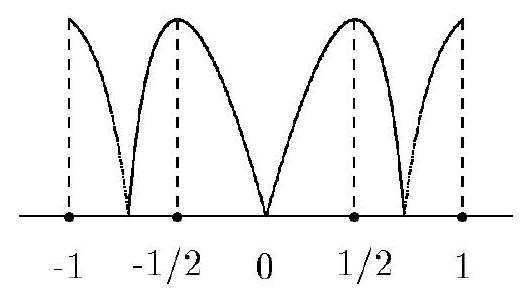
$$
y=\left|4 x^{3}-3 x\right|
$$
... | 1 | Algebra | math-word-problem | Yes | Yes | olympiads | false |
Problem 6. A square table of size $7 \times 7$ with the four corner squares deleted is given.
Figure 4.
a) What is the smallest number of squares which need to be colored black so that a 5 -square entirely uncolored Greek cross (Figure 4) cannot be found
$. Note that a cross is uniquely determined by its central cell. The cross with central cell $(i, j)$ is denoted by $C_{i j}, 2 \leq i, j \leq 6$. The number of all crosses is 25 .
a) The squares $(1, i),(i, 1),(7, i),(i, 7), i=2, \ldots, 6$, are include... | 7 | Combinatorics | math-word-problem | Yes | Yes | olympiads | false |
Problem 1. Let $n$ be a natural number. Find the least natural number $k$ for which there exist $k$ sequences of 0 's and 1's of length $2 n+2$ with the following property: any sequence of 0 's and 1 's of length $2 n+2$ coincides in at least $n+2$ positions with some of these $k$ sequences.
|
Solution: We shall prove that $k=4$. Assume that $k \leq 3$ and let the respective sequences be $a_{1}^{i}, a_{2}^{i}, \ldots, a_{2 n+2}^{i}$ for $i=1, \ldots, k$. Since $k \leq 3$ there is a sequence $b_{1}, b_{2}, \ldots, b_{2 n+2}$ such that $\left(b_{2 l+1}, b_{2 l+2}\right) \neq$ $\left(a_{2 l+1}^{i}, a_{2 l+2}^{... | 4 | Combinatorics | math-word-problem | Yes | Yes | olympiads | false |
Problem 2. Given 10 equal segments in a plane. All intersection points are colored. Each colored point divides each of the given segments it lies on in the ratio $3: 4$. What is the maximum number of colored points? | Solution. We will prove that the maximum number of colored points is 10.
The points that divide a given segment in the ratio $3: 4$ (or $4: 3$) are two; hence, on one segment, there are at most two colored points. On the other hand, each colored point lies on at least two segments. Therefore, the number of colored poi... | 10 | Geometry | math-word-problem | Yes | Yes | olympiads | false |
Problem 3. Given 30 cards, on ten of which the number a is written, on another ten - the number b, and on the remaining ten - the number c (the numbers $a, b$, c are pairwise distinct). It is known that for any five cards, another five can be chosen such that the sum of the numbers written on the ten cards is 0. Prove ... | Solution. Let $a<b<c$. Let's calculate all the sums of numbers written on some five of the given cards. According to the condition of the problem, for each such sum $s$, there exists an opposite sum $-s$. This means that if we mark all the obtained sums on the number line, the resulting set of points will be symmetric ... | 0 | Combinatorics | proof | Yes | Yes | olympiads | false |
Problem 3. On each cell of a $10 \times 10$ board, a pawn is placed. We can choose a diagonal (a diagonal consists of all cells whose centers lie on a straight line that makes an angle of $45^{\circ}$ with the sides of the board), which contains an even number of pawns, and take one arbitrary pawn from it. How many paw... | Solution. We will call a diagonal even (odd) if it contains an even (odd) number of pawns. Initially, the board has 20 odd diagonals. Let's consider how the number of these diagonals changes when a pawn is removed from the board (it lies on at least one even diagonal). If the pawn lies on one even and one odd diagonal,... | 10 | Combinatorics | math-word-problem | Yes | Yes | olympiads | false |
Problem 2. (3 points) A segment of length $\sqrt{2}+\sqrt{3}+\sqrt{5}$ is given. Is it possible to construct a segment of length 1 using only a straightedge and compass? | Solution: We will prove that it is possible to construct a segment of length 1. From a segment of length $a$, we can construct $A B=a(\sqrt{2}+\sqrt{3}+\sqrt{5})$ (by constructing a segment of length $a \sqrt{2}$ as the diagonal of a square with side $a$, then $a \sqrt{3}$ as the diagonal of a rectangle $a \times a \sq... | 1 | Geometry | math-word-problem | Yes | Yes | olympiads | false |
Task 1. Given are 30 cards, on ten of which the number a is written, on another ten - the number b, and on the remaining ten - the number c (the numbers $a, b$, c are pairwise distinct). It is known that for any five cards, another five can be chosen such that the sum of the numbers written on the ten cards is 0. Prove... | Solution. Let $a<b<c$. Let's calculate all the sums of numbers written on some five of the given cards. According to the condition of the problem, for each such sum $s$ there exists an opposite sum $-s$. This means that if we mark all the obtained sums on the number line, the resulting set of points will be symmetric w... | 0 | Combinatorics | proof | Yes | Yes | olympiads | false |
Problem 6. (8 points) In the plane, there is a non-closed, non-self-intersecting broken line consisting of 31 segments (adjacent segments do not lie on the same straight line). For each segment, the line defined by it is constructed. It is possible for some of the 31 constructed lines to coincide. What is the minimum n... | Solution. Evaluation. Besides the ends, the broken line has 30 vertices, each of which is the intersection point of two lines. If the lines are no more than 8, then the intersection points are no more
 Peter has $n^{3}$ unit white cubes, from which he wants to assemble a cube $n \times n \times n$ with a completely white surface. How many of the faces of the unit cubes does Emil need to color to prevent Peter? Solve the problem for:
a) (2 points) $n=2$;
b) (4 points) $n=3$. | Solution. a) It is clearly not enough for Emil to color one wall. However, it is sufficient to color two opposite walls of one small cube: when assembling the $2 \times 2 \times 2$ cube, one of them will always be external.
b) It is sufficient for Emil to color the walls of two small cubes, as when assembling the $3 \... | 12 | Combinatorics | math-word-problem | Yes | Yes | olympiads | false |
Problem 1. (4 points) A billiard table has the shape of a $2 \times 1$ rectangle. Pockets are located at the corners and at the midpoints of the longer sides of the table. Balls are placed on the table such that each pocket lies on a line with at least two balls. What is the minimum number of balls placed? (The pockets... | Solution. We will prove that at least 4 balls are placed. With the notation of the diagram, balls can be placed at the intersection points of $A D \cap C F, A D \cap C E, B D \cap C F$ and $B D \cap C E$.
 On a table, a cardboard circle with a radius of 5 cm is placed. As long as possible, Peter places cardboard squares with a side of 5 cm outside the circle in such a way that the following conditions are met:
1) one vertex of each square lies on the boundary of the circle;
2) the squares do not ov... | Solution. Let the center of the circle be denoted by $O$. If vertex $A$ of the square $ABCD$ lies on the given circle, then points $B, D$, and $O$ lie on a circle with radius 5 cm and center $A$. The inscribed angle $\angle BOD = \frac{1}{2} \angle BAD = 45^{\circ}$. Therefore, each of the placed squares is seen from t... | 8 | Geometry | math-word-problem | Yes | Yes | olympiads | false |
Problem 5. (5 points) In a tournament, 55 boxers participated, and after each match, the winner left the tournament. The matches were held consecutively. It is known that in each match, boxers whose difference in the number of victories (at that moment) was no more than 1, met. How many matches could the winner of the ... | Solution. The winner has played at most 8 matches.
Let $u_{k}$ denote the $k$-th Fibonacci number ( $u_{1}=u_{2}=1, u_{k}=u_{k-1}+u_{k-2}$ for $k \geq 3$ ). We will prove by induction that:
a) if the winner has played at least $n$ matches, then there are at least $u_{n+2}$ participants;
b) there exists a tournament ... | 8 | Combinatorics | math-word-problem | Yes | Yes | olympiads | false |
Task 1. The squares of a $9 \times 9$ board are chess-colored, with the corner squares being white. What is the minimum number of rooks that need to be placed on the board so that they threaten all the white squares? (A rook threatens all the squares in the row and column it is in.) | Solution: An example with 5 towers threatening all white fields is shown in the drawing.

On the other hand, a tower on a white field threatens 7 or 9 white fields, and a tower on a black fiel... | 5 | Combinatorics | math-word-problem | Yes | Yes | olympiads | false |
## Problem 5.
On the board, 101 numbers are written: $1^{2}, 2^{2}, \ldots, 101^{2}$. In one move, it is allowed to erase any two numbers and write down the absolute value of their difference instead. What is the smallest number that can be obtained after 100 moves?
## Answer. 1 | Solution. From four consecutive squares with 3 moves, the number 4 can be obtained:
$$
\begin{aligned}
& (n+1)^{2}-n^{2}=2 n+1 \\
& (n+3)^{2}-(n+2)^{2}=2 n+5 \\
& (2 n+5)-(2 n+1)=4
\end{aligned}
$$
In this way, we can get 24 quadruples from $6^{2}, 7^{2}, \ldots, 101^{2}$. From these, 20 quadruples can be removed by ... | 1 | Number Theory | math-word-problem | Yes | Yes | olympiads | false |
Problem 4. (6 points) From a sheet of squares, a rectangle $10 \times 12$ has been cut out. It has been folded several times along the lines of the square grid until a $1 \times 1$ square is obtained. How many pieces can be obtained if this square is cut along the segment connecting
a) the midpoints of two opposite si... | Solution: a) Let the cutting be vertical, and in all unit squares, let us draw vertical segments connecting the midpoints of opposite sides. When folding along the lines of the square grid, these segments overlap. Therefore, the cutting is done along these and only these segments. As a result, we get either $10+1=11$ o... | 11 | Geometry | math-word-problem | Yes | Yes | olympiads | false |
Problem 6. A square table of size $7 \times 7$ with the four corner squares deleted is given.
Figure 4.
a) What is the smallest number of squares which need to be colored black so that a 5 -square entirely uncolored Greek cross (Figure 4) cannot be found
$. Note that a cross is uniquely determined by its central cell. The cross with central cell $(i, j)$ is denoted by $C_{i j}, 2 \leq i, j \leq 6$. The number of all crosses is 25 .
a) The squares $(1, i),(i, 1),(7, i),(i, 7), i=2, \ldots, 6$, are include... | 7 | Combinatorics | math-word-problem | Yes | Yes | olympiads | false |
Problem 1. Let $n$ be a natural number. Find the least natural number $k$ for which there exist $k$ sequences of 0 's and 1 's of length $2 n+2$ with the following property: any sequence of 0 's and 1 's of length $2 n+2$ coincides in at least $n+2$ positions with some of these $k$ sequences.
|
Solution: We shall prove that $k=4$. Assume that $k \leq 3$ and let the respective sequences be $a_{1}^{i}, a_{2}^{i}, \ldots, a_{2 n+2}^{i}$ for $i=1, \ldots, k$. Since $k \leq 3$ there is a sequence $b_{1}, b_{2}, \ldots, b_{2 n+2}$ such that $\left(b_{2 l+1}, b_{2 l+2}\right) \neq$ $\left(a_{2 l+1}^{i}, a_{2 l+2}^{... | 4 | Combinatorics | math-word-problem | Yes | Yes | olympiads | false |
Problem 11.1 Let $f(x)=\frac{x^{2}+4 x+3}{x^{2}+7 x+14}$.
a) Find the greatest value of $f(x)$;
b) Find the greatest value of the function $\left(\frac{x^{2}-5 x+10}{x^{2}+5 x+20}\right)^{f(x)}$.
|
Solution: a) We shall prove that the greatest value of $f(x)$ equals 2. Since $x^{2}+7 x+14>0, \forall x$, we obtain $f(x) \leq 2 \Longrightarrow(x+5)^{2} \geq 0$, and an equality occurs only when $x=-5$.
b) Let $g(x)=\frac{x^{2}-5 x+10}{x^{2}+5 x+20}$. Since $x^{2}+5 x+20>0, \forall x$, we obtain $g(x) \leq 3 \Longr... | 9 | Algebra | math-word-problem | Yes | Yes | olympiads | false |
Problem 9.3. Let $A_{n}$ be the number of sequences from 0 's and 1 's of length $n$, such that no four consequtive elements equal 0101. Find the parity of $A_{2001}$.
|
Solution: Denote the number of sequences of length $n$, the last three terms of which are $i j k$, where $i, j, k \in\{0,1\}$ and no four consequtive elements equal to 0101 by $a_{i j k}^{n}$.
Obviously $a_{i j k}^{n+1}=a_{0 i j}^{n}+a_{1 i j}^{n}$ when $i j k \neq 101$ and $a_{101}^{n+1}=a_{110}^{n}$. Adding the abo... | 0 | Combinatorics | math-word-problem | Yes | Yes | olympiads | false |
Problem 10a.3. Find all positive integers $x$ and $y$ such that
$$
\frac{x^{3}+y^{3}-x^{2} y^{2}}{(x+y)^{2}}
$$
is a nonnegative integer.
|
Solution: Let $x$ and $y$ be positive integers such that
$$
z=\frac{x^{3}+y^{3}-x^{2} y^{2}}{(x+y)^{2}}
$$
is a nonnegative integer. Substitute $a=x+y$ and $b=x y$ and write the expression in the form $b^{2}+3 a b-a^{2}(a-z)=0$. The discriminant of this quadratic equation $a^{2}(4 a+9-4 z)$ is a perfect square, so $... | 2 | Algebra | math-word-problem | Yes | Yes | olympiads | false |
Problem 11.3. There are 2001 towns in a country every one of which is connected with at least 1600 towns by direct bus line. Find the largest $n$ for which there exist $n$ towns any two of which are connected by direct bus line.
|
Solution: Let $S_{1}$ snd $S_{1}$ be two towns connected by direct bus line. If $k$ is the number of towns connected to both $S_{1}$ and $S_{2}$ by bus line then $(1599-k)+(1599-k)+k \leq 1999$ which implies that $k \geq 1198$. Therefore there exists town $S_{3}$ connected to both $S_{1}$ and $S_{2}$. Further, let $k$... | 5 | Combinatorics | math-word-problem | Yes | Yes | olympiads | false |
Problem 3. Find the least positive integer $n$ such that there exists a group of $n$ people such that:
1. There is no group of four every two of which are friends;
2. For any choice of $k \geq 1$ people among which there are no friends there exists a group of three among the remaining $n-k$ every two of which are fri... |
Solution: Consider a group of 7 people $A_{1}, A_{2}, \ldots, A_{7}$, such that $A_{i}, i=1,2 \ldots, 7$ is not friend only with $A_{i+1}$ and $A_{i-1}$ (we set that $A_{8}=A_{1}$ and $A_{0}=A_{7}$ ). It is easily seen that there are no four every two of which are friends. Also, for any choice of $k \geq 1$ people (in... | 7 | Combinatorics | math-word-problem | Yes | Yes | olympiads | false |
Problem 3. Find the smallest positive integer $n$, for which there exist $n$ different positive integers $a_{1}, a_{2}, \ldots, a_{n}$ satisfying the conditions:
a) the smallest common multiple of $a_{1}, a_{2}, \ldots, a_{n}$ is 1995 ;
b) for each $i, j \in\{1,2, \ldots, n\}$ the numbers $a_{i}$ and $a_{j}$ have a ... |
Solution. Since $1995=3.5 .7 .19$ and $a_{i} / 1995$, then for all $i$
$$
a_{i}=3^{\alpha_{i}} 5^{\beta_{i}} \gamma^{\gamma_{i}} 19^{\delta_{i}}
$$
where the numbers $\alpha_{i}, \beta_{i}, \gamma_{i}, \delta_{i}$ are equal to 0 or 1 . There is no $a_{i}$ which is divisible by 9 . We have $a_{1} a_{2} \ldots a_{n}=k... | 7 | Number Theory | math-word-problem | Yes | Yes | olympiads | false |
Problem 1. Let $a_{n}=\frac{n+1}{2^{n+1}}\left(\frac{2^{1}}{1}+\frac{2^{2}}{2}+\cdots+\frac{2^{n}}{n}\right), n=1,2,3, \ldots$. Prove that
a) $a_{n+1} \leq a_{n}$ for all $n \geq 3$;
b) the sequence $\left\{a_{n}\right\}_{n=1}^{\infty}$ is convergent and find its limit.
|
Solution. a) We have
$$
a_{n+1}=\frac{n+2}{2^{n+2}}\left(\frac{2^{1}}{1}+\frac{2^{2}}{2}+\cdots+\frac{2^{n+1}}{n+1}\right)=\frac{n+2}{2(n+1)}\left(a_{n}+1\right)
$$
From here
$$
a_{n+2}-a_{n+1}=\frac{(n+2)^{2}\left(a_{n+1}-a_{n}\right)-\left(a_{n}+1\right)}{2(n+1)(n+2)}, \quad n=1,2,3 \ldots
$$
Since $a_{n}>0$ for... | 1 | Algebra | proof | Yes | Yes | olympiads | false |
Problem 8'.3. Find all natural numbers $n$ such that there exists an integer number $x$ for which $499\left(1997^{n}+1\right)=x^{2}+x$.
|
Solution: Let $n$ be a solution of the problem. Then $(2 x+1)^{2}=$ $1996 \cdot 1997^{n}+1997$. If $n=1$ we get $(2 x+1)^{2}=1997^{2}$ and so $2 x+1= \pm 1997$. Therefore $x=998$ and $x=-999$ satisfy the conditions of the problem. Let $n \geq 2$. Now $(2 x+1)^{2}$ is divisible by 1997 , which is a prime number, and so... | 1 | Number Theory | math-word-problem | Yes | Yes | olympiads | false |
Problem 8.1. Find all values of the real parameter $m$ such that the equation $\left(x^{2}-2 m x-4\left(m^{2}+1\right)\right)\left(x^{2}-4 x-2 m\left(m^{2}+1\right)\right)=0$ has exactly three distinct roots.
|
Solution: Suppose $m$ satisfies the conditions of the problem and the equations
$$
\begin{aligned}
& x^{2}-2 m x-4\left(m^{2}+1\right)=0 \\
& x^{2}-4 x-2 m\left(m^{2}+1\right)=0
\end{aligned}
$$
share the root $x_{0}$. After subtracting we get $(2 m-4) x_{0}=(2 m-$ 4) $\left(m^{2}+1\right)$ and so $x_{0}=m^{2}+1$ (n... | 3 | Algebra | math-word-problem | Yes | Yes | olympiads | false |
Problem 10.1. Find the least natural number $a$ such that the equation $\cos ^{2} \pi(a-x)-2 \cos \pi(a-x)+\cos \frac{3 \pi x}{2 a} \cdot \cos \left(\frac{\pi x}{2 a}+\frac{\pi}{3}\right)+2=0$ has a root.
|
Solution: The roots of the our equations are the common roots of $\cos \pi(x-a)=1$ and $\cos \frac{3 \pi x}{2 a} \cdot \cos \left(\frac{\pi x}{2 a}+\frac{\pi}{3}\right)+1=0$. The roots of the first one are $x=a+2 n, n=0, \pm 1, \pm 2, \ldots$ and the roots of the second one are $x=2 a\left(k-\frac{1}{3}\right), k=0, \... | 6 | Algebra | math-word-problem | Yes | Yes | olympiads | false |
Problem 8'.1. Find all values of the real parameter $a$ such that the inequalities $|x+1|+|2-x|<a$ and $\frac{5 a-8}{6 x-5 a+5}<-\frac{1}{2}$ are equivalent.
|
Solution: We begin with the first inequality. $|x+1|+|2-x|\frac{1-a}{2}$, i. e., $\frac{1-a}{2}3$. If $x \in[-1 ; 2]$, then $|x+1|+|2-x|=x+1+2-x=3$ and the above equation has a solution only when $a>3$. Finally, if $x>2$, then $x+1+x-23$. Therefore when $a \leq 3$, the inequality has no solution, and when $a>3$, the s... | 4 | Inequalities | math-word-problem | Yes | Yes | olympiads | false |
Problem 10.2. A quadrangle with perpendicular diagonals $A C$ and $B D$ is inscribed in a circle with centre $O$ and radius 1 .
a.) Calculate the sum of the squares of the sides of the quadrangle.
b.) Find the area of $A B C D$ if a circle with centre $I$ is inscribed in it and $O I=\frac{1}{\sqrt{3}}$.
|
Solution: a.) Denote $\angle B A C=\alpha, \angle C A D=\beta$. It follows from the Sine Theorem for $\triangle A B C$ and $\triangle A B D$ that $B C=2 \sin \alpha, A D=$ $2 \sin \angle A B D=2 \sin (90 \mathrm{deg}-\alpha)=2 \cos \alpha$. Analogously $C D=2 \sin \beta$, $A B=2 \cos \beta$. Therefore $A B^{2}+B C^{2}... | 1 | Geometry | math-word-problem | Yes | Yes | olympiads | false |
Problem 3. Let $A$ be a set with 8 elements. Find the maximal number of 3 -element subsets of $A$, such that the intersection of any two of them is not a 2-element set.
|
Solution. Let $B_{1}, B_{2}, \ldots, B_{n}$ be subsets of $A$ such that $\left|B_{i}\right|=3,\left|B_{i} \cap B_{j}\right| \neq 2(i, j=1, \ldots, n)$. Assume that there exists an element $a \in A$, which belongs to four of the subsets $B_{1}, B_{2}, \ldots, B_{n}$ (e.g. $\left.a \in B_{1}, B_{2}, B_{3}, B_{4}\right)$... | 8 | Combinatorics | math-word-problem | Yes | Yes | olympiads | false |
Problem 1. Find all positive roots of the equation
$$
\log _{(x+a-1)} \frac{4}{x+1}=\log _{a} 2
$$
where $a>1$ is a real number.
|
Solution. It is clear that if $a>1$ and $x>0$, then $x+a-1>0$ and $\frac{4}{x+1}>0$. Hence in this case $\log _{(x+a-1)} \frac{4}{x+1}$ is well defined. Since
$$
\log _{(x+a-1)} \frac{4}{x+1}=\frac{\log _{a} \frac{4}{x+1}}{\log _{a}(x+a-1)}
$$
then the given equation is equivalent to
$$
\frac{4}{x+1}=2^{\log _{a}(x... | 1 | Algebra | math-word-problem | Yes | Yes | olympiads | false |
Problem 1. For every real number $x$ we denote by $f(x)$ the maximal value of the function $\sqrt{t^{2}+2 t+2}$ in the interval $[x-2, x]$.
a) Prove that $f(x)$ is an even function and find its minimal value;
b) Prove that the function $f(x)$ is not differentiable for $x=0$.
c) Prove that the sequence $a_{n}=\{f(n)... |
Solution. It is clear that the maximal value of the function $\sqrt{t^{2}+2 t+2}$ in the interval $[x-2, x]$ is reached at the endpoints of this interval. Since the inequality $(x-2)^{2}+2(x-2)+2 \leq$ $x^{2}+2 x+2$ is equivalent to $x \geq 0$, then
$$
f(x)= \begin{cases}\sqrt{x^{2}-2 x+2} & \text { if } \quad x \leq... | 0 | Calculus | proof | Yes | Yes | olympiads | false |
Problem 1. For which integer values of the parameter $a$ the equation $|2 x+1|+|x-2|=a$ has an integer solutions?
|
Solution. We shall consider the following cases:
I. $x>2$. Then $2 x+1>0, x-2>0$ and the equation is equivalent to $2 x+1+x-2=a$. Thus, $x=\frac{1+a}{3}$, which is a solution when $\frac{1+a}{3}>2$, i.e. when $a>5$.
II. $-\frac{1}{2} \leq x \leq 2$. Then $2 x+1 \geq 0, x-2 \leq 0$ and the equation has the form $2 x+1... | 3 | Algebra | math-word-problem | Yes | Yes | olympiads | false |
Problem 3. A square with side length 5 is divided into unit squares by parallel to its sides lines. Let $A$ be the set of the vertexes of the unit squares which are not on the sides of the given square. How many points from $A$ can be chosen at most in a way that no three of them are vertexes of isosceles rectangle tr... |
Solution. We shall prove that the maximal number is 6 . Let us enumerate the points in the way, shown on the table 1 .
It is easy to be seen that no 3 of the points $1,2,3,8,12$ and 16 are vertexes of a isosceles rectangle triangle. Assume that there exists a set of 7 points with the desired property. Note that if 4 ... | 6 | Combinatorics | math-word-problem | Yes | Yes | olympiads | false |
Problem 8.1. Let $F$ be the set of points with coordinates $(x, y)$ such that ||$x|-| y||+|x|+|y|=2$.
(a) Draw $F$.
(b) Find the number of points in $F$ such that $2 y=|2 x-1|-3$.
|
Solution: (a) If $|x| \geq|y|$, then ||$x|-| y||+|x|+|y|=|x|-|y|+$ $|x|+|y|=2|x|=2$, thus $|x|=1$ and therefore $1 \geq|y|$, so $-1 \leq y \leq 1$. We conclude that the segments $-1 \leq y \leq 1$ on the lines $x=1$ and $x=-1$ belong to $F$.
If $|x| \leq|y|$, then ||$x|-| y||+|x|+|y|=-|x|+|y|+|x|+|y|=$ $2|y|=2$, thus... | 3 | Geometry | math-word-problem | Yes | Yes | olympiads | false |
Problem 11.1. The sequence $\left\{x_{n}\right\}_{n=1}^{\infty}$ is defined as:
$$
x_{1}=3, \quad x_{n+1}=x_{n}^{2}-3 x_{n}+4, \quad n=1,2,3, \ldots
$$
(a) Prove that $\left\{x_{n}\right\}_{n=1}^{\infty}$ is monotone increasing and unbounded.
(b) Prove that the sequence $\left\{y_{n}\right\}_{n=1}^{\infty}$ defined... |
Solution: (a) $x_{n+1}-x_{n}=\left(x_{n}-2\right)^{2} \geq 0$ and so $\left\{x_{n}\right\}_{n=1}^{\infty}$ is a monotone increasing function. We now prove by induction that $x_{n} \geq$ $n+2$. Obviously this equality holds for $n=1$. Suppose it is true for $n=k \geq 1$. Then
$$
x_{k+1}=x_{k}\left(x_{k}-3\right)+4 \ge... | 1 | Algebra | proof | Yes | Yes | olympiads | false |
Problem 8.1. Let three numbers $a, b$ and $c$ be chosen so that $\frac{a}{b}=\frac{b}{c}=\frac{c}{a}$.
a.) Prove that $a=b=c$.
b.) Find the sum $x+y$ if $\frac{x}{3 y}=\frac{y}{2 x-5 y}=\frac{6 x-15 y}{x}$ and the expression $-4 x^{2}+36 y-8$ has its maximum value.
| ## Solution:
a.) It is obvious that $a \neq 0, b \neq 0, c \neq 0$. The first equality gives $b^{2}=a c$, whence by multiplying both sides by $b$ we get $b^{3}=a b c$. Similarly $a^{3}=a b c$ and $c^{3}=a b c$. Hence $a^{3}=b^{3}=c^{3}$ and therefore $a=b=c$.
b.) By multiplying both the numerator and the denominator ... | 2 | Algebra | math-word-problem | Yes | Yes | olympiads | false |
Problem 8.2. In the acute triangle $\triangle A B C$ with $\angle B A C=45 \mathrm{deg}$, $B E(E \in A C)$ and $C F(F \in A B)$ are altitudes. Let $H, M$ and $K$ be the orthocentre of $A B C$ and the midpoints of $B C$ and $A H$, respectively.
a.) Prove that the quadrangle $M E K F$ is a square.
b.) Prove that the d... | ## Solution:
a.) The segments $E M$ and $F M$ are medians to the hypotenuses of $\triangle B C E$ and $\triangle B C F$ and therefore $E M=F M=\frac{1}{2} B C$. Similarly, for $\triangle A H E$ and $\triangle A H F$ we get $E K=F K=\frac{1}{2} A H$. Since $\angle B A C=45 \mathrm{deg}$, we find that $\triangle A E B$ ... | 1 | Geometry | proof | Yes | Yes | olympiads | false |
Problem 8.3. Let 1998 points be chosen on the plane so that out of any 17 it is possible to choose 11 that lie inside a circle of diameter 1. Find the smallest number of circles of diameter 2 sufficient to cover all 1998 points.
(We say that a circle covers a certain number of points if all points lie inside the circ... |
Solution: Consider a regular hexagon with a side of length 3 . Choose 1998 points as follows: the 6 vertices of the hexagon and 1992 points inside a circle of diameter 1 centred at the centre of the hexagon. It is clear that the above 1998 points satisfy the condition of the problem. Moreover any circle of radius 1 co... | 7 | Geometry | math-word-problem | Yes | Yes | olympiads | false |
Problem 10.1. Find all values of the real parameter $a$ for which the equation $x^{3}-3 x^{2}+\left(a^{2}+2\right) x-a^{2}=0$ has three distinct roots $x_{1}$, $x_{2}$ and $x_{3}$ such that $\sin \left(\frac{2 \pi}{3} x_{1}\right), \sin \left(\frac{2 \pi}{3} x_{2}\right)$ and $\sin \left(\frac{2 \pi}{3} x_{3}\right)$ ... |
Solution: Since $x^{3}-3 x^{2}+\left(a^{2}+2\right) x-a^{2}=(x-1)\left(x^{2}-2 x+a^{2}\right)$, in order for there to be three distinct real roots it is necessary that $D=1-a^{2}>0$. Therefore $a^{2}\sqrt{1-a^{2}}>0$. The roots of our equation are $x_{1}=1, x_{2}=1+\sqrt{1-a^{2}}, x_{3}=1-\sqrt{1-a^{2}}$. It follows n... | 0 | Algebra | math-word-problem | Yes | Yes | olympiads | false |
Problem 9.1. Let $p$ be a real parameter such that the equation $x^{2}-3 p x-p=0$ has real and distinct roots $x_{1}$ and $x_{2}$.
a) Prove that $3 p x_{1}+x_{2}^{2}-p>0$.
b) Find the least possible value of
$$
A=\frac{p^{2}}{3 p x_{1}+x_{2}^{2}+3 p}+\frac{3 p x_{2}+x_{1}^{2}+3 p}{p^{2}}
$$
When does equality obta... |
Solution: a) It follows from the equation that $x_{2}^{2}=3 p x_{2}+p$ and so $3 p x_{1}+x_{2}^{2}-p=3 p\left(x_{1}+x_{2}\right)=9 p^{2}>0$. The inequality is strict because otherwise $x_{1}=x_{2}=0$.
b) As in a), we obtain $3 p x_{1}+x_{2}^{2}+3 p=3 p x_{2}+x_{1}^{2}+3 p=$ $9 p^{2}+4 p>0$ (the last inequality follow... | 2 | Algebra | math-word-problem | Yes | Yes | olympiads | false |
Problem 10.2. Let $k_{1}$ and $k_{2}$ be circles with centers $O_{1}$ and $O_{2}, O_{1} O_{2}=25$, and radii $R_{1}=4$ and $R_{2}=16$, respectively. Consider a circle $k$ such that $k_{1}$ is internally tangent to $k$ at a point $A$, and $k_{2}$ is externally tangent to $k$ at a point $B$.
a) Prove that the segment $A... | 10.2. a) We shall prove that the position of the point $S=O_{1} O_{2} \cap A B$ does not depend on $k$. Let $\mathrm{O}_{3}$ be the center of $k$. It follows by the Menelaus theorem for $\triangle O_{1} O_{2} O_{3}$ and the line $A B$ that
$$
\frac{O_{3} B}{B O_{2}} \cdot \frac{O_{2} S}{S O_{1}} \cdot \frac{O_{1} A}{A... | 12 | Geometry | proof | Yes | Yes | olympiads | false |
Problem 10.3. Let $A$ be the set of all 4-tuples of 0 and 1. Two such 4-tuples are called neighbors if they coincide exactly at three positions. Let $M$ be a subset of $A$ with the following property: any two elements of $M$ are not neighbors and there exists an element of $M$ which is neighbor of exactly one of them. ... | 10.3. Consider a table with rows corresponding to the elements of $A$ and column corresponding to the elements of $M$. We write $\times$ in a cell if the element of $A$ in the respective row is adjacent to the element of $M$ in the respective column. Let $|M|=k$. It follows from the given condition that there are no tw... | 6 | Combinatorics | math-word-problem | Yes | Yes | olympiads | false |
Problem 9.1. Find all real values of $a$ such that the system
$$
\left\lvert\, \begin{aligned}
& \frac{a x+y}{y+1}+\frac{a y+x}{x+1}=a \\
& a x^{2}+a y^{2}=(a-2) x y-x
\end{aligned}\right.
$$
has a unique solution.
Peter Boyvalenkov | 9.1. If $x \neq-1$ and $y \neq-1$, we easily get that $y=a$. Plugging it in the second equation gives
$$
a x^{2}-\left(a^{2}-2 a-1\right) x+a^{3}=0
$$
If $a=0$ the system has a unique solution $(0 ; 0)$. If $a \neq 0$, we consider the following two cases.
Case 1. -1 is a root of $(*)$. Then (*) gives that $a=1$ or -... | 0 | Algebra | math-word-problem | Yes | Yes | olympiads | false |
Problem 11.1. Let $a \geq 2$ be a real number. Denote by $x_{1}$ and $x_{2}$ the roots of the equation $x^{2}-a x+1=0$ and set $S_{n}=x_{1}^{n}+x_{2}^{n}, n=1,2, \ldots$
a) Prove that the sequence $\left\{\frac{S_{n}}{S_{n+1}}\right\}_{n=1}^{\infty}$ is decreasing.
b) Find all $a$ such that
$$
\frac{S_{1}}{S_{2}}+\f... | 11.1. If $a \geq 2$, then the roots $x_{1}$ and $x_{2}$ of the equation $x^{2}-a x+1=0$ are positive and $x_{1} x_{2}=1$. In particular, $S_{n}>0$ for $n=1,2, \ldots$
a) We have
$$
\begin{aligned}
\frac{S_{n-1}}{S_{n}} \geq \frac{S_{n}}{S_{n+1}} & \Longleftrightarrow\left(x_{1}^{n-1}+x_{2}^{n-1}\right)\left(x_{1}^{n+... | 2 | Algebra | proof | Yes | Yes | olympiads | false |
Problem 11.3. Find all positive integers $n$ for which there exists $n$ points in the plane such that any of them lies on exactly $\frac{1}{3}$ of the lines determined by these $n$ points.
Aleksander Ivanov, Emil Kolev | 11.3. We shall prove that $n=6$. If we take 6 points in general position (no three are collinear), then the lines are 15 and any point lies on 5 lines, i.e. $n=6$ is a solution of the problem.
Denote by $k$ the number of the lines defined by the given $n$ points. Assume that there is a line $l$ containing 4 of the giv... | 6 | Combinatorics | math-word-problem | Yes | Yes | olympiads | false |
Problem 5. Find the number of real solution of the system
$$
\left\lvert\, \begin{aligned}
& x+y+z=3 x y \\
& x^{2}+y^{2}+z^{2}=3 x z \\
& x^{3}+y^{3}+z^{3}=3 y z
\end{aligned}\right.
$$
Sava Grozdev, Svetlozar Doychev | 5. Note first that the the triple $(0,0,0)$ is a solution of the system.
If $y=0$, then it follows from the first equation that $x=-z$ and the second one gives that $x=z=0$.
If $y \neq 0$, set $a=\frac{x}{y}$ and $b=\frac{z}{y}$. Then the system becomes
$$
\left\lvert\, \begin{aligned}
& 1+a+b=3 a y \\
& 1+a^{2}+b^{... | 4 | Algebra | math-word-problem | Yes | Yes | olympiads | false |
Problem 1. Find the least positive integer $n$ with the following property: if $n$ distinct sums of the form $x_{p}+x_{q}+x_{r}, 1 \leq p<q<r \leq 5$, equal 0 , then $x_{1}=x_{2}=x_{3}=x_{4}=x_{5}=0$.
Sava Grozdev, Svetlozar Doychev | 1. If $x_{1}=2$ and $x_{2}=x_{3}=x_{3}=x_{5}=-1$, then all six sums of the form $x_{1}+x_{q}+x_{r}, 2 \leq q4$, there exists $x_{i}$ which occurs at least 5 times in these sums. We may assume that $i=1$.
The sums of the form $x_{1}+x_{q}+x_{r}, 2 \leq q<r \leq 5$, are 6 . Hence at most one of them is non-zero. So we m... | 7 | Algebra | math-word-problem | Yes | Yes | olympiads | false |
Problem 4. A set of at least three positive integers is called uniform if removing any of its elements the remaining set can be disjoint into two subsets with equal sums of elements. Find the minimal cardinality of a uniform set.
Peter Boyvalenkov, Emil Kolev | 4. Let $A=\left\{a_{1}, a_{2}, \ldots, a_{n}\right\}$ be a uniform set. Set $S=a_{1}+a_{2}+\cdots+a_{n}$. It follows from the given condition that $S-a_{i}$ is an even number for any $i=1,2, \ldots, n$ Suppose that the number $S$ is even. Then all the numbers $a_{i}$ are even. Set $a_{i}=2 b_{i}, i=1,2, \ldots, n$. The... | 7 | Combinatorics | math-word-problem | Yes | Yes | olympiads | false |
Problem 9.3. Find the least number of colors with the following property: the integers $1,2 \ldots, 2004$ can be colored such that there are no integers $a<b<c$ of the same color for which $a$ divides $b$ and $b$ divides $c$.
Alexander Ivanov | 9.3. Denote by $f(n)$ the least number of colors such that the integers $1,2, \ldots, n$ can be colored in the required way. We shall prove that $f(n)=\lfloor(k+1) / 2\rfloor$, where $2^{k-1} \leq n<2^{k}$. Observe that in the sequence $1,2,2^{2}, \ldots, 2^{k-1}$ we have no three numbers of the same color. This means ... | 6 | Combinatorics | math-word-problem | Yes | Yes | olympiads | false |
Problem 12.1. Let $a_{1}>0$ and $a_{n+1}=a_{n}+\frac{n}{a_{n}}$ for $n \geq 1$. Prove that:
a) $a_{n} \geq n$ for $n \geq 2$;
b) the sequence $\left\{\frac{a_{n}}{n}\right\}_{n \geq 1}$ converges and find its limit.
Oleg Mushkarov, Nikolai Nikolov | 12.1. a) We have $a_{2}=a_{1}+\frac{1}{a_{1}} \geq 2$. If $a_{n} \geq n$, then
$$
a_{n+1}-n-1=a_{n}+\frac{n}{a_{n}}-n-1=\frac{\left(a_{n}-1\right)\left(a_{n}-n\right)}{a_{n}} \geq 0
$$
and the assertion follows by induction.
b) Let $n \geq 2$. It follows from a) that $a_{n+1} \leq a_{n}+1$. Then $a_{n} \leq a_{2}+n-2... | 1 | Algebra | proof | Yes | Yes | olympiads | false |
Problem 8.2. In a volleyball tournament for the Euro- African cup the European teams are 9 more than the African teams. Every two teams met exactly once and the European teams gained 9 times more points than the African teams (the winner takes 1 point and the loser takes 0 point). What are the maximum possible points g... | 8.2. Denote by $x$ the number of African teams. Then the number of European teams equals $x+9$. The African teams played each other $\frac{(x-1) x}{2}$ games and therefore the points won by them are $\frac{(x-1) x}{2}+k$, where $k$ is the number of wins over European teams.
Further, the points won by the Europeans are... | 11 | Combinatorics | math-word-problem | Yes | Yes | olympiads | false |
Problem 9.5. A square $n \times n(n \geq 2)$ is divided into $n^{2}$ unit squares colored in black or white such that the squares at the four corners of any rectangle (containing at least four squares) have no the same color. Find the maximum possible value of $n$.
Sava Grozdev, Svetlozar Doychev | 9.5. We shall show that the desired value is equal to 4 .
Let $(i, j)$ be the unit square in the $i$-th row and the $j$-th column of a $4 \times 4$ square. It is easy to check that if the squares $(1,1),(1,2),(2,1),(2,3)$, $(3,2),(3,4),(4,3),(4,4)$ are white and the other - black, then the condition of the problem is ... | 4 | Combinatorics | math-word-problem | Yes | Yes | olympiads | false |
Problem 9.1. Let $f(x)=x^{2}+(2 a-1) x-a-3$, where $a$ is a real parameter.
a) Prove that the equation $f(x)=0$ has two distinct real roots $x_{1}$ and $x_{2}$.
b) Find all values of $a$ such that $x_{1}^{3}+x_{2}^{3}=-72$.
Peter Boyvalenkov | 9.1. a) The discriminant of $f(x)$ is equal to $4 a^{2}+13>0$.
b) We consecutively have
$$
\begin{aligned}
-72 & =x_{1}^{3}+x_{2}^{3}=\left(x_{1}+x_{2}\right)\left[\left(x_{1}+x_{2}\right)^{2}-3 x_{1} x_{2}\right] \\
& =(1-2 a)\left(4 a^{2}-a+10\right)=-8 a^{3}+6 a^{2}-21 a+10
\end{aligned}
$$
Therefore the required... | 2 | Algebra | math-word-problem | Yes | Yes | olympiads | false |
Problem 12.3. Find the number of the sequences $\left\{a_{n}\right\}_{n=1}^{\infty}$ of integers such that
$$
a_{n}+a_{n+1}=2 a_{n+2} a_{n+3}+2005
$$
for every $n$.
Nikolai Nikolov | 12.3. Subtracting the equalities $a_{n}+a_{n+1}=2 a_{n+2} a_{n+3}+1$ and $a_{n+1}+$ $a_{n+2}=2 a_{n+3} a_{n+4}+1$, we get $a_{n+2}-a_{n}=2 a_{n+3}\left(a_{n+4}-a_{n+2}\right)$. Then it follows by induction on $k$ that
$$
a_{n+2}-a_{n}=2^{k} a_{n+3} \ldots a_{n+2 k+1}\left(a_{n+2 k+2}-a_{n+2 k}\right)
$$
Hence $2^{k}$... | 8 | Algebra | math-word-problem | Yes | Yes | olympiads | false |
Problem 9.4. Find all values of the real parameter $p$ such that the equation $\left|x^{2}-p x-2 p+1\right|=p-1$ has four real roots $x_{1}, x_{2}, x_{3}$ and $x_{4}$ such that
$$
x_{1}^{2}+x_{2}^{2}+x_{3}^{2}+x_{4}^{2}=20
$$
## Ivailo Kortezov | 9.4. Answer: $p=2$. The condition $p>1$ is necessary (but not sufficient!) for existence of four roots. We consider two cases:
Case 1. If $x^{2}-p x-2 p+1=p-1 \Longleftrightarrow x^{2}-p x-3 p+2=0$ then by the Vieta theorem we obtain $x_{1}^{2}+x_{2}^{2}=p^{2}-2(2-3 p)=p^{2}+6 p-4$.
Case 2. If $x^{2}-p x-2 p+1=1-p \L... | 2 | Algebra | math-word-problem | Yes | Yes | olympiads | false |
Problem 9.5. Let $A B C D$ be a cyclic quadrilateral with circumcircle $k$. The rays $\overrightarrow{D A}$ and $\overrightarrow{C B}$ meet at point $N$ and the line $N T$ is tangent to $k, T \in k$. The diagonals $A C$ and $B D$ meet at the centroid $P$ of $\triangle N T D$. Find the ratio $N T: A P$.
Ivailo Kortezov | 9.5. It follows from the condition that $T$ lies on the $\operatorname{arc} B C$. Let $M=N T \cap D P$ be the midpoint of $N T$. Then we have
$$
M B \cdot M D=M T^{2}=M N^{2}
$$
Thus $M B: M N=M N: M D$ and it follows that $\triangle N M B \sim \triangle D M N$. Hence
$$
\Varangle M N B=\Varangle M D N=\Varangle N C... | 3 | Geometry | math-word-problem | Yes | Yes | olympiads | false |
Problem 5. If $a_{0}=0$ and $a_{n}=a_{\left[\frac{n}{2}\right]}+\left[\frac{n}{2}\right], n \geq 1$, find $\lim _{n \rightarrow+\infty} \frac{a_{n}}{n}$. | 5. We shall prove by induction on $n$ that $a_{n}=n-t_{2}(n)$, where $t_{2}(n)$ is the number of 1 's in the binary representation of $n$. For $n=0$ we have $a_{0}=0$ and the assertion is true. Let us assume that it is true for every $n \leq k-1$. If $k=2 k_{0}$, then $t_{2}\left(k_{0}\right)=t_{2}(k)$ (the binary repr... | 1 | Algebra | math-word-problem | Yes | Yes | olympiads | false |
Problem 12.2. Let $k$ be a circle with center $O$ and radius $\sqrt{5}$ and let $M$ and $N$ be points on a diameter of $k$ such that $M O=N O$. The chords $A B$ and $A C$, passing through $M$ and $N$, respectively, are such that
$$
\frac{1}{M B^{2}}+\frac{1}{N C^{2}}=\frac{3}{M N^{2}}
$$
Find the length of $M O$.
Ol... | 12.2. Let $M$ and $N$ lie on the diameter $P Q$ $(M \in P O, N \in Q O)$ of $k$. Set $x=M O=N O$, $0 \leq x \leq \sqrt{5}$. Then
$M A . M B=M P . M Q=(\sqrt{5}-x)(\sqrt{5}+x)=5-x^{2}$.
Analogously $N$ A. NC $=5-x^{2}$. It follows that $\frac{1}{M B^{2}}+\frac{1}{N C^{2}}=\frac{M A^{2}+N A^{2}}{\left(5-x^{2}\right)^{2... | 1 | Geometry | math-word-problem | Yes | Yes | olympiads | false |
Subsets and Splits
No community queries yet
The top public SQL queries from the community will appear here once available.