
problem stringlengths 15 4.7k | solution stringlengths 2 11.9k | answer stringclasses 51
values | problem_type stringclasses 8
values | question_type stringclasses 4
values | problem_is_valid stringclasses 1
value | solution_is_valid stringclasses 1
value | source stringclasses 6
values | synthetic bool 1
class |
|---|---|---|---|---|---|---|---|---|
If the integers $-7,10,9,0,-9$ are ordered from least to greatest, what is the third integer in the list?
(A) -7
(B) 10
(C) 9
(D) 0
(E) -9 | Ordering the given list of integers from least to greatest, we get $-9,-7,0,9,10$. The third integer in the ordered list is 0 .
ANSWER: (D) | 0 | Number Theory | MCQ | Yes | Yes | olympiads | false |
A list of 5 integers repeats to form the pattern:
$$
4,-3,2,-1,0,4,-3,2,-1,0, \ldots
$$
What is the sum of the first 23 integers?
(A) 3
(B) 8
(C) 10
(D) 11
(E) 13 | The sum of each block of 5 repeating integers is $4-3+2-1+0=2$.
In the first 23 integers, there are 4 such blocks of 5 integers, plus 3 additional integers (since $23=4 \times 5+3$ ).
The sum of the 4 blocks of 5 repeating integers is $4 \times 2=8$, and the next three integers in the list following these 4 blocks ar... | 11 | Algebra | MCQ | Yes | Yes | olympiads | false |
The product of a pair of 2 -digit positive integers is 630 . How many such pairs are there?
(A) 2
(B) 3
(C) 4
(D) 5
(E) 6 | We begin by listing, in order, the smallest 2-digit positive divisors of 630 .
We note that by first writing 630 as a product of its prime factors $\left(630=2 \times 3^{2} \times 5 \times 7\right)$, it may be easier to determine these divisors.
The smallest five 2-digit positive divisors of 630 are 10,14,15,18, and ... | 5 | Number Theory | MCQ | Yes | Yes | olympiads | false |
If $x$ is less than 5 , a possible value of $x$ could be
(A) 7
(B) 0
(C) 108
(D) 12
(E) 23 | Of the given answers, 0 is the only value of $x$ that is less than 5 .
ANswer: (B) | 0 | Inequalities | MCQ | Yes | Yes | olympiads | false |
The faces of a cube are labelled with $1,2,3,4,5$, and 6 dots. Three of the faces are shown. What is the total number of dots on the other three faces?
(A) 6
(B) 8
(C) 10
(D) 12
(E) 15
 | The faces shown are labelled with 1,3 and 5 dots. Therefore, the other three faces are labelled with 2,4 and 6 dots. The total number of dots on the other three faces is $2+4+6=12$.
ANSWER: (D) | 12 | Logic and Puzzles | MCQ | Yes | Yes | olympiads | false |
The sum of the prime factors of 42 is
(A) 23
(B) 43
(C) 12
(D) 17
(E) 13 | Since 42 is an even number, then 2 is a factor of 42 .
Since $42=2 \times 21$ and $21=3 \times 7$, then $42=2 \times 3 \times 7$.
Each of 2, 3 and 7 is a prime number and each is a factor of 42 .
Thus, the sum of the prime factors of 42 is $2+3+7=12$.
(We note that 1,6,14,21, and 42 are also factors of 42 , however... | 12 | Number Theory | MCQ | Yes | Yes | olympiads | false |
Box A contains one $100 \mathrm{~g}$ block, one $20 \mathrm{~g}$ block and three $5 \mathrm{~g}$ blocks. Box B contains one $50 \mathrm{~g}$ block and three $10 \mathrm{~g}$ blocks. Jasmine moves some of the blocks from Box A to Box B and some of the blocks from Box B to Box A. After these moves, Box A contains $65 \ma... | We begin by recognizing that moving a block from Box A to Box B, and then moving the same block from Box B back to Box A has does not change the total mass in each box.
Since such a pair of moves increases the number of blocks that Jasmine moves from Box A to Box B, then all such pairs of moves will not occur in count... | 3 | Logic and Puzzles | MCQ | Yes | Yes | olympiads | false |
In a candy dish, the ratio of red to blue candies is $3: 5$. When 3 blue candies are removed, the ratio of red to blue candies becomes $2: 3$. How many more blue candies than red candies were in the dish before any candies were removed?
(A) 10
(B) 12
(C) 6
(D) 8
(E) 14 | The original ratio of red candies to blue candies is $3: 5$, and so the number of red candies was a positive integer multiple of 3 , and the number of blue candies was the same positive integer multiple of 5 .
For example, there could have been $3 \times 1=3$ red candies and $5 \times 1=5$ blue candies, or $3 \times 2... | 12 | Algebra | MCQ | Yes | Yes | olympiads | false |
Four friends, standing in a row for a picture, are in the following order:
## Anyu Brad Chi Diego
The friends then move so that Anyu is not in the $1^{\text {st }}$ position, Brad is not in the $2^{\text {nd }}$ position, Chi is not in the $3^{\text {rd }}$ position, and Diego is not in the $4^{\text {th }}$ position... | Let Anyu, Brad, Chi, and Diego be represented by $A, B, C$, and $D$, respectively, and so their original order is $A B C D$.
When rearranged, $A$ is not in the $1^{\text {st }}$ position, and so there are exactly 3 cases to consider: $A$ is in the $2^{\text {nd }}$ position, or $A$ is in the $3^{\text {rd }}$ position... | 9 | Combinatorics | MCQ | Yes | Yes | olympiads | false |
The faces of a cube are labelled with $1,2,3,4,5$, and 6 dots. Three of the faces are shown. What is the total number of dots on the other three faces?
(A) 6
(B) 8
(C) 10
(D) 12
(E) 15
 | The faces shown are labelled with 1,3 and 5 dots. Therefore, the other three faces are labelled with 2,4 and 6 dots. The total number of dots on the other three faces is $2+4+6=12$.
ANSWER: (D) | 12 | Logic and Puzzles | MCQ | Yes | Yes | olympiads | false |
Starting at 72 , Aryana counts down by 11 s: $72,61,50, \ldots$ What is the last number greater than 0 that Aryana will count?
(A) 4
(B) 5
(C) 6
(D) 7
(E) 8 | Continuing to count down by 11, we get
$$
72,61,50,39,28,17,6,-5, \ldots
$$
The last number that Aryana will count that is greater than 0 is 6 .
ANSWER: $(\mathrm{C})$ | 6 | Number Theory | MCQ | Yes | Yes | olympiads | false |
A package of 8 greeting cards comes with 10 envelopes. Kirra has 7 cards but no envelopes. What is the smallest number of packages that Kirra needs to buy to have more envelopes than cards?
(A) 3
(B) 4
(C) 5
(D) 6
(E) 7 | Each package of greeting cards comes with $10-8=2$ more envelopes than cards.
Thus, 3 packages of greeting cards comes with $3 \times 2=6$ more envelopes than cards, and 4 packages of greeting cards comes with $4 \times 2=8$ more envelopes than cards.
Kirra began with 7 cards and no envelopes.
To have more envelopes... | 4 | Logic and Puzzles | math-word-problem | Yes | Yes | olympiads | false |
A positive number is divisible by both 3 and 4 . The tens digit is greater than the ones digit. How many positive two-digit numbers have this property?
(A) 4
(B) 5
(C) 6
(D) 7
(E) 8 | A positive number is divisible by both 3 and 4 if it is divisible by 12 (and a positive number that is divisible by 12 is divisible by both 3 and 4 ).
The positive two-digit numbers that are divisible by 12 (and thus 3 and 4 ) are 12,24, 36, 48,60, 72,84 , and 96 .
Of these, $60,72,84$, and 96 have a tens digit that ... | 4 | Number Theory | MCQ | Yes | Yes | olympiads | false |
Equilateral triangle $A B C$ has sides of length 4. The midpoint of $B C$ is $D$, and the midpoint of $A D$ is $E$. The value of $E C^{2}$ is
(A) 7
(B) 6
(C) 6.25
(D) 8
(E) 10
## Part C: Each correct answer is worth 8. | Since $\triangle A B C$ is equilateral and has sides of length 4 , then $A B=B C=A C=4$.
The midpoint of $B C$ is $D$ and so $B D=C D=2$.
The midpoint of $A D$ is $E$ and so $A E=E D$.
Since $A B=A C$ and $D$ is the midpoint of $B C$, then $A D$ is
perpendicular to $B C$, as shown.
 3
(B) 10
(C) 17
(D) 6
(E) 7 | If the bag contained a total of 6 candies and exactly 5 of these candies were red, then the probability of Judith choosing a red candy from the bag would be $\frac{5}{6}$.
Therefore, the total number of candies in the bag could be 6 .
Can you explain why each of the other four answers is not possible?
ANsweR: (D) | 6 | Number Theory | MCQ | Yes | Yes | olympiads | false |
The line graph shows the distance that Andrew walked over time. How long did it take Andrew to walk the first $2 \mathrm{~km}$ ?
(A) 15 minutes
(B) 1 hour, 15 minutes
(C) 1 hour, 45 minutes
(D) 2 hours
(E) 45 minutes
 axis.
Next, locate the point on the line graph for which Andrew's distance walked is $2 \mathrm{~km}$, as shown.
The time in hours corresponding to this point is $\frac{3}{4}$ of an hour greater than 1 hour.
Since $\frac{1}{4}$ of an hour is equal to 15 m... | 1 | Other | MCQ | Yes | Yes | olympiads | false |
A list of five numbers repeats to form the pattern
$$
5,6,7,8,9,5,6,7,8,9,5,6,7,8,9, \ldots
$$
What is the $221^{\text {st }}$ number in the pattern?
(A) 5
(B) 6
(C) 7
(D) 8
(E) 9 | The five numbers $5,6,7,8,9$ repeat to form the pattern shown.
Thus, the $5^{\text {th }}$ number in the pattern is 9 , the $10^{\text {th }}$ number in the pattern is 9 , the $15^{\text {th }}$ number in the pattern is 9 , and so on.
Since 220 is a multiple of 5 , the $220^{\text {th }}$ number in the pattern is als... | 5 | Number Theory | MCQ | Yes | Yes | olympiads | false |
An ant begins its path at $A$, travels only right or down, and remains on the line segments shown. The number of different paths from $A$ to $C$ that pass through $B$ is
(A) 2
(B) 3
(C) 4
(D) 5
(E) 6
 or down (to $F$ ).
Assume the ant begins by travelling right, to $D$.
From $D$, if the ant continues travelling right (to $E$ ) the path cannot pass through $B$ (since the ant can travel only right or down).
 14
(B) 11
(C) 19
(D) 10
(E) 8 | There is no integer greater than 13931 and less than 14000 that is a palindrome. (You should consider why this is true before reading on.)
Let the next palindrome greater than 13931 be $N$.
We proceed under the assumption that $N$ is between 14000 and 15000 and will show that this assumption is correct.
A 5-digit pa... | 10 | Number Theory | MCQ | Yes | Yes | olympiads | false |
The number 6 has exactly 4 positive factors and the number 9 has exactly 3 positive factors. How many numbers in the list 14, 21, 28,35, 42 have exactly 4 positive factors?
(A) 1
(B) 2
(C) 3
(D) 4
(E) 5 | The positive factors of 14 are $1,2,7$, and 14 .
The positive factors of 21 are $1,3,7$, and 21 .
The positive factors of 28 are $1,2,4,7,14$, and 28 .
The positive factors of 35 are $1,5,7$, and 35 .
The positive factors of 42 are $1,2,3,6,7,14,21$, and 42 .
There are 3 numbers in the list (14, 21 and 35 ) that h... | 3 | Number Theory | MCQ | Yes | Yes | olympiads | false |
In the diagram, $\triangle A B C$ is isosceles. $M$ is on $B C$ so that $B M=M C$. If the perimeter of $\triangle A B C$ is 64 and the perimeter of $\triangle A B M$ is 40 , what is the length of $A M$ ?
(A) 10
(B) 8
(C) 16
(D) 12
(E) 24
 4
(B) 5
(C) 7
(D) 8
(E) 11 | We begin by considering the prime factors (called the prime factorization) of each of the two numbers, 4 and 4620 .
$$
\begin{gathered}
4=2 \times 2 \\
4620=2 \times 2 \times 3 \times 5 \times 7 \times 11
\end{gathered}
$$
Let a pair of positive whole numbers whose greatest common factor is 4 and whose lowest common ... | 8 | Number Theory | MCQ | Yes | Yes | olympiads | false |
An ant begins its path at $A$, travels only right or down, and remains on the line segments shown. The number of different paths from $A$ to $C$ that pass through $B$ is
(A) 2
(B) 3
(C) 4
(D) 5
(E) 6
 or down (to $F$ ).
Assume the ant begins by travelling right, to $D$. From $D$, if the ant continues travelling right (to $E$ ) the path cannot pass through $B$ (since the ant can travel only right or down).
 4
(B) 10
(C) 12
(D) 8
(E) 9 | Solution 1
Gaussville's soccer team won $40 \%$ of their first 40 games.
Thus they won $0.40 \times 40=16$ games.
After winning the next $n$ games in a row, they had won $16+n$ games and had played $40+n$ games.
At this point, they had won $50 \%$ or $\frac{1}{2}$ of their games.
This means that the number of game... | 8 | Algebra | MCQ | Yes | Yes | olympiads | false |
In the morning, the temperature was $-3^{\circ} \mathrm{C}$. In the afternoon, the temperature was $5^{\circ} \mathrm{C}$. By how many degrees Celsius did the temperature increase?
(A) 8
(B) 3
(C) 5
(D) 2
(E) 7 | The increase in temperature equals the warmer afternoon temperature minus the colder morning temperature.
The difference between 5 and -3 is $5-(-3)=5+3=8$.
The temperature increased by $8^{\circ} \mathrm{C}$.
ANSWER: (A) | 8 | Algebra | MCQ | Yes | Yes | olympiads | false |
In an increasing list of consecutive integers, the $3^{r d}$ and $4^{\text {th }}$ numbers in the list add to 11 . What is the $6^{\text {th }}$ number in the list?
(A) 10
(B) 11
(C) 9
(D) 8
(E) 12 | Since the third and fourth numbers in the list are consecutive and add to 11, then the third number in the list is 5 and the fourth is 6 .
The fifth number in the list is 7 , and so the sixth number in the list is 8 .
ANSWER: (D) | 8 | Algebra | MCQ | Yes | Yes | olympiads | false |
In the diagram, the perimeter of the triangle is equal to the perimeter of the rectangle. What is the value of $x$ ?
(A) 8
(B) 10
(C) 11
(D) 14
(E) 15
 | The triangle is isosceles, and so the missing side length is also $12 \mathrm{~cm}$.
The perimeter of the triangle is $14+12+12=38 \mathrm{~cm}$.
The perimeter of the rectangle is given by $x+8+x+8=2 x+16 \mathrm{~cm}$.
The perimeter of the triangle is equal to the perimeter of the rectangle, and so $2 x+16=38$.
Si... | 11 | Geometry | MCQ | Yes | Yes | olympiads | false |
Abdul is 9 years older than Susie, and Binh is 2 years older than Susie. How many years older is Abdul than Binh?
(A) 11
(B) 9
(C) 14
(D) 2
(E) 7 | Abdul is 9 years older than Susie, and Binh is 2 years older than Susie, and so Abdul is $9-2=7$ years older than Binh.
For example, if Susie is 10 years old, then Abdul is $9+10=19$, Binh is $2+10=12$, and Abdul is $19-12=7$ years older than Binh.
ANsWer: (E) | 7 | Algebra | MCQ | Yes | Yes | olympiads | false |
The list $11,20,31,51,82$ is an example of an increasing list of five positive integers in which the first and second integers add to the third, the second and third add to the fourth, and the third and fourth add to the fifth. How many such lists of five positive integers have 124 as the fifth integer?
(A) 10
(B) 7
(C... | If the first positive integer in the list is $a$ and the second is $b$, then the third integer is $a+b$, the fourth is $b+(a+b)$ or $a+2 b$, and the fifth is $(a+b)+(a+2 b)$ or $2 a+3 b$.
Thus, we are asked to find the number of pairs of positive integers $a$ and $b$, where $a$ is less than $b$ (since the list is incr... | 8 | Algebra | MCQ | Yes | Yes | olympiads | false |
In the 10 by 10 grid of squares shown, point $P$ can be at any of the 41 points of intersection of pairs of gridlines inside (and not on) $\triangle F G H$. For each possible location of $P$, exactly three triangles are formed: $\triangle F P G$, $\triangle G P H, \triangle H P F$. How many of these 123 triangles have ... | We begin by determining the area of $\triangle F G H$.
The base $G H$ has length 10, the perpendicular height of the triangle from $G H$ to $F$ is also 10, and so the area of $\triangle F G H$ is $\frac{1}{2} \times 10 \times 10=50$.
We wish to determine which of the 41 points is a possible location for $P$ so that $... | 9 | Geometry | MCQ | Yes | Yes | olympiads | false |
How many of the numbers in the list $0.03,1.5,-0.2,0.76$ are less than 1 ?
(A) 0
(B) 1
(C) 2
(D) 3
(E) 4 | Including 1 with the four given numbers and ordering the list, we get $-0.2,0.03,0.76,1,1.5$. Thus, there are 3 numbers in the list which are less than 1 (these are $-0.2,0.03$ and 0.76 ). | 3 | Inequalities | MCQ | Yes | Yes | olympiads | false |
Which of the following is equal to a whole number?
(A) $\frac{8}{6}$
(B) $\frac{9}{5}$
(C) $\frac{10}{4}$
(D) $\frac{11}{3}$
(E) $\frac{12}{2}$ | Of the answers given, $\frac{12}{2}=6$ is the only fraction which is equal to a whole number.
ANSWER: (E) | 6 | Number Theory | MCQ | Yes | Yes | olympiads | false |
If $x=4$ and $x+y=0$, what is the value of $y$ ?
(A) 0
(B) -2
(C) -3
(D) -1
(E) -4 | Since $x+y=0$, then $x$ and $y$ must be opposites.
Since $x=4$, then $y=-4$, and we may check that $4+(-4)=0$.
ANswer: (E) | -4 | Algebra | MCQ | Yes | Yes | olympiads | false |
A line segment is drawn joining the points $(0,6)$ and $(4,0)$, as shown. The area of the shaded triangle is
(A) 12
(B) 5
(C) 18
(D) 10
(E) 48
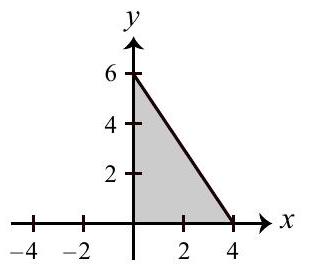 | The length of the base is the distance from the origin to the point $(4,0)$ or 4 .
The height is the distance from the origin to the point $(0,6)$ or 6 .
Thus, the area of the triangle is $\frac{1}{2} \times 4 \times 6=12$.
(We note that the base and height are perpendicular.)
ANSWER: (A) | 12 | Geometry | MCQ | Yes | Yes | olympiads | false |
A perfect square is a whole number whose square root is also a whole number. For example, 144 is a perfect square since its square root is 12 . How many perfect squares are there between 2 and 20 ?
(A) 0
(B) 1
(C) 2
(D) 3
(E) 4 | The whole numbers between 2 and 20 whose square root is a whole number are: 4,9,16 (since $\sqrt{4}=2, \sqrt{9}=3, \sqrt{16}=4)$.
We may note that perfect squares are equal to the square of an integer.
That is, the smallest five positive perfect squares are $1^{2}=1,2^{2}=4,3^{2}=9,4^{2}=16$ and $5^{2}=25$.
Of these... | 3 | Number Theory | MCQ | Yes | Yes | olympiads | false |
Vita picks a number from 1 to 10. Balil adds 5 to this number and calls his result $b$. Cali subtracts 5 from Vita's number and calls her result $c$. The value of $b-c$ is
(A) 25
(B) -10
(C) 0
(D) 5
(E) 10
## Part B: Each correct answer is worth 6. | Balil's result, $b$, is 5 more than Vita's number.
Cali's result, $c$, is 5 less than Vita's number.
Thus the difference between Balil's result and Cali's result, $b-c$, is 10 .
For example, if Vita chooses 8 , then $b=8+5=13$ and $c=8-5=3$ and $b-c=13-3=10$.
ANSWER: (E) | 10 | Algebra | MCQ | Yes | Yes | olympiads | false |
Francesca chooses an integer from the list $-4,-3,-2,-1,0,1,2,3,4,5,6$ and then a second integer that is larger than the first. How many such pairs of integers can she choose so that the sum of the pair is 3 ?
(A) 8
(B) 5
(C) 4
(D) 7
(E) 6 | If Francesca first chooses -4, then there is no integer that she may choose second to give a sum of 3 (the largest integer in the list is 6 , and $-4+6=2$ ).
If she first chooses -3 , she may then choose 6 to give a sum of 3 .
If she first chooses -2 , she may then choose 5 to give a sum of 3 .
If she first chooses ... | 5 | Combinatorics | math-word-problem | Yes | Yes | olympiads | false |
The point totals that Mark scored in five basketball games were $x, 11,13, y, 12$. How many different possible medians are there for his five point totals?
(A) 1
(B) 2
(C) 3
(D) 4
(E) 5 | In a list of five numbers ordered from smallest to largest, the median is equal to the third (middle) number in the list.
Since $x$ and $y$ must be integers, the values of $x$ and $y$ must belong to exactly one of the following three possibilities:
- each of $x$ and $y$ is less than or equal to 11, or
- each of $x$ a... | 3 | Algebra | MCQ | Yes | Yes | olympiads | false |
Three spinners are shown. The spinners are used to determine the hundreds, tens and ones digits of a threedigit number. How many possible three-digit numbers that can be formed in this way are divisible by 6 ?
(A) 11
(B) 16
(C) 22
(D) 12
(E) 9
 8
(B) 12
(C) 14
(D) 27
(E) 10 | Erin receives $\$ 3$ a day. To receive a total of $\$ 30$, it will take Erin $\frac{\$ 30}{\$ 3}=10$ days.
ANSWER: (E) | 10 | Algebra | MCQ | Yes | Yes | olympiads | false |
A rectangle has length $x$ and width $y$. A triangle has base 16 and height $x$. If the area of the rectangle is equal to the area of the triangle, then the value of $y$ is
(A) 16
(B) 4
(C) 8
(D) 12
(E) 32 | The area of the rectangle with length $x$ and width $y$ is $x \times y$.
The area of the triangle with base 16 and height $x$ is $\frac{1}{2} \times 16 \times x$ or $8 \times x$.
The area of the rectangle is equal to the area of the triangle, or $x \times y=8 \times x$, and so $y=8$.
ANSWER: (C) | 8 | Algebra | MCQ | Yes | Yes | olympiads | false |
Which of the following integers is closest to 0 ?
(A) -1
(B) 2
(C) -3
(D) 4
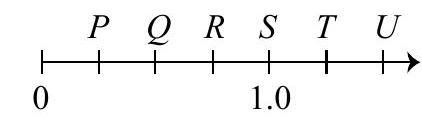
(E) -5 | Place zero and the given answers in their correct locations on the number line, as shown. The integer closest to 0 is -1 .

ANSWER: (A) | -1 | Number Theory | MCQ | Yes | Yes | olympiads | false |
How many integers between 10 and 20 are prime numbers?
(A) 0
(B) 1
(C) 2
(D) 3
(E) 4 | Recall that a prime number is an integer greater than 1 whose only divisors are 1 and itself. The prime numbers between 10 and 20 are: 11,13,17, and 19 .
Thus, there are 4 integers between 10 and 20 which are prime numbers.
ANSWER: (E) | 4 | Number Theory | MCQ | Yes | Yes | olympiads | false |
How many positive integers less than 100 are divisible by both 3 and 7 ?
(A) 2
(B) 3
(C) 4
(D) 5
(E) 6 | Any positive integer that is divisible by both 3 and 7 is divisible by their product, $3 \times 7=21$. That is, we are being asked to count the number of positive integers less than 100 that are multiples of 21.
These integers are: $21,42,63$, and 84 .
We note that the next multiple of 21 is $21 \times 5=105$, which ... | 4 | Number Theory | MCQ | Yes | Yes | olympiads | false |
The mean (average), the median and the mode of the five numbers $12,9,11,16, x$ are all equal. What is the value of $x$ ?
(A) 9
(B) 11
(C) 12
(D) 13
(E) 16 | For the five numbers $12,9,11,16, x$ to have a unique mode, $x$ must equal one of the existing numbers in the list: $12,9,11$, or 16 .
If $x=9$, then the mode is 9 , but the mean of the five numbers $9,9,11,12,16$ is greater than 9 . If $x=16$, then the mode is 16 , but the mean of the five numbers $9,11,12,16,16$ is ... | 12 | Algebra | MCQ | Yes | Yes | olympiads | false |
In Jen's baseball league, each team plays exactly 6 games against each of the other teams in the league. If a total of 396 games are played, how many teams are in the league?
(A) 12
(B) 16
(C) 15
(D) 13
(E) 9 | Let the number of teams in Jen's baseball league be $n$.
Each of these $n$ teams plays 6 games against each of the $n-1$ other teams in the league.
Since there are 2 teams in each of these games, the total number of games played is $\frac{6 n(n-1)}{2}$.
The total number of games played is 396 , so $\frac{6 n(n-1)}{2... | 12 | Combinatorics | math-word-problem | Yes | Yes | olympiads | false |
In quadrilateral $P Q R S$, diagonals $P R$ and $S Q$ intersect at $O$ inside $P Q R S, S P=S Q=S R=1$, and $\angle Q S R=2 \angle Q S P$. Marc determines the measure of the twelve angles that are the interior angles of $\triangle P O S$, $\triangle P O Q, \triangle R O S$, and $\triangle R O Q$. The measure of each of... | We begin by labeling $\angle Q S P=2 \theta$. Since $\angle Q S R=2 \angle Q S P$, $\angle Q S R=2 \times 2 \theta=4 \theta$.
We will now find the measures of all 12 angles in terms of $\theta$.
Let $x=\angle S P R$. Since $\triangle S P R$ has $S P=S R$, it is isosceles which means $\angle S R P=\angle S P R=x$.
Al... | 6 | Geometry | math-word-problem | Yes | Yes | olympiads | false |
If $x=4$ and $y=3 x$, the value of $y$ is
(A) 12
(B) 24
(C) 7
(D) 81
(E) 4 | Since $x=4$, then $y=3 \times 4=12$.
ANSWER: (A) | 12 | Algebra | MCQ | Yes | Yes | olympiads | false |
A cube has exactly six faces and twelve edges. How many vertices does a cube have?
(A) 4
(B) 5
(C) 6
(D) 7
(E) 8 | Every cube has exactly 8 vertices, as shown in the diagram.

ANSWER: (E) | 8 | Geometry | MCQ | Yes | Yes | olympiads | false |
There are several groups of six integers whose product is 1 . Which of the following cannot be the sum of such a group of six integers?
(A) -6
(B) -2
(C) 0
(D) 2
(E) 6 | For the product of two integers to equal 1, the two integers must both equal 1 or must both equal -1 .
Similarly, if the product of six integers is equal to 1, then each of the six integers must equal 1 or -1 .
For the product of six integers, each of which is equal to 1 or -1 , to equal 1 , the number of -1 s must b... | 0 | Number Theory | MCQ | Yes | Yes | olympiads | false |
In a jar, there are 50 coins with a total value of $\$ 5.00$. The coins are quarters (worth $\$ 0.25$ each), dimes (worth $\$ 0.10$ each), and nickels (worth $\$ 0.05$ each). The number of nickels in the jar is three times the number of quarters. The number of dimes is one more than the number of nickels. How many quar... | Solution 1
The number of dimes in the jar is one more than the number of nickels.
If we remove one dime from the jar, then the number of coins remaining in the jar is $50-1=49$, and the value of the coins remaining in the jar is $\$ 5.00-\$ 0.10=\$ 4.90$.
Also, the number of dimes remaining in the jar is now equal t... | 7 | Algebra | MCQ | Yes | Yes | olympiads | false |
The digits from 1 to 9 are written in order so that the digit $n$ is written $n$ times. This forms the block of digits $1223334444 \cdots 999999999$. The block is written 100 times. What is the $1953^{\text {rd }}$ digit written?
(A) 4
(B) 5
(C) 6
(D) 7
(E) 8 | In each block $1223334444 \cdots 999999999$, there is 1 digit 1, 2 digits 2,3 digits 3 , and so on.
The total number of digits written in each block is $1+2+3+4+5+6+7+8+9=45$.
We note that $1953 \div 45$ gives a quotient of 43 and a remainder of 18 (that is, $1953=45 \times 43+18$ ). Since each block contains 45 digi... | 6 | Number Theory | MCQ | Yes | Yes | olympiads | false |
The value of $(2+3)^{2}-\left(2^{2}+3^{2}\right)$ is
(A) 50
(B) 12
(C) 15
(D) -15
(E) -12 | Following the correct order of operations, we get $(2+3)^{2}-\left(2^{2}+3^{2}\right)=5^{2}-(4+9)=25-13=12$.
ANSWER: $(\mathrm{B})$ | 12 | Algebra | MCQ | Yes | Yes | olympiads | false |
If $4 x+12=48$, the value of $x$ is
(A) 12
(B) 32
(C) 15
(D) 6
(E) 9 | If $4 x+12=48$, then $4 x=48-12$ or $4 x=36$, and so $x=\frac{36}{4}=9$.
ANsWER: (E) | 9 | Algebra | MCQ | Yes | Yes | olympiads | false |
The value of $(2+4+6)-(1+3+5)$ is
(A) 0
(B) 3
(C) -3
(D) 21
(E) 111 | Evaluating, $(2+4+6)-(1+3+5)=12-9=3$.
ANswer: (B) | 3 | Algebra | MCQ | Yes | Yes | olympiads | false |
When two integers between 1 and 10 are multiplied, the result is 14 . What is the sum of these two integers?
(A) 2
(B) 5
(C) 7
(D) 9
(E) 33 | There are only two different products of two positive integers whose result is 14 .
These are $2 \times 7$ and $1 \times 14$.
Since the two integers must be between 1 and 10 , then the product must be $2 \times 7$.
The sum of these two integers is $2+7=9$.
ANSWER: (D) | 9 | Algebra | MCQ | Yes | Yes | olympiads | false |
Which integer is closest in value to $\frac{35}{4}$ ?
(A) 10
(B) 8
(C) 9
(D) 7
(E) 6 | Solution 1
Written as a mixed fraction, $\frac{35}{4}=8 \frac{3}{4}$.
Since $\frac{3}{4}$ is closer to 1 than it is to 0 , then $8 \frac{3}{4}$ is closer to 9 than it is to 8 .
The integer closest in value to $\frac{35}{4}$ is 9 .
Solution 2
Written as a decimal $\frac{35}{4}=35 \div 4=8.75$.
Since 0.75 is closer... | 9 | Number Theory | MCQ | Yes | Yes | olympiads | false |
The value of $4^{2}-2^{3}$ is
(A) 8
(B) 2
(C) 4
(D) 0
(E) 6 | Evaluating, we get $4^{2}-2^{3}=16-8=8$.
ANSWER: (A) | 8 | Algebra | MCQ | Yes | Yes | olympiads | false |
If the perimeter of the triangle shown is 21 , what is the value of $x$ ?
(A) 3
(B) 7
(C) 8
(D) 13
(E) 16
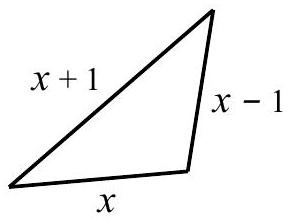 | In terms of $x$, the sum of the three side lengths of the triangle is $x+x+1+x-1=3 x$. Since the perimeter is 21 , then $3 x=21$ and so $x=7$.
ANsWER: (B) | 7 | Geometry | MCQ | Yes | Yes | olympiads | false |
When a number is tripled and then decreased by 6 , the result is 15 . The number is
(A) 8
(B) 6
(C) 5
(D) 7
(E) 9 | Solution 1
To get the original number, we reverse the steps.
That is, we add 6 and then divide by 3 .
Therefore, the original number is $(15+6) \div 3=21 \div 3=7$.
## Solution 2
If the original number is $x$, then when it is tripled the result is $3 x$.
When this result is decreased by 6 , we get $3 x-6$.
Solvi... | 7 | Algebra | MCQ | Yes | Yes | olympiads | false |
The volume of the rectangular prism shown is $60 \mathrm{~cm}^{3}$. What is the value of $x$ ?
(A) 1
(B) 4
(C) 6
(D) 3
(E) 2
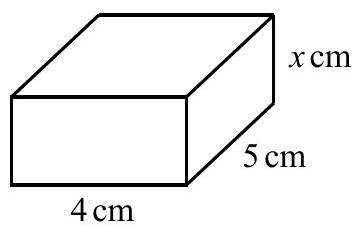 | The volume of a rectangular prism is determined by multiplying the area of its base by its height.
The area of the base for the given prism is $4 \times 5=20 \mathrm{~cm}^{2}$ and its height is $x \mathrm{~cm}$.
Since the prism's volume is $60 \mathrm{~cm}^{3}$, then $20 x=60$ and so $x=3$.
ANSwER: (D) | 3 | Geometry | MCQ | Yes | Yes | olympiads | false |
The values $2,3,4$, and 5 are each assigned to exactly one of the letters $V, W, X$, and $Y$ to give $Y^{X}-W^{V}$ the greatest possible value. The value of $X+V$ is equal to
(A) 5
(B) 6
(C) 7
(D) 8
(E) 9 | To give $Y^{X}-W^{V}$ the greatest possible value, we make $Y^{X}$ as large as possible while making $W^{V}$ as small as possible.
To make $Y^{X}$ as large as possible, we make $Y$ and $X$ as large as possible.
Thus, we must assign $Y$ and $X$ the two largest values, and assign $W$ and $V$ the two smallest values.
L... | 8 | Algebra | MCQ | Yes | Yes | olympiads | false |
Carrie is travelling at a constant speed of $85 \mathrm{~km} / \mathrm{h}$. If Carrie is halfway through a $510 \mathrm{~km}$ trip, how much longer will the trip take?
(A) 5 hours
(B) 425 hours
(C) 12 hours
(D) 1.5 hours
(E) 3 hours | Solution 1
Travelling at a constant speed of $85 \mathrm{~km} / \mathrm{h}$, the entire $510 \mathrm{~km}$ trip would take Carrie $510 \div 85=6$ hours.
Since Carrie is halfway through the $510 \mathrm{~km}$ trip, then the remainder of the trip will take her half of the total trip time or $6 \div 2=3$ hours.
## Solu... | 3 | Algebra | MCQ | Yes | Yes | olympiads | false |
Points $P, Q$ and $R$ are on a number line. $Q$ is halfway between $P$ and $R$. If $P$ is at -6 and $Q$ is at -1 , then $R$ is at
(A) 4
(B) -11
(C) 3
(D) -7
(E) 5
## Part B: Each correct answer is worth 6. | Since $Q$ is halfway between $P$ and $R$, then the distance between $P$ and $Q$ is equal to the distance between $Q$ and $R$.
The distance between $P$ and $Q$ is $-1-(-6)=-1+6=5$.

Since ... | 4 | Algebra | MCQ | Yes | Yes | olympiads | false |
In the sum shown, $P$ and $Q$ each represent a digit. The value of $P+Q$ is
(A) 3
(B) 5
(C) 7
(D) 6
(E) 4
$P Q Q$
$P P Q$
$+Q Q Q$
876 | The sum of the units column is $Q+Q+Q=3 Q$.
Since $Q$ is a single digit, and $3 Q$ ends in a 6 , then the only possibility is $Q=2$.
Then $3 Q=3 \times 2=6$, and thus there is no carry over to the tens column.
The sum of the tens column becomes $2+P+2=P+4$, since $Q=2$.
Since $P$ is a single digit, and $P+4$ ends i... | 5 | Logic and Puzzles | MCQ | Yes | Yes | olympiads | false |
Ahmed chooses two different items for a snack. His choices are an apple, an orange, a banana, and a granola bar. How many different pairs of snacks could he choose?
(A) 3
(B) 4
(C) 5
(D) 6
(E) 7 | Ahmed could choose from the following pairs of snacks: apple and orange, apple and banana, apple and granola bar, orange and banana, orange and granola bar, or banana and granola bar. Therefore, there are 6 different pairs of snacks that Ahmed may choose.
ANSWER: (D) | 6 | Combinatorics | MCQ | Yes | Yes | olympiads | false |
The mean (average) of a set of six numbers is 10 . When the number 25 is removed from the set, the mean of the remaining numbers is
(A) 6
(B) 7
(C) 8
(D) 9
(E) 10 | The mean (average) of the set of six numbers is 10 , and so the sum of the set of six numbers is $6 \times 10=60$.
If the number 25 is removed from the set, the sum of the set of the remaining five numbers is $60-25=35$.
The mean (average) of the remaining set of five numbers is $35 \div 5=7$.
ANsWER: (B) | 7 | Algebra | MCQ | Yes | Yes | olympiads | false |
The eight vertices of a cube are randomly labelled with the integers from 1 to 8 inclusive. Judith looks at the labels of the four vertices of one of the faces of the cube. She lists these four labels in increasing order. After doing this for all six faces, she gets the following six lists: $(1,2,5,8),(3,4,6,7),(2,4,5,... | First we choose to label one of the vertices 2 , and then label the vertex that is farthest away from this vertex $F$, as shown.
(Can you explain why the vertex labelled $F$ is the vertex that is farthest away from the vertex labelled 2?)
Each of the other six vertices of the cube lie on one of the three faces on whi... | 6 | Geometry | MCQ | Yes | Yes | olympiads | false |
The graph shows the number of hours Stan worked on a school project. For how many hours in total did he work on the project?
(A) 6
(B) 2
(C) 8
(D) 9
(E) 10
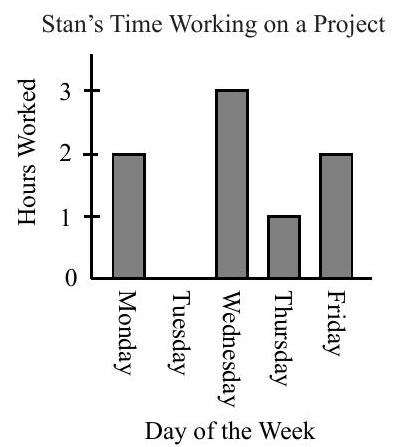 | Reading from the graph, we summarize the number of hours that Stan worked each day in the table below.
| Day | Monday | Tuesday | Wednesday | Thursday | Friday |
| :---: | :---: | :---: | :---: | :---: | :---: |
| Number of Hours | 2 | 0 | 3 | 1 | 2 |
Therefore, Stan worked a total of $2+0+3+1+2=8$ hours on the proje... | 8 | Other | MCQ | Yes | Yes | olympiads | false |
The mean (average) of a set of six numbers is 10 . If the number 25 is removed from the set, the mean of the remaining numbers is
(A) 6
(B) 7
(C) 8
(D) 9
(E) 10 | The mean (average) of the set of six numbers is 10 , and so the sum of the set of six numbers is $6 \times 10=60$.
If the number 25 is removed from the set, the sum of the set of the remaining five numbers is $60-25=35$.
The mean (average) of the remaining set of five numbers is $35 \div 5=7$.
ANSWER: (B) | 7 | Algebra | MCQ | Yes | Yes | olympiads | false |
How many positive integers between 10 and 2016 are divisible by 3 and have all of their digits the same?
(A) 9
(B) 12
(C) 6
(D) 18
(E) 3 | The positive integers between 10 and 2016 which have all of their digits the same are: $11,22,33,44,55,66,77,88,99,111,222,333,444,555,666,777,888,999$, and 1111.
To be divisible by 3 , the sum of the digits of the positive integer must equal a multiple of 3 .
From the list above, the only 2-digit numbers whose digit... | 12 | Number Theory | MCQ | Yes | Yes | olympiads | false |
What is the tens digit of $3^{2016}$ ?
(A) 0
(B) 2
(C) 4
(D) 6
(E) 8 | When two integers are multiplied together, the final two digits (the tens digit and the units digits) of the product are determined by the final two digits of each of the two numbers that are multiplied.
This is true since the place value of any digit contributes to its equal place value (and possibly also to a greate... | 2 | Number Theory | MCQ | Yes | Yes | olympiads | false |
In the table, the numbers in each row form an arithmetic sequence when read from left to right. Similarly, the numbers in each column form an arithmetic sequence when read from top to bottom. What is the sum of the digits of the value of $x$ ?
(An arithmetic sequence is a sequence in which each term
| | | | | 18 ... | We begin by adding variables to some of the blanks in the grid to make it easier to refer to specific entries:
| | | | | 18 |
| :---: | :---: | :---: | :---: | :---: |
| | 43 | $f$ | $g$ | $h$ |
| | | 40 | | $j$ |
| | | $k$ | | $m$ |
| $x$ | $n$ | $p$ | 26 | $q$ |
Since the numbers in each row form an arit... | 2 | Algebra | math-word-problem | Yes | Yes | olympiads | false |
The number 6 has exactly four positive divisors: $1,2,3$, and 6 . How many positive divisors does 20 have?
(A) 2
(B) 6
(C) 3
(D) 5
(E) 8 | The positive divisors of 20 are: $1,2,4,5,10$, and 20 .
Therefore, the number 20 has exactly 6 positive divisors.
ANSWER: (B) | 6 | Number Theory | MCQ | Yes | Yes | olympiads | false |
How many different 3 -digit whole numbers can be formed using the digits 4,7 and 9 , assuming that no digit can be repeated in a number?
(A) 6
(B) 3
(C) 5
(D) 12
(E) 9
## Part B: Each correct answer is worth 6. | Using the digits 4,7 and 9 without repeating any digit in a given number, the following 3-digit whole numbers can be formed: 479,497, 749, 794, 947, and 974 .
There are exactly 6 different 3 -digit whole numbers that can be formed in the manner described. | 6 | Combinatorics | MCQ | Yes | Yes | olympiads | false |
How many even whole numbers between 1 and 99 are multiples of 5 ?
(A) 5
(B) 7
(C) 9
(D) 11
(E) 13 | Solution 1
The multiples of 5 between 1 and 99 are:
$$
5,10,15,20,25,30,35,40,45,50,55,60,65,70,75,80,85,90,95
$$
Of these, only $10,20,30,40,50,60,70,80$, and 90 are even.
Therefore, there are 9 even whole numbers between 1 and 99 that are multiples of 5 .
## Solution 2
To create an even multiple of 5 , we must ... | 9 | Number Theory | MCQ | Yes | Yes | olympiads | false |
In the $3 \times 3$ table shown, the numbers 1,2 and 3 are placed so that each number occurs only once in each row and only once in each column. The value of $X+Y$ is
(A) 3
(B) 2
(C) 5
(D) 6
(E) 4 | Consider the value of $U$ in the diagram shown.
Since a 3 already occurs in the second row, then $U$ cannot equal 3 (each of the numbers 1,2,3, occur only once in each row).
Since a 1 already occurs in the third column, then $U$ cannot equal 1
(each of the numbers 1, 2, 3, occur only once in each column).
Since $U$... | 4 | Logic and Puzzles | MCQ | Yes | Yes | olympiads | false |
You have exactly $\$ 4.40$ ( 440 ) in quarters ( $25 \phi$ coins), dimes ( $10 \phi$ coins), and nickels ( 5 coins). You have the same number of each type of coin. How many dimes do you have?
(A) 20
(B) 11
(C) 10
(D) 12
(E) 4 | The total value of one quarter, one dime and one nickel is $25+10+5=40$.
Since you have equal numbers of quarters, dimes and nickels, you can separate your coins into piles, each containing exactly 1 quarter, 1 dime, and 1 nickel.
Each pile has a value of $40 \notin$, and since $440 \div 40=11$, then you must have 11... | 11 | Algebra | MCQ | Yes | Yes | olympiads | false |
The number represented by $\square$ so that $\frac{1}{2}+\frac{1}{4}=\frac{\square}{12}$ is
(A) 3
(B) 12
(C) 9
(D) 6
(E) 15
Part B: Each correct answer is worth 6. | Solution 1
Evaluating using a denominator of $12, \frac{1}{2}+\frac{1}{4}=\frac{6}{12}+\frac{3}{12}=\frac{9}{12}$ and so the number represented by $\square$ is 9 .
Solution 2
Since $\frac{1}{2}+\frac{1}{4}=\frac{2}{4}+\frac{1}{4}=\frac{3}{4}$ and $\frac{3}{4}=\frac{9}{12}$, then $\frac{1}{2}+\frac{2}{4}=\frac{9}{12}... | 9 | Algebra | MCQ | Yes | Yes | olympiads | false |
The operation $\Delta$ is defined so that $a \Delta b=a \times b+a+b$. For example, $2 \Delta 5=2 \times 5+2+5=17$. If $p \Delta 3=39$, the value of $p$ is
(A) 13
(B) 12
(C) 9
(D) 10.5
(E) 18 | Using the definition of $\Delta$, we see that $p \Delta 3=p \times 3+p+3=3 p+p+3=4 p+3$.
Since $p \Delta 3=39$, then $4 p+3=39$ or $4 p=39-3=36$ and so $p=\frac{36}{4}=9$.
ANswer: (C) | 9 | Algebra | MCQ | Yes | Yes | olympiads | false |
The list of integers $4,4, x, y, 13$ has been arranged from least to greatest. How many different possible ordered pairs $(x, y)$ are there so that the average (mean) of these 5 integers is itself an integer?
(A) 7
(B) 8
(C) 9
(D) 10
(E) 11 | The list of integers $4,4, x, y, 13$ has been arranged from least to greatest, and so $4 \leq x$ and $x \leq y$ and $y \leq 13$.
The sum of the 5 integers is $4+4+x+y+13=21+x+y$ and so the average is $\frac{21+x+y}{5}$. Since this average is a whole number, then $21+x+y$ must be divisible by 5 (that is, $21+x+y$ is a ... | 11 | Number Theory | MCQ | Yes | Yes | olympiads | false |
In the special square shown, the sum of the three numbers in each column equals the sum of the three numbers in each row. The value of $x$ is
(A) 3
(B) 4
(C) 5
(D) 6
(E) 12
| 13 | 8 | |
|... | The sum of the three numbers in the first column is $13+14+9=36$.
The sum of the numbers in each column and in each row in the square is the same and so the sum of the three numbers in the second row is also 36 .
That is, $14+x+10=36$ or $x+24=36$, and so $x=36-24=12$.
ANSWER: (E) | 12 | Logic and Puzzles | MCQ | Yes | Yes | olympiads | false |
In the diagram shown, the number of rectangles of all sizes is
(A) 11
(B) 15
(C) 7
(D) 13
(E) 9
 | We systematically count rectangles by searching for groups of rectangles that are of similar size. The largest rectangles in the diagram are all roughly the same size and overlap in pairs. There are 3 of these; each is shaded black and shown below.
 1
(B) 2
(C) 3
(D) 4
(E) 5 | Reading from the graph, Riley-Ann scored 8 points in Game 1, 7 points in Game 2, 20 points in Game 3, 7 points in Game 4, and 18 points in Game 5.
Therefore the mean number of points that she scored per game is $\frac{8+7+20+7+18}{5}=\frac{60}{5}=12$.
Since the ordered list (smallest to largest) of the number of poin... | 4 | Algebra | MCQ | Yes | Yes | olympiads | false |
Each face of a cube is painted with exactly one colour. What is the smallest number of colours needed to paint a cube so that no two faces that share an edge are the same colour?
(A) 2
(B) 3
(C) 4
(D) 5
(E) 6 | Assume the top face of the cube is coloured green.
Since the front face of the cube shares an edge with the top face, it cannot be coloured green. Thus, we need at least two colours.
Thus, we assume that the front face is coloured blue, as shown in Figure 1.
Since the right face shares an edge with the top face and ... | 3 | Geometry | MCQ | Yes | Yes | olympiads | false |
The value of $(2014-2013) \times(2013-2012)$ is
(A) 0
(B) 1
(C) 2
(D) 2014
(E) -1 | Evaluating, $(2014-2013) \times(2013-2012)=1 \times 1=1$.
ANSWER: (B) | 1 | Algebra | MCQ | Yes | Yes | olympiads | false |
How many prime numbers are there between 10 and 30 ?
(A) 4
(B) 7
(C) 6
(D) 3
(E) 5 | Each prime number is divisible by exactly two numbers, 1 and itself.
Each of the even numbers $\{12,14,16,18,20,22,24,26,28\}$ is divisible by 1 and itself and also
by 2 .
Therefore the numbers $\{12,14,16,18,20,22,24,26,28\}$ are not prime.
Each of the numbers $\{15,21,27\}$ is divisible by 1 and itself and also b... | 6 | Number Theory | MCQ | Yes | Yes | olympiads | false |
The ratio of the number of girls to the number of boys in a class of 24 students is $3: 5$. How many fewer girls than boys are in the class?
(A) 2
(B) 4
(C) 5
(D) 6
(E) 8
Part B: Each correct answer is worth 6. | Solution 1
The ratio of the number of girls to the number of boys is $3: 5$, so for every 3 girls there are 5 boys and $3+5=8$ students.
That is, the number of girls in the class is $\frac{3}{8}$ of the number of students in the class.
Since the number of students in the class is 24 , the number of girls is $\frac{3... | 6 | Algebra | MCQ | Yes | Yes | olympiads | false |
A rectangle whose side lengths are whole numbers has area $48 \mathrm{~cm}^{2}$. The perimeter of this rectangle is $32 \mathrm{~cm}$. Measured in $\mathrm{cm}$, the positive difference between the length and the width of the rectangle is
(A) 47
(B) 2
(C) 22
(D) 8
(E) 13
Grade 8 | The area of the rectangle, $48 \mathrm{~cm}^{2}$, is given by the product of the rectangle's length and width, and so we must consider all possible pairs of whole numbers whose product is 48 .
In the table below, we systematically examine all possible factors of 48 in order to determine the possible whole number side ... | 8 | Algebra | MCQ | Yes | Yes | olympiads | false |
The value of $1+1-2+3+5-8+13+21-34$ is
(A) -32
(B) 1
(C) 88
(D) 0
(E) -34 | By grouping terms using brackets as shown, $(1+1-2)+(3+5-8)+(13+21-34)$, we can see that the result inside each set of brackets is 0 .
Thus the value of $1+1-2+3+5-8+13+21-34$ is 0 .
ANSWER: (D) | 0 | Algebra | MCQ | Yes | Yes | olympiads | false |
The length of each edge of a cube is $1 \mathrm{~cm}$. The surface area of the cube, in $\mathrm{cm}^{2}$, is
(A) 24
(B) 1
(C) 4
(D) 12
(E) 6 | Each face of a cube is a square. The dimensions of each face of the cube are $1 \mathrm{~cm}$ by $1 \mathrm{~cm}$. Thus, the area of each face of the cube is $1 \times 1=1 \mathrm{~cm}^{2}$.
Since a cube has 6 identical faces, the surface area of the cube is $6 \times 1=6 \mathrm{~cm}^{2}$.
ANswer: (E) | 6 | Geometry | MCQ | Yes | Yes | olympiads | false |
If $x=4$ and $3 x+2 y=30$, what is the value of $y$ ?
(A) 18
(B) 6
(C) 3
(D) 4
(E) 9 | Substituting $x=4$ into $3 x+2 y$ we get, $3(4)+2 y=12+2 y$.
Since this expression $12+2 y$ is equal to 30 , then $2 y$ must equal $30-12$ or 18 .
If $2 y=18$, then $y$ is $18 \div 2$ or 9 .
Answer: (E) | 9 | Algebra | MCQ | Yes | Yes | olympiads | false |
Daniel begins with 64 coins in his coin jar. Each time he reaches into the jar, he removes half of the coins that are in the jar. How many times must he reach in and remove coins from his jar so that exactly 1 coin remains in the jar?
(A) 5
(B) 32
(C) 6
(D) 7
(E) 63 | Each time Daniel reaches into the jar, he removes half of the coins that are in the jar.
Since he removes half of the coins, then the other half of the coins remain in the jar.
We summarize Daniel's progress in the table below.
| Number of Times Coins are Removed | 0 | 1 | 2 | 3 | 4 | 5 | 6 |
| :---: | :---: | :---:... | 6 | Number Theory | MCQ | Yes | Yes | olympiads | false |
The mean (average) of five consecutive even numbers is 12 . The mean of the smallest and largest of these numbers is
(A) 12
(B) 10
(C) 14
(D) 8
(E) 16 | Solution 1
Consider the set of five consecutive even numbers 8, 10,12,14, 16 .
The mean of these five numbers is $\frac{8+10+12+14+16}{5}=\frac{60}{5}$ or 12 .
If the five consecutive even numbers were smaller, their mean would be less than 12 .
If the five consecutive even numbers were larger, their mean would be ... | 12 | Algebra | MCQ | Yes | Yes | olympiads | false |
One face of a cube contains a circle, as shown. This cube rolls without sliding on a four by four checkerboard. The cube always begins a path on the bottom left square in the position shown and completes the path on the top right square. During each move, an edge of the cube remains in contact with the board. Each move... | We begin by numbering the checkerboard squares from 1 to 16 , as shown, so that we may refer to each of them specifically.
We denote a move "up" by the letter $U$ and a move "right" by $R$. We will begin by determining which of the 16 squares will not be touched by the face with the circle and then proceed to show tha... | 8 | Combinatorics | MCQ | Yes | Yes | olympiads | false |
The value of $15-3-15$ is
(A) -18
(B) -15
(C) 3
(D) -3
(E) -33 | Evaluating, $15-3-15=12-15=-3$.
ANSWER: (D)
# | -3 | Algebra | MCQ | Yes | Yes | olympiads | false |
Jarek multiplies a number by 3 and gets an answer of 90 . If instead, he divides the number by 3 , what answer does he get?
(A) 5
(B) 10
(C) 30
(D) 60
(E) 270 | Since Jarek multiplies a number by 3 and gets an answer of 90 , then the number must be $\frac{90}{3}=30$. (We may check that $30 \times 3=90$.)
If Jarek instead divides the number 30 by 3, then the answer he gets is $\frac{30}{3}=10$.
ANSWER: (B)
# | 10 | Algebra | MCQ | Yes | Yes | olympiads | false |
The value of $\left(2^{3}\right)^{2}-4^{3}$ is
(A) 0
(B) -8
(C) 4
(D) 10
(E) 12 | Solution 1
Using order of operations to evaluate, $\left(2^{3}\right)^{2}-4^{3}=8^{2}-4^{3}=64-64=0$.
Solution 2
We first express 4 as $2^{2}$ and then use exponent rules to evaluate.
$$
\begin{aligned}
\left(2^{3}\right)^{2}-4^{3} & =\left(2^{3}\right)^{2}-\left(2^{2}\right)^{3} \\
& =2^{3 \times 2}-2^{2 \times 3}... | 0 | Algebra | MCQ | Yes | Yes | olympiads | false |
The Summer Olympics are held once every 4 years. During an 18 year period, what is the largest number of Summer Olympics that could be held?
(A) 3
(B) 4
(C) 5
(D) 6
(E) 7 | Two consecutive Summer Olympics are held 4 years apart.
Each successive Summer Olympics requires an additional 4 years before it is held.
We use this to summarize the minimum time required for the largest number of Summer Olympics to be held, as shown.
| Number of Summer Olympics | Minimum Number of Years Apart |
| ... | 5 | Number Theory | MCQ | Yes | Yes | olympiads | false |
Subsets and Splits
No community queries yet
The top public SQL queries from the community will appear here once available.