
problem stringlengths 15 4.7k | solution stringlengths 2 11.9k | answer stringclasses 51
values | problem_type stringclasses 8
values | question_type stringclasses 4
values | problem_is_valid stringclasses 1
value | solution_is_valid stringclasses 1
value | source stringclasses 6
values | synthetic bool 1
class |
|---|---|---|---|---|---|---|---|---|
Serena colours the hexagons on the tiling shown. If two hexagons share a side, she colours them with different colours. What is the least number of colours that she can use to colour all of the hexagons?
(A) 4
(B) 6
(C) 7
(D) 2
(E) 3
. We will use the numbers $1,2,3$ to represent distinct (different) colours.
We begin by choosing any group of three hexago... | 3 | Combinatorics | MCQ | Yes | Yes | olympiads | false |
Christina and Frieda want to buy the same book. Christina has $\frac{3}{4}$ of the money needed to buy the book and Frieda has half of the money needed to buy the book. If the book was $\$ 3$ cheaper, then together they would have exactly enough money to buy 2 copies of the book. What is the original price of the book?... | Solution 1
Suppose that the cost of one book, in dollars, is $C$.
Then Christina has $\frac{3}{4} C$ and Frieda has $\frac{1}{2} C$.
Combining their money, together Christina and Frieda have $\frac{3}{4} C+\frac{1}{2} C=\frac{3}{4} C+\frac{2}{4} C=\frac{5}{4} C$.
If the book was $\$ 3$ cheaper, then the cost to buy... | 8 | Algebra | MCQ | Yes | Yes | olympiads | false |
The number 503 is a prime number. How many positive integers are factors of 2012 ?
(A) 2
(B) 3
(C) 7
(D) 6
(E) 8 | Both 1 and 2012 are obvious positive integer factors of 2012.
Since 2012 is an even number and $2012 \div 2=1006$, then both 2 and 1006 are factors of 2012 . Since 1006 is also even then 2012 is divisible by 4 .
Since $2012 \div 4=503$, then both 4 and 503 are factors of 2012 .
We are given that 503 is a prime numbe... | 6 | Number Theory | MCQ | Yes | Yes | olympiads | false |
The number $N$ is the product of all positive odd integers from 1 to 99 that do not end in the digit 5. That is, $N=1 \times 3 \times 7 \times 9 \times 11 \times 13 \times 17 \times 19 \times \cdots \times 91 \times 93 \times 97 \times 99$. The units digit of $N$ is
(A) 1
(B) 3
(C) 5
(D) 7
(E) 9 | The units digit of any product is given by the units digit of the product of the units digits of the numbers being multiplied.
For example, the units digit of the product $12 \times 53$ is given by the product $2 \times 3$, so it is 6 .
Thus to determine the units digit of $N$, we need only consider the product of th... | 1 | Number Theory | MCQ | Yes | Yes | olympiads | false |
$3 \times(3+3) \div 3$ equals
(A) 6
(B) 3
(C) 2
(D) 12
(E) 9 | Using the correct order of operations, $3 \times(3+3) \div 3=3 \times 6 \div 3=18 \div 3=6$.
## ANSWER: (A) | 6 | Algebra | MCQ | Yes | Yes | olympiads | false |
When $x=2$, the value of $3^{x}-x^{3}$ is
(A) -2
(B) 0
(C) 3
(D) 1
(E) 9 | Substituting $x=2$, we get
$$
3^{x}-x^{3}=3^{2}-2^{3}=(3 \times 3)-(2 \times 2 \times 2)=9-8=1
$$
ANSwer: (D) | 1 | Algebra | MCQ | Yes | Yes | olympiads | false |
A pyramid has a square base. How many edges does the pyramid have?
(A) 8
(B) 6
(C) 12
(D) 5
(E) 3 | Since the pyramid has a square base, the base of the pyramid has 4 edges (one for each side of the square).
An edge joins each of the 4 vertices of the square to the apex of the pyramid, as shown.
In total, a pyramid with a square base has 8 edges.
 of 7 . The mode of these three numbers is 9 . What is the smallest of these three numbers?
(A) 1
(B) 2
(C) 3
(D) 4
(E) 5 | The mode is the number that occurs most frequently in a set of numbers.
The mode of the three numbers is 9 .
Thus, at least two of the three numbers must equal 9 otherwise there would be three different numbers and so three modes.
If all three of the numbers were equal to 9 , then the average of the three numbers co... | 3 | Algebra | MCQ | Yes | Yes | olympiads | false |
Half of the square root of a number is 1 . The number is
(A) 2
(B) 4
(C) 8
(D) 9
(E) 16 | Solution 1
Since half the square root of the number is one, then the square root of the number must be 2 .
Since the square root of 4 is equal to 2 , then the unknown number is 4 .
## Solution 2
Let the unknown number be $x$.
Since one half the square root of $x$ is one, then $\frac{1}{2} \sqrt{x}=1$.
Multiplying... | 4 | Algebra | MCQ | Yes | Yes | olympiads | false |
At the Gaussland Olympics there are 480 student participants.
Each student is participating in 4 different events.
Each event has 20 students participating and is supervised by 1 adult coach.
There are 16 adult coaches and each coach supervises the same number of events.
How many events does each coach supervise?
(... | Since there are 480 student participants and each student is participating in 4 events, then across all events the total number of (non-unique) participants is $480 \times 4=1920$.
Each event has 20 students participating.
Thus, the number of different events is $\frac{1920}{20}=96$.
Each event is supervised by 1 ad... | 6 | Combinatorics | MCQ | Yes | Yes | olympiads | false |
Different patterns can be created by shading exactly three of the nine small triangles shown, no two of which can share a side.

Patterns that can be matched by rotations or by reflections ... | Care is needed in systematically counting the different patterns.
Dividing the patterns into groups having some like attribute is one way to help this process.
We will count patterns by grouping them according to the number of "corner" triangles $(3,2,1$, or 0 ) that each has shaded.
## 3 shaded corners
There is on... | 10 | Combinatorics | MCQ | Yes | Yes | olympiads | false |
The value of $5+4-3+2-1$ is
(A) 0
(B) -5
(C) 3
(D) -3
(E) 7 | Evaluating, $5+4-3+2-1=9-3+2-1=6+2-1=8-1=7$.
ANSWER: (E) | 7 | Algebra | MCQ | Yes | Yes | olympiads | false |
The value of $\sqrt{9+16}$ is
(A) 5.2
(B) 7
(C) 5.7
(D) 25
(E) 5 | We must first add 9 and 16 . Thus, $\sqrt{9+16}=\sqrt{25}=5$.
ANSWER: (E) | 5 | Algebra | MCQ | Yes | Yes | olympiads | false |
A ski lift carries a skier at a rate of $12 \mathrm{~km}$ per hour. How many kilometres does the ski lift carry the skier in 10 minutes?
(A) 120
(B) 1.2
(C) 2
(D) 2.4
(E) 1.67 | Since 10 minutes is equivalent to $\frac{10}{60}=\frac{1}{6}$ of an hour, the skier travels $12 \div 6=2 \mathrm{~km}$.
ANSWER: (C) | 2 | Algebra | MCQ | Yes | Yes | olympiads | false |
A $51 \mathrm{~cm}$ rod is built from $5 \mathrm{~cm}$ rods and $2 \mathrm{~cm}$ rods. All of the $5 \mathrm{~cm}$ rods must come first, and are followed by the $2 \mathrm{~cm}$ rods. For example, the rod could be made from seven $5 \mathrm{~cm}$ rods followed by eight $2 \mathrm{~cm}$ rods. How many ways are there to ... | Any number of $2 \mathrm{~cm}$ rods add to give a rod having an even length.
Since we need an odd length, $51 \mathrm{~cm}$, then we must combine an odd length from the $5 \mathrm{~cm}$ rods with the even length from the $2 \mathrm{~cm}$ rods to achieve this.
An odd length using $5 \mathrm{~cm}$ rods can only be obta... | 5 | Combinatorics | MCQ | Yes | Yes | olympiads | false |
A pool has a volume of $4000 \mathrm{~L}$. Sheila starts filling the empty pool with water at a rate of $20 \mathrm{~L} / \mathrm{min}$. The pool springs a leak after 20 minutes and water leaks out at $2 \mathrm{~L} / \mathrm{min}$. Beginning from the time when Sheila starts filling the empty pool, how long does it tak... | In the first 20 minutes, Sheila fills the pool at a rate of $20 \mathrm{~L} / \mathrm{min}$ and thus adds $20 \times 20=400 \mathrm{~L}$ of water to the pool.
At this time, the pool needs $4000-400=3600 \mathrm{~L}$ of water to be full.
After filling for 20 minutes, water begins to leak out of the pool at a rate of $... | 3 | Algebra | MCQ | Yes | Yes | olympiads | false |
If $\frac{8}{12}=\frac{\square}{3}$, then the value represented by $\square$ is
(A) 24
(B) 1
(C) 12
(D) 2
(E) 4 | The fractions $\frac{8}{12}$ and $\frac{\square}{3}$ are equivalent fractions.
To reduce the first to the second, the denominator 12 has been divided by a factor of 4 . Therefore, we divide the numerator 8 by the same factor, 4 .
Thus, $\frac{8}{12}=\frac{2}{3}$ and the value represented by $\square$ is 2 .
ANSWER: ... | 2 | Algebra | MCQ | Yes | Yes | olympiads | false |
If Clara doubles a number and then adds 3 , the result is 23 . The original number is
(A) 13
(B) 10
(C) 49
(D) 17
(E) 20 | Solution 1
Since double the original number plus 3 is 23 , then double the original number must equal 20 (that is, $23-3$ ).
Therefore, the original number is 20 divided by 2 , or 10 .
## Solution 2
Let the original number be represented by the variable $x$.
Then doubling the original number and adding 3 gives $2 ... | 10 | Algebra | MCQ | Yes | Yes | olympiads | false |
March 3, 2009 or 3/3/09 was called a "square root day" because the day and the month are both the square root of the last two digits of the year. The number of square root days between January 1, 2012 and December 31, 2099 is
(A) 2
(B) 3
(C) 4
(D) 5
(E) 6 | First recognize that the day and the month must be equal.
Next, since $3^{2}=9$ and $10^{2}=100$, both the day and the month must be larger than 3 but less than 10 so that the year lies between 2012 and 2099.
We list all possible square root days in the table below.
| Day and Month | Last Two Digits of the Year | Da... | 6 | Number Theory | MCQ | Yes | Yes | olympiads | false |
A collection of coins includes only pennies (1申), nickels (5థ), dimes (10థ) and quarters (25)). Using the coins in this collection, it is possible to create any amount of money less than one dollar (100థ). What is the smallest possible number of coins in the collection?
(A) 10
(B) 7
(C) 11
(D) 13
(E) 12 | We first consider the minimum number of coins needed to create 99 , the greatest amount that we are required to create.
We can create $75 \%$ with a minimum number of coins by placing three quarters in the collection. Once at 75 \& , we need $99-75=24$ \& more to reach 99 \&.
To create $24 \phi$ with a minimum number... | 10 | Number Theory | math-word-problem | Yes | Yes | olympiads | false |
In the diagram, each of the integers 1 through 9 is to be placed in one circle so that the integers in every straight row of three joined circles add to 18 . The 6 and 1 have been filled in. The value of the number represented by $x$ is
(A) 4
(B) 5
(C) 7
(D) 8
(E) 3
 8
(B) 4
(C) 7
(D) 5
(E) 6

... | Since 700 is the product of 35 and $y$, then $35 \times y=700$ or $y=700 \div 35=20$.
Since 20 is the product of 5 and $x$, then $5 \times x=20$ or $x=20 \div 5=4$.
ANSWER: (B) | 4 | Algebra | MCQ | Yes | Yes | olympiads | false |
In a magic square, all rows, columns, and diagonals have the same sum. The magic square shown uses each of the integers from -6 to +2 . What is the value of $Y$ ?
(A) -1
(B) 0
(C) -6
(D) +2
(E) -2
| +1 | | $Y$ |
| :---: | :---: | :---: |
| -4 | | |
| -3 | | -5 | | First we must find the magic constant, that is, the sum of each row, column and diagonal. From column one, we find that the magic constant is $(+1)+(-4)+(-3)=-6$.
In the diagonal extending from the top left corner to the bottom right corner, the two existing numbers +1 and -5 have a sum of -4 .
Thus, to obtain the ma... | -1 | Logic and Puzzles | MCQ | Yes | Yes | olympiads | false |
Tanner wants to fill his swimming pool using two hoses, each of which sprays water at a constant rate. Hose $A$ fills the pool in $a$ hours when used by itself, where $a$ is a positive integer. Hose $B$ fills the pool in $b$ hours when used by itself, where $b$ is a positive integer. When used together, Hose $A$ and Ho... | Together, Hose $A$ and Hose $B$ fill the pool in 6 hours.
Thus, it must take Hose $A$ more than 6 hours to fill the pool when used by itself.
Therefore, $a \geq 7$, since $a$ is a positive integer.
Similarly, it must take Hose $B$ more than 6 hours to fill the pool when used by itself.
Therefore, $b \geq 7$, since ... | 9 | Algebra | math-word-problem | Yes | Yes | olympiads | false |
If $x=2$ and $y=1$, the value of $2 x-3 y$ equals
(A) 11
(B) 1
(C) 4
(D) 5
(E) 3 | Substituting $x=2$ and $y=1$ into the expression $2 x-3 y$, we have $2 \times 2-3 \times 1$.
Using the correct order of operations, $2 \times 2-3 \times 1=4-3=1$.
ANSWER: (B) | 1 | Algebra | MCQ | Yes | Yes | olympiads | false |
If $44 \times 25=\square \times 100$, the number that should replace the $\square$ is
(A) 11
(B) 176
(C) 0.0909
(D) 56.8181
(E) 40 | Solution 1
Evaluating the left side of the equation, we get $44 \times 25=1100$.
Thus, the number that should replace the $\square$ is $1100 \div 100=11$.
## Solution 2
The left side of the equation, $44 \times 25$, can be rewritten as $11 \times 4 \times 25$.
Since $11 \times 4 \times 25=11 \times 100$, then we c... | 11 | Algebra | MCQ | Yes | Yes | olympiads | false |
The number of white balls and red balls in a jar is in the ratio of $3: 2$.
If there are 9 white balls, how many red balls are there?
(A) 5
(B) 8
(C) 2
(D) 6
(E) 3 | For every 3 white balls in the jar, there are 2 red balls in the jar.
Since there are 9 white balls in the jar, which is 3 groups of 3 white balls, there must be 3 groups of 2 red balls in the jar.
Thus, there are $3 \times 2=6$ red balls in the jar.
ANSWER: (D) | 6 | Algebra | MCQ | Yes | Yes | olympiads | false |
How many numbers in the list $11,12,13,14,15,16,17$ are prime numbers?
(A) 0
(B) 1
(C) 2
(D) 3
(E) 4 | The numbers 12, 14 and 16 are even, and therefore divisible by 2 so not prime.
The number 15 is divisible by 5 ; therefore, it is also not prime.
Each of the remaining numbers, 11, 13 and 17, has no positive divisor other than 1 and itself. Therefore, 3 numbers in the list are prime.
ANSWER: (D)
# | 3 | Number Theory | MCQ | Yes | Yes | olympiads | false |
If $x, y$ and $z$ are positive integers with $x y=18, x z=3$ and $y z=6$, what is the value of $x+y+z$ ?
(A) 6
(B) 10
(C) 25
(D) 11
(E) 8 | Since $x$ and $z$ are positive integers and $x z=3$, the only possibilities are $x=1$ and $z=3$ or $x=3$ and $z=1$.
Assuming that $x=1$ and $z=3, y z=6$ implies $3 y=6$ or $y=2$.
Thus, $x=1$ and $y=2$ and $x y=2$.
This contradicts the first equation $x y=18$.
Therefore, our assumption was incorrect and it must be t... | 10 | Algebra | MCQ | Yes | Yes | olympiads | false |
In the diagram, a $4 \times 4$ grid is to be filled so that each of the digits 1, 2, 3, and 4 appears in each row and each column. The $4 \times 4$ grid is divided into four smaller $2 \times 2$ squares. Each of these $2 \times 2$ squares is also to contain each of the digits 1, 2, 3 and 4 . What digit replaces $P$ ?
(... | The first row is missing a 4 and a 2. Since there is already a 2 in the second column (in the second row), the first row, second column must contain a 4 and the first row, fourth column must contain a 2. To complete the upper left $2 \times 2$ square, the second row, first column must contain a 3. The second row is now... | 1 | Logic and Puzzles | MCQ | Yes | Yes | olympiads | false |
Each time Kim pours water from a jug into a glass, exactly $10 \%$ of the water remaining in the jug is used. What is the minimum number of times that she must pour water into a glass so that less than half the water remains in the jug?
(A) 5
(B) 6
(C) 7
(D) 8
(E) 9 | Solution 1
We can suppose that the jug contains 1 litre of water at the start. The following table shows the quantity of water poured in each glass and the quantity of water remaining in each glass after each pouring, stopping when the quantity of water remaining is less than $0.5 \mathrm{~L}$.
| Number of glasses | ... | 7 | Algebra | MCQ | Yes | Yes | olympiads | false |
Kira can draw a connected path from $M$ to $N$ by drawing arrows along only the diagonals of the nine squares shown. One such possible path is shown. A path cannot pass through the interior of the same square twice. In total, how many different paths can she draw from $M$ to $N$ ?
(A) 5
(B) 6
(C) 7
(D) 8
(E) 9

The path $M A D N$ is the only path of length 3 (traveling along 3 diagonals).
Since the dia... | 9 | Combinatorics | MCQ | Yes | Yes | olympiads | false |
The value of $1+3^{2}$ is
(A) 16
(B) 10
(C) 8
(D) 6
(E) 5 | Using the correct order of operations, $1+3^{2}=1+9=10$.
ANSWER: (B) | 10 | Algebra | MCQ | Yes | Yes | olympiads | false |
Jack has a 3 litre jug of water. What is the maximum number of 0.5 litre bottles that he can completely fill?
(A) 3
(B) 1.5
(C) 6
(D) 12
(E) 15 | Using a 1 litre jug of water, Jack could fill two 0.5 (one half) litre bottles of water.
Using a 3 litre jug of water, Jack could fill $3 \times 2=6$ bottles of water.
(Check: $3 \div 0.5=3 \div \frac{1}{2}=3 \times 2=6$ )
ANSWER: (C) | 6 | Number Theory | MCQ | Yes | Yes | olympiads | false |
The number of faces $(F)$, vertices $(V)$ and edges $(E)$ of a polyhedron are related by the equation $F+V-E=2$. If a polyhedron has 6 faces and 8 vertices, how many edges does it have?
(A) 12
(B) 14
(C) 16
(D) 18
(E) 10 | The polyhedron has 6 faces and 8 vertices.
The equation $F+V-E=2$ becomes $6+8-E=2$ or $14-E=2$ or $E=14-2=12$.
Therefore, the polyhedron has 12 edges.
ANSWER: (A) | 12 | Geometry | MCQ | Yes | Yes | olympiads | false |
If two numbers differ by 2 and their sum is 20 , the larger number is
(A) 11
(B) 10
(C) 9
(D) 12
(E) 8
Part B: Each correct answer is worth 6. | Solution 1
Since the two numbers differ by 2 but add to 20, the smaller number must be 1 less than half of 20 while the larger number is 1 greater than half of twenty.
The smaller number is 9 and the larger is 11 .
## Solution 2
Since the numbers differ by 2 , let the smaller number be represented by $x$ and the la... | 11 | Algebra | MCQ | Yes | Yes | olympiads | false |
The perimeter of $\triangle A B C$ is 32 . If $\angle A B C=\angle A C B$ and $B C=12$, the length of $A B$ is
(A) 20
(B) 12
(C) 10
(D) 8
(E) 16
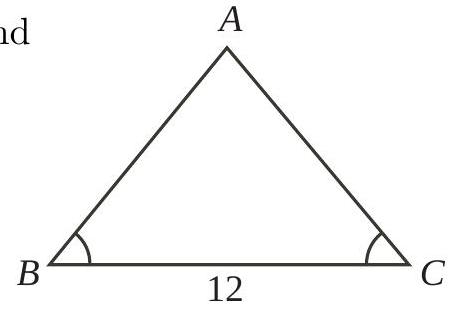 | Since $\angle A B C=\angle A C B$, then $\triangle A B C$ is isosceles and $A B=A C$.
Given that $\triangle A B C$ has a perimeter of $32, A B+A C+12=32$ or $A B+A C=20$.
But $A B=A C$, so $2 A B=20$ or $A B=10$.
ANSWER: $(\mathrm{C})$ | 10 | Geometry | MCQ | Yes | Yes | olympiads | false |
When it is 3:00 p.m. in Victoria, it is 6:00 p.m. in Timmins. Stefan's flight departed at 6:00 a.m. local Victoria time and arrived at 4:00 p.m. local Timmins time. How long, in hours, was his flight?
(A) 5
(B) 9
(C) 13
(D) 7
(E) 8 | When it is 3:00 p.m. in Victoria, it is 6:00 p.m. in Timmins.
Therefore, Victoria time is always 3 hours earlier than Timmins time.
When the flight arrived at 4:00 p.m. local Timmins time, the time in Victoria was 1:00 p.m.
The plane left at 6:00 a.m. Victoria time and arrived at 1:00 p.m. Victoria time.
The flight... | 7 | Logic and Puzzles | MCQ | Yes | Yes | olympiads | false |
In a class of 40 students, 18 said they liked apple pie, 15 said they liked chocolate cake and 12 said they did not like either. How many students in the class liked both?
(A) 15
(B) 10
(C) 3
(D) 7
(E) 5 | Of the 40 students, 12 did not like either dessert.
Therefore, $40-12=28$ students liked at least one of the desserts.
But 18 students said they liked apple pie, 15 said they liked chocolate cake, and $18+15=33$, so $33-28=5$ students must have liked both of the desserts.
ANSWER: (E) | 5 | Combinatorics | MCQ | Yes | Yes | olympiads | false |
In the addition shown, $P, Q$ and $R$ each represent a single digit, and the sum is 2009 . The value of $P+Q+R$ is
(A) 9
(B) 10
(C) 11
(D) 12
(E) 13
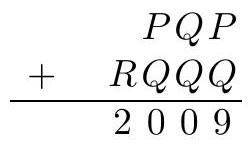 | In the ones column, $P+Q$ ends in 9. So $P+Q=9$ or $P+Q=19$.
Since $P$ is at most 9 and $Q$ is at most 9 , then $P+Q$ is at most 18 .
Therefore, $P+Q=9$ since $P+Q$ cannot equal 19 .
In the tens column, since $Q+Q$ ends in zero, $Q+Q$ equals 0 or 10 .
Therefore, either $Q=0$ or $Q=5$.
If $Q=0$, there would be no "... | 10 | Logic and Puzzles | MCQ | Yes | Yes | olympiads | false |
The value of $6 \times 2-3$ is
(A) 9
(B) -6
(C) 12
(D) 15
(E) 10 | Calculating, $6 \times 2-3=12-3=9$.
ANSWER: (A) | 9 | Algebra | MCQ | Yes | Yes | olympiads | false |
A regular polygon has perimeter $108 \mathrm{~cm}$ and each side has length $12 \mathrm{~cm}$. How many sides does this polygon have?
(A) 6
(B) 7
(C) 8
(D) 9
(E) 10 | Since the polygon has perimeter $108 \mathrm{~cm}$ and each side has length $12 \mathrm{~cm}$, then the polygon has $108 \div 12=9$ sides.
ANSWER: (D) | 9 | Geometry | MCQ | Yes | Yes | olympiads | false |
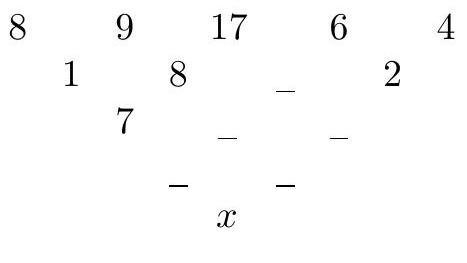
In the chart, each number below the top row is the positive difference of the two numbers to the right and left in the row immediately above it. What is the value of $x$ ?
(A) 1
(B) 2
(C) 3... | The number below and between 17 and 6 is $17-6=11$.
The number below and between 8 and 11 is $11-8=3$.
The number below and between 11 and 2 is $11-2=9$.
The number below and between 7 and 3 is $7-3=4$.
The number below and between 3 and 9 is $9-3=6$.
| 8 | | 9 | | 17 | | 6 |
| :--- | :--- | :--- | :--- | :--- ... | 2 | Logic and Puzzles | MCQ | Yes | Yes | olympiads | false |
Wesley is 15 and his sister Breenah is 7 . The sum of their ages is 22 . In how many years will the sum of their ages be double what it is now?
(A) 7
(B) 8
(C) 15
(D) 14
(E) 11 | The sum of Wesley's and Breenah's ages is 22 .
After each year, each of their ages increases by 1 , so the sum of their ages increases by 2 .
For the sum to increase from 22 to $2 \times 22=44$, the sum must increase by 22 , which will take $22 \div 2=11$ years.
ANSWER: (E) | 11 | Algebra | MCQ | Yes | Yes | olympiads | false |
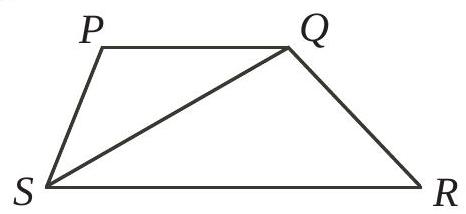
In the diagram, $P Q R S$ is a trapezoid with an area of 12 . $R S$ is twice the length of $P Q$. The area of $\triangle P Q S$ is
(A) 3
(B) 4
(C) 5
(D) 6
(E) 8
 | Solution 1
Since $P Q$ is parallel to $S R$, then the height of $\triangle P Q S$ (considering $P Q$ as the base) and the height of $\triangle S R Q$ (considering $S R$ as the base) are the same (that is, the vertical distance between $P Q$ and $S R$ ).
Since $S R$ is twice the length of $P Q$ and the heights are the... | 4 | Geometry | MCQ | Yes | Yes | olympiads | false |
There are 24 ways in which Beverly, Dianne, Ethan, and Jamaal can arrange themselves to sit in a row of four seats. In how many ways can Beverly, Dianne, Ethan, and Jamaal arrange themselves in a row of four seats so that Ethan does not sit beside Dianne?
(A) 18
(B) 12
(C) 21
(D) 6
(E) 15 | Since Ethan does not sit next to Dianne, the four must arrange themselves in one of the configurations:
$\mathrm{D} \_\mathrm{E}$
$\mathrm{D}$
-
- $\mathrm{D} \_\mathrm{E}$
$\mathrm{E}-\mathrm{D}$
E
$\mathrm{D}$
$\mathrm{E}-\mathrm{D}$
For each of these six configurations, there are two ways for Beverly and Jamaal t... | 12 | Combinatorics | MCQ | Yes | Yes | olympiads | false |
The value of $(1+2)^{2}-\left(1^{2}+2^{2}\right)$ is
(A) 14
(B) 4
(C) 2
(D) 12
(E) 1 | Calculating, $(1+2)^{2}-\left(1^{2}+2^{2}\right)=3^{2}-(1+4)=9-5=4$.
ANsWER: (B) | 4 | Algebra | MCQ | Yes | Yes | olympiads | false |
A number is multiplied by 5 and then 9 is subtracted from the result, giving 51 . What is the original number?
(A) 210
(B) 8.4
(C) 65
(D) 12
(E) 15 | Solution 1
Since 5 times the number minus 9 equals 51 , then 5 times the number must equal 60 (that is, $51+9$ ).
Therefore, the original number is 60 divided by 5 , or 12 .
## Solution 2
Let the original number be $x$.
Then $5 x-9=51$, so $5 x=51+9=60$, so $x=\frac{60}{5}=12$.
ANSWER: (D)
# | 12 | Algebra | MCQ | Yes | Yes | olympiads | false |
The decimal expansion of $\frac{2}{13}$ is the repeating decimal $0 . \overline{153846}$. What digit occurs in the 2008th place after the decimal point?
(A) 8
(B) 6
(C) 5
(D) 4
(E) 3 | The digits after the decimal point occur in repeating blocks of 6 digits.
Since $2008 \div 6=334.666 \ldots$, then the 2008th digit after the decimal point occurs after 334 blocks of digits have been used.
In 334 blocks of 6 digits, there are $334 \times 6=2004$ digits in total. Therefore, the 2008th digit is 4 digit... | 8 | Number Theory | MCQ | Yes | Yes | olympiads | false |
The value of $(4-3) \times 2$ is
(A) -2
(B) 2
(C) 1
(D) 3
(E) 5 | Calculating, $(4-3) \times 2=1 \times 2=2$. | 2 | Algebra | MCQ | Yes | Yes | olympiads | false |
What integer should be placed in the $\square$ to make the statement $\square-5=2$ true?
(A) 7
(B) 4
(C) 3
(D) 1
(E) 8 | When we subtract 5 from the missing number, the answer is 2 , so to find the missing number, we add 5 to 2 and obtain 7 . (Check: $7-5=2$.)
ANSWER: (A) | 7 | Algebra | MCQ | Yes | Yes | olympiads | false |
Six students have an apple eating contest. The graph shows the number of apples eaten by each student. Lorenzo ate the most apples and Jo ate the fewest. How many more apples did Lorenzo eat than Jo?
(A) 2
(B) 5
(C) 4
(D) 3
(E) 6
 $\$ 3$
(B) $\$ 4$
(C) $\$ 5$
(D) $\$ 6$
(E) $\$ 9$
Part B: Each correct answer is worth 6. | Since a large box costs $\$ 3$ more than a small box and a large box and a small box together cost $\$ 15$, then replacing the large box with a small box would save $\$ 3$.
This tells us that two small boxes together cost $\$ 12$.
Therefore, one small box costs $\$ 6$.
ANSWER: (D) | 6 | Algebra | MCQ | Yes | Yes | olympiads | false |
The Grade 7 class at Gauss Public School has sold 120 tickets for a lottery. One winning ticket will be drawn. If the probability of one of Mary's tickets being drawn is $\frac{1}{15}$, how many tickets did she buy?
(A) 5
(B) 6
(C) 7
(D) 8
(E) 9 | The probability that Mary wins the lottery is equal to the number of tickets that Mary bought divided by the total number of tickets in the lottery.
We are told that the probability that Mary wins is $\frac{1}{15}$.
Since there were 120 tickets in total sold, we would like to write $\frac{1}{15}$ as a fraction with 1... | 8 | Combinatorics | MCQ | Yes | Yes | olympiads | false |
What is the largest amount of postage in cents that cannot be made using only 3 cent and 5 cent stamps?
(A) 7
(B) 13
(C) 4
(D) 8
(E) 9 | Solution 1
We look at each of the choices and try to make them using only 3 cent and 5 cent stamps:
(A): 7 cannot be made, since no more than one 5 cent and two 3 cent stamps could be used (try playing with the possibilities!)
(B): $13=5+5+3$
(C): 4 cannot be the answer since a larger number (7) already cannot be m... | 7 | Number Theory | MCQ | Yes | Yes | olympiads | false |
Harry, Ron and Neville are having a race on their broomsticks. If there are no ties, in how many different possible orders can they finish?
(A) 7
(B) 6
(C) 5
(D) 4
(E) 3 | We list all of the possible orders of finish, using $\mathrm{H}, \mathrm{R}$ and $\mathrm{N}$ to stand for Harry, Ron and Neville. The possible orders are HNR, HRN, NHR, NRH, RHN, RNH.
(It is easiest to list the orders in alphabetical order to better keep track of them.) There are 6 possible orders.
ANSWER: (B)
# | 6 | Combinatorics | MCQ | Yes | Yes | olympiads | false |
How many positive whole numbers, including 1 , divide exactly into both 40 and 72 ?
(A) 9
(B) 12
(C) 4
(D) 2
(E) 5 | Solution 1
The positive whole numbers that divide exactly into 40 are 1, 2, 4, 5, 8, 10, 20, 40 .
The positive whole numbers that divide exactly into 72 are $1,2,3,4,6,8,9,12,18,24,36,72$. The numbers that occur in both lists are 1, 2, 4, 8, or four numbers in total.
## Solution 2
The greatest common divisor of 40 ... | 4 | Number Theory | MCQ | Yes | Yes | olympiads | false |
In the diagram, each scale shows the total mass (weight) of the shapes on that scale. What is the mass (weight) of a $\triangle$ ?
(A) 3
(B) 5
(C) 12
(D) 6
(E) 5.5
 | The first scale tells us that a square and a circle together have a mass of 8 .
The second scale tells us that a square and two circles together have a mass of 11.
We can replace the square and one circle on the second scale with an " 8 ", so 8 plus the mass of a circle gives a mass of 11 . This tells us that the mas... | 6 | Logic and Puzzles | MCQ | Yes | Yes | olympiads | false |
In the diagram, the square has a perimeter of 48 and the triangle has a height of 48 . If the square and the triangle have the same area, what is the value of $x$ ?
(A) 1.5
(B) 12
(C) 6
(D) 3
(E) 24
 4
(B) 16
(C) 6
(D) 8
(E) 14
 | Solution 1
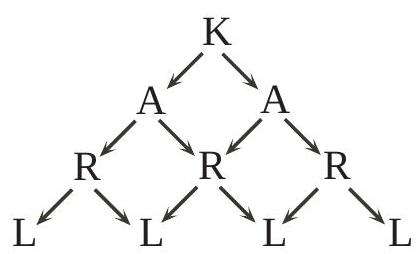
Starting at the "K" there are two possible paths that can be taken. At each "A", there are again two possible paths that can be taken. Similarly, at each "R" there are two possible paths that can be taken.
Therefore, the total number of paths is $2 \times 2 \times 2=8$.
(We can check this by actually trac... | 8 | Combinatorics | MCQ | Yes | Yes | olympiads | false |
In the diagram, the cube has a volume of $8 \mathrm{~cm}^{3}$. What is the value of $x$ ?
(A) 2
(B) 8
(C) 4
(D) 6
(E) 3
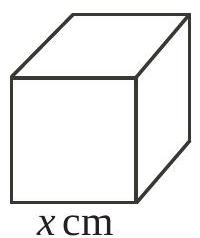 | Since the side length of the cube is $x \mathrm{~cm}$, its volume is $x^{3} \mathrm{~cm}^{3}$.
Since the volume is known to be $8 \mathrm{~cm}^{3}$, then $x^{3}=8$ so $x=2$ (the cube root of 8 ).
ANswer: (A) | 2 | Geometry | MCQ | Yes | Yes | olympiads | false |
The Gauss family has three boys aged 7 , a girl aged 14 , and a boy aged 15 . What is the mean (average) of the ages of the children?
(A) 9
(B) 7
(C) 11
(D) 14
(E) 10 | The children in the Gauss family have ages $7,7,7,14,15$.
The mean of their ages is thus $\frac{7+7+7+14+15}{5}=\frac{50}{5}=10$.
ANSWER: (E) | 10 | Algebra | MCQ | Yes | Yes | olympiads | false |
Sally picks four consecutive positive integers. She divides each integer by four, and then adds the remainders together. The sum of the remainders is
(A) 6
(B) 1
(C) 2
(D) 3
(E) 4 | Let us try the integers $5,6,7,8$.
When 5 is divided by 4 , the quotient is 1 and the remainder is 1 .
When 6 is divided by 4 , the quotient is 1 and the remainder is 2 .
When 7 is divided by 4 , the quotient is 1 and the remainder is 3 .
When 8 is divided by 4 , the quotient is 2 and the remainder is 0 .
The sum ... | 6 | Number Theory | MCQ | Yes | Yes | olympiads | false |
In the diagram, $A B C D$ is a square with side length 6 , and $W X Y Z$ is a rectangle with $Z Y=10$ and $X Y=6$. Also, $A D$ and $W X$ are perpendicular. If the shaded area is equal to half of the area of $W X Y Z$, the length of $A P$ is
(A) 1
(B) 1.5
(C) 4
(D) 2
(E) 2.5
 20
(B) 3.5
(C) 5
(D) 6.2
(E) 125 | Since $3+5 x=28$, then $5 x=28-3=25$ so $x=\frac{25}{5}=5$.
ANSWER: (C) | 5 | Algebra | MCQ | Yes | Yes | olympiads | false |
Which of the following is closest to one million $\left(10^{6}\right)$ seconds?
(A) 1 day
(B) 10 days
(C) 100 days
(D) 1 year
(E) 10 years | Solution 1
In one minute, there are 60 seconds.
In one hour, there are 60 minutes, so there are $60 \times 60=3600$ seconds.
In one day, there are 24 hours, so there are $24 \times 3600=86400$ seconds.
Therefore, $10^{6}$ seconds is equal to $\frac{10^{6}}{86400} \approx 11.574$ days, which of the given choices is ... | 10 | Number Theory | MCQ | Yes | Yes | olympiads | false |
Gail is a server at a restaurant. On Saturday, Gail gets up at 6:30 a.m., starts work at $x$ a.m. and finishes at $x$ p.m. How long does Gail work on Saturday?
(A) $24-2 x$ hours
(D) 0 hours
(B) $12-x$ hours
(C) $2 x$ hours
(E) 12 hours | Solution 1
Between $x$ a.m. and $x$ p.m. there are 12 hours. (For example, between 10 a.m. and 10 p.m. there are 12 hours.)
Therefore, Gail works for 12 hours on Saturday.
## Solution 2
From $x$ a.m. until 12 noon, the number of hours which Gail works is $12-x$.
From 12 noon until $x$ p.m., she works $x$ hours.
T... | 12 | Algebra | MCQ | Yes | Yes | olympiads | false |
In the addition of two 2-digit numbers, each blank space, including those in the answer, is to be filled with one of the digits $0,1,2,3,4,5,6$, each used exactly once. The units digit of the sum is
(A) 2
(B) 3
(C) 4
(D) 5
(E) 6

Since we are adding two 2-digit numbers, then their sum cannot be 200 or greater, so $E$ must be a 1 if the sum is to have 3 digi... | 5 | Logic and Puzzles | MCQ | Yes | Yes | olympiads | false |
Five students wrote a quiz with a maximum score of 50 . The scores of four of the students were $42,43,46$, and 49 . The score of the fifth student was $N$. The average (mean) of the five students' scores was the same as the median of the five students' scores. The number of values of $N$ which are possible is
(A) 3
(B... | The five scores are $N, 42,43,46$, and 49 .
If $N46$, the median score is 46 .
If $N \geq 43$ and $N \leq 46$, then $N$ is the median.
We try each case.
If $N46$, then the median is 46 , so the mean should be 46 .
Since the mean is 46 , then the sum of the 5 scores must be $5 \times 46=230$.
Therefore, $N+42+43+4... | 3 | Algebra | MCQ | Yes | Yes | olympiads | false |
The value of $30-5^{2}$ is
(A) 20
(B) 55
(C) 625
(D) 400
(E) 5 | Calculating using the correct order of operations, $30-5^{2}=30-25=5$.
ANSWER: (E) | 5 | Algebra | MCQ | Yes | Yes | olympiads | false |
How many prime numbers are there between 20 and 30 ?
(A) 0
(B) 1
(C) 2
(D) 3
(E) 4 | We check each number between 20 and 30 .
None of 20, 22, 24, 26, 28, and 30 is a prime number, because each has a factor of 2.
Neither 21 nor 27 is a prime number, since each has a factor of 3 .
Also, 25 is not a prime number, since it has a factor of 5 .
We do not need to look for any larger prime factors, since t... | 2 | Number Theory | MCQ | Yes | Yes | olympiads | false |
The Gauss Candy Company has 8362 lollipops to package. They place exactly 12 lollipops in each package. How many lollipops remain after the maximum possible number of packages are filled?
(A) 2
(B) 4
(C) 6
(D) 8
(E) 10
Part B: Each correct answer is worth 6. | Solution 1
When we divide 8362 by 12, we obtain
$$
\begin{array}{r}
696 \\
\\
\frac{72}{116} \\
\frac{108}{82} \\
\\
\frac{72}{10}
\end{array}
$$
so $\frac{8362}{12}=696 \frac{10}{12}$. In other words, 8362 lollipops make up 696 complete packages leaving 10 lollipops left over.
## Solution 2
When we divide 8362 by... | 10 | Number Theory | MCQ | Yes | Yes | olympiads | false |
The sound of thunder travels away from a lightning flash at $331 \mathrm{~m} / \mathrm{s}$. Joe sees a lightning flash, and then hears the thunder 12 seconds later. To the nearest tenth of a kilometre, how far away is Joe from the lightning flash?
(A) 3.0
(B) 3.5
(C) 4.0
(D) 4.5
(E) 5.0 | Since the sound of thunder travels at $331 \mathrm{~m} / \mathrm{s}$ and the thunder is heard 12 seconds after the lightning flash, then Joe is $12 \mathrm{~s} \times 331 \mathrm{~m} / \mathrm{s}=3972 \mathrm{~m}=3.972 \mathrm{~km}$ from the lightning flash, or, to the nearest tenth of a kilometre, $4.0 \mathrm{~km}$.
... | 4 | Algebra | MCQ | Yes | Yes | olympiads | false |
Last year, Kiril's age was a multiple of 7 .
This year, Kiril's age is a multiple of 5 .
In how many years will Kiril be 26 years old?
(A) 11
(B) 21
(C) 4
(D) 18
(E) 16 | We need to find two consecutive numbers the first of which is a multiple of 7 and the second of which is a multiple of 5 .
We try the multiples of 7 and the numbers after each.
Do 7 and 8 work? No, since 8 is not a multiple of 5 .
Do 14 and 15 work? Yes, since 15 is a multiple of 5.
This means that this year, Kiril... | 11 | Number Theory | MCQ | Yes | Yes | olympiads | false |
If $10^{x}-10=9990$, then $x$ is equal to

(A) 3
(B) 5
(C) 6
(D) 4
(E) 9 | Since $10^{x}-10=9990$, then $10^{x}=9990+10=10000$.
If $10^{x}=10000$, then $x=4$, since 10000 ends in 4 zeroes.
ANSWER: (D) | 4 | Algebra | MCQ | Yes | Yes | olympiads | false |
Bethany, Chun, Dominic, and Emily go to the movies. They choose a row with four consecutive empty seats. If Dominic and Emily must sit beside each other, in how many different ways can the four friends sit?
(A) 6
(B) 5
(C) 12
(D) 30
(E) 3 | Solution 1
We can write out the possible arrangements, using the first initials of the four people, and remembering that there two different ways in which Dominic and Emily can sit side by side:
DEBC, DECB, EDBC, EDCB, BDEC, CDEB, BEDC, CEDB, BCDE, CBDE, BCED, CBED
There are 12 possible arrangements.
## Solution 2
... | 12 | Combinatorics | MCQ | Yes | Yes | olympiads | false |
In the addition of two 2-digit numbers, each blank space, including those in the answer, is to be filled with one of the digits $0,1,2,3,4,5,6$, each used exactly once. The units digit of the sum is
(A) 2
(B) 3
(C) 4
(D) 5
(E) 6

Since we are adding two 2-digit numbers, then their sum cannot be 200 or greater, so $E$ must be a 1 if the sum is to have 3 digi... | 5 | Logic and Puzzles | MCQ | Yes | Yes | olympiads | false |
The 8 people at a party shook hands exactly once with each of the others before the ninth person arrived. The ninth person then shook hands with some of these 8 people. A total of 32 handshakes took place. With how many people did the ninth person shake hands?
(A) 3
(B) 4
(C) 5
(D) 6
(E) 7 | Label the first 8 people at the party as A, B, C, D, E, F, G, and H.
Then A shakes hands with the 7 others, B accounts for 6 more handshakes (since we have already included B shaking hands with A), C accounts for 5 more handshakes (since we have already included $\mathrm{C}$ shaking hands with A and B), D accounts for... | 4 | Combinatorics | MCQ | Yes | Yes | olympiads | false |
In the diagram, the points are evenly spaced vertically and horizontally. A segment $A B$ is drawn using two of the points, as shown. Point $C$ is chosen to be one of the remaining 18 points. For how many of these 18 possible points is triangle $A B C$ isosceles?
(A) 6
(B) 4
(C) 5
(D) 2
(E) 3 | In how many ways can we place $C$ so that $A B=A C$ ?
To get from $A$ to $B$ we go 1 unit in one direction and 2 units in the perpendicular direction from $A$.
To choose $C$ so that $A B=A C$, we must also go 1 unit in one direction and 2 units in the perpendicular direction.
This gives the 3 possible points:
 1
(B) 2
(C) 3
(D) 4
(E) 6 | Calculating the numerator first, $\frac{3 \times 4}{6}=\frac{12}{6}=2$. | 2 | Algebra | MCQ | Yes | Yes | olympiads | false |
The symbol \begin{tabular}{l|l}
3 \& 4
\hline 5 \& 6
\hline
is evaluated as $3 \times 6+4 \times 5=38$. If
\hline 2 \& 6
\hline 1 \&
\hline
\end{tabular} is evaluated as 16 , then the number that should be placed in the empty space is
(A) 1
(B) 2
(C) 3
(D) 4
(E) 5 | Solution 1
When we calculate the value of the symbol, we add the product of the numbers on each of the two diagonals.
The product of the entries on the diagonal with the 1 and the 6 is 6 .
Since the symbol is evaluated as 16 , then the product of the entries on the other diagonal is 10 . Since one of the entries on ... | 5 | Logic and Puzzles | MCQ | Yes | Yes | olympiads | false |
A game is said to be fair if your chance of winning is equal to your chance of losing. How many of the following games, involving tossing a regular six-sided die, are fair?
- You win if you roll a 2
- You win if you roll an even number
- You win if you roll a number less than 4
- You win if you roll a number divisible... | When a die is rolled, there are six equally likely possibilities ( 1 through 6 ).
In order for the game to be fair, half of the six possibilities, or three possibilities, must be winning possibilities.
In the first game, only rolling a 2 gives a win, so this game is not fair.
In the second game, rolling a 2,4 or 6 g... | 2 | Combinatorics | MCQ | Yes | Yes | olympiads | false |
How many different combinations of pennies, nickels, dimes and quarters use 48 coins to total $\$ 1.00$ ?
(A) 3
(B) 4
(C) 5
(D) 6
(E) 8 | Solution 1
We want to combine 48 coins to get 100 cents.
Since the combined value of the coins is a multiple of 5 , as is the value of a combination of nickels, dimes and quarters, then the value of the pennies must also be a multiple of 5 .
Therefore, the possible numbers of pennies are 5, 10, 15, 20, 25, 30, 35, 4... | 4 | Combinatorics | MCQ | Yes | Yes | olympiads | false |
The value of $(-3)(-4)(-1)$ is
(A) -12
(B) -8
(C) 8
(D) 11
(E) 12 | Calculating, $(-3)(-4)(-1)=(12)(-1)=-12$.
ANSWER: (A) | -12 | Algebra | MCQ | Yes | Yes | olympiads | false |
The average (mean) of the numbers $6,8,9,11$, and 16 is
(A) 8
(B) 9
(C) 10
(D) 11
(E) 7 | The mean of these five numbers is $\frac{6+8+9+11+16}{5}=\frac{50}{5}=10$.
ANSWER: (C) | 10 | Algebra | MCQ | Yes | Yes | olympiads | false |
$10 \%$ of 10 multiplied by $20 \%$ of 20 equals
(A) 40000
(B) 0.4
(C) 400
(D) 40
(E) 4 | $10 \%$ of 10 is $0.1 \times 10=1$ or $\frac{1}{10} \times 10=1$.
$20 \%$ of 20 is $0.2 \times 20=4$ or $\frac{1}{5} \times 20=4$.
Therefore, $10 \%$ of 10 times $20 \%$ of 20 equals $1 \times 4=4$.
ANSWER: (E) | 4 | Algebra | MCQ | Yes | Yes | olympiads | false |
If $8210=8.21 \times 10^{\square}$, then the value that should go in the $\square$ is
(A) 1
(B) 2
(C) 3
(D) 4
(E) 5 | $8210=8.21 \times 1000$ so we must have $10^{\square}=1000$ so the required number is 3 .
ANswer: (C) | 3 | Algebra | MCQ | Yes | Yes | olympiads | false |
Pete is given three positive integers and is told to add the first two, and then multiply the result by the third. Instead, he multiplies the first two and adds the third to that result. Surprisingly, he still gets the correct answer of 14 . How many different values could the first number have been?
(A) 5
(B) 4
(C) 6
... | Let the three positive integers be $x, y$ and $z$.
From the given information $(x+y) \times z=14$ and $(x \times y)+z=14$.
Let us look at the third number, $z$, first.
From the first equation $(x+y) \times z=14$, we see that $z$ must be a factor of 14 .
Therefore, the only possible values of $z$ are $1,2,7$ and 14 ... | 4 | Algebra | math-word-problem | Yes | Yes | olympiads | false |
A purse contains a collection of quarters, dimes, nickels, and pennies. The average value of the coins in the purse is 17 cents. If a penny is removed from the purse, the average value of the coins becomes 18 cents. How many nickels are in the purse?
(A) 2
(B) 5
(C) 0
(D) 1
(E) 8 | Suppose that there are $n$ coins in the purse to begin with.
Since the average value of the coins is 17 cents, then the total value of the coins is $17 n$.
When one coin is removed, there are $n-1$ coins.
Since the new average value of the coins is 18 cents, then the new total value of the coins is $18(n-1)$.
Since... | 2 | Algebra | MCQ | Yes | Yes | olympiads | false |
The value of $\frac{10+20+30+40}{10}$ is
(A) 90
(B) 91
(C) 10
(D) 64
(E) 9 | Simplifying,
$$
\frac{10+20+30+40}{10}=\frac{100}{10}=10
$$
Answer: (C) | 10 | Algebra | MCQ | Yes | Yes | olympiads | false |
What is the median quiz score of the 25 scores shown on the bar graph?
(A) 8
(B) 9
(C) 10
(D) 11
(E) 12
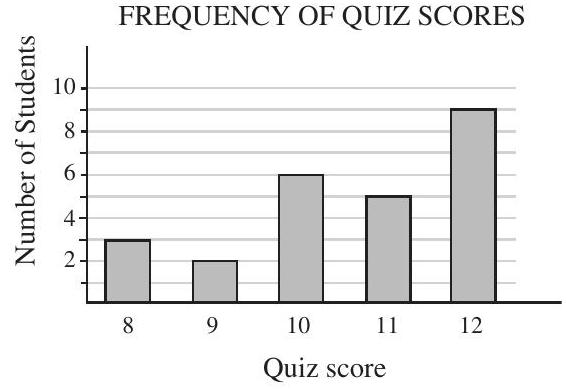 | When we list the quiz scores in ascending order, including repetition, we get $8,8,8$, $9,9,10,10,10,10,10,10,11,11,11,11$, $11,12,12,12,12,12,12,12,12,12$.
Since there are 25 scores, the middle score is the 13th along, so the median is 11 .
 9
(B) 4
(C) 6
(D) 10
(E) 17 | Evaluating the exponents, $3^{2}=9$ and $3^{3}=27$, so the even whole numbers between the two given numbers are the even whole numbers from 10 to 26 , inclusive. These are $10,12,14,16,18$, $20,22,24$, and 26 , so there are 9 of them.
Answer: (A) | 9 | Number Theory | MCQ | Yes | Yes | olympiads | false |
What is the maximum number of rectangular wooden blocks with dimensions $20 \mathrm{~cm} \times 30 \mathrm{~cm} \times 40 \mathrm{~cm}$ that could fit into a rectangular box with inner dimensions $40 \mathrm{~cm} \times 60 \mathrm{~cm} \times 80 \mathrm{~cm}$ ?
(A) 2
(B) 4
(C) 10
(D) 8
(E) 6
 8
(B) 9
(... | Let the volume of a large glass be $L$ and of a small glass be $S$. Since the jug can exactly fill either 9 small glasses and 4 large glasses, or 6 small glasses and 6 large glasses, then $9 S+4 L=6 S+6 L$ or $3 S=2 L$. In other words, the volume of 3 small glasses equals the volume of 2 large glasses. (We can also see... | 10 | Algebra | MCQ | Yes | Yes | olympiads | false |
In the Gauss 2004 Olympics, there are six competitors and eight events. The top three competitors in each event receive gold, silver and bronze medals respectively. (There are no ties at the Gauss Olympics, and no competitor can win more than one medal on the same event.) Each competitor scores 5 points for each gold m... | We consider each possible number of silver medals starting with 8 .
Could she have won 8 silver medals? This would account for 24 points in 8 events, but since she won 27 points in 8 events, this is not possible.
Could she have won 7 silver medals? This would account for 21 points in 7 events, and so in the remaining... | 4 | Combinatorics | MCQ | Yes | Yes | olympiads | false |
If $800670=8 \times 10^{x}+6 \times 10^{y}+7 \times 10^{z}$, where $x, y$ and $z$ are whole numbers, then $x+y+z$ equals
(A) 11
(B) 8
(C) 6
(D) 3
(E) 5 | Rewriting the given integer,
$$
800670=800000+600+70=8 \times 10^{5}+6 \times 10^{2}+7 \times 10^{1}
$$
so $x=5, y=2$ and $z=1$, which gives $x+y+z=8$.
Answer: (B) | 8 | Number Theory | MCQ | Yes | Yes | olympiads | false |
$\frac{7863}{13}=604+\frac{\square}{13}$. The number represented by $\square$ is
(A) 11
(B) 8
(C) 9
(D) 3
(E) 10 | Rewriting the right side with a common denominator,
$\frac{7863}{13}=\frac{604 \times 13+\square}{13}=\frac{7852+\square}{13}$
Therefore, $\square=11$.
Answer: (A) | 11 | Algebra | MCQ | Yes | Yes | olympiads | false |
There are 13 trees on one side of the street on Trina's way from her house to school. Today, on her way to school, Trina put a chalk mark on every other tree, starting with the first she passed. When she goes home from school, she will put a chalk mark on every third tree, again starting with the first one she passes. ... | We number the trees from 1 to 13 , with tree number 1 being closest to Trina's house and tree number 13 being closest to her school. On the way to school, she puts a chalk mark on trees 1, 3, 5, 7, 9, 11, 13. On her way home, she puts a chalk mark on trees $13,10,7,4,1$. This leaves trees $2,6,8,12$ without chalk marks... | 4 | Number Theory | MCQ | Yes | Yes | olympiads | false |
If $2^{a}=8$ and $a=3 c$, then $c$ equals
(A) 0
(B) $\frac{3}{4}$
(C) 1
(D) $\frac{4}{3}$
(E) 6 | Since $2^{3}=8$ and $2^{a}=8$, then $a=3$. Since $a=3$ and $a=3 c$, then $c=1$.
Answer: (C) | 1 | Algebra | MCQ | Yes | Yes | olympiads | false |
Subsets and Splits
No community queries yet
The top public SQL queries from the community will appear here once available.