| --- |
| license: mit |
| language: |
| - en |
| library_name: pytorch |
| pipeline_tag: text-generation |
| tags: |
| - recurrent |
| - cnn |
| - vla |
| - no-attention |
| datasets: |
| - HuggingFaceFW/fineweb |
| - HuggingFaceTB/smollm-corpus |
| - HuggingFaceFV/finevideo |
| --- |
| |
| # VLA (recurrent CNN), v485 |
|
|
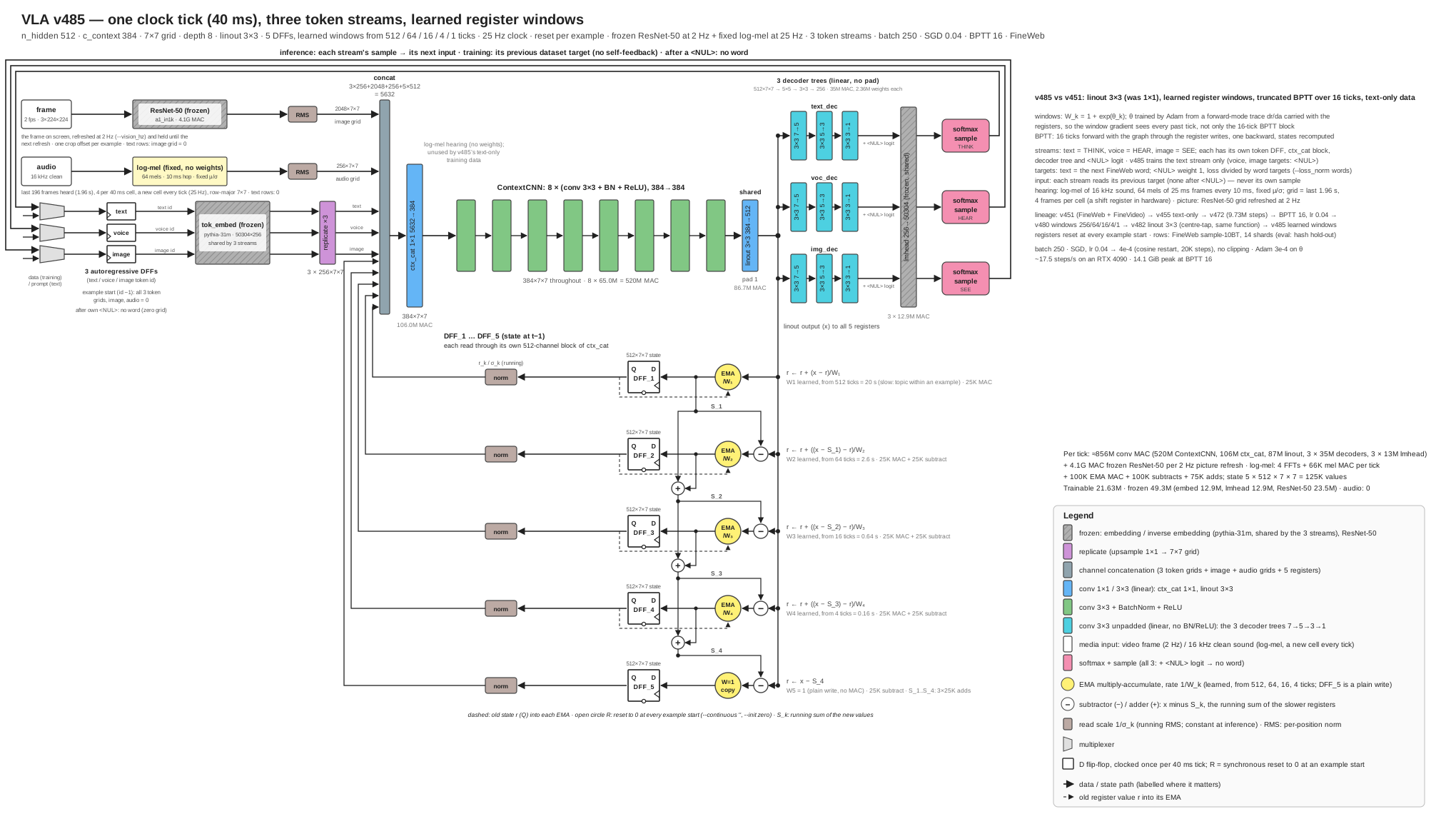
| A language model with no attention and no positional encoding. Its memory is five 2-D registers of |
| 512 × 7 × 7. Every tick, one convolutional network reads the current token together with the registers and |
| writes the registers back. It is the text-trained core of a vision-language-action design aimed at a single chip |
| running at 100 Hz or more with no external components: no off-chip memory, every weight stored on the chip. A CNN |
| makes that possible because it is parameter-efficient: the same small kernels run at every grid position and |
| every tick. |
|
|
| Code, functional spec and figures: [github.com/siliconperception/vla](https://github.com/siliconperception/vla) |
|
|
|  |
|
|
| ## Use |
|
|
| ```bash |
| git clone https://github.com/siliconperception/vla && cd vla && pip install -r requirements.txt |
| for p in "The colors of the rainbow are" \ |
| "The best way to learn a new language is" \ |
| "My grandmother's recipe for apple pie starts with" \ |
| "When you plant a vegetable garden, the first thing to do is" \ |
| "The history of the bicycle began in"; do |
| python vla.py --pretrained --generate --n 120 --prompt "$p" --device cuda |
| done |
| |
| # prompt tuning: fit the starting registers (weights frozen) until the model predicts the prompt, |
| # then continue from them; prints the cold and the tuned continuation |
| python vla.py --pretrained --generate --prompt_tune 200 --n 120 --prompt "The colors of the rainbow are" --device cuda |
| ``` |
|
|
| `--pretrained` downloads `model.safetensors` and `vla_args.json` (the settings the weights were trained with) |
| and restores both. The weights are not a `transformers` model; load them through `vla.py`. |
|
|
| ## Model |
|
|
| | | | |
| |---|---| |
| | Parameters | 70.9 M: 21.6 M trained, 49.3 M frozen (token embedding and output layer from pythia-31m, a ResNet-50) | |
| | State | 5 registers × 512 × 7 × 7 = 125,440 values | |
| | Register windows | learned: 530 / 57 / 15 / 3.8 / 1 ticks (21 s, 2.3 s, 0.61 s, 0.15 s and one tick at 25 Hz) | |
| | State update | 1×1 mix (5,632 → 384), 8 × (3×3 conv, BatchNorm, ReLU) at 384, 3×3 project (384 → 512), cascade write | |
| | Readout | 3 decoders (text, voice, image), each a tree of three 3×3 convs and the frozen pythia-31m output layer | |
| | Tokenizer | pythia-31m BPE (50,304) plus a `<NUL>` token ("say nothing this tick") | |
|
|
| ## Training |
|
|
| - 10.18 M steps × 250 rows, one token per row per step, plain SGD. |
| - Up to step 9.73 M (run v472): learning rate cycling 1e-4 → 1e-2, the gradient stopped at the registers. |
| - Since then: learning rate 0.04, truncated backpropagation through time over 16 steps, the register projection |
| widened to 3×3 (from its 1×1 weights, the same function at the switch), and learned register windows (from |
| 512 / 64 / 16 / 4). The windows are trained by Adam from a forward-mode sensitivity of the registers to their |
| rates, so their gradient sees every past step, not only the last 16. |
| - Data across its lineage: FineWeb-Edu (SmolLM corpus), FineWeb sample-10BT, and FineVideo and VALOR (speech, |
| captions and frames); text-only FineWeb in its latest phase. |
|
|
| ## Evaluation (at the published step, 10,180,000) |
|
|
| | | Score | |
| |---|---| |
| | FineWeb held-out (100 documents, nats/token) | 4.527 | |
| | BabyLM 2026 dev (100 pieces, nats/token) | 4.518 | |
| | BLiMP (1,005 pairs from all 67 paradigms) | 70.1 % | |
| | ComVE (999 pairs, common-sense) | 66.3 % | |
|
|
| The BLiMP and ComVE pairs are scored the same way as for these reference models (each sentence read without |
| context; the lower total loss wins): |
|
|
| | Model | Size | BLiMP | ComVE | |
| |---|---|---|---| |
| | pythia-14m | 14 M | 69.7 | 64.7 | |
| | pythia-31m | 31 M | 71.1 | 66.9 | |
| | babyllama-10m-2024 | trained on 10 M words | 70.0 | 63.7 | |
| | SmolLM2-135M | 135 M | 80.9 | 79.3 | |
| | **this model** | 21.6 M trained | 70.1 | 66.3 | |
|
|
| ## Limits |
|
|
| A small model: it writes fluent text that is often not factual or consistent. Not instruction-tuned, not safety |
| filtered beyond its training corpora. The voice and image decoders are present but this checkpoint was last |
| trained on text. Training is continuing; this card describes the step above. |
|
|
| ## License |
|
|
| MIT, Copyright (c) 2024-2026 Silicon Perception Inc. The license covers the software and these weights and grants |
| no patent rights; see [PATENTS](https://github.com/siliconperception/vla/blob/main/PATENTS). Frozen third-party |
| weights inside: EleutherAI [pythia-31m](https://huggingface.co/EleutherAI/pythia-31m) embedding and output |
| layer (Apache-2.0), [timm/resnet50.a1_in1k](https://huggingface.co/timm/resnet50.a1_in1k) (Apache-2.0). |
|
|


